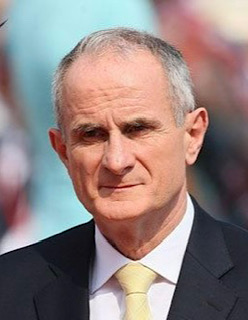
McAleese marries Mary Leneghan in 1976. The couple resides in Scholarstown, Dublin, for a short period, and then for almost twelve years near Ratoath, County Meath. In 1980, he returns to full-time education at Trinity College Dublin (TCD), to study as a dentist, subsequently moving back, with his family, to Northern Ireland, where he practises as a dentist in Crossmaglen and Bessbrook, County Armagh.
While his wife serves as President of Ireland, McAleese initiates a series of meetings with senior Ulster loyalistparamilitary leaders to pursue peace negotiations. These actions do not take place without controversy, but are widely viewed as instrumental in bringing loyalist paramilitary groups to peace talks.
In May 2011, McAleese is appointed as a Senator by the Taoiseach Enda Kenny. In August 2011, he is appointed the Chancellor of Dublin City University, taking over from David Byrne.
On February 1, 2013, McAleese announces his intention to resign as a member of Seanad Éireann.
McAleese accepts an appointment as Chairman of the Inter-Departmental Committee which is set up by the Government of Ireland to investigate the Magdalene laundries. His findings have been criticised by some survivors and researchers from the Magdalene Names project.
On October 18-19, 2014, McAleese attends the One Young World Summit in Dublin as a keynote speaker. Here, he hosts a special session for the One Young World Peace and Conflict Resolution Project alongside former Ulster Defence Association (UDA) prisoner Jackie McDonald and former Irish Republican Army (IRA) prisoner Sean Murray. They address young people from 191 countries to share and develop ideas to strengthen efforts at conflict resolution in their own countries.
McAleese and his wife Mary have three children. The family moves to Rostrevor, County Down, in 1987, when he sets up practice in County Armagh.
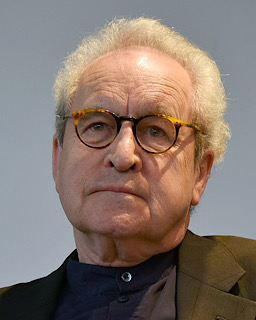
Banville is born to Agnes (née Doran) and Martin Banville, a garage clerk, in Wexford. He is the youngest of three siblings. He is educated at CBS Primary, Wexford, a Christian Brothers school, and at St. Peter’s College, Wexford. Despite having intentions of being a painter and an architect, he does not attend university. After school, he works as a clerk at Aer Lingus, which allows him to travel at deeply discounted rates. He takes advantage of these rates to travel to Greece and Italy. He begins working as a sub-editor at The Irish Press in 1969.
Banville publishes his first book, a collection of short stories titled Long Lankin, in 1970. His first novel, Nightspawn, appears in 1971, followed by his second, Birchwood, two years later. His The Revolutions Trilogy, published between 1976 and 1982, comprises works named after renowned scientists: Doctor Copernicus, Kepler and The Newton Letter. His next work, Mefisto, has a mathematical theme, and, in combination with the three books from The Revolutions Trilogy, is the fourth book from the “Scientific Tetralogy.” His 1989 novel, The Book of Evidence, begins The Frames Trilogy, dealing with the work of art. It is completed by Ghosts and Athena. His thirteenth novel, The Sea, wins the Booker Prize in 2005. In addition, he publishes crime novels as Benjamin Black, most of which feature the character of Quirke, an Irish pathologist based in 1950s Dublin. His alternative history novel, The Secret Guests (2020), is published under the name B. W. Black.
In 1969, Banville marries the American textile artist Janet Dunham, whom he met in San Francisco the previous year while she is a student at the University of California, Berkeley. The couple has two sons together. The marriage breaks down after Banville has an affair with a neighbour, Patricia Quinn, who subsequently becomes director of the Arts Council of Ireland. Banville has two daughters with Quinn, born around 1990 and 1997. Despite separating, Banville and Dunham never divorce and he describes them as remaining “on good terms.” Dunham dies at Blackrock Clinic on November 22, 2021, after which Banville states that he experienced “brain fog” due to grief and is unable to write for six months. In a 2024 interview, he expresses regret over his relationship history, saying, “I caused Janet such anguish. I have caused Patricia Quinn such anguish. I wasn’t good with my children. I was not a good parent. I am not a good person. I am selfish. But I have to have responsibility.”
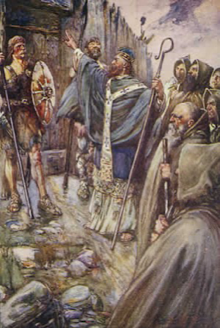
He is born into the Cenél Conaill, a branch of the Northern Uí Néill, then Ireland’s most powerful dynasty. His place of birth is reputedly Gartan in modern day County Donegal, though there is no contemporary evidence for this.
His is the son of Fedlimid, who is said to be a great-grandson of Niall Nóigiallach, and his wife Eithne. The Irish form of his name, Colum Cille, has been taken to mean ‘Dove of the Church’. He is fostered and baptised by a priest named Cruithnechán, who lives near his birthplace. It is reputed that he undergoes schooling in bardic studies. His biographer, Adomnán (c. 624–704), states that he receives monastic training under a bishop whom he names variously as Findbarr or Finnio, who can most likely be identified as Finnian of Movilla. Otherwise little is known of his early life.
Adomnán states that Columba leaves Ireland in his forty-second year. Later tradition records that his departure is an act of penitence for instigating the battle of Cúl Dreimhne in 561, supposedly because he surreptitiously copies a Psalter lent to him by his former master, Finnian. Adomnán simply states, however, that he leaves Ireland to become a “pilgrim for Christ.” He probably also wishes to sever himself from the secular concerns arising from his family connections. Whatever the reason, he remains in Scotland for the rest of his life, returning to Ireland only on a few occasions.
His choice of Iona, an island off the Ross of Mull on the western coast of Scotland, as a monastic refuge is influenced by the contacts that his family has with the kingdom of Dál Riata and its rulers. Certainly it is under Dál Riata patronage that he subsequently founds the island monasteries of Campus Lunge (on Tiree) and Hinba, which more recent opinion takes to have been the island of Colonsay. He also founds churches in Inverness, probably following on his meeting with and likely conversion of Bridei I, king of the Picts. All of Iona’s foundations, on both sides of the Irish Sea, are under the headship of the abbot of the mother-house, and many of the abbots of the most important houses of the paruchia of Iona are of Columba’s kin-group. Although many foundations elsewhere in Scotland and in Northumbria are later attributed to him, it is doubtful whether Iona evangelises outside of Ireland, Dál Riata and Pictland. Yet there can be no doubt of his political influence. He “ordains” Áedán king of Dál Riata, and his influence and connections enable him to strengthen the alliance between the Uí Néill and Dál Riata.
One of the few, if not the only, times he leaves Scotland is toward the end of his life, when he returns to Ireland to found the monastery at Durrow.
According to traditional sources, Columba dies in Iona on Sunday, June 9, 597, and is buried by his monks in the abbey he created. However, Dr. Daniel P. McCarthy disputes this and assigns a date of 593 to Columba’s death. The Annals record the first raid made upon Iona in 795, with further raids occurring in 802, 806 and 825. Columba’s relics are finally removed in 849 and divided between Scotland and Ireland.
Colmcille is one of the three patron saints of Ireland, after Patrick and Brigid of Kildare. He is the patron saint of the city of Derry, where he founded a monastic settlement in c. 540. The Catholic Church of Saint Colmcille’s Long Tower, and the Church of Ireland St. Augustine’s Church both claim to stand at the spot of this original settlement. The Church of Ireland Cathedral, St. Columb’s Cathedral, and the largest park in the city, St. Columb’s Park, are named in his honour. The Catholic Boys’ Grammar School, St. Columb’s College, has him as Patron and namesake.
St. Columba’s National School in Drumcondra is a girls’ school named after the saint.
St. Colmcille’s Primary School and St. Colmcille’s Community School are two schools in Knocklyon, Dublin, named after him, with the former having an annual day dedicated to the saint on June 9.
The town of Swords, Dublin is reputedly founded by Colmcille in 560 AD. St. Colmcille’s Boys’ National School and St. Colmcille’s Girls’ National School, both located in the town of Swords, are also named after the Saint as is one of the local Gaelic teams, Naomh Colmcille.
The Columba Press, a religious and spiritual book company based in Dublin, is named after Colmcille.
Warfield is a singer, songwriter, mandolin player and a founding member of The Wolfe Tones, performing with the band for nearly thirty-seven years, writing and recording over 60 songs. As a founding member, he is featured on every album recorded by the band from 1965’s debut album The Foggy Dew through to 1989’s 25th Anniversary.
In 1989, a contract is signed by Warfield, signing rights to an American distributor, Shanachie Records. The contents of this contract are apparently misrepresented to the other members of The Wolfe Tones, resulting in a clause that prevents them from recording any new material. Unable to reverse this agreement, they continue to tour, albeit without any new material. As of July 2017, Warfield has not spoken to his brother and former bandmate Brian Warfield since he left The Wolfe Tones in 2001.
A solo album, Legacy, is released in 1995 as he is still eligible to record under his own name. With Warfield on vocals and mandolin, the music on this album is performed by a new band, although he is still touring with The Wolfe Tones. Legacy is followed by Liberte’ ’98, Sons of Erin, Take Me Home To Mayo and Clear The Way. He also has a video Legacy and two books, The Songs and Ballads of 1798 and The Irish Songster of the American Civil War.
In 2001, after a show played in Limerick, Warfield leaves The Wolfe Tones to concentrate on his own career. Calling themselves “Brian Warfield, Tommy Byrne and Noel Nagle, formerly of The Wolfe Tones,” the remaining three go on to release You’ll Never Beat the Irish (2001) and the subsequent album Child of Destiny (2011).
Warfield has performed his music and songs at American Civil War events and commemorations at such sites as Gettysburg, Sharpsburg and Harrisburg with his band, The Sons of Erin. His 2002 release, Clear the Way, is the second in his Irish Songs in the Civil War series.
The ballad “Take Me Home to Mayo,” written by Belfastman Seamus Robinson as a tribute to Michael Gaughan, is recorded as a duet with Irish American Andy Cooney and is the title track of another 2002 Warfield release.
In 2003, following a complaint by an Ulster Unionist Party (UUP) politician, Roy Beggs, Jr., a radio channel dedicated to the music of Derek Warfield is removed from the in-flight entertainment of Aer Lingus. Beggs complains of the “Blatant promotion of militant, armed republicanism” by the playing of this music, saying it is the same as “the speeches of Osama bin Laden being played on a trans-Atlantic Arabian airline.” Aer Lingus removes the material from their flights stating: “It is something that should not have been on board and we removed it immediately we became aware of it.”
In March 2006, Warfield releases his ninth solo album, a 36-song double CD of Irish songs. On March 1, 2006, his wife Nuala dies, followed by the death of his eldest daughter on September 28, 2007.
Warfield now tours with his new band, Derek Warfield and The Young Wolfe Tones.
A biography of Robert Emmet in two volumes, although not written by Warfield, has been published by him, and a collaboration with Raymond Daly of Tullamore has resulted in the publishing of a critically acclaimed book of lyrics and histories of Irish songs called Celtic and Ireland in Song and Story.
Daly’s father, Kevin Daly, was a colonel in the Irish Army, where he was Director of Signals. She is an atheist, while her brother and an uncle are Catholic priests. She studies accountancy at Dublin City University (DCU). She is twice elected president of the DCU Students’ Union and is active in the students’ movement as a campaigner for abortion rights and information. On leaving college she takes a job in the catering section of Aer Lingus on a low wage and becomes SIPTU‘s shop steward at Dublin Airport when the airline is engaged in extensive cost-cutting and outsourcing.
Since 2012, Daly has formed a close political association with Mick Wallace. After Wallace is condemned by left-wing TDs following the revelation his building company had avoided €2.1 million in taxes, she resigns from the Socialist Party in August 2012 in protest and redesignates herself as a United Left Alliance TD, before switching party again in 2015 to her current party, Independents 4 Change.
At the 2019 European Parliament elections, Daly is elected for the Dublin constituency. Since becoming an MEP, she has gained international attention for her foreign policy views, particularly regarding Russia and China, which have been the subject of controversy and criticism.
A report by The Irish Times in April 2022 describes Daly and Wallace’s media profile in China, and discusses how since January 2021, Daly has been featured in more Chinese-language news articles than any other Irish person, while Wallace has the second most Chinese-language news articles. In April 2022, Daly and Wallace initiate defamation proceedings against RTÉ.
Aer Lingus (Irish: Aer Loingeas) is founded by the Irish government as the national airline of the Republic of Ireland on April 15, 1936.
Aer Lingus is founded with a capital of £100,000. Its first chairman is Seán Ó hUadhaigh. Pending legislation for Government investment through a parent company, Aer Lingus is associated with Blackpool and West Coast Air Services which advances the money for the first aircraft and operates with Aer Lingus under the common title “Irish Sea Airways.” Aer Lingus Teoranta is registered as an airline on May 22, 1936. The name Aer Lingus is proposed by Richard F. O’Connor, who is County Cork Surveyor, as well as an aviation enthusiast.
Later that year, the airline acquires its second aircraft, a four-engined biplane de Havilland DH.86 Express named Éire, with a capacity of 14 passengers. This aircraft provides the first air link between Dublin and London by extending the Bristol service to Croydon. At the same time, the DH.84 Dragon is used to inaugurate an Aer Lingus service on the Dublin-Liverpool route.
Aer Lingus is established as the national carrier under the Air Navigation and Transport Act (1936). In 1937, the Irish government creates Aer Rianta, now called Dublin Airport Authority (DAA), a company to assume financial responsibility for the new airline and the entire country’s civil aviation infrastructure. In April 1937, Aer Lingus becomes wholly owned by the Irish government via Aer Rianta.
Aer Lingus is privatised between 2006 and 2015. It is a former member of the Oneworld airline alliance, which it leaves on March 31, 2007.
Ryanair owns over 29% of Aer Lingus stock and the Irish state owns over 25% before being bought out by International Airlines Group (IAG) in 2015. The state had previously held an 85% shareholding until the Government’s decision to float the company on the Dublin and London stock exchanges on October 2, 2006. The principal group companies include Aer Lingus Limited, Aer Lingus Beachey Limited, Aer Lingus (Ireland) Limited and Dirnan Insurance Company Limited, all of which are wholly owned.
On May 26, 2015, after months of negotiations on a possible IAG takeover, the Irish government agrees to sell its stake in Aer Lingus. Ryanair retains a 30% stake in the company which it agrees to sell to IAG on July 10, 2015, for €2.55 per share. In August 2015, Aer Lingus’ shareholders officially accept IAG’s takeover offer. IAG subsequently assumed control of Aer Lingus on September 2, 2015.
After the takeover by IAG, it is expected that Aer Lingus would re-enter Oneworld, however, at a press briefing on November 15, 2017, the airline’s then CEO Stephen Kavanagh states that the airline has “no plans to join Oneworld.” The airline is now a wholly owned subsidiary of IAG.
King is the son of Henry King, businessman, of Rathdrum, and Susan King (née Crowe). He is educated at the Church of Ireland Ranelagh School, Athlone, and at Mountjoy School, Clontarf, Dublin (1936–39). Subsequently he joins the printing firm of W. & S. McGowan in Dundalk, where he goes on to become a director. During the 1940s his interest in amateur drama leads him to take classes at the Gaiety School of Acting in Dublin, where his fellow students include Milo O’Shea and Eamonn Andrews. Around this time, he is also involved in An Óige (the Irish Youth Hostel Association), in which he serves as honorary national secretary and honorary treasurer. This involvement leads him to travel extensively from the late 1940s around Europe, where he visits many major art museums and galleries.
King begins to acquire works of art, by both European and Irish artists, and by the mid-1950s he has amassed one of the most important collections of modern art in Ireland. Around 1954 he himself begins to paint, under the guidance of Barbara Warren and the English artist Neville Johnson. In his early work he focuses on urban scenes, often based on the area of Ringsend, Dublin, where he uses subdued tones to produce poetic images of a sombre mood. Even here his interest in the formal qualities of painting – such as the flatness of the picture surface and the juxtaposition of areas of colour on it, which becomes a defining feature of his art – is evident. In 1964 he leaves his successful business career behind in order to devote himself entirely to art, a bold move considering the limited audience for modern art that exists in Ireland at the time. In his own words he recalls how “Painting was what I wanted to do, I realised I didn’t need a car. I could do without an awful lot of things.” (Sunday Independent, November 7, 1982)
By this time, King is working in a fully abstract style. However, he still draws his inspiration from the external world, particularly the milieu of the circus. A painting such as Trapeze (1976; Allied Irish Bank collection) shows how he responds to acrobatic performance, not in any literal or figurative sense, but to the tensions and balances inherent within it. The overall effect is to convey to the viewer the essence of anticipation of the performance. Indeed, his works can create an almost physical sense of involvement on the part of the viewer. This is especially true of his Berlin Suite, a series of screen-prints produced as a result of a visit to East Berlin and published by Editions Alecto of London (1970). He is also inspired to produce a number of paintings on this theme of the claustrophobia of the divided city. Ultimately, he aspires to create works which, with their economy and restraint, achieve a meticulously balanced harmony. This concern leads him, in such works as the Baggot Street Series, to move away from even the most veiled figurative references, evidence for the fact that he constantly strives to further his artistic explorations.
King often works seven days a week. This quiet determination contributes in no small part to the international standing he soon achieves, as does his prolific record as an exhibitor. Writing a foreword to an exhibition of his work at Kilkenny in 1975, the critic William Packer finds that King’s art “confounds the expectations we might have of Irish art, for it is far from local in ambition, accomplishment, and seriousness.” He mounts over twenty-five one-man exhibitions and contributes to a large number of group shows in Ireland and abroad. A significant proportion of his output is to be found in galleries in Europe and the United States, including the Museum of Modern Art, New York, and the Tate Gallery, London. He is also represented in the major public and corporate collections in Ireland, such as the Irish Museum of Modern Art, Ulster Museum, Trinity College Dublin (TCD), Crawford Municipal Gallery, Dublin City Gallery The Hugh Lane, Arts Council, Aer Lingus, Bank of Ireland, Allied Irish Bank, and ESB. In fact, King, with his hard-edge abstract style, is one of the very few artists working in Ireland at the time whose work is comparable to that of the major (principally American) international exponents of abstraction. The term “hard-edge,” applied to King’s style, may however belie the subtlety he could achieve in terms of his handling of colour and texture. This is particularly true of his works in the media of pastel and tapestry, while his last paintings show a tendency towards more expressive brushwork and a more complex approach to colour.
King enjoys a happy relationship with Oliver Dowling from 1960 to the time of his death, at Dún Laoghaire, County Dublin, on April 7, 1986, having suffered a heart attack just three days before an exhibition of his work is due to open in Dublin at the Oliver Dowling Gallery. His legacy is not alone artistic: he also makes a significant contribution to the promotion of modern art in Ireland in his capacity as a member of the organising committee for the Rosc exhibition since its inception in the 1960s, where his wide knowledge of international art is much respected. A member of Aosdána, he twice serves as commissioner for the Department of Foreign Affairs cultural committee. He is also generous in his encouragement of young artists, whose work he regularly adds to his own collection.
(From: “King, Cecil” by Rebecca Minch, Dictionary of Irish Biography, http://www.dib.ie, May 2012 | Pictured: Abstract, Oil on Canvas by Cecil King)
An Aer Lingus aeroplane, the St. Kevin, crashes into Moel Siabod, a 2,860-foot mountain in Wales, during a blinding rainstorm on January 10, 1952, and burns out with the loss of all twenty passengers and a crew of three. It is Aer Lingus’s first fatal crash in fifteen years of service. Tragically the only item to survive intact is a child’s doll, belonging to a four-year-old passenger.
The plane is flying en route from LondonNortholt to Dublin leaving at 5:25 p.m. and is due to land at Collinstown at 8:10 p.m. The last message received is a report to the Nevin Radio Station, south of Anglesey, which says that the plane is flying normally. The plane is piloted by Captain J. R. Keohane, from Whitehall, Dublin, with W. A. Newman, from Dundrum, Dublin, as First Officer and Deirdre Sutton as air hostess.
The crash is believed to have occurred within the next half-hour during a gale. The first news of the disaster comes from two people who telephone Caernarvon police at 7:10 p.m. and report that they had heard the sound of an aircraft overhead, then the sound of a crash and saw a big glow in the sky near the mountains. Police and scores of Royal Air Force (RAF) men and soldiers are involved in the tortuous rescue mission in torrential rain.
When the first rescue party has struggled 1,000 feet up the steep slope of the mountain, they find the smouldering debris embedded in the earth. Most of the passengers had been buried in the bog by the impact. By midnight about 100 helpers are directed to the desolate mountain top and they work by torch light to extricate the bodies from the wreckage and the bog.
The cause of the crash is never established, although it is believed that the atrocious weather conditions may have led to mechanical failure.
On a lonely hillside in Snowdonia, Wales, a simple stone commemorates the victims of Ireland’s first air disaster.
(From: “Night 23 killed on a Welsh hillside,” Independent.ie, January 8, 2012)
In 1975, with Aer Lingus and the Guinness Peat Group, Ryan founds Guinness Peat Aviation (later GPA Group), an aircraft leasing company, with a $50,000 investment. GPA grows to be the world’s biggest aircraft lessor, worth $4 billion at its peak. However its value dramatically collapses in 1992 after the cancellation of its planned IPO.
Ryan makes €55m from the sale of AerFi, the successor to GPA, in 2000. In 2001, he acquires Castleton Farm near Lexington, Kentucky from the Van Lennep Family Trust. He renames it Castleton Lyons and undertakes renovations to the property while returning to its original roots as a thoroughbred operation. He is a tax exile who lives in Monte Carlo, but also owns a stud farm near his home in Dolla, County Tipperary. He is the 7th wealthiest individual from Ireland in the Sunday Times Rich List 2007 with over €1.5bn(£1bn).
Ryan is best known in the public mind as the founder of the eponymous Ryanair with Christopher Ryan and Liam Lonergan. Ryanair is believed to be the main source of his wealth in later life. Ryanair is now one of the biggest airlines in Europe and is valued at over 15 billion Euros as of December 2019.
Ryan over the years helps nurture two successful business protégés, Denis O’Brien and Michael O’Leary, both of whom become billionaires.
Ryan is an active and innovative funder of university education in Ireland. He donates a marine science institute to NUI Galway in 1993 which is named the Martin Ryan Marine Science Institute in honour of his father. He shows interest in marine science and aquaculture development in the west of Ireland. He also funds The Ryan Academy for Entrepreneurship at the Citywest park, that is run by Dublin City University.
At the time of his death Ryan owns 16% of Tiger Airways, a discount carrier based in Singapore which is founded in December 2003.
Ryan dies on October 3, 2007 at Celbridge, County Kildare following an 18-month battle with pancreatic cancer. His eldest son, Cathal, dies just three months later, aged 48, after being diagnosed with cancer.
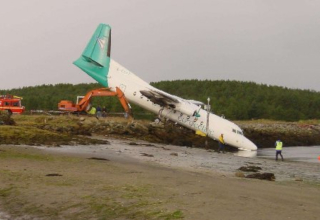
A Euroceltic Airways commuter aircraft with 40 passengers on board, including the Irish rock band Aslan, overshoots the runway at Sligo Airport on November 2, 2002 and ends up with its nose in the sea.
Nobody is injured in the incident, which happens as the aircraft attempts to land during heavy rain. A member of the rock band Aslan, who are among the passengers on the Euroceltic Airways flight from Dublin, describes it as a “very, very frightening experience.”
Although the Fokker 27 Friendship aircraft also faces high winds as it makes the landing, the major problem seems to be due to the amount of rainwater on the runway, which is located on a coastal spit at Strandhill. According to a Euroceltic spokesman, “The pilot touched down and hit the brakes, but it aquaplaned, basically, and kept going.”
The plane crosses a short, rocky beach at the end of the runway, bursting three of its tires, before coming to a stop with its nose in the sea. The 36 passengers and four crew are safely evacuated and the plane is removed after crash inspectors examine the scene. An inquiry by the Department of Transport takes place.
Euroceltic, a Luton-based airline owned by a group from Waterford, began operating the Dublin-Sligo and Dublin-Donegal routes in the summer of 2002. The two Fokker 27 planes in use are scheduled for replacement by Fokker 50s, bought from Aer Lingus, in the weeks following the accident. However, according to the spokesman, the age of the planes, built in 1984, is not a factor in the incident. He says the pilot and co-pilot on the Sligo flight are both “very experienced.”
Aslan goes ahead with their concert in Sligo the following Saturday night despite the shock. Guitarist Billy McGuinness describes his fear as he watched the plane’s tires burst, “When I saw the sea, I thought, ‘Oh my God, we’re in trouble here’.” Band members had earlier joked about the tradition of rock groups being involved in air crashes, he added.
Euroceltic flight schedules return to normal on November 4. At the time of the accident, the company also flies from Waterford to Luton and Liverpool.
(From: “Investigation under way after plane skids off Sligo runway” by Frank McNally, The Irish Times, November 4, 2002)



 seamus dubhghaill