seamus dubhghaill

Promoting Irish Culture and History from Little Rock, Arkansas, USA


Leave a comment

Death of Leo Whelan, Portrait & Genre Painter

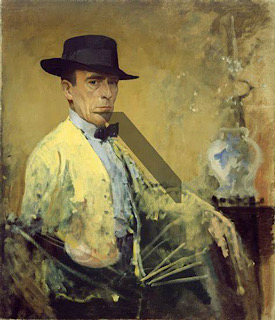
(Michael) Leo Whelan, portrait and genre painter, dies from leukemia on November 6, 1956, at the Mater private nursing home in Dublin.

Whelan is born on January 17, 1892, at 20 St. George’s Villas, Fairview, Dublin, one of two sons and three daughters of Maurice Whelan, a draper, of County Kerry ancestry, and Mary Whelan (née Cruise), from County Roscommon. The family subsequently moves to 65 Eccles Street, where his parents operated a small hotel. Educated at Belvedere College, Dublin, he then attends the Dublin Metropolitan School of Art (DMSA) (1908–14), where he is a student of William Orpen, who has a huge influence on his artistic style. His fellow students at the school include Patrick Tuohy and Séan Keating.

Whelan is awarded many prizes in the Royal Dublin Society (RDS) Taylor art competitions, including one in 1912 for a portrait of his sister Lena, entitled On the Moors, rendered in a strongly academic technique. In 1916, he wins the Taylor scholarship for the Royal Hibernian Academy (RHA) schools for his finest early work, The Doctor’s Visit, an adroitly executed composition of contrasting shadows and light. Typical of many of his genre interiors, the painting depicts a room in the family home, with relatives as models: Whelan’s mother sits by the bed watching over his ill cousin, while his sister, dressed in a Mater hospital nurse’s uniform, is in the background opening the door for the doctor. The subtly evoked atmosphere of restrained emotion foreshadowed a hallmark of his mature style.

Whelan exhibits annually at the RHA for forty-five years (1911–56), averaging six works per year. He is elected an RHA associate in 1920, becoming a full member in 1924. He participates in the Exposition d’art irlandais at the Galerie Barbazanges in Paris in 1922. A visiting teacher at the RHA schools in 1924, he also teaches in the DMSA for a time. He has studios at 64 Dawson Street (1914–27) and 7 Lower Baggot Street (1931–56). Beginning in the 1910s, he receives regular commissions for portraits, constituting his primary source of income. Having become the family’s main breadwinner following his parents’ deaths in the 1920s, he concentrates most of his production on this lucrative activity, portraying numerous leading figures in the spheres of politics, academia, religion, society, medicine, and law.

Coming from a family of militant nationalist sympathies, in 1922 he begins a large group portrait, GHQ Staff of the Pre-Treaty IRA, including Michael CollinsRichard MulcahyRory O’ConnorLiam Mellows and nine others, composed from individual studies of the men rendered during clandestine sittings in his home and studio. The painting, which he leaves unfinished, is in McKee Barracks, Dublin. He receives special praise for his portraits of John Henry Bernard, Provost of Trinity College Dublin (TCD) and of Louis Claude Purser, TCD vice-provost. The latter is awarded a medal at the 1926 Tailteann Games. He exhibits seventeen paintings at the Royal Society of Portrait Painters, London, of which he is a member, and shows two works at the Royal Academy of Arts, London. His 1929 portrait of John McCormack, one of his major patrons, is presented by the tenor’s family some fifty years later to the National Concert Hall, Dublin.

Situated securely in the academic tradition, in most of his portraits Whelan favours a sombre, restricted palette, with the sitter placed, in grave demeanour, against a monotone background with few accessories. In a 1943 interview he asserts that twentieth-century portraiture suffers from the drabness of modern costume, for which the artist must compensate by careful rendition of the subject’s hands. He tends to depart from his prevailing portrait style when painting women, whom he characteristically depicts in meticulously observed interiors, a notable example being his portrait of Society hostess Gladys Maccabe (c.1946; NGI).

Whelan’s commercial concentration on portraiture notwithstanding, he expresses his true talent in genre compositions, especially kitchen interiors, in which he emulates the technique of the Dutch painter Johannes Vermeer. Two of the most accomplished of these depict his sister Frances in the basement kitchen of the family home: The Kitchen Window (1927; Crawford Art Gallery, Cork) demonstrates a particularly skillful use of light, while Interior of a Kitchen (1935) is notable for the dexterous handling of objects of varied shapes and textures. His genre works include both urban and rural scenes, with a distinctive interest in portraying occupations and other activities. Gypsy (1923), an Orpenesque composition of a shawled woman in a west-of-Ireland landscape with a caravan in the background, receives wide contemporary critical acclaim. Jer (c.1925), depicting a man seated by the fire in a cottage interior, is reproduced in J. Crampton Walker’s Irish Art and Landscape (1927). The Fiddler (c.1932), a naturalistic, sensitively characterised study, is first shown at an Ulster Academy exhibition at Stranmillis, Belfast. A Kerry Cobbler is reproduced in Twelve Irish Artists (1940), introduced by Thomas Bodkin, as among the works denoting the development of a distinctively Irish school of painting.

In 1929, Whelan designs the first Irish Free State commemorative stamp, a portrait of Daniel O’Connell for the centenary of Catholic emancipation. Commissioned by the Thomas Haverty trust to paint an incident from the life of Saint Patrick for the 1932 Eucharistic Congress, he executes The Baptism by St. Patrick of Ethna the Fair and Fedelmia the Ruddy, Daughters of the Ard Rí Laoghaire, a work highly conservative in style. He rapidly completes an oil study of the papal legate, Lorenzo Lauri, also for the Eucharistic Congress. He is represented in the art competitions at the 1932 Summer Olympics in Los Angeles. His depiction of Saint Brigid, shown at the Academy of Christian Art exhibition (1940), becomes a familiar image owing to the wide circulation of reproductions.

Whelan’s political portraits are influential in creating a strong, assured image of the newly formed Irish state, and thus retain an historical significance. His posthumous portrait, The Late General Michael Collins, exhibited at the RHA in 1943 and now held in Leinster House, is an iconic, heroic image of the fallen leader. His portraits of Arthur Griffith and Kevin O’Higgins – commissioned posthumously, as is the Collins, by Fine Gael – also hang in Leinster House, while that of John A. Costello, exhibited at the RHA in 1949, is now held in the King’s Inns, Dublin. He paints two presidents, Douglas Hyde and Seán T. O’Kelly, both works currently in Áras an Uachtaráin. A portrait of Éamon de Valera, painted in 1955 when the sitter is Leader of the Opposition, is in Leinster House. In 1954, he designs a second commemorative stamp, picturing a reproduction of a portrait bust of John Henry Newman, to mark the centenary of the Catholic University of Ireland.

Whelan is elected an honorary academician of both the Ulster Academy of Arts (1931), and the Royal Ulster Academy (1950). He becomes a member of the United Arts Club in 1934. As a representative of the RHA, he sits on the board of governors of the National Gallery of Ireland for many years, and is on the advisory committee of the Municipal Gallery of Modern Art. Unmarried, he resides until his death at the Eccles Street address, with two sisters who continue to manage the family hotel. He dies on November 6, 1956, from leukemia at the Mater private nursing home in Dublin. He is buried in Glasnevin Cemetery.

(From: “Whelan, (Michael) Leo,” by Carmel Doyle, Dictionary of Irish Biography, http://www.dib.ie, October 2009)


Leave a comment

Death of Timothy Harrington, Journalist, Barrister & Politician

Timothy Charles Harrington, Irish journalist, barrister, nationalist politician and Member of Parliament (MP) in the House of Commons of the United Kingdom, dies in Dublin on March 12, 1910, following a stroke.

Harrington is born on September 20, 1851, in Castletownbere, County Cork, son of Denis Harrington and his wife, Eileen (née O’Sullivan). He is educated at the Catholic University of Ireland and Trinity College Dublin (TCD).

As a member of the Irish Parliamentary Party (IPP), Harrington represents Westmeath from February 1883 to November 1885. In 1885 he is elected for the new constituency of Dublin Harbour, which he represents until his death. He serves as Lord Mayor of Dublin three times from 1901 to 1904.

Harrington owns two newspapers, United Ireland and the Kerry Sentinel, and is a member of the so-called Bantry band of prominent nationalist politicians from the Bantry vicinity. They are also more pejoratively known as the Pope’s brass band. Tim Healy is another prominent member of this unofficial group.

In 1884, Harrington publishes a pamphlet, “Maamtrasna Massacres – Impeachment of the Trials,” in which he dismantles the Crown Prosecution’s case against the eight men accused of the murders of the Joyce family on August 17, 1882. He provides evidence that Crown Prosecutor George Bolton had deliberately suppressed evidence that would have acquitted Maolra Seoighe (English: Myles Joyce), who was hanged, and four men who were sentenced to twenty years of penal servitude.

Harrington is secretary and chief organiser of the Irish National League (INL), a supporter of Charles Stewart Parnell and is largely responsible for devising the agrarian Plan of Campaign in 1886. He becomes a Parnellite Nationalist when the party splits in 1891, continuing as secretary of the INL. In 1897 he proclaims himself an Independent Nationalist and sides with William O’Brien‘s United Irish League (UIL) from its early days. He is briefly considered as a possible alternative to John Redmond as leader of the re-united Irish Parliamentary Party in 1900 when he stands in the 1900 United Kingdom general election Ireland as a Nationalist again.

Thereafter Harrington becomes excluded from Redmond’s closed circle of confidants, retains sympathy with O’Brien, and represents the interests of the tenant farmers at the 1902 Land Conference negotiations which lead to the enactment of the unprecedented Wyndham Land Purchase (Ireland) Act 1903.

On September 7, 1901, as the Lord Mayor of Dublin, Harrington kicks off at the official ceremony to open Bohemian F.C.‘s new home, Dalymount Park.

Harrington retains the party nomination for the Dublin Harbour constituency in the January 1910 United Kingdom general election, largely because of local divisions about who should succeed him and because an O’Brienite offer to pay his election expenses deters rivals from going to the polls. He decides that the finely balanced result of the general election means that every nationalist vote would be required at Westminster. He therefore travels to London, but shortly after attending the parliamentary party meeting on February 23 he suffers a stroke. After some days’ recuperation he is brought home to Dublin, but his condition deteriorates and he dies on March 12, 1910, at his home, 70 Harcourt Street. He is buried near the Parnell circle at Glasnevin Cemetery.

Harrington is celebrated by a statue erected in 2001 at the east end of Castletownbere near the Millbrook bar.


Leave a comment

Opening of the Royal College of St. Patrick in Maynooth

The Royal College of St. Patrick in Maynooth, County Kildare, is established by the Maynooth College Act 1795 and opens on October 1, 1796. Today known as St. Patrick’s Pontifical University, Maynooth, the college and national seminary on its grounds are often referred to as Maynooth College.

Thomas Pelham, the Chief Secretary for Ireland, introduces a bill for the foundation of a Catholic college, and this is enacted by parliament. It is built to hold up to 500 students for the Catholic priesthood of whom up to 90 are to be ordained each year. It is once the largest seminary in the world.

The town of Maynooth is the seat of the FitzGeralds, Earls of Kildare. The ivy-covered tower attached to St. Mary’s Church of Ireland is all that remains of the ancient college of St. Mary of Maynooth, founded and endowed by Gerald FitzGerald, 8th Earl of Kildare, and dedicated to the Blessed Virgin Mary. On October 7, 1515, Henry VIII grants licence for the establishment of a college. In 1518, the 9th Earl presents a petition to the Archbishop of Dublin, William Rokeby, for a license to found and endow a college at Maynooth, the College of the Blessed Virgin Mary. In 1535 the college is suppressed and its endowments and lands confiscated as part of the Reformation.

The present college is created in the 1790s against the background of the upheaval during the French Revolution and the gradual removal of the penal laws. The college is particularly intended to provide for the education of Catholic priests in Ireland, who until this Act had to go to Continental Europe for their formation and theological education. Many are educated in France, and the church and government are concerned at the Dechristianization of France during the French Revolution, and at the same time at the risk of revolutionary thinking arising from training in revolutionary France. A number of the early lecturers in Maynooth, are exiles from France. Also among the first professors is a layman, James Bernard Clinch, recommended by Edmund Burke. Also relevant is the enactment of the Roman Catholic Relief Act 1793.

The college is legally established on June 5, 1795, by the Maynooth College Act 1795 as The Royal College of St. Patrick, by act of the Parliament of Ireland, to provide “for the better education of persons professing the popish or Roman Catholic religion.” The college is originally established to provide a university education for Catholic lay and ecclesiastical students, the lay college is based in Riverstown House on the south campus from 1802. With the opening of Clongowes Wood College in 1814, the lay college is closed and the college functions solely as a Catholic seminary for almost 150 years.

In 1800, John Butler, 12th Baron Dunboyne, dies and leaves a substantial fortune to the college. Butler had been a Roman Catholic, and Bishop of Cork, who had embraced Protestantism in order to marry and guarantee the succession to his hereditary title. However, there are no children to his marriage, and it is alleged that he had been reconciled to the Catholic Church at his death. Were this the case, a Penal Law demands that the will is invalid, and his wealth is to pass to his family. Much litigation follows before a negotiated settlement in 1808 that leads to the establishment of a Dunboyne scholarship fund.

The land is donated by William FitzGerald, 2nd Duke of Leinster, who had argued in favour of Catholic emancipation in the Irish House of Lords. He lives nearby at Carton House and also at Leinster House. The building work is paid for by the British Government with the parliament continuing to give it an annual grant until the Irish Church Act 1869. When this law is passed the college receives a capital sum of £369,000. The trustees invest 75% of this in mortgages to Irish landowners at a yield of 4.25% or 4.75% per annum. This is considered a secure investment at the time but agitation for land reform and the depression of the 1870s erodes this security. The largest single mortgage is granted to the Earl of Granard. Accumulated losses on these transactions reaches £35,000 by 1906.

The first building to go up on the site is designed by, and named after, John Stoyte. Stoyte House, which can still be seen from the entrance to the old campus, is a well-known building to Maynooth students and stands very close to the very historic Maynooth Castle. Over the next 15 years, the site at Maynooth undergoes rapid construction so as to cater for the influx of new students, and the buildings which now border St. Joseph’s Square (to the rear of Stoyte House) are completed by 1824.

The Rev. Laurence F. Renehan (1797–1857), a noted antiquarian, church historian, and cleric, serves as president of St. Patrick’s from 1845 until 1857. Under Renehan, many of the college’s most important buildings are constructed by Augustus Pugin.

In 1876, the college becomes a constituent college of the Catholic University of Ireland, and later offers Royal University of Ireland degrees in arts and science. Even after the granting of the Pontifical Charter in 1896 the college becomes a recognised college of the National University of Ireland in 1910, and from this time its arts and science degrees are awarded by the National University of Ireland. However, during this time the Pontifical University of Maynooth continues to confer its degrees in theology, because until 1997 theology degrees are prohibited by the Royal University of Ireland and its successor the National University of Ireland.

In 1997, the Universities Act, 1997 is passed by the Oireachtas. Chapter IX of the Act provides for the creation of the separate Maynooth University. This new university is created from the college’s faculties of Arts, Celtic Studies and Philosophy, and Science.

In 1994, W. J. Smyth had been appointed to the position of Master of St. Patrick’s College Maynooth (NUI). In 1997, this position is converted into President of Maynooth University. After his 10-year term ends in 2004, he is replaced by John Hughes as president of Maynooth University and a new line of heads for the college.

By 2016, the number of resident seminarians has dropped from several hundreds to just 40 to 60. In August 2016, it is revealed that, due to frequent use of Grindr by college students, the then Archbishop of Dublin Diarmuid Martin decides to transfer the students from his diocese to the Irish Pontifical College in Rome. According to Martin, “there are allegations on different sides,” one of which of an “atmosphere that was growing in Maynooth” of a “homosexual, a gay culture, that students have been using an app called Grindr,” which “would be fostering promiscuous sexuality, which is certainly not in any way the mature vision of sexuality one would expect a priest to understand.” Subsequently, the college trustees order a review of the college’s policy on social media use.


Leave a comment

Death of William Walsh, Archbishop of Dublin

William Joseph Walsh, archbishop and nationalist, dies in Dublin on April 9, 1921. He serves as the Roman Catholic Archbishop of Dublin from July 3, 1885, until his death.

Walsh is born at 11 Essex Quay in Dublin, the only child of Ralph and Mary Perce Walsh. His father is a watchmaker and jeweler. He inherits his sympathy for Irish nationalism and independence from his father, who has the boy enrolled in the Repeal Association before he is two years old. He is educated locally at Mr. Fitzpatrick’s School on Peter St. and at St. Laurence O’Toole Seminary School, Harcourt Street, Dublin. In 1856, he goes to the Catholic University of Ireland and three years later to St. Patrick’s College, Maynooth where he becomes Professor of Theology in 1867. He is appointed vice-president of Maynooth in 1878 and president in 1880. A poor preacher, he makes the press his pulpit, making a name for himself in the areas of land law and education.

Walsh is ordained into the priesthood on May 22, 1866. He is appointed Archbishop of Dublin on July 3, 1885, followed by his consecration on August 2, 1885. He serves in this position until his death in 1921 and is succeeded by Edward Joseph Byrne.

The Land issue divides the Irish hierarchy. Walsh supports agrarian reform on behalf of the rural population. He is openly sympathetic to Irish nationalism, and an advocate of both Home Rule and agrarian land reform. It is his support for this movement, led by Michael Davitt, which leads the Vatican to honour Michael Logue in Armagh with the dignity of Cardinal in 1893 rather than Walsh in Dublin.

Walsh serves on the Senate of the Royal University of Ireland (1883–84) and as part of the Commission of National Education (1885–1901). He is appointed Chancellor of the newly founded National University of Ireland in 1908, a position he holds until his death, after which he is succeeded by Éamon de Valera.

Walsh has been described as “the greatest archbishop of Dublin since Laurence O’Toole (Lorcán Ua Tuathail). Walsh Road in Drumcondra, Dublin is named after him.


Leave a comment

Death of Philologist Eugene O’Curry

eugene-ocurry

Eugene O’Curry, philologist and antiquary, dies of a heart attack in Dublin on July 30, 1862.

O’Curry is born at Doonaha, near Carrigaholt, County Clare, the son of Eoghan Ó Comhraí, a farmer, and his wife Cáit. Eoghan has spent some time as a traveling peddler and has developed an interest in Irish folklore and music. Unusual for someone of his background, he is literate and is known to possess a number of Irish manuscripts. It is likely that Eoghan is primarily responsible for his son’s education.

Having spent some years working on his father’s farm and as a school teacher, O’Curry moves to Limerick in 1824 and spends seven years working there at a psychiatric hospital. He marries Anne Broughton, daughter of John Broughton of Killaderry near Broadford, County Limerick on October 3, 1824. He is a supporter of Catholic emancipation and in 1828 writes a poem congratulating Daniel O’Connell on his election as an MP.

During this period O’Curry is establishing a reputation for his knowledge of the Irish language and Irish history, and, by 1834, is in correspondence with the antiquary John O’Donovan. He is employed, from 1835 to 1842, on O’Donovan’s recommendation, in the topographical and historical section of Ordnance Survey Ireland. O’Donovan goes on to marry O’Curry’s sister-in-law, Mary Anne Broughton, in 1840. O’Curry spends much of the remainder of his life in Dublin and earns his living by translating and copying Irish manuscripts. The catalogue of Irish manuscripts in the British Museum (1849) is compiled by him for a fee of £100. He is responsible for the transcripts of Irish manuscripts from which O’Donovan edits the Annals of the Four Masters between 1848 and 1851.

In 1851 O’Curry is elected a member of the Royal Irish Academy and, on the founding of the Catholic University of Ireland in 1854, he is appointed professor of Irish history and archaeology. He works with George Petrie on the Ancient Music of Ireland (1855). In 1852, he and O’Donovan propose the Dictionary of the Irish Language, which is eventually begun by the Royal Irish Academy in 1913 and finally completed in 1976.

O’Curry’s lectures are published by the university in 1860, and give a better knowledge of Irish medieval literature than can be obtained from any other one source. Three other volumes of lectures are published posthumously, under the title On the Manners and Customs of the Ancient Irish (1873). His voluminous transcripts, notably eight huge volumes of early Irish law, testify to his unremitting industry. The Celtic Society, of the council of which he is a member, publishes two of his translations of medieval tales.

Eugene O’Curry dies of a heart attack at his home in Dublin on July 30, 1862, and is survived by two sons and two daughters. He is buried at Glasnevin Cemetery in Dublin. O’Curry Road in the Tenters area of Dublin 8 is named in his honour.


Leave a comment

Birth of George Sigerson, Physician & Writer

george-sigerson

George Sigerson, Irish physician, scientist, writer, politician, and poet, is born at Holy Hill, near Strabane in County Tyrone on January 11, 1836. He is a leading light in the Irish Literary Revival of the late 19th century in Ireland.

Sigerson is the son of William and Nancy (née Neilson) Sigerson and has three brothers, James, John and William, and three sisters, Ellen, Jane, and Mary Ann. He attends Letterkenny Academy but is sent by his father, who developed the spade mill and who played an active role in the development of Artigarvan, to complete his education in France.

He studies medicine at the Queen’s College, Galway, and Queen’s College, Cork, and takes his degree in 1859. He then goes to Paris where he spends some time studying under Jean-Martin Charcot and Duchenne de Boulogne. Sigmund Freud is one of his fellow students.

Sigerson returns to Ireland and opens a practice in Dublin, specializing in neurology. He continues to visit France annually to study under Charcot. His patients included Maud Gonne, Austin Clarke, and Nora Barnacle. He lectures on medicine at the Catholic University of Ireland and is professor of zoology and later botany at the University College Dublin.

His first book, The Poets and Poetry of Munster, appears in 1860. He is actively involved in political journalism for many years, writing for The Nation. Sigerson and his wife Hester are by now among the dominant figures of the Gaelic Revival. They frequently hold Sunday evening salons at their Dublin home to which artists, intellectuals, and rebels alike attend, including John O’Leary, W.B. Yeats, Patrick Pearse, Roger Casement, and 1916 signatory Thomas MacDonagh. Sigerson is a co-founder of the Feis Ceoil and President of the National Literary Society from 1893 until his death. His daughter, Dora, is a poet who is also involved in the Irish literary revival.

Nominated to the first Seanad Éireann of the Irish Free State, Sigerson briefly serves as the first chairman on December 11-12, 1922, before the election of James Campbell, 1st Baron Glenavy. Sigerson dies at his home at 3 Clare Street, Dublin, on February 17, 1925, at the age of 89, after a short illness. On February 18, 1925, the day after his death, the Seanad Éireann pays tribute to him.

The Sigerson Cup, the top division of third level Gaelic football competition in Ireland is named in his honour. Sigerson donates the salary from his post at UCD so that a trophy can be purchased for the competition. In 2009, he is named in the Sunday Tribune‘s list of the “125 Most Influential People In GAA History.” The cup is first presented in 1911, with the inaugural winners being UCD GAA.


Leave a comment

Opening of the Catholic University of Ireland

The Catholic University of Ireland in Dublin is opened, and lectures commence on November 3, 1854, with the registration of seventeen students, the first being Daniel O’Connell, grandson of the notable Catholic politician Daniel O’Connell.

The university is founded in 1851 following the Synod of Thurles in 1850, and in response to the Queen’s University of Ireland and its associated colleges which are non-denominational. Cardinal Paul Cullen has previously forbidden Catholics from attending these “godless colleges.” On May 18, 1854, the university is formally established with five faculties of law, letters, medicine, philosophy, and theology with John Henry Newman as the Rector.

In 1861, Dr. Bartholomew Woodlock, the rector from 1860–1879, tries to secure land for a building near Holy Cross College Clonliffe, the establishment to be known as St. Patrick’s University. Plans are drawn up by architect J.J. McCarthy and a foundation stone laid. Cardinal Cullen is against the idea of educating lay and clerical students on the same premises. However, this plan is shelved because of the expansion of the railway line. A church and monastery are eventually built on the site. Under the name St. Patrick’s University night classes are advertised by the University under Dr. Woodlock’s name.

Some feeder secondary schools are established for the Catholic University of Ireland. The nearby Catholic University School is joined by St. Flannan’s College in County Clare and Catholic University High School in Waterford.

The Catholic University is neither a recognised university so far as the civil authorities are concerned, nor an institution offering recognised degrees. Newman has little success in establishing the new university, though over £250,000 has been raised from the laity to fund it. Though they hold the foundation money as trustees, the hierarchy in 1859 spends most of it to support an Irish Brigade led by Myles O’Reilly to help defend Rome in the Second Italian War of Independence. Newman leaves the university in 1857.

Subsequently the school goes into a serious decline, with only three students registered in 1879. The situation changes in 1880 when the recognised Royal University of Ireland comes into being and students at the Catholic University are entitled to sit the Royal University examinations and receive its degrees.

In 1909 the Catholic University essentially comes to an end with the creation of the National University of Ireland, with University College Dublin as a constituent, however the Catholic University of Ireland remains a legal entity until 1911.

(Pictured: J. J. McCarthy’s design for the Catholic University of Ireland)