Reynolds is educated at Summerhill College in Sligo, County Sligo and works for a state transport company before succeeding at a variety of entrepreneurial ventures, including promoting dances and owning ballrooms, a pet-food factory, and newspapers. In 1974 he is elected to the Longford County Council as a member of Fianna Fáil. He enters Dáil Éireann, lower house of the Oireachtas, the Irish parliament, in 1977 as a member representing the Longford-Westmeath parliamentary constituency and becomes Minister for Posts and Telegraphs in Haughey’s Fianna Fáil government (1979–81). He is subsequently Minister of Industry and Commerce (1987–88) and Minister for Finance (1988–91) in Haughey’s third and fourth governments. He breaks with Haughey in December 1991. On January 30, 1992, Haughey retires as leader of Fianna Fáil at a parliamentary party meeting. Reynolds easily defeats his rivals Mary O’Rourke and Michael Woods in the party leadership election and succeeds Haughey as Taoiseach on February 11, 1992.
The Fianna Fáil–Progressive Democratscoalition that Reynolds inherits breaks up in November 1992 but, after the general election later that month, he surprises many observers by forming a new coalition government with the Labour Party in January 1993. He plays a significant part in bringing about a ceasefire between the Irish Republican Army (IRA) and unionist paramilitary groups in Northern Ireland in 1994, but he is less effective in maintaining his governing coalition. When this government founders in November 1994, he resigns as Taoiseach and as leader of Fianna Fáil, though he remains acting prime minister until a new government is formed the following month. He unsuccessfully seeks his party’s nomination as a candidate for the presidency of Ireland in 1997. He retires from public life in 2002.
In 1968, O’Malley enters politics upon the sudden death of his uncle Donogh who, at that the time, is the sitting Minister for Education. He is chosen after Donogh’s widow, Hilda, still in shock at the sudden death of her husband, turns down the opportunity to contest the by-election necessitated by his death.
O’Malley is subsequently elected as a Fianna Fáil TD for the Limerick East constituency in the by-election. Perhaps the first sign of the defiance that would define his career materialises during the 1969 Irish general election when Hilda asks her nephew to step aside and allow her to contest in the Limerick East constituency as the main Fianna Fáil candidate. He refuses and places third in the four-seat constituency, with his aunt, running as an independent, coming in fifth.
Following the general election, O’Malley is appointed Parliamentary Secretary to both Minister for DefenceJim Gibbons and TaoiseachJack Lynch and serves as Government Chief Whip. In his role as a confidante of Lynch, the political lines within Fianna Fáil that put him on a collision course of over twenty years with Charles Haughey, are drawn. He plays a central role in the Arms Crisis prosecutions of Haughey and Neil Blaney in 1970. After their acquittals, the stage is set within Fianna Fáil for a long-term power struggle that eventually results in O’Malley’s expulsion from the party in 1984.
In the meantime, O’Malley’s next position within Lynch’s government comes when he is made Minister for Justice after Mícheál Ó Móráin is forced to resign due to ill-health. One of the most significant aspects of his legacy transpires during his tenure as Minister for Justice from 1970 to 1973. In response to the ongoing conflict in Northern Ireland, he tries and fails to introduce internment without trial for republicans within the State. He is, however, successful in reintroducing the Offences Against the State Act, which enables convictions for Irish Republican Amy (IRA) membership on the word of a Garda Superintendent, and the Special Criminal Court, a non-jury court presided over by three judges which tries cases of terrorism and serious organised crime.
In 1982, after Fianna Fáil loses its majority but stays in government by virtue of a confidence and supply agreement with Sinn Féin – The Workers Party and two independents, O’Malley is appointed Minister for Trade, Commerce and Tourism, but with the death of Colley and the loss of O’Donoghue’s seat, he becomes increasingly isolated within Fianna Fáil.
After the party whip is removed from him in 1984, amidst inter-party wrangling over the New Ireland Forum, O’Malley is expelled from the party the following year, the final straw being his famous “I stand by the Republic” speech in which he announces his intention to abstain on a vote regarding the liberalisation of the sales of contraceptives, which Fianna Fáil opposes.
O’Malley’s animus for Haughey does not stop him from entering coalition with Fianna Fáil after the 1989 Irish general election, with him once again appointed Minister for Industry and Commerce. While in government, he finally witnesses the downfall of Haughey in 1992, when he is forced to resign over the emergence of new evidence concerning his tapping of journalists’ phones in the 1980s. The coalition with Fianna Fáil does not last long under new Taoiseach Albert Reynolds, with the Government collapsing after Reynolds accuses O’Malley of dishonesty during the Beef Tribunal.
O’Malley retires as leader of the Progressive Democrats in 1993, and the party moves into opposition, only to re-enter government with Fianna Fáil in 1997, where it remains upon O’Malley’s retirement from politics in 2002.
While the Progressive Democrats no longer exist, they are generally credited with the breaking up of the Fianna Fáil versus Fine Gael dichotomy of Irish politics that had dominated since the founding of the Free State. Since 1922, Irish governments have tended to be either single-party Fianna Fáil cabinets, be they minority or majority, or Fine Gael-led coalitions, typically involving the Labour Party. A Fine Gael-Labour coalition is in power at the time of the founding of the Progressive Democrats, and a single-party government or clear majority has not been won in Ireland since.
O’Malley dies in Dublin on July 21, 2021, at the age of 82, having been in poor health for some time. He is predeceased by his wife, Pat, and survived by their six children, four daughters including the former TD Fiona O’Malley, and two sons.
Perhaps O’Malley’s greatest legacy is the political reality of Ireland today: the low-tax, pro-business economic policies of the Progressive Democrats have been the dominant ideology in the State since the 1990s. Sinn Féin, the party most affected by his measures as Minister for Justice, no longer vote against the retention of the Offences Against the State Act and Special Criminal Court.
Cronin is known as an arts activist as well as a writer. He is Cultural Adviser to TaoiseachCharles Haughey and briefly to Garret FitzGerald. He involves himself in initiatives such as Aosdána, the Irish Museum of Modern Art and the Heritage Council. He is a founding member of Aosdána, and is a member of its governing body, the Toscaireacht, for many years. He is elected Saoi, a distinction for exceptional artistic achievement, in 2003. He is also a member of the governing bodies of the Irish Museum of Modern Art and the National Gallery of Ireland, of which he is for a time Acting Chairman.
His first collection of poems, called simply Poems (Cresset Press, London), is published in 1958. Several collections follow and his Collected Poems (New Island Books, Dublin) is published in 2004. The End of the Modern World (New Island Books, 2016), written over several decades, is his final publication.
Cronin’s novel, The Life of Riley, is a satire on Bohemian life in Ireland in the mid-20th century, while his memoir Dead as Doornails addresses the same subject.
Cronin knows Samuel Beckett from when they do some work for the BBC during the 1950s and 1960s. He gives a prefatory talk to Patrick Magee‘s reading of The Unnamable on the BBC Third Programme. Beckett is not impressed, saying, “Cronin delivered his discourse… It was all right, not very exciting.” Cronin later publishes a biography of him, Samuel Beckett: The Last Modernist (1996), followed on from No Laughing Matter: The Life and Times of Flann O’Brien (1989).
In his later years, Cronin suffers from failing health, which prevents him from traveling abroad, thus limiting his dealings to local matters. He dies in Dublin on December 27, 2016, one day short of his 93rd birthday.
Cronin firstly marries Thérèse Campbell, from whom he separates in the mid-1980s. She dies in 1999. They have two daughters, Iseult and Sarah. Iseult is killed in a road accident in Spain. He secondly marries the writer Anne Haverty who, along with daughter Sarah, survives him.
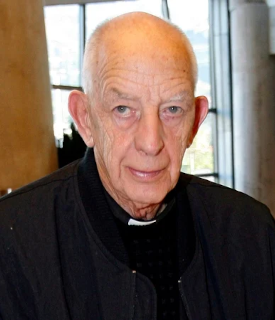
Flannery edits the Dominican bi-monthly journal entitled Doctrine and Life from 1958 to 1988, while at St. Saviour’s Priory, Dublin, where he also serves as prior from 1957 to 1960. He also edits the Religious Life Review. During and after the Second Vatican Council he makes available in English all the documents from the event.
From August 1969, Flannery is a member of the executive committee of the Northern Relief Coordination Committee, raising funds on behalf of the families of those interned without trial in Northern Ireland during the early 1970s.
Flannery embodies the post-Vatican II conception of the priest as a social catalyst engaged by the gospel, closer to his flock than to the clerical hierarchy. He has a great gift for friendship, is indefatigably interested in people, and courts religious affairs commentators and journalists at a time when the hierarchy ignores them, magnifying his influence.
Flannery dies of a heart attack on October 21, 2008, at Kiltipper Woods Care Centre, Dublin. Following a funeral mass at St. Saviour’s Priory, he is buried in the Dominican plot at Glasnevin Cemetery, Dublin, on October 24, 2008.
George Bernard Francis Clarke, Irish barrister who is Chief Justice of Ireland from July 2017 to October 2021, is born on October 10, 1951, in Walkinstown, Dublin. He has a successful career as a barrister for many years, with a broad practice in commercial law and public law. He is the chair of the Bar Council of Ireland between 1993 and 1995. He is appointed to the High Court in 2004 and becomes a judge of the Supreme Court of Ireland in February 2012. Following his retirement from the bench, he returns to work as a barrister. Across his career as a barrister and a judge, he is involved in many seminal cases in Irish legal history.
Clarke is the son of a customs officer who dies when he is aged eleven. His mother is a secretary. He is educated at Drimnagh Castle Secondary School, a Christian Brotherssecondary school in Dublin. He wins the Dublin Junior High Jump Championship in 1969. He studies Economics and Maths at undergraduate level at University College Dublin (UCD), while concurrently studying to become a barrister at King’s Inns. He is the first of his family to attend third level education and is able to attend university by receiving grants. While attending UCD, he loses an election to Adrian Hardiman to become auditor of the Literary and Historical Society (L&H).
Clarke is called to the Bar in 1973 and to the Inner Bar in 1985. He has a practice in commercial, constitutional and family law. Two years after commencing practice he appears as junior counsel for the applicant in State (Healy) v Donoghue before the Supreme Court, which establishes a constitutional right to legal aid in criminal cases.
Clarke represents Michael McGimpsey and his brother Christopher in a challenge against the constitutionality of the Anglo-Irish Agreement, which is ultimately unsuccessful in the Supreme Court in 1988.
Clarke appears for the plaintiff with Michael McDowell and Gerard Hogan in Cox v Ireland in 1990, where the Supreme Court first introduces proportionality into Irish constitutional law and discovers the right to earn a livelihood. He represents Seán Ardagh and the Oireachtas Subcommittee formed after the death of John Carthy in a constitutional case which limits the powers of investigation of the Oireachtas, which leads to the unsuccessful Thirtieth Amendment of the Constitution. In an action taken by tobacco companies to challenge the legality of bans on tobacco advertising, he appears for the State.
Clarke is Chairman of the Bar Council of Ireland from 1993 to 1995. Between 1999 and 2004, he acts as chair of Council of King’s Inns. He is a professor at the Kings’s Inns between 1978 and 1985 and is appointed an adjunct professor at University College Cork (UCC) in 2014. He also serves as an adjunct professor at Trinity College Dublin (TCD).
Clarke acts as a chair of the Employment Appeals Tribunal while still in practice. He is also a steward of the Turf Club and the chairman of Leopardstown Racecourse. He was due to take over as senior steward of the Turf Club but does not do so due to his appointment to the High Court.
Clarke is appointed as a High Court judge in 2004. He is chairman of the Referendum Commission for the second Lisbon Treaty referendum in 2009. As a High Court judge he gives a ruling on the Leas Cross nursing home case against RTÉ, that the public interest justifies the broadcasting of material that otherwise would have been protected by the right to privacy. He frequently presides over the Commercial Court during his time at the High Court. He is involved in the establishment of two High Court lists in Cork, Chancery and a Non-Jury List.
Clarke is appointed to the Supreme Court on February 9, 2012, and serves as Chief Justice from October 2017 until his retirement on October 10, 2021, required by law on his 70th birthday. In March 2021, the Cabinet begins the process of identifying his successor. Donal O’Donnell is selected to replace him. His final day in court is October 8, 2021, where judges, lawyers and civil servants make a large number of tributes to him. Mary Carolan of The Irish Times says that under his leadership the Supreme Court is “perhaps the most collegial it had been in some time.”
Following his retirement from the judiciary, Clarke resumes his practice as a barrister and rejoins the Bar of Ireland. Under the rules of the Bar of Ireland, he cannot appear before a court of equal or lesser jurisdiction to that on which he sat as a judge. Given that he was the most senior judge in Ireland, he cannot appear in any court in Ireland. He can appear in the European Union (EU) courts. However, he indicates his intention to focus on mediation and arbitration work.
Clarke has been married to Dr. Jacqueline Hayden since 1977. They have a son and a daughter. He is interested in rugby and horse racing, at one point owning several horses.
Colley is born in the Dublin suburb of Fairview on October 18, 1925, the son of Harry and Christina Colley. His father is a veteran of the 1916 Easter Rising and a former adjutant in the Irish Republican Army (IRA), who is elected to Dáil Éireann in 1944, as a Fianna Fáil candidate. He is educated at St. Joseph’s Secondary C.B.S. in Fairview, where one of his classmates and closest friends is Charles Haughey, who later becomes his political archrival. He studies law at University College Dublin (UCD) and qualifies as a solicitor in the mid-1940s. He remains friends with Haughey after leaving school and, ironically, encourages him to become a member of Fianna Fáil in 1951. Haughey is elected to Dáil Éireann in the 1957 Irish general election, ousting Colley’s father in the process. This puts some strain on the relationship between the two young men.
Colley is elected to the Dáil at the 1961 Irish general election, reclaiming his father’s old seat in the Dublin North-East constituency. Furthermore, he is elected in the same constituency as Haughey, thereby accentuating the rivalry. Thereafter, he progresses rapidly through the ranks of Fianna Fáil. He becomes a member of the Dáil at a time when a change from the older to the younger generation is taking place, a change facilitated by TaoiseachSeán Lemass.
Colley is active in the Oireachtas as chairman of some of the Joint Labour Committees, which are set up under the Labour Court, to fix legally enforceable wages for groups of workers who have not been effectively organised in trade unions. He is also leader of the Irish parliamentary delegation to the Consultative Assembly of the Council of Europe. His work as a backbencher is rewarded by his appointment as Parliamentary Secretary to the Minister for Lands in October 1964.
Following the return of Lemass’s government at the 1965 Irish general election, Colley joins the cabinet as Minister for Education. He introduces a plan to establish comprehensive schools, set up an advisory council on post-primary school accommodation in Dublin, and introduces a school psychological service.
Colley is promoted as Minister for Industry and Commerce in a cabinet reshuffle in July 1966, and he continues the government policy of economic expansion that had prevailed since the late 1950s.
In November 1966, Seán Lemass resigns suddenly as party leader. Colley contests the subsequent leadership election. He is the favoured candidate of party elders such as Seán MacEntee and Frank Aiken, the latter managing Colley’s campaign. Charles Haughey and Neil Blaney also declare their interest in the leadership; however, both withdraw when the Minister for Finance, Jack Lynch, announces his candidacy. Colley does not back down, and the leadership issue goes to a vote for the first time in the history of the Fianna Fáil party. The leadership election takes place on November 9, 1966, and Lynch beats Colley by 59 votes to 19. When the new Taoiseach announces his cabinet, Colley retains the Industry and Commerce portfolio.
In the wake of the Arms Crisis in 1970, a major reshuffle of the cabinet takes place, with four Ministers either removed, or resigned, or simply retired from the government due to the scandal. Colley remains loyal to the party leader and is rewarded by his appointment as Minister for Finance, the second most important position in government.
In 1973, Fianna Fáil are ousted after sixteen years in government when the national coalition of Fine Gael and the Labour Party come to power. Colley is appointed opposition Spokesman on Finance, in the new Fianna Fáil front bench. As the 1977 Irish general election approaches, Colley and Martin O’Donoghue are the main architects of Fianna Fáil’s election manifesto.
Fianna Fáil sweeps to power at the 1977 Irish general election, with a 20-seat Dáil majority, contrary to opinion polls and political commentators. Colley is re-appointed as Minister for Finance and Minister for the Public Service, and is also appointed as Tánaiste, establishing him firmly as the heir apparent to Taoiseach Jack Lynch.
In December 1979, Jack Lynch resigns unexpectedly as Taoiseach and as Fianna Fáil leader. Colley and Charles Haughey seek the leadership position and are evenly matched. A secret ballot is taken on December 7, 1979. The Minister for Foreign Affairs, Michael O’Kennedy, announces his support for Haughey on the eve of the election. This apparently swings the vote, and Haughey beats Colley by 44 votes to 38. Colley remains as Tánaiste but demands and receives a veto on Haughey’s ministerial appointments to the departments of Justice and Defence.
Fianna Fáil loses power at the 1981 Irish general election. Haughey delays naming a new opposition front bench, but Colley remains a key member of the Fianna Fáil hierarchy. The party regains office at the February 1982 Irish general election. He demands the same veto as before on Haughey’s Defence and Justice appointments but is refused. When it is revealed that Ray MacSharry is to be appointed Tánaiste in his stead, he declines another ministerial position. This effectively brings his front bench political career to an end, but he remains a vocal critic of the party leadership from the backbenches.
When the Fianna Fáil government collapses and are replaced by another coalition government after the November 1982 Irish general election, a number of TDs and Senators express lack of confidence in Haughey’s leadership once again. Several unsuccessful leadership challenges take place in late 1982 and early 1983, with Colley now supporting Desmond O’Malley and the Gang of 22 who oppose Haughey.
Colley dies suddenly on September 17, 1983, aged 57, while receiving treatment for a heart condition at Guy’s Hospital, Southwark, London. He is survived by his wife, three sons, and four daughters, one of whom, Anne Colley, becomes a TD as a member of the Progressive Democrats party.
On the foundation of the Sunday Tribune in 1980, Kennedy joins it as the paper’s political correspondent. The paper’s publisher, John Mulcahy, had become familiar with Kennedy when she had contributed to his journal, The Hibernia Magazine. When the Tribune briefly ceases production, she moves to the Sunday Press.
In 1982, Kennedy’s telephone, along with those of two other journalists, is tapped by former Minister for JusticeSeán Doherty. Early in 1987, she successfully sues the incumbent Charles Haughey-led Fianna Fáil government for illegally tapping her phone. The revelation in 1992 that Charles Haughey had personally ordered the phone taps leads to Haughey’s resignation as Taoiseach.
Kennedy stands in the 1987 Irish general election as a candidate for the newly formed Progressive Democrats party in Dún Laoghaire. She comes in third in the poll, winning 9.4% of the first-preference vote. She is one of fourteen Progressive Democrat TDs elected to Dáil Éireann in that election, a feat the party never achieves again. She is appointed the party’s spokesperson for foreign affairs.
She stands again in the 1989 Irish general election and wins 9% of the first-preference vote but fails to retain her seat.
Following her election defeat, Kennedy returns to The Irish Times, then edited by Conor Brady, whom she had worked with at the Tribune when he was the editor. She avoids party-political journalism for several years, but she returns to covering politics in the early 1990s and becomes the political editor of The Irish Times in 1999. She becomes the newspaper’s first female editor upon the departure of Brady in late 2002. One of her rivals for the editor’s chair is the paper’s high-profile columnist, Fintan O’Toole.
Kennedy is paid more than the editor of Britain’s top non-tabloid newspaper The Daily Telegraph, which has a circulation of about nine times that of The Irish Times. Later columnist Fintan O’Toole tells the Sunday Independent, “We as a paper are not shy of preaching about corporate pay and fat cats but with this there is a sense of excess. Some of the sums mentioned are disturbing. This is not an attack on Ms. Kennedy, it is an attack on the executive level of pay. There is double standard of seeking more job cuts while paying these vast salaries.”
In September 2006, Kennedy approves the publication of an article in The Irish Times giving confidential details of investigations being made into payments purported to have been made in 1993 to Taoiseach Bertie Ahern. She refuses, upon request of the investigating Mahon Tribunal, to provide details of the source of the printed information. She responds that the documents have since been destroyed. Her refusal causes the Tribunal to seek High Court orders compelling her to provide details of the source. On October 23, 2007, the High Court grants the orders compelling her to go before the Tribunal and answer all questions. In its judgment, the High Court, criticising her decision to destroy the documents, says it was an “astounding and flagrant disregard of the rule of law.” In 2009, however, the Supreme Court of Ireland overturns this ruling, holding that the High Court had not struck the correct balance between the journalists’ right to protect their source and the tribunal’s right to confidentiality.
Kennedy announces on March 12, 2011, her intention to retire from The Irish Times by September, after a nine-year term as editor. She actually retires in June and is succeeded by news editor Kevin O’Sullivan on June 23, 2011.
In August 2012, Kennedy is appointed Adjunct Professor of Journalism at the University of Limerick. She has been awarded five honorary doctorates from Irish universities.
In the late 1980s, Reid facilitates a series of meetings between Gerry Adams and John Hume, in an effort to establish a “Pan-Nationalist front” to enable a move toward renouncing violence in favour of negotiation. Reid, himself a staunch nationalist who favours a united Ireland and the withdrawal of British forces from Northern Ireland, then acts as their contact person with the Irish Government in Dublin from a 1987 meeting with Charles Haughey up to the signing of the Good Friday Agreement in 1998. In this role, which is not public knowledge at the time, he holds meetings with various Taoisigh, and particularly with Martin Mansergh, advisor to various Fianna Fáil leaders. After the eventual success of the peace negotiations, Gerry Adams says, “there would not be a peace process at this time without [Father Reid’s] diligent doggedness and his refusal to give up.”
After he moves to Dublin, Reid is involved in peace efforts in the Basque Country. In January 2003, he is awarded the Sabino Arana 2002 “World Mirror” prize, by the Sabino Arana Foundation in Bilbao, in recognition of his efforts at promoting peace and reconciliation. He and a Methodist minister, the Rev. Harold Good, announce that the IRA has decommissioned their arms at a news conference in September 2005.
Reid is involved in controversy in November 2005 when he makes comments during a meeting in Fitzroy Presbyterian Church concerning the Unionist community in Northern Ireland. When the loyalist activist Willie Frazer makes remarks that Catholics had butchered Protestants during the Troubles, Reid angrily responds, “You don’t want to hear the truth. The reality is that the nationalist community in Northern Ireland were treated almost like animals by the unionist community. They were not treated like human beings. They were treated like the Nazis treated the Jews.” Reid later apologises, saying his remarks had been made in the heat of the moment. In an interview with CNN, he says that “The IRA were, if you like, a violent response to the suppression of human rights.”
Reid dies in a Dublin hospital on November 22, 2013. He is survived by two sisters and an aunt, and is buried in Milltown Cemetery, Belfast.
Paul McGuinness, the founder of Principle Management Limited, a popular music act management company based in Dublin, is born on June 16, 1951, in Rinteln, Westphalia, Germany. He is the manager of the rock band U2 from 1978 to 2013.
McGuinness is born in a British military hospital at Rinteln where his father, Philip McGuinness, a native of Liverpool, is serving with the Royal Air Force. His mother, Sheila McGuinness (née Lyne), is a schoolteacher from County Kerry. There are three children in the family: Paul, Niall, and Katy.
McGuinness receives his early formal education in Ireland at the private Jesuit boarding school, Clongowes Wood College. From there he goes on to Trinity College Dublin, where he directs plays, edits the magazine T.C.D. Miscellany, and promotes gigs, but drops out before obtaining a degree.
Before becoming involved with U2, Guinness works as a film assistant director on productions such as John Boorman‘s Zardoz. For a time, he also manages folk-rock group Spud.
McGuinness first meets U2 at a Dublin gig on May 25, 1978, where they are supporting the Gamblers. Following this meeting, he becomes U2’s manager, having been introduced to the band by Bill Graham, a journalist with Hot Press magazine. His original agreement with the band is that the money is to be split equally five ways, though this is later changed.
McGuinness founds Principle Management Limited on March 29, 1984. He and Bill Whelan set up a music publishing company called McGuinness/Whelan Publishing in the late 1980s. Whelan later composes the music for the theatrical show Riverdance.
In 2002, McGuinness is presented with a Lifetime Achievement Award at the Meteor Music Awards at the Point Theatre in Dublin and U2 wins the best Irish Band Award.
Noted for his business acumen, McGuinness is responsible for U2 3D concert films, U2-branded iPods, sponsorship from BlackBerry and the first-ever concert streamed live on YouTube.
McGuinness is regarded as the fifth member of U2, although in an interview with The Irish Press in 1985, when asked if he is the fifth member of U2, he replies, “The fifth member of U2 is in Adam (Clayton)‘s trousers.” He is also regarded as one of the most successful managers in the music business.
McGuinness steps down as manager of U2 after 34 years on November 13, 2013, with Madonna‘s manager, Guy Oseary, succeeding him in 2014 when he sells Principle Management Limited to Live Nation.
McGuinness is a founding partner of TV3 (Ireland) and is one of the owners of Ardmore Film Studios. He becomes a member of the Arts Council of Ireland on January 1, 1988, having been appointed by Charles Haughey. He serves until February 2000 when he resigns.
McGuinness has been an advocate on behalf of artists, record labels, and music publishers. On January 28, 2008, in a speech at the Midem music industry convention in Cannes, he specifically accuses companies such as Apple, Google, Yahoo!, and Facebook of building “multi-billion dollar industries on the back of our content without paying for it.”
In 2015, McGuinness founds Primo Productions, a film and TV company. Primo produces three seasons of Riviera, a drama set in the South of France. He writes the “list of ingredients” for the show: “Rich people behaving badly in the sun, yachts, Maseratis, great clothes, beautiful women, art fraud, money laundering through the auction houses, Russians, English people, American, French. Murder, adultery.” Everyday life on the Côte d’Azur. His production partner is Kris Thykier of Archery Pictures. The show is originally commissioned by Anne Mensah of Sky Atlantic.
McGuinness marries Kathy Gilfillan in 1977. They meet while he is studying at Trinity. Gilfillan is director of The Lilliput Press. They have two children.
The general election of 1981 is the first one of five during the 1980s. The election also sees three new leaders of the three main parties fight their first general election. Charles Haughey had become Taoiseach and leader of Fianna Fáil at the end of 1979, Garret FitzGerald is the new leader of Fine Gael and Frank Cluskey is leading the Labour Party.
Haughey and Fianna Fáil seem extremely popular with the electorate in early 1981. He is expected to call the election at the time of the Fianna Fáil ardfheis on February 14, but the Stardust fire causes the ardfheis to be postponed, and the Republican hunger strike in the Maze Prison begins in March. By the dissolution in May, much of the earlier optimism in the party has filtered out. The Anti H-Block movement fields abstentionist candidates in solidarity with the hunger strikers, undermining the Republican credentials of Fianna Fáil.
Fianna Fáil’s manifesto promises more spending programmes and Fine Gael puts forward a series of tax-cutting plans.
Fianna Fáil loses seats as a result of sympathy to the Anti H-Block candidates and the attractive tax proposals of Fine Gael. It is the worst performance for Fianna Fáil in twenty years. Meanwhile, Labour Party leader Frank Cluskey loses his seat, necessitating a leadership change with Michael O’Leary succeeding Cluskey. A Fine Gael–Labour Party coalition government comes to power. Fine Gael and the Labour Party form the 17th Government of Ireland, a minority coalition government, with Garret FitzGerald becoming Taoiseach.
(Pictured: Fine Gael’s Garret FitzGerald, who is appointed Taoiseach following the 1981 Irish General Election)