Campbell is born into a Catholic and Irish nationalist family from County Down. He is educated at St. Malachy’s College, Belfast. After working for his father he teaches for a while. He travels to Dublin in 1902, meeting leading nationalist figures. His literary activities begin with songs, as a collector in Antrim, County Antrim and working with the composer Herbert Hughes. He is then a founder of the Ulster Literary Theatre in 1904. He contributes a play, The Little Cowherd of Slainge, and several articles to its journal Uladh edited by Bulmer Hobson. The Little Cowherd of Slainge is performed by the Ulster Literary Theatre at the Clarence Place Hall in Belfast on May 4, 1905, along with Lewis Purcell’s The Enthusiast.
Campbell moves to Dublin in 1905 and, failing to find work, moves to London the following year where he is involved in Irish literary activities while working as a teacher. He marries Nancy Maude in 1910, and they move shortly thereafter to Dublin, and then later to County Wicklow. His play Judgement is performed at the Abbey Theatre in April 1912.
Campbell takes part as a supporter in the Easter Rising of 1916, doing rescue work. The following year he publishes a translation from Irish of the short stories of Patrick Pearse, one of the leaders of the Rising.
Campbell becomes a Sinn FéinCouncillor in Wicklow in 1921. Later in the Irish Civil War he is on the Republican side, and is interned in 1922-23. His marriage breaks up, and he emigrates to the United States in 1925 where he settles in New York City. He lectures at Fordham University, and works in academic Irish studies, founding the University’s School of Irish Studies in 1928, which lasts four years. He is the editor of The Irish Review (1934), a short lived “magazine of Irish expression.” The business manager is George Lennon, former Officer Commanding of the County WaterfordFlying Column during the Irish War of Independence. The managing editor is Lennon’s brother-in-law, George H. Sherwood.
Campbell returns to Ireland in 1939, settling at Glencree, County Wicklow. He dies at Lacken Daragh, Enniskerry, County Wicklow on June 6, 1944.
Sir Joseph LarmorFRSFRSE, Irish and British physicist and mathematician who makes breakthroughs in the understanding of electricity, dynamics, thermodynamics, and the electron theory of matter, is born in Magheragall, County Antrim, on July 11, 1857. His most influential work is Aether and Matter, a theoretical physics book published in 1900.
In 1903 Larmor is appointed Lucasian Professor of Mathematics at Cambridge, a post he retains until his retirement in 1932. He never marries. He is knighted by King Edward VII in 1909.
McCracken’s father is Captain John McCracken, a Presbyterian of Scottish descent and a prominent shipowner. Her mother, Ann Joy, comes from a French ProtestantHuguenot family, which made its money in the linen trade and founded the Belfast News Letter. Her liberal and far-sighted parents send her to David Manson‘s progressive co-educational school, where ‘young ladies’ received the same education as the boys. She excels at mathematics.
As an adult, McCracken manages a successful muslin business in Belfast, which pioneers the production of patterned and checked muslin. She runs the business together with her sister and has at least one agent in Dublin.
McCracken is the sister of Henry Joy McCracken, one of the founding members of the Society of United Irishmen. In the aftermath of her brother’s defeat at the Battle of Antrim on June 7, 1798, she helps Henry Joy and some colleagues hide in the hills of south Antrim, bringing them clothes and money. She is arranging for a ship to take him to the United States when he is recognised by three Carrickfergus soldiers and arrested there on July 7, 1798.
McCracken shares her brother’s interest in reviving the oral-music tradition of Ireland and is a founding member of the Belfast Harp Society (1808–1813). She supports Edward Bunting in his collecting of traditional music, introducing him to people who can help, acting as his unofficial secretary and contributes anonymously to the second volume of his work The Ancient Music of Ireland in 1809. Bunting lives with the McCrackens for thirty-five years, before moving to Dublin 1819 and thereafter corresponds regularly with McCracken.
McCracken, like her brother, holds radical beliefs and these extend not just to the politics of the time, but to many social issues, such as poverty and slavery. She is dedicated to the poor of Belfast and from her earliest childhood she works to raise funds and provide clothes for the children of the Belfast Poorhouse, now known as Clifton House, Belfast. Following a visit from Elizabeth Fry she forms the Ladies Committee of the Belfast Charitable Society and is chair from 1832–1855. Thanks to the efforts of the committee a school, and later a nursery, is set up to educate the orphans of Belfast. She takes particular pains to find a suitable teacher, displaying a high level of dedication and compassion for her cause. The committee also inspects the homes where children of the poorhouse are apprenticed out.
McCracken leads the Women’s Abolitionary Ccmmittee in Belfast during the height of the anti-slavery movement and continues to promote the cause long after the spirit of radicalism had died in Belfast. By the 1850s, the liberality of the 1790s had largely evaporated in the aftermath of the failure of the Irish Rebellion of 1798, and the subsequent executions or exile of the leading protagonists.
At the age of 88, McCracken is to be seen at the Belfast docks, handing out anti-slavery leaflets to those boarding ships bound for the United States, where slavery is still practised. Her continued campaign long after the deaths of her counterparts serves to demonstrate the strength of radicalism that exists in certain circles of Belfast society at the close of the eighteenth century.
After her brother’s execution in Belfast, McCracken takes over the care of his illegitimate daughter, Maria, which is not universally accepted in her wider family. She lives with Maria and her family until her death at the age of 96 on July 26, 1866. She is buried in grave number 35 at Clifton Street Cemetery.
A blue plaque has been placed by the Ulster History Circle on the house at 62 Donegall Pass, Belfast, where McCracken lived for much of her later life.
A British advance force of 400 is defeated at Tuberneering on June 4. This rebel victory punches a hole in the dragnet the military has attempted to throw around County Wexford and also yields them three artillery pieces. The town of Arklow has been evacuated in the ensuing panic but the rebels content themselves with taking the town of Gorey and staying within the Wexford border. On June 5 the rebels attempt to break out of County Wexford across the River Barrow and to spread the rebellion but are halted by a major British victory at the Battle of New Ross. When the rebels finally move against Arklow, the town has been reoccupied by a force of 1,700 men sent from Dublin under Francis Needham, 1st Earl of Kilmorey, who quickly fortifies the town with barricades and has artillery positioned on all the approaches to the town.
The rebel army that forms for attack on the afternoon of June 9 is a combined force of Wexford and Wicklow rebels led by Billy Byrne, Anthony Perry, Conor McEvoy, Edward Fitzgerald, and Fr. Michael Murphy. The British in Arklow consist of approximately 1,000 militia from counties Antrim and Cavan and 150 regular cavalry supported by 250 Yeomanry. They are joined by 315 Durham Fencibles (Princess of Wales’s Fencible Dragoons) arriving an hour before the rebels.
The area surrounding the town and the approaches is covered by scrub and the rebel strategy adopted is to advance under cover attacking the town simultaneously from several points. Before the action begins, the rebels under Esmonde Kyan open fire upon the town with some of the artillery captured at Tuberneering and have some success by scoring a direct hit on a British artillery position, destroying the cannon and killing the attendant crew. The main assault is quickly launched but at all entry points the Irish are thrown back by the musket fire of the well-trained and disciplined militia and volunteers, and canister shot from the 3 pounder battalion gun brought by the fencibles. An attempt by the British to turn the Irish failure into a rout is defeated when pikemen and sharpshooters drive a cavalry charge back across the River Avoca, but an attempt to force a way into the town through the outlying fishing port is bloodily repulsed.
As Irish casualties mount, the lack of ammunition and proper leadership begin to work against them, and after Fr. Murphy is killed leading a charge, their attacks start to fade. As nightfall comes, the rebels begin to withdraw under cover of darkness and collect their wounded. They are not pursued or molested by the garrison who are, unknown to the rebels, down to their last three or four rounds per man and are themselves at the brink of defeat.
While rebel casualties are estimated at about 1,000 no full casualty list seems to exist on the British side, but are probably in the region of 100 dead and wounded. The defeat at Arklow marks the third failure to extend the fight for Irish independence beyond the borders of County Wexford following the other bloody repulses at New Ross and Bunclody. The Irish strategy now changes to a policy of static defence against the encroaching British armies.
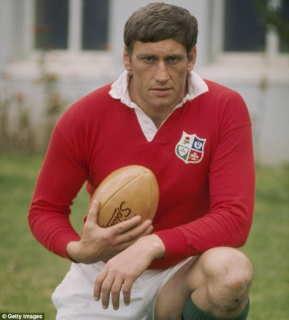
Owing to his father’s death when he is four years old, McBride spends most of his spare time helping out on his family farm. Because of this he does not start playing rugby until he is seventeen. He is educated at Ballymena Academy and plays for the school’s First XV. After he leaves he joins Ballymena R.F.C.
In 1962 McBride is selected to play for Ireland. His first Test on February 10, 1962 is against England at Twickenham Stadium. Later that year he is selected to tour South Africa with the British and Irish Lions.
McBride continues to play for Ireland throughout the 1960s and plays for Ireland when they first defeat South Africa in 1965, and when Ireland defeats Australia in Sydney, the first time a Home Nations team had defeated a major southern hemisphere team in their own country. He is again selected for the Lions in 1966, this time touring New Zealand and Australia. He tours South Africa with the Lions again in 1968.
McBride is selected to play for the Lions in their 1971 tour of New Zealand. Despite being criticized by some as being “over the hill,” he is made pack leader and helps the Lions to a test series win over New Zealand, their first and last series win over New Zealand. He receives an MBE in 1971 for services to rugby football.
McBride’s leadership qualities lead to his appointment as captain of the British and Irish Lions in their 1974 tour to South Africa. The test series is won 3–0, with one match drawn, the first Lions series ever won in South Africa. It is one of the most controversial and physical test match series ever played. At the time there are only substitutions if a doctor agrees that a player is physically unable to continue and there are no video cameras and sideline officials to keep the punching, kicking and head butting to a minimum. If the South Africans are to resort to foul play then the Lions decide “to get their retaliation in first.” The signal for this is to call “99,” which is a signal for the Lions to clobber their nearest rival players.
In 1975 as his international career is ending McBride plays his last game for Ireland at Lansdowne Road. The game is against France, and near the end of the match he scores his first test try for Ireland. It is the crowning moment of a great playing career. His last international game is against Wales on March 15, 1975. After retiring from playing the game, McBride coaches the Irish team and is manager of the 1983 Lions tour to New Zealand. Despite the test results being mainly poor, team camaraderie is high and some good wins are recorded in other games.
In 1997 McBride is an inaugural inductee into the International Rugby Hall of Fame. He has been asked to present test jerseys and give motivational speeches to Lions players prior to matches. In 2004 he is named in Rugby World magazine as “Rugby Personality of the Century.” He is a major supporter of the Wooden Spoon Society.
Basil Blackshaw, Northern Irish artist, dies at the age of 83 on May 2, 2016. He is best known for his paintings of dogs, horses, landscapes and people and is regarded as one of the country’s most talented artists.
Blackshaw’s home and studio is in County Antrim by Lough Neagh. He becomes well known for his country scenes including landscapes, farm buildings and horses, painted in an expressionist style.
Blackshaw is initially acclaimed for his mastery of traditional approaches to painting. He continues to develop as an artist, becoming most highly regarded for his very loose gestural application of paint and a very distinctive and subtle use of colour. His paintings of such sports as horse racing and boxing make him particularly popular, but he is also a talented portrait painter.
Blackshaw’s paintings are often figurative in form, but with a non-naturalistic palette which re-balances the composition in an expressionist, even abstract, way. His themes are very Irish and often rural; greyhounds, Irish Travellers, and the landscape. He also produces portraits and designs posters for Derry‘s Field Day Theatre Company.
The Arts Council of Northern Ireland organises a major retrospective of Blackshaw’s work in 1995, which travels from Belfast to Dublin, Cork and many galleries in the United States. In 2001 he receives the GlenDimplex Award for a Sustained Contribution to the Visual Arts in Ireland. The Ulster Museum holds a major exhibition of his work in 2002 and a major book is published by Eamonn Mallie on the artist in 2003.
For a 2005 exhibition at the Fenton Gallery in Cork, Blackshaw works exclusively over a period of 20 months creating a dramatic collection of fifteen new paintings. His choice of arguably mundane subjects, The Studio Door, Car, Wall, Six Trees, express both an engagement with tradition and a watchful detachment.
In 2006 Blackshaw’s work is exhibited at the Irish College in Paris (French: Centre Culturel Irlandais).
Blackshaw is elected as an associate of The Royal Ulster Academy of Arts in 1977 and elected an Academician in 1981. Dublin’s Royal Hibernian Academy describes him as “one of Ireland’s greatest artists” who was “lauded by the art world and his fellow painters.”
Basil Blackshaw dies on May 2, 2016. Father to well-known artist Anya Waterworth, he is buried in a wicker coffin in a humanist funeral, the ceremony ending to Bob Dylan‘s “Mr. Tambourine Man” at Roselawn Cemetery on the outskirts of Belfast. More than 100 mourners come to pay their respects. Among them are artists Jack Pakenham and Neil Shawcross, actor Stephen Rea and boxing legend Barry McGuigan.
Sankey is the fourth son of Eleanor and Matthew Sankey. His mother is herself from a family of military men, her father being Colonel Henry O’Hara, J.P of O’Hara Broom, County Antrim. His father is a barrister at Bawnmore, County Cork and Modeshil, County Tipperary. He does his schooling at Rev. Flynn’s School on Harcourt Street in Dublin and enters the East India Company’s Addiscombe Military Seminary at Addiscombe, Surrey in 1845. At Addiscombe he is awarded for his excellence at painting.
Sankey is commissioned as a second lieutenant in the Madras Engineer Group in November 1846 and is then trained in military engineering with the Royal Engineers at Chatham, Kent from January 1, 1847, holding temporary rank as an ensign in the British Army. He then arrives in India in November 1848. After two years of service at Mercatur, he officiates in 1850 as Superintending Engineer at Nagpur. During this time, he makes a small collection of fossils of Glossopteris from the Nagpur district and writes a paper on the geology of the region in 1854. The collection is moved from the Museum of Practical Geology to the British Museum in 1880.
In 1856, Sankey is promoted as the Superintendent of the East Coast Canal at Madras. In May 1857, he is promoted Under-Secretary of the Public Works Department under Col. William Erskine Baker in Calcutta. During the Indian Rebellion of 1857, he is commissioned as the Captain of the Calcutta Cavalry Volunteers but is soon despatched to Allahabad where he leads the construction of several embankments and bridges across the Yamuna and Ganges. He is involved in the construction of shelters to advancing troops along the Grand Trunk Road to aid the quelling of the Indian Rebellion of 1857. He arrives in course of this work at Cawnpore (now Kanpur) a day before the Second Battle of Cawnpore. He also is involved in crucial civil works that aid the quelling of the rebellion by bridging the Ghaghara and Gomti rivers at Gorakhpur and Phulpur that enable the Gurkha regiment to cross these rivers.
Sankey receives several commendations from his commanders here and later in the taking of the fort at Jumalpur, Khandua nalla and Qaisar Bagh, vital actions in the breaking of the Siege of Lucknow. For his actions at Jumalpur he is recommended for the Victoria Cross, although he does not receive this honour. He receives a medal for the Indian Rebellion of 1857 and is promoted to second captain on August 27, 1858, and given brevet promotion to major the following day for his services in the quelling of the rebellion. He is sent to the Nilgiris due to ill-health during this time.
Sankey spends a year in Burma as the executive engineer and Superintendent of the jail at Moulmein. On June 29, 1861, he is promoted to substantive captain and is posted as the Garrison Engineer at Fort William, Calcutta and later as the assistant to Chief Engineer, Mysore until 1864, when he is made the Chief Engineer. During this period, he creates a system within the irrigation department to deal with old Indian water catchment systems, surveying the catchment area and determining the area drained and the flows involved. Due to the reorganisation of the armed forces following the assumption of Crown rule in India he is transferred to the Royal Engineers on April 29, 1862.
In 1870, at the request of the Victorian Colonial Government in Australia, in view of his experience with hydrological studies in Mysore, Sankey is invited to be Chairman of the Board of Enquiry on Victorian Water Supply. During this visit, he also gives evidence to the Victorian Select Committee on Railways, as well as reports on the Yarra River Floods, and the Coliban Water Supply, and later contributes to the report on the North West Canal. While in Australia, he is also invited to the colony of South Australia to report on the water supply of Adelaide.
Sankey is appointed as an under-secretary to the Government of India in 1877, which earns him the Afghanistan Medal. In 1878, he is promoted as the Secretary in the public works department at Madras and is promoted substantive colonel on December 30. He is appointed Companion of the Order of the Bath on July 25, 1879, and also commands the Royal Engineers on the advance from Kandahar to Kabul during the Second Anglo-Afghan War. For about five years he is in Madras where he becomes a member of the legislative council in Madras and is elected as a Fellow of the University of Madras. He also helps in the creation and improvements of the Marina, the gardens and the Government House grounds. He is promoted major general on June 4, 1883, and retires from the army on January 11, 1884, with the honorary rank of lieutenant general. He also receives the distinguished service award in India.
After retirement, Sankey returns to Ireland, where he becomes the Chairman of the Board of Works. He is promoted Knight Commander of the Order of the Bath on May 25, 1892, for his work in Ireland. He also undertakes projects in Mexico. Later he settles in London where he dies at St. George’s Hospital on November 11, 1908, and is interred at Hove, East Sussex.
Sankey is memorialised in Phoenix Park, Dublin. A circle of trees bears the name Sankey’s Wood. A plaque dated 1894 lies half-hidden in the undergrowth there.
Simms is the owner of a paper mill in Ballyclare with his brother William Simms, one of twelve proprietors of the Northern Star. A close friend of Theobald Wolfe Tone, he is one of the founders of the Society of United Irishmen in Belfast in 1791 and the author of “Declaration and Resolutions of the Society of United Irishmen of Belfast.” He serves as the first Secretary of the Society, drafting many of its early letters, pamphlets and papers.
Following the French declaration of war on Britain in February 1793, the movement is outlawed and goes underground from 1794 as they become more determined to force a revolt against British rule. Simms, along with his brother William and Thomas Addis Emmet are arrested, but swiftly acquitted. The leadership is divided into those who wish to wait for French aid before rising and the more radical elements that wish to press ahead regardless. However, the suppression of a bloody preemptive rebellion, which breaks out in Leitrim in 1793, leads to the former faction prevailing and links are forged with the revolutionary French government with instructions to wait sent to all of the United Irish membership.
In 1795, along with Wolfe Tone, Samuel Neilson and Thomas Russell meet atop the summit of McArt’s Fort, overlooking Belfast, and, in Wolfe Tone’s words, “took a solemn obligation…never to desist in our efforts until we had subverted the authority of England over our country and asserted her independence.” The Simms brothers are again arrested in 1797 and held in Newgate Prison. From there he is transported along with Russell and Emmett to Fort George, Scotland. In his absence, the printing press and building housing the Northern Star is burned.
Upon his release, Simms is appointed as Commander of the United Army in Antrim. The appointment is met reluctantly however, as he feels his lack of military experience counts against him being an effective leader. In addition, many leaders are beginning to agitate for a rising without French aid. He is unwavering in his rejection of this idea. He resigns his position on June 1, 1798, after falling out with the leadership on this issue when most had changed their minds. He is replaced by Henry Joy McCracken who leads the Society in the Battle of Antrim. Simms is accused by many of cowardice and indecision for his refusal to launch an insurrection in Antrim.
Simms is nonetheless arrested and again imprisoned in Fort George with Emmet and William James MacNeven and is released in 1802. When Robert Emmet‘s failed coup is launched in 1803, the Simms brothers do not participate. He dies at the age of 82 in 1843.
Dobbs is born in County Antrim on November 19, 1871 to barrister Conway Edward Dobbs who is Justice of the Peace for County Antrim, High Sheriff for Carrickfergus in 1875 and High Sheriff for County Louth in 1882. Her mother is Sarah Mulholland, daughter of St. Clair Kelvin Mulholland of Eglantine, County Down. The family spends time living in Dublin where Dobbs is born. She attempts to learn Irish, however, when her father dies in 1898 her mother moves the family back to Glenariff.
Dobbs is interested in learning Irish and finds it easier to learn in County Donegal where it is still spoken. Her first teacher is Hugh Flaitile. She attends the Irish College at Cloughaneely in the Donegal Gaeltacht. She brings the idea of promoting the language to the Glens of Antrim and her circle of friends. She is one of the small number of Protestant women interested in the Gaelic revival.
The year 1904 sees the “Great Feis” in Antrim and Dobbs is a founder member of the Feis na nGleann committee and later a tireless literary secretary. In 1946, the Feis committee decides to honour her by presenting her with an illuminated address. It can be seen today at Portnagolan House with its stained glass windows commemorating a great Irishwoman. During her speech she says, “Ireland is a closed book to those who do not know her language. No one can know Ireland properly until one knows the language. Her treasures are hidden as a book unopened. Open the book and learn to love your language.”
Dobbs writes seven plays, published by Dundalgan Press in 1920, though only three are actually performed. The Doctor and Mrs. McAuley wins the Warden trophy for one-act plays at the Belfast festival in 1913. Her plays, however, are generally not a success and after 1920 she never writes another. She continues to work on historical and archaeological studies and her articles are published in the Ulster Journal of Archaeology, in a German magazine for Celtic studies, in the French Revue Celtique and in the Irish magazine Ériu.
Roger Casement is a good friend and although Dobbs never makes her political opinions known she contributes to his defence costs when he is accused of treason. Although her political views are not clearly known, Dobbs has been a member of the Gaelic League and in the executive of Cumann na mBan.
Dobbs dies at her home, Portnagolan House, Cushendall, on January 2, 1962.
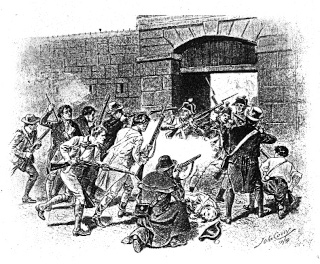
The Hearts of Steel, also known as the Steelboys, an exclusively Protestant movement originating in County Antrim due to grievances about the sharp rise of rent and evictions, is involved in conflict in Ulster on December 23, 1770. Five hundred members of the Hearts of Steel force the release a prisoner in Belfast.
The Hearts of Steel arise in 1769 in opposition to unjust and exorbitant rents, chiefly exacted by middlemen, speculators or “forestallers,” who take lands from absentee landlords at greatly increased rents and make their own profit by doubling the rents on the poor tenants.
In 1770 in Templepatrick, County Antrim, a local landlord evicts tenants and replaces them with speculators who can outbid the locals for the land. At some point a local is arrested and charged with maiming cattle belonging to a merchant from Belfast, which spurs the farmers of Templepatrick to take up arms and march on Belfast to demand his release. The protestors surround the barracks and threaten to burn the house of Waddell Cunningham, who is one of the new speculators in Templepatrick. The soldiers in the barracks fire upon the protestors killing several and wounding others. The protestors eventually set fire to Cunningham’s house and as the fire threatens to spread and destroy the town of Belfast itself, the mayor decides to free the prisoner.
Further consternation is caused by the sharp increase of rents throughout Ulster. At the same time the leases expire for Lord Donegall‘s south County Antrim estate. While he keeps his rent at the old prices, he greatly increases their renewal fee. These coincide with several years of severe harvest failures which result in high bread prices. The result of this is that people are unable to support themselves or their families, being left in the utmost state of deprivation and destitution, with many evicted from their land for failure to pay.
The Hearts of Steel protests and uprisings quickly spread throughout the county and into counties Armagh, Down, and Londonderry, which are also subject to the Hearts of Oak protest movement with which it merges. One tactic of the protestors is the “houghing” of cattle, which involves laming cattle by cutting the leg tendons. They also force farmers to sell food at prices they set, and demand anyone letting out land to do so at the cost of 12 shillings per acre. Landlords are threatened that if they try to collect the cess from anyone that their houses will be destroyed.
The disturbances are so widespread in the affected counties that the Irish government passes legislation to severely punish the “wicked and disorderly persons.” By the later half of 1772 they send the army into Ulster to crush them. Men are hanged while many others are said to have drowned trying to flee across the sea to Scotland. The Lord Lieutenant of Ireland, Lord Townshend, privately blames the landlords and their actions for the disturbances and so issues a general pardon in November 1772.
(Pictured: The Hearts of Steel storming the barracks at Belfast, December 1770 | Linen Hall Library)




 seamus dubhghaill