Burke receives his early education at a Quaker school in Ballitore, County Kildare. In 1744, he enters Trinity College, Dublin, a Protestant establishment, which up until 1793, did not permit Catholics to take degrees. He graduates from Trinity in 1748. Burke’s father wants him to read Law, and with this in mind he goes to London in 1750, where he enters the Middle Temple, before soon giving up legal study to travel in Continental Europe. After eschewing the Law, he pursues a livelihood through writing.
Burke criticizes British treatment of the American colonies, including through its taxation policies. He also supports the American Revolution, believing both that it could not affect British or European stability and would be an innovative experiment in political development since the Americas are so far away from Europe and thus could have little impact on England.
Burke is remembered for his support for Catholic emancipation, the impeachment of Warren Hastings from the East India Company, and for his later opposition to the French Revolution. In his Reflections on the Revolution in France, he claims that the revolution is destroying the fabric of good society and condemned the persecution of the Catholic Church that results from it. This leads to his becoming the leading figure within the conservative faction of the Whig Party, which he dubs the “Old Whigs,” as opposed to the pro–French Revolution “New Whigs” led by Charles James Fox.
For more than a year prior to his death, Burke realizes that his “stomach” is “irrecoverably ruind.” Edmund Burke dies in Beaconsfield, Buckinghamshire, on July 9, 1797, and is buried there alongside his son and brother. His wife, Mary Jane Nugent, survives him by nearly fifteen years.
In the nineteenth century Burke is praised by both conservatives and liberals. Subsequently, in the twentieth century, he becomes widely regarded as the philosophical founder of modern conservatism.
Brian Coffey, Irish poet and publisher, is born in Dún Laoghaire, County Dublin on June 8, 1905. His work is informed by his Catholicism and by his background in science and philosophy, and his connection to surrealism. For these reasons, he is seen as being closer to an intellectual European Catholic tradition than to mainstream Irish Catholic culture.
In the early 1930s, Coffey moves to Paris where he studies Physical Chemistry under Jean Baptiste Perrin, who won the Nobel Prize for Physics in 1926. He completes these studies in 1933, and his Three Poems is printed in Paris by Jeanette Monnier that same year. In 1934 he enters the Institut Catholique de Paris to work with the noted French philosopher Jacques Maritain, taking his licentiate examination in 1936. He then moves to London for a time and contributes reviews and a poem to T.S. Eliot‘s The Criterion magazine. He returns to Paris in 1937 as an exchange student to work on his doctoral thesis on the idea of order in the work of Thomas Aquinas. In 1938, Coffey’s second volume of poetry, Third Person, is published by George Reavey‘s Europa Press.
During the war, Coffey teaches in schools in London and Yorkshire, leaving his young family in Dublin. After the war, he returns to Paris and completes his doctoral thesis. The family then moves so that Coffey can take up a teaching post at the JesuitSaint Louis University.
By the early 1950s, Coffey becomes uncomfortable for a number of reasons, including the nature of his work, his distance from Ireland and the pressures that inevitably come to bear on an academic who has previously associated with well-known left-wing writers in Paris. For these reasons, he resigns in 1952.
In 1952, Coffey returns to live in London and, from 1973, Southampton. He begins again to publish his poetry and translations, mainly of French poetry. The first work in English to appear after this period of silence is Missouri Sequence, apparently begun in St. Louis but first appearing in the University Review, later known as the Irish University Review, in 1962.
Over the next decade or so, he publishes regularly in the University Review. He also sets up his own publishing enterprise, Advent Press, which publishes work by himself and by younger writers he wants to support.
Brian Coffey dies at the age of 89 on April 14, 1995, and is buried in Southampton, England.
Arkle, the greatest Irish steeplechaser of all time, dies at the early age of thirteen on May 31, 1970. A baygelding by Archive out of Bright Cherry, Arkle is the grandson of the unbeaten flat racehorse and prepotent sire Nearco.
At 212, his Timeform rating is the highest ever awarded to a steeplechaser. Only Flyingbolt, also trained by Dreaper, has a rating anywhere near his at 210. Next on their ratings are Sprinter Sacre on 192 and then Kauto Star and Mill House on 191. Despite his career being cut short by injury, Arkle wins three Cheltenham Gold Cups, the Blue Riband of steeplechasing, and a host of other top prizes.
In December 1966, Arkle races in the King George VI Chase at Kempton Park Racecourse but strikes the guard rail with a hoof when jumping the open ditch, which results in a fractured pedal bone. Despite this injury, he completes the race and finishes second. He is in plaster for four months and, though he makes a good enough recovery to go back into training, he never runs again. He is retired and ridden as a hack by his owner and then succumbs to what has been variously described as advanced arthritis or possibly brucellosis and is put down at the early age of thirteen.
Arkle becomes a national legend in Ireland. His strength is jokingly claimed to come from drinking Guinness twice a day. At one point, the slogan Arkle for President is written on a wall in Dublin. The horse is often referred to simply as “Himself,” and the story goes that he receives items of fan mail addressed to “Himself, Ireland.”
The government-owned Irish National Stud, at Tully, Kildare, County Kildare, has the skeleton of Arkle on display in its museum. A 1.1 scale bronze statue in his memory was erected in Ashbourne, County Meath on April 19, 2014.
After the failure of the authorities to produce a “book of evidence” against them, the four are released but are immediately re-arrested. During interrogation in Garda Síochána custody, all except Plunkett sign alleged confessions, presenting with extensive bruising and injuries they claim are inflicted by members of the Gardaí.
While awaiting trial, Fitzpatrick jumps bail and leaves the country. The trial of McNally, Kelly, and Breatnach in the Special Criminal Court becomes the longest-running trial in Irish criminal history, at 65 days, before it collapses due to the death of one of the three judges, Judge John O’Connor of the Circuit Court.
Medical evidence of beatings is presented to the court, both during the initial trial and the second trial. The court rejects this evidence, finding that the beatings have been self-inflicted or inflicted by the co-accused. Anticipating a conviction, Kelly flees before the conclusion of the second trial. The three are found guilty, solely on the basis of their confessions, and sentenced to between nine and twelve years in prison. Kelly is sentenced in absentia.
In May 1980, Breatnach and McNally are acquitted on appeal on the grounds that their statements had been taken under duress. The same month, the Provisional Irish Republican Army claims responsibility for the robbery. Kelly returns to Ireland from the United States in June 1980, expecting to be acquitted. Instead he is incarcerated in the maximum-security Portlaoise Prison and spends the next four years proclaiming his innocence, including a 38-day period on hunger strike.
After a campaign by the Irish Council for Civil Liberties, Amnesty International, and others and a song, Wicklow Boy, by the popular folk singer Christy Moore, Kelly is eventually released on “humanitarian grounds” in 1984. He is given a presidential pardon in 1992 and receives £1,000,000 in compensation. Breatnach and McNally are also given compensation.
Mayo is the eldest son of Robert Bourke, 5th Earl of Mayo, and his wife, Anne Charlotte, daughter of the Hon. John Jocelyn. His younger brother, the Hon. Robert Bourke, is also a successful politician. He is educated at Trinity College, Dublin.
After travelling in Russia, Mayo enters parliament for Kildare in 1847, a seat he holds until 1852, and then represents Coleraine from 1852 to 1857 and Cockermouth from 1857 to 1868. He is thrice appointed Chief Secretary for Ireland – in 1852, 1858, and 1866. In 1869 he becomes the fourth Viceroy of India where he is locally often referred to as “Lord Mayo.” He consolidates the frontiers of India and reorganises the country’s finances. He also does much to promote irrigation, railways, forests, and other useful public works. He establishes local boards to solve local problems. During his tenure, the first census takes place in 1872. The European-oriented Mayo College at Ajmer is founded by him for the education of young Indian chiefs, with £70,000 being subscribed by the chiefs themselves.
While visiting the convict settlement at Port Blair in the Andaman Islands in 1872 for the purpose of inspection, he is assassinated by Sher Ali Afridi, an AfridiPathan convict who uses a knife. His murderer appears to be motivated only by a sense of injustice at his own imprisonment and has resolved to kill a high-ranking colonial official. Mayo’s body is brought home to Ireland and buried at the medieval ruined church in Johnstown, County Kildare, near his home at Palmerstown House. Afridi is hanged.
In 1873, the newly discovered swallowtail butterflyPapilio mayo from the Andaman Islands is named in his honour. The traditional Irish marchLord Mayo (Tiagharna Mhaighe-eo) is named after him. According to tradition, it is composed by his harper David Murphy to appease Mayo after Murphy angered him.
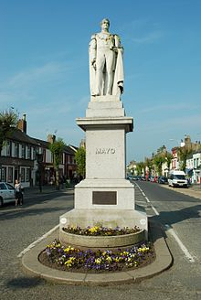
On August 19, 1875, a statue of Lord Mayo is unveiled in the town of Cockermouth in the centre of the main street. The 800-guinea cost of the statue is raised by public subscription. The statue, carved in Sicilian marble, depicts Lord Mayo in his viceregal garb, and still stands today.
In 2007, a statue of Lord Mayo is unearthed in Jaipur, India, after being buried for six decades. The statue had previously been installed in the premises of Mayo Hospital, currently known as the Mahilya Chikatsalya, Jaipur. The 9-foot-tall cast-iron statue, weighing around 3 tons, was ordered sculpted by the Maharaja Ram Singh ji of Jaipur, as a tribute to Lord Mayo after his assassination. To prevent it from vandalism, the statue is buried in the premises of the Albert Hall Museum of Jaipur at the time of the independence of India. After six decades, the statue is unearthed by the Jaipur Mayo Alumni Chapter on May 29, 2007, and sent to Mayo College, in Ajmer, India, where it is installed. Mayo College in Ajmer already has a full life-size statue of Lord Mayo sculpted in white marble installed in front of its famous Main Building since inception and a marble sculpted bust of him in its School Museum.
Joseph Mary Plunkett, Irish nationalist, poet, journalist, and a leader of the 1916 Easter Rising, is born at 26 Upper Fitzwilliam Street in Dublin on November 21, 1887.
Both his parents come from wealthy backgrounds, and his father, George Noble Plunkett, has been made a papal count. Despite being born into a life of privilege, young Joe Plunkett does not have an easy childhood.
Plunkett contracts tuberculosis at a young age. This is to be a lifelong burden. His mother is unwilling to believe his health is as bad as it is. He spends part of his youth in the warmer climates of the Mediterranean and North Africa. He spends time in Algiers where he studies Arabic literature and language and composes poetry in Arabic. He is educated at the Catholic University School and by the Jesuits at Belvedere College in Dublin and later at Stonyhurst College, in Lancashire, England, where he acquires some military knowledge from the Officers’ Training Corps. Throughout his life, Plunkett takes an active interest in Irish heritage and the Irish language and also studies Esperanto. He is one of the founders of the Irish Esperanto League. He joins the Gaelic League and begins studying with Thomas MacDonagh, with whom he forms a lifelong friendship. The two are both poets with an interest in theatre, and both are early members of the Irish Volunteers, joining their provisional committee. Plunkett’s interest in Irish nationalism spreads throughout his family, notably to his younger brothers George and John, as well as his father, who allows his property in Kimmage, south Dublin, to be used as a training camp for young men who wish to escape conscription in Britain during the First World War. Men there are instead trained to fight for Ireland.
Sometime in 1915 Plunkett joins the Irish Republican Brotherhood (IRB) and soon after is sent to Germany to meet with Roger Casement, who is negotiating with the German government on behalf of Ireland. Casement’s role as emissary is self-appointed, and, as he is not a member of the IRB, the organisation’s leadership wishes to have one of their own contact Germany to negotiate German aid for an uprising the following year. Plunkett is seeking, but not limiting himself to, a shipment of arms. Casement, on the other hand, spends most of his energies recruiting Irish prisoners of war in Germany to form a brigade to fight instead for Ireland. Some nationalists in Ireland see this as a fruitless endeavour, and prefer to seek weapons. Plunkett successfully gets a promise of a German arms shipment to coincide with the rising.
Plunkett is one of the original members of the IRB Military Committee that is responsible for planning the Easter Rising, and it is largely his plan that is followed. Shortly before the rising is to begin, Plunkett is hospitalised following a turn for the worse in his health. He has an operation on his neck glands days before Easter and has to struggle out of bed to take part in what is to follow. Still bandaged, he takes his place in the General Post Office with several other of the rising’s leaders, including Patrick Pearse and Tom Clarke, though his health prevents him from being terribly active. His energetic aide-de-camp is Michael Collins.
Following the surrender Plunkett is held in Kilmainham Gaol, and faces a court-martial. Seven hours before his execution by firing squad at the age of 28, he is married in the prison chapel to his sweetheart Grace Gifford, a Protestant convert to Catholicism, whose sister, Muriel, had years before also converted and married his best friend Thomas MacDonagh, who is also executed for his role in the Easter Rising. Plunkett is executed by firing squad on May 4, 1916, and is the fourth and youngest signatory of the Proclamation of the Irish Republic to be executed.
The main railway station in Waterford City is named after Plunkett as is Joseph Plunkett Tower in Ballymun. Plunkett barracks in the Curragh Camp, County Kildare is also named after him.
His last game for Ireland is against Australia in October 1968, when he lines out alongside his brother Tommy. He coaches Leinster to Interprovincial Championship success five times between 1979 and 1983 before he succeeds Willie John McBride as Ireland coach during the 1984–85 season. Under In 1985, under Doyle’s stewardship, Ireland wins the Triple Crown and Five Nations Championship.
Doyle leads Ireland to the inaugural 1987 Rugby World Cup, but that joy is tinged with sadness as he suffers a heart attack at the opening dinner. He battles illness and adversity and his recovery from a brain problem is chronicled in his book 0.16.
In later years, apart from working in his veterinary practice, Doyle is a regular contributor to rugby matters on RTÉ Radio One.
Mick Doyle is killed in an automobile accident in Dungannon, County Tyrone, on May 11, 2004.
An Aer LingusBoeing 747, named the St. Patrick, brings Pope John Paul II from Rome to Dublin Airport. The Pope kisses the ground as he disembarks. After being greeted by the President of Ireland, Dr. Patrick Hillery, the Pope flies by helicopter to the Phoenix Park where he celebrates Mass for 1,250,000 people, one quarter of the population of the island of Ireland, one third of the population of the Republic of Ireland. Afterwards he travels to Killineer, near Drogheda, where he leads a Liturgy of the Word for 300,000 people, many from Northern Ireland. There the Pope appeals to the men of violence, “on my knees I beg you to turn away from the path of violence and return to the ways of peace.” The Pope has hopes of visiting Armagh, but the security situation in Northern Ireland renders it impossible. Drogheda is selected as an alternative venue as it is situated in the Catholic Archdiocese of Armagh. Returning to Dublin that evening, the Pope is greeted by 750,000 people as he travels in an open top popemobile through the city centre and visits Aras an Uachtarain, the residence of the Irish President.
The Pope begins the second day of his tour with a short visit to the ancient monastery at Clonmacnois in County Offaly. With 20,000 in attendance, he speaks of how the ruins are “still charged with a great mission.” Later that morning he celebrates a Youth Mass for 300,000 at Ballybrit Racecourse in Galway. It is here that the Pope utters perhaps the most memorable line of his visit, “Young people of Ireland, I love you.” That afternoon, he travels by helicopter to Knock Shrine in County Mayo which he describes as “the goal of my journey to Ireland.” The outdoor Mass at the shrine is attended by 450,000. The Pope meets with the sick and elevates the church to the title of Basilica.
The final day of the visit begins with a trip to St. Patrick’s College, Maynooth, the National Seminary, in County Kildare. Some 80,000 people pack the grounds of the college for the brief visit. A dense fog delays the Pope’s arrival from Dublin by helicopter. The final Mass of the Pope’s visit to Ireland is celebrated at Greenpark Racecourse in Limerick before 400,000 people, many more than had been expected. The Mass is offered for the people of Munster. Pope John Paul leaves Ireland from nearby Shannon Airport travelling to Boston where we begins a six-day tour of the United States.
Arthur Guinness is born into the ProtestantGuinness family, part of the Anglo-Irish aristrocracy. They claim to descend from the Gaelic Magennis clan of County Down. However, recent DNA evidence suggests descent from the McCartans, another County Down clan, whose spiritual home lay in the townland of “Guiness” near Ballynahinch, County Down.
Guinness’s place and date of birth are the subject of speculation. His gravestone in Oughter Ard, County Kildare, reads that he dies on January 23, 1803, at the age of 78, and that he is born some time in 1724 or very early in 1725. This contradicts the date of September 28, 1725, chosen by the Guinness company in 1991, apparently to end speculation about his birthdate. The place of birth is perhaps his mother’s home at Read homestead at Ardclough, County Kildare.
In 2009 it is claimed that Guinness is born in nearby Celbridge where his parents live in 1725 and where his father later becomes land steward for the Archbishop of Cashel, Dr. Arthur Price. In his will, Dr. Price leaves £100 each to “his servant” Arthur and his father in 1752.
Guinness leases a brewery in Leixlip in 1755, brewing ale. Guinness also purchases a long lease of an adjacent site from George Bryan of Philadelphia in 1756 that is developed as investment property. He leaves his younger brother in charge of the Leixlip enterprise in 1759 and moves on to another at St. James’ Gate, Dublin. He signs a 9,000-year lease for the brewery, effective from December 31, 1759. The lease is presently displayed in the floor at St. James’ Gate. By 1767 he is the master of the Dublin Corporation of Brewers. His first actual sales of porter are listed on tax data from 1778. From the 1780s his second son, Arthur, works at his side and becomes the senior partner in the brewery in 1803.
Guinness’ major achievement is the expansion of his brewery in 1797–1799. Thereafter he brews only porter and employs members of the Purser family who have brewed porter in London from the 1770s. The Pursers become partners in the brewery for most of the 19th century. By the time of his death in 1803, the annual brewery output is over 20,000 barrels. Subsequently Arthur and/or his beer is nicknamed “Uncle Arthur” in Dublin. Guinness’ florid signature is still copied on every label of bottled Guinness.
From 1764, Guinness and his wife Olivia, whom he marries in 1761, live at Beaumont House, which Guinness has built on a 51-acre farm which is now a part of Beaumont Convalescent Home, behind the main part of Beaumont Hospital, between Santry and Raheny in north County Dublin. His landlord is Charles Gardiner. Beaumont, meaning beautiful hill, is named by Arthur and the later Beaumont parish copies the name. From March 1798 he lives at Mountjoy Square in Dublin, which is then in the process of being built in the style of elegant Georgian architecture. Three of his sons are also brewers, and his other descendants eventually include missionaries, politicians, and authors.
Sir Arthur Guinness dies in Mountjoy Square, Dublin, on January 23, 1803, and is buried in his mother’s family plot at Oughter Ard, County Kildare.
John Devoy, one of the most devoted revolutionaries the world has ever seen, is born in Kill, County Kildare, on September 3, 1842. Dedicating over 60 years of his life to the cause of Irish freedom, he is one of the few people to have played a leading role in the Fenian Rising of 1867, the 1916 Easter Rising, and the Irish War of Independence (1919 – 1921).
After the Great Famine, the family moves to Dublin where Devoy’s father obtains at job at Watkins’ brewery. Devoy attends night school at the Catholic University before joining the Fenians. In 1861 he travels to France with an introduction from Timothy Daniel Sullivan to John Mitchel. Devoy joins the French Foreign Legion and serves in Algeria for a year before returning to Ireland to become a Fenian organiser in Naas, County Kildare.
In 1865, when many Fenians are arrested, James Stephens, founder of the Irish Republican Brotherhood (IRB), appoints Devoy Chief Organiser of Fenians in the British Army in Ireland. His duty is to enlist Irish soldiers in the British Army into the IRB. In November 1865 Devoy orchestrates Stephens’ escape from Richmond Prison in Dublin.
In February 1866 an IRB Council of War calls for an immediate uprising but Stephens refuses, much to Devoy’s annoyance, as he calculated the Fenian force in the British Army to number 80,000. The British get wind of the plan through informers and move the regiments abroad, replacing them with regiments from Britain. Devoy is arrested in February 1866 and interned in Mountjoy Gaol, then tried for treason and sentenced to fifteen years penal servitude. In Portland Prison Devoy organises prison strikes and, as a result, is moved to Millbank Prison in Pimlico, London.
In January 1871, he is released and exiled to the United States as one of the “Cuba Five.” He receives an address of welcome from the House of Representatives. Devoy becomes a journalist for the New York Herald and is active in Clan na Gael. Under Devoy’s leadership, Clan na Gael becomes the central Irish republican organisation in the United States. In 1877 he aligns the organisation with the Irish Republican Brotherhood in Ireland.
Devoy’s fundraising efforts and work to sway Irish Americans to physical force nationalism makes possible the Easter Rising in 1916. In 1914, Patrick Pearse visits the elderly Devoy in America, and later the same year Roger Casement works with Devoy in raising money for guns to arm the Irish Volunteers. Though he is skeptical of the endeavor, he finances and supports Casement’s expedition to Germany to enlist German aid in the struggle to free Ireland from English rule. Also, before and during World War I, Devoy is also identified closely with the Ghadar Party, and is accepted to have played a major role in supporting Indian Nationalists, as well as playing a key role in the Hindu-German Conspiracy which leads to the trial that is the longest and most expensive trial in the United States at the time.
In 1916 Devoy plays an important role in the formation of the Clan-dominated Friends of Irish Freedom, a propaganda organization whose membership totals 275,000 at one point. The Friends fail in their efforts to defeat Woodrow Wilson for the presidency in 1916. Fearful of accusations of disloyalty for their cooperation with Germans and opposition to the United States’ entering the war on the side of Great Britain, the Friends significantly lower their profile after April 1917. Sinn Féin‘s election victories and the British government’s intentions to conscript in Ireland in April 1917 help to revitalize the Friends.
With the end of the war, Devoy plays a key role in the Friends’ advocacy for not the United States’ recognition of the Irish Republic but, in keeping with President Wilson’s war aims, self-determination for Ireland. The latter does not guarantee recognition of the Republic as declared in 1916 and reaffirmed in popular election in 1918. American Irish republicans challenge the Friends’ refusal to campaign for American recognition of the Irish Republic. Not surprisingly, Devoy and the Friends’ Daniel F. Cohalan become the key players in a trans-Atlantic dispute with de facto Irish president Éamon de Valera, touring the United States in 1919 and 1920 in hopes of gaining U.S. recognition of the Republic and American funds. Believing that the Americans should follow Irish policy, de Valera forms the American Association for the Recognition of the Irish Republic in 1920 with help from the Philadelphia Clan na Gael.
Devoy returns to Ireland and in 1919 addresses Dáil Éireann. He later supports the Anglo-Irish Treaty of 1921. Devoy is editor of The Gaelic American from 1903 until his death in Atlantic City on September 29, 1928. His body is returned to Ireland and buried in Glasnevin Cemetery. A large memorial to him stands on the road between his native Kill and Johnstown.




 seamus dubhghaill