The battle consists of ten days of fighting in the countryside around Kilmallock in County Limerick, in which the National Army of the Irish Free State, advancing south from Limerick city, find their path blocked by anti-Treaty IRA troops, dug into a number of villages at Bruff, Bruree and Patrickswell. The fighting end with the retreat of the anti-Treaty fighters and the occupation of Kilmallock by Free State forces.
The prelude to the battle is the fall of Limerick city to Free State forces. The Republican forces in the city under Liam Deasy withdraw from their positions after a week of fighting and concentrate in Kilmallock and the nearby towns of Bruff and Bruree. The Free State forces, advancing south from the city, find their path blocked by the Republicans dug in at the three hilltop towns.
The National Army’s attempt to break through this position produces the only “line battle” of the war with the two sides facing each other along clear front-lines. The Kilmallock-Bruff-Bruree triangle sees some of the war’s most intense fighting.
Whereas in the fighting in Dublin, Limerick and Waterford, Free State troops equipped with artillery overcome Anti-Treaty resistance relatively easily, at Kilmallock they have a much harder time. The main reason for this is that the Free State troops, most of whom are new recruits, are facing some of the best of the IRA forces without an advantage in numbers or firepower. General Eoin O’Duffy complains of shortage of arms and ammunition. He estimates that while his forces have about 1,300 rifles, the Republicans could muster over 2,000. He is also critical of the quality of the troops at his disposal, whom he describes as, “a disgruntled, undisciplined and cowardly crowd.”
The Republicans know this and are confident of success. Nevertheless, the Republican commanders have their own issues with logistical support and lack of co-operation between forces from different counties. Deasy’s command includes Volunteers from counties Limerick itself, Cork and Kerry, all of whom have their own commanders. They have three improvised armoured cars, some mortars and heavy machine guns but no artillery.
O’Duffy draws up plans for the advance on Kilmallock with the assistance of his second-in-command Major GeneralW. R. E. Murphy who had been a lieutenant colonel in World War I. His experience in the trenches has a major effect on his approach – pre-disposing him to cautious advances and use of trenches for cover.
The Republican forces have the better of the first clashes. On Sunday, July 23, Free State forces take Bruff and begin their advance on Kilmallock, but are twice beaten back by determined Republican resistance. The following day, the Republicans manage to retake Bruff in a counter-attack, taking 76 prisoners. As a result of this setback, O’Duffy calls off the advance for the time being and waits for reinforcements.
National Army forces quickly retake Bruff after reinforcements arrive. However, things get worse for the National Army as the week goes on. They make slow progress in taking the Republican strongpoints, and their casualties also mount. On Tuesday, July 25, a unit of the Dublin Guard under Tom Flood is ambushed on a narrow road. They fight their way clear, but only after losing four men. Three more Free State soldiers are killed two days later. On July 30, Major General Murphy launches an attack to take Bruree. The Dublin Guards attack the town from the southeast, supported by armoured cars and an 18-pound field gun. The Republicans hold out for five hours until Free State artillery is brought into action. At least 13 Free State soldiers and nine Anti-Treaty fighters are killed in the action and more are wounded before the Free State troops secure Bruree.
The Republican commander, Deasy, knows how important Bruree is to the defence of Kilmallock and draws up plans to recapture the town using three armoured cars, trench mortars and machine guns. On August 2, Republicans capture Patrickswell south of Limerick. The armoured cars then attack Bruree, taking Free State forces by surprise. One car attacks Commandant Flood’s headquarters at the Railway Hotel. The Commandant and his men manage to escape out the back of the building under the cover of Lewis gun fire. The second armoured car rams the front door of another post in the school house, which persuades the twenty-five troops inside to surrender.
However, when Free State reinforcements, along with armoured cars arrive, the Republican counter-attack stalls. The Free State reinforcements are led by Commandant General Seamus Hogan, who personally leads his forces, riding in the armoured car nicknamed “The Customs House.” Having failed to secure the surrender of the town, Republican forces retreat.
Having held Bruree against a Republican counterattack, Free State forces prepare to capture Kilmallock itself, but anticipate there will be heavy fighting. Republican Adjutant General Con Moloney comments on August 2, “Up to yesterday we have had the best of the operations there [the Kilmallock area]. There will, I fear, be a big change there now as the enemy have been reinforced very considerably.” In the 3rd Western Division area they have all but disbanded, unwilling to fight Free Staters, destroy roads, and now discouraged by the Catholic church.
On Thursday, August 3, a force of 2,000 Free State troops, backed up by armoured cars and artillery, advance on Kilmallock from Bruree, Dromin and Bulgaden. Seven hundred troops arrive the next day with an armoured car and a field gun. By Saturday, the town is surrounded by Free State forces. The Dublin Guard are also on hand to prevent Republican forces from escaping. Three miles away, Free State artillery is deployed and shells Republican forces on Kilmallock Hill and Quarry Hill. The two hills are soon controlled by Free State forces.
The National Army has, therefore, assembled sufficient force to smother resistance at Kilmallock. They are still, however, expecting hard fighting before they take the town. To their surprise, when the Free State troops enter the town, they encounter only light resistance from a Republican rearguard (volunteers from Cork). Most of the Republican troops have already abandoned their positions and retreated to Charleville.
They departed not because the Free State troops are stronger, but because they have been outflanked by Free State seaborne landings on the coasts of County Kerry and County Cork on August 2 and 8 respectively. The landings in Cork and Kerry force Commandant General Deasy to release units from this area to return home to their own areas. Although the landings in Cork occur after the retreat from Kilmallock, the subsequent loss of brigades from Cork adds to Commandant General Deasy’s problems. The final phase of the fighting in County Limerick comes when the Free State advance south is held up at Newcastle West. Another day of heavy fighting ensues in which the National Army troops have to bring up armoured cars and artillery to dislodge the Republicans, who reportedly lose up to 12 men before they retreat in the direction of Cork.
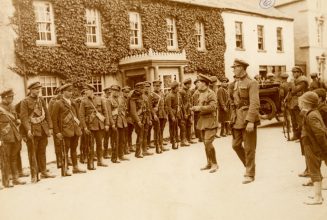
(Pictured: National Army troops lined up for a roll call during the Irish Civil War with local children casting an eye over the proceedings)
Lynch is called to the bar in 1949, and becomes a senior counsel in 1970. His practice is centered on the Midland circuit.
Lynch becomes a judge of the High Court in 1984. In December 1984, he is appointed the sole member of the tribunal into the Kerry Babies case. He is among three judges who sit in a divisional High Court which hears an unsuccessful challenge by Des Hanafin to result of the 1995 divorce referendum. He hears the High Court hearing of Bula Ltd v Tara Mines Ltd (No 6) in 1996 which runs for 277 days.
Lynch is appointed to the Supreme Court of Ireland in April 1996. He is delayed from first sitting on the court as the Bula case has not yet completed. He retires in December 1999.
Lynch is married to Bernadette, with whom he has five children. He dies at the age of 85 on October 31, 2013, in a nursing home near Croom, County Limerick.
The eldest of the three sons and one daughter of Daniel Sheehan, tenant farmer, and his wife, Ellen (née Fitzgerald). He is educated at the local primary school. In his book Ireland since Parnell (1921) he states that witnessing the ragged poverty of labourers’ and smallholders’ children who attended the school made him determined to do something for the poor. The family’s Fenian tradition and his parents’ eviction from their holding in 1880 form his early years. At the age of sixteen he becomes a schoolteacher.
In 1890, Sheehan takes up journalism, serving as correspondent of the Kerry Sentinel and special correspondent of the Cork Daily Herald in Killarney. He also becomes correspondence secretary to the Kanturk trade and labour council, which campaigns on behalf of agricultural labourers. He manages to get reports of meetings into the Cork papers, and this helps the rapid spread of the association, which in 1890 becomes the Irish Democratic Trade and Labour Federation, under the leadership of Michael Davitt. It is, however, fatally disrupted by the Parnell split. While Sheehan continues to admire Davitt, and despite the pre-split Irish party leadership having opposed the federation as a threat to Charles Stewart Parnell‘s leadership, he becomes a Parnellite, and always remembers his only meeting with Parnell at Tralee, when the chief is presented with a loyal address (drafted by Sheehan) from his Killarney supporters. After Parnell’s death and the defeat of the Second Home Rule Bill, he temporarily drops out of Irish politics.
Following his marriage on February 6, 1894, to Mary Pauline O’Connor of Tralee, Sheehan joins the staff of the Glasgow Observer in pursuit of journalistic experience, then becomes editor of the Catholic News in Preston, Lancashire. In 1898, he returns to Ireland and works on various papers, including the Cork Constitution, before serving as editor of the Skibbereen-based Cork County Southern Star (1899–1901), where his Parnellism brings him into conflict with the Bishop of Ross, Denis Kelly. He expresses sympathy for the newly founded United Irish League (UIL), established by William O’Brien in Connacht with the dual aim of representing western smallholders and using a new land agitation as a vehicle for Irish Party reunion. He does not, however, join the UIL himself.
In August 1894, the Clonmel solicitor J. J. O’Shee, anti-Parnellite MP for West Waterford from 1895, forms the Irish Land and Labour Association (ILLA) to agitate on behalf of agricultural labourers and small tenant farmers. Its appearance reflects the breakdown of the centralised party discipline which had existed before the Parnell split, and recognition that the land war’s prime beneficiaries had been large and middle-sized tenant farmers rather than the nation as a whole. On returning from Britain in 1898, Sheehan throws himself into organising the ILLA and becomes its president. In 1900 there are 100 branches, mostly in Cork, Tipperary, and Limerick. The Irish Party leadership look on this organisation with some suspicion.
At the 1900 United Kingdom general election in Ireland Sheehan seeks the Irish Parliamentary Party (IPP) nomination for South Cork but was defeated by Edward Barry. After the death of Dr Charles Tanner, however, he succeeds in obtaining the IPP nomination for the constituency of Mid Cork, despite the party leadership’s attempts to deny recognition to ILLA branches in order to hand the nomination to its favoured candidate. Sheehan is elected unopposed on May 17, 1901. At the age of 28, he is the youngest Irish member of parliament. Although he has been admitted to the party, his position as a labour representative and his perceived independent base make him something of an outsider.
From October 1904 Sheehan allies himself with O’Brien, writing regularly for the latter’s weekly a TheIrish People. Redmondites accuse him of opportunism, but he always maintains that his personal inclination as an old Parnellite has been towards John Redmond and that his support for O’Brien derives from the older man’s willingness from 1904 to identify himself with the labourers’ campaign. Although their alliance originally likely contains elements of expediency, Sheehan and O’Brien develop a deep personal friendship.
Sheehan’s support for O’Brien leads to a split in the ILLA in 1906, with Tipperary and Waterford branches following O’Shee and Redmond, and Sheehan retaining the support of his Cork base and of some branches in Limerick and Kerry. He serves on the Cork advisory committee which represents tenant interests in land purchase negotiations under the Wyndham Land Act. It’s policy of “conference plus business” combines an offer to negotiate with willing landlords and a threat of agitation against those unwilling to give satisfactory terms. His faction of the ILLA becomes the basis for the grassroots organisation of O’Brien’s followers, and sporadic attempts, financed by O’Brien, are made to spread it outside its Munster base. Both factions of the ILLA claim credit for the passage of the 1906 and 1911 Labourers’ (Ireland) Acts which provide for the allocation of cottages and smallholdings to labourers. In Cork and some other parts of Munster these buildings become popularly known as “Sheehan’s cottages,” a term which long outlives Sheehan’s political career. He also helps to bring about the creation of a “model village” at Tower, near Blarney, the result of cooperation between the local ILLA branch and the rural district council.
At the 1906 general election the Redmond leadership attempts to avoid an open split by allowing O’Brien’s supporters to return unopposed. However, the continuing conflict between the two factions rapidly leads to a formal break. Shortly after the election Sheehan is excluded from the IPP, and thereby deprived of the parliamentary stipend paid to MPs with insufficient resources to maintain themselves. With the support of O’Brien and the small group of O’Brienite MPs, he maintains that the party has no right to exclude an elected MP willing to take the party pledge. After resigning his seat to which he was re-elected without opposition on December 31, 1906, he demands readmission to the party and mounts an unsuccessful lawsuit demanding payment of the stipend. He is subsequently supported from the proceeds of collections outside church gates on Sundays.
Sheehan and the other O’Brienite MPs are readmitted to the party in 1908 as part of an attempt at general reconciliation after the disruptions following the rejection of the Irish Council Bill. Dissensions rapidly reappear over Augustine Birrell‘s 1909 land act, which the O’Brienites see as wriggling out of the financial responsibilities accepted by the British government in the Wyndham land act and as sabotaging land purchase, since landlords will not accept the terms offered. Sheehan’s section of the ILLA is denied official recognition and thereby prevented from sending delegates to a party convention called to consider the bill. At the convention, groups of “heavies”recruited from Joseph Devlin‘s Ancient Order of Hibernians (AOH) exclude delegates with Cork accents, while O’Brienite speakers are howled down. This leads to the formation in March 1909 of the All-for-Ireland League (AFIL), a body based on the existing O’Brienite organisation and advocating O’Brien’s policy of gradually implementing home rule through step-by-step cooperation with moderate unionist supporters of devolution. Although O’Brien’s temporary retirement for health reasons in April 1909 leads to the suspension of the AFIL, it is revived in response to an attempted purge of the O’Brienite MPs by the leadership and by O’Brien’s reappearance in response to the January 1910 general election. Sheehan writes regularly for its paper, the Cork Free Press.
In the general election the O’Brienites hold their seats while two Cork Redmondites are displaced. Sheehan is re-elected for Mid Cork, defeating the Redmondite W. G. Fallon in a campaign marked by widespread rioting and impassioned clerical denunciations of Sheehan. Fallon subsequently attempts to get up a “red scare” against the ILLA. The Cork ILLA later splits over Sheehan’s slightly erratic leadership. While the split is initially personality-driven, the breakaway faction, led by Patrick Bradley and centred in east Cork, moves back toward alignment with Redmond. At the December 1910 election the AFIL consolidates its position in Cork, but is defeated everywhere else. Sheehan retains his Mid Cork seat against a local candidate but is defeated in a simultaneous contest in East Limerick. He is also defeated when he stands for Cork County Council in June 1911, though the AFIL wins control of that body.
Sheehan studies law at University College Cork (UCC) (1908–09), where he is an exhibitioner and prizeman, and at King’s Inns, where he graduated with honours. He is called to the bar in 1911 and practised on the Munster circuit. In 1913–14 he is active in the AFIL’s attempts to avert partition by trying to recruit sections of British political opinion in favour of a conference between the parties. He becomes vice-chairman of the Imperial Federation League. This receives considerable attention among the British political classes but contributes to the decline of the AFIL’s electoral base. The policy of conciliation has been driven to a considerable extent by the belief that it is the only way of achieving home rule. The abolition of the House of Lords’ veto and the introduction of the third home rule bill by the Asquith government undercuts this argument and increases Redmond’s prestige, while AFIL denunciations of Redmondism are seen as driven by personal resentment and playing into the hands of unionists. The decision of the AFIL MPs to abstain from supporting the bill on its final passage through the House of Commons in 1914 as a protest against the prospect of a partition-based compromise is represented by Redmondites as a vote against home rule itself and contributed to AFIL loss of Cork County Council in June 1914.
On the outbreak of World War I, Sheehan supports O’Brien in calling for Irish enlistment for foreign service. In November 1914, at the age of forty-two, he enlists himself and is gazetted as a lieutenant in the Royal Munster Fusiliers. It is claimed that he is almost single-handedly responsible for raising the 9th (service) battalion of this regiment. Three of his sons also enlist. Two of his sons are killed in action with the Royal Flying Corps, and a daughter is disabled by injuries received in an air raid while serving as a nurse. In the spring and summer of 1915 he organises and leads recruiting campaigns in Cork, Limerick, and Clare. This is part of a nationwide drive for recruits, aimed in particular at the farming community, which reflects the realisation that the war is going to last much longer than expected.
In 1915, Sheehan is promoted to the rank of captain and serves with his battalion on the Loos-en-Gohellesalient and at the Battle of the Somme, contributing a series of articles from the trenches to the London Daily Express. Various ailments, including deafness caused by shellfire, and hospitalisation necessitate his transfer to the 3rd Royal Munster Fusiliers (Reserve) Battalion, and he resigns his commission on January 13, 1918, due to ill health. In April 1918 he speaks at Westminster against the bill extending conscription to Ireland, threatening to resist it by force. One of his last parliamentary speeches (in October 1918) is in support of a bill providing land grants for Irish ex-servicemen. With the growth of Sinn Féin and the virtual demise of the AFIL, his position in Cork grows increasingly untenable. The Sheehan family faces intimidation and are obliged to leave their home on the Victoria Road for London, where he has secured the Labour Party nomination for the Limehouse–Stepney division of the East End, later represented by Clement Attlee.
Sheehan is unsuccessful in the 1918 United Kingdom general election, and is obliged to leave politics after a financially disastrous involvement in an Achill Island mining company leads to his bankruptcy. Unable to practise at the bar because of the hearing loss caused by his war service, he returns to journalism and becomes editor and publisher of TheStadium, a daily newspaper for sportsmen. In 1921, shortly before the Anglo-Irish truce, he publishes Ireland since Parnell, a history of recent events heavily dependent on the writings of O’Brien but incorporating some personal reminiscences. It concludes by blaming the outbreak of the IRA guerrilla campaign on provocation by Crown forces, denouncing reprisals, and pleading for British recognition of Dáil Éireann and dominion home rule for an undivided Ireland.
Sheehan moves to Dublin in 1926 after hearing that the threats against him have been lifted. His wife, who has never fully recovered from the stresses and bereavements she has experienced since 1914, dies soon afterward. Sheehan himself becomes managing editor of Irish Press and Publicity Services and, in 1928, publisher and editor of the South Dublin Chronicle. The paper gives critical support to the Irish Labour Party, publishes campaigning articles on slum conditions, and advocates housing reform. In September 1930, he is an unsuccessful Labour candidate for Dublin County Council. In the 1930s, as his health deteriorates further, he works as coordinator for the ex-servicemen’s group the Old Comrades’ Association, editing both northern and southern editions of its annual journal. In 1942, he offers himself to Richard Mulcahy as a Fine Gael candidate for Cork South-East, but is turned down. He dies on November 28, 1948, while visiting his daughter at Queen Anne Street, London. Both he and his wife are buried in Glasnevin Cemetery.
(From: “Sheehan, Daniel Desmond (‘D. D.’)” by Patrick Maume, Dictionary of Irish Biography, http://www.dib.ie, October 2009)
The son of a local school teacher, Noonan is raised in Loughill, County Limerick. He is educated at the local National School and St. Patrick’s Secondary School in Glin, before studying to be a primary school teacher at St. Patrick’s College, Drumcondra, Dublin. He subsequently completes a BA and H.Dip. in English and Economics at University College Dublin (UCD). He begins to work as a secondary school teacher in Dublin. He develops an interest in politics from his mother, whose family had been heavily involved in Fine Gael at the local level in Limerick, and joins the Dublin branch of the party after graduating from university.
Having been involved in the local Fine Gael organisation in Limerick since the late 1960s, Noonan first holds political office in 1974, when he is elected as a member of Limerick County Council. Having built up a local profile he contests the 1981 Irish general election for the party and secures a seat in Limerick East. Upon taking his Dáil seat, he becomes a full-time politician, giving up his teaching post and resigning his seat on Limerick County Council. Though Fine Gael forms a coalition government with the Labour Party, as a first time Teachta Dála (TD), he remains on the backbenches. He serves as a TD from 1981 to 2020.
Noonan marries Florence Knightley, a native of Castlemaine, County Kerry and a primary school teacher, in 1969. They have three sons (Tim, John and Michael) and two daughters (Orla and Deirdre). In May 2010, Noonan appears on RTÉ‘s The Frontline to talk about his wife’s battle with Alzheimer’s disease. Florence Noonan dies on February 23, 2012 of pneumonia.
O’Grady is the son of Admiral Hayes O’Grady and his wife, Susan Finucane. His father is one of the chiefs of the Cinél Donnghaile, the collective name of the O’Gradys. He is a nephew of Standish O’Grady, 1st Viscount Guillamore, and a cousin of the novelist Standish James O’Grady, with whom he is sometimes confused. As a child he is fostered in Coonagh, County Limerick, an Irish-speaking area. There he learns Irish and comes into contact with the Gaelic manuscript tradition, listening to stories read aloud from manuscripts in farmers’ houses during wakes or while carding wool. He maintains this interest in the literary tradition throughout his life.
O’Grady receives his secondary education in Rugby School in Rugby, Warwickshire, England, his name appearing in the school register for August 1846. Subsequently he attends Trinity College Dublin (TCD) from 1850 to 1854 but does not graduate. He is critical of an education system that makes no mention of Irish history and legend. During his student days he becomes a friend of the leading scholars and antiquarians, John O’Donovan, George Petrie and Eugene O’Curry, as well as the bookseller and publisher, John O’Daly. At this time he begins copying Gaelic manuscripts under their direction. He purchases from O’Daly in 1853 a collection in Irish of “tales and other pieces, in prose and verse” which he presents to the British Museum in 1892. He is a founding member of the Ossianic Society in 1853 and becomes its president in 1856. O’Curry attacks him publicly in a review in TheTablet, questioning his ability as a scholar. The publication of the society’s third volume prompts the review.
In 1857 O’Grady moves to the United States where he remains for thirty years. In 1901 he contributes an essay on Anglo-Irish Aristocracy to a collection entitled Ideals in Ireland edited by Augusta, Lady Gregory.
O’Grady is a bachelor all his life and dies on October 16, 1915, in his home in Ballinruan, Hale, Cheshire, England. He is buried in Altrincham cemetery.
Butler succeeds to the title at the age of fifteen and was educated at the University of Oxford, taking the degree of LL.D. in 1677. In 1678, he is commissioned as a captain in Colonel Thomas Dongan‘s regiment, which is disbanded before he takes up his post.
In 1692, Butler is created Earl of Newcastle in County Limerick in the Jacobite peerage of Ireland. In France he is named Colonel of the 2nd Queen’s Regiment of Irish Horse in the service of that country and serves with distinction in various battles of the War of the Spanish Succession, also becoming a Lieutenant-General in the Spanish army. He is at the Siege of Roses in 1693, and in 1694 is a Brigadier attached to the army of Germany. He serves in Italy and other parts of Continental Europe from 1701 to 1703, sharing all the fortunes of the Irish Brigade. He later serves in the French army as a Lieutenant-General. He is created Brigadier of Cavalry in 1694.
Butler dies at the age of eighty-eight in Paris on June 18, 1740, and is buried at St. Paul’s there. John C. O’Callaghan writes in Irish Brigades in the Service of France (Glasgow, 1870): “The successive claimants of the title of Galmoy were officers in France down to the Revolution; in whose armies, as well as in others, various gentlemen have honourably represented a name, of which the illustrious General Lafayette is related to have said, in the war for the independence of the United States of America, that ‘whenever he wanted anything well done, he got a Butler to do it.'”
Notwithstanding the attainder, the viscountcy is assumed by his nephew, James Butler of the Irish Brigade in France, the son of the Viscount’s brother, Richard Butler of Galmoye.
William Richard English-Murphy, DSOMC, Irish soldier and policeman known as W. R. E. Murphy, dies on March 5, 1975, in Ardee, County Louth. He serves as an officer with the British Army in World War I and later in the National Army. In the Irish Civil War, he is second in overall command of the National Army from January to May 1923. He is first Irish Commissioner of the Dublin Metropolitan Police (DMP) and the last Commissioner of the force before its merger with the Garda Síochána in 1925. Thereafter he is the Deputy Commissioner of the Gardaí until his retirement in 1955.
Murphy is born in Danecastle, Bannow, County Wexford, on January 26, 1890. His parents die when he is four years old. His grandparents also die during his childhood. He and his sister Mae (Mary Sarah) are separately raised by relatives in Belfast and Waterford. He is completing his master’s degree at Queens University Belfast (QUB) when he follows the call of John Redmond to join the war effort and ensure Irish independence. Ulster regiments reject him because he is Catholic. Seeking a regiment that treats Irish volunteers with respect, he joins the British Army in Belfast in 1915 as an officer cadet in the South Staffordshire Regiment.
Murphy serves in the Battle of Loos in 1915 and is wounded but returns to action for the start of the Battle of the Somme in July 1916. He becomes commanding officer of the 1st Battalion, the South Staffordshire Regiment in August 1918, reaching the rank of temporary lieutenant colonel. In 1918, his regiment is posted to the Italian Front, at the Piave River, where they are when the armistice is declared on November 4, 1918. He is granted the rank of substantive lieutenant colonel on the retired list on May 16, 1922.
After he returns to Ireland, Murphy resumes his career as a teacher. At some point, he joins the Irish Republican Army (IRA), an organisation fighting to end British rule in Ireland.
In December 1921, the Anglo-Irish Treaty is signed between British and Irish leaders, resulting in the setting up of the Irish Free State. Conflict over the Treaty among Irish nationalists ultimately leads to the outbreak of the Irish Civil War in June 1922. Murphy enlists as a general in the new National Army of the Irish Free State. After the start of the Irish Civil War, he is put in command of troops charged with taking posts held by the anti-Treaty IRA in Limerick.
At the Battle of Kilmallock in July–August 1922, Murphy is second in command to Eoin O’Duffy. His troops successfully dislodge the anti-Treaty IRA from positions around Kilmallock in County Limerick, but he is criticised for his tendency to “dig in” and resort to trench warfare rather than rapid offensive action.
Afterward, Murphy is put in overall command of Free State forces in County Kerry until January 1923. He lobbies Richard Mulcahy, commander in chief, for 250 extra troops, to bring his command up to 1,500 and help to put down the guerrilla resistance there. In the early stages of the guerrilla war, he organises large-scale “sweeps” to break up the republican concentrations in west Cork and east Kerry. These meet with little success, however. He exercises overall command in the county, but day-to-day operations are largely run by Brigadier Paddy Daly, of the Dublin Guard.
In October, in response to continuing guerrilla attacks on his troops, Murphy orders a nightly curfew to be put into place in Tralee.
In December, Murphy writes to Mulcahy that the “Irregular [Anti-Treaty] organisation here is well-nigh broken up,” and suggests the end of the war in the county is in sight. His optimistic prediction, however, proves premature.
On December 20, Murphy sentences four captured republican fighters to death under the fictitious “Public Safety Act” for possession of arms and ammunition. However, the sentences are to be called off if local guerrilla activity ceases. Humphrey Murphy, the local IRA Brigade commander, threatens to shoot eight named government supporters in reprisal if the men are executed. Eventually, their sentence is commuted to penal servitude.
In January 1923, Murphy is promoted from his command in Kerry to “responsibility for operations and organisation at the national level” in the army. Paddy Daly takes over as commanding officer in Kerry. Murphy later voices the opinion that Daly had been a bad choice, given his implication in the Ballyseedy massacre and other events of March 1923, in which up to 30 anti-Treaty prisoners were killed in the county.
Murphy leaves the National Army after the end of the Irish Civil War in May 1923 and becomes the first Irish commissioner of the Dublin Metropolitan Police. He later becomes deputy commissioner of the Garda Síochána, when DMP is merged with the new national police force in 1925. He holds this post until his retirement in 1955.
Murphy is at the forefront of efforts to close down Dublin’s red-light district, the Monto, in the early 1920s. Between 1923 and 1925, religious missions led by Frank Duff of the Legion of Mary, a Roman Catholic organisation, and Fr. R.S. Devane work to close down the brothels. They receive the cooperation of Murphy in his role as Dublin Police Commissioner, and the campaign ends with 120 arrests and the closure of the brothels following a police raid on March 12, 1925.
Murphy lives with his daughter, Joan McMahon, in Ardee, County Louth, after his wife, Mary Agnes Fortune, dies on July 31, 1958. He dies on March 5, 1975, and is buried in St. Peter’s Churchyard, Bray, County Wicklow.
(Pictured: Major-General W. R. E. Murphy, as depicted on a Wills’ Irish Sportsmen cigarette card, from their boxing series)
Bracken is the third child and second of three sons of Joseph Kevin (J. K.) Bracken and Hannah Bracken (née Ryan). The family moves to Kilmallock, County Limerick, in 1903, the year before his father’s death. By 1908, his mother takes the family to live in Glasnevin, a new suburb in north Dublin, and subsequently off the North Circular Road. He is educated in St. Patrick’s National School, Drumcondra, and at the Christian Brothers‘ O’Connell School in North Richmond Street. He is a mischievous, delinquent child, one time throwing a schoolfellow into the Royal Canal. In February 1915 he is sent to Mungret College, a Jesuit boarding school near Limerick. He is not amenable to the regime and runs away on several occasions, finding accommodation in local hotels under a false name.
At the end of 1915 Bracken goes to Australia with £14 in his pocket. He is first based in Echuca, Victoria, where he is put up in a convent. Later he moves to other houses run by religious orders. A voracious reader, he claims that he is doing research for a life of CardinalPatrick Francis Moran, and signs himself “Brendan Newman Bracken.” He seeks admission as a pupil to Riverview, the fashionable Jesuit school in Sydney, claiming that he had been educated at Clongowes Wood College. Unfortunately for him, a priest who had just come out from Clongowes exposes him. Opinionated and argumentative, he does not conceal his skepticism about the Catholic religion. For a time, he teaches in a Protestant school in Orange, New South Wales.
Bracken returns to Ireland in 1919. By this time his mother has remarried and is living with her new husband, Patrick Laffan, on a farm in Beauparc, County Meath. After a short stay there, he moves to Liverpool and finds employment as a teacher at the Liverpool Collegiate School, claiming that he had been to the University of Sydney. He teaches at the school for two terms in 1920, earning extra money as tutor to a young boy. With his savings he is able to gain admission to Sedbergh School, a public school in the town of Sedbergh in Cumbria, North West England, giving his name as Brendan Rendall Bracken, born 1904, and stating that his parents had perished in a bush fire in Australia, leaving him money to complete his education. He remains only one term but distinguishes himself by winning a prize for history. After Sedbergh, Bracken teaches at Rottingdean preparatory school and then at Bishops Stortford School. He cuts a flamboyant figure and drops the name of famous acquaintances with gay abandon. He stands over 6 feet and has a powerful presence and a domineering personality; his mop of red hair and pale freckled skin combine with black teeth to give him a bizarre appearance.
In 1922 Bracken moves to London. He takes charge of the Illustrated Review when its editor, Hilaire Belloc, resigns. Renamed English Life and covering political and social events, it affords Bracken an opportunity to meet prominent people, including J. L. Garvin, editor of The Observer. In autumn 1923 Garvin introduces him to Winston Churchill, who had lost his parliamentary seat in 1922 and decided to contact Leicester West in the 1923 United Kingdom general election. Bracken offers his services as campaign manager. The friendship between Churchill and Bracken is soon so close that Bracken is rumoured to be Churchill’s natural son. Churchill’s wife Clementine dislikes Bracken and discourages the friendship.
Meanwhile Bracken enjoys the life of a ubiquitous socialite and builds up his career in publishing. He becomes a director of Eyre & Spottiswoode in 1926, starting The Banker, a monthly magazine, for them, and acquiring the Financial News in 1928 and a half-share in The Economist. To these are added in due course the Investors Chronicle and The Practitioner. His success in business enables him to acquire a home in North Street in 1928, near the Houses of Parliament. He is driven about in a chauffeured Hispano-Suiza car.
In 1929, Bracken has himself adopted as conservative candidate for Paddington North, a marginal seat. After a hard-fought campaign characterised by minor violence provoked by Bracken’s intemperate language, he wins the seat by 528 votes. At one point a rumour is put about that Bracken is in reality a Polish Jew, which he has to disprove by exhibiting a copy of his birth certificate. His background is a subject of speculation among acquaintances, and in throwaway remarks he gives different fictitious versions of it, Ireland figuring in none of them. He does however remain in constant touch with his mother, to whom he seems to have been deeply devoted, until her death in 1928. However, he has as little contact as possible with his brother and sisters, although he does give assistance to some of them and their families at various times.
In parliament Bracken voices right-wing views on economic issues and is an enthusiastic imperialist. After Churchill resigns from the conservative front bench in 1930 because they would not oppose the Labour government’s proposal for Indian self-government, he is supported by Bracken. During the 1930s, when Churchill is in the wilderness, disagreeing with the party leadership on India and on what he sees as a policy of appeasement toward Hitler‘s Germany, Bracken is his sole political ally. Stanley Baldwin calls him Churchill’s “faithful chela.”
In September 1939, Churchill joins Neville Chamberlain‘s war cabinet as First Lord of the Admiralty. Bracken is appointed his parliamentary private secretary, continuing in that role when Churchill becomes Prime Minister. Despite the king’s opposition, Churchill insists in June 1940 that Bracken should be appointed a privy councillor. Bracken shuts up his house and moves to the Prime Minister’s residence for the duration of the war. As a confidant of the Prime Minister, he often acts as a go-between with other politicians and newspapermen. He is allowed to oversee patronage and takes a special interest in ecclesiastical appointments. In July 1941, he is persuaded by Lord Beaverbrook and Churchill to become Minister for Information. He wins over most of the proprietors by giving them more news, often on a confidential basis, and censorship is kept to a minimum. The BBC is also allowed a fair measure of freedom as long as it behaves responsibly; under the leadership of Cyril Radcliffe, the civil service head of the ministry, it operates more smoothly. Bracken was generally acclaimed for that success.
After the resignation of the Labour ministers from the government at the end of the war in Europe, Bracken joins the cabinet as First Lord of the Admiralty. He is prominent in the general election campaign that follows and is the only conservative minister apart from Churchill to give more than one radio broadcast. He is accused, probably unjustly, of provoking Churchill to take extreme positions, and blamed when the conservatives are heavily defeated at the polls. Bracken himself loses Paddington North to Lt. Gen. Sir Noel Mason-MacFarlane. However, he is soon back in parliament representing Bournemouth, and as front-bench spokesman is an uncompromising opponent of the nationalisation measures of the Labour government (1945–51). He is out of sympathy with the leftward drift of the conservative party associated with Rab Butler and Harold Macmillan.
In December 1951, when Churchill is again Prime Minister, Bracken declines an invitation to serve as Colonial Secretary, pleading that his recurring sinusitis makes it impossible. He resigns his seat in the House of Commons and is created a peer, Viscount Bracken of Christchurch in Hampshire, but never takes his seat in the House of Lords. Although he retires from politics, he remains close to political events through his friendship with Churchill. He is deeply involved in concealing the severe stroke that Churchill suffers in 1953, so that he can carry on as Prime Minister.
In the postwar period, Bracken has important business interests. The Financial News group acquires the Financial Times in 1945, and he is returned as chairman of the expanded company. He writes a weekly Financial Times column until 1954. He oversees the building near St. Paul’s of a new head office, named “Bracken House” after his death. He is also chairman of the Union Corporation mining house, with interests in South Africa, which he frequently visits. From 1950 he is chairman of the board of governors of Sedbergh School, where he goes frequently and often walks for miles across the fells. He organises and finances the restoration of the eighteenth-century school building as a library, with a commemoratory inscription, “Remember Winston Churchill.”
From 1955 Bracken is a trustee of the National Gallery. He is an unrelenting opponent of the proposal to return to Ireland the impressionist paintings bequeathed to it by Hugh Lane, because a codicil willing them to Dublin has not been witnessed. Throughout the postwar period he carries on a prolific correspondence with friends such as Lord Beaverbrook, the American ambassador Lewis Douglas, and the Australian entrepreneur W. S. Robinson. These are a valuable and entertaining source on the political history of the time.
In January 1958, Bracken, who has always been a heavy smoker, is diagnosed with throat cancer. He lingers on until August 8, 1958, when he dies at the flat of his friend Sir Patrick Hennessy in Park Lane. He resists efforts made to reconcile him to the church of Rome. By his own wish he is cremated, and his ashes are scattered on Romney Marsh, Kent. On his instructions his papers are burned by his chauffeur. His estate comes to £145,032.
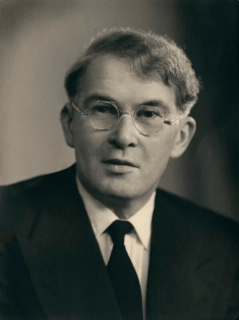
(From: “Bracken, Brendan” by Charles Lysaght, Dictionary of Irish Biography, www. dib.ie, October 2009 | Pictured: Brendan Bracken, bromide print by Elliott & Fry, January 13, 1950, National Portrait Gallery, London)
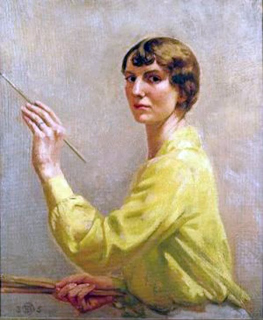
Brigid GanlyHRHA, Irish painter and sculptor, is born Rosaleen Brigid O’Brien on January 29, 1909, in Dublin.
Ganly is one of five children born to Dermod O’Brien and his wife Mabel Smiley. Her father is a painter. His grandfather is the Irish republicanWilliam Smith O’Brien. She grows up in Country Limerick at a farm in Cahirmoyle until the family moves to Fitzwilliam Square in Dublin. She goes on to attend the Metropolitan School of Art where she has the opportunity to study under Patrick Tuohy, Seán Keating and Oliver Sheppard. She is a talented sculptor and wins several awards, including the Taylor scholarship in 1929, for her allegorical male nude, Pity. She spends time in Paris in 1951 where she trains with André Lhote. She travels to Greece where Lhote continues to influence her work.
Ganly also studies painting in the Royal Hibernian Academy School where she has Margaret Clarke and Seán O’Sullivan as teachers. She is made an associate of the Royal Hibernian Academy in 1928 and becomes a member in 1935, though in 1969 she resigns her membership in protest at the lack of young artists being given the opportunity to exhibit. In 1972 she is made an honorary member and returns.
Ganly is a representational artist and while known as a portrait artist, she also paints landscapes, interiors and may be best known for her still lifes. Some of her best works are portraits of her husband, her sister Ethel, her father, and her friend Sheila Pim. She illustrates the book-jackets of Pym’s works. She has many exhibitions, with the RHA and the Water Colour Society of Ireland. There is a retrospective of her life in 1998 in the Hugh Lane Gallery and her works are in the collections there. She is also in the collections of the Waterford Municipal Gallery, Crawford Art Gallery, Cork and in The National Self-Portrait Collection of Ireland. She is part of the 2014 exhibition “Irish Women Artists: 1870-1970.”
Ganly’s sister-in-law is Kitty Wilmer O’Brien with whom she often exhibits. She marries Andrew Ganly, a dental surgeon and writer, in 1936. He dies in 1982. They have two children, Eoghan and Phillida.
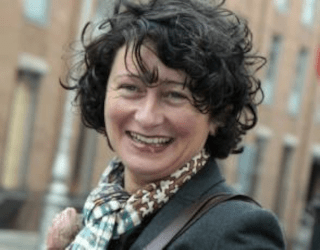
O’Malley comes from a political family. Her father, Desmond O’Malley, is a former Fianna Fáil cabinet minister and founder of the Progressive Democrats. Her granduncle, Donogh O’Malley, is a Fianna Fáil minister in the 1960s. She is also a cousin of another former Progressive Democrats TD, Tim O’Malley.
O’Malley is a member of the Oireachtas Committee on Arts, Sports and Tourism and the Oireachtas Committee on Health and Children. She is also a member of the Dáil All-Party group concerned with matters of sexual and reproductive health. She has traveled to South America and South Africa with the United Nations Population Fund and has spoken extensively of the need for a clear safe sex message both in Ireland and in the developing world.
O’Malley loses her Dáil seat at the 2007 Irish general election, but is nominated by the Taoiseach, Bertie Ahern, to the Seanad in August 2007. She is narrowly defeated in the race to become the leader of the Progressive Democrats by Ciarán Cannon.
O’Malley is an independent politician from the dissolution of the Progressive Democrats in 2009. She is an independent candidate at the 2011 Seanad election for the Dublin University constituency but is not elected.