Cruise O’Brien follows his cousin Owen into Sandford Park School, which has a predominantly Protestant ethos despite objections from Catholic clergy. He subsequently attends Trinity College Dublin (TCD) before joining the Irish diplomatic corps.
Although he is a fierce advocate of his homeland, Cruise O’Brien is a strong critic of Irish Republican Army (IRA) violence and of what he considers the romanticized desire for reunification with Northern Ireland. His collection of essays Maria Cross: Imaginative Patterns in a Group of Modern Catholic Writers (1952; written under the pseudonym Donat O’Donnell) impresses UN Secretary-GeneralDag Hammarskjöld, who in 1961 appoints him UN special representative in the Congo, later the Democratic Republic of the Congo. He orders UN peacekeeping forces into the breakaway Katanga province, and the resulting scandal forces him out of office. Despite UN objections, he writes To Katanga and Back (1963) to explain his actions.
After serving as vice-chancellor of the University of Ghana (1962–65) and Albert Schweitzer Professor of Humanities at New York University (1965–69), Cruise O’Brien enters Irish politics. He holds a Labour Party seat in Dáil Éireann from 1969 to 1977 and then in the Senate from 1977 to 1979, representing Trinity College, of which he is pro-chancellor (1973–2008).
In 1979, Cruise O’Brien is named editor in chief of the British Sunday newspaper The Observer, but he leaves after three tumultuous years. He remains an active newspaper columnist, especially for the Irish Independent until 2007. His books include States of Ireland (1972) and On the Eve of the Millennium (1995), as well as perceptive studies of Charles Stewart Parnell, Edmund Burke, and Thomas Jefferson.
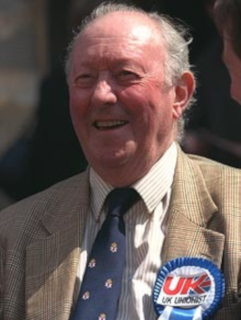
In early July 1996, in the period of Cruise O’Brien’s involvement as a UK Unionist Party (UKUP) representative in talks at Stormont, he suffers a mild stroke. He recovers well, but is left with anxiety about his recall of names. His last public appearance is on September 7, 2006, to deliver an address on the ninetieth anniversary of the death of Tom Kettle, in the old House of Lords chamber of the Bank of Ireland on College Green.
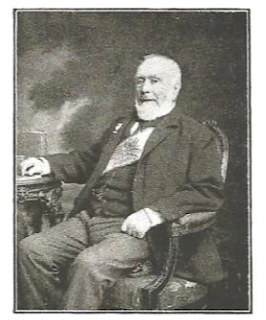
He marries firstly Mary Halloran of Cloyne, County Cork, in 1845. She dies in 1901. In the year of his retirement, he remarries Florence Henrietta Gore, widow of Edward Croker. He has no children. James Joyce remarks in Ulysses that his second marriage at the age of 85 infuriates his nephew, who had been waiting patiently for years to inherit his money.
Despite his many years of service on the Bench, Chatterton does not seem to be highly regarded as a judge. On his retirement the Bar pays tribute to his good qualities but adds several qualifications: “there might have been on the Bench lawyers more profound, reasoners more acute…” In his first decade on the Bench, Chatterton has to endure the continual denigration of Jonathan Christian, the Lord Justice of Appeal in Chancery. Christian is notoriously bitter-tongued, and while he despises most of his colleagues, he seems to have a particular dislike of Chatterton. He regularly votes on appeal to overturn his judgments, and frequently adds personal insults. Nor does he confine his attacks to the courtroom: there is controversy in 1870 when remarks of Christian that Chatterton is “lazy, stupid, conceited and so incompetent that he ought to be pensioned off” find their way into The Irish Times. The hint about pensioning off Chatterton is not taken up, no doubt because he enjoys the confidence of the Lord Chancellor of Ireland, Thomas O’Hagan, 1st Baron O’Hagan, who is also on bad terms with Christian. In an appeal from Chatterton in 1873, the two appeal judges clash publicly, with O’Hagan reprimanding Christian for insulting a judge who is not there to defend himself.
Chatterton becomes involved in controversy in 1885, over the first attempt to rename Sackville Street to O’Connell Street. Dublin Corporation votes for the name change, but it arouses considerable objections from local residents, one of whom seeks an injunction. Chatterton grants the injunction on the ground that the corporation has exceeded its statutory powers. Rather unwisely, he also attacks the merits of the decision, accusing the Corporation of “sentimental notions.” The corporation is angered by both the decision and the criticisms: while it may have been a coincidence, the fact that Temple Street is briefly renamed Chatterton Street is interpreted by some as an insult to the judge, since the street is much frequented by prostitutes. The controversy is short-lived as the corporation is granted the necessary statutory powers in 1890, and the new name becomes official in 1924, by which time it has gained popular acceptance.
In 2004, Bacik’s book Kicking and Screaming: Dragging Ireland into the 21st Century, is published by The O’Brien Press.
In 2007, she contested the Seanad Éireann elections for the third time in the Dublin University constituency, and is elected to the third seat, behind sitting Independent senators Shane Ross and David Norris. She initially sits as an Independent senator.
In February 2009, Bacik is included in an ‘All Star Women’s Cabinet’ in the Irish Independent. In March 2009, she confirmed claims made on a TV programme that she had taken two voluntary pay cuts of 10% in addition to a pension levy. In June 2009, she is the Labour Party candidate for the Dublin Central by-election. She comes in third with 17% of the first preference votes. She joins the Labour Party group in the Seanad in September 2009, and becomes Labour Party Seanad spokesperson for both Justice and Arts, Sports and Tourism. In November 2009, a feature by Mary Kenny of the Irish Independent includes Bacik in a list of women who “well deserved their iconic status.”
In May 2010, Bacik seeks Labour’s nomination to contest the next election in the Dublin South-East constituency but is not selected. In December 2010, she is added to the ticket as the second candidate beside Labour Party leader, Eamon Gilmore, in the Dún Laoghaire constituency for the 2011 Irish general election. Gilmore tops the poll, with Bacik receiving 10.1% of first preference votes but she is not elected. She is re-elected to Seanad Éireann at the subsequent election, after which she becomes Deputy Leader of the Seanad. She holds her seat in the Seanad in 2016 and in 2020.
On April 27, 2021, after the resignation of Eoghan Murphy from his Dáil seat in Dublin Bay South, Bacik announces her intention to stand in the upcoming by-election. She campaigns with an emphasis on providing affordable housing, as well as improving healthcare and childcare, tackling climate change, and achieving “a true republic in which church and state are separated.” During the campaign, she describes herself as having “more bills passed into law than any other Senator, on issues such as workers’ conditions, women’s health rights, and LGBT equality”. She also campaigns on increasing the number of sports amenities for children in the area, calling for unused Defence Forces football fields at the Cathal Brugha Barracks to be freed up for local sports, with the suggestion rejected by Fine GaelMinister for DefenceSimon Coveney. Fine Gael complains to RTÉ after she features prominently on National Treasures, a prime-time TV show broadcast by RTÉ during the campaign. RTÉ has strict rules about fair coverage of candidates during campaigns. The national broadcaster blames an “inadvertent error” for the programme being shown three days before the election. A steering group within the broadcaster tells Fine Gael that “the broadcast should not have happened.” Consequentially, RTÉ has to show a special report on the by-election on Prime Time to “ensure fair coverage is given to all candidates.”
Bacik wins this election, receiving 8,131 (30.2%) first-preference votes. It is her fourth attempt as a Labour candidate, and she expresses her delight at the success at the count centre in the RDS. Following the election, she is described by The Irish Times as “a formidable activist and public intellectual” and that Fine Gael’s perceived antipathy towards their former TD, Kate O’Connell, may have contributed to the surge in support to Bacik from women voters. The newspaper claims that her election is “a long overdue morale boost” for Labour.
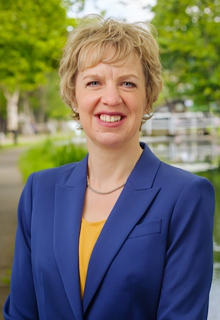
In March 2022, Bacik confirms she will run to succeed Alan Kelly as Labour Party leader. Kelly states that he believes that Bacik will succeed him. On March 24, 2022, she is confirmed as Labour Party leader unopposed at a party conference in Dublin. In a speech, she says she will focus on the rising cost of living and the serious and global problems facing the country. She pledges that Labour will fight the next election as a “standalone party” rather than joining any left-wing alliance.
Thrift was born in Halifax, West Yorkshire, England, on February 28, 1870, one of at least two sons and two daughters of Henry George Thrift, civil servant, and Sarah Anne Thrift (née Smith). The family moves in his childhood to Dublin, where his father is an officer in the Inland Revenue.
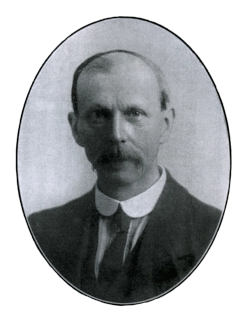
He is educated at The High School, Dublin, and enters Trinity College Dublin in 1889 with a second sizarship in mathematics, and commences a highly distinguished university career, scoring firsts in several examinations and winning numerous prizes. Elected fellow in mathematics and experimental science, and in mental and moral philosophy in 1896, he becomes Erasmus Smith’s Professor of Natural and Experimental Philosophy at TCD from 1901 to 1929. He is awarded a Doctor of Science (DSc) in 1936. He is appointed Provost of Trinity College Dublin in 1937, serving until his death in 1942.
While rarely speaking on controversial issues, Thrift opposes the 1925 legislation banning divorce, which he describes as an infringement of individual and minority rights, and a betrayal of commitments made by Arthur Griffith during the Anglo-Irish Treaty debates. His capable service on various Dáil committees is recognised by his election as Leas-Ceann Comhairle (deputy speaker). A long-serving council member of the Royal Dublin Society (RDS) (1902–42), he is a commissioner of charitable donations and bequests, and financial adviser to the General Synod of the Church of Ireland. He sits on the governing boards of the Erasmus Smith schools and of the Incorporated Society for Promoting Protestant Schools in Ireland.
Thrift’s portrait is painted by Leo Whelan. He marries Etta Robinson, a daughter of C. H. Robinson, a medical doctor, and they have three sons and three daughters. He dies at the provost’s house, Trinity College Dublin, on April 23, 1942. He is buried at Mount Jerome Cemetery, Harold’s Cross, County Dublin.
O’Malley comes from a political family. Her father, Desmond O’Malley, is a former Fianna Fáil cabinet minister and founder of the Progressive Democrats. Her granduncle, Donogh O’Malley, is a Fianna Fáil minister in the 1960s. She is also a cousin of another former Progressive Democrats TD, Tim O’Malley.
O’Malley is a member of the Oireachtas Committee on Arts, Sports and Tourism and the Oireachtas Committee on Health and Children. She is also a member of the Dáil All-Party group concerned with matters of sexual and reproductive health. She has traveled to South America and South Africa with the United Nations Population Fund and has spoken extensively of the need for a clear safe sex message both in Ireland and in the developing world.
O’Malley loses her Dáil seat at the 2007 Irish general election, but is nominated by the Taoiseach, Bertie Ahern, to the Seanad in August 2007. She is narrowly defeated in the race to become the leader of the Progressive Democrats by Ciarán Cannon.
O’Malley is an independent politician from the dissolution of the Progressive Democrats in 2009. She is an independent candidate at the 2011 Seanad election for the Dublin University constituency but is not elected.
Ware is born on November 16, 1594, in Castle Street, Dublin, eldest surviving son among ten children of Sir James Ware, auditor general, and his wife Mary Bryden, sister of Sir Ambrose Briden of Maidstone, Kent, England, whose house provides Ware’s base in England. His father, a Yorkshireman, comes to Ireland in the train of Lord Deputy of Ireland Sir William FitzWilliam in 1588 and builds up a substantial landed estate. He enters Trinity College Dublin (TCD), where his father is the college auditor, as a fellow commoner in 1605 and is presented a silver standing bowl in 1609. His association with the college continues, as he particularly remembers the philosophy lectures of Anthony Martin, who becomes a fellow in 1611. He takes his MA on January 8, 1628, but by then he has already launched on his future course. His father procures him the reversion of his office in 1613, and by 1620 he already owns the Annals of Ulster and is taking notes from the Black Book of Christ Church. In 1621, he marries Elizabeth Newman, daughter of Jacob Newman, one of the six clerks in chancery. Newman becomes clerk of the rolls in 1629, which apparently facilitates Ware’s assiduous research in the Irish public records.
From Ware’s numerous surviving notebooks, it is possible to follow his scholarly tracks over the rest of his life. He is particularly concerned to trace the succession of the Irish bishops. The first fruits appear in print in 1626, Archiepiscoporum Cassiliensium et Tuamensium . . . adjicitur historia coenobiorum Cisterciensium Hiberniae, followed in 1628 by De presulibus Lageniae . . ., the whole to be rounded off in 1665 with De presulibus Hiberniae. . . . However, he has wide interests in Irish history and in 1633 edits Edmund Spenser‘s A View of the Present State of Irelande and the Irish histories of Edmund Campion, Meredith Hanmer, and Henry of Marlborough. The first Irish biographical dictionary follows in 1639, De scriptoribus Hiberniae. Both publications are dedicated to the viceroy, Thomas Wentworth. In public life he is a supporter, first of Wentworth, later of James Butler, 1st Duke of Ormond, rather than a leader, and always a stout royalist. He is knighted in 1630 and following his father’s death in 1632 he succeeds as auditor general. He is elected member of parliament for Dublin University in 1634, 1640, and 1661, but is not admitted to the Privy Council of Ireland until 1640.
Shortly after the outbreak of rebellion in October 1641, Ware is in England, and in London at the time of the passing of the Adventurers’ Act 1640, presumably on the council’s business. During Ormond’s prolonged negotiations with the confederates, he is sent to advise the king at Oxford in November 1645. While there he works in the Bodleian Library and is incorporated into the university as a Doctor of Civil Law. On his way back to Ireland in January 1646, he is captured at sea by a parliament ship and held prisoner in the Tower of London until October 1646.
When Ormond is arranging the surrender of Dublin to the parliament in the summer of 1647, Ware is sent to London as one of the hostages for his performance of the terms. Back in Dublin he has been replaced as auditor general but is able to carry on his work on the public records. In 1648 he publishes the catalogue of his manuscript library. As a leading royalist he is unwelcome to those governing the city for the parliament and is sent into exile in France on April 7, 1649, with his eldest son, also James, who already holds the reversion of the auditor generalship and eventually succeeds his father. He is allowed to live in London from October 1650, and from 1653, when hostilities end in Ireland, he is allowed brief visits there, perhaps taking up residence again in 1658.
Ware’s years in London are spent in the library of Archbishop of ArmaghJames Ussher, then in Lincoln’s Inn, and in the Royal, Cotton, Carew, and Dodsworth libraries. He publishes his De Hibernia et antiquitatibus ejus disquisitiones in 1654, lamenting the inaccessibility of his notes, then in Dublin. The second edition, published in 1658, also includes the annals of Henry VII. His Opuscula Sancto Patricio . . . adscripta . . . appears in 1656. In it he remarks that his knowledge of the Irish language is not expert enough for an edition of the ‘Lorica’. According to Roderick O’Flaherty, Ware can read and understand but not speak Irish. For the older language he employs Irish scholars, Dubhaltach Mac Fhirbhisigh being the last and most learned. The 1660 Stuart Restoration sees him back as auditor general and one of the commissioners for the Irish land settlement. He publishes annals of Henry VIII in 1662, and in 1664 annals for 1485–1558.
Ware dies in his house in Castle Street on December 1, 1666, and is buried in the family vault in St. Werburgh’s Church, Dublin. He has numerous friends among the scholars of the day, including Irish Franciscans, across the sectarian divide. While clergy lists are still partly dependent on his work, his notebooks and manuscripts remain of first importance for the study of medieval Ireland. Of his ten children, two boys and two girls survive him. His wife dies on June 9, 1651. The engraving by George Vertue prefixed to Harris’ edition of Ware’s Works is claimed to be based on a portrait in the possession of the family.
(From: “Ware, Sir James” by William O’Sullivan, Dictionary of Irish Biography, http://www.dib.ie, October 2009)
When appointed Lord Chancellor of Ireland in 1789, FitzGibbon is granted his first peerage as Baron FitzGibbon, of Lower Connello in the County of Limerick, in the Peerage of Ireland that year. This does not entitle him to a seat in the British House of Lords, only in the Irish House of Lords. His later promotions come mostly in the Peerage of Ireland, being advanced to a Viscountcy in 1793 and the Earldom of Clare in 1795. He finally achieves a seat in the British House of Lords in 1799 when created Baron FitzGibbon, of Sidbury in the County of Devon, in the Peerage of Great Britain.
As Lord Chancellor for Ireland, FitzGibbon is a renowned champion of the Protestant Ascendancy and an opponent of Catholic emancipation. He despises the Parliament of Ireland‘s popular independent Constitution of 1782. He is also personally and politically opposed to the Irish politician Henry Grattan who urges a moderate course in the Irish Parliament and is responsible for defeating Grattan’s efforts to reform the Irish land tithe system under which Irish Catholic farmers (and all non-Anglican farmers) are forced to financially support the minority Anglican Church of Ireland. These are not fully repealed until 1869 when the Church of Ireland is finally disestablished, although Irish tithes are commuted after the Tithe War (1831–1836).
FitzGibbon opposes the Irish Roman Catholic Relief Act 1793 personally but apparently recommends its acceptance in the House of Lords, being forced out of necessity when that Act had been recommended to the Irish Executive by the British Cabinet led by William Pitt the Younger. Pitt expects Ireland to follow the British Roman Catholic Relief Act 1791 and allow Catholics to vote again and hold public offices. At the same time, FitzGibbon apparently denounces the policy this Act embodies, so it is probably safe to say that FitzGibbon’s own beliefs and principles conflict with his obligations as a member of the Irish executive of the time.
FitzGibbon’s role in the recall, soon after his arrival, of the popular pro-Emancipation Lord Lieutenant of Ireland, William Fitzwilliam, 4th Earl of Fitzwilliam, is debatable. Although he is probably politically opposed to the Lord Lieutenant of Ireland, Fitzwilliam is apparently recalled, because of his own independent actions. Fitzwilliam is known to be friendly to the Ponsonby family and is generally a Foxite liberal Whig. His close association with and patronage of Irish Whigs led by Grattan and Ponsonby during his short tenure, along with his alleged support of an immediate effort to secure Catholic emancipation in a manner not authorized by the British cabinet is likely what leads to his recall. Thus, if anyone is to blame in the short-lived “Fitzwilliam episode” it is Henry Grattan and the Ponsonby brothers – presumably William Ponsonby, later Lord Imokilly, and his brother George Ponsonby — not to mention Lord Fitzwilliam himself. Irish Catholics at the time and later naturally see things very differently and blame hardline Protestants such as FitzGibbon.
Irish Catholics and FitzGibbon apparently agree on one point – Irish political and economic union with Great Britain, which eventually takes place in 1801. Pitt wants Union with Ireland concomitantly with Catholic emancipation, commutation of tithes, and the endowment of the Irish Catholic priesthood. Union is opposed by most hardline Irish Protestants, as well as liberals such as Grattan. FitzGibbon is a strong supporter of the Union since 1793 but refuses to have Catholic emancipation with the Union.
In the end, FitzGibbon’s views wins out, leading to the Union of Ireland with Great Britain to form the United Kingdom of Great Britain and Ireland without any concessions for Ireland’s Catholic majority, or for that matter, Catholics in the rest of the new United Kingdom. He later claims that he has been duped by the way in which the Act is passed and is bitterly opposed to any concessions during the short remainder of his life.
FitzGibbon’s role as Lord Chancellor of Ireland during the period of the 1798 rebellion is questionable. According to some, he supports a hardline policy which uses torture, murder and massacre to crush the rebellion, or that as Lord Chancellor, he has considerable influence on military affairs, and that martial law cannot be imposed without his consent. Others allege that as Lord Chancellor, he has no say in military affairs. His former side is displayed by sparing the lives of the captured United Irish leaders in return for their confession of complicity and provision of information relating to the planning of the rebellion. However, this willingness of the prisoners to partake of the agreement is spurred by the execution of the Sheares brothers on July 14, 1798.
In contrast to the leniency shown to the largely upper-class leadership, the full weight of military repression is inflicted upon the common people throughout the years 1797–98 with untold thousands suffering imprisonment, torture, transportation and death. Fitzgibbon ss inclined to show no mercy to unrepentant rebels and in October 1798 he expressed his disgust upon the capture of Wolfe Tone that he had been granted a trial and his belief that Tone should have been hanged as soon as he set foot on land.
FitzGibbon is quick to recognise that sectarianism is a useful ally to divide the rebels and prevent the United Irishmen from achieving their goal of uniting Protestant, Catholic and Dissenter, writing in June 1798, “In the North nothing will keep the rebels quiet but the conviction that where treason has broken out the rebellion is merely popish.”
FitzGibbon is noted by some as a good, improving landlord to both his Protestant and Catholic tenants. Some claim that the tenants of his Mountshannon estate call him “Black Jack” FitzGibbon. However, there is no evidence to support this claim, although there is little to no evidence on his dealings as a landlord. Irish nationalists and others point out that while he might have been interested in the welfare of his own tenants on his own estate, he treats other Irish Catholics very differently. Without further evidence, his role as a Protestant landowner in mainly Catholic Ireland is of little importance against his known dealings as Lord Chancellor.
FitzGibbon dies at his home, 6 Ely Place near St. Stephen’s Green, Dublin, on January 28, 1802, and is buried in the churchyard at St. Peter’s Church, Aungier Street, Dublin. A hero to Protestant hardliners, but despised by the majority Catholic population, his funeral cortege is the cause of a riot and there is a widespread story that a number of dead cats are thrown at his coffin as it departs Ely Place.
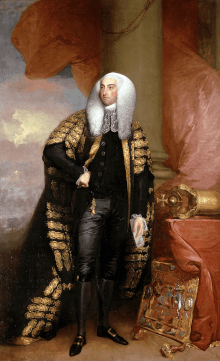
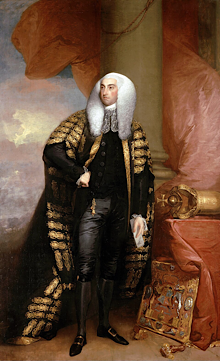
(Pictured: “Portrait of John FitzGibbon, 1st Earl of Clare,” painting by Gilbert Stuart, 1789)
Gwynn spends his early childhood in rural County Donegal, which is to shape his later view of Ireland. He attends Brasenose College, Oxford, where, as scholar, in 1884 he is awarded first-class honours in classical moderations and in 1886 literae humaniores. During term holidays he returns to Dublin, where he meets several of the political and literary figures of the day.
After graduating, Gwynn spends ten years from 1886 tutoring as a schoolmaster, for a time in France, which creates a lifelong interest in French culture, as expressed in his Praise of France (1927). By 1896 he has developed an interest in writing, becoming a writer and journalist in London focused on English themes, until he comes into contact with the emerging Irish literary revival, when he serves as secretary of the Irish Literary Society.
This is the beginning of a long and prolific career as a writer covering a wide range of literary genres, from poetry and biographical subjects to general historical works. The eighteenth century is Gwynn’s particular specialism. He writes numerous books on travel and on the topography of his own homeland, as well as on his other interests: wine, eighteenth-century painting and fishing.
Gwynn returns to Ireland in 1904 when he enters politics. In the 1906 Galway Borough by-election he wins a seat for Galway Borough, which he represents as a member of the Irish Parliamentary Party until 1918. During this period, he is active in the Gaelic League and is one of the few Irish MPs to have close links to the Irish literary revival. Along with Joseph Maunsel Hone and George Roberts he founds the Dublin publishing house of Maunsel and Company. He is opposed to the demand for the Irish language to be a compulsory subject for matriculation. He supports the campaign which wins the establishment of a Catholic university when he serves on the Irish University Royal Commission in 1908. During the debate on the third Home Rule Bill, and at the request of his party leader John Redmond, he writes The case for Home Rule (1911) and is in charge of much of the party’s official publicity and its replies to criticism from Sinn Féin.
On the outbreak of World War I in August 1914, Gwynn strongly supports Redmond’s encouragement of Irish nationalists and the Irish National Volunteers to support the Allied and British war effort by enlisting in Irish regiments of the Irish Divisions, especially as a means to ensure the implementation of the suspended Home Rule Act at the end of an expectedly short war. Now over fifty, he enlists in January 1915 with the 7th Leinster Regiment in the 16th (Irish) Division. In July he is commissioned as a captain in the 6th (Service) Battalion, Connaught Rangers and serves with them on the Western Front at Messines, the Somme and elsewhere.
Gwynn is one of five Irish Nationalist MPs who enlist and serve in the army, the others being John L. Esmonde, Willie Redmond, William Redmond and D. D. Sheehan, as well as former MP Tom Kettle. Together with Kettle and William Redmond, he undertakes a recruitment drive for the Irish divisions, co-operating with Kettle on a collection of ballads called Battle Songs for the Irish Brigade (1915). He is made a chevalier of the Legion of Honour in July 1915. In 1916, he is appointed to the Dardanelles Commission.
Recalled to Ireland in late 1917 to participate in the Irish Convention chaired by Sir Horace Plunkett, Gwynn sides with the Redmondite faction of the Irish Party in supporting a compromise with the southern unionists in an attempt to reach consensus on a Home Rule settlement which would avoid partition. On the death of Redmond in March 1918, he takes over as leader of the moderate nationalists in the Convention. He opposes the threat of compulsory military service during the Conscription Crisis of 1918, though as a member of the Irish Recruiting Council he continues to support voluntary recruitment, encountering intense opposition led by Sinn Féin.
Gwynn forms the Irish Centre Party in 1919 and stands unsuccessfully as an Independent Nationalist for Dublin University in the 1918 Irish general election. The party merges with Plunkett’s Irish Dominion League to press for a settlement by consent on the basis of dominion status, but Gwynn subsequently breaks with Plunkett due to his willingness to accept partition as a temporary compromise. The polarities which divide Ireland during the Irish War of Independence and Irish Civil War increasingly sideline his brand of moderate cultural nationalism. Although he supports the newly emergent nation, he equally condemns some of the excesses, such as the burning of houses belonging to Free State senators.
Gwynn’s personal life also becomes complicated at this stage and around 1920. He has a romantic association with married artist Grace Henry who is perhaps the best-known female artist in Ireland at the time. During this period, he and Grace travel in France and Italy and at various stages in his life she painted portraits of him including a very distinguished looking one of him in his late 60s or early 70s. Their relationship contributes significantly to the separation of Henry from her artist husband Paul Henry in 1930.
During the 1920s, Gwynn also devotes himself to writing, covering political events as Irish correspondent to The Observer and The Times. Later in his career, he writes some substantial works, and together with his son Denis Gwynn (The Life of John Redmond, 1932) does much to shape the retrospective image and self-justification of John Redmond. In the mid-1930s he authors three books with a connecting theme of fishing with the artist Roy Beddington serving as illustrator: The Happy Fisherman (1936), From River to River (1937), and Two in a Valley (1938).
Gwynn is awarded an honorary D.Litt. by the National University of Ireland in 1940, and a Litt.D. by the University of Dublin in 1945. The Irish Academy of Letters awards him the Gregory Medal in April 1950. In his literary writings he stands for a humanism and tolerance, which qualities, due to political upheavals, were relatively rare in the Ireland of his day.
Gwynn dies on June 11, 1950, at his home in Terenure, Dublin, and is buried at Tallaght Cemetery, south County Dublin.
Gwynn marries his cousin Mary Louisa (d. 1941), daughter of Rev. James Gwynn. She later converts to Catholicism. They have three sons and two daughters who are brought up in her religion, of whom Aubrey (1892–1983) becomes a Jesuit priest and professor of medieval history at University College Dublin (UCD). Their second son, Denis Rolleston (1893–1971), is professor of modern Irish history at University College Cork (UCC).
Gwynn’s brother Edward John (1868–1941) becomes provost of Trinity College and another brother Robert Malcolm becomes its senior dean. His sister Lucy Gwynn is the first woman registrar of Trinity. A third brother, Charles, has a successful career in the British Army and retires as a Major General. Younger brothers Lucius and Jack are noted cricketers.
Whiteside is the son of William Whiteside, a clergyman of the Church of Ireland. His father is transferred to the parish of Rathmines but dies when his son is only two years old, leaving his widow in straitened circumstances. She schools her son personally in his early years. He is educated at Trinity College Dublin, enters the Middle Temple, and is called to the Irish bar in 1830.
Whiteside very rapidly acquires a large practice, and after taking silk in 1842 he gains a reputation for forensicoratory surpassing that of all his contemporaries and rivalling that of his most famous predecessors of the 18th century. He defends Daniel O’Connell in the state trial of 1843, and William Smith O’Brien in 1848. His greatest triumph is in the Yelverton case in 1861. He is elected Member of Parliament (MP) for Enniskillen in 1851, and in 1859 becomes an MP for Dublin University. In Parliament, he is no less successful as a speaker than at the bar, and in 1852 is appointed Solicitor-General for Ireland in the first administration of Prime MinisterEdward Smith-Stanley, becoming Attorney-General for Ireland in 1858, and again in 1866. In the same year he is appointed Lord Chief Justice of the Queen’s Bench, having previously turned down offers of a junior judgeship. His reputation as a judge does not equal his reputation as an advocate, although he retains his great popularity. In 1848, after a visit to Italy, he publishes Italy in the Nineteenth Century. In 1870 he collects and republishes some papers contributed many years before to periodicals, under the title Early Sketches of Eminent Persons.
In July 1833, Whiteside marries Rosetta, daughter of William and Rosetta Napier, and sister of Sir Joseph Napier, Lord Chancellor of Ireland. Like his brother-in-law, Joseph, he is devoted to the Church of Ireland and strongly opposes its disestablishment.
Whiteside is universally well-liked, being noted for charm, erudition and a sense of humour. Barristers who practise before him say that his charm, courtesy and constant flow of jokes make appearing in his Court a delightful experience.
Whiteside’s last years on the bench ware affected by ill health. He dies on November 25, 1876, at Brighton, Sussex, England. His brother-in-law, from whom he is estranged in later years, is overcome with grief at his death and collapses at the funeral. He is buried at Mount Jerome Cemetery in Dublin.
(Pictured: Statue of James Whiteside by Albert Bruce-Joy on display in St. Patrick’s Cathedral)
Browne grows up in the Bogside area of Derry. The Browne family also lives in Athlone and Ballinrobe for a period of time. His mother Mary Therese (née Cooney) is born in 1885 in Hollymount, County Mayo. His father Joseph Brown, a Royal Irish Constabulary (RIC) sergeant, later works as an inspector for the National Society for the Prevention of Cruelty to Children and, partly as a result of this work, all of the Browne family becomes infected with tuberculosis. Both parents die of the disease during the 1920s. His father is the first to die, leaving only £100 behind to support a wife and seven children. Fearing that if she and the children remain in Ireland they will be forced into a workhouse, Mary sells all their possessions and takes the family to London. Within two days of their arrival, Mary is dead, later buried in a pauper’s grave. Of her seven children, six contract tuberculosis. Noël is only one of two Browne children to survive into adulthood after those bouts with TB.
In 1929, Browne is admitted free of charge to St. Anthony’s, a preparatory school in Eastbourne, England. He then wins a scholarship to Beaumont College, the Jesuitpublic school near Old Windsor, Berkshire, where he befriends Neville Chance, a wealthy boy from Dublin. Neville’s father, the eminent surgeon Arthur Chance, subsequently pays Browne’s way through medical school at Trinity College Dublin.
In 1940, while still a student, Browne suffers a serious relapse of tuberculosis. His treatment at a sanatorium in Midhurst, Sussex is paid for by the Chance family. He recovers, passes his medical exams in 1942, and starts his career as a medical intern at Dr. Steevens’ Hospital in Dublin, where he works under Bethel Solomons. He subsequently works in numerous sanatoria throughout Ireland and England, witnessing the ravages of the disease. He soon concludes that politics is the only way in which he can make an attack on the scourge of tuberculosis.
The poverty and tragedy that had shaped Browne’s childhood deeply affects him. He considers both his survival and his level of education a complete fluke, a stroke of random chance that saved him when he was seemingly destined to die unknown and in poverty like the rest of his family. He finds this completely distasteful and is moved to enter politics as a means to ensure no one else would suffer the same fate that had befallen his family.
A ‘White Paper’ on proposed healthcare reforms had been prepared by the previous government, and results in the 1947 Health Act. In February 1948, Browne becomes Minister for Health and starts the reforms advocated by the Paper and introduced by the Act.
The health reforms coincide with the development of a new vaccine and of new drugs (e.g., BCG and penicillin) that help to treat a previously untreatable group of medical conditions. Browne introduces mass free screening for tuberculosis sufferers and launches a huge construction program to build new hospitals and sanitoria, financed by the income and accumulated investments from the Department of Health-controlled Hospital Sweeps funds. This, along with the introduction of Streptomycin, helps dramatically reduce the incidence of tuberculosis in Ireland.
As Minister for Health Browne comes into conflict with the bishops of the Catholic Church and the medical profession over the Mother and Child Scheme. This plan, also introduced by the 1947 Health Act, provides for free state-funded healthcare for all mothers and children aged under 16, with no means test, a move which is regarded as radical at the time in Ireland, but not in the rest of Europe. Virtually all doctors in private practice oppose the scheme, because it would undermine the “fee for service” model on which their income depended.
The Church hierarchy, which controls many hospitals, vigorously opposes the expansion of “socialised medicine” in the Irish republic. They claim that the Mother and Child Scheme interferes with parental rights, and fear that the provision of non-religious medical advice to mothers will lead to birth control contrary to Catholic teaching. They greatly dislike Browne, seeing him as a “Trinity Catholic,” one who has defied the Church’s ruling that the faithful should not attend Trinity College Dublin, which had been founded by Protestants and for many years did not allow Catholics to study there.
Under pressure from bishops, the coalition government backs away from the Mother and Child Scheme and forces Browne’s resignation as Minister for Health. Following his departure from government, he embarrasses his opponents by arranging for The Irish Times to publish TaoiseachJohn A. Costello‘s and MacBride’s correspondence with the Catholic hierarchy, which details their capitulation to the bishops.
The controversy over the Mother and Child Scheme leads to the fall of the coalition government in which Browne had served as a Minister. But Church opposition to socialised medicine continues under the subsequent Fianna Fáil-led government. The hierarchy does not accept a no-means-test mother-and-infant scheme even when Fianna Fáil reduces the age limit from sixteen years to six weeks, and the government again backs down.
After his resignation as Minister for Health, Browne leaves Clann na Poblachta, but is re-elected to the Dáil as an Independent TD from Dublin South-East in the subsequent election.
Browne joins Fianna Fáil in 1953 but loses his Dáil seat at the 1954 Irish general election. He fails to be selected as a candidate for the 1957 Irish general election and he resigns from the party. He is re-elected at that election for Dublin South-East as an Independent TD.
In 1977 Browne is the first Irish parliamentarian to call for law reforms in regard to homosexuality, which is illegal at the time, and in 1979 is one of the few Irish politicians to attend the opening of the Hirschfeld Centre, Dublin’s first full-time LGBT community space.
In 1990, a number of left-wing representatives within the Labour Party, led by Michael D. Higgins, approach Browne and suggest that he should be the party’s candidate in the presidential election due later that year. Though in failing health, Browne agrees. However, the offer horrifies party leader Dick Spring and his close associates for two reasons. Firstly, the leadership had secretly decided to run Mary Robinson, a barrister and former senator. Secondly, many around Spring are “appalled” at the idea of running Browne, believing he has “little or no respect for the party” and is “likely in any event to self-destruct as a candidate.” When Spring informs Browne by telephone that the party’s Administrative Council has chosen Robinson over him, Browne hangs up the telephone.
Browne spends the remaining seven years of his life constantly criticising Robinson who had gone on to win the election, thus becoming the seventh President of Ireland, and who is considered highly popular during her term. During the campaign he also indicates support for the rival Fine Gael candidate, Austin Currie.
After retiring from politics, Browne moves with his wife Phyllis to Baile na hAbhann, County Galway. He dies at the age of 81 in the Regional Hospital, Galway, on May 21, 1997. He is buried in a small graveyard near Baile na hAbhann.