After acting as chaplain to Seth Ward, Bishop of Exeter and then Bishop of Salisbury, and Lord Chancellor Clarendon, he is elected principal of St. Alban Hall, Oxford, in 1673. In 1679 he is appointed provost of Trinity College, Dublin, where he does much to encourage the study of the Irish language. He helps to found the Dublin Philosophical Society and contributes to it a paper entitled Introductory Essay to the Doctrine of Sounds (printed in Philosophical Transactions, No. 156, Oxford, 1684).
In 1683 Marsh is consecrated Bishop of Ferns and Leighlin, but after the accession of James II he is compelled by the turbulent soldiery to flee to England in 1689, when he becomes Vicar of Gresford, Flintshire, and Canon of St. Asaph. Returning to Ireland in 1691 after the Battle of the Boyne, he is made Archbishop of Cashel, and three years later he becomes Archbishop of Dublin. About this time, he founds Marsh’s Library in Dublin, which is the oldest public library in Ireland. He becomes Archbishop of Armagh in 1703. Between 1699 and 1711 he is six times a Lord Justice of Ireland.
Narcissus Marsh dies on November 2, 1713. His funeral oration is pronounced by his successor at Dublin, Archbishop William King. A more acerbic account is provided by Jonathan Swift.
Many oriental manuscripts belonging to Narcissus Marsh are now in the Bodleian Library in Oxford.
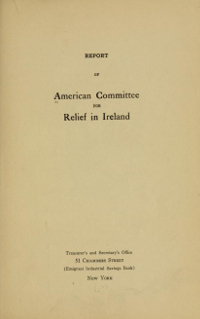
The American Committee for Relief in Ireland (ACRI) is founded through the initiative of Dr. William J. Maloney and others on December 16, 1920, with the intention of giving financial assistance to civilians in Ireland who have been injured or suffer severe financial hardship due to the ongoing Irish War of Independence.
The Committee is only one of several U.S. based philanthropic organisations that emerge following World War I with a view to influencing the post-war settlement from their perspective of social justice, economic development and long term stability in Europe. Some of them concentrate their efforts on events in Ireland, and while activists of Irish ethnicity are well represented, membership is far from confined to Americans of Irish heritage. Apart from the ACRI, bodies such as the American Commission on Irish Independence and the American Commission on Conditions in Ireland raise money and attempt to influence U.S. foreign policy in a manner sympathetic to the goal of Irish secession from the United Kingdom.
This period of Irish political radicalism coincides with a Red Scare in the United States. Jim Larkin, an Irish trade unionist, who has been closely associated with James Connolly in Ireland and with the Wobblies in the U.S., is serving a five-year sentence in Sing Sing prison for promoting his socialist agenda. While his political views differ fundamentally from most of the Sinn Féin leadership, Irish republicanism is seen by many of the American establishment as based on a questionable ideology. During the Irish War of Independence, the activities of Irish-American fund-raising organisations are viewed with suspicion and kept under close scrutiny by the intelligence services including J. Edgar Hoover, head of the General Intelligence Division of the Federal Bureau of Investigation. U.S. policy towards Irish concerns, initially hostile or at best indifferent, become somewhat less so following the 1920 U.S. presidential election and the landslide victory of Warren G. Harding over James M. Cox.
Following the burning of parts of Cork on December 11, 1920 by elements of the British security forces known as the Black and Tans, approaches are made by the city’s Lord Mayor, Donal O’Callaghan, to the American Red Cross for humanitarian assistance. The society, having taken advice from President Woodrow Wilson, the British embassy, the Foreign Office and the British Red Cross, decline at this time to act on his appeal. Numerous organisations and committees across the United States, operating independently in raising humanitarian aid money for Ireland realise that their funds will not be channelled through the U.S. Committee of the Red Cross and so another distribution channel is needed.
Five days after the inferno at Cork, a widely publicised meeting takes place at the Banker’s Club in New York City. It is organised by William Maloney with the intention of establishing a single nationwide organisation. It will have as its goal, explicitly and solely for the purpose of humanitarian relief, the raising and distribution in Ireland of $10 million. The body which soon emerges styles itself “The American Committee for Relief in Ireland.” One of its founding members, Levi Hollingsworth Wood, approaches a Dublin-based businessman and fellow Quaker, James Douglas, requesting his assistance in the local distribution of the funds on a non-partisan basis. In Ireland, Douglas speaks with Laurence O’Neill, the Lord Mayor of Dublin, who in turn contacts senior members of Sinn Féin to inform them of the wishes of the American Committee. These meetings culminate in the establishment of the Irish White Cross, for the purpose of local distribution of the Committee’s funds.
Charles Wolfe, Irish poet, is born at Blackhall, County Kildare, on December 14, 1791. He is chiefly remembered for “The Burial of Sir John Moore after Corunna” which achieves popularity in 19th century poetry anthologies.
Not long after he is born, his father dies, and the family moves to England. In 1801, Wolfe is sent to a school in Bath but is sent home a few months later due to ill health. From 1802 to 1805, he is tutored by a Dr. Evans in Salisbury before being sent to Hyde Abbey School, Winchester. In 1808, his family returns to Ireland, and the following year he enters Trinity College, Dublin, graduating in 1814.
Wolfe is ordained as a Church of Ireland priest in 1817, first taking the Curacy of Ballyclog in County Tyrone before transferring almost immediately to Donaghmore, County Tyrone. There he develops a close friendship and deep respect for the Rev. Thomas Meredith, Rector of nearby Ardtrea, and a former Fellow of Trinity College Dublin. Wolfe writes two epitaphs for Meredith, one on his memorial in the parish church of Ardtrea, and another intended for his tomb.
Wolfe is best remembered for his poem “The Burial of Sir John Moore after Corunna”, written in 1816 and much collected in 19th and 20th century anthologies. The poem first appears anonymously in the Newry Telegraph of April 19, 1817, and is reprinted in many other periodicals. But it is forgotten until after his death when Lord Byron draws the attention of the public to it. Wolfe’s only volume of verse, Poetical Remains, appears in 1825 with “The Burial of Sir John Moore” and fourteen other verses of an equally high standard.
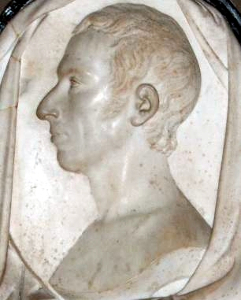
Wolfe remains at Donaghmore until 1820 but, rejected by the woman for whom he gave up his academic career, and with Meredith, his only real friend in County Tyrone, now dead, he moves to Southern France. Shortly before his death he returns to Ireland and lives at Cobh, County Cork, where he dies at the age of 31 of consumption, which he catches from a cow. He is buried in Cobh at Old Church Cemetery. There is also a plaque to his memory in the church at Castlecaulfield, the village where he lives whilst Curate at Donaghmore, as well as a marble monument to him at St. Patrick’s Cathedral, Dublin.
(Pictured: Bas-relief of Charles Wolfe in St. Patrick’s Cathedral, Dublin)
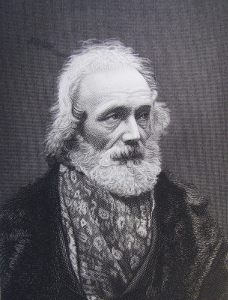
Henry is the son of a woolen draper, Robert Henry, and his wife Kathleen Elder. He is educated by Unitarianschoolmasters and then at Trinity College, Dublin. At age 11 he falls in love with the poetry of Virgil and gets into the habit of always carrying a copy of the Aeneid in his left breast-pocket.
Henry graduates from Trinity with the gold medal for Classics. He then turns to medicine and practises as a physician in Dublin until 1845. In spite of his unconventionality and unorthodox views on religion and his own profession, he is very successful. He marries Anne Jane Patton, from Donegal, and has three daughters, only one of whom, Katherine, born in 1830, survives infancy.
His accession to a large fortune in 1845 enables him to devote himself entirely to the absorbing occupation of his life – the study of Virgil. Accompanied by his wife and daughter, he visits all those parts of Europe where he is likely to find rare editions or manuscripts of the poet. When his wife dies in Tyrol he continues his work with his daughter, who becomes quite a Virgil expert in her own right, and crosses the Alps seventeen times. After the death of his daughter in 1872 he returns to Dublin and continues his research at Trinity College, Dublin.
As a commentator on Virgil, Henry will always deserve to be remembered, notwithstanding the occasional eccentricity of his notes and remarks. The first fruits of his researches are published at Dresden in 1853 under the quaint title Notes of a Twelve Years Voyage of Discovery in the first six Books of the Eneis. These are embodied, with alterations and additions, in the Aeneidea, or Critical, Exegetical and Aesthetical Remarks on the Aeneis (1873-1892), of which only the notes on the first book are published during Henry’s lifetime. As a textual critic Henry is exceedingly conservative. His notes, written in a racy and interesting style, are especially valuable for their wealth of illustration and references to the less-known classical authors.
Henry is also the author of five collections of verse plus two long narrative poems describing his travels, and various pamphlets of a satirical nature. At its best his poetry has something of the flavour of Robert Browning and Arthur Hugh Clough while at its worst it resembles the doggerel of William McGonagall. His five volumes of verse are all published at his own expense and receive no critical attention either during or after his lifetime.
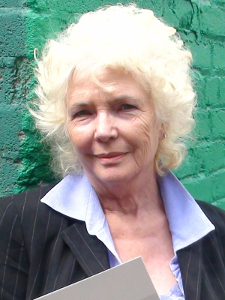
Flanagan is the daughter of Rosanna (née McGuirk) and Terence Niall Flanagan, an Irish Army officer and Communist who had fought in the International Brigade in the Spanish Civil War against General Francisco Franco. Although her parents are not Irish speakers, they want Fionnula and her four siblings to learn the Irish language, thus she grows up speaking English and Irish fluently. She is educated in Switzerland and England. She trains extensively at the Abbey Theatre in Dublin and travels throughout Europe before settling in Los Angeles, California in early 1968.
Flanagan comes to prominence in Ireland in 1965 as a result of her role as Máire in the Telefís Éireann production of the Irish language play An Triail, for which she receives the Jacob’s Award in Dublin for her “outstanding performance.” With her portrayal of Gerty McDowell in the 1967 film version of Ulysses, she establishes herself as one of the foremost interpreters of James Joyce. She makes her Broadway debut in 1968 in Brian Friel‘s Lovers, then appears in The Incomparable Max (1971) and such Joycean theatrical projects as Ulysses in Nighttown and James Joyce’s Women (1977-1979), a one-woman show written by Flanagan and directed for the stage by Burgess Meredith. It is subsequently filmed in 1983, with Flanagan both producing and playing all six main female roles.
Nearly 150,000 people take to the streets on December 9, 2005, as the Irish Ferries protest mushrooms into the largest public demonstration the country has seen for two decades.
An Garda Síochána estimate that 40,000 people take part in the march in Dublin, although organisers claim the figure is far higher. Gerry Adams of Sinn Féin, Pat Rabbitte of the Labour Party and John Gormley of the Green Party participate in the march in the capital. Staff on board the MS Isle of Inismore in Pembroke and the four engineers holed up in the ships control room say they are overwhelmed by the level of support shown by marchers in the rallies.
Bus and rail services are disrupted during the protest but return to normal for evening rush hour.
The Irish Small & Medium Enterprises Association (ISME) strongly criticises the National Day of Protest. In a statement, ISME Chief Executive Mark Fielding says the protest is undermining the industrial relations process in this country and has very little to do with the Irish Ferries dispute and is in fact an attempt by the unions to influence negotiations in advance of any new national pay agreement.
Director General of the Irish Business and Employers Confederation (IBEC) Turlough O’Sullivan says there is nothing to be gained from disrupting business and the general public. He adds that whatever one’s views on the Irish Ferries dispute, nothing can justify calling a national work stoppage when discussions are already underway in a bid to resolve the row.
Mellows is born at Hartshead Military Barracks, Ashton-Under-Lyne, Lancashire, England, to William Joseph Mellows, a British Armynon-commissioned officer, and Sarah Jordan, of Inch, County Wexford. His family moves to 10 Annadale Avenue, Fairview, Dublin, in February 1895 when Sergeant Mellows is transferred there, however Liam remains in Wexford with his grandfather Patrick Jordan due to ill health. He attends the military school in Wellington Barracks in Cork and the Portobello garrison school in Dublin but ultimately refuses a military career much to his father’s disappointment, instead working as a clerk in several Dublin firms, including the Junior Army & Navy Stores on D’Olier Street.
A nationalist from an early age, Mellows approaches Thomas Clarke, who recruits him to Fianna Éireann, an organisation of young republicans.
Mellows leads roughly 700 Volunteers in abortive attacks on Royal Irish Constabulary stations at Oranmore and Clarinbridge in County Galway and takes over the town of Athenry. However, his men are very badly armed and supplied and they disperse after a week, when British troops and the cruiser HMS Gloucester are sent west to attack them.
After this insurrection fails, Mellows escapes to the United States, where he is arrested and detained without trial in The Tombs in Lower Manhattan, New York, on a charge of attempting to aid the German side in World War I. After his release in 1918, he works with John Devoy and helps to organise Éamon de Valera’s fund-raising visit to America in 1919–1920.
Mellows returns to Ireland to become Irish Republican Army “Director of Supplies” during the Irish War of Independence, responsible for buying arms. At the 1918 general election of December, he is elected to the First Dáil as a Sinn Féin candidate for both East Galway and for North Meath. He considers the Anglo-Irish Treaty as signed to be a betrayal of the Irish Republic. A conference of 9 TDs is deputed to meet privately on January 5, 1922, to resolve the dispute and to achieve a unified front by compromise. The four other anti-Treaty TDs say there is agreement but Mellows does not and is seen thereafter by pro-Treaty TDs as one of their most implacable opponents. The following day the Dáil votes to approve the Treaty by a majority of 64 to 57.
Mellows is one of the more strident TDs on the approach to the Irish Civil War. In June 1922, he and fellow republicans Rory O’Connor, Joe McKelvey and Richard Barrett, among others, enters the Four Courts, which has been occupied by anti-Treaty forces since April. However, they are bombarded by pro-Treaty Free State forces and surrender after two days. Mellows has a chance to escape along with Ernie O’Malley but does not take it. Imprisoned in Mountjoy Gaol, Mellows, O’Connor, McKelvey and Barrett are executed by firing squad on December 8, 1922, in reprisal for the shooting of TD Seán Hales. Mellows is buried in Castletown cemetery, County Wexford, a few miles from Arklow. An annual commemoration ceremony is held at his grave site, in which a wreath is laid by a member of the Liam Mellows Commemoration committee.
Mellows is commemorated by statues in Oranmore and Eyre Square in Galway, in the official name of the Irish Defence Forces army barracks at Renmore and in the naming of Mellows Bridge in Dublin. Mellows Avenue in Arklow is named in his honour. He is also commemorated in the names of two hurling clubs, one in Galway and one in Wexford, and by Unidare RFC in Ballymun and their “Liam Mellows Perpetual Cup.”
Graves is born to John Crosbie Graves (1776–1835), Chief Police Magistrate for Dublin, and Helena Perceval, the daughter and co-heiress of the Rev. Charles Perceval (1751–1795) of Bruhenny, County Cork. Educated at Trinity College, Dublin, he wins a scholarship in Classics, and in 1834 graduates BA as Senior Moderator in mathematics, getting his MA in 1838. He plays cricket for Trinity, and later in his life does much boating and fly-fishing. It is intended that he join the 18th Royal Irish Regiment of Foot under his uncle, Major-General James William Graves (1774–1845), and in preparation he becomes an expert swordsman and rider.
After leaving Trinity College, Graves follows in the steps of his grandfather, Thomas Graves, who was appointed Dean of Ardfert in 1785 and Dean of Connor in 1802, and his great uncle, Richard Graves. He is appointed a fellow of Trinity College from 1836 to 1843 before taking the professorship of mathematics, a position he holds until 1862.
Graves is elected a member of the Royal Irish Academy in 1837 and subsequently holds various officerships, including President from 1861 to 1866. In 1860 he is appointed Dean of the Chapel Royal and, from 1864 to 1866, he is the Dean of Clonfert before being consecrated as Bishop of Limerick, Ardfert and Aghadoe, a position he holds for 33 years until his death on July 17, 1899. He is elected a Fellow of the Royal Society in 1880 and receives the honorary degree of DCL from Oxford University in 1881.
In 1841 Graves publishes an original mathematical work and he embodies further discoveries in his lectures and in papers read before and published by the Royal Irish Academy. He is a colleague of Sir William Rowan Hamilton and, upon the latter’s death, Graves gives a presidential panegyric containing a valuable account both of Hamilton’s scientific labours and of his literary attainments.
Graves is very interested in Irish antiquarian subjects. He discovers the key to the ancient Irish Ogham script which appears as inscriptions on cromlechs and other stone monuments. He also prompts the government to publish the old Irish Brehon Laws, Early Irish law. His suggestion is adopted, and he is appointed a member of the Commission to do this.
Graves’ official residence is The Palace at Limerick, but from the 1850s he takes the lease of Parknasilla House, County Kerry, as a summer residence. In 1892 he buys out the lease of the house and a further 114 acres of land that includes a few islands. In 1894 he sells it to Great Southern Hotels, who still own it to this day.
Atherton is born in 1598 in Somerset, England. He studies at Oxford University and joins the ranks of the Anglican clergy. In 1634 he becomes Bishop of Waterford and Lismore in the Church of Ireland. In 1640 he is accused of buggery with a man, John Childe, his steward and titheproctor. They are tried under a law that Atherton himself had helped to institute. They are both condemned to death, and Atherton is executed in St. Stephen’s Green, Dublin. Reportedly, he confesses to the crime immediately before his execution, although he had proclaimed his innocence before that.
More recently, some historical evidence has been developed that shows Atherton might have been a victim of a conspiracy to discredit him and his patrons. This is attributable to Atherton’s status as an astute lawyer, who seeks to recover lost land for the relatively weak Protestant Church of Ireland during the 1630s. Unfortunately for Atherton, this alienates him from large landowners, who then allegedly use his sexuality to discredit him.
English Puritan, Congregationalist and Independent activists, as well as English and Scottish Presbyterian activists, contemporaneously campaign to abolish Episcopacy (bishops) within the embattled Church of England, Church of Scotland and Church of Ireland, notionally expediting the political interest in Atherton’s downfall.
Posthumous accusations of sexual wrongdoing also include allegations of “incest” with his sister-in-law, and infanticide of the resultant child, as well as zoophilia with cattle. However, these allegations begin to be circulated several months after his death in an anonymous pamphlet, and may have been intended to further discredit the bishop’s campaign to restore the finances of the Church of Ireland.
(Pictured: Anonymous pamphlet of the hangings of John Atherton and John Childe, 1641)
Harty’s father teaches him the viola, the piano and counterpoint, and, at the age of twelve, he follows his father’s profession and is appointed organist of Magheracoll Church, County Antrim.
Harty takes further posts in his teenage years as a church organist in Belfast and Bray. While in the latter, he comes under the influence of Michele Esposito, professor of piano at the Royal Irish Academy of Music, who encourages him to pursue a career as a piano accompanist. As Bray is only twelve miles from Dublin, Harty is able go into the city to hear an orchestra for the first time in his life.
After his early career as a church organist in his native Ireland, Harty moves to London at about age 20, soon becoming a well-known piano accompanist. The Musical Times calls him “the prince of accompanists.” As a composer he writes throughout his career, many of his works being well received, though few are regularly performed in the 21st century.
In his career as a conductor, which begins in 1904, Harty is particularly noted as an interpreter of the music of Hector Berlioz. From 1920 to 1933 he is the chief conductor of The Hallé symphony orchestra in Manchester, which he returns to the high standards and critical acclaim that it had enjoyed under its founder, Charles Hallé. His last permanent post is with the London Symphony Orchestra, but it lasts only two years, from 1932 to 1934, as Harty does not prove to be a box-office draw. According to a historian of the orchestra, Richard Morrison, Harty is “brutally and hurtfully” dropped in 1934.
During his conducting career, Harty makes some recordings with his orchestras. Shortly after his dismissal by the London Symphony Orchestra, Harty begins to suffer the symptoms of a brain tumor. After surgery which includes the removal of his right eye, he resumes his career until 1940, but the tumour returns to cause his death at the age of 61 in Hove on February 19, 1941. He is cremated, and his ashes are interred in the grounds of Hillsborough parish church, near the front door. There is a separate memorial in the church.