seamus dubhghaill

Promoting Irish Culture and History from Little Rock, Arkansas, USA


Leave a comment

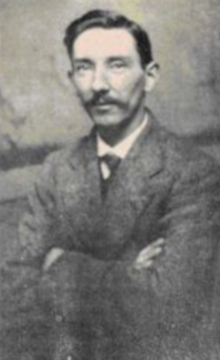
The Execution of Tom Williams, IRA Volunteer

File source: http://en.wikipedia.org/wiki/File:Vol._Tom_Williams.jpg

Thomas Joseph Williams, a volunteer in C Company, 2nd Battalion of the Belfast Brigade in the Irish Republican Army (IRA), is hanged in the Crumlin Road Gaol on September 2, 1942, for his involvement in the killing of Royal Ulster Constabulary (RUC) police officer Patrick Murphy during the Northern campaign.

Williams is born in the Beechmount area of Belfast on May 12, 1923. He is the third child in a family of six. After the death of his mother, he and his brother go to live with their grandmother at 46 Bombay Street in the Clonard area of Belfast. The Williams family has to leave the small Catholic enclave in the Shore Road area of Belfast after their house is attacked and burned.

As a child, Williams suffers from asthma and as a result is often very ill. He attends St. Gall’s Primary School but leaves at an early age to obtain work, which at the time is difficult due to discrimination. His work therefore consists of labouring and as a delivery boy.

As soon as Williams is old enough, he joins Na Fianna Éireann, the republican Scout Organisation founded by Constance Markievicz in 1909, becoming a member of the Con Colbert slua in the Clonard area. Alfie Hannaway, a friend of Williams, is his OC in Na Fianna, and assigns him to the rank of Quartermaster for the company. He takes his role in Na Fianna very seriously and all who came to know him are struck by his dedication and maturity, even at this early age.

At the age of 17, Williams is old enough to become a volunteer and joins C Company of the IRA in the Clonard area where he lives. Due to his “dedication and his remarkable ability” he is appointed to the role of Adjutant of C Company.

At Easter 1942 the government of Northern Ireland bans all parades to commemorate the anniversary of the Easter Rising. An IRA unit of six men and two women stage a diversionary action against the RUC to allow three parades to take place in West Belfast, but in this clash a RUC officer is killed, and the six IRA men are captured. The RUC officer, Constable Patrick Murphy, a father of nine children, from the Falls Road area of Belfast, is one of a minority of Catholics serving in the RUC.

There is debate over the years about who actually fired the fatal shot. The six IRA members are convicted and sentenced to death for murder under the law of common purpose. Five have their sentences commuted. The sentence of Williams, who acknowledges that he is the leader of the IRA unit involved and takes full responsibility for the actions of his men, is not commuted.

Williams is hanged in Crumlin Road Gaol in Belfast on the morning of September 2, 1942. The executioner is the official English hangman Thomas Pierrepoint, assisted by his nephew Albert Pierrepoint. Afterwards Williams’ body is interred in unhallowed ground in an unmarked grave within the grounds of the prison. His remains are only released in January 2000 after the closure of the prison in 1996 and a lengthy campaign by the National Graves Association, Belfast.

Williams’s funeral is held on January 19, 2000, and is attended by thousands, with burial at Milltown Cemetery. Joe Cahill, Williams’s cell mate, and John Oliver, sentenced to death with Williams but later reprieved, as well as Madge McConville, who had been arrested with Williams, Greta McGlone, Billy McKee, Eddie Keenan and perhaps least known, Nell Morgan, Williams’s girlfriend at the time of his death, are all present. Six senior Sinn Féin members including Gerry Adams are also present in St. Paul’s Church on the Lower Falls Road for the Mass.

Williams is remembered in a ballad Tom Williams. Various recordings have been made, most notably by the Flying Column and Éire Óg, who preamble their version with the story of the campaign to release his body. The now disbanded, Volunteer Tom Williams Republican Flute Band from Glasgow, Scotland is named in his memory as is the Tom Williams Camogie Club in Belfast.

(Pictured: Tom Williams’ headstone at Milltown Cemetery after being reinterred)


Leave a comment

Death of Yann Renard-Goulet, Sculptor & Breton Nationalist

yann-goulet-custom-house-memorial

Yann Renard-Goulet, French sculptor, Breton nationalist and war-time collaborationist with Nazi Germany who headed the Breton Bagadou Stourm militia, dies in Bray, County Wicklow on August 22, 1999.

Goulet is born in Saint-Nazaire, France on August 20, 1914. Before World War II, he is a member of the Breton National Party and a former member of the French Section of the Workers’ International (SFIO). His artistic career begins at the École nationale supérieure des Beaux-Arts, where he studies art and architecture, and learns sculpture with Auguste Rodin‘s assistant, Charles Despiau. His works in France include bas-reliefs shown at the Exposition International de Paris (1938), and the monument to the youth of the French empire in Lille (1939). He is part of the Breton artistic movement Seiz Breur.

Goulet’s involvement in Breton nationalism leads to accusations that he had orchestrated the destruction of the Monument to the Breton-Angevin Federation at Pontivy on December 18, 1938, by Gwenn ha du, the nationalist terrorist group. He is detained, but then released.

In 1939, he is sent to Strasbourg to study the art of sabotage. He participates in the beginning of World War II fighting for France, and is captured by the Germans on June 11, 1940, while blowing up a bridge on the Aisne with friends from a French corps.

Later in the war, Goulet joins the assault section of Bagadou Stourm, Breton nationalist stormtroopers allied to the Germans. He also collaborates with the pro-Nazi nationalist newspaper L’Heure Bretonne. In 1941 in Paris, he becomes head of Bagadou Stourm and the “Youth Organizations” of the Breton National Party. The promotion of Bagadou Stourm officers is named “Patrick Pearse” to commemorate the 25th anniversary of the 1916 Easter Rising against British rule in Ireland.

After the liberation of France, Goulet travels with his wife and children to Ireland, and is sentenced to death as a Collaborationist by a French court in his absence. He acquires Irish citizenship in 1952 and becomes an art professor.

Goulet is commissioned to create public works commemorating the Irish Republican Army (IRA) and other republicans, including the Custom House Memorial (Dublin), the East Mayo Brigade IRA Memorial, the Republican Memorial (Crossmaglen), and the Ballyseedy Memorial (Kerry). He exhibits regularly at the Royal Hibernian Academy, eventually becoming the RHA Professor of Sculpture. He is also made a member of Aosdána in 1982.

Towards the end of the 1960s, Goulet claims to have taken the reins of the Breton Liberation Front (Front de Libération de la Bretagne, or FLB) and to have been behind all their attacks.

In 1969 Goulet becomes secretary general and chair of the Comité National de la Bretagne Libre and publishes the communiques of the FLB. In 1968, the head of police in Bray congratulate him on organising the previous day’s attack on the CRS barracks in Saint-Brieuc.

Goulet died at Bray, County Wicklow, on August 22, 1999, two days after his 85th birthday.

(Pictured: Custom House Memorial in Dublin by Yann Renard-Goulet, 1957)


1 Comment

Assassination of RIC Inspector Percival Lea-Wilson

percival-lea-wilson

Percival Lea-Wilson, a District Inspector in the Royal Irish Constabulary (RIC) who is stationed at Gorey, County Wexford, is shot dead on June 15, 1920, by the Irish Republican Army (IRA) outside his Gorey home on the orders of Michael Collins.

Lea-Wilson is born in Kensington, London and is educated at the University of Oxford but his route into the British Army begins with a stint as a RIC constable in Charleville, County Cork in the early 20th century.

When World War I breaks out in 1914 Lea-Wilson joins the British army where he reaches the rank of captain in the 18th Royal Irish Regiment. An injury during the war forces him back to Ireland where he is stationed in Dublin, just in time for the Easter Rising in 1916.

When the weeklong rising ends, the rebels who had fought in the Four Courts and the GPO are marched to the Rotunda Hospital where they are kept overnight under the glare of British troops. Among those detained are leaders of the rebellion such as Sean Mac Diarmada and Tom Clarke. Clarke is singled out and subjected to public humiliation by 28-year-old British army Captain Percival Lea-Wilson.

Lea-Wilson and his soldiers walk among the captured rebels, and he picks the 58-year-old Clarke out of the group. He marches Clarke to the steps of the hospital where he orders soldiers to strip him bare as nurses look on in horror from the windows above. Clarke is beaten and left there overnight in his tattered clothes. One of the prisoners, Michael Collins, who witnesses Clarke’s mistreatment at the hands of the British captain vows vengeance.

In the years following the Easter Rising, Lea-Wilson settles in Wexford where he attains the role of RIC district inspector.

On the morning of June 15, 1920, Lea-Wilson is walking back home after paying a visit to the RIC barracks in Gorey. Dressed in his civilian clothes, he stops at the local railway station where he purchases a newspaper and meets Constable Alexander O’Donnell, who accompanies him on part of his walk home.

O’Donnell and Lea-Wilson part company at the railway bridge on Ballycanew Road while further up that very same stretch of road there is a number of men standing around a parked car with its hood raised. Michael Collins had sent Liam Tobin and Frank Thornton from Dublin to meet with Joe McMahon, Michael McGrath and Michael Sinnott in Enniscorthy. They were then driven by Jack Whelan to Ballycanew Road to carry out the assassination of Lea-Wilson.

Unaware of his assassins lying in wait, Lea-Wilson is reading his paper while strolling along the road. The men by the parked car pull out revolvers when their target comes into range and two bullets strike him down. He manages to quickly get back on his feet and attempts to make an escape, but his six assassins run after him and finally bring him down in a hail of bullets. A coroner’s report later states that Lea-Wilson had been shot seven times.

When the shooting ends, one of Lea-Wilson’s executioners calmly walks up to the body to make sure he is dead. He then picks up the newspaper from the ground and takes it with him. Later that evening Michael Collins is in the Wicklow Hotel in Dublin when word reaches him from Wexford of the shooting death of Lea-Wilson. Collins greets the news with glee and mentions to one of his comrades, “Well we finally got him!”

Percival Lea-Wilson is buried in Putney Vale Cemetery in southwest London. His grave is marked by a plaque which mentions his assassination in Gorey in 1920, a death which has its roots in the Easter Rising four years previously.


Leave a comment

Birth of Irish Historian Robert Walter Dudley Edwards

CREATOR: gd-jpeg v1.0 (using IJG JPEG v62), default quality

Robert Walter Dudley Edwards, Irish historian, is born in Dublin on June 4, 1909.

Edwards, known to his friends as Robin and his students as Dudley, is the son of Walter Dudley Edwards, a journalist who comes to Ireland with his wife, Bridget Teresa MacInerney from Clare, and becomes a civil servant. His mother is a supporter of women’s rights and Edwards recalls that he had a ‘Votes for Women’ flag on his pram. His mother is a suffragette and a member of Cumann na mBan, a women’s organisation designed to support the Irish Volunteers. Members of Cumann na mBan gather intelligence, transport arms, nurse wounded men, provide safe houses, and organise support for Irish Republican Army (IRA) men in prison.

Edwards is first educated at the Catholic University School, then moves to St. Enda’s School, a school set up by 1916 Irish revolutionary leader Patrick Pearse, after the 1916 rising, and then Synge Street CBS, finally returning to the Catholic University School. In his final exams he fails French and Irish but gains first place in Ireland in history.

In University College Dublin, Edwards is auditor of the Literary and Historical Society, gains a first-class degree in history in 1929 followed by a first-class master’s degree in 1931 with the National University of Ireland prize. He carries out postgraduate work at the University of London and earns his PhD in 1933, published in 1935 as Church and State in Tudor Ireland.

Also in 1933, Edwards marries Sheila O’Sullivan, a folklorist and teacher. They have three children, Mary Dudley Edwards a teacher and rights activist, Ruth Dudley Edwards, a historian, crime novelist, journalist and broadcaster, and Owen Dudley Edwards, a historian at the University of Edinburgh.

Along with Theodore William Moody, Edwards founds the Irish Historical Society in 1936, and its journal Irish Historical Studies is first published in 1938.

In 1937 Edwards is awarded a D.Litt by the National University of Ireland and in 1939 is appointed to a statutory lectureship in Modern Irish History at University College Dublin. He succeeds Mary Hayden to the Chair of Modern Irish History in 1944, which he holds until he retires in 1979. His contribution to the discipline of History in Ireland is substantial and includes the setting up of University College Dublin Archives Department, now part of the School of History.

The introduction to Edwards’ book Age of Atrocity records how the leading Irish history journal, Irish Historical Studies, edited by Edwards and Moody, for the first half-century and more of its existence, systematically avoids the theme of violence, killing and atrocity during the 16th and 17th centuries.

Following his wife’s death in April 1985, Robert Dudley Edwards dies on June 5, 1988, in St. Vincent’s Hospital in Dublin after a short illness.

(Pictured: Robert Walter Dudley Edwards (left) and Theodore William Moody (right).)


Leave a comment

Birth of Mary Hayden, Historian & Activist

mary-hayden

Mary Teresa Hayden, Irish historian, Irish language activist and campaigner for women’s causes, is born in Dublin on May 9, 1862.

Hayden is educated initially at the Dominican College, Eccles Street and then at Alexandra College in Dublin. She attends the Royal University of Ireland where she graduates with a BA in 1885 and an MA in 1887 in Modern Languages. With Agnes O’Farrelly she campaigns for women’s rights in the university.

A campaigner for gender equality and noted as a public speaker, Hayden is a prominent member of the Irish Women’s Suffrage and Local Government Association. She is a member of the Gaelic League and friends with Patrick Pearse. However, she opposes violence and disapproves of the 1916 Easter Rising.

In 1911 Hayden is elected to the senate of the National University of Ireland and in 1915 is appointed Professor of History at University College Dublin, a position she retains until her death.

Hayden helps to form the Women’s Social and Progressive League as a political party committed to opposing the 1937 constitution of Ireland and any regressive consequences it would entail. She opposes articles 40, 41, and 45 concerning the status of women.

Mary Hayden dies in Dublin on July 12, 1942.


Leave a comment

Birth of John MacBride

john-macbride

Major John MacBride, Irish republican executed by the British for his participation in the 1916 Easter Rising, is born in Westport, County Mayo on May 7, 1865.

MacBride is born to Patrick MacBride, a shopkeeper and trader, and the former Honoria Gill. He is educated at the Christian Brothers School in Westport and at St. Malachy’s College in Belfast. He studies medicine but gives it up and begins working with a chemist’s firm in Dublin.

MacBride joins the Irish Republican Brotherhood (IRB) and is associated with Michael Cusack in the early days of the Gaelic Athletic Association. He also joins the Celtic Literary Society through which he comes to know Arthur Griffith, who is to remain a friend and influence throughout his life. Beginning in 1893, he is termed a “dangerous nationalist” by the British government. In 1896, he travels to the United States on behalf of the IRB. Upon his return he emigrates to South Africa.

In the Second Boer War MacBride is instrumental in the raising of the Irish Transvaal Brigade and leads it into action against the British. When organised resistance collapses, he and the surviving members cross the border into Mozambique. After the war he marries Maud Gonne and they have a son, Seán MacBride, who is also to make a name for himself in Irish Politics. The marriage, however, is not a success and they go their separate ways. MacBride keeps up his associations with Republican activists but does not become personally involved other than making the odd speech in support of Ireland’s Cause.

After returning permanently from Paris to Dublin in 1905, MacBride joins other Irish nationalists in preparing for an Insurrection. Because he is so well known to the British, the leaders think it wise to keep him outside their secret military group planning a Rising. As a result, he happens to find himself in the midst of the Rising without notice.

MacBride is in Dublin early on Easter Monday morning, April 24, to meet his brother, Dr. Anthony MacBride, who is arriving from Westport to be married two days later. As MacBride walks up Grafton Street, he sees Thomas MacDonagh in uniform and leading his troops. He offers his services and is appointed second-in-command at the Jacob’s Biscuit Factory, which is occupied and held through Easter Week until the order to surrender is received. As he is dressed in civilian clothes rather than a military uniform, he could likely have escaped without too much difficulty but rather he decides to go with his comrades into captivity.

Tried by court martial under the Defence of the Realm Act, MacBride is found guilty and sentenced to death. He is executed on May 5, 1916, two days before his forty-eighth birthday. Facing the British firing squad, MacBride refuses to be blindfolded saying, “I have looked down the muzzles of too many guns in the South African war to fear death and now please carry out your sentence.”

John MacBride is buried in the cemetery at Arbour Hill Prison in Dublin.


Leave a comment

Birth of Irish American Actor Gregory Peck

gregory-peck

Actor Gregory Peck is born in La Jolla, California on April 5, 1916, to Bernice Mary (Ayres) and Gregory Pearl Peck, a chemist and pharmacist in San Diego. Through his Irish-born paternal grandmother, Catherine Ashe, Peck is related to Thomas Ashe, who takes part in the Easter Rising fewer than three weeks after Peck’s birth and dies while on hunger strike in 1917.

Peck’s parents divorce when he is five years old. An only child, he is sent to live with his grandmother. He never feels as though he has a stable childhood. His fondest memories are of his grandmother taking him to the movies every week and of his dog, which follows him everywhere.

At the age of ten Peck is sent to a Catholic military school, St. John’s Military Academy in Los Angeles. While he is a student there, his grandmother dies. At 14, he moves back to San Diego to live with his father and attends San Diego High School. After graduating he enrolls for one year at San Diego State Teacher’s College (now known as San Diego State University).

Peck studies pre-med at the University of California, Berkeley and while there is bitten by the acting bug and decides to change the focus of his studies. He enrolls in the Neighborhood Playhouse School of the Theatre in New York City and debuts on Broadway after graduation. His debut is in Emlyn Williams‘ play The Morning Star (1942). By 1943, he is in Hollywood, where he debuts in the RKO Pictures film Days of Glory (1944).

Stardom comes with Peck’s next film, The Keys of the Kingdom (1944), for which he is nominated for an Academy Award. Peck’s screen presence displays the qualities for which he becomes well known. He is tall, rugged and heroic, with a basic decency that transcends his roles. He appears in Alfred Hitchcock‘s Spellbound (1945) as an amnesia victim accused of murder. In The Yearling (1946), he is again nominated for an Academy Award and wins the Golden Globe Award. He is especially effective in westerns and appears in such varied fare as David O. Selznick‘s critically blasted Duel in the Sun (1946), the somewhat better received Yellow Sky (1948) and the acclaimed The Gunfighter (1950). He is nominated again for the Academy Award for his roles in Gentleman’s Agreement (1947), which deals with antisemitism, and Twelve O’Clock High (1949), a story of high-level stress in an Air Force bomber unit in World War II.

With a string of hits to his credit, Peck makes the decision to only work in films that interest him. He continues to appear as the heroic, larger-than-life figures in such films as Captain Horatio Hornblower R.N. (1951) and Moby Dick (1956). He works with Audrey Hepburn in her debut film, Roman Holiday (1953).

Peck finally wins the Oscar, after four nominations, for his performance as lawyer Atticus Finch in To Kill a Mockingbird (1962). In the early 1960s, he appears in two darker films than he usually makes, Cape Fear (1962) and Captain Newman, M.D. (1963), which deal with the way people live. He also gives a powerful performance as Captain Keith Mallory in The Guns of Navarone (1961), one of the biggest box-office hits of that year.

In the early 1970s, Peck produces two films, The Trial of the Catonsville Nine (1972) and The Dove (1974), when his film career stalled. He makes a comeback playing, somewhat woodenly, Robert Thorn in the horror film The Omen (1976). After that, he returns to the bigger-than-life roles he is best known for, such as MacArthur (1977) and the monstrous Nazi Dr. Josef Mengele in the huge hit The Boys from Brazil (1978). In the 1980s, he moves into television with the miniseries The Blue and the Gray (1982) and The Scarlet and the Black (1983). In 1991, he appears in the remake of his 1962 film, playing a different role, in Martin Scorsese‘s Cape Fear (1991). He is also cast as the progressive-thinking owner of a wire and cable business in Other People’s Money (1991).

In 1967, Peck receives the Academy’s Jean Hersholt Humanitarian Award. He has also been awarded the Presidential Medal of Freedom. Always politically progressive, he is active in such causes as anti-war protests, workers’ rights and civil rights. In 2003, Peck’s portrayal of Atticus Finch is named the greatest film hero of the past 100 years by the American Film Institute.

Gregory Peck dies in his sleep at his home in Los Angeles, California from bronchopneumonia at the age of 87 on June 12, 2003. He is entombed in the Cathedral of Our Lady of the Angels mausoleum in Los Angeles. His eulogy is read by Brock Peters, whose character, Tom Robinson, was defended by Peck’s Atticus Finch in To Kill a Mockingbird.


Leave a comment

Premiere of “Cathleen ni Houlihan”

cathleen-ni-houlihan

Cathleen ni Houlihan, a one-act play written by William Butler Yeats and Lady Gregory, is first performed in Dublin on April 2, 1902, with Maud Gonne in the leading role. It is first published in the October 1902 number of Samhain magazine.

The play centers on the Irish Rebellion of 1798. The play is startlingly nationalistic, in its last pages encouraging young men to sacrifice their lives for the heroine Cathleen ni Houlihan, who represents an independent and separate Irish state. The title character first appears as an old woman at the door of a family celebrating their son’s wedding. She describes her four “beautiful green fields,” representing the four provinces of Ireland, that have been unjustly taken from her. With little subtlety, she requests a blood sacrifice, declaring that “many a child will be born and there will be no father at the christening” and that “they that have red cheeks will have pale cheeks for my sake, and for all that, they will think they are well paid.” She convinces the future groom, Michael, to give up the wedding and go fight.

After the youth leaves the safety of his home to fight for her, she appears as an image of youth with “the walk of a queen,” professing of those who fight for her: “They shall be remembered forever, They shall be alive forever, They shall be speaking forever, The people shall hear them forever.”

Death is common during the time around the rising, but becoming a martyr is somethings that is admirable, so oftentimes people welcome death so they can create themselves a heroic memory. The martyrs will be remembered forever, which is why this theme is so ingrained into this play.

Cathleen ni Houlihan is such a simple play that contains many symbols and has the goal of convincing men to fight for Ireland. While the play is written about the rising of 1798, it is meant to inspire people for the 1916 Easter Rising. Throughout the whole play, there is constant reference to memory and its influence on the public. The men that die while fighting for Ireland are considered heroes, which is why memory and martyrdom are such important themes that are incorporated into works about revolution.

Cathleen ni Houlihan is about Irish Independence, but there are themes of martyrdom in other works, like the musicals about American Independence, Hamilton and 1776.

(Pictured: Scene from a production of “Cathleen ni Houlihan,” circa 1912)


Leave a comment

Birth of Arthur Griffith, Founder of Sinn Féin

arthur-griffith

Arthur Joseph Griffith, writer, newspaper editor and politician who founded the political party Sinn Féin, is born in Dublin on March 31, 1871. He leads the Irish delegation at the negotiations that produce the 1921 Anglo-Irish Treaty and serves as President of Dáil Éireann from January 1922 until his death in August 1922.

Griffith, a Roman Catholic, is educated by the Irish Christian Brothers. He works for a time as a printer before joining the Gaelic League, which is aimed at promoting the restoration of the Irish language.

After a short spell in South Africa, Griffith founds and edits the Irish nationalist newspaper The United Irishman in 1899. In 1904, he writes The Resurrection of Hungary: A Parallel for Ireland, which advocates the withdrawal of Irish members from the Parliament of the United Kingdom and the setting up of the institutions of government at home, a policy that becomes known as Sinn Féin (ourselves). On November 28, 1905, he presents “The Sinn Féin Policy” at the first annual Convention of the National Council. The occasion is marked as the founding date of the Sinn Féin party. Although the organization is still small at the time, Griffith takes over as president of Sinn Féin in 1911.

Griffith is arrested following the Easter Rising of 1916, despite not having taken any part in it. On his release, he works to build up Sinn Féin, which wins a string of by-election victories. At the party’s Ardfheis (annual convention) in October 1917, Sinn Féin becomes an unambiguously republican party, and Griffith resigns the presidency in favour of the 1916 leader Éamon de Valera, becoming vice-president instead. Griffith is elected as a member of parliament (MP) in June 1918, and is re-elected in the 1918 general election, when Sinn Féin wins a huge electoral victory over the Irish Parliamentary Party and refusing to take their seats at Westminster, set up their own constituent assembly, Dáil Éireann.

In the Dáil, Griffith serves as Minister for Home Affairs from 1919 to 1921, and Minister for Foreign Affairs from 1921 to 1922. In September 1921, he is appointed chairman of the Irish delegation to negotiate a treaty with the British government. After months of negotiations, he and the other four delegates sign the Anglo-Irish Treaty, which creates the Irish Free State, but not as a republic. This leads to a split in the Dáil. After the Treaty is narrowly approved by the Dáil, de Valera resigns as president and Griffith is elected in his place. The split leads to the Irish Civil War.

Griffith enters St. Vincent’s Nursing Home, Leeson Street, Dublin, during the first week of August 1922, following an acute attack of tonsillitis. He is confined to his room by his doctors, who had observed signs of what they thought might be a subarachnoid hemorrhage. It is difficult to keep him quiet and he resumes his daily work in the government building. When about to leave for his office shortly before 10:00 AM on August 12, 1922, he pauses to retie his shoelace and falls down unconscious. He regains consciousness but collapses again with blood coming from his mouth. Three doctors render assistance, but to no avail. Father John Lee of the Marist Fathers administers extreme unction, and Griffith expires as the priest recites the concluding prayer. The cause of death, cerebral hemorrhage, is also reported as being due to heart failure. He dies at the age of 51, ten days before Michael Collins‘ assassination in County Cork and two months after the outbreak of the Irish Civil War. He is buried in Glasnevin Cemetery four days later.


Leave a comment

Liam Cosgrave Elected Taoiseach of Ireland

liam-cosgrave

Liam Cosgrave is elected the sixth Taoiseach of Ireland on March 14, 1973. He serves in the position from March 1973 to July 1977.

Cosgrave is born on April 13, 1920, in Castleknock, County Dublin. His father, William Thomas Cosgrave, was the first President of the Executive Council and head of the government of the Irish Free State during the first 10 years of its existence (1922–32). The eldest son, he is educated at Synge Street CBS, Castleknock College, Dublin, studies law at King’s Inns and is called to the Irish bar in 1943. In that same year he enters Dáil Éireann (the lower house of the Oireachtas, the Irish parliament), and he retains his seat until his retirement from politics in 1981.

In 1948, when the first inter-party government replaces Éamon de Valera’s Fianna Fáil regime, which had been in power for the previous 16 years, Cosgrave becomes parliamentary secretary to the Taoiseach and to the Minister for Industry and Commerce. It is a short-lived administration, going out of power in 1951 after three years of rule. But in a second inter-party government (1954–57), he becomes Minister for External Affairs and leads the first Irish delegation to the United Nations General Assembly in 1956.

Cosgrave succeeds James Dillon as leader of the Fine Gael party in 1965. Eight years later, as leader of a coalition government in which Fine Gael combines forces with the Labour Party, he becomes Taoiseach. He and British Prime Minister Edward Heath are the main participants in the intergovernmental conference at Sunningdale in December 1973 that gives birth to Northern Ireland’s first, though short-lived, power-sharing executive (1973–74).

A devout Roman Catholic, Cosgrave is intensely conservative on social issues and shocks his cabinet colleagues by voting against his own government’s bill on liberalizing the sale of contraceptives in 1974. The National Coalition is defeated in the general election of June 1977, largely on the economic issues of inflation and unemployment.

In 1981, Cosgrave retires as Dáil Deputy for Dún Laoghaire to be replaced by his son, Liam T. Cosgrave. He reduces his involvement in public life, but he makes occasional appearances and speeches. In October 2010 he attends the launch of The Reluctant Taoiseach, a book about former Taoiseach John A. Costello written by David McCullagh. He also appears in public for the Centenary of the Easter Rising in 2016, watching from a car as the military parade marches through Dublin. On May 8, 2016, in a joint appearance with the grandsons of Éamonn Ceannt and Cathal Brugha, he unveils a plaque commemorating the 1916 Rising at St. James’s Hospital, the former site of the South Dublin Union.

Liam Cosgrave dies on October 4, 2017, at the age of 97 of natural causes. He had been at Tallaght Hospital for several months prior to his death there. His funeral is held on October 7, 2017, after which he is interred alongside his father at Inchicore‘s Goldenbridge Cemetery.

Taoiseach Leo Varadkar says “Liam Cosgrave was someone who devoted his life to public service; a grateful country thanks and honours him for that and for always putting the nation first. Throughout his life he worked to protect and defend the democratic institutions of our State and showed great courage and determination in doing so. He always believed in peaceful co-operation as the only way of achieving a genuine union between the people on this island, and in the 1970s he celebrated that this country had embarked, in his own words, ‘on a new career of progress and development in the context of Europe’. I had the honour on a few occasions to meet and be in the presence of Liam Cosgrave, and I was always struck by his commanding presence and great humility, which in him were complementary characteristics.”