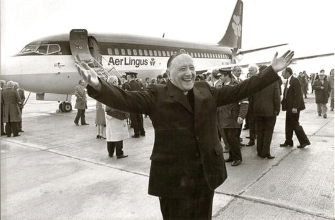
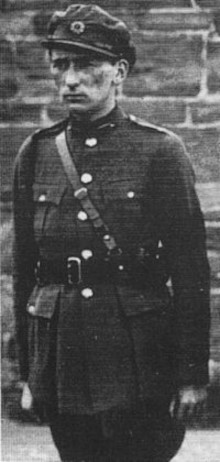
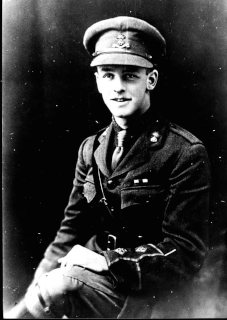
Flanagan also plays senior Gaelic football for Mayo. He captains the All-Ireland final-winning sides of 1950 and 1951 and wins five Connacht senior championship medals in all. He also wins two National Football League titles in 1949 and 1954. While still a footballer, he enters into a career in politics.
Flanagan comes from a Fianna Fáil family and is recruited into the party in east Mayo. He is elected a Fianna Fáil TD for Mayo South at the 1951 Irish general election and then wins a seat from 1969 in Mayo East at each subsequent election until he loses his seat at the 1977 Irish general election.
Flanagan rises rapidly through the party ranks and is appointed a Parliamentary Secretary under TaoiseachSeán Lemass in 1959. In the 1966 Fianna Fáil leadership election he supports Jack Lynch. When Lynch becomes Taoiseach, he is promoted to the Cabinet as Minister for Health. Three years later in 1969, he becomes Minister for Lands. He loses his seat at the 1977 Irish general election and effectively retires from domestic politics. However, he is elected to the European Parliament in the first direct elections in 1979. He is re-elected in 1984 and retires from politics in 1989.
Flanagan marries Mary Patricia Doherty in 1950. They have two sons and five daughters, including Dermot, who also plays All-Ireland senior football for Mayo.
Flanagan dies at the Mater Misericordiae University Hospital in Dublin on February 5, 1993, at the age of 71. Following his death, a Mayo sports journalist comments, “Above all, we’ll miss that noble link with an era when, as children, Seán Flanagan was our second God.”
Born on January 29, 1932, in Clara, County Offaly, Cowen is the son of Christy Cowen, a cattle dealer and a Fianna Fáil member who served as a member of Offaly County Council from 1932 until his death in 1967. He is educated at Clara National School and subsequently attends TullamoreCBS. After completion of his secondary schooling, he works in the family business which includes a public house and a butcher shop. He later becomes an auctioneer.
Cowen first becomes involved in politics in 1967, when he is co-opted onto Offaly County Council, following the death of his father. Later that year he heads the poll in the Tullamore area and retains his seat until his death.
Cowen returns to the Dáil following the 1977 Irish general election, when Fianna Fáil returns to power in a landslide. Once again, he remains on the backbenches.
In 1979, Jack Lynch resigns as Taoiseach and Leader of Fianna Fáil. Cowen supports the bid of Charles Haughey for the leadership. Haughey wins the subsequent leadership election. In spite of offering his support, Cowen fails to secure promotion to ministerial office.
A period of political instability follows with three general elections being held throughout 1981 and 1982. Cowen retains his seat in all of these elections. In March 1982, he is finally promoted to junior ministerial level, when he is appointed Minister of State at the Department of Agriculture with special responsibility for disadvantaged areas. He holds that position until December of the same year, when Fianna Fáil loses power.
While attending a meeting of Offaly County Council in January 1984, Cowen is taken ill. He is taken to St. Vincent’s Hospital in Dublin where he dies several days later on January 24, 1984. He is survived by his wife, Mary, and three sons. The consequent by-election for his seat in the 24th Dáil, is won by his second son, Brian, who goes on to serve as Taoiseach from 2008 to 2011. In 2011, Cowen’s youngest son, Barry, is elected to the seat previously held by his father and brother, having previously been an Offaly County Councillor for the Tullamore electoral area.
In May 2017, Kenny announces that he is planning to resign as Taoiseach and Fine Gael leader. Varadkar stands in the leadership election to replace him. Although more party members vote for his opponent, Simon Coveney, he wins by a significant margin among Fine Gael members of the Oireachtas and is elected leader on June 2. Twelve days later, he is appointed Taoiseach, and at 38 years of age becomes the youngest person to hold the office. He is Ireland’s first, and the world’s fourth, openly gay head of government and the first Taoiseach of Indian heritage.
In 2020, Varadkar calls a general election to be held in February. While polls in 2019 have suggested a favourable result for Fine Gael, they ultimately come in third in terms of seats and votes, behind Fianna Fáil and Sinn Féin, with 35 seats, a loss of 15 seats for the party from the previous general election, when it had finished in first position. He resigns and is succeeded by Micheál Martin as Taoiseach. He is subsequently appointed Tánaiste and Minister for Enterprise, Trade and Employment as part of a three-party coalition composed of Fianna Fáil, Fine Gael and the Green Party.
Gobnait Ní Bhruadair, Irish republican and lifelong radical, dies in Sneem, County Kerry, on January 16, 1955. She campaigns passionately for causes as diverse as the reform of nursing, protection and promotion of the Irish language and the freedom of Ireland from British rule.
Ní Bhruadair is born the Hon. Albinia Lucy Brodrick on December 17, 1861, at 23 Chester Square, Belgrave, London, the fifth daughter of William Brodrick, 8th Viscount Midleton (1830–1907), and his wife, Augusta Mary (née Freemantle), daughter of Thomas Fremantle, 1st Baron Cottesloe. She spends her early childhood in London until the family moves to their country estate in Peper Harow, Surrey in 1870. Educated privately, she travels extensively across the continent and speaks fluent German, Italian and French, and has a reading knowledge of Latin.
The polar opposite of Ní Bhruadair, her brother is consistent in his low opinion of the Irish and holds imperialist views that warmly embrace much of the jingoism associated with social Darwinism. The young Albinia Lucy Brodrick conforms to her familial political views on Ireland, if her authorship of the pro-Unionist song “Irishmen stand” is an indicator. However, by the start of the twentieth century she becomes a regular visitor to her father’s estate in County Cork. There she begins to educate herself about Ireland and begins to reject the views about Ireland that she had been raised on. In 1902 she writes about the need to develop Irish industry and around the same time she begins to develop an interest in the Gaelic revival. She begins to pay regular visits to the Gaeltacht where she becomes fluent in Irish and is horrified at the abject poverty of the people.
From this point on, Ní Bhruadair’s affinity with Ireland and Irish culture grows intensely. Upon her father’s death in 1907 she becomes financially independent and in 1908 purchases a home near West Cove, Caherdaniel, County Kerry. The same year she establishes an agricultural cooperative there to develop local industry. She organises classes educating people on diet, encourages vegetarianism and, during the smallpox epidemic of 1910, nurses the local people. Determined to establish a hospital for local poor people, she travels to the United States to raise funds.
There Ní Bhruadair takes the opportunity to study American nursing, meets leading Irish Americans and becomes more politicised to Ireland’s cause. Upon her return to Kerry, she establishes a hospital in Caherdaniel later in 1910. She renames the area Ballincoona (Baile an Chúnaimh, ‘the home of help’), but it is unsuccessful and eventually closes for lack of money. She writes on health matters for The Englishwoman and Fortnightly, among other journals, is a member of the council of the National Council of Trained Nurses and gives evidence to the royal commission on venereal disease in 1914.
Along with Dr. Kathleen Lynn she works with the Irish White Cross to distribute food to the dependents of IRA volunteers. By the end of the Irish War of Independence she has become hardened by the suffering she has seen and is by now implacably opposed to British rule in Ireland. She becomes one of the most vociferous voices against the Anglo-Irish Treaty of December 6, 1921. She becomes a firebrand speaker at meetings in the staunchly republican West Kerry area. In April 1923 she is shot by Irish Free State troops and arrested. She is subsequently imprisoned in the North Dublin Union, where she follows the example of other republicans and goes on hunger strike. She is released two weeks later. Following the formation of Fianna Fáil by Éamon de Valera in 1926, she continues to support the more hardline Sinn Féin.
In October 1926 Ní Bhruadair represents Munster at the party’s Ardfheis. She owns the party’s semi-official organ, Irish Freedom, from 1926–37, where she frequently contributes articles and in its later years acts as editor. Her home becomes the target of the Free State government forces in 1929 following an upsurge in violence from anti-Treaty republicans against the government. She and her close friend Mary MacSwiney leave Cumann na mBan following the decision by its members at their 1933 convention to pursue social radicalism. The two then establish an all-women’s nationalist movement named Mná na Poblachta, which fails to attract many new members.
Ní Bhruadair continues to speak Irish and regularly attends Conradh na Gaeilge branch meetings in Tralee. Although sympathetic to Catholicism, she remains a member of the AnglicanChurch of Ireland, and regularly plays the harmonium at Sneem’s Church of Ireland services. Described by a biographer as “a woman of frugal habits and decided opinions, she was in many ways difficult and eccentric.” She dies on January 16, 1955, and is buried in the Church of Ireland graveyard in Sneem, County Kerry.
In her will Ní Bhruadair leaves most of her wealth (£17,000) to republicans “as they were in the years 1919 to 1921.” The vagueness of her bequest leads to legal wrangles for decades. Finally, in February 1979, Justice Seán Gannon rules that the bequest is void for remoteness, as it is impossible to determine which republican faction meets her criteria.
Cowen is exposed to politics at a young age. His grandfather was a councillor in the Fianna Fáil party, and his father, Bernard Cowen, held a seat in Dáil Éireann, the lower house of the Oireachtas (Irish parliament). He is an exemplary debater in school and often speaks at his father’s election rallies. He studies at University College Dublin and at the Incorporated Law Society of Ireland, where he is trained as a solicitor. His father’s death in 1984 prompts a by-election for the seat he had held in the Dáil. At the age of 24, he captures the seat, becoming one of the youngest members ever to sit in the Dáil.
Cowen’s political mentor is Albert Reynolds, who becomes Taoiseach in 1992 when Fianna Fáil is in a coalition government with the Progressive Democrats. He is an outspoken critic of the coalition, famously stating about the Progressive Democrats, “When in doubt, leave them out!” He serves as Minister for Labour (1992–93), and in 1993, after the breakup of the Fianna Fáil–Progressive Democrats government, he helps to negotiate the short-lived coalition of Fianna Fáil and the Labour Party. He then serves as Minister for Transport, Energy, and Communications (1993–94), leaving office after Fianna Fáil is forced into opposition by the formation of a Fine Gael–Labour–Democratic Left coalition.
During Fianna Fáil’s years out of government, Cowen serves successively as opposition Spokesperson for Agriculture, Food, and Forestry (1994–97) and Spokesperson for Health (1997). Following elections in 1997, Fianna Fáil leader Bertie Ahern forms a coalition government with the Progressive Democrats, and the party once again returns to power. Cowen serves as Minister for Health and Children (1997–2000), Minister for Foreign Affairs (2000–04), and Minister for Finance (2004–08). In June 2007 he was appointed Tánaiste.
Cowen is known for his sharp tongue and sometimes rough-hewn manner, but he is also recognized for his fierce intelligence, wit, and jovial demeanour. A combative politician and loyal party member, he is for many years seen as an obvious successor to Ahern. In April 2008, amid an investigation into possible past financial misconduct, Ahern announces that he will resign as Taoiseach and Leader of Fianna Fáil the following month. Cowen, who had remained supportive of Ahern throughout, is elected Leader of Fianna Fáil in April 2008. He becomes Taoiseach the following month and is faced with leading the country amid the global financial crisis that creates Ireland’s worst economy since the 1930s.
Cowen’s government oversees the bailout of Ireland’s banking system, which had been thrown into crisis by the collapse of the housing market, but the rescue comes at the cost of a skyrocketing deficit. As the country’s economic difficulties deepen, he seeks a cure that he hopes would obviate the need of foreign intervention, proposing an increase in income taxes and cuts in services. In November 2010, however, as concern for Ireland’s financial stability grows among its eurozone partners, he agrees to accept a bailout of more than $100 million from the European Union and the International Monetary Fund. There is concern in Ireland that one condition for foreign aid might be an increase in Ireland’s comparatively low corporate taxes. The Green Party, Fianna Fáil’s junior partner in the governing coalition, responds to the situation by calling for early elections.
In mid-January 2011 Cowen’s leadership of Fianna Fáil is challenged by Minister for Foreign Affairs Micheál Martin, partly in response to rumours that had swirled of a golf course meeting that had taken place between the Taoiseach and the former head of the Anglo Irish Bank before the government’s bailout of the Irish banking industry. He survives a leadership vote, but about one-third of the party’s parliamentary bloc votes against him. In a rapid succession of events that occur over the course of a few days, an unsuccessful reshuffle of the cabinet follows the resignation of six cabinet ministers, after which Cowen calls for an election to be held on March 11 and then announces that he will step down as party leader but continue as caretaker Taoiseach until the election. The Green Party then withdraws from the ruling coalition, forcing an even earlier election. Waiting until the parliament passes a finance bill that is necessary to meet the conditions of an International Monetary Fund–European Union loan but which imposes austerity measures that had proved very unpopular with much of the Irish public, he officially calls the election for February 25. Martin takes over as the Leader of Fianna Fáil, which suffers a crushing defeat in the election at the hands of Fine Gael.
In May 2014, Cowen becomes part of the board of Topaz Energy. He is appointed to the board of Beacon Hospital in February 2015. In July 2017, he is conferred with an honorary doctorate from the National University of Ireland. During his 50-minute acceptance speech he criticises the EU for its behaviour towards Ireland during the financial crisis and expresses regret that so many jobs were lost during the recession. Following the conferring ceremony, the NUI faces considerable public criticism for deciding to make the award to Cowen. Former (and founding) President of the University of Limerick, Edward M. Walsh, announces that he will hand back his own honorary doctorate in protest, and does so on November 14, 2018.
On July 5, 2019, Cowen is admitted to Beacon Hospital after suffering a major brain hemorrhage. He is then transferred to St. Vincent’s University Hospital where he spends five months before transferring to a physical rehabilitation facility. As of late 2020, while he is still in hospital following a stroke the previous year, he has been making steady progress.
Plant is the second eldest child and son in a family of six children. His parents are John William Albert Plant, a farmer, and Catherine Hayden.
One Sunday in 1916 George and his older brother Jimmy are arrested by the Royal Irish Constabulary (RIC) after being seen speaking to two well-known republicans, Seán Hayes and Dan Breen. In custody the two brothers are beaten and mistreated resulting in a hatred of the RIC. He serves with the Irish Republican Army during the Irish War of Independence and with the Anti-Treaty IRA in the Irish Civil War.
In 1923 George and Jimmy leave Ireland for Canada and the United States but continue as active IRA members. In 1929 they return to Ireland and carry out a bank raid in Tipperary on behalf of the IRA. They are arrested two days later at the family farm and subsequently sentenced to 7 years in prison. They are released in a general amnesty after the Fianna Fáil and Éamon de Valera election victory in 1932. He is a strong supporter of Seán Russell. In 1939 following the outbreak of World War II, known in Ireland as The Emergency, de Valera is determined to maintain Irish neutrality and is not going to allow the IRA to jeopardize this. The IRA links with Germany and campaign in Britain are severely straining Anglo-Irish relations so emergency legislation is introduced.
Russell, the IRA Chief of Staff, dies in August 1940 after taking ill on board a U-boat and Stephen Hayes from County Wexford becomes IRA Chief of Staff. In late August 1940 an address on Lansdowne Road Dublin is raided by the Garda Síochána. Among the men arrested is Michael Devereux, a 24-year-old married truck driver from County Wexford who is also Quartermaster of the IRAs Wexford Brigade. He is released after three days without charge. Shortly afterwards Gardaí in County Wexford find an IRA arms dump. Many in the IRA suspect that Devereux had turned informer, so Stephen Hayes orders Devereux’s execution. George Plant and another man, Michael Walsh from County Kilkenny, are ordered to carry out the order. Devereux meets Plant and Walsh who tell Devereux that Tom Cullimore, the Wexford Brigade’s OC is blamed for the arms dump and that they have shot him. They order Devereux to drive them to an IRA safe house at Grangemockler in south County Tipperary. Devereux, believing he is the prime suspect in a murder, stays willingly at the safe house. A week later, on September 27, 1940, Devereux is invited to go for a walk with Plant and Paddy Davern, the owner of the safe house. Somewhere along the walk Plant accuses Devereux of being an informer and shoots him dead. Plant is arrested nine weeks later on suspicion of IRA membership and brought before the Special Criminal Court in Dublin. On February 10, 1941, Radio Éireann broadcasts a radio appeal for Michael Devereux on behalf of his wife.
In September 1941 Stephen Hayes is accused of being an informer by a group of Northern IRA members led by Seán McCaughey. He manages to escape to a garda station. Shortly afterwards a large force of Garda Síochána and Irish Army descend on the area around the Davern farmhouse where they find Devereux’s car buried under an onion bed and eventually discover Devereux’s body, a year to the day after his death. Two weeks later, Plant, already in prison on IRA membership charges, is charged with Devereux’s murder. A trial is held with a senior IRA officer, Joseph o’Connor, also charged with Devereux’s murder. The first trial collapses after two days when Paddy Davern and Micheal Walsh, two of the prosecution witnesses, refuse to give evidence. This result leads to the court issuing a nolle prosequi order which should have meant the end of the affair, however both men are rearrested and recharged with the same offence, under Emergency Order 41f. Minister for JusticeGerald Boland transfers the case to a Special Military Court with army officers acting as judges. In addition to Plant, Paddy Davern and Michael Walsh are also now charged with Devereux’s murder. The second trial begins at Collins Barracks, Dublin in February 1942 with Seán MacBride, a former IRA Chief of Staff and future government minister as the defendant’s barrister. Davern states his original statement was given at gunpoint but under the new order even statements given under duress are admissible. The court only has two sentencing options – death or acquittal. Joseph O’Connor is acquitted and despite MacBride’s best efforts the other three are sentenced to death. Davern and Walsh have their sentences commuted to life imprisonment and are both released in 1946.
Just one week after sentence is passed, Plant is executed in Portlaoise Prison by a six-man firing squad drawn from the Irish Army. Much bitterness is caused by the treatment of Plant’s relatives. Neither his wife or mother or infant son are allowed to visit him in the week before his execution. Censorship ensures there is little mention in the newspapers, so his family only learns of his execution from a brief radio broadcast shortly before they receive a telegram. He is buried in the grounds of Portlaoise Prison, but is reinterred in 1948, when he is buried with full IRA military honours in his local church St. Johnstown in County Tipperary, and a Celtic cross is erected over his grave.
Plant’s wife moves to the United States where she remarries. His brother Jimmy dies in London in 1978. The Plant’s family farm is now part of the Coolmore Estate.
Gregory becomes involved in republican politics, joining Sinn Féin and the Irish Republican Army (IRA) in 1964. In UCD he helps found the UCD Republican Club, despite pressure from college authorities, and becomes involved with the Dublin Housing Action Committee. Within the party he is a supporter of Wicklow Republican Seamus Costello. Costello, who is a member of Wicklow County Council, emphasises involvement in local politics and is an opponent of abstentionism. Gregory sides with the Officials in the 1970 split within Sinn Féin. Despite having a promising future within the party, he resigns in 1972 citing frustration with ideological infighting in the party. Later, Costello, who had been expelled by Official Sinn Féin, approaches him and asks him to join his new party, the Irish Republican Socialist Party. He leaves the party after Costello’s assassination in 1977. He is briefly associated with the Socialist Labour Party.
Gregory contests the 1979 local elections for Dublin City Council as a “Dublin Community Independent” candidate. At the February 1982 general election, he is elected to Dáil Éireann as an Independent TD. On his election he immediately achieves national prominence through the famous “Gregory Deal,” which he negotiates with Fianna Fáil leader Charles Haughey. In return for supporting Haughey as Taoiseach, he is guaranteed a massive cash injection for his inner-city Dublin constituency, an area beset by poverty and neglect.
Although Gregory is reviled in certain quarters for effectively holding a government to ransom, his uncompromising commitment to the poor is widely admired. Fianna Fáil loses power at the November 1982 general election, and many of the promises made in the Gregory Deal are not implemented by the incoming Fine Gael–Labour Party coalition.
Gregory is involved in the 1980s in tackling Dublin’s growing drug problem. Heroin had largely been introduced to Dublin by the Dunne criminal group, based in Crumlin, in the late 1970s. In 1982 a report reveals that 10% of 15- to 24-year-olds have used heroin at least once in the north inner city. The spread of heroin use also leads to a sharp increase in petty crime. He confronts the government’s handling of the problem as well as senior Gardaí, for what he sees as their inadequate response to the problem. He co-ordinates with the Concerned Parents Against Drugs group in 1986, who protest and highlight the activities of local drug dealers and defend the group against accusations by government Ministers Michael Noonan and Barry Desmond that it is a front for the Provisional IRA. He believes that the solution to the problem is multi-faceted and works on a number of policy level efforts across policing, service co-ordination and rehabilitation of addicts. In 1995 in an article in The Irish Times, he proposes what would later become the Criminal Assets Bureau, which is set up in 1996, catalysed by the death of journalistVeronica Guerin. His role in its development is later acknowledged by then Minister for JusticeNora Owen.
Gregory also advocates for Dublin’s street traders. After attending a sit-down protest with Sinn Féin Councillor Christy Burke, and future Labour Party TD Joe Costello on Dublin’s O’Connell Street in defence of a street trader, he, Burke and four others are arrested and charged with obstruction and threatening behaviour. He spends two weeks in Mountjoy Prison after refusing to sign a bond to keep the peace.
Gregory remains a TD from 1982 and, although he never holds a government position, remains one of the country’s most recognised Dáil deputies. He always refuses to wear a tie in the Dáil chamber stating that many of his constituents could not afford them.
Gregory dies on January 2, 2009, following a long battle with cancer. Following his death, tributes pour in from politicians from every party, recognising his contribution to Dublin’s north inner city. During his funeral, politicians from the Labour Party, Fianna Fáil and Fine Gael are told that although they speak highly of Gregory following his death, during his time in the Dáil he had been excluded by many of them and that they were not to use his funeral as a “photo opportunity.” He is buried on January 7, with the Socialist Party‘s Joe Higgins delivering the graveside oration.
TánaisteFrances Fitzgerald resigns from Government in the “national interest” on November 28, 2017, hours ahead of a no-confidence motion in the Dáil threatens to bring down the Government.
Fitzgerald tells a Cabinet meeting she will be “vindicated” by the Disclosures Tribunal led by Justice Peter Charleton, which is examining allegations of the smear campaign against Garda whistleblower Sgt. Maurice McCabe.
The Tánaiste tells her colleagues she believes she has done nothing wrong but is resigning to avoid “an unwelcome and potentially destabilising general election.” In a statement, she says, “It has been the greatest honour of my life to serve in Government, but I believe it is necessary to take this decision to avoid an unwelcome and potentially destabilising general election at this historically critical time.”
The Tánaiste says she has always sought to act with integrity and responsibility and is now seeking to place “the national interest ahead of my own personal reputation.” She adds, “I decided that my continuation in office risks destabilising that good work, and so I have decided to step down so that this work may continue, and the country can be spared an unnecessary election. It will also allow me to vindicate my good name at the Charleton tribunal, without causing any further distraction to the work of the government. I have always believed in due process, and I believe that in the current situation that is becoming increasingly difficult for me. I acted correctly in difficult circumstances and, in fact, did everything that I could to support the search for truth and protect whistleblowers.”
Earlier in the day, Attorney GeneralSéamus Woulfe gives a presentation to the Cabinet insisting it would be “inappropriate and improper” for Fitzgerald to have intervened when she received the emails in 2015.
TaoiseachLeo Varadkar accepts Fitzgerald’s resignation at the end of the Cabinet meeting and telephones Fianna Fáil leader Micheál Martin to advise him of the development. In a statement in the Dáil, Varadkar says she is leaving office without getting a full and fair hearing, but the work of Government must not be interrupted. It is my strong view that a good woman is leaving office without getting a full and fair hearing. Frances has been an exemplary member of Government and a loyal colleague.”
Varadkar also announces that Minister for JusticeCharles Flanagan is to make a Dáil statement on the controversies surrounding his department. He tells the Dáil that Flanagan will apologise for his department’s failure to answer questions fully in recent weeks and will offer further assurance that questions not answered yet would be answered.
In the evening, Secretary General of the Department of Justice Noel Waters confirms his departure from his position. He is due to resign in February 2018 but confirms he will leave the role immediately. This is a decision he has made on his own, he adds.
Meanwhile, Fine Gael sources say the resignation of Fitzgerald has handed the Fianna Fáil leader a “significant win” and has damaged the Taoiseach. Speaking at his frontbench meeting after the resignation is confirmed, Martin thanks his party for their patience over a difficult few days. He says the focus now needs to be on Brexit and supporting the Government’s stance during the talks scheduled for mid-December.
Fitzgerald had been under intense political pressure in recent days over the handling of the case of Garda whistleblower Sgt McCabe. However, even if the immediate threat of an election has been removed, the crisis has significantly weakened the Government and damaged trust between Fine Gael and Fianna Fáil, which supports the minority Government with a confidence-and-supply arrangement.
Fitzgerald has insisted she was unaware of a legal strategy by former Garda commissioner Nóirín O’Sullivan in 2015 to question the integrity and credibility of Sgt. McCabe at the O’Higgins commission, which was examining allegations of Garda malpractice.
Fianna Fáil and Sinn Féin have been seeking the Tánaiste’s resignation, and both table motions of no confidence in her, the first of which is due to have been heard at 8:00 PM that evening.
During the crisis Varadkar stands by Fitzgerald and offers her his full support. However, Fine Gael Teachtaí Dála (TD) and Ministers question Varadkar’s confidence in Fitzgerald in recent days as more details emerge. Fine Gael Ministers react with fury on November 27 when it emerges that Fitzgerald had received three emails on two separate dates notifying her of the legal strategy pursued by O’Sullivan against Sgt. McCabe.
The Department of Justice emails show Fitzgerald was repeatedly told in 2015 about an “aggressive” approach to undermine Sgt. McCabe at the O’Higgins commission. In two separate emails on July 4, 2015, she is advised of media queries about the “aggressive” approach being adopted by former Garda commissioner O’Sullivan and advises how to respond if the media asks her about the matter. It is a senior Department of Justice official who describes the approach as “aggressive.”
The emails reveal that a senior official suggested to Fitzgerald that she should say that it would be “very unfair to Sgt. McCabe” if she was to respond to queries about the commission. This release of emails about the controversy undermines efforts to defuse the row between Fine Gael and Fianna Fáil over Fitzgerald’s position.
Earlier in the day, Independent Alliance members of Cabinet say they will seek “political accountability” from Fitzgerald. There had been no appetite from within Fine Gael for a general election on the matter, as they fear they will face an intense backlash from voters.
(From: “Frances Fitzgerald resigns in ‘national interest’ to avoid an election” by Sarah Bardon, The Irish Times, http://www.irishtimes.com, November 28, 2017)
Derrig is born on November 26, 1897, in Westport, County Mayo. He is educated locally and later at University College Galway. During his time in college, he organises a corps of the Irish Volunteers. After the 1916 Easter Rising, he is arrested and imprisoned, and sent to the prisons of Woking, Wormwood Scrubs and Frongoch internment camp. He is arrested in 1918 and is accused of attempting to disarm a soldier. He is sentenced to five months imprisonment by a court in Belfast. When he is released, he supports Joseph MacBride at the 1918 Irish general election. He also graduates from college and becomes headmaster in a technical college in Mayo.
At the June 1927 Irish general election Derrig is elected to Dáil Éireann as a Fianna Fáil TD for Carlow–Kilkenny. In Éamon de Valera‘s first government in 1932 Derrig is appointed Minister for Education. He initiates a review of industrial and reformatory schools and the rules under the Children Act 1908, resulting in the critical 1936 Cussen Report that follows which he shelves, and a report in 1946-48 by the Irish American priest Father Edward J. Flanagan, which is also shelved. His lack of action wis noted in 2009 when the Ryan Report examines the subsequent management of these “residential institutions.” He is the first Minister to seek a report that could result in much-needed reforms. It is suggested that he does not want to follow British law reforms in the 1920s and 1930s, because of his strong anti-British views, and that Irish children have suffered needlessly as a result. From 1939 to 1943, he serves as Minister for Lands. He is re-appointed to Education in 1943 until 1948. During this period a bitter teachers’ strike, involving the Irish National Teachers Organisation (INTO), takes place, lasting from March 20 to October 30. Between 1951 and 1954, he becomes Minister for Lands again.
León Ó Broin, senior civil servant, historian, and author, is born Leo Byrne on November 10, 1902, at 21 Aungier Street, Dublin, the second of four sons of James P. Byrne, a potato factor’s bookkeeper, and Mary Byrne (née Killeen), daughter of a seaman who abandoned his family.
After early education in convent school, Ó Broin attends Synge Street CBS, where he is especially adept at languages. After working in several minor clerical employments, he becomes a clerk in the Kingsbridge headquarters of the Great Southern Railway. Joining a local Sinn Féin club, he canvasses for the party in the College Green ward during the 1918 Irish general election. Sent from an early age to Irish language classes by his father, he attends the Irish summer college in Spiddal, County Galway, and joins the Gaelic League, becoming by early 1921 secretary of central branch. He writes articles for the league’s successive weekly organs, each in its turn suppressed by the authorities. Despite regarding such writing as practice work within a language he is yet learning, he is selected best writer of Irish at the 1920 Dublin feis.
Arrested with his father and two brothers just before Christmas 1920 when Black and Tans discover a letter in Irish on his person during a house raid, Ó Broin is imprisoned for several weeks in Wellington Barracks. Leaving his railway job, he works as a clerk in the clandestine office of the Dáil ÉireannDepartment of Agriculture (1921–22). During the Irish Civil War, with departmental work at a standstill, he joins the National Army as a commissioned officer assigned to general headquarters staff at Portobello Barracks. Having recently commenced legal studies at the King’s Inns and University College Dublin (UCD), he handles army legal matters, such as compensation claims for damage to property.
Called to the bar in 1924, Ó Broin enters the civil service. Assigned to the Department of Education (1925–27), he was involved in launching the Irish language publishing imprint An Gúm, intended to redress the paucity of reading material, apart from school texts, in the language. Transferred to the Department of Finance (1927), he serves as estimates officer and parliamentary clerk and is assistant secretary of the economy committee established by the Cumann na nGaedheal government to make recommendations on reductions in current expenditure. Appointed private secretary to the Minister for Finance (1931–32), he serves both Ernest Blythe and the first Fianna Fáil minister, Seán MacEntee. Promoted to assistant principal (1932), and to principal officer (1939), he represents the department on the Irish Folklore Commission, and serves on the interdepartmental committee that, after the disastrous Kirkintilloch bothy fire in 1937, investigates seasonal migration to Scotland. During the emergency he is regional commissioner for Galway and Mayo (1940–45), one of eight such officers charged with organising contingency preparations for dealing with the likely collapse of central administration in the event of invasion by any of the wartime belligerents.
Transferred out of Finance, Ó Broin becomes assistant secretary (1945–48) and secretary (1948–67) of the Department of Posts and Telegraphs, administering both the postal service and telecommunications. He works closely with Fianna Fáil minister Patrick Little to improve the range and quality of music offered by the broadcasting service, playing a large part in the decision to form and adequately staff a full Radio Éireann symphony orchestra. He represents Ireland in several post-war conferences in Europe and America that reorganise the international regulation of broadcasting activities. He is elected to the European Broadcasting Union‘s administrative council (1953). He establishes and serves on a departmental committee in 1953 that studies all facets of launching a television service.
A devout but liberal Catholic, Ó Broin is prominent for many years in the Legion of Mary, founded by his close friend and civil-service colleague Frank Duff. President of a legion presidium of writers, actors, and artists, he is first editor (1937–47) of the quarterly organ Maria Legionis. Sharing Duff’s ecumenism, he belongs to the Mercier Society, the Pillar of Fire Society, and Common Ground, groups organised by Duff in the early 1940s to facilitate discussion between Catholics and, respectively, protestants, Jews, and secular intellectuals. The first two are suspended amid disapproval by the Catholic Archbishop of Dublin, John Charles McQuaid.
On retirement from the civil service in 1967, Ó Broin concentrates on the parallel career of research and writing that he had cultivated over many years. Having begun writing articles and short stories in Irish from his earliest years in the Gaelic League, he publishes his first collection of short stories, Árus na ngábhad, in 1923. With the establishment of An Gúm, he publishes three more collections of original short stories and translations of such masters of the genre as Alexander Pushkin, Prosper Mérimée, Guy de Maupassant, and Jerome K. Jerome. He translates several popular modern novels, including Robert Louis Stevenson‘s Kidnapped and H. G. Wells‘s The War of the Worlds. Active as secretary, actor, and writer with the state-subsidised Gaelic Drama League (An Comhar Drámaíochta), which produces Irish language plays, he publishes many plays in Irish, both original and translated. His best-selling book in Irish is Miss Crookshank agus coirp eile (1951), about the mummified corpses in the vaults of St. Michan’s Church, Dublin.
Ó Broin writes prolifically on modern Irish history and biography. His Irish language biography of Charles Stewart Parnell (1937), the first full-scale study of its kind in Irish since the commencement of the language revival, is a landmark publication, praised for the quality of its prose by such critics as Frank O’Connor and Seán Ó Faoláin. His biography of Robert Emmet, published in Irish in 1954, and awarded the Douglas Hyde prize, pioneers the scholarly subversion of the romantic myth surrounding its subject, and includes consideration of the political and social context. The subjects of subsequent biographies include Richard Robert Madden, Charles Gavan Duffy, Joseph Brenan, Michael Collins, and Frank Duff.
Ó Broin takes a largely biographical approach to historical writing, researching neglected aspects of pivotal historical events, and basing his studies on previously unexploited primary sources, often the papers of a single individual, whose career serves as the linchpin of his narrative, filtering events through the perspective of that person. Another vein of his scholarship is his primary research into the history of Irish separatism, especially with sources in the Irish State Paper Office.
Ó Broin receives an honorary LL. D from the National University of Ireland (NUI) in 1967. Elected a member of the Royal Irish Academy (RIA) in 1971, he is a council member (1974–76) and senior vice-president (1976–77) and chairs the group whose recommendations results in the academy’s establishment of the National Committee on International Affairs. He is president of the Irish Historical Society (1973–74), and a member of the Irish Manuscripts Commission.
In 1925 Ó Broin marries Cait Ní Raghallaigh, an office assistant reared in Baltinglass, County Wicklow, whom he met in the Gaelic League. They have two sons and three daughters. After residing in the south city suburbs, they move to Booterstown, County Dublin in the 1930s, and from there to the Stillorgan Road in the 1950s.
Ó Broin dies February 26, 1990, in Dublin, and is buried in Deans Grange Cemetery. His papers are in the National Library of Ireland (NLI). His eldest son, Eimear Ó Broin, is an accomplished musicologist and assistant conductor of the several Radio Éireann orchestras (1953–89).
(From: “Ó Broin, León” by Lawrence William White, Dictionary of Irish Biography, http://www.dib.ie)