seamus dubhghaill

Promoting Irish Culture and History from Little Rock, Arkansas, USA


Leave a comment

Ireland Joins the European Monetary System

counting cashIreland joins the new European Monetary System (EMS) on March 13, 1979. The EMS is an arrangement established in 1979 under the Jenkins Commission where most nations of the European Economic Community (EEC) link their currencies to prevent large fluctuations relative to one another.

After the demise of the Bretton Woods system in 1971, most of the EEC countries agree in 1972 to maintain stable exchange rates by preventing exchange rate fluctuations of more than 2.25%. In March 1979, this system is replaced by the European Monetary System, and the European Currency Unit (ECU) is defined.

The basic elements of the arrangement are:

  • The ECU: With this arrangement, member currencies agree to keep their foreign exchange rates within agreed bands with a narrow band of +/− 2.25% and a wide band of +/− 6%
  • An Exchange Rate Mechanism (ERM)
  • An extension of European credit facilities
  • The European Monetary Cooperation Fund: created in April 1973 and allocates ECUs to members’ central banks in exchange for gold and US dollar deposits

Although no currency is designated as an anchor, the Deutsche Mark and German Deutsche Bundesbank soon emerge as the centre of the EMS. Because of its relative strength, and the low-inflation policies of the bank, all other currencies are forced to follow its lead if they want to stay inside the system. Eventually, this situation leads to dissatisfaction in most countries, and is one of the primary forces behind the drive to a monetary union.

Periodic adjustments raise the values of strong currencies and lower those of weaker ones, but after 1986 changes in national interest rates are used to keep the currencies within a narrow range. In the early 1990s the European Monetary System is strained by the differing economic policies and conditions of its members, especially the newly reunified Germany, and the permanent withdrawal of the United Kingdom and Italy from the system in September 1992. Speculative attacks on the French franc during the following year lead to the so-called Brussels Compromise in August 1993 which establishes a new fluctuation band of +15%.

In May 1998, the European Monetary System is no longer a functional arrangement as the member countries fix their mutual exchange rates when participating in the euro. Its successor however, the ERM-II, is launched on January 1, 1999. In ERM-II the ECU basket is discarded and the new single currency euro becomes an anchor for the other currencies participating in the ERM-II. Participation in the ERM-II is voluntary and the fluctuation bands remain the same as in the original ERM, i.e. +15 percent, once again with the possibility of individually setting a narrower band with respect to the euro. Denmark and Greece become new members at this time.

Leave a comment

Birth of Frank Harris, Journalist & Novelist

frank-harris

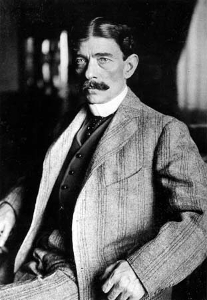
Frank Harris, Irish American editor, novelist, short story writer, journalist and publisher, is born James Thomas Harris to Welsh parents in Galway, County Galway on February 14, 1855. He is friendly with many well-known figures of his day.

Harris’s father, Thomas Vernon Harris, is a naval officer from Fishguard, Pembrokeshire, Wales. While living with his older brother he is, for a year or more, a pupil at The Royal School, Armagh. At the age of twelve he is sent to Wales to continue his education as a boarder at the Ruabon Grammar School in Denbighshire, a time he is to remember later in My Life and Loves. He is unhappy at the school and runs away within a year.

Harris runs away to the United States in late 1869, arriving in New York City virtually penniless. The 13-year-old takes a series of odd jobs to support himself, working first as a shoeshiner, a porter, a general laborer, and a construction worker on the erection of the Brooklyn Bridge. He later turns these early occupational experiences into art, incorporating tales from them into his book The Bomb (1908).

From New York Harris moves to Chicago, where he takes a job as a hotel clerk and eventually a manager. Owing to Chicago’s central place in the meat packing industry, he makes the acquaintance of various cattlemen, who inspire him to leave the big city to take up work as a cowboy. He eventually grows tired of life in the cattle industry and enrolls at the University of Kansas, where he studies law and earns a degree, gaining admission to the Kansas Bar Association.

Harris is not cut out to be a lawyer and soon decides to turn his attention to literature. He returns to England in 1882, later traveling to various cities in Germany, Austria, France, and Greece on his literary quest. He works briefly as an American newspaper correspondent before settling down in England to seriously pursue the vocation of journalism.

Harris first comes to general notice as the editor of a series of London papers including The Evening News, The Fortnightly Review and the Saturday Review, the latter being the high point of his journalistic career, with H. G. Wells and George Bernard Shaw as regular contributors.

From 1908 to 1914 Harris concentrates on working as a novelist, authoring a series of popular books such as The Bomb, The Man Shakespeare, and The Yellow Ticket and Other Stories. With the advent of World War I in the summer of 1914, he decides to return to the United States.

From 1916 to 1922 Harris edits the U.S. edition of Pearson’s Magazine, a popular monthly which combines short story fiction with socialist-tinted features on contemporary news topics. One issue of the publication is banned from the mails by United States Postmaster General Albert S. Burleson during the period of American participation in World War I. Despite this Harris manages to navigate the delicate situation which faces the left-wing press and keeps Pearson’s Magazine functioning and solvent during the war years.

Harris becomes an American citizen in April 1921. In 1922 he travels to Berlin to publish his best-known work, his four-volume autobiography My Life and Loves (1922–1927). It is notorious for its graphic descriptions of his purported sexual encounters and for its exaggeration of the scope of his adventures and his role in history. A fifth volume, supposedly taken from his notes but of doubtful provenance, is published in 1954, long after his death.

Harris also writes short stories and novels, two books on William Shakespeare, a series of biographical sketches in five volumes under the title Contemporary Portraits and biographies of his friends Oscar Wilde and George Bernard Shaw. His attempts as a playwright are less successful. Only Mr. and Mrs. Daventry (1900), which is based on an idea by Oscar Wilde, is produced on the stage.

Married three times, Harris dies of a heart attack in Nice, France on August 26, 1931. He is buried at Cimetière Sainte-Marguerite, adjacent to the Cimetière Caucade, in Nice. Just after his death a biography written by Hugh Kingsmill (pseudonym of Hugh Kingsmill Lunn) is published.


1 Comment

Archibald Hamilton Rowan Tried for Distribution of Seditious Paper

archibald-hamilton-rowan

Archibald Hamilton Rowan, a founding member of the Dublin Society of United Irishmen, is tried on a charge of distributing seditious paper on January 29, 1794.

Hamilton Rowan is born in the home of his grandfather, William Rowan, in London on May 1, 1751, and lives there with his mother and sister for much of his early life. He is admitted to Queens’ College, Cambridge in 1768, but is expelled from the college and rusticated for an attempt to throw a tutor into the River Cam. He is sent for a period in 1769 to Warrington Academy.

Hamilton Rowan travels throughout the 1770s and 1780s, visiting parts of Europe, the Americas, and North Africa. In 1781 he marries Sarah Dawson in Paris, France. The couple has ten children. He is the godfather of the Irish mathematician William Rowan Hamilton.

Hamilton Rowan returns to Ireland in his thirties, in 1784, to live at Rathcoffey near Clane in County Kildare. He becomes a celebrity and, despite his wealth and privilege, a strong advocate for Irish liberty. That same year he joins the Killyleagh Volunteers, a militia group later associated with radical reform. He first gains public attention by championing the cause of fourteen-year-old Mary Neal in 1788. Neal had been lured into a Dublin brothel and then assaulted by Lord Carhampton. Hamilton Rowan publicly denounces Carhampton and publishes a pamphlet A Brief Investigation of the Sufferings of John, Anne, and Mary Neal in the same year. An imposing figure at more than six feet tall, his notoriety grows when he enters a Dublin dining club threatening several of Mary Neal’s detractors, with his massive Newfoundland at his side and a shillelagh in hand. The incident wins him public applause and celebrity as a champion of the poor.

In 1790 Hamilton Rowan joins the Northern Whig Club, and by October has become a founding member of the Dublin Society of United Irishmen, working alongside famous radicals such as William Drennan and Theobald Wolfe Tone. He is arrested in 1792 for seditious libel when caught handing out “An Address to the Volunteers of Ireland,” a piece of United Irish propaganda. Unknown to him, from 1791 Dublin Castle has a spy in the Dublin Society, Thomas Collins, whose activity is never discovered. From February 1793 Britain and Ireland join the War of the First Coalition against France, and the United Irish movement is outlawed in 1794.

Hamilton Rowan’s reputation for radicalism and bluster grow during this time when he leaves Ireland to confront the Lord Advocate of Scotland about negative comments made in respect to his character and that of members of the Society of United Irishmen. As a prominent member of the Irish gentry, he is an important figure in the United Irishmen and becomes the contact for the Scottish radical societies as a result of his visit. Upon his return to Dublin, he is charged and was found guilty of seditious libel, even though he is excellently defended by the famous John Philpot Curran. He is sentenced to two years imprisonment, receives a fine of £500, and is forced to pay two assurities for good behaviour of £1,000 each. In January 1794 he retires to his apartments in Dublin’s Newgate Prison.

In the years following, Hamilton Rowan spends time in exile in France, the United States and Germany. He is allowed to return to Ireland in 1806. He returns to the ancestral home of Killyleagh Castle, County Down, receiving a hero’s welcome. While he has agreed to be a model citizen under the conditions of his return to Ireland, he remains active in politics and retains his youthful radicalism. Following his last public appearance at a meeting in the Rotunda in Dublin on January 20, 1829, he is lifted up by a mob and paraded through the streets.

Hamilton Rowan dies at the age of 84 in his home on November 1, 1834. He is buried in the vaults of St. Mary’s Church, Dublin.


Leave a comment

Birth of Maureen Potter, Actor & Comedienne

maureen-potter

Maria Philomena Potter, singer, actor, comedian and performer known as Maureen Potter, is born on January 3, 1925 in Fairview, Dublin.

Potter is educated at St. Mary’s school in Fairview. She has a long career in Irish theatre, mainly as Ireland’s première comedienne, but also as a straight actress. She first appears professionally with Jimmy O’Dea in pantomime and appears frequently on television and in cabaret. She is a regular performer at the Gaiety Theatre in Dublin and for many years stars in Christmas pantomime. She becomes the first star to have a bronze cast of her handprints outside the theatre. She marries Jack O’Leary in 1959, an Irish army officer whom she had first met in 1943, and he writes most of her comedic material.

Among Potter’s many dramatic roles in the theatre is that of Maisie Madigan in Juno and the Paycock. While still a teenager, she tours abroad before World War II as a singer and dancer with Jack Hylton and his orchestra. On a tour of Germany, they once perform in front of Adolf Hitler and other Nazis. She plays the role of Dante Riordan in Joseph Strick‘s film, A Portrait of the Artist as a Young Man (1977). In September 1938, she appears on the BBC Television Service with Jack Hylton and his band. Film of her performance is held by the Alexandra Palace Television Society. In 2001, the Archivist of the Alexandra Palace Television Society gives Potter a copy of her 1938 television appearance.

Potter is conferred with the Freedom of the City of Dublin in 1984, and is later awarded an honorary degree from Trinity College, Dublin. She dies in her sleep at her home in Clontarf on April 7, 2004, at the age of 79. She is survived by her husband Jack O’Leary, and her sons John and Hugh.


1 Comment

Birth of Composer Gerard Victory

gerard-victoryThe prolific Irish composer Thomas Joseph Gerard Victory is born in Dublin on December 24, 1921. He writes over two hundred works across many genres and styles, including tonal, serial, aleatoric and electroacoustic music.

Victory is the son of shop keeper Thomas Victory and his wife, Delia (née Irwin). After schooling, he reads Celtic Studies at University College Dublin and Music at Trinity College Dublin, earning a doctorate in 1972.

In April 1948 Victory marries Geraldine Herity and they have five children: Alma, Fiona, Isolde, Raymond, and Alan.

In terms of composition, Victory is mostly self-taught, although he receives some formal training from John Francis Larchet, Alan Rawsthorne and Walter Beckett. He also attends the “International Summer Courses for New Music” in Darmstadt, Germany.

In 1948 he is joint composer of music for a song in a play by Irish playwright Teresa Deevy called Light Falling. This is performed by the Abbey Experimental Theatre Company in the Peacock Theatre, Dublin.

Victory’s career is primarily in music administration, serving as Director of Music for Ireland’s national broadcasting station RTÉ from 1967 to 1982. He is a president of UNESCO‘s International Rostrum of Composers, a Fellow of the Royal Irish Academy of Music and a recipient of the French Ordre des Arts et des Lettres and the Order of Merit of the Federal Republic of Germany.

The Gerard Victory Commission is a prize named in his honour that is awarded to the most promising individual composer.

Gerard Victory dies in Dublin on March 14, 1995. His papers are held in Trinity College and a number of his scores are held at the Contemporary Music Centre.


Leave a comment

Death of Samuel Beckett, Playwright & Poet

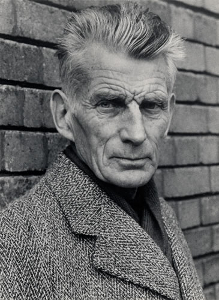
Samuel Barclay Beckett, avant-garde novelist, playwright, theatre director, and poet, dies in ParisFrance on December 22, 1989.

Beckett is born on Good Friday, April 13, 1906, in FoxrockDublin. His father, William Frank Beckett, works in the construction business and his mother, Maria Jones Roe, is a nurse. Beckett attends Earlsfort House School in Dublin and then, at age 14, he goes to Portora Royal School, the same school attended by Oscar Wilde. He receives his bachelor’s degree from Trinity College, Dublin in 1927. In his youth he periodically experiences severe depression keeping him in bed until mid-day. This experience later influences his writing.

In 1928, Beckett finds a welcome home in Paris where he meets and becomes a devoted student of James Joyce. In 1931, he embarks on a restless sojourn through Great Britain, France and Germany. He writes poems and stories and does odd jobs to support himself. On his journey, he comes across many individuals who inspire some of his most interesting characters.

In 1937, Beckett settles in Paris. Shortly thereafter, he is stabbed by a pimp after refusing his solicitations. While recovering in the hospital, he meets Suzanne Dechevaux-Dumesnuil, a piano student in Paris. The two become life-long companions and eventually marry. After meeting with his attacker, Beckett drops the charges, partly to avoid the publicity.

During World War II, Beckett’s Irish citizenship allows him to remain in Paris as a citizen of a neutral country. He fights in the resistance movement until 1942 when members of his group are arrested by the Gestapo. He and Suzanne flee to the unoccupied zone until the end of the war.

After the war, Beckett is awarded the Croix de Guerre for bravery during his time in the French resistance. He settles in Paris and begins his most prolific period as a writer. In five years, he writes EleutheriaWaiting for GodotEndgame, the novels MolloyMalone DiesThe Unnamable, and Mercier et Camier, two books of short stories, and a book of criticism.

Beckett’s first publication, Molloy, enjoys modest sales, but more importantly praise from French critics. Soon, Waiting for Godot, achieves quick success at the small Theatre de Babylone putting Beckett in the international spotlight. The play runs for 400 performances and enjoys critical praise.

Beckett writes in both French and English, but his most well-known works, written between World War II and the 1960s, are written in French. Early on he realizes his writing has to be subjective and come from his own thoughts and experiences. His works are filled with allusions to other writers such as Dante AlighieriRené Descartes, and James Joyce. Beckett’s plays are not written along traditional lines with conventional plot and time and place references. Instead, he focuses on essential elements of the human condition in dark humorous ways. This style of writing has been called “Theater of the Absurd” by Martin Esslin, referring to poet Albert Camus’ concept of “the absurd.” The plays focus on human despair and the will to survive in a hopeless world that offers no help in understanding.

The 1960s are a period of change for Beckett. He finds great success with his plays across the world. Invitations come to attend rehearsals and performances which lead to a career as a theater director. In 1961, he secretly marries Suzanne Dechevaux-Dumesnuil who takes care of his business affairs. A commission from the BBC in 1956 leads to offers to write for radio and cinema through the 1960s.

Beckett continues to write throughout the 1970s and 1980s, mostly in a small house outside Paris. There he can give total dedication to his art of evading publicity. In 1969, he is awarded the Nobel Prize in Literature, though he declines accepting it personally to avoid making a speech at the ceremonies. However, he should not be considered a recluse. He often times meets with other artists, scholars and admirers to talk about his work.

By the late 1980s, Beckett is in failing health and is moved to a small nursing home. His wife Suzanne dies on July 17, 1989. His life is confined to a small room where he receives visitors and writes. Suffering from emphysema and possibly Parkinson’s disease, he dies on December 22, 1989.


Leave a comment

Birth of Irish Language Scholar Osborn Bergin

CREATOR: gd-jpeg v1.0 (using IJG JPEG v62), quality = 100

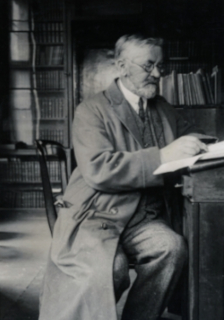
Osborn Joseph Bergin, a scholar of the Irish language and early Irish literature, is born in Cork, County Cork on November 26, 1873.

Bergin is the sixth child and eldest son of Osborn Roberts Bergin and Sarah Reddin, and is educated at Queen’s College Cork, now University College Cork. He then goes to Germany for advanced studies in Celtic languages, working with Heinrich Zimmer at the Friedrich Wilhelm University in Berlin, now the Humboldt University of Berlin, and later with Rudolf Thurneysen at the University of Freiburg, where he writes his dissertation on palatalization in 1906. He then returns to Ireland and teaches at the School of Irish Learning and at University College Dublin.

Within one year of becoming Director of the School of Irish Studies in the Dublin Institute for Advanced Studies, Bergin resigns both the senior professorship and his office of director. The reason for his resignation is never made public.

Bergin, who never uses the name Joseph except when signing with his initials, does not seem to have felt the need of institutional religion, and during his lifetime, he rarely attends religious services. He develops Irish nationalist sympathies and remains a firm nationalist all his life but without party affiliations. From the number of Irish speakers living in Cork, he quickly masters the spoken Irish of West Munster. By 1897, his knowledge of spoken and literary Modern Irish is so strong that he is appointed lecturer in Celtic in Queen’s College, Cork. It is during this time that he becomes an active member of the Gaelic League.

Bergin publishes extensively in the journal for Irish scholarship, Ériu. He is best known for his discovery of Bergin’s Law, which states that while the normal order of a sentence in Old Irish is verb-subject-object, it is permissible for the verb, in the conjunct form, to be placed at the end of the sentence. His friend Frank O’Connor writes humorously that while he discovers the law “he never really believed in it.” He writes poetry in Irish and makes a number of well-received translations of Old Irish love poetry.

Bergin is celebrated in Brian O’Nolan‘s poem Binchy and Bergin and Best, originally printed in the Cruiskeen Lawn column in The Irish Times and now included in The Best of Myles. He is noted for his feuds with George Moore and William Butler Yeats, but he enjoys a lifelong friendship with George William Russell. Frank O’Connor describes Bergin’s eccentricities affectionately in his memoir My Father’s Son.

Osborn Bergin dies in a nursing home in Dublin at the age of 76 on October 6, 1950, having never married.


Leave a comment

The Grange Ambush

grange-ambush-memorial

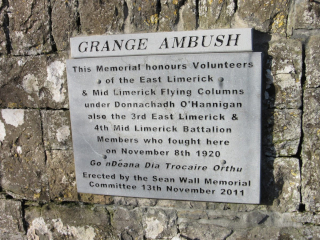
An Irish Republican Army (IRA) column mounts an ambush at Grange, County Limerick on November 8, 1920.

Approximately fifty men of 3rd Battalion East Limerick IRA parade at 5:00 AM on the cold bleak morning of November 8. They are armed with 21 rifles and 21 shotguns, plus a small quantity of explosives. It has been decided to ambush a convoy at Grange Bridge, a point about eight miles from Limerick and about four miles from Bruff. They set out and occupy positions around John O’Neill’s house. The ambush site is about four miles from the big British garrison at Bruff to the south. The IRA expects two British lorries around 9:00 AM, however, in the end eight lorries and two armoured cars arrive at noon.

It is a joint action involving the flying columns of both the 3rd Battalion East Limerick Brigade and the 4th Battalion Mid Limerick Brigade, supported by men from the local companies of Bruff, Grange and Holy Cross in the East Limerick Brigade and from the Fedamore and Ballybricken Companies of the Mid Limerick Brigade. Donnchadha O’Hannigan has overall command of the combined columns and most of the ambushers are placed in houses and behind walls on both sides of the road. Among the IRA men who take part in the action is their chaplain, the Curate at Fedamore, Fr. William Joseph Carroll, who had been awarded the Military Cross for bravery in 1918 by the British Army. Also among the attackers is Maurice Meade, who had been a member of Roger Casement‘s Irish Brigade in Germany.

Something makes the British suspicious and they send one lorry ahead as a decoy. It is bombed by the IRA and raked with small arms fire. At this point, a British armoured car appears, with an officer mounted on the running board firing a revolver and its machine gun firing at the IRA at close range. The IRA account names the officer on the running board as Lt. Watling and they believe that they wounded him and he died in the hospital at Bruff that night.

More British reinforcements appear and the IRA realises that they are up against a vastly larger force than they had anticipated, so they retreat. Apart from one minor wounded man, they have no casualties.

The Royal Fusiliers‘ account says while escorting a Royal Air Force convoy from Fermoy to Oranmore, Lieutenant Allan and thirty other ranks are ambushed at Grange, near Bruff. The rebels, however, are speedily dealt with, and a quantity of arms, ammunition and two prisoners are taken. Unfortunately, Flying Officer Watling and Bandsman Bailey are wounded, the latter seriously. The only other casualty is Private French, who is shot at when a sentry at Galbally, and has the back luck of losing his arm.


Leave a comment

Birth of Sir Oliver Plunkett, Archbishop of Armagh

oliver-plunkett

Sir Oliver Plunkett, Catholic Archbishop of Armagh and Primate of All Ireland who was the last victim of the Popish Plot, is born on November 1, 1625, in Loughcrew, County Meath, to parents of Hiberno-Norman ancestors.

Until his sixteenth year, Plunkett’s education is entrusted to his cousin Patrick Plunkett, Abbot of St. Mary’s, Dublin, and brother of Luke Plunkett, the first Earl of Fingall, who later becomes successively Bishop of Ardagh and of Meath. As an aspirant to the priesthood, he sets out for Rome in 1647.

Plunkett is admitted to the Pontifical Irish College in Rome and proves to be an able pupil. He is ordained a priest in 1654 and deputed by the Irish bishops to act as their representative in Rome. Meanwhile, the Cromwellian conquest of Ireland (1649–1653) has defeated the Roman Catholic cause in Ireland. As a result, it is impossible for Plunkett to return to Ireland for many years, so he petitions to remain in Rome. At the Congregation of Propaganda Fide on July 9, 1669, he is appointed Archbishop of Armagh and is consecrated on November 30 at Ghent. He returns to Ireland on March 7, 1670, as the English Restoration of 1660 has begun on a basis of toleration.

Plunkett sets about reorganising the ravaged Roman Church and builds schools both for the young and for clergy. The Penal Laws have been relaxed in line with the Declaration of Breda in 1660 and he is able to establish a Jesuit College in Drogheda in 1670, which becomes the first Catholic-Protestant integrated school in Ireland.

On the enactment of the Test Act in 1673, to which Plunkett does not agree for doctrinal reasons, the college is closed and demolished. Plunkett goes into hiding, travelling only in disguise, and refuses a government edict to register at a seaport to await passage into exile.

In 1678 the so-called Popish Plot, concocted in England by clergyman Titus Oates, leads to further anti-Roman Catholic action. Archbishop Peter Talbot of Dublin is arrested, and Plunkett again goes into hiding. Despite being on the run and with a price on his head, Plunkett refuses to leave his flock.

Plunkett is arrested in Dublin in December 1679 and imprisoned in Dublin Castle. He is tried at Dundalk for conspiring against the state by allegedly plotting to bring 20,000 French soldiers into the country, and for levying a tax on his clergy to support 70,000 men for rebellion. The trial soon collapses as the prosecution witnesses are themselves wanted men and afraid to appear in court. Plunkett is moved to Newgate Prison in London in order to face trial at Westminster Hall. The first grand jury finds no true bill, but he is not released. The second trial is generally regarded as a serious miscarriage of justice as Plunkett is denied defending counsel.

Archbishop Plunkett is found guilty of high treason in June 1681 “for promoting the Roman faith,” and is condemned to death. Plunkett is hanged, drawn, and quartered at Tyburn on July 1, 1681, the last Roman Catholic martyr to die in England. His body is initially buried in two tin boxes in the courtyard of St. Giles in the Fields church. The remains are exhumed in 1683 and moved to the Benedictine monastery at Lamspringe, near Hildesheim in Germany. His head is brought to Rome, and from there to Armagh, and eventually to Drogheda where it has rested in St. Peter’s Church since June 29, 1921. Most of the body is brought to Downside Abbey, England, where the major part is located today, with some parts remaining at Lamspringe.

Sir Oliver Plunkett is canonised in Rome by Pope Paul VI on October 12, 1975, the first new Irish saint in almost seven hundred years, and the first of the Irish martyrs to be beatified. For the canonisation, the customary second miracle is waived.


Leave a comment

Death of Padraic Fallon, Poet & Playwright

padraic-fallon

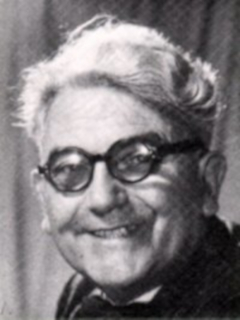
Padraic Fallon, Irish poet and playwright, dies on October 9, 1974, in Aylesford, England.

Fallon is born in Athenry, County Galway on January 3, 1905. His upbringing and his early impressions of the town and the surrounding landscape are intimately described in his poetry. After passing the civil service exams in 1923 he moves to Dublin to work in the Customs House. In Dublin he becomes part of the circle of George William Russell (Æ) who encourages his literary ambitions and arranges for the publication of his early poetry. He forms close friendships with Seumas O’Sullivan, editor of The Dublin Magazine, the poets Austin Clarke, Robert Farren, F.R. Higgins and Patrick McDonagh, and later the novelist James Plunkett.

In 1939, Fallon leaves Dublin to serve as a Customs official in County Wexford, living in Prospect House, near Wexford with his wife, Dorothea (née Maher) and his six sons. During this time, he becomes a close friend of the painter Tony O’Malley.

Fallon’s early poetry, short stories and literary criticism are published in The Dublin Magazine and The Bell. He is a regular contributor to Raidió Éireann in the 1940s and 1950s, serving variously as a journalist, scriptwriter and literary critic. A number of his short stories and early dramatic pieces are broadcast by the station during the 1940s. The first of his verse plays for radio, Diarmuid and Gráinne, is broadcast by Raidió Éireann in November 1950. This is followed by The Vision of Mac Conglinne (1953), Two Men with a Face (1953), The Poplar (1953), Steeple Jerkin (1954), The Wooing of Étain (1954), A Man in the Window (1955), Outpost (1955), Deirdre’s King (1956), The Five Stations (1957), The Hags of Clough (1957), The Third Bachelor (1958), At the Bridge Inn (1960) and Lighting up Time (1961).

Three plays adapted from Irish mythology, Diarmuid and Gráinne, The Vision of Mac Conglinne and Deirdre’s King, receive particular contemporary critical acclaim. The landscape, mythology and history of Ireland, interwoven with classical themes and religious symbolism, are frequent themes in his poetry and dramatic works. A number of Fallon’s radio plays are later broadcast on BBC Third Programme and, in translation, in Germany, the Netherlands, and Hungary. The play The Seventh Step is staged at The Globe Theatre in Dublin in 1954. A second one, Sweet Love ’till Morn, is staged at the Abbey Theatre in 1971. He also writes dramatic pieces for television such as A Sword of Steel (1966) and The Fenians (1967), the latter produced by James Plunkett. In a number of his plays and radio dramas he cooperates with contemporary composers providing incidental music, an example being The Wooing of Étain (1954) with music by Brian Boydell.

Fallon retires from the Civil Service in 1963, returning to Dublin before moving to Cornwall in 1967 to live with his son, the sculptor Conor Fallon and his daughter-in-law, the artist Nancy Wynne-Jones. He and his wife return to Ireland in 1971. He spends his last years in Kinsale. He is visiting his son Ivan Fallon in Kent at the time of his death.

While Fallon’s poetry had previously appeared in The Dublin Magazine, The Bell, The Irish Times and a number of anthologies, his first volume of collected poetry, Poems, incorporating a number of previously unpublished poems, is not produced until 1974, months before his death. Three volumes of his poetry, edited by his son, the journalist and critic Brian Fallon, are published after his death: Poems and Versions in 1983, Collected Poems in 1990, and A Look in the Mirror and Other Poems in 2003. In 2005, three of his verse plays, The Vision of Mac Conglinne, The Poplar, and The Hags of Clough, are published in a single volume. A selection of his prose writings and criticism edited by Brian Fallon, A Poet’s Journal, is published in the same year.