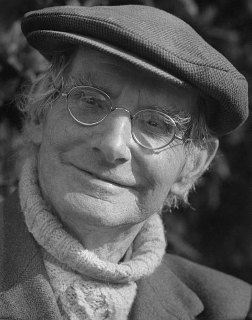
Russell is born on April 10, 1867, in Lurgan, County Armagh, in what is now Northern Ireland. He writes with the pseudonym Æ (often written AE or A.E.). He is also a writer on mysticism, and a central figure in the group of devotees of theosophy which meets in Dublin for many years. He takes his pseudonym from a proofreader’s query about his earlier pseudonym, “AEon.”
Russell is the second son of Thomas Russell and Mary Armstrong. His father, the son of a small farmer, becomes an employee of Thomas Bell and Co., a prosperous firm of linen drapers. The family relocates to Dublin, where his father has a new offer of employment, when he is eleven years old.
Following his time at the Metropolitan School of Art, Russell becomes an accounts clerk in a drapery store but leaves in 1897 to organize agricultural cooperatives. Eventually he becomes editor of the periodicals Irish Homestead (1905–23) and The Irish Statesman (1923–30). In 1894 he publishes the first of many books of verse, Homeward: Songs by the Way, which establishes him in what is known as the Irish Literary Revival. His first volume of Collected Poems appears in 1913 and a second in 1926. He maintains a lifelong interest in theosophy, the origins of religion, and mystical experience. Candle of Vision: Autobiography of a Mystic (1918) is the best guide to his religious beliefs.
At the turn of the 20th century, Russell is considered by many to be the equal of Yeats, but he does not continue to grow and develop as Yeats does. He is prolific and versatile, but many critics find his poetry facile, vague, and monotonous, with “rather too much of the Celtic Twilight” in it.
Russell, who had become increasingly unhappy in the Irish Free State which, according to Yeats, he called “a country given over to the Devil,” moves to England soon after his wife’s death in 1932. Despite his failing health he goes on a final lecture tour in the United States but returns home utterly exhausted. He dies of cancer in Bournemouth, England, on July 17, 1935. His body is brought back to Ireland, and he is interred in Mount Jerome Cemetery, Dublin.
Boland is the son of Irish Republican Brotherhood member James Boland and Kate Woods. He was active in GAA circles in early life and referees the 1914 All-Ireland Senior Football Championship Final. He joins the IRB at the same time as his older brother Gerald in 1904, following in the footsteps of his father, uncle and probably grandfather. He is educated at the Synge Street CBS, but hads a personality clash with one of the brothers so he refuses to carry on his attendance at the school. He then goes to De la Salle College, County Laois, as a novice.
Boland later joins the Irish Volunteers along with Gerry and his younger brother Ned. They take an active part in the Easter Rising of 1916.
At the 1918 Irish general election, Boland is elected as an MP for South Roscommon. In line with all the Sinn Féin MPs elected at that election, he does not take his seat in the British House of Commons but withdraws to sit in the declared independent Dáil Éireann (the First Dáil) and is named by Éamon de Valera as special envoy to the United States, a role his uncle Jack had played 25 years earlier. He leaves Ireland for the United States along with de Valera as part of a campaign to raise awareness and support for their cause in America. He negotiates a loan of $20,000 from the Irish Republic to the Russian Soviet Federative Socialist Republic through the head of the Soviet Bureau, Ludwig Martens, using some Russian jewelry as collateral. These jewels are transferred to Ireland when he returns. His sister Kathleen and her mother are entrusted with the safekeeping of jewels.
In the 1922 Irish general election, Boland is re-elected to the Dáil representing Mayo South–Roscommon South. Six weeks later, on July 31, he is shot by soldiers of the National Army when they attempt to arrest him at the Skerries Grand Hotel. Two officers enter his room and, although unarmed, he is shot and mortally wounded during a struggle.
Boland’s death affects Collins and possibly spurs him toward peace negotiations with Éamon de Valera.
Boland’s brother, Gerald Boland, is a prominent member of Fianna Fáil and later serves as Minister for Justice. His nephew, Kevin Boland, serves as a Minister until he resigns in solidarity with the two ministers, Charles Haughey and Neil Blaney, who are sacked from the government in May 1970 during the Arms Crisis. Kevin Boland’s resignation from Fianna Fáil and the subsequent loss of his seat marks the end of an era for the Boland political dynasty.
In the 1991 TV movie The Treaty, Boland is portrayed by Malcolm Douglas. In the 1996 film Michael Collins, he is portrayed by American actor Aidan Quinn. The film is criticised for fictionalising both Boland’s death and Collins’ life.
James Stephens formally establishes the Irish Republican Brotherhood (IRB) in Peter Lanigan’s timber yard, Lombard Street, Dublin, on Saint Patrick’s Day, March 17, 1858. It is originally named the Irish Revolutionary Brotherhood, but soon comes to be known as the Irish Republican Brotherhood. At the same time, John O’Mahoney is founding the American branch of the revolutionary group. O’Mahoney gives the organization the better-known name Fenians, in honor of the Fianna, the soldiers led by Fionn mac Cumhaill, the heroic warrior of Irish legend.
The IRB is a small, secret, revolutionary body whose sole object is to “establish and maintain a free and independent Republican Government in Ireland.” Stephens is a Young Irelander and is a lieutenant to William Smith O’Brien at the Battle of Widow McCormack’s Cabbage Patch in Ballingary, County Tipperary, in August 1848. He is wounded three times and is smuggled onto a ship to England and then to France, where he spends the next eight years. Upon his return to Dublin in 1856, he determines to organise a revolutionary movement and that leads to the founding of the IRB.
The IRB becomes known as the Fenian movement in the 1850s and 1860s and is committed to the use of force to establish an independent Irish republic. After organising an abortive rising in March 1867, it suffers deep internal divisions over its leadership and strategy in both the United States and Ireland—whether it is best to strike at England, in Ireland or in Canada. The issue is resolved after a series of failed interventions in Canada in 1866, 1867 and 1871, and after bombings in England that do not lead Ireland closer to independence. The IRB is unable to exploit the weaknesses and divisions in the constitutional movement following Charles Stewart Parnell’s divorce scandal (1890–91).
The IRB is eventually rejuvenated in Ireland about 1907, led by Bulmer Hobson and Tom Clarke, thus preparing the way for all that follows.The governing body is the Supreme Council. Before 1916 this consists of eleven members, and after the 1917 reorganisation it contains fifteen members. When not in session, all powers of the Supreme Council, except for declaring war, devolve onto an executive of three: the president, secretary and treasurer.
The constitution provides for the establishment of a military council, subordinate to the Supreme Council. The seven signatories of the 1916 Proclamation of the Irish Republic constitute the entire military council at the time. The constitution is dedicated to the use of force against England at any favourable opportunity, but this is to be a democratic decision: “The IRB shall await the decision of the Irish Nation as expressed by a majority of the Irish people as to the fit hour of inaugurating a war against England and shall, pending such an emergency, lend its support to every movement calculated to advance the cause of Irish independence, consistent with the preservation of its own integrity,” a clause adopted in 1873 in response to the controversies arising from the 1867 Fenian Rising.
The IRB plans the 1916 Easter Rising but the Irish Volunteers and the Irish Citizen Army make it possible. The establishment of the Irish Volunteers gives the IRB the great opportunity to train and equip its members as a military body for the purpose of securing independence for Ireland by force of arms and securing the cooperation of all Irish military bodies in the accomplishment of its objectives. Numerically the IRB probably never exceeds 2,000 members, but they are all extremely loyal and well trained, and there is very tight security. The executions of 1916 just about wipe out the Supreme Council, and after the prisoners are released, the IRB has to reconstitute itself.
Following the Easter Rising some republicans—notably Éamon de Valera and Cathal Brugha—leave the organization, which they view as no longer necessary, since the Irish Volunteers now perform its function. The IRB, during the Irish War of Independence (1919-21), is under the control of Michael Collins, who is secretary, and subsequently president, of the Supreme Council. Volunteers such as Séumas Robinson say afterwards that the IRB by then is “moribund where not already dead,” but there is evidence that it is an important force during the war.
When the Anglo-Irish Treaty is signed on December 6, 1921, it is debated by the Supreme Council, which votes to accept it by eleven votes to four. Those on the Supreme Council who oppose the Treaty include former leader Harry Boland, Austin Stack and Liam Lynch. Anti-Treaty republicans like Ernie O’Malley, who fought during the Irish Civil War against the Treaty, sees the IRB as being used to undermine the Irish Republic. The IRB becomes quiescent during the Irish Civil War, which ends in May 1923, but it emerges again later that year as a faction within the National Army that supports Minister for Defence Richard Mulcahy against the “Old IRA,” which fought against the recruitment of ex-British Army personnel and the demobilization of old IRA men. This comes to a head with the Irish Army Mutiny of 1924, in the wake of which Mulcahy resigns and other IRB members of the army are dismissed by acting President of the Executive CouncilKevin O’Higgins. The IRB subsequently dissolves itself, although it is not known whether a formal decision is taken, or it simply ceases to function.
The Irish Citizen Army also becomes involved in the battle, supporting the anti-Treaty IRA in the O’Connell Street area. The fighting begins with an assault by Provisional Government forces on the Four Courts building and ends in a decisive victory for the Provisional Government.
On April 14, 1922, about 200 Anti-Treaty IRA militants, with Rory O’Connor as their spokesman, occupy the Four Courts in Dublin, resulting in a tense stand-off. They want to spark a new armed confrontation with the British, which they hope will bring down the Anglo-Irish Treaty, unite the two factions of the IRA against their former common enemy and restart the fight to create an all-Ireland Irish Republic. At the time the British Army still has thousands of soldiers concentrated in Dublin, awaiting evacuation.
Winston Churchill and the British cabinet have been applying pressure on the Provisional Government to dislodge the rebels in the Four Courts, as they consider their presence a violation of the Treaty. Such pressure falls heaviest on Michael Collins, President of the Provisional Government Cabinet and effective head of the regular National Army. Collins, a chief IRA strategist during the War of Independence from Britain, has resisted giving open battle to the anti-Treaty militants since they occupied Four Courts in April. His colleagues in the Provisional Government Cabinet, including Arthur Griffith, agree that Collins must mount decisive military action against them.
In June 1922 the Provisional Government engages in intense negotiations with the British Cabinet over a draft Constitution that seeks to avert the impending civil war. They particularly seek to remove the requirement of an oath to the British Crown by all members of the Dublin government, a key point of contention with anti-Treaty partisans. However, the conservative British Cabinet refuses to cooperate. The pro-treaty element of Sinn Féin wins the elections on June 16.
Following the assassination of Sir Henry Wilson in London on June 22, 1922, and the arrest by Four Courts troops of National Army Deputy Chief of Staff Gen. J. J. “Ginger” O’Connell, British pressure on the Provisional Government intensifies. The British now threaten to invade and re-occupy all of Ireland. On June 27 the Provisional Government Cabinet agrees on an ultimatum to the Four Courts garrison to evacuate or face immediate military action.
Churchill offers a loan of British artillery for use by the National Army, along with 200 shells from their store of 10,000 at Kilmainham, three miles away. It is possible that some British special troops are also covertly loaned. Two 18-pounder field guns are placed on Bridge Street and Winetavern Street, across the River Liffey from the Four Courts complex. After an ultimatum is delivered to the anti-Treaty garrison in the early hours of June 28, the National Army commences the bombardment of Four Courts.
No authoritative record exists regarding the order to commence bombardment. Historians tend to attribute the order to Collins, but some biographers dispute this. Anti-Treaty survivors allege that they are preparing for an 8:00 a.m. evacuation when the bombardment begins at 4:00 a.m.
Inside the building are 12 members of the Irish Republican Army Executive, including Chief of StaffJoe McKelvey, Director of Engineering Rory O’Connor, Quartermaster General Liam Mellows and Director of Operations Ernie O’Malley. The garrison consists of roughly 180 men drawn from the 1st and 2nd Battalions of the IRA’s 1st Dublin Brigade, commanded by Commandant Paddy O’Brien, armed for the most part only with small arms apart from one captured armoured car, which they name “The Mutineer.” The members of the IRA Army Executive are the political leaders of the garrison but serve as common soldiers under the command of O’Brien. The Anti-Treaty side fortifies the Four Courts to some extent, planting mines around the complex and barricading the doors and windows, but their leadership orders them not to fire first, in order to retain the moral high ground, and so the Free State troops are allowed to surround the Four Courts.
After the first day’s bombardment proves ineffective, the British give the Free State two more 18-pounder cannon and proffer 60-pounder howitzers along with an offer to bomb the Four Courts from the air. Collins turns down the latter two offers because of the risk of causing heavy civilian casualties. On June 29, Free State troops storm the eastern wing of the Four Courts, losing three killed and 14 wounded and taking 33 prisoners. The republicans’ armoured car is disabled and abandoned by its crew. Early the next day O’Brien is injured by shrapnel and O’Malley takes over military command in the Four Courts. By this time the shelling has caused the Four Courts to catch fire. In addition, orders arrive from Oscar Traynor, the anti-treaty IRA commander in Dublin, for the Four Courts garrison to surrender, as he cannot reach their position to help them. O’Malley rules this order invalid, as the Four Courts is a GHQ operation. However, in view of the rapidly deteriorating situation, at 3:30 p.m. on June 30, O’Malley surrenders the Four Courts to Brigadier GeneralPaddy Daly of the Free State’s Dublin Guard unit. Three of the republican garrison die in the siege.
Several hours before the surrender, the Public Record Office of Ireland (PRO) block located in the western block of the Four Courts, which is used as an ammunition store by the Four Courts garrison, is the centre of a huge explosion, destroying Irish state records going back to the Anglo-Norman conquest. Forty advancing Free State troops are badly injured. Assigning blame for the explosion remains controversial. It is alleged by the National Army Headquarters that the Anti-treaty forces deliberately booby-trapped the PRO to kill advancing Free State troops. Tim Healy, a government supporter, later claims that the explosion is the result of land mines laid before the surrender, which explode after the surrender. However, a study of the battle concludes that the explosion is caused by fires ignited by the shelling of the Four Courts, which eventually reach two truckloads of gelignite in the munitions factory. A towering mushroom cloud rises 200 feet over the Four Courts.
At this stage in the battle troops on each side still have a sense of kinship with the other, as most of them had fought together in the Irish Republican Army during the Irish War of Independence. By appealing to friends on the Free State side, several anti-Treaty leaders among the Four Courts garrison, notably Ernie O’Malley and Seán Lemass, escape from captivity to continue the fight.
Despite the Free State force’s success in taking the Four Courts, fighting continues in Dublin until July 5. On June 29 anti-Treaty IRA units from the Dublin Brigade led by Oscar Traynor have occupied O’Connell Street, part of Parnell Square, York Street and some of other locations to try to distract Free State attention from their attack on the Four Courts. Not all the IRA units in the capital are prepared to fight against the new Irish government, however, and their numbers are probably about 500 throughout the city. Their numbers are supplemented by about 150 Citizen Army men and women who bring with them arms and ammunition dumped since the insurrection of Easter 1916.
The republicans occupy the northeastern part of O’Connell Street, with their strong point at “the block,” a group of buildings that the Anti-Treatyites had connected by tunneling through the walls. They had also taken over the adjoining Gresham, Crown, Granville and Hammam hotels. Their only position on the western side of the street is in the YMCA building. Additionally, they have an outpost south of the River Liffey at the Swan Pub on Aungier Street. Oscar Traynor apparently hopes to receive reinforcements from the rest of the country, but only Anti-Treaty units in Belfast and Tipperary reply and both of them arrive too late to take part in the fighting.
The Provisional Government troops, commanded by General Tom Ennis, start by clearing out the outlying anti-treaty garrisons, which is accomplished by July 1. They then draw a tighter cordon around O’Connell Street. Artillery is used to drive the Anti-Treaty fighters out of positions on Parnell Street and Gardiner Street, which gives the Free State troops a clear field of fire down O’Connell Street.
The republican outpost in the YMCA is eliminated when Free State troops tunnel underneath it and detonate a bomb. Traynor’s men in “the block” hold out until artillery is brought up, under the cover of armored cars, to bombard them at point-blank range. Incendiary bombs are also planted in the buildings. Traynor and most of his force make their escape when the buildings they are occupying catch fire. They mingle with civilian crowds and make their way to Blessington.
Left behind is Republican leader Cathal Brugha and a rear guard of 15 men, who stay behind in the Hammam Hotel after Traynor, and most other IRA men have left. At 5:00 p.m. on July 5, when the fires make the hotel untenable, Brugha orderes his men to surrender. He, however, stays behind, only to emerge from the building alone, armed with a revolver. He is shot in the thigh by Free State troops and dies later from blood loss. There are some further sporadic incidents of fighting around the city as Free State troops disperse anti-treaty IRA groups.
Cathal Brugha is the last casualty in the Battle of Dublin, which costs the lives of at least 80 people (15 anti-Treaty IRA Volunteers, 29 National Army soldiers, one British Royal Air Force serviceman and 35 civilians) and over 280 wounded. In addition, the Free State takes over 450 Republican prisoners. The high civilian casualties are doubtless the result of the use of heavy weapons, especially artillery, in a densely populated urban area.
When the fighting in Dublin dies down, the Free State government is left firmly in control of the Irish capital and the anti-treaty forces disperse around the country. Roundups after the fighting result in more Republican prisoners and the death of prominent anti-Treaty activist Harry Boland who is shot dead in Skerries, Dublin, on July 31.
Oscar Traynor, Ernie O’Malley and the other anti-Treaty fighters who escape the fighting in Dublin regroup in Blessington, around 30 km southwest of the city. An anti-Treaty IRA force from County Tipperary had arrived there but too late to participate in the Dublin fighting. Instead, this force heads south and takes a string of towns, including Enniscorthy and Carlow, but quickly abandons them when faced with superior Free State forces. Most of the Republicans then retreat further south to the so-called Munster Republic, territory southwest of a line running from Limerick to Waterford. This in turn is taken by the Free State in an offensive from July to August 1922.
Four of the Republican leaders captured in the Four Courts, Rory O’Connor, Liam Mellows, Joe McKelvey and Richard Barrett, are later executed by the government in reprisal for the Anti-Treaty side’s killing of TDSeán Hales. The street where Cathal Brugha is killed is later renamed Cathal Brugha Street in his honour.
Russell is the second son of Thomas Russell and Mary Armstrong. His father, the son of a small farmer, becomes an employee of Thomas Bell and Co., a prosperous firm of linen drapers. The family relocates to Dublin, where his father has a new offer of employment, when he is eleven years old.
Following his time at the Metropolitan School of Art, Russell becomes an accounts clerk in a drapery store but leaves in 1897 to organize agricultural cooperatives. Eventually he becomes editor of the periodicals Irish Homestead (1905–23) and The Irish Statesman (1923–30). In 1894 he publishes the first of many books of verse, Homeward: Songs by the Way, which establishes him in what is known as the Irish Literary Revival. His first volume of Collected Poems appears in 1913 and a second in 1926. He maintains a lifelong interest in theosophy, the origins of religion, and mystical experience. Candle of Vision: Autobiography of a Mystic (1918) is the best guide to his religious beliefs.
At the turn of the 20th century, Russell is considered by many to be the equal of Yeats, but he does not continue to grow and develop as Yeats does. He is prolific and versatile, but many critics find his poetry facile, vague, and monotonous, with “rather too much of the Celtic Twilight” in it.
Russell, who had become increasingly unhappy in the Irish Free State which, according to Yeats, he called “a country given over to the Devil,” moves to England soon after his wife’s death in 1932. Despite his failing health he goes on a final lecture tour in the United States but returns home utterly exhausted. He dies of cancer in Bournemouth, England, on July 17, 1935. His body is brought back to Ireland, and he is interred in Mount Jerome Cemetery, Dublin.
The son of a docker, Doherty is born into an Irish republican family, his grandfather being a member of the Irish Citizen Army which fought against British rule in the 1916 Easter Rising. Doherty leaves school at the age of 14 and begins work on the docks and as an apprentice plumber, before being arrested in 1972 on his seventeenth birthday under the Special Powers Act. He is interned on the prison ship HMS Maidstone and at Long Kesh Detention Centre, and while interned hears of the events of Bloody Sunday in Derry, where 14 civil rights protesters were shot dead by the British Army. This leads to him joining the IRA after he is released in June 1972. In the mid-1970s he is convicted of possession of explosives and sentenced to six years imprisonment in Long Kesh. He is released in December 1979.
After his release, Doherty becomes part of a four-man active service unit nicknamed the “M60 gang” due to their use of an M60 heavy machine gun, along with Angelo Fusco and Paul Magee. On April 9, 1980, the unit lures the Royal Ulster Constabulary (RUC) into an ambush on Stewartstown Road, killing one constable and wounding two others. On May 2 the unit is planning another attack and has taken over a house on Antrim Road, when an eight-man patrol from the Special Air Service (SAS) arrive in plain clothes, after being alerted by the RUC. A car carrying three SAS members goes to the rear of the house, and another car carrying five SAS members arrives at the front of the house. As the SAS members at the front of the house exit the car, the IRA unit opens fire with the M60 machine gun from an upstairs window, hitting Captain Herbert Westmacott in the head and shoulder. Westmacott, who is killed instantly, is the highest-ranking member of the SAS killed in Northern Ireland. The remaining SAS members at the front, armed with Colt Commando automatic rifles, submachine guns and Browning pistols, return fire but are forced to withdraw. Magee is apprehended by the SAS members at the rear of the house while attempting to prepare the IRA unit’s escape in a transit van, while the other three IRA members remain inside the house. More members of the security forces are deployed to the scene and, after a brief siege, the remaining members of the IRA unit surrender.
The trial of Doherty and the other members of the M60 gang begins in early May 1981, on charges including three counts of murder. On June 10, Doherty and seven other prisoners, including Angelo Fusco and the other members of the IRA unit, take a prison officer hostage at gunpoint in Crumlin Road Gaol. After locking the officer in a cell, the eight take other officers and visiting solicitors hostage, also locking them in cells after taking their clothing. Two of the eight wear officers’ uniforms while a third wears clothing taken from a solicitor, and the group moves towards the first of three gates separating them from the outside world. They take the officer on duty at the gate hostage at gunpoint and force him to open the inner gate. An officer at the second gate recognises one of the prisoners and runs into an office and presses an alarm button, and the prisoners run through the second gate towards the outer gate. An officer at the outer gate tries to prevent the escape but is attacked by the prisoners, who escape onto Crumlin Road. As the prisoners are moving towards the car park where two cars are waiting, an unmarked RUC car pulls up across the street outside Crumlin Road Courthouse. The RUC officers open fire, and the prisoners return fire before escaping in the waiting cars. Two days after the escape, Doherty is convicted in absentia and sentenced to life imprisonment with a minimum recommended term of thirty years.
Doherty escapes across the border into the Republic of Ireland, and then travels to the United States on a false passport. He lives with an American girlfriend in Brooklyn and New Jersey, working on construction sites and as a bartender at Clancy’s Bar in Manhattan, where he is arrested by the Federal Bureau of Investigation (FBI) on June 28, 1983. He is imprisoned in the Metropolitan Correctional Center in Manhattan, and a legal battle ensues with the British government seeking to extradite him back to Northern Ireland. Doherty claims he is immune from extradition as the killing of Westmacott was a political act, and in 1985 federal judge John E. Sprizzo rules Doherty cannot be extradited as the killing was a “political offense.” His legal battle continues as the United States Department of Justice then attempts to deport him for entering the country illegally.
Doherty remains in custody at the Metropolitan Correctional Center and attempts to claim political asylum, and June 15, 1988, the United States Attorney GeneralEdwin Meese overturns an earlier ruling by the Federal Board of Immigration Appeals that Doherty can be deported to the Republic of Ireland and orders his deportation to Northern Ireland. In February 1989 new Attorney General Dick Thornburgh chooses not to support the decision made by his predecessor and asks lawyers for Doherty and the Immigration and Naturalization Service to submit arguments for a review of the decision and Doherty’s claim for asylum. By this time Doherty’s case is a cause célèbre with his sympathisers including over 130 Congressmen and a son of then President of the United StatesGeorge H. W. Bush, and in 1990 a street corner near the Metropolitan Correctional Center is named after him.
Larkin is born to Irish parents in Liverpool, England, on January 21, 1876. He and his family later move to a small cottage in Burren, County Down. Growing up in poverty, he receives little formal education and begins working in a variety of jobs while still a child.
In 1905, Larkin is one of the few foremen to take part in a strike on the Liverpool docks. He is elected to the strike committee, and although he loses his foreman’s job as a result, his performance so impresses the National Union of Dock Labourers (NUDL) that he is appointed a temporary organiser.
Larkin moves to Belfast in 1907 to organise the city’s dock workers for the NUDL. He succeeds in unionising the workforce, and as employers refuse to meet the wage demands, he calls the dockers out on strike in June. Carters and coal men soon join in, the latter settling their dispute after a month.
In 1908, Larkin moves south and organises workers in Dublin, Cork, and Waterford, with considerable success. His involvement, against union instructions, in a dispute in Dublin results in his expulsion from the NUDL. The union later prosecutes him for diverting union funds to give strike pay to Cork workers engaged in an unofficial dispute. After trial and conviction for embezzlement in 1910, he is sentenced to prison for a year. This is widely regarded as unjust, and the Lord Lieutenant of Ireland, Lord Aberdeen, pardons him after he has served three months in prison.
After his expulsion from the NUDL, Larkin founds the Irish Transport and General Workers’ Union (ITGWU) at the end of December 1908. The organisation exists today as the Services Industrial Professional & Technical Union (SIPTU). In early 1909, Larkin moves to Dublin, which becomes the main base of the ITGWU and the focus of all his future union activity in Ireland.
In June 1911, Larkin establishes a newspaper, The Irish Worker and People’s Advocate, as a pro-labour alternative to the capitalist-owned press. In 1912, in partnership with James Connolly, Larkin helps form the Irish Labour Party.
In early 1913, Larkin achieves some successes in industrial disputes in Dublin. Two major employers, Guinness and the Dublin United Tramway Company, are the main targets of Larkin’s organising ambitions. The chairman of the Dublin United Tramway Company, industrialist and newspaper proprietor William Martin Murphy, is determined not to allow the ITGWU to unionise his workforce. On August 15, he dismisses 40 workers he suspects of ITGWU membership, followed by another 300 over the next week. On August 26, 1913, the tramway workers officially go on strike.
The resulting industrial dispute is the most severe in Ireland’s history. Employers in Dublin engage in a sympathetic lockout of their workers when the latter refuses to sign the pledge, employing blackleg labour from Britain and from elsewhere in Ireland. Guinness, the largest employer in Dublin, refuses the employers’ call to lock out its workers but it sacks 15 workers who struck in sympathy.
For seven months the lockout affects tens of thousands of Dublin workers and employers, with Larkin portrayed as the villain by Murphy’s three main newspapers, the Irish Independent, the Sunday Independent, and the Evening Herald, and by other bourgeois publications in Ireland. The lockout eventually concludes in early 1914 when calls by James Connolly and Larkin for a sympathetic strike in Britain are rejected by the British Trades Union Congress (TUC). Larkin’s attacks on the TUC leadership for this stance also lead to the cessation of financial aid to the ITGWU.
Some months after the lockout ends, Larkin leaves for the United States. He intends to recuperate from the strain of the lockout and raise funds for the union. Once there he becomes a member of the Socialist Party of America and is involved in the Industrial Workers of the World union (the Wobblies). He becomes an enthusiastic supporter of the Soviet Union and is expelled from the Socialist Party of America in 1919 along with numerous other sympathisers of the Bolsheviks during the Red Scare of that year.
Upon his return to Ireland in April 1923, Larkin receives a hero’s welcome and immediately sets about touring the country meeting trade union members and appealing for an end to the Irish Civil War. In September 1923, Larkin forms the Irish Worker League (IWL), which is soon afterwards recognised by the Communist International as the Irish section of the world communist movement.
James Larkin dies in his sleep on January 30, 1947, in the Meath Hospital in Dublin. Fr. Aloysius Travers, OFM, who had administered last rites to James Connolly in 1916, also administers extreme unction to Larkin. His funeral mass is celebrated by the Catholic Archbishop of Dublin, John Charles McQuaid, who had visited him in hospital before he died, and thousands line the streets of the city as the hearse passes through on the way to Glasnevin Cemetery.
Today a statue of “Big Jim” stands on O’Connell Street in Dublin, completed by Oisín Kelly and unveiled in 1979.
O’Rahilly is born in Ballylongford, County Kerry to Richard Rahilly, a grocer, and Ellen Rahilly (née Mangan). He has two siblings who live to adulthood, Mary Ellen “Nell” Humphreys (née Rahilly) and Anno O’Rahilly, both of whom are active in the Irish revolutionary period. He is educated in Clongowes Wood College (1890–1893). As an adult, he becomes a republican and a language enthusiast. He joins the Gaelic League and becomes a member of An Coiste Gnotha, its governing body. He is well traveled, spending at least a decade in the United States and in Europe before settling in Dublin.
In 1913 O’Rahilly is a founding member of the Irish Volunteers, who organize to work for Irish independence and resist the proposed Home Rule. He serves as the IV Director of Arms. He personally directs the first major arming of the Irish Volunteers, the landing of 900 Mausers at the Howth gun-running on July 26, 1914.
O’Rahilly is not party to the plans for the Easter Rising, nor is he a member of the Irish Republican Brotherhood (IRB), but he is one of the main people who trains the Irish Volunteers for the coming fight. The planners of the Rising go to great lengths to prevent those leaders of the Volunteers who are opposed to unprovoked, unilateral action from learning that a rising is imminent, including its Chief-of-Staff Eoin MacNeill, Bulmer Hobson, and O’Rahilly. When Hobson discovers that an insurrection is planned, he is kidnapped by the Military Council leadership.
Learning this, O’Rahilly goes to Patrick Pearse‘s school, Scoil Éanna, on Good Friday. He barges into Pearse’s study, brandishing his revolver as he announces, “Whoever kidnaps me will have to be a quicker shot!” Pearse calms him down, assuring him that Hobson is unharmed and will be released after the rising begins.
O’Rahilly takes instructions from MacNeill and spends the night driving throughout the country, informing Volunteer leaders in Cork, Kerry, Tipperary, and Limerick that they are not to mobilise their forces for planned manoeuvres on Sunday.
Arriving home, O’Rahilly learns that the Rising is about to begin in Dublin on the following day, Easter Monday, April 24, 1916. Despite his efforts to prevent such action, he sets out to Liberty Hall to join Pearse, James Connolly, Thomas MacDonagh, Tom Clarke, Joseph Plunkett, Countess Markievicz, Seán Mac Diarmada, Éamonn Ceannt and their Irish Volunteers and Irish Citizen Army troops. Arriving in his De Dion-Bouton motorcar, he gives one of the most quoted lines of the rising – “Well, I’ve helped to wind up the clock…I might as well hear it strike!” His car is used to fetch supplies during the siege and later as part of a barricade on Prince’s Street, where it is burned out.
O’Rahilly fights with the GPO garrison during Easter Week. One of the first British prisoners taken in the GPO is Second Lieutenant AD Chalmers, who is bound with telephone wire and lodged in a telephone box by the young Volunteer Captain and IRB activist, Michael Collins. Chalmers later recalls O’Rahilly’s kindness to him. In a statement to a newspaper reporter, he says that he was taken from the phone box after three hours and brought up to O’Rahilly, who ordered, “I want this officer to watch the safe to see that nothing is touched. You will see that no harm comes to him.”
On Friday, April 28, with the GPO on fire, O’Rahilly volunteers to lead a party of men along a route to Williams and Woods, a factory on Great Britain Street, now Parnell Street. A British machine gun at the intersection of Great Britain and Moore streets cuts him and several of the others down. He slumps into a doorway on Moore Street, wounded and bleeding badly but, hearing the English marking his position, makes a dash across the road to find shelter in Sackville Lane, now O’Rahilly Parade. He is wounded diagonally from shoulder to hip by sustained fire from the machine-gunner.
According to ambulance driver Albert Mitchell in a witness statement more than 30 years later, O’Rahilly still clung to life 19 hours after being severely wounded, long after the surrender had taken place on Saturday afternoon.
Desmond Ryan‘s The Rising: The Complete Story of Easter Week maintains that it “was 2:30 PM when Miss O’Farrell reached Moore Street, and as she passed Sackville Lane again, she saw O’Rahilly’s corpse lying a few yards up the laneway, his feet against a stone stairway in front of a house, his head towards the street.”
The United Kingdom declares martial law in Ireland for one month on April 25, 1916, the day after the commencement of the Easter Rising. A curfew is imposed from 8:30 PM until 5:00 AM. Anyone spotted on the streets during the hours of darkness are to be shot on sight. The trams stop running at 7:00 PM and the theatres and cinemas close by 8:00 PM. Those rushing for trams leaving the city centre have to pass through a stop-and-search military cordon.
With vastly superior numbers and artillery, the British army quickly suppresses the Rising and Pearse agrees to an unconditional surrender on Saturday, April 29, 1916. Most of the leaders are executed following courts-martial, but the Rising succeeds in bringing physical force republicanism back to the forefront of Irish politics. Support for republicanism continues to rise in Ireland in the context of the ongoing war in Europe and the Middle East and revolutions in other countries, and especially as a result of the Conscription Crisis of 1918 and the failure of the British-sponsored Irish Convention.
Seán O’Casey, Irish playwright renowned for realistic dramas of the Dublin slums in war and revolution, in which tragedy and comedy are juxtaposed in a way new to the theatre of his time, is born at 85 Upper Dorset Street in Dublin on March 30, 1880.
Born as John Casey into a lower middle-class Irish Protestant family, his father dies when he is six, and thereafter the family becomes progressively poorer. With only three years of formal schooling, he educates himself by reading. He starts work at 14, mostly at manual labour, including several years with the Irish railways.
O’Casey becomes caught up in the cause of Irish nationalism, and he changes his name to its Irish form and learns the Irish language. His attitudes are greatly influenced by the poverty and squalor he witnesses in Dublin’s slums and by the teachings of the Irish labour leader Jim Larkin. He becomes active in the labour movement and writes for The Irish Worker. He also joins the Irish Citizen Army, a paramilitary arm of the Irish labour unions, and draws up its constitution in 1914. At this time, he becomes disillusioned with the Irish nationalist movement because its leaders put nationalist ideals before socialist ones. He does not take part in the 1916 Easter Rising against the British authorities.
Disgusted with the existing political parties, he turns his energies to drama. His tragicomedies reflect in part his mixed feelings about his fellow slum dwellers, seeing them as incapable of giving a socialist direction to the Irish cause but at the same time admirable for their unconquerable spirit.
After several of his plays have been rejected, the Abbey Theatre in Dublin produces The Shadow of a Gunman (1923), set during the guerrilla warfare between the Irish Republican Army and British forces. In 1924 the Abbey stages Juno and the Paycock, his most popular play, set during the period of civil war over the terms of Irish independence. The Plough and the Stars (1926), with the 1916 Easter Rising as its background, causes riots at the Abbey by patriots who think the play denigrates Irish heroes. When first produced in the 1920s, these plays have an explosive effect on the audiences at the Abbey and help to enlarge the theatre’s reputation.
O’Casey goes to England in 1926, meets the Irish actress Eileen Carey Reynolds, marries her, and henceforth makes England his home. His decision to live outside Ireland is motivated in part by the Abbey’s rejection of The Silver Tassie, a partly Expressionist antiwar drama produced in England in 1929. Another Expressionist play, Within the Gates (1934), follows, in which the modern world is symbolized by the happenings in a public park. The Star Turns Red (1940) is an antifascist play, and the semiautobiographical Red Roses for Me (1946) is set in Dublin at the time of the Irish railways strike of 1911.
O’Casey’s later plays, given to fantasy and ritual and directed against the life-denying puritanism he believes has beset Ireland, include Cock-a-Doodle Dandy (1949), The Bishop’s Bonfire (1955), and The Drums of Father Ned (1958). His last full-length play is a satire on Dublin intellectuals, Behind the Green Curtains, published in 1961.
O’Casey’s three indisputably great plays are The Shadow of a Gunman, Juno and the Paycock, and The Plough and the Stars. All are tragicomedies set in the slums of Dublin during times of war and revolution. Violent death and the everyday realities of tenement life throw into relief the blustering rhetoric and patriotic swagger of men caught up in the struggle for Irish independence. The resulting ironic juxtapositions of the comic and tragic reveal the waste of war and the corrosive effects of poverty. His gifts are for vivid characterization and working-class language and, though he portrays war and poverty, he writes some of the funniest scenes in modern drama. His later plays are not considered as powerful or moving as his earlier realistic plays. In his later plays he tends to abandon vigorous characterization in favour of expressionism and symbolism, and sometimes the drama is marred by didacticism.
Six volumes of O’Casey’s autobiography appeared from 1939 to 1956. They are later collected as Mirror in My House (1956) in the United States and as Autobiographies (1963) in Great Britain. O’Casey’s letters from 1910 to 1941 are edited by David Krause in two volumes (1975, 1980).




 seamus dubhghaill