seamus dubhghaill

Promoting Irish Culture and History from Little Rock, Arkansas, USA


Leave a comment

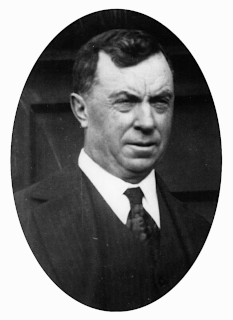
Execution of IRA Volunteer Richard “Dick” Barrett

Richard Barrett, commonly called Dick Barrett, a prominent Irish Republican Army (IRA) volunteer, is executed by a Free State forces firing squad on December 8, 1922. He fights in the Irish War of Independence and on the Anti-Treaty side in the Irish Civil War, during which he is captured and later executed.

Barrett is born on December 17, 1889, in Knockacullen (Hollyhill), Ballineen, County Cork, the son of Richard Barrett, farmer, and Ellen Barrett (née Henigan). Educated at Knocks and Knockskagh national schools, he enters the De La Salle College, Waterford, where he trains to be a teacher. Obtaining a first-class diploma, he first teaches at Ballinamult, County Waterford but then returns to Cork in early 1914 to take up a position at the St. Patrick’s Industrial School, Upton. Within months he is appointed principal of Gurrane National School. Devoted to the Irish language and honorary secretary of Knockavilla GAA club, he does much to popularise both movements in the southern and western districts of Cork. He appears to have been a member of the Cork Young Ireland Society.

From 1917, inspired by the Easter Rising, Barrett takes a prominent part in the organisation and operation of the Irish Volunteers and Irish Republican Brotherhood (IRB). By this time, he is also involved with Sinn Féin, in which role he attends the ardfheis at the Mansion House in October 1917 and the convention of the Irish Volunteers at Croke Park immediately afterwards.

Through planning and participating in raids and gunrunning episodes, Barrett comes into close contact with many GHQ staff during the Irish War of Independence, thereby ensuring his own rapid promotion. He is an active Irish Republican Army (IRA) brigade staff officer and occasionally acts as commandant of the West Cork III Brigade. He also organises fundraising activities for the purchase of weapons and for comrades on the run. In July 1920, following the arrest of the Cork III Brigade commander Tom Hales and quartermaster Pat Harte, he is appointed its quartermaster. He is arrested on March 22, 1921, and imprisoned in Cork jail, later being sent to Spike Island, County Cork.

As one of the senior officers held in Spike Island, Barrett is involved in many of the incidents that occur during his time there. After the truce is declared on July 11, 1921, some prisoners go on hunger strike, but he calls it off after a number of days on instructions from outside as a decision had been made that able-bodied men are more important to the cause. In November, Barrett escapes by rowboat alongside Moss (Maurice) Twomey, Henry O’Mahoney, Tom Crofts, Bill Quirke, Dick Eddy and Paddy Buckley.

Following the Irish War of Independence, Barrett supports the Anti-Treaty IRA‘s refusal to submit to the authority of Dáil Éireann (civil government of the Irish Republic declared in 1919). He is opposed to the Anglo-Irish Treaty and calls for the total elimination of English influence in Ireland. In April 1922, under the command of Rory O’Connor, he, along with 200 other hardline anti-treaty men, take over the Four Courts building in the centre of Dublin in defiance of the new Irish government. They want to provoke British troops, who are still in the country, into attacking them. They hope this will restart the war with Britain and reunite the IRA against their common enemy. Michael Collins tries desperately to persuade O’Connor and his men to vacate the building. However, on June 28, 1922, after the Four Courts garrison had kidnapped J. J. O’Connell, a general in the new National Army, Collins’s soldiers shell the Four Courts with British artillery to spark off what becomes known as the Battle of Dublin. O’Connor surrenders following two days of fighting, and Barrett, with most of his comrades, is arrested and held in Mountjoy Gaol. This incident marks the official outbreak of the Irish Civil War, as fighting escalates around the country between pro- and anti-treaty factions.

After the death of Michael Collins in an ambush, a period of tit-for-tat revenge killings ensues. The government implements martial law and enacts the necessary legislation to set up military courts. In November, the government begins to execute Anti-Treaty prisoners, including Erskine Childers. In response, Liam Lynch, the Anti-Treaty Chief of Staff, gives an order that any member of the Dáil who had voted for the ‘murder legislation’ is to be shot on sight.

On December 7, 1922, Teachta Dála (TD) Sean Hales is killed by anti-Treaty IRA men as he leaves the Dáil. Another TD, Pádraic Ó Máille, is also shot and badly wounded in the incident. An emergency cabinet meeting is allegedly held the next day to discuss the assassination of Hales. It is proposed that four prominent members of the Anti-Treaty side currently held as prisoners be executed as a reprisal and deterrent. The names put forward were Barrett, O’Connor, Liam Mellows and Joe McKelvey. It is alleged that the four are chosen to represent each of the four provinces – Munster, Connacht, Leinster and Ulster respectively, but none of the four is actually from Connacht. The executions are ordered by Minister for Justice Kevin O’Higgins. At 2:00 AM on the morning of December 8, 1922, Barrett is awoken along with the other three and informed that they are all to be executed at 8:00 that morning.

Ironies stack one upon the other. Barrett is a member of the same IRA brigade as Hales during the Anglo-Irish War, and they were childhood friends. O’Connor had been best man at O’Higgins’ wedding a year earlier. The rest of Sean Hales’ family remains staunchly anti-Treaty, and publicly denounces the executions. In reprisal for O’Higgins’ role in the executions, the Anti-Treaty IRA kills his father and burns his family home in Stradbally, County Laois. O’Higgins himself dies by an assassin’s hand on July 10, 1927.

The executions stun Ireland, but in terms of halting the Anti-Treaty assassination policy, they have the desired effect. The Free State government continues to execute enemy prisoners, and 77 official executions take place by the end of the war.

Barrett is now buried in his home county, Cork, following exhumation and reinternment by a later government. A monument is erected by old comrades of the West Cork Brigade, the First Southern Division, IRA, and of the Four Courts, Dublin, garrison in 1922 which is unveiled on December 13, 1952, by the Tánaiste Seán Lemass.

A poem about the execution is written by County Galway clergyman Pádraig de Brún.


Leave a comment

Founding of the 32 County Sovereignty Movement

The 32 County Sovereignty Movement, often abbreviated to 32CSM or 32csm, is an Irish republican group founded by Bernadette Sands McKevitt on December 7, 1997, at a meeting of like-minded Irish republicans in Finglas, Dublin. It does not contest elections but acts as an advocacy group, with branches or cumainn organised throughout the traditional counties of Ireland.

The 32CSM has been described as the “political wing” of the now defunct Real Irish Republican Army (RIRA), but this is denied by both organisations. The group originates in a split from Sinn Féin over the Mitchell Principles.

Those present at the initial meeting are opposed to the direction taken by Sinn Féin and other mainstream republican groups in the Northern Ireland peace process, which leads to the Belfast Agreement (also known as the Good Friday Agreement) the following year. The same division in the republican movement leads to the paramilitary group now known as the Real IRA breaking away from the Provisional Irish Republican Army at around the same time.

Most of the 32CSM’s founders had been members of Sinn Féin. Some had been expelled from the party for challenging the leadership’s direction, while others felt they had not been properly able to air their concerns within Sinn Féin at the direction its leadership had taken. Bernadette Sands McKevitt, wife of Michael McKevitt and a sister of hunger striker Bobby Sands, is a prominent member of the group until a split in the organisation.

The name refers to the 32 counties of Ireland which are created during the Lordship and Kingdom of Ireland. With the partition of Ireland in 1920–22, twenty-six of these counties form the Irish Free State which is abolished in 1937 and is now known as Ireland since 1949. The remaining six counties of Northern Ireland remain part of the United Kingdom. Founder Bernadette Sands McKevitt says in a 1998 interview with the Irish Mirror that people did not fight for “peace” – “they fought for independence” – and that the organisation reaffirms to the republican position in the 1919 Irish Declaration of Independence.

Before the referendums on the 1998 Good Friday Agreement, the 32CSM lodges a legal submission with the United Nations challenging British sovereignty in Ireland. The referendums are opposed by the 32CSM but are supported by 71% of voters in Northern Ireland and by 94% in the Republic of Ireland. It is reported in February 2000 that the group established a “branch” in Kilburn, London.

In November 2005, the 32CSM launches a political initiative titled Irish Democracy, A Framework for Unity.

On May 24, 2014, Gary Donnelly, a member of the 32CSM, is elected to the Derry City and Strabane District Council. In July 2014, a delegation from the 32CSM travels to Canada to take part in a six-day speaking tour. On arrival the delegation is detained and refused entry into Canada.

The 32CSM has protested against what it calls “internment by remand” in both jurisdictions in Ireland. Other protests include ones against former Democratic Unionist Party (DUP) leader Ian Paisley in Cobh, County Cork, against former British Prime Minister John Major being given the Keys to Cork city, against a visit to the Republic of Ireland by Police Service of Northern Ireland (PSNI) head Sir Hugh Orde, and against the Israeli occupation of Palestine and Anglo-American occupation of Iraq.

In 2015, the 32CSM organises a demonstration in Dundee, Scotland, in solidarity with the men convicted of shooting Constable Stephen Carroll, the first police officer to be killed in Northern Ireland since the formation of the PSNI. The organisation says the “Craigavon Two” are innocent and have been victims of a miscarriage of justice.

The group is currently considered a Foreign Terrorist Organization (FTO) in the United States, because the group is considered to be inseparable from the Real IRA, which is designated as an FTO. At a briefing in 2001, a spokesman for the U.S. Department of State states that “evidence provided by both the British and Irish governments and open-source materials demonstrate clearly that the individuals who created the Real IRA also established these two entities to serve as the public face of the Real IRA. These alias organizations engage in propaganda and fundraising on behalf of and in collaboration with the Real IRA.” The U.S. Department of State’s designation makes it illegal for Americans to provide material support to the Real IRA, requires U.S. financial institutions to block the group’s assets and denies alleged Real IRA members visas into the U.S.

The 32CSM also operates outside of the island of Ireland to some extent. The Gaughan/Stagg Cumann covers England, Scotland and Wales, and has an active relationship of mutual promotion with a minority of British left-wing groups and anti-fascist organisations. The James Larkin Republican Flute Band in Liverpool, and the West of Scotland Band Alliance, the largest section of which is the Glasgow-based Parkhead Republican Flute Band, are also supporters of the 32CSM. As of 2014, the 32CSM’s alleged paramilitary wing, the Real IRA, is reported to have been still involved in attempts to perpetrate bombings in Britain as part of the Dissident Irish Republican campaign, which has been ongoing since 1998.


2 Comments

Death of Andy O’Sullivan, IRA Intelligence Officer

Andy O’Sullivan, Intelligence Officer and regional leader in the Irish Republican Army (IRA), dies on November 22, 1923, during the 1923 Irish hunger strikes while interned in Mountjoy Prison.

O’Sullivan is a member of the Irish Republican Army and is one of three IRA men to die on hunger strike in 1923. IRA Volunteers Joseph Whitty from Wexford dies on September 2, 1923, and Denny Barry from Riverstick, County Cork, dies on November 20, 1923, in the Curragh Camp hospital. Whitty, Barry and O’Sullivan are three of the twenty-two Irish Republicans in the 20th century who die on hunger strike.

O’Sullivan is born in Denbawn, County Cavan, in 1882, the eldest of eight children. His father, Michael Sorohan, emigrates to the United States but returns to take over the family farm. O’Sullivan works on the family farm but wins a scholarship provided by the local newspaper, The Anglo-Celt, to Monaghan Agricultural College. From there he wins another scholarship to the Royal Albert College in Dublin and attends the college as a full-time student from 1907 to 1909. He graduates as one of the top students in his year and is also elected head of the student union, the highest elected position in the college. In addition, he is secretary of the college hurling team which is undefeated after fourteen games in 1909.

In 1909, O’Sullivan gets a job as an agricultural instructor in the Mallow area of County Cork. In addition to educating and advising local farmers on crops and new techniques, he also judges local agricultural shows.

O’Sullivan is a captain in the IRA in the intelligence unit during the Irish War of Independence. He begins his intelligence activities in 1917 using the code name W.N. – the last 2 letters of his first and last name.

During the Irish Civil War O’Sullivan is officer commanding (OC) Administration in the North Cork area and later in the IRA’s 1st Southern Cork Division, where he had been appointed by Liam Lynch. He dedicates his life to the establishment of an Irish Republic: “His ideal and his goal was a Republic, and he went straight ahead working to achieve it. Nothing else bothered him.” After the signing of the 1921 Anglo-Irish Treaty, he joins the anti-treaty side during the Irish Civil War.

During the Irish Civil War, O’Sullivan is arrested by Free State forces and interned in Mountjoy Prison. In 1923, after the end of the war, thousands of interned Irish republicans protest being held without trial, poor prison conditions and being treated as convicts rather than political prisoners. On October 13, 1923, Michael Kilroy, the OC of the IRA prisoners in Mountjoy Prison, announces that 300 men will go on hunger strike. This action starts the 1923 Irish hunger strikes. Within days, thousands of Irish republican prisoners are on hunger strike in multiple prisons and internment camps across Ireland. The mass hunger strike of 1923 starts at midnight on October 14, 1923. Previously, the Free State government had passed a motion outlawing the release of prisoners on hunger strike. However, because of the large numbers of Republicans on strike, at the end of October, the Government sends a delegation to speak with the IRA leadership. On November 23, 1923, the day after o’Sullivan’s death, the 41-day hunger strike is called off, setting in motion a release program for many of the prisoners. However, some are not released until as late as 1932.

O’Sullivan dies at the age of 41 on November 22, 1923, in St. Bricin’s Military Hospital, Dublin, after 40 days on hunger strike. He is buried in the republican plot in Saint Gobnait’s Cemetery, Goulds Hill, Mallow, County Cork, on November 27, 1923. His funeral cortège is reported to be a mile in length.

O’Sullivan’s name is commemorated on a statue that stands outside Cavan Courthouse in Farnham Street, Cavan, County Cavan.


4 Comments

The Wellington Barracks Attack

During the early morning hours of November 8, 1922, the Anti-Treaty Irish Republican Army (IRA) makes its most determined attack on Wellington Barracks in Dublin during the Irish Civil War.

The attack seems to be part of a general “hit-up” by the Republicans in the city. Other military barracks around the city are also attacked in the same week.

The Barracks’ orderly clerk is attending the morning parade, where National Army soldiers, mostly unarmed, are listening to the orders of the day, read by the regimental sergeant major. When he hears machine gun fire, the clerk first believes it to be practice firing. Then he sees puffs of dust spring up from the ground as bullets land around him. He throws himself to the ground.

Another soldier tells The Irish Times, “The first outburst crashed in on us just like a flash of lightning and did most of the damage. All of us that could crawled around for cover, it was simply death to walk in the square at that time.”

The IRA has occupied the upper stories and roofs of the houses across the Grand Canal, at the rear of the barracks. From there, they rake the parade square with gunfire. The sound is deafening to the stricken soldiers. One says, “It seemed as if marbles were being rained down from an immense height.”

A total of eighteen soldiers are hit. One is killed instantly and fourteen wounded, seven of whom require surgery. As the firing starts, a butcher’s van owned by one R. McGurk of Harold’s Cross is making a delivery to the barracks. The storm of bullets peppers the unfortunate deliverymen, killing their horse and mortally wounding the driver. According to the soldier, “the whole thing lasted about 15 minutes, the rest of the soldiers came out then and started some Lewis guns going.”

One hundred soldiers had been lined up on the square shoulder to shoulder. The National Army believes the IRA used a Lewis machine gun and tells the press there were up to forty attackers armed with rifles and machine guns. But in fact, IRA reports show that their squad, a party from the Dublin Brigade active service unit (ASU), led by William Roe, has only eleven men, broken up into four parties, with only two of the parties firing ninety rounds with a Thompson submachine gun and fifteen with a “Peter the Painter” Mauser automatic.

The IRA volunteers make their escape across country, through the villages of Kimmage and Crumlin, pursued by Irish Free State troops. They are seen carrying two badly wounded men of their own. The Army later claims the two were killed in the firefight, but there is no indication that this is true.

(From: “Wellington Barracks, Dublin, 1922 – A Microcosm of the Irish Civil War” by John Dorney, The Irish Story, http://www.theirishstory.com, June 2010)


Leave a comment

Birth of Edward MacLysaght, Genealogist of 20th Century Ireland

Edgeworth Lysaght, later Edward Anthony Edgeworth Lysaght, and from 1920 Edward MacLysaght (Irish: Éamonn Mac Giolla Iasachta), a genealogist of twentieth century Ireland, is born on November 6, 1887, at Flax Bourton, Somerset, England. His numerous books on Irish surnames build upon the work of Rev. Patrick Woulfe’s Irish Names and Surnames (1923).

Lysaght is born to Sidney Royse Lysaght (1856-1941), of Irish origin, a director of the family iron and steel firm John Lysaght and Co. and a writer of novels and poetry, and Katherine (died 1953), daughter of Joseph Clarke, of Waddington, Lincolnshire. His grandfather, Thomas Royse Lysaght, is an architect, and his great-grandfather, William Lysaght, a small landowner distantly connected with the Barons Lisle. He is named “Edgeworth Lysaght” after his father’s friend, the economist Francis Ysidro Edgeworth. He loses the sight in one eye after a childhood accident.

Lysaght is educated at Nash House preparatory school, Bristol, and Rugby School at Rugby, Warwickshire, where he is unhappy, his parents’ frequent absence due to his father’s business responsibilities necessitating travel to South America, South Africa, and Australia contributing to this. He is a contemporary there of Rupert Brooke, whose father is Lysaght’s housemaster. Eighteen months after leaving Rugby, on the advice of Francis Edgeworth, he goes to Corpus Christi College, Oxford, to study law, but, having on his own account “had a wild time as part of the smart set” and anticipating rustication after a drunken incident, he leaves after three terms.

Lysaght takes up residence in a caravan at Lahinch, County Clare, where he had previously holidayed and become friendly with local people. His father, himself strongly connected to his Irish boyhood and wanting to establish himself as a “country gentleman,” recognizes his son’s enthusiasm for Ireland and in 1909 purchases a 600-acre estate at Tuamgraney, at which Lysaght farms until 1913, introducing an electrical generator and other forms of modernization including the development of a lime kiln, nursery, and school where young men of means can learn the basics of farming. This is the beginning of a metamorphosis for him. Although of English upbringing, he dislikes the local gentry, considering them “layabout rentiers,” and prefers to make friendships amongst employees and his neighbours. He seeks to replace his English accent with a Clare accent, eschews his lack of religion of a few years before in favour of Roman Catholicism, and becomes involved in the Gaelic League.

An integral factor in Lysaght’s reinvention is his relationship with Mabel (“Maureen”) Pattison. Five years his senior, they meet when he spends a period at a Dublin hospital. She is born and raised in South Africa, her father a civil servant there, but has Irish family including a local postmistress. His family seeks to avoid what they consider an unsuitable marriage, sending him and his brother Patrick on a world tour, but the couple are nevertheless married at the Brompton Oratory on September 4, 1913. Mabel introduces him to friends in the Arts Club, and he enters Dublin literary society. His father invests £300 in Maunsell’s publishers, who produces Lysaght’s book of poems, Irish Eclogues. As of the early 1930s, he serves on the General Committee of the Munster Agricultural Society.

By 1915, Lysaght’s command of the Irish language has improved dramatically, and in that year he founds the Nua-Ghaeltacht at Raheen, County Clare. He is an independent delegate to the 1917-18 Irish Convention in which he opposes John Redmond‘s compromise on Home Rule. By 1918 his involvement in all aspects of the Irish independence movement have deepened greatly. Although not known if he is actually a member of the Irish Republican Army (IRA), he is very active in the Irish War of Independence as a supporter, financially and otherwise, of the East Clare Brigade of the IRA and its legendary leaders, Michael and Conn Brennan.

In 1920, Lysaght, along with others of the name, changes his name to “MacLysaght,” “so as to emphasise its Gaelic origin.”

MacLysaght’s Raheen office serves as a meeting place for the Volunteers and guns, documents and ammunition are stored there. However, the war leads to a sharp decline in the fortunes of his farm. The execution of close friends such as Conor Clune of Quin in November 1920 and the subsequent devastating raids on his farm result in his playing a far more active role in Sinn Féin as a loyal supporter of the new TD for Clare, Éamon de Valera. For this he is imprisoned following his return from Britain as part of a Sinn Féin delegation which is publicising the Black and Tans atrocities.

MacLysaght is elected to the Free State Seanad Éireann in 1922. He is appointed Inspector for the Irish Manuscripts Commission in 1938. He is elected to the Royal Irish Academy in 1942 and in the same year is awarded a Doctor of Letters (D.Litt). He is appointed Chief Herald of Ireland in 1943 and serves in this post until 1954. He serves as Keeper of Manuscripts at the National Library of Ireland from 1948 to 1954 and is Chairman of the Irish Manuscripts Commission from 1956 to 1973.

MacLysaght dies at the age of 98 on March 4, 1986, and is interred in the graveyard of St. Cronan’s Church, Tuamgraney.


Leave a comment

Death of Major General William Hickie, Irish-Born British Army Officer

Major General Sir William Bernard Hickie, KCB, Irish-born senior British Army officer and Irish nationalist politician dies in Dublin on November 3, 1950. He sees active service in the Second Boer War from 1899 to 1902, is Assistant Quartermaster General in the Irish Command from 1912 to 1914 and serves in World War I from 1914 to 1918. He commands a brigade of the British Expeditionary Force in 1914 and is commander of the 16th (Irish) Division from 1915 on the Western Front.

Hickie is born on May 21, 1865, at Slevoir, Terryglass, near Borrisokane, County Tipperary, the eldest of the eight children of Colonel James Francis Hickie and his wife Lucila Larios y Tashara, originally of Castile. He is educated at St. Mary’s College, Oscott, Birmingham, England, a renowned seminary for training youths of prosperous Roman Catholic families.

Hickie attends the Royal Military College, Sandhurst, from 1882 to 1885. He is commissioned into his father’s regiment, the Royal Fusiliers at Gibraltar, in 1885 and serves with them for thirteen years in the Mediterranean, Egypt, and India, during which time he is promoted to captain on November 18, 1892. In 1899 he graduates as captain at the Staff College, Camberley, and is selected when the Second Boer War breaks out as a Special Service Officer in which capacity he acts in various positions of authority and command. He leaves Southampton for South Africa on board the SS Canada in early February 1900 and is promoted from captain of mounted infantry to battalion command as major on March 17, 1900. He is subsequently in command of a corps until eventually at the end of 1900 he is given command of an independent column of all arms. He holds this position for eighteen months. He serves with distinction at the Battle of Bothaville in November 1900 and receives the brevet promotion to lieutenant colonel on November 29, 1900. He serves in South Africa throughout the war, which ends with the Treaty of Vereeniging in June 1902. Four months later he leaves Cape Town on the SS Salamis with other officers and men of the 2nd battalion Royal Fusiliers, arriving at Southampton in late October, when the battalion is posted to Aldershot Garrison. In December 1902 he is elected a Fellow of the Royal Geographical Society (FRGS).

After the end of the war in South Africa there follows various staff appointments, the first from December 1902 as deputy-assistant adjutant general for district staff in the Cork district. In 1907 Hickie is back in regimental service in Dublin and Mullingar with the 1st Royal Fusiliers, where he is in command of the regiment for the last two years. From 1909 to 1912 is appointed to the Staff of the 8th Infantry Division in Cork where for four years he is well known in the hunting field and on the polo ground. In May 1912, he is promoted to colonel and becomes Quartermaster General of the Irish Command at Royal Hospital Kilmainham for which he is appointed a Companion of the Order of the Bath.

When war is declared, the Staff of the Irish Command becomes automatically the staff of the II Army Corps and accordingly with the outbreak of World War I in August 1914, Hickie is promoted to brigadier general and, as part of the British Expeditionary Force in France, takes charge of the Adjutant and Quartermaster-General’s Department during the retreat of the II Corps after the Battle of Mons, to Paris, and during the First Battle of the Marne. In mid-September 1914, he relieves one of the brigadiers in the fighting line as commander of the 13th Brigade (5th Infantry Division) and then commands the 53rd Brigade (18th Infantry Division) until December 1915, when he is ordered home to assume command of the 16th (Irish) Division at Blackburn.

Promoted to major general, Hickie takes over from Lieutenant General Sir Lawrence Parsons. It is politically a highly sensitive appointment which requires the professionalism and political awareness he, fortunately, possesses as the division is formed around a core of Irish National Volunteers in response to Edward Carson‘s Ulster Volunteers. He is much more diplomatic and tactful than his predecessors and speaks of the pride which his new command gives him but does not hesitate to make sweeping changes amongst the senior officers of the Irish Division. After putting the division through intensive training, it leaves under Irish command of which each man takes personal pride. It arrives in December 1915.

In the next two years and four months during which Hickie commands the 16th (Irish) Division, it earns a reputation for aggression and élan and wins many memorials and mentions for bravery in the engagements during the 1916 Battle of Guillemont and the capture of Ginchy, both of which form part of the Battle of the Somme, then during the Battle of Messines, the Third Battle of Ypres and in attacks near Bullecourt in the Battle of Cambrai offensive in November 1917.

During this period the Division makes considerable progress in developing its operational techniques but at a price in losses. The growing shortage of Irish replacement recruits, due to nationalist disenchantment with the war and the absence of conscription in Ireland, is successfully met by Hickie by integrating non-Irish soldiers into the division.

In February 1918, Hickie is invalided home on temporary sick leave, but when in the hospital the German spring offensive begins on March 21, with the result that after his division moves under the command of General Hubert Gough it is practically wiped out and ceases to exist as a division. Although promised a new command, this does not happen before the Armistice in November. He typifies the army’s better divisional commanders, is articulate, intelligent and is competent and resourceful during the BEF’s difficult period 1916–17, laying the foundations for its full tactical success in 1918. He is advanced to Knight Commander of the Order of the Bath in 1918.

Hickie retires from the army in 1922, when the six Irish line infantry regiments that have their traditional recruiting grounds in the counties of the new Irish Free State are all disbanded. He identifies himself strongly with the Home Rule Act and says that its scrapping is a disaster and is equally outspoken in condemning the activities of the Black and Tans. In 1925, he is elected as a member of Seanad Éireann, the Irish Free State Senate.

Hickie holds his seat until the Seanad is dissolved in 1936, to be replaced by Seanad Éireann in 1937. He is President of the Area Council (Southern Ireland) of the Royal British Legion from 1925 to 1948. He never marries.

Hickie dies on November 3, 1950, in Dublin and is buried in Terryglass, County Tipperary.


Leave a comment

Birth of Reg Ryan, Irish Footballer

Reginald Alphonso Ryan, Irish footballer also referred to as Paddy Ryan, is born in Dublin, County Dublin, on October 30, 1925. He plays for West Bromwich Albion F.C., Derby County F.C. and Coventry City F.C. He is also a dual international, playing for both Ireland teams – the FAI XI and the IFA XI. He is the last player to represent both teams. He is considered more of a goal creator then a goalscorer.

Ryan initially plays Gaelic football for the Marino School in Dublin while growing up, but then switches to soccer after moving to Blackpool, Lancashire, England, during the early years of World War II. He then plays with Claremount School, Blackpool Boys, various factory teams and has trials with both Sheffield United F.C. and Nottingham Forest F.C. before joining Nuneaton Borough F.C.

Ryan has two spells with Coventry City. In April 1943, he signs for the club as an amateur and during the 1942–43 season he plays two games in wartime regional leagues. He then turns professional in August 1944 and makes a further four appearances for the club during the 1944–45 wartime season. After playing for West Bromwich Albion and Derby County, he returns to City in September 1958. He then helps the club win promotion from the newly formed Football League Fourth Division, after they finish as runners-up in 1959. During his second spell with City he plays 70 times in all competitions.

In April 1945, Ryan signs for West Bromwich Albion and, during the 1945–46 season, makes 17 appearances in the Football League South. He makes his debut for the club against Millwall F.C. in November 1945. Together with Davy Walsh and Jackie Vernon, he helps West Brom gain promotion to the Football League First Division in 1949. In 1954, together with Ronnie Allen and Frank Griffin, he is also a member of the West Brom team that finishes as First Division runners-up and FA Cup winners. He also helps West Brom gain a share of the FA Charity Shield when he scores in a 4–4 draw against Wolverhampton Wanderers F.C.

Ryan signs for Derby County in June 1955 for a fee of £3,000. He is appointed team captain by manager Harry Storer, Jr., and during his three seasons with the club misses only three matches – two because of injury and one because of international duty. He is a member of the side promoted as champions of the Third Division North to the Football League Second Division in 1956–57. In 1955 he also plays for an English Division Three North XI against an English Division Three South XI. He plays 133 league games for County, scoring 30 goals. He also plays a further six games for the club in the FA Cup, scoring a further goal.

When Ryan begins his international career in 1949 there are, in effect, two Ireland teams, chosen by two rival associations. Both associations, the Northern Ireland–based Irish Football Association (IFA) and the Republic of Ireland–based Football Association of Ireland (FAI) claim jurisdiction over the whole of Ireland and select players from the whole island. As a result, several notable Irish players from this era, including Ryan, play for both teams.

Between 1949 and 1955 Ryan makes 16 appearances and scores 3 goals for the FAI XI. He makes his debut in a 3–1 defeat to Sweden on November 13, 1949, in a qualifier for the 1950 FIFA World Cup. He scores his first two goals for the FAI XI in October 1953 during the qualifiers for the 1954 FIFA World Cup, one against France in a 5–3 defeat and the second, a penalty, against Luxembourg in 4–0 win. On November 7, 1954, in a friendly against Norway, he scores his third goal, again from the penalty spot, and earns the FAI XI a 2–1 victory. He makes his last appearance for the FAI XI on November 27, 1955, in a 2–2 draw with Spain.

Ryan makes his one and only appearance for the IFA XI in a 0–0 draw with Wales on March 8, 1950. As well as being part of the 1950 British Home Championship, the game also doubles up as a qualifier for the 1950 FIFA World Cup. Ryan, together with Con Martin, Davy Walsh and Tom Aherne, is one of four players born in the Irish Free State, included in the IFA XI that day. He earlier plays for the FAI XI in the same competition, and as a result, plays for two different teams in the same FIFA World Cup tournament. This situation eventually leads to intervention by FIFA and, as a result, Ryan becomes one of the last four Irish Free State–born players to play for the IFA XI.

After retiring as a player in November 1960, Ryan works as a pools supervisor for both Coventry City (1960–1961) and West Bromwich Albion (1961–1962). Between September 1962 and October 1976, he is chief scout for West Brom. He later works as a scout for various clubs including Aston Villa F.C., Derby County F.C., Hereford United F.C. and Leeds United F.C. before retiring in 1994.

Ryan dies at the age of 71 on February 13, 1997, at Sheldon, West Midlands, England.


Leave a comment

Birth of Philip Shanahan, Sinn Féin Politician

Philip Shanahan, Irish Sinn Féin politician, is born in Hollyford, County Tipperary, on October 27, 1874. He is elected to the House of Commons of the United Kingdom in 1918 and serves as a Teachta Dála (TD) in Dáil Éireann from 1919 to 1922.

At some point Shanahan moves to Dublin, where he is a licensed vintner, maintaining an Irish pub in the notorious Monto red-light district.

Shanahan is involved in the Easter Rising in Dublin in April 1916. This leads to him having legal difficulties over the licence of his public house. He consults the lawyer and politician Tim Healy who comments:

“I had with me today a solicitor with his client, a Dublin publican named Phil Shanahan, whose licence is being opposed, and whose house was closed by the military because he was in Jacob’s during Easter week. I was astonished at the type of man – about 40 years of age, jolly and respectable. He said he ‘rose out’ to have a ‘crack at the English’ and seemed not at all concerned at the question of success or failure. He was a Tipperary hurler in the old days. For such a man to join the Rebellion and sacrifice the splendid trade he enjoyed makes one think there are disinterested Nationalists to be found. I thought a publican was the last man in the world to join a rising! Alfred Byrne, MP, was with him, and is bitter against the Party. I think I can save Shanahan’s property.”

Shanahan is elected for Dublin Harbour at the 1918 Irish general election, defeating Alfred Byrne. Like other Sinn Féin MPs, he does not take his seat at Westminster, but becomes a member of the revolutionary Dáil. He represents Dublin Harbour in the First Dáil from 1919 to 1921. He is arrested and detained in custody by the British government in April 1920 but is released in time to attend the next meeting of the Dáil on June 29, 1920.

During the Irish War of Independence, Billy Dunleavy recalls, “The IRA were the best men we ever had at that time. The Tans used to go around in the tenders with a wire over the top and if it was going by up there in Talbot Street they’d (IRA) say, ‘Get out of the way, quick!’ and they’d throw a hand grenade into the car. Now Phil Shanahan, he owned a pub over there on the corner, he was a great man and he used to hide them after they’d been out on a job. He had cellars and all the IRA men used to go there and hide their stuff.”

In 1921 a general election is held for the House of Commons of Southern Ireland. Republicans use this as an election for the Second Dáil. Shanahan is elected unopposed for the four member Dublin Mid constituency. He is defeated at the 1922 Irish general election to the Third Dáil, as a member of the Anti-Treaty faction of Sinn Féin, which opposes the creation of the Irish Free State in the place of the Republic declared in 1919.

Shanahan leaves Dublin in 1928 and returns to his home village of Hollyford, County Tipperary. He dies there on November 21, 1931, at the age of 57.


Leave a comment

Birth of T. P. O’Connor, Politician & Journalist

Thomas Power O’Connor, PC, Irish nationalist politician and journalist known as T. P. O’Connor and occasionally as Tay Pay (mimicking his own pronunciation of the initials T. P.), is born in Athlone, County Westmeath, on October 5, 1848. He serves as a Member of Parliament (MP) in the House of Commons of the United Kingdom of Great Britain and Ireland for nearly fifty years.

O’Connor is the eldest son of Thomas O’Connor, an Athlone shopkeeper, and his wife Teresa (née Power), the daughter of a non-commissioned officer in the Connaught Rangers. He is educated at The College of the Immaculate Conception in Athlone, and Queen’s College Galway, where he wins scholarships in history and modern languages and builds up a reputation as an orator, serving as auditor of the college’s Literary and Debating Society.

O’Connor enters journalism as a junior reporter on Saunders’ Newsletter, a Dublin journal, in 1867. In 1870, he moves to London and is appointed a sub-editor on The Daily Telegraph, principally on account of the utility of his mastery of French and German in reportage of the Franco-Prussian War. He later becomes London correspondent for the New York Herald. He compiles the society magazine Mainly About People (M.A.P.) from 1898 to 1911.

O’Connor is elected Member of Parliament for Galway Borough in the 1880 United Kingdom general election, as a representative of the Home Rule League, which is under the leadership of William Shaw, though virtually led by Charles Stewart Parnell, who wins the party’s leadership a short time later. At the next general election in 1885, he is returned both for Galway Borough and for the Liverpool Scotland constituencies, which has a large Irish population. He chooses to sit for Liverpool and represents that constituency in the House of Commons from 1885 until his death in 1929. He remains the only British MP from an Irish nationalist party ever to be elected to a constituency outside of the island of Ireland. He continues to be re-elected in Liverpool under this label unopposed in the 1918, 1922, 1923, 1924 and 1929 general elections, despite the declaration of a de facto Irish Republic in early 1919, and the establishment by the 1921 Anglo-Irish Treaty of a quasi-independent Irish Free State in late 1922.

From 1905, O’Connor belongs to the central leadership of the United Irish League. During much of his time in parliament, he writes a nightly sketch of proceedings there for The Pall Mall Gazette. He becomes “Father of the House,” with unbroken service of 49 years, 215 days. The Irish Nationalist Party ceases to exist effectively after the Sinn Féin landslide of 1918, and thereafter he effectively sits as an independent. On April 13, 1920, he warns the House of Commons that the death on hunger strike of Thomas Ashe will galvanise opinion in Ireland and unite all Irishmen in opposition to British rule.

O’Connor founds and is the first editor of several newspapers and journals: The Star, the Weekly Sun (1891), The Sun (1893), M.A.P. and T.P.’s Weekly (1902). In August 1906, he is instrumental in the passing by Parliament of the Musical Copyright Act 1906, also known as the T.P. O’Connor Bill, following many of the popular music writers at the time dying in poverty due to extensive piracy by gangs during the piracy crisis of sheet music in the early 20th century. The gangs often buy a copy of the music at full price, copy it, and resell it, often at half the price of the original. The film I’ll Be Your Sweetheart (1945), commissioned by the British Ministry of Information, is based on the events of the day.

O’Connor is appointed as the second president of the British Board of Film Censors (BBFC) in 1916 and appears in front of the Cinema Commission of Inquiry (1916), set up by the National Council of Public Morals where he outlines the BBFC’s position on protecting public morals by listing forty-three infractions, from the BBFC 1913–1915 reports, on why scenes in a film may be cut. He is appointed to the Privy Council by the first Labour government in 1924. He is also a Fellow of the Chartered Institute of Journalists, the world’s oldest journalists’ organisation. It continues to honour him by having a T.P. O’Connor charity fund.

In 1885, O’Connor marries Elizabeth Paschal, the daughter of a judge of the Supreme Court of Texas.

O’Connor dies in London on November 18, 1929, and is buried at St. Mary’s Catholic Cemetery, Kensal Green, in north-west London. He is the last Father of the House to die as a sitting MP until Sir Gerald Kaufman in 2017.


Leave a comment

Ulster Day

Ulster’s Solemn League and Covenant, commonly known as the Ulster Covenant, is signed by nearly 500,000 people on and before September 28, 1912, in protest against the Third Home Rule Bill introduced by the British Government in the same year.

The Covenant is first drafted by Thomas Sinclair, a prominent unionist and businessman from Belfast. Sir Edward Carson is the first person to sign the Covenant at Belfast City Hall with a silver pen, followed by Charles Stewart Vane-Tempest-Stewart, 6th Marquess of Londonderry (the former Lord Lieutenant of Ireland), representatives of the Protestant churches, and then by Sir James Craig. The signatories, 471,414 in all, are all against the establishment of a Home Rule parliament in Dublin. The Ulster Covenant is immortalised in Rudyard Kipling‘s poem “Ulster 1912.” On September 23, 1912, the Ulster Unionist Council votes in favour of a resolution pledging itself to the Covenant.

The Covenant has two basic parts: the Covenant itself, which is signed by men, and the Declaration, which is signed by women. In total, the Covenant is signed by 237,368 men; the Declaration, by 234,046 women. Both the Covenant and Declaration are held by the Public Record Office of Northern Ireland (PRONI). An online searchable database is available on the PRONI website.

In January 1913, the Ulster Volunteers aim to recruit 100,000 men between the ages of 17 and 65 who had signed the Covenant as a unionist militia. A British Covenant, similar to the Ulster Covenant in opposition to the Home Rule Bill, receives two million signatures in 1914.

The majority of the signatories of the Covenant are from Ulster, although the signing is also attended by several thousand southern unionists. Acknowledging this, Carson pays tribute to “my own fellow citizens from Dublin, from Wicklow, from Clare [and], yes, from Cork, rebel Cork, who are now holding the hand of Ulster,” to cheers from the crowd.

Robert James Stewart, a Presbyterian from Drum, County Monaghan, and the grandfather of Heather Humphreys, the Minister for Arts, Heritage and the Gaeltacht (2014-16) in the Republic of Ireland, is one of around 6,000 signatories in County Monaghan, where one quarter of the population is Protestant before the establishment of the Irish Free State. Almost 18,000 people sign either the Covenant or the Declaration in County Donegal.

The signature of Frederick Hugh Crawford is claimed by him to have been written in blood. However, this is disputed. Based on the results of a forensic test that he carries out in September 2012 at PRONI, Dr. Alastair Ruffell of Queen’s University Belfast asserts that he is 90% positive that the signature is not blood. Crawford’s signature is injected with a small amount of luminol. This substance reacts with iron in blood’s hemoglobin to produce a blue-white glow. The test is very sensitive and can detect tiny traces even in old samples. Crawford’s signature is still a rich red colour today which would be unlikely if it had been blood. Nevertheless, some unionists are not convinced by the evidence.

The term “Solemn League and Covenant” recalls a key historic document signed in 1643, by which the Scottish Covenanters make a political and military alliance with the leaders of the English Parliamentarians during the First English Civil War.

The Ulster Covenant is used as a template for the “Natal Covenant,” signed in 1955 by 33,000 British-descended Natalians against the nationalist South African government’s intention of declaring the Union a republic. It is signed in Durban‘s City Hall. Loosely based on Belfast’s Ulster Covenant, the Ulster scene is almost exactly reproduced.

September 28 is today known as “Ulster Day” to unionists.

(Pictured: Sir Edward Carson signing the Solemn League and Covenant)