seamus dubhghaill

Promoting Irish Culture and History from Little Rock, Arkansas, USA


Leave a comment

Assassination of INLA Chief of Staff Gino Gallagher

Gino Gallagher, Irish republican who is Chief of Staff of the Irish National Liberation Army, is killed in Belfast, Northern Ireland, at the age of 32 on January 30, 1996, while waiting in line for his unemployment benefit.

Gallagher is always on time. He often reprimands colleagues for their lack of punctuality. He arrives to sign on at the social security office on the Falls Road at exactly 11:00 a.m. every two weeks. Usually a friend goes with him, however, on this day he goes alone. He is talking to the woman at the counter when a man approaches from behind. He does not get a chance to turn around. Four bullets are fired into the back of his head. He slumps to the ground and dies instantly.

As the office descends into chaos, the killer calmly walks out. He is in his mid-20s but well disguised in a woolen cap, pony-tail wig and glasses. He was only 5’3″ tall.

The INLA vows revenge and immediately begins an investigation. Early on there are no concrete clues. “It was an unbelievably clean killing,” says one source in the Irish Republican Socialist Party (IRSP), the INLA`s political wing. “People in the dole office, the street, the houses nearby were all questioned. Nobody really saw anything. We don’t know if the gunman acted with others or alone. We don’t know where he drove to. No car has been found. He did a very professional job.”

Four groups of people could, in theory, be responsible: loyalist paramilitaries, disgruntled former INLA members, elements of British intelligence, or the Irish Republican Army (IRA).

In June 1994, Gallagher had shot dead three loyalists on the Shankill. But the INLA rules out possible retaliation by the Ulster Defence Association (UDA) or Ulster Volunteer Force (UVF), believing that a loyalist assassin would not move so confidently in a republican area.

The Royal Ulster Constabulary (RUC) and Sinn Féin politicians point to an INLA feud. The group has historically been riven by internal disputes and it suffered serious difficulties the previous April. A statement read aloud in a Dublin courtroom by four Northern Irish men arrested following an arms find in Balbriggan announces an unconditional INLA ceasefire.

Gallagher, supported by others, says that the men lack the authority to make the statement. He takes over as Chief-of-Staff, and the four are expelled from the republican socialist movement. They receive almost no internal backing, and a violent split is avoided.

The gut reaction of some members of the INLA is that people loyal to these former members could have carried out the attack on Gallagher. But others think it unlikely. “I don’t believe these people are leading suspects,” says one source. “They’re a beaten docket. It would be illogical anyway. They wanted an end to violence so why provoke conflict with us by killing Gino?”

Gallagher’s killing bears no resemblance to previous INLA feuds, when attacks were claimed by each faction. No one admits responsibility for his death. No splinter group is set up claiming to be the “real INLA” and no gang warfare breaks out on the streets.

There is some speculation that elements of British intelligence could be responsible. The INLA, which describes itself as Marxist, is the only paramilitary group in Northern Ireland which refuses to call a ceasefire. Although substantially smaller than the IRA, it is well armed. It has engaged in an 18-month suspension of violence, but there is a strong possibility it will eventually return to conflict. Gallagher had said that Irish unity and socialism could not be achieved through constitutional politics. He foresaw violence “having some part to play in our strategy.”

“He was a real threat to the state, and some of its agents could have wanted him out of the way before he caused any trouble,” says an IRSP source.

One of the most popular and controversial theories is that the IRA had killed Gallagher. In an internal IRSP document two weeks prior to his assassination, Gallagher expresses fear that his life is in danger from the IRA. He has also been warned by contacts in the Provisionals that he is at risk.

Gallagher was reorganising the INLA into a more formidable force than it had been in years. It was building a base in areas where it had been dormant. He had also taken over as the IRSP’s national organiser.

In December 1996, the IRSP refused to make a submission to the Mitchell Commission, saying to do so would be “collaborating” with the peace process. It had just started giving regular media interviews and had reopened offices on the Falls Road. It was considering contesting any elections to a talk’s convention in the North and challenging Sinn Féin in nationalist areas. Gallagher’s high profile as a gunman made him popular with IRA grassroots and it was feared that he could become a rallying point for dissidents.

“He led an organisation which was nowhere near the size of the Provos,” says one republican source, “but he really had them worried. He saw a vacuum emerging as republican supporters became disillusioned with the peace process and he wanted to fill it. Given time, he could have caused trouble. It wouldn’t be surprising if the Provos wanted to nip that in the bud.”

Notably, Sinn Féin does not condemn the killing. An unnamed spokesman, an unusual move, describes it as “tragic.” Similar language has been used about the assassination of drug dealers when the IRA has not wanted to admit responsibility.

The IRA issues a statement denying responsibility but, as one source says, “they aren’t likely to admit it.” If IRA involvement is established, the INLA will have to decide whether or not to retaliate. Arguments are made not to allow the Provisionals to walk over the INLA, but the organisation also fears being wiped out in a bitter republican feud.

If clues about the killing remain scarce, the less likely it is that former INLA members are involved. “They wouldn’t be able to fully cover their tracks,” says one source. “If the group responsible is able to do that, then it’s a really professional outfit. That points to the IRA or elements of British intelligence.”

(From: “Gallagher murder ‘an unbelievably clean killing'” by Susanne Breen, The Irish Times, http://www.irishtimes.com, February 3, 1996)


Leave a comment

Death of John McKeague, Northern Irish Loyalist

John Dunlop McKeague, a Northern Irish loyalist and one of the founding members of the paramilitary group the Red Hand Commando (RHC) in 1970, is killed by the Irish National Liberation Army (INLA) in Belfast, Northern Ireland, on January 29, 1982.

McKeague is born in 1930 at Messines Cottage, Bushmills, County Antrim, Northern Ireland, one of six children of Thomas McKeague and his wife, Isabella. The family operates a guesthouse in Portrush before moving to Belfast, where they open a stationer’s shop on Albertbridge Road. It is inherited by McKeague and in the late 1970s it becomes a confectioner’s shop and café.

In the late 1960s, McKeague is active in Ian Paisley‘s Free Presbyterian Church of Ulster and the Willowfield branch of the Ulster Protestant Volunteers (UPV). He is linked to William McGrath and the revived Ulster Volunteer Force (UVF) of the mid-1960s, and he publicises the claims of Gusty Spence that the police had framed him for the murder of a Catholic barman. On November 30, 1968, he participates in a banned demonstration by supporters of Ian Paisley against a civil rights march in Armagh city. Throughout the late 1960s and early 1970s he publishes a magazine, Loyalist News, full of anti-Catholic rhetoric and gossip, sectarian rhymes, Protestant religious material, and illustrated lessons in the use of firearms. He takes part in the bombing campaign of 1969 which leads to the downfall of Prime Minister of Northern Ireland Terence O’Neill and stands unsuccessfully for Belfast Corporation in 1969 as a Protestant Unionist Party (PUP) candidate. McKeague, who never marries, is a promiscuous homosexual. His paramilitary recruitment of young men has homoerotic overtones, and his violence contains elements of sexual perversion.

In 1969, McKeague and his associates take over the nascent Shankill Defence Association (SDA), which had been formed to oppose a destructive redevelopment scheme. He becomes its chairman and, despite his outsider status and eccentricities, is given to strutting around wearing a helmet and brandishing a stick, often seen as offering communal defence against a perceived Catholic threat. The organisation acquires 1,000 members. In August 1969, he orchestrates mob attacks on Catholic enclaves in Belfast, including Bombay Street. He boasts of these activities, becoming a figure of hate for Catholics. In October 1969, he is arrested and charged with conspiracy to cause an explosion but is cleared in February 1970. The sentence is reduced to three months on appeal. He testifies before Justice Leslie Scarman‘s tribunal, appointed to inquire into the unrest. In the course of his evidence, he exults over the August 1969 riots and the tribunal’s report condemns him by name. He later further enrages Catholics by calling the events of Bloody Sunday in January 1972 “Good Sunday” in a television interview.

McKeague seeks publicity and power, but his eccentricity and unwillingness to participate where he cannot command dooms his political ambitions. In the 1970 United Kingdom general election he wins only 441 votes in Belfast North. He is expelled from the UPV after being prosecuted in February–March 1970 over the loyalist bombing campaign of 1969, even though he is acquitted. He and Ian Paisley exchange bitter invective and he subsequently supports William Craig‘s Vanguard movement. In 1971, he and two associates are prosecuted under the new Incitement to Hatred Act for publishing a Loyalist song book, which includes verses, probably composed by McKeague, reveling in the murder of Catholics. The defendants plead that the book is purely a historical record, and their acquittal vitiates the act. After he quarrels with the newly formed Ulster Defence Association (UDA), which is created by a federation of the SDA with other local vigilante groups, his elderly mother is burned alive when the UDA petrol-bombs the family shop on May 9, 1971.

Early in 1972 McKeague is expelled from the SDA. He founds the Red Hand Commandos (RHC), centered on east Belfast and north Down, which perpetrates numerous sectarian murders. As RHC leader, he allegedly participates in murders involving torture and mutilation. He aligns the RHC with the UVF in 1972 and in February 1973 he is one of the first loyalist internees. He is subsequently imprisoned for three years for armed robbery, although he always asserts his innocence of this charge. During his imprisonment he assumes a leadership role among loyalist prisoners, undertaking two short hunger strikes in protest against the Special Powers Act and prison conditions. Later, in December 1981, he acts as an intermediary during a loyalist prison protest. On his release in 1975, the RHC splits and thereafter he denies any connection with the organisation, threatening to sue newspapers that link him with it. Until his death he is co-chair of the Ulster Loyalist Central Co-ordinating Committee (ULCCC), a paramilitary umbrella group established in 1974. On October 6, 1975, a Catholic customer is killed and McKeague’s sister severely injured when his shop is bombed by the Irish Republican Army (IRA).

From the mid-1970s McKeague advocates negotiated independence for Northern Ireland, arguing that this can accommodate republican anti-British feeling and unionist fears of a united Ireland. “The days of the Orange card are gone forever,” he says (Sunday World, January 31, 1982). He is a founder and deputy leader of the minuscule Ulster Independence Association and suggests that the “Londonderry Air” become Ulster‘s national anthem. In talks with nationalists and republicans, he tells the Catholic priest Des Wilson that a united Ireland would be acceptable to Protestants, provided “we enter as a free people, even if we’re only independent for five minutes.” However, his record is an insuperable barrier to these initiatives.

In his last years, McKeague is chairman of the Frank Street–Cluan Place–Stormont Street Housing Association. He lobbies for a security wall to shield this Protestant district of Belfast from the Catholic Short Strand on which it borders. Construction of the wall begins just before his death. He is shot dead by the INLA at his shop on Albertbridge Road on January 29, 1982. Shortly before his death, he is linked to the rape and prostitution of teenage boys at Kincora Boys’ Home in east Belfast. He had apparently been an informer to the security forces, and it is sometimes suggested that his murder is part of an official cover-up. He is buried in Bushmills, with Church of Ireland rites.

McKeague exemplifies the social deviant who can gain prominence during political instability, projecting and legitimising his hatreds and obsessions through extremist politics. In his last years, he accepts that he will die violently. He says that if loyalists kill him, “I want . . . to be left in the Republican area so that they’re blamed” (Sunday World, January 31, 1972).

(From: “McKeague, John Dunlop” by Patrick Maume, Dictionary of Irish Biography, http://www.dib.ie, October 2009)


Leave a comment

The Darkley Killings

The Darkley killings or Darkley massacre is a gun attack carried out on November 20, 1983, near the village of Darkley, County Armagh, Northern Ireland. Three gunmen attack worshippers attending a church service at Mountain Lodge Pentecostal Church, killing three Protestant civilians and wounding seven. The attackers are rogue members of the Irish National Liberation Army (INLA). They claim responsibility using the cover name “Catholic Reaction Force,” saying it is retaliation for recent sectarian attacks on Catholics by the loyalist Protestant Action Force (PAF). The attack is condemned by INLA leadership.

In the months before the Darkley killings, several Catholic civilians are killed by loyalists. On October 29, 1983, a Catholic civilian member of the Workers’ Party, David Nocher (26), is shot dead in Belfast. On November 8, Catholic civilian Adrian Carroll (24) is shot dead in Armagh. Ulster Defence Regiment (UDR) personnel are later convicted but the convictions are cleared on appeal for three of them (see UDR Four case). Carroll is the brother of an INLA member who was killed a year earlier. These attacks are claimed by the Protestant Action Force, a cover name used mostly by members of the Ulster Volunteer Force (UVF). It is believed the Darkley killings are primarily a retaliation for the killing of Carroll.

On the evening of Sunday, November 20, about sixty people are attending a church service at Mountain Lodge Pentecostal Church. The small, isolated wooden church is outside the village of Darkley, near the border with the Republic of Ireland and several miles from Armagh. As the service begins, three masked gunmen arrive, at least one of whom is armed with a Ruger semi-automatic rifle, and open fire on those standing in the entrance. Three church elders are killed: Harold Browne (59), Victor Cunningham (39) and David Wilson (44). The fatally wounded Wilson staggers into the service, where he collapses and dies. The gunmen then stand outside the building and spray it with bullets, wounding an additional seven people before fleeing in a car. The service is being tape-recorded when the attack takes place. On the tape, the congregation can be heard singing the hymn “Are You Washed in the Blood of the Lamb,” followed by the sound of gunfire. All of the victims are Protestant civilians.

In a telephone call to a journalist, a caller claims responsibility for the attack on behalf of the “Catholic Reaction Force.” He says it is “retaliation for the murderous sectarian campaign carried out by the Protestant Action Force” and adds, “By this token retaliation we could easily have taken the lives of at least 20 more innocent Protestants. We serve notice on the PAF to call an immediate halt to their vicious indiscriminate campaign against innocent Catholics, or we will make the Darkley killings look like a picnic.” The caller names nine Catholics who had been attacked.

The name “Catholic Reaction Force” had never been used before and police say they believe the attack is carried out by members of the INLA. The INLA condemn the attack and deny direct involvement, but say it is investigating the involvement of INLA members or weapons. A week later, INLA leader Dominic McGlinchey admits that one of the gunmen had been an INLA member and admits supplying him with the gun but says there is no justification for the attack. The INLA member’s brother had been killed by loyalists. McGlinchey explains that the INLA member had asked him for a gun to shoot a known loyalist who had been involved in sectarian killings. However, “clearly deranged by the death of his brother,” he “used it instead to attack the Darkley Gospel Hall.” McGlinchey says, “he must have been unbalanced or something to have gone and organised this killing. We are conducting an inquiry.”

There are reprisal sectarian attacks on Catholics in North Belfast, Lisburn, and Portadown within 24 hours of the Darkley massacre. On December 5, fifteen days after the Darkley attack, the PAF shoot dead INLA member Joseph Craven (26) in Newtownabbey.

The name “Catholic Reaction Force” is used several other times. In August 1984, it is used to issue a threat to newspapers against the families of Royal Ulster Constabulary (RUC) officers, after Sean Downes, a Catholic man, dies after the RUC shot him with a plastic bullet during an anti-internment march on the Andersontown Road, Belfast. In May 1986, it is used to claim the killing of Protestant civilian David Wilson (39), who is shot while driving his firm’s van in Donaghmore. The Irish Republican Army (IRA) also claims responsibility, saying Wilson was a member of the UDR. The “Catholic Reaction Force” declares a ceasefire on October 28, 1994. In 2001, the name is used to claim two attacks on homes in which there are no injuries, and in 2002 is used to issue a threat to hospital workers suspected of links to the security forces.

(Pictured: The Mountain Lodge Pentecostal Church at Aughnagurgan outside Darkley, County Armagh, Northern Ireland)


Leave a comment

Death of Brian Robinson, Loyalist Militant & Member of the UVF

Brian Robinson, loyalist militant from Belfast, Northern Ireland, and member of the Ulster Volunteer Force (UVF), is shot dead by two members of an undercover British Army unit on September 2, 1989. His death is one of the few from the alleged shoot-to-kill policy in Northern Ireland to have involved a loyalist victim.

Robinson is born in Belfast in 1962 to Rab and Margaret Robinson, and brought up a Protestant on Disraeli Street in the staunchly loyalist Woodvale district of the Shankill Road. It is unknown when he becomes a member of the local Ulster Volunteer Force. He holds the rank of volunteer in its B Company, 1st Battalion Belfast Brigade. By the time of his death he has moved to Forthriver Crescent in the Glencairn estate, an area immediately northwest of Woodvale.

On September 2, 1989, Robinson and fellow UVF member Davy McCullough are travelling on a motorbike, with Robinson as the passenger armed with a gun, in Belfast’s Crumlin Road, close to the Irish nationalist area of Ardoyne. Upon seeing Paddy McKenna, a Catholic civilian, walking along the street, Robinson opens fire, hitting McKenna a total of eleven times and killing him. Unbeknownst to the two UVF members, an undercover British Army unit, linked to the Special Air Service, is in the area. Giving chase in a Vauxhall Astra car and a Fiat, the soldiers ram the motorbike, forcing both men off the road. Robinson is shot twice in his torso, then twice more in the back of the head by a female soldier standing over him. He is 27-years-old. Upon hearing the news of her son’s death, Robinson’s mother, Margaret, suffers a fatal heart attack. The two are buried on the same day.

The UVF leadership in west Belfast later claims that the intelligence leading to Robinson’s death had been provided by one of their own men, Colin “Crazy” Craig, who allegedly had been a police informer for several years. Craig is killed by the Irish National Liberation Army (INLA) on June 16, 1994, along with fellow UVF members Trevor King and David Hamilton. A UVF commander is quoted as mourning King and Hamilton, but adding that Craig was in line to be shot by the UVF anyway. Republican sources claim that the security forces infiltration of the UVF is even deeper, including Trevor King and “the most senior UVF figure in the North.”

Robinson’s funeral is well-attended as it leaves his home in Forthriver Crescent. Despite his membership in the UVF there are no paramilitary displays at the funeral, and the coffin is covered in the Union Jack instead of a UVF standard. Robinson is a member of the “Old Boyne Heroes” lodge of the Orange Order, and several members wearing their sashes flank the coffin. The cortege then meets up with Margaret Robinson’s funeral as it leaves her home in Crimea Street. A lorry carrying floral tributes leads the cortege. Both mother and son are buried in Roselawn Cemetery. A death notice from Robinson’s Orange lodge is published in the local press, which causes controversy.

Robinson’s death is commemorated annually in a band parade attended by loyalist bands in the Belfast area. One band, Star of the Shankill, has “In Memory of Brian Robinson” written on its crest and emblazoned upon its bass drum. The band also attracts controversy when it appears at a parade organised by the Apprentice Boys of Derry that passes near the area in which Robinson killed his victim. In 2010, Rab Robinson, the brother of Brian, issues an appeal to the parades organisers to postpone the parade that year, owing to the death of his younger brother earlier that year.

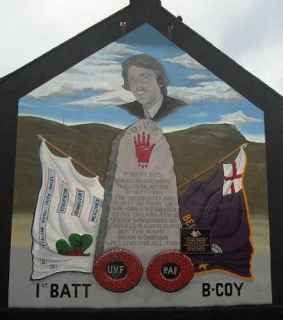
Robinson is commemorated in a mural on Disraeli Street, off Woodvale Road in Belfast.

In 2015, Robinson’s son Robert removes a Special Air Service flag that had been erected by the loyalists at the Twaddell Avenue protest camp. The Shankill UVF is later said to be reviewing its policy of flying the flag.

(Pictured: Mural commemorating Brian Robinson on Disraeli Street, off Woodvale Road in Belfast)


Leave a comment

Birth of Irish Republican Colm Murphy

Colm Murphy, Irish republican who is the first person to be convicted in connection with the Omagh bombing, but whose conviction is overturned on appeal, is born on August 18, 1952, in Belleeks, County Armagh, Northern Ireland.

Murphy is an active Irish republican paramilitary from his late teens. In March 1972, he is arrested in Dundalk regarding an assault and is sentenced to two years in prison after the Garda Síochána find a loaded revolver in his car. He is imprisoned in the Curragh Camp but escapes in October 1972 and is not recaptured until May 1973. In June 1976, he is imprisoned again, receiving a three-year sentence for firearms offences and a one-year sentence for Provisional Irish Republican Army membership, both sentences to run concurrently. In July 1983, he is arrested in the United States after attempting to buy a consignment of M60 machine guns to be shipped to Ireland for use by the Irish National Liberation Army (INLA). He receives a five-year prison sentence but returns to Ireland in December 1985 after being released early.

In the late 1980s, Murphy begins investing in property and forms a company named Emerald Enterprises in 1990. He purchases the Emerald Bar public house in Dundalk for IR£100,000, and it later becomes a meeting place for dissident republicans. Other investments included 30 acres of land in Drogheda bought for IR£52,000 in 1995, and his company wins contracts for an IR£11 million development at Dublin City University (DCU) and the multi-million-pound International Financial Services Centre in the Dublin Docklands.

Murphy is arrested by the Gardaí on February 21, 1999, for questioning under anti-terrorist legislation. On February 24, he becomes the first person to be charged in connection with the Omagh bombing, when he appears before Dublin‘s Special Criminal Court and is charged with conspiring to cause an explosion under the terms of Ireland’s Offences Against the State Act, between August 13-16, 1998. He is also charged with membership in an illegal organisation, the Real Irish Republican Army (RIRA).

On October 10, 2000, the BBC television show Panorama names Murphy as one of four people connected with the Omagh bombing, along with Seamus Daly and Liam Campbell. In 2001, he undertakes legal action against the BBC and Daily Mail publishers Associated Newspapers for contempt of court. The action against Associated Newspapers is settled on July 31, 2001, and the newspaper releases a statement saying Murphy is entitled to be presumed innocent of the charges against him until proven guilty.

Murphy’s trial begins at Special Criminal Court in Dublin on October 12, 2001. The court hears that Murphy had supplied two mobile phones which were used during the bombing. One witness, Murphy’s second cousin, retracts his evidence and the judge calls the conduct of two detectives outrageous, saying they had persistently lied under cross-examination. Despite this, on January 22, 2002, he is convicted of conspiring to cause the Omagh bombing, and on January 25 is sentenced to 14 years imprisonment with the judge describing him as a long-time republican extremist.

On January 21, 2005, Murphy’s conviction is overturned and a new trial ordered, due to the invasion of Murphy’s presumption of innocence, and alteration of Gardaí interview notes and evidence presented by two officers. A week later, his legal case against the BBC is resolved, with the BBC issuing a statement that Murphy “was fully entitled to maintain his innocence of the charges against him and to test the evidence against him at his trial.”

On October 23, 2006, two Gardaí officers are found not guilty of perjuring themselves during Murphy’s trial. On May 23, 2007, it is announced that Murphy is suffering from short-term memory loss resulting from a car accident in 1988. His lawyers attempt to prevent a retrial taking place, on the grounds that his condition interferes with his right to a fair hearing. The Court of Criminal Appeal is scheduled to hear his case again in October 2008. Following a retrial held in January 2010, he is acquitted on February 24, 2010.

In 2009, Murphy is one of four men found by a civil court to be liable for the Omagh bombing in a case taken by relatives of the victims. On July 7, 2011, in Belfast High Court, Lord Justice Malachy Higgins directs a retrial of the civil claims against Murphy. He questions evidence surrounding emails from U.S. undercover agent David Rupert while overturning the judgment on Murphy. The paucity of the email evidence, the lack of consistency in the emails or at least ambiguity, the possibility of initials referring to someone other than Murphy and the fact that they refer on occasions to double hearsay considerably weaken the emails as evidence, he says. Following a civil retrial on March 20, 2013, Murphy and Seamus Daly are found liable for involvement in the bombing.

Murphy dies peacefully of degenerative lung disease at the age of 70 on April 18, 2023, at Our Lady of Lourdes Hospital in Drogheda, County Louth.


1 Comment

The Mahon’s Hotel Bombing

A Continuity Irish Republican Army (IRA) bomb explodes at Mahon’s Hotel in Irvinestown, County Fermanagh, Northern Ireland, on February 6, 2000, less than 24 hours before the Ulster Unionist Party’s Ken McGuinness is due to visit. The Continuity IRA is the only republican organisation which has not called a ceasefire.

The bombing follows repeated warnings from senior police officers on both sides of the Northern Ireland border that republican dissidents continue to pose a threat. Both the Continuity IRA and Real IRA have been recruiting and rearming in preparation for a campaign to wreck the Northern Ireland peace process.

The splinter republican organisation is behind a bomb attack on the Killyhevlin Hotel in Enniskillen in July 1996. The attack follows a week-long marching stand-off at Drumcree.

In September 1997, it places at bomb in Markethill, in County Armagh, just 24 hours after Sinn Féin joins the political negotiations which lead to the Good Friday Agreement.

In January 1998, a Continuity IRA bomb wrecks a club in County Fermanagh. The explosion coincides with a series of loyalist attacks, which follow the murder of the Portadown Loyalist Volunteer Force (LVF) leader Billy Wright.

The latest explosion in Irvinestown comes in a week when the new political institutions are facing suspension because of the stalemate over paramilitary arms decommissioning. This attack by the Continuity IRA looks deliberately timed to add to the peace process’s troubles.

BBC Northern Ireland political editor Stephen Grimason says the bomb will not help the current situation. “We are hearing an argument reinforced from unionists that if these things are left lying around then people will use them,” he says. “So the anti-agreement unionists will be using this as a weapon. But I would have thought it will harden the attitudes of the Ulster Unionist Council and the Ulster Unionist executive, meeting tonight on the issue of weapons,” he adds.

Grimason adds that unionists in general will want to hear about the forensics of the bomb and if there was a Semtex booster charge used. “They will use that as another means of saying that this is all the IRA,” he says. But he adds that there will be those who will see this as a move against Sinn Féin President Gerry Adams because it removes the room for manoeuvre that he has.

BBC Northern Ireland chief security correspondent Brian Rowan says the bomb contained one to two kilos of high explosive, but that the security forces had not yet revealed what type it is. He says the bomb had the appearance of the Continuity IRA which in “times of trouble made more trouble.” He adds, “They would see this as a reminder that they are still out there and as a reminder to other republicans that there is an alternative to the mainstream IRA, and to the peace process strategy. It is about damaging a process that this organisation very much opposes, a process in which they believe republicans principles have been sold out.”

Rowan says security sources believe in some areas the Real IRA, Continuity IRA and the more mainstream Irish National Liberation Army (INLA) co-operate in attacks. INLA prisoners have been released under the Good Friday Agreement early prisoner release scheme, following the INLA’s ceasefire declaration.

“In the Fermanagh area security forces believe the Continuity IRA is operating alone and there is a pattern of activity over a period of years. There is nothing to suggest it was any other group.” He says there is nothing coming from republicans or security sources at this time to suggest that the IRA has any intention of actual decommissioning in the “immediate period ahead.”

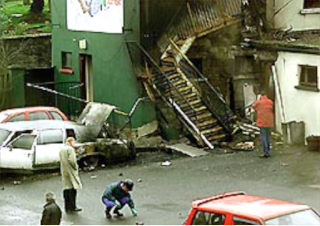
(From: “Bombing follows dissident pattern,” BBC News, http://www.news.bbc.co.uk, February 7, 2000 | Photo: RUC forensic experts examine the scene of the bomb attack at Mahons Hotel in Irvinestown, Northern Ireland, Associated Press)


Leave a comment

The Murder of IRA Volunteer Eamon Collins

Eamon Collins, member of the Provisional Irish Republican Army (IRA) in the late 1970s and early 1980s, is beaten and stabbed to death by an unidentified assailant(s) in the early morning hours of January 27, 1999, in Newry, County Down, Northern Ireland.

Collins is born in 1954 in Camlough, County Armagh, Northern Ireland, the son of Brian Collins, a farmer, livestock trader, and cattle smuggler, and Kathleen Collins (née Cumiskey). His extended family has no history of political involvement, though his upbringing is fervently Catholic and nationalist. He leaves secondary school at age 16 and briefly works as a clerk in the Ministry of Defence in London. He returns home for family reasons and resumes his education in 1971 through a scholarship to St. Colman’s College, Newry, County Down. In 1973 he goes to Queen’s University Belfast (QUB) to study law.

Collins develops ultra-leftist political beliefs in his late teens and supports the Northern Ireland civil rights movement but retains reservations about the use of violence. He is further radicalised by being beaten up by soldiers searching his family’s farm at Easter 1974 and by the downfall of the power sharing executive. He loses interest in his studies, leaves QUB in 1976 without completing his degree, and drifts for two years, joining an anarchist collective in Belfast. He comes back into contact with the republican movement through the blanket protest by Long Kesh inmates; he had known hunger striker Raymond McCreesh as a teenager. In 1978 he joins the customs service in Newry and begins to pass information to the IRA, which he joins in 1979. He is central to IRA recruitment and intelligence in Newry and south Down. Without firing a shot himself he facilitates at least five murders, including that of a customs colleague.

In 1982 Collins marries and the couple has four children. By 1984 he has developed doubts about his activities. He antagonises the Belfast leadership, which is moving towards political engagement and away from the all-out revolutionary violence that he favours, and while he admires the hardline South Armagh IRA for its military professionalism, he regards its members as political primitives. On February 28, 1985, he is arrested after an IRA mortar attack in which nine Royal Ulster Constabulary (RUC) members are killed. He breaks down after six days of interrogation and is recruited as a “supergrass,” but retracts his evidence a fortnight later and is held on remand on the basis of his confessions.

In January–February 1987 Collins is tried for murder but acquitted after the judge rules his statements inadmissible. He completes an Open University degree while awaiting trial. After his release he is ostracised and is interrogated by the IRA, which in July 1987 orders him to leave Northern Ireland. He engages in youth work in Dublin from 1987 to 1990, taking a diploma in community work at Maynooth. His wife and children remain in Newry and he visits them regularly in defiance of the expulsion order. In 1990 he returns to live in Newry and teaches at the Ulster People’s College in Belfast. From 1992–94 he is a community worker in Edinburgh. His wife and children continue to live on the Barcroft Park estate in Newry.

In 1994 Collins returns permanently to Northern Ireland after securing a job at a youth club in Armagh. In April 1995 he describes his career in a television documentary, admitting the murders for which he had been tried. In 1997 he publishes a memoir, Killing Rage, a powerful account of life as a paramilitary, although it is not entirely reliable. After the 1995 documentary he experiences verbal and physical harassment. This intensifies after May 1998 when he testifies for The Sunday Times in a libel action by Thomas Murphy, whom the paper accuses of being a leading IRA member. Four months after Murphy loses the case, the family farmhouse in Camlough, which Collins is renovating, is burned down. After the Omagh bombing he publishes several articles denouncing the Real IRA, several of whose activists he had recruited into the IRA from the Irish National Liberation Army (INLA) in the early 1980s. Graffiti regularly appears outside his home in Newry denouncing him as a British agent.

Early in the morning of January 27, 1999, Collins paints out the latest graffiti, and is walking his dogs near the Barcroft Park Estate in Newry along a quiet stretch of country lane at Doran’s Hill, just within sight of Sliabh gCuircin (Camlough Mountain). His body also bears marks of having been struck by a car moving at speed. The subsequent police investigation and Coroner’s Inquest comments upon the extremity of weaponed violence to Collins’ head and face used during the attack.

Rumoured reasons behind the murder are that Collins had returned to Northern Ireland in breach of the IRA’s banning order, and further he had detailed IRA activities and publicly criticized in the media a multiplicity of Irish Republican paramilitary splinter groups that had appeared after the Provisional IRA’s 1994 ceasefire, and that he had testified in court against Murphy. Gerry Adams states the murder was “regrettable,” but adds that Collins had “many enemies in many places.”

After a traditional Irish wake, with a closed coffin necessitated due to the damage to his face, and a funeral service at St. Catherine’s Dominican Church in Newry, Collins’ body is buried at the city’s Monkshill Cemetery, not far from the grave of Albert White, a Catholic former Royal Ulster Constabulary Inspector, whose assassination he helped to organise in 1982.

In January 2014 the Police Service of Northern Ireland (PSNI) releases a statement that a re-examination of the evidence from the scene of the 1999 murder had revealed new DNA material of a potential perpetrator’s presence, and makes a public appeal for information, detailing the involvement of a specific car model, a white coloured Hyundai Pony, and a compass pommel that had broken off a hunting knife during the attack and had been left behind at the scene. In February 2014 detectives from the Serious Crime Branch arrest a 59-year-old man at an address in Newry in relation to the murder, but he is subsequently released without charge. In September 2014 the police arrest three men, aged 56, 55 and 42, in County Armagh in relation to inquiries into the murder, all of whom are subsequently released without charges after questioning. In January 2019 the police release a statement regarding the murder that one of the assailants had been seriously injured by an accidentally sustained knife wound during the attack, and had left traces of his own blood at the scene, and that recent scientific advances in DNA evidence had increased the possibility of his identification. In May 2019, three men aged 60 to 62 are arrested and questioned, but then released unconditionally.


Leave a comment

Founding of the Irish National Liberation Army (INLA)

The Irish National Liberation Army (INLA, Irish: Arm Saoirse Náisiúnta na hÉireann), an Irish republican socialist paramilitary group, is founded at the Spa Hotel in Lucan, Dublin, on December 10, 1974, during the 30-year period of conflict known as “the Troubles.” The group seeks to remove Northern Ireland from the United Kingdom and create a socialist republic encompassing all of Ireland. With membership estimated at 80–100 at their peak, it is the paramilitary wing of the Irish Republican Socialist Party (IRSP), which is founded the same day. The IRSP’s foundation is made public but the INLA’s is kept a secret until the group can operate effectively.

The INLA is founded by former members of the Official Irish Republican Army who oppose that group’s ceasefire. It is initially known as the “People’s Liberation Army” or “People’s Republican Army.” The INLA wages a paramilitary campaign against the British Army and Royal Ulster Constabulary (RUC) in Northern Ireland. It is also active to a lesser extent in the Republic of Ireland, Great Britain and Continental Europe. High-profile attacks carried out by the INLA include the Droppin Well bombing (1982), the Shankill Road killings (1994) and the assassinations of Airey Neave (1979) and Billy Wright (1997). However, the INLA is smaller and less active than the main republican paramilitary group, the Provisional Irish Republican Army (IRA). It is also weakened by feuds and internal tensions. Members of the group use the covernames People’s Liberation Army, People’s Republican Army, and Catholic Reaction Force for attacks its volunteers carry out but for which the INLA does not want to claim responsibility. The INLA becomes a proscribed group in the United Kingdom on July 3, 1979, under the 1974 Prevention of Terrorism Act.

After a 24-year armed campaign, the INLA declares a ceasefire on August 22, 1998. In August 1999, it states that “There is no political or moral argument to justify a resumption of the campaign.” On October 11, 2009, speaking at the graveside of its founder Seamus Costello in Bray, the INLA formally announces an end to its armed campaign, stating the current political framework allows for the pursuit of its goals through peaceful, democratic means and begins decommissioning its weapons.

The IRSP supports a “No First Strike” policy, that is allowing people to see the perceived failure of the Northern Ireland peace process for themselves without military actions.

The INLA is a proscribed organisation in the United Kingdom under the Terrorism Act 2000 and an illegal organisation in the Republic of Ireland.

(Pictured: INLA logo consisting of the Starry Plough and the Flag of Ireland with a red star and a fist holding an AK-47-derivative rifle)


Leave a comment

The Beginning of the 1980 Hunger Strike

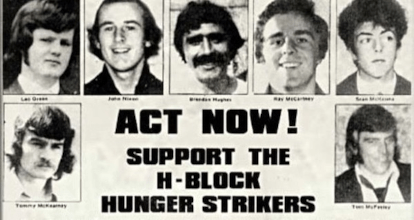
Irish political prisoners confined in the infamous H-Blocks of Long Kesh Detention Centre commence a hunger strike on October 27, 1980. The hunger strike is to continue until their demands for political status and for an end to British torture are met, or until death.

It begins with seven republican volunteers: Brendan Hughes, the IRA commanding officer in the prison, Sean McKenna, Tommy McKearney, Tommy McFeely, Leo Green, and Raymond McCartney, all of the Irish Republican Army (IRA), and John Nixon of the Irish National Liberation Army (INLA).

On December 1, three female prisoners, Mary Doyle, Mairéad Farrell and Mairéad Nugent, join the strike in Armagh Prison. Thirty more republican prisoners join later.

Despite being deceived into ending prematurely after 53 days, it sets the scene for a second hunger strike the following March, led by Bobby Sands. The first hunger strike announcement is made in a statement which is reprinted in full below.

“We the Republican POWs in the H-Blocks, Long Kesh, demand the right of political recognition and that we be accorded the status of political prisoners. We claim this right as captured combatants in the continuing struggle for national liberation and self-determination. We refute most strongly the tag of criminal with which the British have attempted to label us and our struggle, and we point to the devisive, partitionist institution of the six-county state as the sole criminal aspect of the present conflict.

“All of us were arrested under repressive laws, interrogated and often tortured in RUC barracks, and processed through special non-jury courts, where we were sentenced to lengthy terms of imprisonment. After this we were put in the H-Blocks and were expected to bow the knee before the British administration and wear their criminal uniform. Attempts to criminalise us were designed to depoliticise the Irish national struggle.

“We don’t have to recite again the widespread, almost total forms of punishment, degradations and deprivations we have been subjected to. All have failed to break our resistance.

“For the past four years we have endured this brutality in deplorable conditions. We have been stripped naked and robbed of our individuality, yet we refuse to be broken. Further repression only serves to strengthen our resolve and that of our gallant female comrades’ enduring the same hardships in Armagh jail.

“During this period many individuals, religious figures and political organisations and sections of the media have condemned the way we have been treated. Yet despite appeals for a resolution of the H-Block protest, the British government has remained intransigent and has displayed vindictive arrogance in dealing with the problem. They refuse to treat this issue in a realistic manner which is just another reflection of their attitude to the entire Irish question.

“Bearing in mind the serious implications of our final step, not only for us but for our people, we wish to make it clear that every channel has now been exhausted, and not wishing to break faith with those from whom we have inherited our principles, we now commit ourselves to a hunger strike.

“We call on the Irish people to lend us their support for our just demands and we are confident that this support will be very much in evidence in the coming days.

“We call on all solidarity and support groups to intensify their efforts and we also look forward with full confidence to the support of our exiled countrymen in America and Australia.

“We declare that political status is ours of right and we declare that from Monday, October 27th, 1980, a hunger strike by a number of men representing H- Blocks 3, 4, and 5 will commence.

“Our widely recognised resistance has carried us through four years of immense suffering, and it shall carry us through to the bitter climax of death, if necessary.”

Signed: PRO, H-Block blanket men, Long Kesh camp

(From: “The 1980 H-Block hunger strike,” Irish Republican News, http://www.republican-news.org, October 31, 2020)


Leave a comment

Blair & Ahern Meet in Aftermath of the Omagh Bombing

British Prime Minister Tony Blair meets with Taoiseach Bertie Ahern in Ashford Castle, County Mayo on August 26, 1998. They join forces to fight terrorism and discuss laws which will be introduced in the aftermath of the Omagh bombing, which took place eleven day earlier on August 15 in Omagh, County Tyrone, 110 kilometres west of Belfast, and resulted in 28 deaths.

Leading the way in a return to the past is Ahern’s Dublin government, which has introduced the toughest anti-terrorist legislation in the history of the Irish Republic. He concedes that the measures are draconian but says that his government is determined to do everything in its power, “working closely with the British government to defeat and suppress this murderous conspiracy against the people of Ireland.”

Prime Minister Blair promises that he too plans to introduce extreme measures. “We will bring in similar measures to those proposed by the Irish government, so we will then have the toughest anti-terrorist measures for the whole of Ireland, the Republic and Northern Ireland, that we have ever seen.”

With no plans to recall the British parliament, it is thought that existing legislation will be applied, since it already includes measures similar to those announced by the Irish government.

Oppressive British legislation has sustained British rule in Ireland for decades. This includes internment without trial, non-jury courts, entry and search of homes without a warrant, seven-day detention with unrecorded and unsupervised interrogation, denial of access to lawyers, exclusion orders and more. Most of these are still in use in 1998.

The Ahern package includes withdrawal of a suspect’s right to silence — refusal to answer questions can be used as evidence that a suspect is a member of an illegal organisation, the seizure of property that has been used for storing weapons or making bombs, and the creation of a new offence of directing an unlawful organisation. This is expected to carry the penalty of life imprisonment.

Omagh is 75% nationalist, with good cross-community relations, and has largely escaped the worst of the conflict. Although Republican dissidents have carried out a spate of similar bombings in the previous year, the towns targeted are mainly Unionist and further east.

In the wake of the Good Friday Agreement, Republican splinter groups remain on a military footing. These groups — the Irish National Liberation Army (INLA), the Continuity IRA and the Real IRA — have announced their determination to fight on.

The group that claims responsibility for the Omagh bombing is the Real IRA, which was formed in protest at the IRA’s 1997 cease-fire. Irish police have insisted that the Real IRA is the military wing of the recently formed 32 County Sovereignty Movement (32CSM), although this is denied by that organisation.

Although both the INLA and the Real IRA have declared a unilateral cease-fire since the Omagh bombing, media focus has settled on Bernadette Sands McKevitt, sister of the 1980s IRA hunger striker Bobby Sands, who is a leading figure in the 32 County Sovereignty Movement. Sands-McKevitt has condemned the Omagh bombing, but her home in Blackrock, County Louth, has since been targeted by local townspeople who have staged protests against her and her family. She has also been denied a visa to enter the United States on a speaking tour.

The Omagh bombing could not have come at a better time for Britain. With the war formally over and Sinn Féin penned, the bombing delivers an opportunity to smash the Republican left once and for all and wrench it from any semblance of ongoing support in Ireland.

All nationalist opponents of the Good Friday Agreement must now cope with being stained by the blood of Omagh. With the massive referendum vote in favour of peace to back them up, the British and Irish governments can be satisfied that the Good Friday Agreement now looks more in place than at any other time. As one nationalist describes the situation, “If the Good Friday Agreement was a defeat for the cause of Irish nationalism, the Omagh bombing has turned it into a rout.”

(From: “Blair, Ahern make the most of Omagh bomb” by Dave Riley, Green Left (www.greenleft.org), August 26, 1998)