seamus dubhghaill

Promoting Irish Culture and History from Little Rock, Arkansas, USA


Leave a comment

Blair & Ahern Meet in Aftermath of the Omagh Bombing

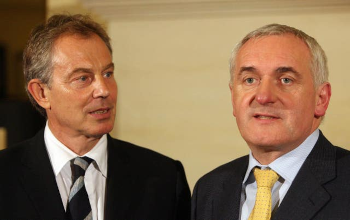
British Prime Minister Tony Blair meets with Taoiseach Bertie Ahern in Ashford Castle, County Mayo on August 26, 1998. They join forces to fight terrorism and discuss laws which will be introduced in the aftermath of the Omagh bombing, which took place eleven day earlier on August 15 in Omagh, County Tyrone, 110 kilometres west of Belfast, and resulted in 28 deaths.

Leading the way in a return to the past is Ahern’s Dublin government, which has introduced the toughest anti-terrorist legislation in the history of the Irish Republic. He concedes that the measures are draconian but says that his government is determined to do everything in its power, “working closely with the British government to defeat and suppress this murderous conspiracy against the people of Ireland.”

Prime Minister Blair promises that he too plans to introduce extreme measures. “We will bring in similar measures to those proposed by the Irish government, so we will then have the toughest anti-terrorist measures for the whole of Ireland, the Republic and Northern Ireland, that we have ever seen.”

With no plans to recall the British parliament, it is thought that existing legislation will be applied, since it already includes measures similar to those announced by the Irish government.

Oppressive British legislation has sustained British rule in Ireland for decades. This includes internment without trial, non-jury courts, entry and search of homes without a warrant, seven-day detention with unrecorded and unsupervised interrogation, denial of access to lawyers, exclusion orders and more. Most of these are still in use in 1998.

The Ahern package includes withdrawal of a suspect’s right to silence — refusal to answer questions can be used as evidence that a suspect is a member of an illegal organisation, the seizure of property that has been used for storing weapons or making bombs, and the creation of a new offence of directing an unlawful organisation. This is expected to carry the penalty of life imprisonment.

Omagh is 75% nationalist, with good cross-community relations, and has largely escaped the worst of the conflict. Although Republican dissidents have carried out a spate of similar bombings in the previous year, the towns targeted are mainly Unionist and further east.

In the wake of the Good Friday Agreement, Republican splinter groups remain on a military footing. These groups — the Irish National Liberation Army (INLA), the Continuity IRA and the Real IRA — have announced their determination to fight on.

The group that claims responsibility for the Omagh bombing is the Real IRA, which was formed in protest at the IRA’s 1997 cease-fire. Irish police have insisted that the Real IRA is the military wing of the recently formed 32 County Sovereignty Movement (32CSM), although this is denied by that organisation.

Although both the INLA and the Real IRA have declared a unilateral cease-fire since the Omagh bombing, media focus has settled on Bernadette Sands McKevitt, sister of the 1980s IRA hunger striker Bobby Sands, who is a leading figure in the 32 County Sovereignty Movement. Sands-McKevitt has condemned the Omagh bombing, but her home in Blackrock, County Louth, has since been targeted by local townspeople who have staged protests against her and her family. She has also been denied a visa to enter the United States on a speaking tour.

The Omagh bombing could not have come at a better time for Britain. With the war formally over and Sinn Féin penned, the bombing delivers an opportunity to smash the Republican left once and for all and wrench it from any semblance of ongoing support in Ireland.

All nationalist opponents of the Good Friday Agreement must now cope with being stained by the blood of Omagh. With the massive referendum vote in favour of peace to back them up, the British and Irish governments can be satisfied that the Good Friday Agreement now looks more in place than at any other time. As one nationalist describes the situation, “If the Good Friday Agreement was a defeat for the cause of Irish nationalism, the Omagh bombing has turned it into a rout.”

(From: “Blair, Ahern make the most of Omagh bomb” by Dave Riley, Green Left (www.greenleft.org), August 26, 1998)


Leave a comment

Death of Arthur Griffith, Founder of Sinn Féin

Arthur Joseph Griffith, writer, newspaper editor and politician who founded the political party Sinn Féin, dies suddenly in Dublin on August 12, 1922. He leads the Irish delegation at the negotiations that produce the 1921 Anglo-Irish Treaty and serves as President of Dáil Éireann from January 1922 until his death.

Griffith, a Roman Catholic, is born at 61 Upper Dominick Street, Dublin on March 31, 1871, of distant Welsh lineage. He is educated by the Irish Christian Brothers. He works for a time as a printer before joining the Gaelic League (Conradh na Gaeilge), which is aimed at promoting the restoration of the Irish language.

After a short spell in South Africa, Griffith founds and edits the Irish nationalist newspaper The United Irishman in 1899. In 1904, he writes The Resurrection of Hungary: A Parallel for Ireland, which advocates the withdrawal of Irish members from the Parliament of the United Kingdom and the setting up of the institutions of government at home, a policy that becomes known as Sinn Féin (ourselves). On November 28, 1905, he presents “The Sinn Féin Policy” at the first annual Convention of the National Council. The occasion is marked as the founding date of the Sinn Féin party. Although the organization is still small at the time, Griffith takes over as president of Sinn Féin in 1911.

Griffith is arrested following the Easter Rising of 1916, despite not having taken any part in it. On his release, he works to build up Sinn Féin, which wins a string of by-election victories. At the party’s Ardfheis (annual convention) in October 1917, Sinn Féin becomes an unambiguously republican party, and Griffith resigns the presidency in favour of the 1916 leader Éamon de Valera, becoming vice-president instead. Griffith is elected as a member of parliament (MP) for East Cavan in a by-election in June 1918, and is re-elected in the 1918 Irish general election, when Sinn Féin wins a huge electoral victory over the Irish Parliamentary Party and, refusing to take their seats at Westminster, set up their own constituent assembly, Dáil Éireann.

In the Dáil, Griffith serves as Minister for Home Affairs from 1919 to 1921, and Minister for Foreign Affairs from 1921 to 1922. In September 1921, he is appointed chairman of the Irish delegation to negotiate a treaty with the British government. After months of negotiations, he and the other four delegates sign the Anglo-Irish Treaty, which creates the Irish Free State, but not as a republic. This leads to a split in the Dáil. After the Treaty is narrowly approved by the Dáil, de Valera resigns as president and Griffith is elected in his place. The split leads to the Irish Civil War.

Griffith enters St. Vincent’s Nursing Home, Leeson Street, Dublin, during the first week of August 1922, following an acute attack of tonsillitis. He is confined to his room by his doctors, who had observed signs of what they thought might be a subarachnoid hemorrhage. It is difficult to keep him quiet and he resumes his daily work in the government building. When about to leave for his office shortly before 10:00 AM on August 12, 1922, he pauses to retie his shoelace and falls down unconscious. He regains consciousness but collapses again with blood coming from his mouth. Three doctors render assistance, but to no avail. Father John Lee of the Marist Fathers administers extreme unction, and Griffith expires as the priest recites the concluding prayer. The cause of death, intracerebral hemorrhage, is also reported as being due to heart failure. He dies at the age of 51, ten days before Michael Collins‘s assassination in County Cork and two months after the outbreak of the Irish Civil War. He is buried in Glasnevin Cemetery four days later.


Leave a comment

Belfast Nationalists Vote Against Orange Parades

Nationalist residents of Belfast’s Lower Ormeau Road vote overwhelmingly on August 4, 2000, against allowing Orange Order parades through the flashpoint district. Results indicate that over 90% of those polled in a secret vote on the mainly nationalist lower Ormeau area of south Belfast want such parades rerouted.

The nationalist residents’ group, the Lower Ormeau Concerned Community (LOCC), which organised the ballot, says the majority of the 600 people who voted want the parades rerouted. In a statement it says it welcomes the result as “an overwhelming and democratic expression of our community’s desire to live free from sectarian harassment”.

LOCC spokesman Gerard Rice says, “We do not claim to speak for loyalist residents.” He adds that the loyal orders will now have to listen to the people of the area. “The whole point in this exercise was not to vindicate our position, but to set out clearly an informed position as to what exactly the opinion in our community is and has been for many years,” he tells BBC Radio Ulster.

“The Orange Order and other loyal institutions have said for many, many years that really people living on the Ormeau Road want parades. That they are actually a colourful event that people can enjoy. We have said that many people within our community would say parades by the loyal institutions were seen as sectarian, coat trailing exercises, the institutions were seen as anti-Catholic and sectarian organisations. Now we can actually say that 95.9% of our community believe that to be true.”

However, the Belfast County Grand Master of the Orange Order rejects the results of the poll. Dawson Baillie says the vote was unrepresentative because it did not include the staunchly loyalist Donegall Pass area and the Ballynafeigh district above the Ormeau Bridge. “We believe that it’s our right and everyone’s right to walk down a main thoroughfare. We’re not going into side streets on the right-hand side of that part of the Ormeau Road or the left-hand side. We go straight down the main thoroughfare. Our parade at any given point would take no more than three to four minutes to pass.”

Unionists question the validity of the poll as it excludes nearby loyalist areas. Dawn Purvis of the Progressive Unionist Party says the poll would not help to resolve the situation. “You don’t get people to enter into talks on the basis of no parade. You get people to enter into talks on the basis of an accommodation,” she says. “If that poll had been held to show what concerns the people of Lower Ormeau have over loyal order parades, that would have been better, that would have been a way forward, trying to address the concerns of the residents of the Lower Ormeau Road. LOCC have not been forthcoming with those concerns, so the talks haven’t moved forward.”

Reverend Martin Smyth, the Belfast South MP, says it had been “a stage-managed exercise” to show how well the group could conduct their business in that area and “to gather support from those who don’t want a procession down that road.”

However, Rice rejects the suggestions that it is unrepresentative because loyalist areas had been left out. Another LOCC representative, John Gormley, says they would welcome equivalent ballots from the loyalist part of the Ormeau area.

Local parish priest Father Anthony Curran says he is satisfied with the conduct of the vote. “A large number of people seem to have come out, a very broad section of the community, elderly young middle-aged, sick. They came free from fear and intimidation.”

A similar poll was last conducted in the Lower Ormeau area in 1995 by management consultants Coopers & Lybrand, when a large majority voted against allowing loyalist marches in the area.

The Northern Ireland Parades Commission has barred the Orange Order from marching through the Lower Ormeau area during its Twelfth of July demonstrations for the previous two years.

(From: “Poll ‘rejects’ loyal order parades” by BBC News (news.bbc.co.uk), August 4, 2000)


Leave a comment

Death of Irish Poet Francis Edward Ledwidge

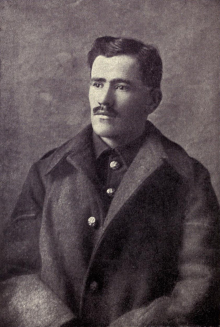
Francis Edward Ledwidge, Irish poet from County Meath, sometimes known as the “poet of the blackbirds,” is killed in action He was later also known as a World War I war poet. He was killed in action on July 31, 1917, at the Battle of Pilckem Ridge near Boezinge, Ypres Salient, Belgium.

Born on August 19, 1887, to a poor family in Slane, County Meath, Ledwidge starts writing at an early age, and is first published in a local newspaper at the age of fourteen. Finding work as a labourer and miner, he is also a trade union activist and a keen patriot and nationalist, associated with Sinn Féin. He becomes friendly with a local landowner, the writer Lord Dunsany, who gives him a workspace in the library of Dunsany Castle and introduces him to literary figures including William Butler Yeats and Katherine Tynan, with whom he has a long-term correspondence. He is elected to a local authority post and helps organise the local branch of the Irish Volunteers, while Dunsany edits and helps him secure publication for a first volume of his poetry.

Having sided with the faction of the Irish Volunteers which oppose participation in the war, he enlists in the Royal Inniskilling Fusiliers in October 1914, and continues to write poetry on assignment, sending work to Lord Dunsany and to family and other friends. The poems he writes on active service reveal his pride at being a soldier, as he believes, in the service of Ireland. He often wonders whether he would find a soldier’s death.

On July 31, 1917, a group from Ledwidge’s battalion of the Royal Inniskilling Fusiliers are road-laying in preparation for an assault during the Third Battle of Ypres, near the village of Boezinge, northwest of Ypres.

According to Irish author and lecturer Alice Curtayne, “Ledwidge and his comrades had been toiling since the early morning at roadmaking. The army’s first need was men; their second, guns; their third roads. These latter consisted mainly of heavy beech planks bolted together, which could be rapidly laid down. No advance could be supported in that sodden land without a sufficiency of these communications tracks, six or seven feet wide. Supplies were conveyed by pack mules over the wooden paths. Survivors concur in placing the road work done by B Company that day one mile northeast of Hellfire Corner, so called because it was very exposed to German shelling. There was a violent rainstorm in the afternoon, shrouding the region in a gray monochrome. Sullenly, the enemy’s long-range guns continued to fling their shells far behind the lines. Roadwork could not be suspended, however, as the tracks were in use as fast as they were laid down. Tea was issued to the men and, drenched to the skin, they stopped to swallow it. A shell exploded beside Ledwidge and he was instantly killed.”

A Roman Catholic military chaplain, Father Devas, is the first on the scene. That night, Father Devas writes in his diary, “Crowds at Holy Communion. Arranged for service but washed out by rain and fatigues. Walk in rain with dogs. Ledwidge killed, blown to bits; at Confession yesterday and Mass and Holy Communion this morning. R.I.P.”

Ledwidge is first buried at Carrefour de Rose, and later re-interred in the nearby Artillery Wood Military Cemetery, at Boezinge, where the Welsh poet Hedd Wyn, who was killed in action on the same day, also lies buried.

Dunsany arranges for the publication of more of Ledwidge’s poems, and a collected edition in 1919. Further poems, from the archives at Dunsany Castle and some material held by family, are later published by Ledwdige’s biographer, Alice Curtayne, and by one of the Ledwidge memorial societies. Ledwidge is selected as one of twelve prominent war poets for the exhibition Anthem for Doomed Youth at the Imperial War Museum in London in 2002, and memorialised at an event in Inchicore, Dublin, in 2017, with his work set to music by Anúna. A museum of his life and work is opened in his birthplace cottage in 1982. Some of his manuscripts are held in the National Library of Ireland and more in the archives of Dunsany Castle.


Leave a comment

Birth of Joseph Campbell, Poet & Lyricist

Joseph Campbell, Irish poet and lyricist, is born in Belfast on July 15, 1879. He writes under the Gaelic form of his name Seosamh Mac Cathmhaoil (also Seosamh MacCathmhaoil), as Campbell is a common anglicisation of the old Irish name MacCathmhaoil. He is now remembered best for words he supplied to traditional airs, such as “My Lagan Love” and “Gartan Mother’s Lullaby.” His verse is also set to music by Arnold Bax and Ivor Gurney.

Campbell is born into a Catholic and Irish nationalist family from County Down. He is educated at St. Malachy’s College, Belfast. After working for his father he teaches for a while. He travels to Dublin in 1902, meeting leading nationalist figures. His literary activities begin with songs, as a collector in Antrim, County Antrim and working with the composer Herbert Hughes. He is then a founder of the Ulster Literary Theatre in 1904. He contributes a play, The Little Cowherd of Slainge, and several articles to its journal Uladh edited by Bulmer Hobson. The Little Cowherd of Slainge is performed by the Ulster Literary Theatre at the Clarence Place Hall in Belfast on May 4, 1905, along with Lewis Purcell’s The Enthusiast.

Campbell moves to Dublin in 1905 and, failing to find work, moves to London the following year where he is involved in Irish literary activities while working as a teacher. He marries Nancy Maude in 1910, and they move shortly thereafter to Dublin, and then later to County Wicklow. His play Judgement is performed at the Abbey Theatre in April 1912.

Campbell takes part as a supporter in the Easter Rising of 1916, doing rescue work. The following year he publishes a translation from Irish of the short stories of Patrick Pearse, one of the leaders of the Rising.

Campbell becomes a Sinn Féin Councillor in Wicklow in 1921. Later in the Irish Civil War he is on the Republican side, and is interned in 1922-23. His marriage breaks up, and he emigrates to the United States in 1925 where he settles in New York City. He lectures at Fordham University, and works in academic Irish studies, founding the University’s School of Irish Studies in 1928, which lasts four years. He is the editor of The Irish Review (1934), a short lived “magazine of Irish expression.” The business manager is George Lennon, former Officer Commanding of the County Waterford Flying Column during the Irish War of Independence. The managing editor is Lennon’s brother-in-law, George H. Sherwood.

Campbell returns to Ireland in 1939, settling at Glencree, County Wicklow. He dies at Lacken Daragh, Enniskerry, County Wicklow on June 6, 1944.


Leave a comment

Death of Francis McPeake II, Uilleann Piper & Singer

Francis ‘Francie’ McPeake II, uilleann piper and singer, dies in Belfast on July 7, 1986. He is a crucial figure in preserving the great Ulster piping tradition.

McPeake is born on January 20, 1917 at 43 Malcolmson Street, Belfast, the son of Francis J. McPeake (1885–1971), piper and tram conductor, and Mary McPeake (née Loney). His father, a staunch nationalist, wins the Feis piping competition in Belfast in 1909 and represents Ireland together with a Welsh harper, John Page, at the Pan-Celtic Congress in Brussels in 1911. In July 1912 he wins first prize in the learners’ class when he attends the foundation of the Pipers’ Club in Dublin. He represents Ireland in many instances as one of relatively few pipers from Northern Ireland at the time.

McPeake continues the strong musical tradition in the family. He also plays the pipes and father and son are recorded by Peter Kennedy in 1952. They appear at the Royal Albert Hall in 1956 and later form the McPeake Trio along with his brother James, who plays the fiddle, the piano accordion, and later a harp made by McFall in Belfast. The trio comes to be known as The McPeakes. They sing in Irish and in English and are closely identified with particular songs, such as “The Jug of Punch,” “The Lament of Aughrim,” and “The Verdant Braes of Skreen,” though the one most associated with them is “Will You Go, Lassie, Go?”

The McPeakes win first prize at the international Eisteddfod in Wales in the late 1950s and acquire a strong international reputation with Bob Dylan being among their fans. The trio is later augmented by members of the next generation, recorded by Peter Kennedy again, and make several recordings, including Irish Folk (1964) and Welcome Home (1967), which is a cassette reissue of a 1962 album for the Topic Records label. Some of Kennedy’s recordings of the McPeake family are released on the compact disc Traditional Songs of Ireland (CD-SDL 411) in 1995. A fourth-generation family group follows, Clan McPeake, inheriting the commitment, much of the repertoire, and the verve of the earlier generations.

McPeakes’s gift for teaching is employed at the Francis McPeake School of Music, which is established in 1977, and he writes a well-reviewed tin whistle tutor entitled Smash the Windows, published by Appletree Press in 1981. He also forms the Clonard Traditional Music Society.

McPeake dies on July 7, 1986. The McPeake family remains closely associated with traditional music and with Belfast. The Francis McPeake International Summer School is established in 2004.

(From: “McPeake, Francis (‘Francie’)” by Ríonach uí Ógáin, Dictionary of Irish Biography, content licensed under a Creative Commons Attribution Non Commercial 4.0 International license)


Leave a comment

Birth of Sebastian Barry, Novelist, Playwright & Poet

Sebastian Barry, novelist, playwright and poet, is born in Dublin on July 5, 1955. He is noted for his lyrical literary writing style and is considered one of Ireland’s finest writers. He is named Laureate for Irish Fiction, 2019–2021.

Barry’s mother is acclaimed actress Joan O’Hara. He is educated at Catholic University School and Trinity College, Dublin, where he reads English and Latin. His literary career begins in poetry before he begins writing plays and novels.

Barry starts his literary career with the novel Macker’s Garden in 1982. This is followed by several books of poetry and a further novel, The Engine of Owl-Light (1987), before his career as a playwright begins with his first play produced in the Abbey Theatre, Boss Grady’s Boys (1988).

Barry’s maternal great-grandfather, James Dunne, provides the inspiration for the main character in his most internationally known play, The Steward of Christendom, which wins the Christopher Ewart-Biggs Memorial Prize, the Lloyd’s Private Banking Playwright of the Year Award and other awards. The main character in the play, Thomas Dunne, is the chief superintendent of the Dublin Metropolitan Police from 1913 to 1922. He oversees the area surrounding Dublin Castle until the Irish Free State takeover on January 16, 1922. One of his grandfathers belonged to the British Army Corps of Royal Engineers while the other is a painter, a Nationalist, and a devotee of Éamon de Valera.

Both The Steward of Christendom and the novel The Whereabouts of Eneas McNulty, are about the dislocations, physical and otherwise, of loyalist Irish people during the political upheavals of the early 20th century. The title character of the latter work is a young man forced to leave Ireland by his former friends in the aftermath of the Irish War of Independence.

Barry has been twice shortlisted for the Man Booker Prize for his novels A Long Long Way (2005) and The Secret Scripture (2008), the latter of which wins the 2008 Costa Book of the Year and the James Tait Black Memorial Prize. His fifth novel, On Canaan’s Side (2011), is longlisted for the 2011 Man Booker Prize and wins the 2012 Walter Scott Prize. In January 2017, he is awarded the Costa Book of the Year prize for Days Without End (2016), becoming the first novelist to win the prestigious prize twice. The novel also wins The Walter Scott Prize and The Independent Booksellers’ Prize, and is longlisted for the Man Booker Prize 2017.

Barry’s play Andersen’s English is inspired by children’s writer Hans Christian Andersen coming to stay with Charles Dickens and his family in the Kent marshes. Directed by Max Stafford-Clark and produced by the Out of Joint Theatre Company and Hampstead Theatre, the play tours in the United Kingdom from February 11 to May 8, 2010. Our Lady of Sligo is directed in 1998 by Stafford-Clark at the Royal National Theatre co−produced by Out of Joint.

In 2001, Barry establishes his personal and professional archive at the Harry Ransom Center. More than sixty boxes of papers document his diverse writing career and range of creative output which includes drawings, poetry, short stories, novels, essays, and scripts.

Barry has been awarded honorary degrees from NUI Galway, the Open University and the University of East Anglia. His academic posts include Honorary Fellow in Writing at the University of Iowa (1984), Heimbold Visiting Professor at Villanova University (2006) and Writer Fellow at Trinity College, Dublin (1995–1996).

Barry lives in County Wicklow with his wife, actor and screenwriter Alison Deegan.


Leave a comment

Death of Frank Harte, Traditional Irish Singer

Frank Harte, traditional Irish singer, music collector, architect and lecturer, dies of a heart attack on June 27, 2005.

Harte is born in Chapelizod, County Dublin on May 14, 1933. He emigrates to the United States for a short period, but later returns to Ireland where he works as an architect, lecturer at Dublin Institute of Technology in Rathmines, Dublin and in later life fully engages in songs in many ways.

Harte’s introduction to Irish traditional singing comes from a chance listening to an itinerant who is selling ballad sheets at a fair in Boyle, County Roscommon. He begins collecting early in life and by the end of his life has assembled a database of over 15,500 recordings.

Harte becomes a great exponent of the Dublin street ballad, which he prefers to sing unaccompanied. He is widely known for his distinctive singing, his Dublin accent having a rich nasal quality complementing his often high register. His voice mellows considerably by the time of his later recordings, allowing for an expressive interpretation of many love songs such as “Bonny Light Horseman” on the album My Name is Napoleon Bonaparte. This is contrasted sublimely by his cogent interpretation of the popular “Molly Malone.” He also becomes more accustomed to singing with accompaniment which is not strictly part of the Irish singing tradition and does not come naturally to him.

Though Irish Republican in his politics, Harte believes that the Irish song tradition need not be a sectarian or nationalist preserve. He believes that songs are a key to understanding the past often saying, “those in power write the history, while those who suffer write the songs, and, given our history, we have an awful lot of songs.” Though considered a stalwart of traditional Irish singing and well aware of it, he does not consider himself to be a sean-nós singer.

Harte wins the All-Ireland Fleadh Cheoil singing competition on a number of occasions and in 2003 receives the Traditional Singer of the Year award from the Irish-language television channel TG4.

Harte records several albums and makes numerous television and radio appearances, most notably the Singing Voices series he writes and presents for RTÉ Radio, which is produced by Peter Browne in 1987. He is a regular at the Sunday morning sessions at The Brazen Head pub, along with Liam Weldon who runs the session. He is also an enthusiastic supporter of An Góilín Traditional Singer’s Club.

Harte appears at many American festivals including The Blarney Star in New York City, Gaelic Roots in Boston College, The Catskills Irish Arts Week, The Greater Washington Ceili Club Festival in Maryland and the Milwaukee Irish Fest and for seventeen years he is a veritable staple at the Irish Week every July in the Augusta Heritage Festival in Elkins, West Virginia where he often performs with Mick Moloney.

Frank Harte dies of a heart attack, aged 72, on June 27, 2005. His influence is still evident in singers such as Karan Casey and he continues to be remembered fondly in sessions and folk clubs on both sides of the Irish Sea.


Leave a comment

The Holy Cross Dispute

The Holy Cross dispute begins on June 19, 2001, and continues into 2002 in the Ardoyne area of north Belfast. During the 30-year conflict known as the Troubles, Ardoyne becomes segregated – Ulster Protestants and Irish Catholics living in separate areas. This leaves Holy Cross, a Catholic primary school for girls, in the middle of a Protestant area. During the last week of school in June 2001 before the summer break, Protestant loyalists begin picketing the school, claiming that Catholics are regularly attacking their homes and denying them access to facilities.

On Tuesday, June 19, Royal Ulster Constabulary (RUC) officers have to protect children and parents entering the school after they are attacked by loyalist stone throwers. Police describe the attack as “vicious.” Following the incident, a blockade of the school develops, with loyalists standing across the road and RUC officers keeping the children and their parents away.

The following day, the school is forced to close when loyalists block the entrance. During the evening, up to 600 loyalists and nationalists clash with each other and with the police. Shots are also fired at the police and over 100 petrol bombs are thrown. During the riots the police fire a number of the new ‘L21 A1’ plastic baton rounds for the first time. Thirty-nine RUC officers are injured. Nine shots in total are fired – six from loyalists and three from republicans. The trouble comes after an explosion at the rear of Catholic homes next to a peace line. Both loyalist and nationalist politicians blame each other for the violence. This is the first of many large riots to take place in Belfast within more than a year.

The morning blockade continues on Thursday, June 21. About 60 of the school’s 230 pupils enter the school through the grounds of another school. Senior Sinn Féin member Gerry Kelly says, “It’s like something out of Alabama in the 1960s.” Three Protestant families leave their homes in Ardoyne Avenue, saying they are afraid of a nationalist attack. During the evening and night there are serious disturbances in the area around the school. Loyalists fire ten shots and throw six blast bombs and 46 petrol bombs at police lines. Two Catholic homes are attacked with pipe bombs, and a child is thrown against a wall by one of the blasts. Twenty-four RUC officers are hurt.

On Friday, June 22, a number of schoolchildren again have to enter the school through the grounds of another school. This is the last day of school before the summer break.

Talks between the protesters and the schoolchildren’s parents take place over the summer, but no agreement is reached. On August 20, a paint bomb is thrown at the home of a Protestant man in Hesketh Park, smashing a window and causing paint damage to furniture. The man had taken part in the loyalist protest.

The picket resumes on September 3, when the new school term begins. For weeks, hundreds of loyalist protesters try to stop the schoolchildren and their parents from walking to school through their area. Hundreds of riot police, backed up by the British Army, escort the children and parents through the protest each day. Some protesters shout sectarian abuse and throw stones, bricks, fireworks, blast bombs and urine-filled balloons at the schoolchildren, their parents and the police. Death threats are made against the parents and school staff by the Red Hand Defenders, a loyalist paramilitary group. The protest is condemned by both Catholics and Protestants, including politicians. Some likened the protest to child abuse and compare the protesters to North American white supremacists in the 1950s. During this time, the protest sparks bouts of fierce rioting between Catholics and Protestants in Ardoyne, and loyalist attacks on police. On November 23, the loyalists end the protest after being promised tighter security for their area and a redevelopment scheme. The security forces remain outside the school for several months.

In January 2002, a scuffle between a Protestant and a Catholic outside the school sparks a large-scale riot in the area and attacks on other schools in north Belfast. The picket is not resumed, and the situation remains mostly quiet. The following year, the BBC airs a documentary-drama about the protests.


Leave a comment

Death of Charlotte Grace O’Brien, Philanthropist & Activist

Charlotte Grace O’Brien, author, philanthropist and an activist in nationalist causes and the protection of female emigrants, dies on June 3, 1909. She is known also as a plant collector.

Born on November 23, 1845, at Cahirmoyle, County Limerick, O’Brien is the younger daughter in a family of five sons and two daughters. Her father is William Smith O’Brien, the Irish nationalist and her mother is Lucy Caroline, eldest daughter of Joseph Gabbett, of High Park, County Limerick. On her father’s return in 1854 from the penal colony in Tasmania, she rejoins him in Brussels and stays there until he comes back to Cahirmoyle in 1856. On her mother’s death in 1861, she moves with her father to Killiney, near Dublin, and is his constant companion until his death at Bangor, Gwynedd in 1864.

From 1864, O’Brien lives at Cahirmoyle with her brother Edward, caring for his motherless children until his remarriage in 1880. Having been hard of hearing since childhood, by 1879 she has become entirely deaf. She goes to live at Ardanoir near Foynes on the River Shannon and spends time writing. She becomes a staunch supporter of Charles Stewart Parnell.

A bad harvest in Ireland in 1879, combined with Irish political turmoil, causes many Irish people to emigrate to the United States. In articles and letters to newspapers and reviews, O’Brien exposes the awful conditions that exist in the Queenstown (Cobh) lodging houses, on board the emigrant ships, and in the dock slums of New York City, where the Irish have to stay upon landing. A notable piece she writes is the Horrors of the Immigrant Ship which appears in The Pall Mall Gazette on May 6, 1881.

A visit to Queenstown, the port of embarkation, and a tour of the White Star Line‘s Germanic leads her to successfully lobby to get a Catholic priest aboard the emigrant ship to help ease the passage, at least spiritually. That achievement captures even more public attention by virtue of the fact that O’Brien herself is Protestant. Despite the limit of 1,000 passengers, she notes the steamer has carried as many as 1,775 at one time.

O’Brien presses the Board of Trade for greater vigilance, and in April 1882, founds a 105-bed boarding house at Queenstown for the reception and protection of girls on the point of emigrating. The O’Brien Emigrants Home at The Beach, Queenstown fails because it is boycotted by other boardinghouse keepers and local merchants, forcing her to order provisions from Cork.

O’Brien also daily visits three or four of the ships for which her lodgers are destined along with a medical officer. She makes passages herself to America, using the occasion to investigate shipboard conditions and lobby for the reform and enforcement of health and safety standards.

O’Brien finds little effort to provide food, drink or accommodation at the Castle Garden entry facility. She also finds that often the illiterate young women are being tricked into prostitution through spurious offers of employment. Additionally, she notes the high infant mortality rates in the tenements where the women live. She proposes to Archbishop John Ireland of Minnesota an information bureau at Castle Garden, a temporary shelter to provide accommodation for immigrants and a chapel. Archbishop Ireland agrees to raise the matter at the May 1883 meeting of the Irish Catholic Association which endorses the plan and votes to establish an information bureau at Castle Garden. Ireland also contacts Cardinal John McCloskey, Archbishop of New York, about providing a priest for immigrants arriving at Castle Garden.

The Mission opens on January 1, 1884, with Rev. John J. Riordan appointed as the first chaplain at Castle Garden. Immigrant girls needing accommodation are placed in local boarding houses until May 1 when a Home for Immigrant Girls is opened at 7 Broadway. In 1885, the James Watson House at 7 State Street is purchased from Isabella Wallace for the Mission of Our Lady of the Rosary for the Protection of Irish Immigrant Girls to serve as a way station for young immigrant women. Between 1884 and 1890, the Mission provides assistance to 25,000 Irish immigrant women.

In 1881–82, O’Brien embarks on a campaigning lecture tour in the United States. She encounters problems, however, particularly given her Protestant background and the need to enlist support from Catholic clergy. Poor health, and her profound deafness cause her to curtail her activities in America. When she returns to Ireland in 1883, she finds herself suspected of being a British agent whose Emigrant Boarding house and whose plans for an American home for Irish immigrant girls facilitate the government’s assisted emigrant scheme. Supposedly, this would be the scheme that helps landlords clear their estates of poor tenants. In fact, O’Brien opposes assisted emigration, but she continues to assist those who are sent to her.

O’Brien retires from active public work in 1886, moving to Ardanoir, Foynes, on the Shannon Estuary. She spends considerable time in Dublin, where she socialises with Douglas Hyde and the painter William Osbourne. She joins the Roman Catholic Church in 1887. She dies of heart failure on June 3, 1909, at Foynes, and is buried at Knockpatrick.