Between 1932 and 1937, Dillon serves as a TD for the Donegal constituency for the National Centre Party and after its merger with Cumann na nGaedheal, for the new party of Fine Gael. He plays a key role in instigating the creation of Fine Gael and becomes a key member of the party in later years. He remains as TD for Monaghan from 1937 to 1969. He becomes deputy leader of Fine Gael under W. T. Cosgrave.
Dillon temporarily resigns from Fine Gael in 1942 over its stance on Irish neutrality during World War II. While Fine Gael supports the government’s decision to stay out of the war, he urges the government to side with the Allies. A passionate anti-Nazi, he describes the Nazi creed as “the devil himself with twentieth-century efficiency.” His zeal against Adolf Hitler draws him the ire of the German Minister to Ireland Eduard Hempel, who denounces him as a “Jew” and “German-hater.” Even Éamon de Valera, then Taoiseach, is not spared the fierceness of Dillon’s rhetoric. When the Taoiseach ridicules his stark support for the Allies, noting this means he has to adopt a Pro-British stance, Dillon defiantly retorts, “My ancestors fought for Ireland down the centuries on the continent of Europe while yours were banging banjos and bartering budgies in the backstreets of Barcelona.”
In 1942, while holidaying in Carna, County Galway, Dillon meets Maura Phelan of Clonmel on a Friday. By that Monday the two are engaged and six weeks after that the pair are married. He is 40 and Maura is 22 years of age.
Dillon is one of the independents who supports the first inter-party government (1948–1951) and is appointed Minister for Agriculture. As Minister, he is responsible for huge improvements in Irish agriculture. Money is spent on land reclamation projects in the areas of less fertile land while the overall quality of Irish agricultural produce increases.
Dillon rejoins Fine Gael in 1953. He becomes Minister for Agriculture again in the second inter-party government (1954–1957). In 1959, he becomes leader of Fine Gael, succeeding Richard Mulcahy. He becomes president of the party in 1960. In 1965, Fine Gael loses the general election to Seán Lemass and Fianna Fáil. The non-Fianna Fáil parties win 69 seats to Fianna Fáil’s 72. Had the other parties won four more seats between them, they would have been able to form a government. Having narrowly failed to become Taoiseach, Dillon stands down as Fine Gael leader after the election.
On Northern Ireland, while Dillon stands against Partition, he equally opposes any “armed solution” or militant nationalist policy, stating, “We have got to win, not only the barren acres of Ulster, but the hearts of the people who live in it.”
Dillon is a colourful contributor to Dáil proceedings and is noted for his high standard of oratory. He remains a TD until 1969, when he retires from politics. He dies in Malahide, Dublin on February 10, 1986, at the age of 83.
Boland is born to Patrick Boland (1840–1877), businessman, and Mary Donnelly. Following the death of his mother in 1882, he is placed with his six siblings under the guardianship of his uncle Nicholas Donnelly, auxiliary bishop of Dublin.
Boland is educated at two private Catholic schools, one Irish, the second English, and both of whose existence and evolution are influenced by John Henry Newman – the Catholic University School, Dublin, and The Oratory School, Birmingham. His secondary education at the two schools helps give him the foundation and understanding to play an influential role in the politics of Great Britain and Ireland at the beginning of the 20th century, when he is a member of the Irish Parliamentary Party which pursues constitutional Home Rule.
In 1892 Boland graduates with a BA from London University. He studies for a semester in Bonn, Germany, where he is a member of Bavaria Bonn, a student fraternity that is member of the Cartellverband. He studies law at Christ Church, Oxford, graduating with a BA in 1896 and MA in 1901. Although called to the Bar in 1897, he never practises.
Boland is the first Olympic champion in tennis for Great Britain and Ireland at the first modern Olympics, which takes place in Athens in 1896. He visits his friend Thrasyvoulos Manos in Athens during the Olympics, and Manos, a member of the organising committee, enters Boland in the tennis tournament. Boland promptly wins the singles tournament, defeating Friedrich Traun of Germany in the first round, Evangelos Rallis of Greece in the second, Konstantinos Paspatis of Greece in the semifinals, and Dionysios Kasdaglis of Greece in the final.
Boland then enters the doubles event with Traun, the German runner whom he had defeated in the first round of the singles. Together, they win the doubles event. They defeat Aristidis and Konstantinos Akratopoulos of Greece in the first round, have a bye in the semifinals, and defeat Demetrios Petrokokkinos of Greece and Dimitrios Kasdaglis in the final. When the Union Flag and the German flag are run up the flagpole to honour Boland and Traun’s victory, Boland points out to the man hoisting the flags that he is Irish, adding “It’s a gold harp on a green ground, we hope.” The officials agree to have an Irish flag prepared.
Following a visit to Kerry, Boland becomes concerned about the lack of literacy among the native population, as he also has a keen interest in the Irish language.
In 1908, Boland is appointed a member of the commission for the foundation of the National University of Ireland (NUI). From 1926 to 1947, he is General Secretary of the Catholic Truth Society. He receives a papal knighthood, becoming a Knight of St. Gregory in recognition for his work in education, and in 1950 he is awarded an honorary doctorate of Laws by the NUI.
Boland marries Eileen Moloney (1876–1937), daughter of an Australian Dr. Patrick Moloney, at SS Peter and Edward, Palace-street, Westminster, on October 22, 1902. They have one son and five daughters. His daughter Honor Crowley (née Boland) succeeds her husband, Frederick Crowley, upon his death sitting as Fianna FáilTD for South Kerry from 1945 until her death in 1966. His daughter Bridget Boland is a playwright who writes The Prisoner.
Boland dies at the age of 87 at his home in London on Saint Patrick’s Day, March 17, 1958.
Dillon is a member of the British House of Commons during 1880–1883 and 1885–1918. For his vigorous work in the Irish National Land League, which seeks fixed tenure, fair rents, and free sale of Irish land, he is imprisoned twice between May 1881 and May 1882. He is Parnell’s fellow inmate in Kilmainham Gaol in Dublin from October 1881. For six months in 1888 he is imprisoned for aiding William O’Brien, author of the “plan of campaign” against high rent charges by English absentee landlords in Irish farming districts.
When Parnell is named co-respondent in Captain William Henry O’Shea’s divorce suit in 1890, Dillon and O’Brien at first affirm their support of him, but they finally decide that he will thenceforth be a liability as party leader. The party then splits, the anti-Parnellite majority forming the Irish National Federation, of which Dillon serves as chairman from 1896. In 1900, however, he agrees to join a reunited party under the Parnellite John Redmond.
During the prime ministry of Arthur James Balfour (1902–1905), Dillon comes to believe that the British Conservative government intends to grant Irish reforms without independence, thereby “killing Home Rule by kindness.” In 1905 he advises Irishmen to vote for Liberal Party candidates for Parliament, and, after the Liberals had taken office that year, he supports their reform program.
Throughout World War I Dillon vehemently opposes the extension of British military conscription to Ireland, both because that measure would strengthen the agitation by the more extreme nationalist Sinn Féin party and because he never accepted the view that British imperial interests necessarily coincided with those of Ireland. After the Easter Rising in Dublin in 1916, he protests against the harsh measures that ensue and, in the House of Commons, makes a passionate speech in defense of the Irish rebels.
Upon Redmond’s death on March 6, 1918, Dillon, who had broken with him over Irish support for the British war effort, succeeds him as Irish Parliamentary Party leader. By that time, however, the party has been discredited and in the 1918 Irish general election Sinn Féin wins easily. On losing his House of Commons seat to Éamon de Valera, the future president of the Republic of Ireland, he retires from politics.
Griffith, a Roman Catholic, is born at 61 Upper Dominick Street, Dublin on March 31, 1871, of distant Welsh lineage. He is educated by the Irish Christian Brothers. He works for a time as a printer before joining the Gaelic League (Conradh na Gaeilge), which is aimed at promoting the restoration of the Irish language.
After a short spell in South Africa, Griffith founds and edits the Irish nationalist newspaper The United Irishman in 1899. In 1904, he writes The Resurrection of Hungary: A Parallel for Ireland, which advocates the withdrawal of Irish members from the Parliament of the United Kingdom and the setting up of the institutions of government at home, a policy that becomes known as Sinn Féin (ourselves). On November 28, 1905, he presents “The Sinn Féin Policy” at the first annual Convention of the National Council. The occasion is marked as the founding date of the Sinn Féin party. Although the organization is still small at the time, Griffith takes over as president of Sinn Féin in 1911.
Griffith is arrested following the Easter Rising of 1916, despite not having taken any part in it. On his release, he works to build up Sinn Féin, which wins a string of by-election victories. At the party’s Ardfheis (annual convention) in October 1917, Sinn Féin becomes an unambiguously republican party, and Griffith resigns the presidency in favour of the 1916 leader Éamon de Valera, becoming vice-president instead. Griffith is elected as a member of parliament (MP) for East Cavan in a by-election in June 1918, and is re-elected in the 1918 Irish general election, when Sinn Féin wins a huge electoral victory over the Irish Parliamentary Party and, refusing to take their seats at Westminster, set up their own constituent assembly, Dáil Éireann.
In the Dáil, Griffith serves as Minister for Home Affairs from 1919 to 1921, and Minister for Foreign Affairs from 1921 to 1922. In September 1921, he is appointed chairman of the Irish delegation to negotiate a treaty with the British government. After months of negotiations, he and the other four delegates sign the Anglo-Irish Treaty, which creates the Irish Free State, but not as a republic. This leads to a split in the Dáil. After the Treaty is narrowly approved by the Dáil, de Valera resigns as president and Griffith is elected in his place. The split leads to the Irish Civil War.
Griffith enters St. Vincent’s Nursing Home, Leeson Street, Dublin, during the first week of August 1922, following an acute attack of tonsillitis. He is confined to his room by his doctors, who had observed signs of what they thought might be a subarachnoid hemorrhage. It is difficult to keep him quiet and he resumes his daily work in the government building. When about to leave for his office shortly before 10:00 AM on August 12, 1922, he pauses to retie his shoelace and falls down unconscious. He regains consciousness but collapses again with blood coming from his mouth. Three doctors render assistance, but to no avail. Father John Lee of the Marist Fathers administers extreme unction, and Griffith expires as the priest recites the concluding prayer. The cause of death, intracerebral hemorrhage, is also reported as being due to heart failure. He dies at the age of 51, ten days before Michael Collins‘s assassination in County Cork and two months after the outbreak of the Irish Civil War. He is buried in Glasnevin Cemetery four days later.
The ideas that lead to Sinn Féin are first propounded by the United Irishman newspaper and its editor, Arthur Griffith. An article by Griffith in that paper in March 1900 calls for the creation of an association to bring together the disparate Irish nationalist groups of the time and, as a result, Cumann na nGaedheal is formed at the end of 1900. Griffith first puts forward his proposal for the abstention of Irish members of parliament (MP) from the Parliament of the United Kingdom at the 1902 Cumann na nGaedheal convention. A second organisation, the National Council, is formed in 1903 by Maud Gonne and others, including Griffith, on the occasion of the visit of King Edward VII to Dublin. Its purpose is to lobby Dublin Corporation to refrain from presenting an address to the king. The motion to present an address is duly defeated, but the National Council remains in existence as a pressure group with the aim of increasing nationalist representation on local councils.
Griffith elaborates his policy in a series of articles in the United Irishman in 1904, which outline how the policy of withdrawing from the imperial parliament and passive resistance had been successfully followed in Hungary, leading to the Austro-Hungarian Compromise of 1867 and the creation of a dual monarchy, and proposes that Irish MPs should follow the same course. These are published later that year in a booklet entitled The Resurrection of Hungary: A Parallel for Ireland. Also in 1904, Mary Ellen Butler, a friend of Griffith and cousin of Ulster Unionist Party leader Edward Carson, remarks in a conversation that his ideas are “the policy of Sinn Féin, in fact” and Griffith enthusiastically adopts the term. The phrase Sinn Féin (‘Ourselves’ or ‘We Ourselves’) had been in use since the 1880s as an expression of separatist thinking and was used as a slogan by the Gaelic League in the 1890s.
The first annual convention of the National Council on November 28, 1905, is notable for two things: the decision, by a majority vote (with Griffith dissenting), to open branches and organise on a national basis; and the presentation by Griffith of his ‘Hungarian’ policy, which is now called the Sinn Féin policy. This meeting is usually taken as the date of the foundation of the Sinn Féin party. In the meantime, a third organisation, the Dungannon Clubs, named after the Dungannon Convention of 1782, has been formed in Belfast by Bulmer Hobson, and it also considers itself to be part of ‘the Sinn Féin movement.’
By 1907, there is pressure on the three organisations to unite — especially from the United States, where John Devoy offers funding, but only to a unified party. The pressure increases when Charles Dolan, the Irish Parliamentary Party MP for North Leitrim, announces his intention to resign his seat and contest it on a Sinn Féin platform. On April 21, 1907, Cumann na nGaedheal and the Dungannon Clubs merge as the ‘Sinn Féin League.’ Negotiations continue until August when, at the National Council annual convention, the League and the National Council merge on terms favourable to Griffith. The resulting party is named Sinn Féin, and its foundation is backdated to the National Council convention of November 1905.
In the 1908 North Leitrim by-election, Sinn Féin secures 27% of the vote. Thereafter, both support and membership fall. Attendance is poor at the 1910 Ardfheis, and there is difficulty finding members willing to take seats on the executive. While some local councillors are elected running under the party banner in the 1911 local elections, by 1915 the party is, in the words of one of Griffith’s colleagues, “on the rocks,” and so insolvent financially that it cannot pay the rent on its headquarters in Harcourt Street in Dublin.
Following the Easter Rising in 1916, Sinn Féin grows in membership, with a reorganisation at its Ard Fheis in 1917. Its split in 1922 in response to the Anglo-Irish Treaty which leads to the Irish Civil War leads to the origins of Fianna Fáil and Fine Gael, the two parties which have since dominated Irish politics. Another split in the remaining Sinn Féin organisation in the early years of the Troubles in 1970 leads to the Sinn Féin of today, which is a republican, left-wing nationalist and secular party.
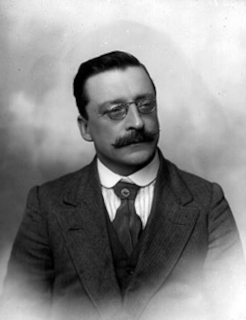
(Pictured: Arthur Griffith, founder (1905) and third president (1911-17) of Sinn Féin)
Sheppard is born to Simpson Sheppard, a sculptor, and Ellen White, of Ormond Quay, Dublin.
Sheppard is based in Dublin for almost all of his life, having travelled widely across Europe. He and his wife Rosie have several children. They live at Howth and 30 Pembroke Road in central Dublin. She dies in 1931.
From 1902 to 1937 Sheppard teaches sculpture at the Dublin Metropolitan School of Art, which is renamed the National College of Art in 1936. His annual stipend is £250 but for this he only has to lecture on three mornings per week, allowing him plenty of time for work on commissioned projects. One of his most famous students is the sculptor Kathleen Cox.
Sheppard is generally critical of the low standards of sculpture in Ireland, saying, “For the last sixty years or so thousands of figures and groups have been executed in Dublin for ecclesiastical purposes, and, with one or two exceptions…was not up to a reasonable standard. The making of a work of art hardly entered into it at all. The sculptor, well trained and properly encouraged, should collaborate with the architect.”
In 1890–1910 Sheppard is a part of the Celtic Revival movement, and, from his works such as Inis Fáil, is admired by his student William Pearse. Through him he meets his brother, Patrick Pearse, who later helps launch the Easter Rising in 1916. While most of the Revival’s artists are writers, playwrights and poets, Sheppard can claim to be the main sculptor working on themes similar to theirs.
Sheppard is in the minority of Irish Protestants who support independence, starting with support for the Irish Parliamentary Party in the 1880s, when he is an art student. After the Irish War of Independence (1919–21) he says, “They thought me too old to fight but I have tried to help in other ways. My politics are simple. I have always thought that this country should be a free country.” His opinions are not overly dogmatic, considering his work on the war memorials in 1920.
In the mid-1920s the first series of Irish Free State coinage is planned and is finally launched in 1928. Sheppard is one of the designers short-listed but his designs are not accepted.
Sheppard dies in Dublin on September 14, 1941.
(Pictured: “The Dying Cúchulainn,” sculpture by Oliver Sheppard, now at the General Post Office (GPO) in Dublin)
McGarrity’s family grows up in poverty, motivating his need to immigrate later in life. He grows up hearing his father discussing Irish politics, including topics such as the Fenians, the Irish Parliamentary Party (IPP), and Irish Home Rule. By the time he is an adult, he has developed a keen interest in politics himself.
McGarrity immigrates to the United States in 1892 at the age of 18. He is reputed to have walked to Dublin before boarding a cattle boat to Liverpool disguised as a drover, and then sailing to the United States using a ticket belonging to someone else. He settles in Philadelphia, Pennsylvania and becomes successful in the liquor business. His business fails, however, on three occasions, twice due to embezzlement by his business partner.
In 1893 McGarrity joins Clan na Gael, an Irish organisation based in the United States committed to aiding the establishment of an independent Irish state. Clan na Gael had been heavily involved with the Fenian Brotherhood that McGarrity had grown up hearing about, and by the latter half of the 19th century had become a sister organisation of the Irish Republican Brotherhood (IRB). In the decade just before McGarrity joins, Clan na Gael and the Fenian movement had waged the Fenian dynamite campaign, where they attempted to force the British state to make concessions in Ireland by bombing British Infrastructure. However, this had caused a split within Clan na Gael that is not mended until seven years after McGarrity joins when, in 1900, the factions reunite and plead to support “the complete independence of the Irish people, and the establishment of an Irish republic.” In the years that follow the 1880s and 1890s, he is, amongst others, credited with helping to stitch the organisation back together and bring it renewed strength.
McGarrity helps sponsor several Irish Race Conventions and founds and runs a newspaper called The Irish Press from 1918-22 that supports the Irish War of Independence. He is the founder of the Philadelphia chapter of Clan Na Gael.
When Éamon de Valera arrives in the United States in 1919 they strike up an immediate rapport and McGarrity manages de Valera’s tour of the country. He persuades de Valera of the benefits of supporting him and the Philadelphia branch against the New York branch of the Friends of Irish Freedom organisation led by John Devoy and Judge Daniel F. Cohalan. He becomes president of the American Association for the Recognition of the Irish Republic. He christens his newborn son Éamon de Valera McGarrity, although their relationship becomes strained upon de Valera’s entry back into Dáil Éireann in the Irish Free State.
The Irish Civil War sees a split in Clan na Gael just as it had split Sinn Féin back in Ireland. McGarrity and a minority of Clan na Gael members support the anti-treaty side but a majority support the pro-treaty side, including John Devoy and Daniel Cohalan. Furthermore, in October 1920 Harry Boland informs the Clan na Gael leadership that the IRB will be cutting their ties to the Clan unless the IRB is given more influence over their affairs. Devoy and Cohalan resist this, but McGarrity sees the Clan’s connection with the IRB as vital. While McGarrity’s faction is initially labelled “Reorganised Clan na Gael,” they are able to inherit total control of the Clan na Gael name as Devoy is not able to keep effective organisation of the group. In general, however, the in-fighting amongst the Irish on both sides of the Atlantic is quite disheartening for Irish Americans and in the years to come neither pro or anti-treaty sides of Clan na Gael see much in the way of donations.
With the scope of Clan na Gael now narrowed, and Devoy and Cohalan removed from the picture, McGarrity becomes chairman of the organisation. He does not support the founding of Fianna Fáil in 1926 and opposes the party’s entry into the Dáil in 1927. Even after the Irish Civil War, he still supports the idea that a 32-county Irish Republic can be achieved through force. in the spring of 1926, he receives Chief of Staff of the Irish Republican ArmyAndrew Cooney to the United States. Cooney and Clan na Gael formally agree that each organisation will support the other and that Clan na Gael will raise funds, purchase weapons and build support for the IRA in the United States.
Going into the late 1920s though Clan na Gael, as are most Irish American organisations, is struggling. Having limped past the split caused by the Irish Civil War, the rejection of Fianna Fáil has caused a second split in the membership. Many Irish Americans see the IRA and Fianna Fáil as one and the same at that point and Clan na Gael and McGarrity’s hostility to them causes much friction.
By July 1929, the Clan’s membership in one of its strongholds, New York City, is down to just 620 paid members. Then in October of that same year Wall Street crashes and the Great Depression hits. In 1933 McGarrity is left almost bankrupt after he is found guilty of “false bookkeeping entries.” His livelihood is saved when he becomes one of the main ticket agents in the United States for the Irish Hospitals’ Sweepstake. He is a personal friend of Joseph McGrath, one of the founders of the Sweepstake. The sweepstakes allow him to turn his fortunes around.
Despite the trying times of both Clan na Gael and his personal life, McGarrity holds fast in his belief in physical force Irish Republicanism. In 1939 he supports the demand from Seán Russell for the “S-Plan” bombing campaign in Britain, which proves disastrous. He allegedly meets Hermann Göring in Berlin in 1939 to ask for aid for the IRA, which leads indirectly to “Plan Kathleen.”
McGarrity is a lifelong friend of fellow Carrickmore native and avid Republican, Patrick McCartan. When he dies on September 4, 1940, a mass is held in the St. Mary’s Pro-Cathedral in Dublin. He remains an unrepentant physical force republican all his life. A number of McGarrity’s papers are in the National Library of Ireland. He donates his personal Library to Villanova University.
The IRA signs all its statements ‘J.J. McGarrity’ until 1969 when the organisation splits into the ‘Official‘ and ‘Provisional‘ movements. Thereafter the term continues to be used by the Officials while the Provisionals adopt the moniker ‘P.O’Neill.’
Logue is born in Kilmacrennan, County Donegal in the west of Ulster on October 1, 1840. He is the son of Michael Logue, a blacksmith, and Catherine Durning. From 1857 to 1866, he studies at Maynooth College, where his intelligence earns him the nickname the “Northern Star.” Before his ordination to the priesthood, he is assigned by the Irish bishops as the chair of both theology and belles-lettres at the Irish College in Paris in 1866. He is ordained priest in December of that year.
Logue remains on the faculty of the Irish College until 1874, when he returns to Donegal as administrator of a parish in Letterkenny. In 1876, he joins the staff of Maynooth College as professor of Dogmatic Theology and Irish language, as well as the post of dean.
On May 13, 1879, Logue is appointed Bishop of Raphoe by Pope Leo XIII. He receives his episcopal consecration on the following July 20 from Archbishop Daniel McGettigan, with Bishops James Donnelly and Francis Kelly serving as co-consecrators, at the pro-cathedral of Raphoe. He is involved in fundraising to help people during the 1879 Irish famine, which, due to major donations of food and government intervention never develops into a major famine. He takes advantage of the Intermediate Act of 1878 to enlarge the Catholic high school in Letterkenny. He is also heavily involved in the Irish temperance movement to discourage the consumption of alcohol.
Logue publicly supports the principle of Irish Home Rule throughout his long reign in both Raphoe and Armagh, though he is often wary of the motives of individual politicians articulating that political position. He maintains a loyal attitude to the British Crown during World War I, and on June 19, 1917, when numbers of the younger clergy are beginning to take part in the Sinn Féin agitation, he issues an “instruction” calling attention to the teaching of the Roman Catholic Church as to the obedience due to legitimate authority, warning the clergy against belonging to “dangerous associations,” and reminding priests that it is strictly forbidden by the statutes of the National Synod to speak of political or kindred affairs in the church.
Logue opposes the campaign of murder against the police and military begun in 1919, and in his Lenten pastoral of 1921 he vigorously denounces murder by whomsoever committed. This is accompanied by an almost equally vigorous attack on the methods and policy of the government. He endorses the Anglo-Irish Treaty in 1921.
In 1921, the death of Cardinal James Gibbons makes Logue archpriest (protoprete) of the College of Cardinals. He is more politically conservative than Archbishop of DublinWilliam Joseph Walsh, which creates tension between Armagh and Dublin. In earlier life he was a keen student of nature and an excellent yachtsman.
Cardinal Michael Logue dies in Ara Coeli, the residence of the archbishop, on November 19, 1924, and is buried in a cemetery in the grounds of St. Patrick’s Cathedral, Armagh.
MacSwiney is born at 23 North Main Street, Cork, County Cork, one of eight children of John and Mary MacSwiney. Following the failure of this business, John MacSwiney emigrates to Australia in 1885 leaving the children in the care of their mother and his eldest daughter.
MacSwiney is educated by the Christian Brothers at the North Monastery school in Cork but leaves at fifteen to help support the family. He becomes an accountancy clerk but continues his studies and matriculates successfully. He continues in full-time employment while he studies at the Royal University (now University College Cork), graduating with a degree in Mental and Moral Science in 1907.
In 1901 MacSwiney helps to found the Celtic Literary Society, and in 1908 he founds the Cork Dramatic Society with Daniel Corkery and writes a number of plays for them. His first play, The Last Warriors of Coole, is produced in 1910. His fifth play, The Revolutionist (1915), takes the political stand made by a single man as its theme.
Described as a sensitive poet-intellectual, MacSwiney’s writings in the newspaper Irish Freedom bring him to the attention of the Irish Republican Brotherhood. He is one of the founders of the Cork Brigade of the Irish Volunteers in 1913 and is President of the Cork branch of Sinn Féin. He founds a newspaper, Fianna Fáil, in 1914, but it is suppressed after only 11 issues. In April 1916, he is intended to be second in command of the Easter Rising in Cork and Kerry but stands down his forces on the order of Eoin MacNeill.
Following the rising, MacSwiney is imprisoned by the British Government under the Defence of the Realm Act 1914 in Reading and Wakefield Gaols until December 1916. In February 1917 he is deported from Ireland and imprisoned in Shrewsbury and Bromyardinternment camps until his release in June 1917. It is during his exile in Bromyard that he marries Muriel Murphy of the Cork distillery-owning family. In November 1917, he is arrested in Cork for wearing an Irish Republican Army (IRA) uniform, and inspired by the example of Thomas Ashe, goes on a hunger strike for three days prior to his release.
In the 1918 Irish general election, MacSwiney is returned unopposed to the first Dáil Éireann as Sinn Féin representative for Mid Cork, succeeding the Nationalist MP D. D. Sheehan. After the murder of his friend Tomás Mac Curtain, the Lord Mayor of Cork on March 20, 1920, he is elected as Lord Mayor. On August 12, 1920, he is arrested in Cork for possession of “seditous articles and documents,” and also possession of a cipher key. He is summarily tried by a court on August 16 and sentenced to two years’ imprisonment at Brixton Prison in England.
In prison MacSwiney immediately starts a hunger strike in protest of his internment and the fact that he was tried by a military court. Eleven other Irish Republican prisoners in Cork Jail go on hunger strike at the same time. On August 26, the British Government states that “the release of the Lord Mayor would have disastrous results in Ireland and would probably lead to a mutiny of both military and police in south of Ireland.”
MacSwiney’s hunger strike gains world attention. The British Government is threatened with a boycott of British goods by Americans, while four countries in South America appeal to Pope Benedict XV to intervene. Protests are held in Germany and France as well. An Australian member of Parliament, Hugh Mahon, is expelled from the Parliament of Australia for “seditious and disloyal utterances at a public meeting,” after protesting against the actions of the British Government. Two weeks later, the Spanish Catalan organization Autonomous Center of Employees of Commerce and Industry (CADCI) sends a petition to British Prime MinisterDavid Lloyd George calling for his release and the newspaper of the organization, Acció (Acción in Spanish), begins a campaign for MacSwiney.
Food is often placed near MacSwiney to persuade him to give up the hunger strike. Attempts at force-feeding are undertaken in the final days of his strike. On October 20, 1920, he slips into a coma and dies five days later after 73 days on hunger strike. His body lay in St. George’s Cathedral, Southwark in London where 30,000 people file past it. Fearing large-scale demonstrations in Dublin, the authorities divert his coffin directly to Cork, and his funeral in the Cathedral of St. Mary and St. Anne on October 31 attracts huge crowds. He is buried in the Republican plot in St. Finbarr’s Cemetery in Cork. Arthur Griffith delivers the graveside oration.
In 1895, the City of Dublin Steam Packet Company orders four steamers for Royal Mail service, named for four provinces of Ireland: RMS Leinster, RMS Connaught, RMS Munster, and RMS Ulster. The RMS Leinster is a 3,069-ton packetsteamship with a service speed of 23 knots. The vessel, which is built at Cammell Laird‘s in Birkenhead, England, is driven by two independent four-cylinder triple-expansion steam engines. During World War I, the twin-propellered ship is armed with one 12-pounder and two signal guns.
The ship’s log states that she carries 77 crew and 694 passengers on her final voyage under the command of Captain William Birch. The ship had previously been attacked in the Irish Sea but the torpedoes missed their target. Those on board include more than 100 British civilians, 22 postal sorters and almost 500 military personnel from the Royal Navy, British Army and Royal Air Force. Also aboard are nurses from the UK, Ireland, Australia, New Zealand, Canada and the United States.
Just before 10:00 AM as it is sailing east of the Kish Bank in a heavy swell, passengers see a torpedo approach from the port side and pass in front of the bow. A second torpedo follows shortly afterwards, and strikes the ship forward on the port side in the vicinity of the mail room. Captain Birch orders the ship to make a U-turn in an attempt to return to Kingstown as it begins to settle slowly by the bow. It sinks rapidly, however, after a third torpedo strikes her, causing a huge explosion.
Captain Birch who is wounded in the initial attack, drowns when his lifeboat is swamped in heavy seas and capsizes while attempting to transfer survivors to HMS Lively. Several of the military personnel who die are buried in Grangegorman Military Cemetery.
One of the rescue ships is the armed yacht and former fishery protection vessel HMY Helga. Stationed in Kingstown harbour at the time of the sinking, she had shelled Dublin during the 1916 Easter Rising in Dublin two years earlier. She was later bought and renamed the Muirchú by the Irish Free State government as one of its first fishery protection vessels.
At October 18, 1918 at 9:10 AM SM UB-125, outbound from Germany, picks up a radio message requesting advice on the best way to get through the North Seaminefield. The sender is Oberleutnant zur See Robert Ramm aboard SM UB-123. Extra mines have been added to the minefield since SM UB-123 had made her outward voyage from Germany. As SM UB-125 had just come through the minefield, Vater radios back with a suggested route. SM UB-123 acknowledges the message and is never heard from again.
The following day, ten days after the sinking of the RMS Leinster, SM UB-123 accidentally detonates a mine while trying to cross the North Sea and return to base in Imperial Germany. It is October 19, 1918. Oberleutnant zur See Robert Ramm, who has a wife and children, never returns to them. Thirty-five other German families are similarly bereaved. No bodies are ever found.
In 1991, the anchor of the RMS Leinster is raised by local divers. It is placed near Carlisle Pier and officially dedicated on January, 28, 1996.