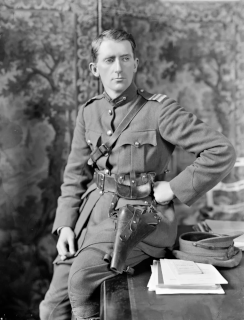
Stack is born to William Stack, an attorney’s clerk, and Nanette O’Neill. He is educated at the Christian Brothers School in Tralee. At the age of fourteen, he leaves school and becomes a clerk in a solicitor‘s office. A gifted Gaelic footballer, he captains the Kerry team to All-Ireland victory in 1904. He also serves as President of the Kerry Gaelic Athletic Association County Board.
Stack becomes politically active in 1908 when he joins the Irish Republican Brotherhood (IRB). In 1916, as commandant of the Kerry Brigade of the Irish Volunteers, he makes preparations for the landing of arms by Roger Casement. He is made aware that Casement was arrested on Easter Saturday and was being held in Tralee. He makes no attempt to rescue him from Ballymullen Barracks.
Stack, as part of his role as Minister for Home Affairs, is widely credited with the creation and administration of the Dáil Courts. These are courts run by the Irish Republican Army (IRA) in parallel and opposition to the judicial system being run by the British government. The IRA and Sinn Féin are highly successful in both getting the civilian population of Ireland to use the courts and accept their rulings. The success of this initiative gives Sinn Féin a large boost in legitimacy and supports their goals in creating a “counter-state” within Ireland as part of their overarching goals in the Irish War of Independence.
Stack opposes the Anglo-Irish Treaty of 1921 and takes part in the subsequent Irish Civil War. He is captured in 1923 and goes on hunger strike for forty-one days before being released in July 1924.
In 1925, Stack marries Winifred (Una) Gordon, (née Cassidy), the widow of a Royal Irish Constabulary (RIC) district inspector, Patrick Gordon.
Stack’s health never recovers following his hunger strike and he dies at the age of 49 in a Dublin hospital on April 27, 1929.
Austin Stack Park in his hometown of Tralee, one of the Gaelic Athletic Association’s stadiums, is named in his honour, as is the Austin Stacks GAA hurling and Gaelic football club.
O’Connor is educated in St. Mary’s College, Dublin, and then in Clongowes Wood College, County Kildare, a public school run by the Jesuit order. It is also attended by the man who later condemns O’Connor to death, his close friend Kevin O’Higgins. He studies experimental physics, logic, and metaphysics. He also attends the College of Science, Merrion Street. He takes a BA (1906) and receives a B.Eng (1911). In 1910, he takes his Bachelor of Engineering and Bachelor of Arts degrees at University College Dublin (UCD), then known as the National University. Prominent in the university’s Literary and Historical Society, he advocates militant constitutional nationalism as one of the many society members active in the Young Ireland branch of the United Irish League.
During the subsequent Irish War of Independence (1919-21) O’Connor is Director of Engineering of the Irish Republican Army (IRA), a military organisation descended from the Irish Volunteers. The specialist skills of engineering and signaling are essential to the development of the 5th Battalion, Dublin Brigade. Its men are forbidden frontline duty as their contribution is regarded as vital, their number too small. But units only expand on an incremental local basis, disappointing General Richard Mulcahy.
O’Connor is also involved in the Republican breakout from Strangeways Prison in Manchester, England, on October 25, 1919. Michael Collins takes a particular interest in the escape and actually visits Austin Stack in the prison under a false name to finalise the arrangements. IRA men hold up traffic while a ladder is propped up against the outside of a prison wall. In all six prisoners escape, among them Piaras Beaslaí.
O’Connor refuses to accept the Anglo-Irish Treaty of 1921, which establishes the Irish Free State. It is ratified by a narrow vote in Dáil Éireann, the Irish parliament. He and many like him feel that the Treaty copper-fastens the partition of the six counties of Northern Ireland and undermines the Irish Republic declared in 1916.
On January 10, a meeting is held at O’Connor’s home in Monkstown, Dublin. In attendance are all senior anti-Treaty IRA officers except Liam Mellows. O’Connor is appointed to chair this grouping, known as the Republican Military Council. It is agreed that an IRA convention should be called without delay; failing this, a separate GHQ will be formed. At a further meeting in O’Connor’s office on March 20, a temporary IRA GHQ staff is elected under Liam Lynch as chief of staff. O’Connor remains in charge of engineering.
On March 26, 1922, the anti-Treaty officers of the IRA hold a convention in Dublin, in which they reject the Treaty and repudiate the authority of the Dáil. However, they are prepared to discuss a way forward. The convention meets again on April 9. It creates a new army constitution and places the army under a newly elected executive of 16 men, including O’Connor, that are to choose an army council and headquarters staff. Asked by a journalist if this development means the anti-Treatyites ware proposing a “military dictatorship” in Ireland, O’Connor replies, “You can take it that way if you want.”
On April 14, 1922, O’Connor is one of a number of IRA leaders in a 200-strong force that occupies the Four Courts building in the centre of Dublin in defiance of the Provisional Government. They intend to provoke the British troops, who are still in the country, into attacking them, which they believe will restart the war with Britain and re-unite the IRA against their common enemy. They also occupy other smaller buildings regarded as being associated with the former British administration, such as the Ballast Office and the Freemasons‘ Hall in Molesworth Street, but the Four Courts remains the focus of interest. On June 15, O’Connor sends out men to collect the rifles that belong to the mutineers of the Civic Guards.
Michael Collins tries desperately to persuade the IRA men to leave the Four Courts. At the Third IRA Convention on June 18, the Executive is split over whether the Irish Government should demand that all British troops leave within 72 hours. A motion to this effect, opposed by Lynch, is narrowly defeated, whereupon O’Connor and others leave the meeting to set up a separate GHQ. The IRA effectively splits into two factions opposed to the government.
On June 22, 1922, Sir Henry Wilson is assassinated in London by two IRA men, Reginald Dunne and Joseph O’Sullivan, each a former British soldier. Some now argue that this was done on the orders of Michael Collins, who had been a close friend of Dunne’s in the London Irish Republican Brotherhood (IRB). Prime MinisterDavid Lloyd George writes an angry letter to Collins, which includes the line “…still less can Mr. Rory O’Connor be permitted to remain his followers and his arsenal in open rebellion in the heart of Dublin… organizing and sending out from this centre enterprises of murder not only in the area of your Government…”
On June 28, 1922, after the Four Courts garrison has kidnapped J. J. “Ginger” O’Connell, a general in the National Army, Collins gives orders for the shelling of the Four Courts with borrowed artillery lent by Winston Churchill. The shelling leads to the Four Courts catching fire, damaging parts of the building in addition to destroying numerous government documents. O’Connor is one of 130 men that surrender on June 30, some of whom are arrested and imprisoned in Mountjoy Prison. This incident marks the official start of the Irish Civil War, as fighting breaks out openly around the country between pro- and anti-Treaty factions.
On December 8, 1922, along with three other republicans, Liam Mellows, Richard Barrett and Joe McKelvey, captured with the fall of the Four Courts, O’Connor is executed by firing squad in reprisal for the anti-Treaty IRA’s killing of Free State Teachta Dála (TD) Sean Hales. The execution order is signed by Kevin O’Higgins. O’Connor had been best man at O’Higgins’s wedding on October 27, 1921. Their deaths remain a symbol of the bitterness and division of the Irish Civil War. O’Connor, one of 77 republicans executed by the Provisional Government, is seen as a martyr by the Republican movement in Ireland.
On O’Connor’s execution, the equestrienne Joan de Sales La Terriere, a close friend of his, names her son in his honour. “Rory O’Connor Place” in Arklow is named in his honour. There is also a pub in Crumlin, Dublin, named after him and a housing estate near Dún Laoghaire, County Dublin, called “Rory O’Connor Park.” A Sinn Féincumann (UCD) is named after him.
(Pictured: Rory O’Connor addressing members of the IRA’s Dublin City Brigade at Smithfield, April 1922)
Durcan grows up in Dublin and in Turlough, County Mayo. His father, John, is a barrister and circuit court judge. He has a difficult and formal relationship with his father. He enjoys a warmer and more natural relationship with his mother, Sheila MacBride Durcan, through whom he is a great-nephew of both Maud Gonne, the Irish social and political activist, and John MacBride, one of the leaders of the Easter Rising, which begins the Irish War of Independence leading to the foundation of the Irish Free State.
In 1966, Durcan moves to London, where he works at the North Thames Gas Board. He meets Nessa O’Neill in 1967 and they marry and have two daughters, Sarah and Siabhra. They live in South Kensington, then move to Cork, where his wife teaches in a prison. The marriage ends in early 1984.
Durcan’s main published collections include A Snail in my Prime, Crazy About Women, Greetings to Our Friends in Brazil and Cries of an Irish Caveman. He appears on the 1990 Van Morrison album Enlightenment, giving an idiosyncratic vocal performance on the song “In The Days Before Rock’n’Roll,” which he also co-writes.
In 2003, Durcan publishes a collection of his weekly addresses to the nation, Paul Durcan’s Diary, on RTÉ Radio 1 programme Today with Pat Kenny. He gets his inspiration from Paidraig Whitty, a local Wexford poet. He is shortlisted in 2005 for the Poetry Now Award for his collection The Art of Life (The Harvill Press, 2004). In 2009, he is conferred with an honorary degree by Trinity College, Dublin. He is the Ireland Fund Artist-in-Residence in the Celtic Studies Department of St. Michael’s College at the University of Toronto in October 2009. In 2011 he is conferred with an honorary doctorate from University College Dublin.
Between 2004 and 2007 Durcan is the third Ireland Professor of Poetry. He is a member of Aosdána. Awards he has received include the Patrick Kavanaugh Poetry Award (1974), the Irish American Culture Institute Poetry Award (1989), the Whitbread Prize for Daddy, Daddy (1990) and the London Poetry Book Society choice for The Berlin Wall Café.
A number of poems from Durcan’s poetry career are studied by Irish students who take the Leaving Certificate.
Following the Irish War of Independence, Mountjoy Prison is transferred to the control of the Irish Free State, which becomes the State of Ireland in 1937. In the 1920s, the families of the dead men request their remains be returned to them for proper burial. This effort is joined in the later 1920s by the National Graves Association. Through the efforts of the Association, the graves of the men are identified in 1934, and in 1996 a Celtic cross is erected in Glasnevin Cemetery, Dublin, to commemorate them.
The campaign to rebury the men drags on for 80 years from their deaths. Following an intense period of negotiations, the Irish government relents. Plans to exhume the bodies of the ten men are announced on November 1, 2000, the 80th anniversary of the execution of Kevin Barry. On October 14, 2001, the Forgotten Ten are afforded full state honours, with a private service at Mountjoy Prison for the families of the dead, a Requiem Mass at St. Mary’s Pro-Cathedral and burial in Glasnevin Cemetery.
According to The Guardian, some criticise the event as glorifying militant Irish republicanism. It coincides with the Fianna FáilArdfheis. The progress of the cortège through the centre of Dublin is witnessed by crowds estimated as being in the tens of thousands who break into spontaneous applause as the coffins pass. On O’Connell Street, a lone piper plays a lament as the cortège pauses outside the General Post Office (GPO), the focal point of the 1916 Easter Rising. In his homily during the Requiem Mass, CardinalCahal Daly, a long-time critic of the IRA campaign in Northern Ireland, insists that there is a clear distinction between the conflict of 1916–22 and the paramilitary-led violence of the previous 30 years:
“The true inheritors today of the ideals of the men and women of 1916 to 1922 are those who are explicitly and visibly committed to leaving the physical force tradition behind… Surely this state funeral can be an occasion for examination of conscience about the ideals of the men who died, and about our responsibility for translating those ideals into today’s realities.”
In his graveside oration TaoiseachBertie Ahern echoes these sentiments and also pays tribute to the Ten:
“These 10 young men were executed during the War of Independence. The country was under tremendous pressure at the time. There was a united effort. Meanwhile, elected by the people, Dáil Éireann was developing, in spite of a war going on. Democracy was being put to work. Independent civic institutions, including the Dáil courts, were beginning to function. Before their deaths, the ten had seen the light of freedom. They understood that Ireland would be free and independent.”
The state funeral, broadcast live on national television and radio, is only the 13th since independence. Patrick Maher is not reburied with his comrades. In accordance with his wishes, and those of his family, he is reinterred in Ballylanders, County Limerick.
A feature length Irish language documentary on the re-interments, An Deichniúr Dearmadta (The Forgotten Ten) airs on TG4 on March 28, 2002.
(Pictured: The grave of nine of the Forgotten Ten in Glasnevin Cemetery, Dublin)
Doyle fights in the Irish War of Independence (1919-21) and takes the anti-Treaty side in the Irish Civil War (1922-23) and is subsequently interned among numerous others. Together with two fellow-detainees, Timothy Coughlin and Bill Gannon, he takes part in forming a secret “vengeance grouping.” The three vow that once free of imprisonment they will take revenge on their opponents, whom they consider traitors to the Irish cause.
Most such private revenge pacts are broken up by the IRA leadership when it reorganises following 1924, but Doyle and his two fellow conspirators persist and carry through their deadly aim. On July 10, 1927, the three surprised O’Higgins on his way to Mass at the Booterstown Avenue side of Cross Avenue in Blackrock, Dublin, and shoot him down.
O’Higgins is especially hated by IRA members for having ordered the executions of seventy-seven of their fellows during the Civil War, an act for which he outspokenly takes responsibility and refuses to express any remorse. Moreover, he is a dominant member of the Irish Free State government, and the conspirators have good reasons to believe that his death would weaken it.
The three make their escape and are not apprehended. However, Timothy Coughlin is shot to death by police informer Sean Harling on the night of January 28, 1928, on Dublin’s Dartry Road, under circumstances which remain controversial up to the present. A second IRA man is known to have been with Coughlin that night, in surveillance of Harling’s home, and escapes unharmed. It is believed that Doyle is that second man, though this point, as many other details of this still rather mysterious affair, remains not quite certain.
Doyle is among the beneficiaries of the amnesty issued by Éamon de Valera when he comes to power in 1932, under which numerous IRA men are released from prison and the charges against others dropped. In later times Doyle openly admits his part in the killing of O’Higgins, and indeed takes pride in it, without fear of prosecution.
With the end of the IRA’s alliance with de Valera and the increasing confrontation between them, Doyle, now a veteran highly respected in the IRA circles, becomes deeply involved in the organisation’s 1940s campaigns. Harry, the memoirs of IRA man Harry White, make repeated admiring references to “Archie Doyle of Dublin, the Tan War veteran who had fought through it all.”
During the IRA’s Northern campaign, Doyle is said to have participated in the abortive raid on the British barracks at Crossmaglen, County Armagh, on September 2, 1942, in retaliation for the execution of Tom Williams earlier that morning. The IRA unit, some twenty men in a commandeered lorry and accompanying car, is discovered by a passing Royal Ulster Constabulary (RUC) patrol near the village of Cullaville. Doyle is mentioned in White’s memoirs as having “jumped out of the car, Thompson in hand, and started shooting at the RUC.” Since the element of surprise is lost, the attack on the barracks has to be cancelled.
A week later, on September 9, White mentions Doyle as having commanded the assassination of Sergeant Denis O’Brien, Irish Special Branch detective and himself a former IRA man, near Dublin. It is a highly controversial affair, opposed by the IRA GHQ in Belfast as damaging to the Northern campaign, and precipitates a massive manhunt by the Irish police. It is IRA Chief of StaffCharlie Kerins who is caught two years later, charged with the O’Brien assassination and eventually executed for it. White, however, claims that it is Doyle who actually commands that action, on Kerins’s orders. Doyle, who openly spoke of his part in killing O’Higgins, seems far more reticent about this part of his career.
In 1943 Doyle is assigned as the IRA’s Quartermaster General in Belfast.
On July 1, 1943, Doyle is mentioned as having participated, together with Kerins and with Jackie Griffith, in an operation of “fund-raising” for the hard-pressed IRA (i.e., robbery). The three men arrive on bikes at the gates of Player Wills factory on the South Circular Road, Dublin, and with scarves around their faces stop at gunpoint a van loaded with some £5,000 for wages and drive away with the van and the money.
Griffith is shot down by the police in Dublin less than a week later, in what is charged to be an extrajudicial assassination, and Kerins is caught in 1944 and executed, becoming a major IRA martyr. Doyle, however, continually survives decades of a very dangerous way of life and manages to die of old age. He dies in St. James’s Hospital in Dublin in 1980.
Sheppard is based in Dublin for almost all of his life, having traveled widely across Europe. His wife Rosie dies in 1931, with whom he has several children. They live at Howth and 30 Pembroke Road in central Dublin.
From 1902 to 1937 Sheppard teaches sculpture at the Dublin Metropolitan School of Art. His annual stipend is £250 but for this he only has to lecture three mornings a week, allowing him plenty of time for work on commissioned projects. One of his most famous students is the sculptor, Kathleen Cox.
The Dying Cuchulain is considered Sheppard’s masterpiece and an important work of Irish art. It is a bronze figure of the mythological warrior-hero Cuchulain, who continued to fight against his enemies while gravely wounded and tied to a tree. It is created in 1911 and later chosen by Éamon de Valera in 1935 as the national memorial to the 1916 Easter Rising. It can still be viewed today in the General Post Office (GPO), O’Connell Street, Dublin.
Sheppard is generally critical of the low standards of sculpture in Ireland: “For the last sixty years or so thousands of figures and groups have been executed in Dublin for ecclesiastical purposes, and, with one or two exceptions … was not up to a reasonable standard. The making of a work of art hardly entered into it at all. The sculptor, well trained and properly encouraged, should collaborate with the architect.”
Sheppard is in the minority of Irish Protestants who support independence, starting with support for the Irish Parliamentary Party in the 1880s, when he is an art student.
In 1890–1910 Sheppard is a part of the Celtic Revival movement, and, from his works such as Inis Fáil, is admired by his student William Pearse. Through him he meets his brother Patrick Pearse who later helps launch the Easter Rising in 1916. While most of the Revival’s artists are writers, playwrights and poets, Sheppard can claim to be the main sculptor working on themes similar to theirs.
After the Irish War of Independence (1919–21) Sheppard says, “They thought me too old to fight but I have tried to help in other ways. My politics are simple. I have always thought that this country should be a free country.” His opinions are not overly dogmatic, considering his work on the war memorials in 1920.
In the mid-1920s the first series of Irish Free State coinage is planned and is finally launched in 1928. Sheppard is one of the designers short-listed but his designs are not accepted.
After his retirement in 1937 from the National College of Art, the now renamed Dublin Metropolitan School of Art, he is appointed in 1938 by the Minister for Education to the College’s standing committee. He is also made a judge in the Royal Dublin Society art competition in 1939 and 1940.
Frank Ryan, politician, journalist, intelligence agent and paramilitary activist, is born in the townland of Bottomstown, Elton, County Limerick, on September 11, 1902. A fascinating, somewhat mythical figure, he lives during turbulent times when Ireland finally disposes of tyrannical British rule in Ireland and becomes an icon for socialist republicans in Europe during the 1930s and 40s.
Ryan fights on the Anti-Treaty side in the Irish Civil War (1922-23) and is wounded and interned. In November 1923 he is released and returns to UCD. He secures his degree in Celtic Studies and further secures the editorship of An Phoblacht (The Republic), the newspaper of the anti-Treaty Irish Republican Army (IRA).
The split in the Irish independence party, Sinn Féin, results in regular fist fights between pro and anti-Treaty forces. Cumann na nGaedhael, the pro-Treaty political party in government, recruits the Army Comrades Association (Blueshirts) under former Garda CommissionerEoin O’Duffy to protect their members from anti-Treaty IRA protesters at annual Armistice Day and Wolfe Tone commemorations. Ryan is a forceful orator at these events and is frequently arrested and beaten up by the Gardai. The fractious politics results in Dáil members Sean Hales and Kevin O’Higgins being shot dead in public.
The outbreak of the Spanish Civil War (1936-39) inspires Ryan to lead the first contingent of Irish volunteers to support the Popular Front government of Republican Spain. A brave and inspiring leader, he serves with Italian and German Republican divisions. He is seriously wounded at the Battle of Jarama in February 1937. Following recuperation in Ireland, he is appointed adjutant to republican General José Miaja. During the Aragon Offensive he is captured with 150 of his men in April 1938 and sentenced to death. Irish President, Éamon de Valera, intervenes with General Francisco Franco and Ryan’s sentence is commuted to thirty years. His health suffers severely in Burgos Prison, Spain during his two-year incarceration.
Franco refuses to release Ryan because he is considered his most dangerous prisoner. In August 1940 he is transferred to Berlin, where he is re-united with IRA Chief of StaffSeán Russell. An attempt to return both men to Ireland by U-boat ends with Russell dying from a perforated ulcer. Ryan voluntarily returns to Germany where he serves as the unofficial IRA ambassador for German intelligence. Irishman Francis Stuart, son-in-law of Maud Gonne, who writes some of William Joyce’s propaganda, takes good care of Ryan until his untimely death at a hospital in Loschwitz in Dresden on June 10, 1944.
Ryan’s funeral in Dresden is attended by Elizabeth Clissmann, wife of Helmut Clissmann, and Francis Stuart. Clissmann eventually forwards details of Ryan’s fate to Leopold Kerney in Madrid. According to Stuart and Clissmann, the cause of death is pleurisy and pneumonia.
In 1963, historian Enno Stephan locates Ryan’s grave in Dresden. Three volunteers of the International Brigades, Frank Edwards, Peter O’Connor and Michael O’Riordan travel to East Germany as a guard of honour to repatriate Ryan’s remains in 1979. On June 21, 1979, his remains arrive in Whitefriar Street Carmelite Church, his local church when he lived in Dublin. The church is packed with all shades of Republican and left-wing opinion, as well as those from his past such as the Stuarts, the Clissmanns, Peadar O’Donnell, George Gilmore, and ex-comrades and sympathizers from all over the world. The cortège on its way to Glasnevin Cemetery halts at the GPO in memory of the dead of the 1916 Easter Rising. His coffin is borne to the grave in Glasnevin Cemetery by Irish veterans of the Spanish Civil War, Frank Edwards, Peter O’Connor, Michael O’Riordan and Terry Flanagan. Con Lehane delivers the funeral oration while a piper plays “Limerick’s Lamentation.” He is buried next to Éamonn Mac Thomáis.
Ryan leads a vicarious life in pursuit of human rights, socialism and republicanism. His life story remains more colourful than fiction.
The Second Dáil (Irish: An Dara Dáil) is Dáil Éireann as it convenes on August 16, 1921, following the dissolution of the First Dáil. The Second Dáil runs until June 8, 1922.
From 1919 to 1922, Dáil Éireann is the revolutionary parliament of the self-proclaimed Irish Republic. The Second Dáil consists of members elected at the 1921 Irish elections, but with only members of Sinn Féin taking their seats. On January 7, 1922, it ratifies the Anglo-Irish Treaty by 64 votes to 57 which ends the Irish War of Independence and leads to the establishment of the Irish Free State on December 6, 1922.
Since 1919, those elected for Sinn Féin at the 1918 Irish general election had abstained from the House of Commons and established Dáil Éireann as a parliament of a self-declared Irish Republic, with members calling themselves Teachtaí Dála or TDs. In December 1920, in the middle of the Irish War of Independence, the British Government passes the Government of Ireland Act 1920, which enacts partition by establishing two home rule parliaments in separate parts of Ireland. These provisions arise out of discussions held at the Irish Convention held in 1917, from which Sinn Féin abstains. In May 1921 the first elections to the House of Commons of Northern Ireland and the House of Commons of Southern Ireland are held, by means of the single transferable vote. On May 10, 1921, the Dáil passes a resolution that the elections scheduled to take place later in the month in both parts of the country will be “regarded as elections to Dáil Éireann.”
In the elections for Southern Ireland, all seats are uncontested, with Sinn Féin winning 124 of the 128 seats, and Independent Unionists winning the four seats representing the Dublin University. In the 1921 Northern Ireland general election, the Ulster Unionist Party (UUP) wins 40 of the 52 seats, with Sinn Féin and the Nationalist Party winning 6 seats each. Of the six seats won by Sinn Féin in Northern Ireland, five are held by people who had also won seats in Southern Ireland.
The Second Dáil responds favourably to the proposal from King George V on June 22, 1921, for a truce, which becomes effective from noon on July 11, 1921. This is upheld by nearly all of the combatants while the months-long process of arranging a treaty gets under way. The Truce allows the Dáil to meet openly without fear of arrest for the first time since September 1919, when it had been banned and driven underground.
On September 14, 1921, the Dáil ratifies the appointment of Arthur Griffith, Michael Collins, Robert Barton, Eamonn Duggan and George Gavan Duffy as envoys plenipotentiary for the peace conference in England. These envoys eventually sign the Anglo-Irish Treaty on December 6. The debate on the Treaty starts on December 14 and continues until January 7, 1922. On that date, the Dáil approves the treaty by 64 in favour to 57 against. As the leader of the anti-Treaty minority, de Valera resigns as President. He allows himself to be nominated again but is defeated on a vote of 60–58. He is succeeded as president by Arthur Griffith. The anti-Treaty deputies continue to attend the Dáil, with de Valera becoming the first Leader of the Opposition in the Dáil.
The ratification specified by the Treaty is by “a meeting summoned for the purpose of the members elected to sit in the House of Commons of Southern Ireland.” The Dáil vote does not fulfil this because four unionists are absent and one Northern Ireland member is present. The requisite approval comes at a separate meeting on January 14, 1922, attended by the unionists and boycotted by anti-Treaty TDs. The meeting also approves a Provisional Government led by Collins, which runs in parallel to Griffith’s Dáil government and with overlapping membership. The Government of Ireland Act 1920 requires the Commons to be summoned by the Lord Lieutenant and its members to take an oath of allegiance to the king, whereas the meeting on January 14 is summoned by Griffith and the members present do not take an oath.
Under the terms of the Treaty, a Constituent Assembly is to be elected to draft a Constitution for the Irish Free State to take effect by December 6, 1922. The assembly is also to serve as a “Provisional Parliament” to hold the Provisional Government responsible. This election is held on June 16, 1922, pursuant to both a resolution by the Second Dáil on May 20 and a proclamation by the Provisional Government on 27 May 27.
The Third Dáil is elected at the general election held on June 16, 1922. This election is required to be held under the Anglo-Irish Treaty signed on December 6, 1921.
(Pictured: Some members of the Second Dáil at the Grosvenor Hotel in London, seated (L to R) Éamon de Valera and Arthur Griffith, National Library of Ireland, NPA-RPH-10)
On July 30, 1919, the first assassination authorised by Michael Collins is carried out by The Squad, also known as the Twelve Apostles, when Detective Sergeant “the Dog” Smith is shot near Drumcondra, Dublin.
On April 10, 1919, the First Dáil announces a policy of ostracism of Royal Irish Constabulary (RIC) men. At the time Sinn Féin official policy is against acts of violence. Boycotting, persuasion and mild intimidation succeed against many officers. However, others escalate their activities against republicans and in March 1920 Collins asks Dick McKee to select a small group to form an assassination unit.
When The Squad is formed, it comes directly under the control of the Director of Intelligence or his deputy and under no other authority. The Squad is commanded by Mick McDonnell.
The original “Twelve Apostles” are Mick McDonnell, Tom Keogh, Jimmy Slattery, Paddy Daly, Joe Leonard, Ben Barrett, Vincent Byrne, Sean Doyle, Paddy Griffin, Eddie Byrne, Mick Reilly and Jimmy Conroy. After some time, The Squad is strengthened with members Ben Byrne, Frank Bolster, Mick Keogh, Mick Kennedy, Bill Stapleton and Sam Robinson. Owen Cullen, a member of 2nd Battalion, is driver for a short time, and Paddy Kelly of County Clare for a short time. They are employed full-time and received a weekly wage.
Sometimes, as occasion demands, The Squad is strengthened by members of the IRA Intelligence Staff, the Active Service Unit, munition workers and members of the Dublin Brigade, TipperaryFlying Column men, Dan Breen, Séumas Robinson, Seán Treacy and Seán Hogan, and also Mick Brennan and Michael Prendergast of County Clare. The IRA Intelligence Staff consists of the Director of Intelligence Michael Collins, the Deputy Director of Intelligence Liam Tobin, the Second Deputy Director of Intelligence Tom Cullen, the Third Director of Intelligence Frank Thornton, and members Joe Dolan, Frank Saurin, Ned Kelleher, Joe Guilfoyle, Paddy Caldwell, Paddy Kennedy, Charlie Dalton, Dan McDonnell and Charlie Byrne. The munitions workers include Mat Furlong, Sean Sullivan, Gay McGrath, Martin O’ Kelly, Tom Younge and Chris Reilly.
Other members include Mick Love, Gearoid O’Sullivan, Patrick Caldwell, Charlie Dalton, Mick O’Reilly, Sean Healy, James Ronan, Paddy Lawson, John Dunne, Johnny Wilson and James Heery. Seán Lemass and Stephen Behan, the father of Irish writers Brendan and Dominic Behan, have also been listed as members of the Apostles. There is no hard evidence to support the inclusion of many of the names, but those who subsequently serve in the Irish Army have their active service recorded in their service records held in the Military Archives Department in Cathal Brugha Barracks, Rathmines. Andrew Cooney is also reported to have been associated with The Squad. Stephen Behan’s involvement is first made public in 1962, when the BBC broadcasts an episode of This Is Your Life dedicated to Behan. During the broadcast, remaining members of the squad joined Behan on the set of the show.
Following “The Dog” Smith’s assassination, The Squad continues to target plainclothes police, members of the G Division of the Dublin Metropolitan Police, and, occasionally, problematic civil servants. Organisationally it operates as a subsection of Collins’ Intelligence Headquarters. Two of the executions by The Squad are the killing on January 21, 1920, of RIC Inspector William Redmond of the DMP “G” Division and on March 2, 1920, a British double agent John Charles Byrnes.
One of the Apostles’ particular targets is the Cairo Gang, a deep-cover British intelligence group, so called since it has either been largely assembled from intelligence officers serving in Cairo or from the Dublin restaurant called The Cairo, which the gang frequents. Sir Henry Wilson brings in the Cairo Gang in the middle of 1920, explicitly to deal with Michael Collins and his organization. Given carte blanche in its operations by Wilson, the Cairo Gang adopts the strategy of assassinating members of Sinn Féin unconnected with the military struggle, assuming that this will cause the IRA to respond and bring its leaders into the open.
The most well-known operation executed by the Apostles occurs on what becomes known as Bloody Sunday, November 21, 1920, when British MI5 officers, linked to the Cairo Gang and significantly involved in spying, are shot at various locations in Dublin with fourteen killed and six wounded. In addition to the The Squad, a larger number of IRA personnel are involved in this operation. The only IRA man captured during the operation is Frank Teeling. In response to the killings, the Black and Tans retaliate by shooting up a Gaelic football match between Dublin and Tipperary at Croke Park, the proceeds from which are for the Irish Republican Prisoners Fund. Fourteen civilians are killed including one of the players, Michael Hogan, and 68 are wounded. The Hogan stand at Croke Park is named after Hogan.
The elimination of the Cairo Gang is seen in Dublin as an intelligence victory, but British Prime MinisterDavid Lloyd George comments dismissively that his men “… got what they deserved, beaten by counterjumpers…”. Winston Churchill adds that they were “.. careless fellows … who ought to have taken precautions.”
Some members of The Squad are hanged in 1921 for the killings on Bloody Sunday, including Thomas Whelan and Patrick Moran. Moran had killed a vet, Patrick MacCormack, who seems to have been an innocent victim.
In May 1921, after the IRA’s Dublin Brigade takes heavy casualties during the burning of the Custom House, The Squad and the Brigade’s Active Service Unit are amalgamated into the Dublin Guard, under Paddy Daly. Under the influence of Daly and Michael Collins, most of the Guard take the Free State side and join the National Army in the Irish Civil War of 1922–23. During this conflict some of them are attached to the Criminal Investigation Department and are accused of multiple assassinations of Anti-Treaty fighters. They are also involved in several atrocities against Republican prisoners, particularly after the death of Collins, due to many of them having personal ties with him.
Bill Stapleton goes on to become a director in Bord na Móna, Charles Dalton and Frank Saurin become directors in the Irish Sweepstakes. In October 1923, Commandant James Conroy is implicated in the murder of two Jewish men, Bernard Goldberg and Emmanuel ‘Ernest’ Kahn. He avoids arrest by fleeing to Mexico, returning later to join the Blueshirts. A later application for an army pension is rejected. The killings are the subject of a 2010 investigative documentary by RTÉ, CSÍ: Murder in Little Jerusalem.
Cohalan is an outspoken critic during the Irish War of Independence, condemning acts of violence on both sides. In particular, he denounces the policy of reprisals. In July 1920, he pronounces an interdict on the killers of a Royal Irish Constabulary (RIC) sergeant, shot dead in the church porch in Bandon. He declares that anyone killing from ambush will be excommunicated. On December 12, 1920, Cohalan issues a decree saying that “anyone within the diocese of Cork who organises or takes part in ambushes or murder, or attempted murder, shall be excommunicated.” In turn, his life is threatened by the Irish Republican Army (IRA). In August 1928, he condemns the British government which had allowed Terence MacSwiney to die on hunger strike in 1920.
The Bessborough Home in Cork is run by the Sisters of the Sacred Hearts of Jesus and Mary and when the department “sought a change of superior in Bessborough because of the appallingly high death rate, he [Catholic Bishop of Cork Dr. Daniel Cohalan] denounced the request. The replacement of the Bessborough superior was delayed for four years after the department requested it, and many infants died during that time. It seems probable that the bishop’s intervention was elicited by the congregation.” In general, the report finds that the major causes of infant mortality in the homes were respiratory infections and gastroenteritis, while “public attention has focused on marasmus [malnutrition]” suggesting “willful neglect.” However, it says that “the term marasmus is best seen as indicating that a child was failing to thrive, but medical experts suggest that this was due to an underlying, undiagnosed medical condition.”
Cohalan dies in office at the age of 94 at Bon Secours Hospital, Cork, on August 24, 1952. A story, current at the time in Cork, refers to his antipathy towards bishops of the Church of Ireland who styled themselves “Bishop of Cork.” A month before his death, and on his deathbed, word is brought to him of the death of the Church of Ireland Bishop of Cork, Cloyne and Ross, Robert Hearn. The response of Cohalan, known “affectionately” as “Danny Boy”, is reputedly, “now he knows who’s Bishop of Cork.”