seamus dubhghaill

Promoting Irish Culture and History from Little Rock, Arkansas, USA


Leave a comment

Death of Terence O’Brien, Catholic Bishop of Emly

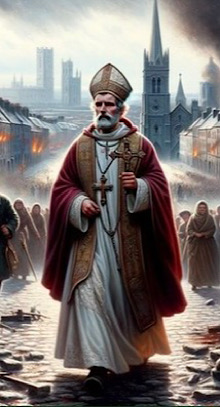
Terence Albert O’Brien (Irish: Muiris Ó Briain Aradh), Irish priest of the Dominican Order and Roman Catholic Bishop of Emly, dies on October 30, 1651.

O’Brien is born into the Gaelic nobility of Ireland at CappamoreCounty Limerick in 1601. Both of his parents are from the derbhfine of the last Chief of the Name of Clan O’Brien Arradh and claim lineal descent from Brian Boru. His family owns an estate of 2,500 Irish acres centered around Tuogh, which is later confiscated by the Commonwealth of England. He joins the Dominicans in 1621 at Limerick, where his uncle, Maurice O’Brien, is then prior. He takes the name “Albert” after the Dominican scholar Albertus Magnus. In 1622, he goes to study in Toledo, Spain, returning eight years later to become prior at St. Saviour’s in Limerick. In 1643, he is provincial of the Dominicans in Ireland. In 1647, he is consecrated Bishop of Emly by Giovanni Battista Rinuccini.

During the Irish Confederate Wars, like most Irish Catholics, O’Brien sides with Confederate Ireland. His services to the Catholic Confederation are highly valued by the Supreme Council. He treats the wounded and supports Confederate soldiers throughout the conflict. He is against a peace treaty that does not guarantee Catholic freedom of worship in Ireland and in 1648 signs the declaration against the Confederate’s truce with Murrough O’Brien, 1st Earl of Inchiquin, who has committed atrocities such as the Sack of Cashel against Catholic clergy and civilians, and the declaration against the Protestant royalist leader, James Butler, 1st Duke of Ormond, in 1650 who, due to his failure to resist the Cromwellian conquest of Ireland is not deemed fit to command Catholic troops. He is one of the prelates, who, in August 1650 offers the Protectorate of Ireland to Charles IV, Duke of Lorraine.

In 1651, Limerick is besieged and O’Brien urges a resistance that infuriates the Ormondists and Parliamentarians. Following surrender, he is found ministering to the wounded and ill inside a temporary plague hospital. As previously decided by the besieging army, O’Brien is denied quarter and protection. Along with Alderman Thomas Stritch and English Royalist officer Colonel Fennell, he is tried by a drumhead court-martial and sentenced to death by New Model Army General Henry Ireton. On October 30, 1651, O’Brien is first hanged at Gallows Green and then posthumously beheaded. His severed head is afterward displayed spiked upon the river gate of the city.

After the successful fight that is eventually spearheaded by Daniel O’Connell for Catholic emancipation between 1780 and 1829, interest revives as the Catholic Church in Ireland is rebuilding after three hundred years of being strictly illegal and underground. As a result, a series of re-publications of primary sources relating to the period of the persecutions and meticulous comparisons against archival Government documents in London and Dublin from the same period are made by Daniel F. Moran and other historians.

The first Apostolic Process under Canon Law begins in Dublin in 1904, after which a positio is submitted to the Holy See.

In the February 12, 1915 Apostolic decree, In Hibernia, heroum nutricePope Benedict XV formally authorizes the formal introduction of additional Causes for Roman Catholic Sainthood.

During a further Apostolic Process held in Dublin between 1917 and 1930 and against the backdrop of the Irish War of Independence and the Irish Civil War, the evidence surrounding 260 alleged cases of Roman Catholic martyrdom are further investigated, after which the findings are again submitted to the Holy See.

On September 27, 1992, O’Brien and sixteen other Irish Catholic Martyrs are beatified by Pope John Paul II. June 20th, the anniversary of the 1584 execution of Elizabethan era martyr Dermot O’Hurley, is assigned as the feast day of all seventeen. A large backlighted portrait of him is on display in St. Michael’s Church, Cappamore, County Limerick, which depicts him during The Siege of Limerick.


Leave a comment

The Proclamation of Dungannon

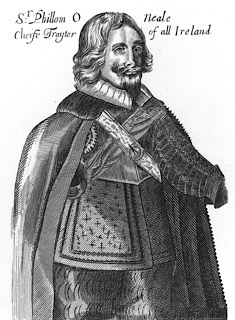
The Proclamation of Dungannon is a document produced by Sir Phelim O’Neill on October 24, 1641, in the Irish town of Dungannon. O’Neill is one of the leaders of the Irish Rebellion of 1641, which was launched the previous day. O’Neill’s Proclamation sets out a justification of the uprising. He claims to have been given a commission signed and sealed on October 1 by the King of England, Scotland and Ireland Charles I that commands him to lead Irish Catholics in defence of the Kingdom of Ireland against Protestants who sympathise with Charles’s opponents in the Parliament of England.

Following the trial and execution of the Lord Deputy of IrelandThomas Wentworth, 1st Earl of Strafford, in May 1641, Ireland is in a state of turmoil. There is growing tension between Catholics and Protestants (particularly those of a Puritan tendency) with the former generally sympathetic to King Charles while the latter supports the English Parliament and the Scottish Covenanters in the dispute that shortly leads to the outbreak of the English Civil War. This forms part of the wider War of the Three Kingdoms.

On October 23, a major uprising breaks out in Ulster organised by leading members of the Gaelic aristocracy. The rebels attack Protestant plantation settlements as well as native Irish Protestants and take garrison towns held by the Irish Army. Irish government authorities in Dublin struggle to contain the insurgency with the limited number of troops they have at their disposal. A last-minute warning saves Dublin Castle from a surprise attack, although O’Neill is clearly unaware of the failure of the Dublin plot when he issues his proclamation.

After seizing several key strategic points in Ulster over the previous twenty-four hours, O’Neill makes his proclamation in Dungannon, a town that has symbolic importance as the traditional capital of the O’Neill dynasty.

In support of his actions, O’Neill claims to have a document from King Charles commissioning him. The Commission is supposedly signed under the Great Seal of Scotland. By declaring their loyalty to the Crown and defence of the Catholic religion, O’Neill and his followers adopt a political stance which is taken up by the subsequent Irish Confederation which governs rebel-controlled territory in the name of the King from 1642 until 1649. The Proclamation encourages many Catholics to believe they can lawfully join the rising with the King’s blessing, while Protestants are left demoralised.

O’Neill’s second and more trenchant proclamation is made “from our camp at Newry” on November 4, 1641 alongside Rory Maguire. He also publishes the actual royal commission that gives authority for his earlier proclamation. It is subtly different, in that it empowers him to arrest and seize property from all of Charles’s English Protestant subjects living in Ireland, but exempts his Irish and Scottish subjects.

Until the late nineteenth century historians generally accept that the commission is genuine, or at the very least Charles had secretly encouraged the Irish Catholics to launch a rising. Since then, for a variety of reasons, it has been considered to be a forgery produced by O’Neill and his associates without the knowledge of the King. They may well have acquired a copy of the Great Seal of Scotland when they captured the garrison town of Charlemont on October 23.

The historian David Stevenson notes that it would be unlikely that the commission would have been addressed to O’Neill. Had it been genuine it would almost certainly have been issued to more senior Irish Royalists such as the James Butler, 1st Duke of Ormond, or the leading Catholic noble of Ulster, Randal MacDonnell, 1st Marquess of Antrim. It is also unlikely to have been issued at Edinburgh as O’Neill claimed. However, King Charles was in Edinburgh on October 1, dealing with Scottish political matters.

Forgery or not, King Charles publicly proclaims all the Irish rebels as traitors on January 1, 1642.

That the Commission is genuine is widely accepted in England and Scotland by the King’s opponents and even some of his own supporters. It seems to tie in with earlier rumours of an army plot which had suggested that Charles might bring over the New Irish Army, made up largely of Ulster Catholics, to impose his will on England and Scotland. Anger at the King’s alleged links with the insurgents grow – particularly as horror stories of atrocities committed, such as the Portadown Massacre, begin to filter across the Irish Sea. Tensions arising from news of the Irish rebellion is a factor in the English push to Civil War in early 1642.

The Scottish authorities dispatch an Army which quickly retakes much of Ulster from the insurgents. Once the English Civil War breaks out in October 1642, Charles’ emissaries begin negotiations with the Irish rebels for their support, which seems to present further evidence to his opponents of his links with the Catholic Ulster leaders. Many of these later dealings are exposed when Charles private letters are captured during the Battle of Naseby (1645) and published as King’s Cabinet Opened.

When O’Neill is captured in 1653 following the Cromwellian conquest of Ireland, he is put on trial for his life. The authorities offer to spare him if he will repeat his earlier claims that Charles had ordered the Catholics to rise in 1641. O’Neill now refuses to implicate the King, who had been executed four years earlier, and is put to death himself. Nonetheless, the English Republicans continue to use O’Neill’s earlier claims of the King’s involvement to justify their decision to commit regicide.


Leave a comment

Birth of James FitzJames Butler, 2nd Duke of Ormonde

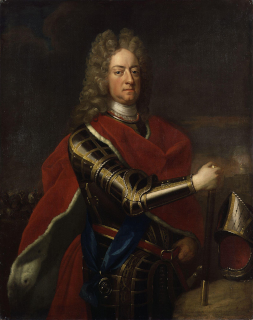
James FitzJames Butler, 2nd Duke of Ormonde, KG, Irish statesman and soldier, is born into a Protestant family on April 29, 1665, at Dublin Castle. He is the third of the Kilcash branch of the family to inherit the earldom of Ormond. He serves in the campaign to put down the Monmouth Rebellion, in the Williamite War in Ireland, in the Nine Years’ War and in the War of the Spanish Succession but is accused of treason and goes into exile after the Jacobite rising of 1715.

Butler is the second but eldest surviving son, and one of eleven children, of Thomas Butler by his wife Emilia van Nassau-Beverweerd. His father is known as Lord Ossory. His father is heir apparent of James Butler, 1st Duke of Ormond but predeceases him and so never becomes duke. His father’s family, the Butler dynasty, is Old English and descends from Theobald Walter, who had been appointed Chief Butler of Ireland by King Henry II in 1177. His mother is Dutch. She descends from a cadet branch of the House of Nassau.

Butler is educated in France and afterwards at Christ Church, Oxford. On the death of his father on July 30, 1680, he becomes Baron Butler in the peerage of England and the 7th Earl of Ossory in the peerage of Ireland.

Butler obtains command of a cavalry regiment in Ireland in 1683 and having received an appointment at court on the accession of James II, he serves against the Duke of Monmouth at the Battle of Sedgemoor in July 1685. Having succeeded his grandfather as 2nd Duke of Ormonde on July 21, 1688, he is appointed a Knight of the Order of the Garter on September 28, 1688. In 1688, he also becomes Chancellor of the University of Dublin and Chancellor of the University of Oxford.

In January and February 1689, Butler votes against the motion to put William of Orange and Mary on the throne and against the motion to declare that James II has abdicated it. Nevertheless, he subsequently joins the forces of William of Orange, by whom he is made colonel of the 2nd Troop of Horse Guards on April 20, 1689. He accompanies William in his Irish campaign, debarking with him in Carrickfergus on June 14, 1690, and commands this troop at the Battle of the Boyne in July 1690. In February 1691 he becomes Lord Lieutenant of Somerset.

Butler serves on the continent under William of Orange during the Nine Years’ War and, having been promoted to major general, he fights at the Battle of Steenkerque in August 1692 and the Battle of Landen in July 1693, where he is taken prisoner by the French and then exchanged for the Duke of Berwick, James II’s illegitimate son. He is promoted to lieutenant general in 1694.

After the accession of Queen Anne in March 1702, Butler becomes commander of the land forces co-operating with Sir George Rooke in Spain, where he fights in the Battle of Cádiz in August 1702 and the Battle of Vigo Bay in October 1702 during the War of the Spanish Succession (1701–1714). Having been made a Privy Councillor, he succeeds Lord Rochester as Lord Lieutenant of Ireland in 1703. In 1704, he leases and rebuilds a property that becomes known as Ormonde Lodge in Richmond outside London.

Following the dismissal of the Duke of Marlborough, Butler is appointed Commander-in-Chief of the Forces and colonel of the 1st Regiment of Foot Guards on January 4, 1712, and Captain General on February 26, 1712. In the Irish Parliament he and the majority of peers support the Tory interest.

Butler plays a dramatic role at the notorious meeting of the Privy Council on March 8, 1711, when Antoine de Guiscard, a French double agent who is being questioned about his treasonable activities, attempts to assassinate Robert Harley, 1st Earl of Oxford, against whom he has a personal grudge for drastically cutting his allowance, by stabbing him with a penknife. Harley is wounded, but not seriously, due largely to the fact that he is wearing a heavy gold brocade waistcoat in which the knife gets stuck. Several Councillors, including Butler, stab Guiscard in return. Guiscard implores Butler to finish the deed, but he replies that it is not for him to play the hangman. In any case, he has the sense to see that Guiscard must be kept alive at least long enough to be questioned, although as it turns out Guiscard’s wounds are fatal, and he dies a week later.

On April 23, 1712, Butler leaves Harwich for Rotterdam to lead the British troops taking part in the war. Once there he allows himself to be made the tool of the Tory ministry, whose policy is to carry on the war in the Netherlands while giving secret orders to him to take no active part in supporting their allies under Prince Eugene. In July 1712, he advises Prince Eugene that he can no longer support the siege of Le Quesnoy and that he is withdrawing the British troops from the action and instead intends to take possession of Dunkirk. The Dutch are so exasperated at the withdrawal of the British troops that they close the towns of Bouchain on Douai to British access, despite the fact that they have plenty of stores and medical facilities available. Butler takes possession of Ghent and Bruges as well as Dunkirk, in order to ensure his troops are adequately provided for. On April 15, 1713, he becomes Lord Lieutenant of Norfolk.

Ormonde’s position as Captain-General makes him a personage of much importance in the crisis brought about by the death of Queen Anne and, during the last years of Queen Anne, he almost certainly has Jacobite leanings and corresponds with the Jacobite Court including his cousin, Piers Butler, 3rd Viscount Galmoye, who keeps barrels of gunpowder at Kilkenny Castle. King George I, on his accession to the throne in August 1714, institutes extensive changes and excludes the Tories from royal favour. Butler is stripped of his posts as Captain-General, as colonel of the 1st Regiment of Foot Guards and as Commander in Chief of the Forces with the first two posts going to the Duke of Marlborough and the role of Commander-in-Chief going to John Dalrymple, 2nd Earl of Stair. On November 19, 1714, Butler is instead made a member of the reconstituted Privy Council of Ireland.

Accused of supporting the Jacobite rising of 1715, Butler is impeached for high treason by Lord Stanhope on June 21, 1715. He might avoid the impending storm of Parliamentary prosecution, if he remains in England and stands trial but instead, he chooses to flee to France in August 1715 and initially stays in Paris with Lord Bolingbroke. On August 20, 1715, he is attainted, his estate forfeited, and honours extinguished. The Earl Marshal is instructed to remove the names and armorial bearings of Butler and Bolingbroke from the list of peers and his banner as Knight of the Garter is taken down in St. George’s Chapel.

On June 20, 1716, the Parliament of Ireland passes an act extinguishing the regalities and liberties of the county palatine of Tipperary; for vesting Butler’s estate in the crown and for giving a reward of £10,000 for his apprehension, should he attempt to land in Ireland. But the same parliament passes an act on June 24, 1721, to enable his brother, Charles Butler, 1st Earl of Arran, to purchase his estate, which he does accordingly.

Butler subsequently moves to Spain where he holds discussions with Cardinal Giulio Alberoni. He later takes part in a Spanish and Jacobite plan to invade England and puts James Francis Edward Stuart on the British throne in 1719, but his fleet is disbanded by a storm in the Bay of Biscay. In 1732, he moves to Avignon, where he is seen in 1733 by the writer Lady Mary Wortley Montagu. He dies at Avignon in exile on November 16, 1745, but his body is returned to London and buried in Westminster Abbey on May 22, 1746.

On July 20, 1682, Butler, then called Lord Ossory, marries Lady Anne Hyde, daughter of Laurence Hyde, who is then Viscount Hyde of Kenilworth but becomes Earl of Rochester in November. The couple has a daughter, Mary, who dies young in 1688.

Following the death of his first wife in 1685, Butler plans to marry again in order to secure a male heir. He gains permission from the House of Lords for the arranging of a jointure for another marriage in May 1685, and in August of that year, he marries Lady Mary Somerset, daughter of the Duke of Beaufort and Mary Capel. The couple has a son, Thomas (1686–1689), and two daughters, Elizabeth (1689–1750) and Mary (1690–1713). His second wife is a Lady of the Bedchamber to Queen Anne. Their younger daughter, Mary, marries John Ashburnham, 1st Earl of Ashburnham.

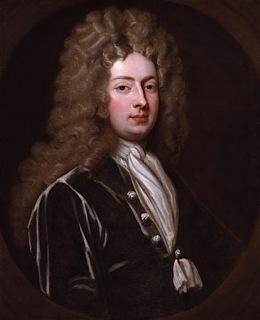
(Pictured: Portrait of James Butler, 2nd Duke of Ormonde, by Michael Dahl, National Portrait Gallery)


Leave a comment

Death of Sir James Ware, Anglo-Irish Historian

Sir James Ware, historian, collector of manuscripts, and civil servant, dies at his home in Castle Street, Dublin, on December 1, 1666.

Ware is born on November 16, 1594, in Castle Street, Dublin, eldest surviving son among ten children of Sir James Ware, auditor general, and his wife Mary Bryden, sister of Sir Ambrose Briden of Maidstone, Kent, England, whose house provides Ware’s base in England. His father, a Yorkshireman, comes to Ireland in the train of Lord Deputy of Ireland Sir William FitzWilliam in 1588 and builds up a substantial landed estate. He enters Trinity College Dublin (TCD), where his father is the college auditor, as a fellow commoner in 1605 and is presented a silver standing bowl in 1609. His association with the college continues, as he particularly remembers the philosophy lectures of Anthony Martin, who becomes a fellow in 1611. He takes his MA on January 8, 1628, but by then he has already launched on his future course. His father procures him the reversion of his office in 1613, and by 1620 he already owns the Annals of Ulster and is taking notes from the Black Book of Christ Church. In 1621, he marries Elizabeth Newman, daughter of Jacob Newman, one of the six clerks in chancery. Newman becomes clerk of the rolls in 1629, which apparently facilitates Ware’s assiduous research in the Irish public records.

From Ware’s numerous surviving notebooks, it is possible to follow his scholarly tracks over the rest of his life. He is particularly concerned to trace the succession of the Irish bishops. The first fruits appear in print in 1626, Archiepiscoporum Cassiliensium et Tuamensium . . . adjicitur historia coenobiorum Cisterciensium Hiberniae, followed in 1628 by De presulibus Lageniae . . ., the whole to be rounded off in 1665 with De presulibus Hiberniae. . . . However, he has wide interests in Irish history and in 1633 edits Edmund Spenser‘s A View of the Present State of Irelande and the Irish histories of Edmund Campion, Meredith Hanmer, and Henry of Marlborough. The first Irish biographical dictionary follows in 1639, De scriptoribus Hiberniae. Both publications are dedicated to the viceroy, Thomas Wentworth. In public life he is a supporter, first of Wentworth, later of James Butler, 1st Duke of Ormond, rather than a leader, and always a stout royalist. He is knighted in 1630 and following his father’s death in 1632 he succeeds as auditor general. He is elected member of parliament for Dublin University in 1634, 1640, and 1661, but is not admitted to the Privy Council of Ireland until 1640.

Shortly after the outbreak of rebellion in October 1641, Ware is in England, and in London at the time of the passing of the Adventurers’ Act 1640, presumably on the council’s business. During Ormond’s prolonged negotiations with the confederates, he is sent to advise the king at Oxford in November 1645. While there he works in the Bodleian Library and is incorporated into the university as a Doctor of Civil Law. On his way back to Ireland in January 1646, he is captured at sea by a parliament ship and held prisoner in the Tower of London until October 1646.

When Ormond is arranging the surrender of Dublin to the parliament in the summer of 1647, Ware is sent to London as one of the hostages for his performance of the terms. Back in Dublin he has been replaced as auditor general but is able to carry on his work on the public records. In 1648 he publishes the catalogue of his manuscript library. As a leading royalist he is unwelcome to those governing the city for the parliament and is sent into exile in France on April 7, 1649, with his eldest son, also James, who already holds the reversion of the auditor generalship and eventually succeeds his father. He is allowed to live in London from October 1650, and from 1653, when hostilities end in Ireland, he is allowed brief visits there, perhaps taking up residence again in 1658.

Ware’s years in London are spent in the library of Archbishop of Armagh James Ussher, then in Lincoln’s Inn, and in the Royal, Cotton, Carew, and Dodsworth libraries. He publishes his De Hibernia et antiquitatibus ejus disquisitiones in 1654, lamenting the inaccessibility of his notes, then in Dublin. The second edition, published in 1658, also includes the annals of Henry VII. His Opuscula Sancto Patricio . . . adscripta . . . appears in 1656. In it he remarks that his knowledge of the Irish language is not expert enough for an edition of the ‘Lorica’. According to Roderick O’Flaherty, Ware can read and understand but not speak Irish. For the older language he employs Irish scholars, Dubhaltach Mac Fhirbhisigh being the last and most learned. The 1660 Stuart Restoration sees him back as auditor general and one of the commissioners for the Irish land settlement. He publishes annals of Henry VIII in 1662, and in 1664 annals for 1485–1558.

Ware dies in his house in Castle Street on December 1, 1666, and is buried in the family vault in St. Werburgh’s Church, Dublin. He has numerous friends among the scholars of the day, including Irish Franciscans, across the sectarian divide. While clergy lists are still partly dependent on his work, his notebooks and manuscripts remain of first importance for the study of medieval Ireland. Of his ten children, two boys and two girls survive him. His wife dies on June 9, 1651. The engraving by George Vertue prefixed to Harris’ edition of Ware’s Works is claimed to be based on a portrait in the possession of the family.

(From: “Ware, Sir James” by William O’Sullivan, Dictionary of Irish Biography, http://www.dib.ie, October 2009)


Leave a comment

Death of Rory O’Moore, Organizer of the Irish Rebellion of 1641

Sir Rory O’Moore (Irish: Ruaidhrí Ó Mórdha), Irish politician and landowner also known Sir Roger O’Moore or O’More or Sir Roger Moore, dies in obscurity on February 16, 1655. He is most notable for being one of the four principal organizers of the Irish Rebellion of 1641.

O’Moore belongs to an ancient Irish noble family descended from Conall Cernach. He is born in either County Laois, around 1600, or more likely at Balyna, his father’s estate in County Kildare.

O’Moore’s uncle, Rory O’More, Lord of Laois, had fought against the English during the Tudor conquest of Ireland. In 1556, Queen Mary I confiscates the O’Mores’ lands and creates “Queens County” (modern-day County Laois). Over 180 family members, who are peaceful and have taken no part in any rebellion, are murdered with virtually all of the leaders of Laois and Offaly by the English at a feast at Mullaghmast, County Kildare, in 1577. Rory Óg and his wife Maighréad O’Byrne, sister of Fiach MacHugh O’Byrne, are hunted down and killed soon afterwards. This leads to the political downfall of the O’Moore family as their estates are given to English settlers.

Given the causes of the rebellion and the Crown’s weakness during the Bishops’ Wars into 1641, O’Moore plans a bloodless coup to overthrow the English government in Ireland. With Connor Maguire, 2nd Baron of Enniskillen, he plans to seize Dublin Castle, which is held by a small garrison, on October 23, 1641. Allies in Ulster led by Sir Phelim O’Neill are to seize forts and towns there. The leaders are to assume the governing of their own country and with this provision offer allegiance to King Charles. They are betrayed, and the plan is discovered on October 22 and the rising fails in its first objective. O’Neill has some success, and O’Moore quickly succeeds in creating an alliance between the Ulster Gaelic clans and the Old English gentry in Leinster.

In November 1641, the Irish forces besiege Drogheda, and a royalist force comes north from Dublin to oppose them. O’Moore is one of the leaders of the rebel army that intercepts and defeats the relief force at the Battle of Julianstown on November 29.

In the ensuing Irish Confederate Wars, a major achievement by O’Moore is to recruit Owen Roe O’Neill from the Spanish service in 1642. He commands the Confederate forces in what is now County Laois and County Offaly, which remain peaceful, and helps arrange alliances with Murrough O’Brien, 1st Earl of Inchiquin, in 1647 and James Butler, 1st Duke of Ormond, in 1648. The resulting larger alliance fails to stop the Cromwellian invasion of Ireland (1649–53) in which an estimated third of the Irish population dies.

The Irish historian Charles Gavan Duffy writes: “Then a private gentleman, with no resources beyond his intellect and his courage, this Rory, when Ireland was weakened by defeat and confiscation, and guarded with a jealous care constantly increasing in strictness and severity, conceived the vast design of rescuing the country from England, and even accomplished it; for, in three years, England did not retain a city in Ireland but Dublin and Drogheda, and for eight years the land was possessed and the supreme authority exercised by the Confederation created by O’Moore. History contains no stricter instance of the influence of an individual mind.”

Bishop Michael Comerford writes that after O’Moore’s defeat at the Battle of Kilrush in April 1642 he retires and dies in Kilkenny city in the winter of 1642–43, having co-founded the Irish Catholic Confederation there a few months earlier. However, this ignores his contacts with Inchiquin and Ormonde in 1647–48.

In 1652, O’Moore goes to Inishbofin off the coast of Galway, one of the last Catholic strongholds, but as the parliamentary forces approach, he makes arrangements to flee. Walter Lynch, Bishop of Clonfert, sails in the last ship to leave the island without waiting for O’Moore, who is forced to make his own way. He finally escapes into Ulster but dies in obscurity on February 16, 1655. He is buried at Steryne churchyard, in the parish of Magilligan, County Londonderry.

St. Colman’s Church on the island once bears a tablet with the inscription: “In memory of many valiant Irishmen who were exiled to this Holy Island and in particular Rory O’More a brave chieftain of Leix, who after fighting for Faith and Fatherland, disguised as a fisherman escaped from his island to a place of safety. He died shortly afterwards, a martyr to his Religion and his County, about 1653. He was esteemed and loved by his countrymen, who celebrated his many deeds of valour and kindness in their songs and reverenced his memory, so that it was a common expression among them; ‘God and Our Lady be our help and Rory O’More’.”

O’More marries Jane Barnewall, daughter of Sir Patrick Barnewall, of Donabate, County Dublin, and his second wife Mary Bagenal. They had two sons and four daughters. His daughter Anne marries Patrick Sarsfield from an Old English Catholic family from The Pale. His grandsons include Patrick Sarsfield, 1st Earl of Lucan, who leads a Jacobite force in the Williamite War in Ireland, and his brother William Sarsfield, whose descendants include all the Earls of Lucan and the 4th and all subsequent Earls Spencer, through which O’More is an ancestor to Diana, Princess of Wales.

The Balyna estate is inherited from Calvagh O’More by Rory’s brother Lewis. Balyna is passed down to Lewis’s last surviving O’More descendant, Letitia, who is also descended from Rory O’More because her grandfather married a second cousin. Letitia marries a Richard Farrell in 1751. This Farrell family henceforth takes the surname More O’Ferrall.

The Rory O’More Bridge in Dublin is renamed after him. The film Rory O’More, made by the Kalem Company in 1911, directed by Sidney Olcott and Robert G. Vignola, sets O’More’s rebellion in 1798 rather than the 17th century, and moves the action to the Lakes of Killarney.


Leave a comment

Death of James Butler, 2nd Duke of Ormonde

James FitzJames Butler, 2nd Duke of Ormonde, KG, Irish statesman and soldier, dies in Avignon on November 16, 1745. He is the third of the Kilcash branch of the family to inherit the earldom of Ormond. He serves in the campaign to put down the Monmouth Rebellion, in the Williamite War in Ireland, in the Nine Years’ War and in the War of the Spanish Succession but is accused of treason and goes into exile after the Jacobite rising of 1715.

Butler is born into a Protestant family on April 29, 1665, at Dublin Castle. He is the second but eldest surviving son, and one of eleven children, of Thomas Butler by his wife Emilia van Nassau-Beverweerd. His father is known as Lord Ossory. His father is heir apparent of James Butler, 1st Duke of Ormond but predeceases him and so never becomes duke. His father’s family, the Butler dynasty, is Old English and descends from Theobald Walter, who had been appointed Chief Butler of Ireland by King Henry II in 1177. His mother is Dutch. She descends from a cadet branch of the House of Nassau.

Butler is educated in France and afterwards at Christ Church, Oxford. On the death of his father on July 30, 1680, he becomes Baron Butler in the peerage of England and the 7th Earl of Ossory in the peerage of Ireland.

Butler obtains command of a cavalry regiment in Ireland in 1683 and having received an appointment at court on the accession of James II, he serves against the Duke of Monmouth at the Battle of Sedgemoor in July 1685. Having succeeded his grandfather as 2nd Duke of Ormonde on July 21, 1688, he is appointed a Knight of the Order of the Garter on September 28, 1688. In 1688, he also becomes Chancellor of the University of Dublin and Chancellor of the University of Oxford.

In January and February 1689, Butler votes against the motion to put William of Orange and Mary on the throne and against the motion to declare that James II has abdicated it. Nevertheless, he subsequently joins the forces of William of Orange, by whom he is made colonel of the 2nd Troop of Horse Guards on April 20, 1689. He accompanies William in his Irish campaign, debarking with him in Carrickfergus on June 14, 1690, and commands this troop at the Battle of the Boyne in July 1690. In February 1691 he becomes Lord Lieutenant of Somerset.

Butler serves on the continent under William of Orange during the Nine Years’ War and, having been promoted to major general, he fights at the Battle of Steenkerque in August 1692 and the Battle of Landen in July 1693, where he is taken prisoner by the French and then exchanged for the Duke of Berwick, James II’s illegitimate son. He is promoted to lieutenant general in 1694.

After the accession of Queen Anne in March 1702, Butler becomes commander of the land forces co-operating with Sir George Rooke in Spain, where he fights in the Battle of Cádiz in August 1702 and the Battle of Vigo Bay in October 1702 during the War of the Spanish Succession (1701–1714). Having been made a Privy Councillor, he succeeds Lord Rochester as Lord Lieutenant of Ireland in 1703. In 1704, he leases and rebuilds a property that becomes known as Ormonde Lodge in Richmond outside London.

Following the dismissal of the Duke of Marlborough, Butler is appointed Commander-in-Chief of the Forces and colonel of the 1st Regiment of Foot Guards on January 4, 1712, and Captain General on February 26, 1712. In the Irish Parliament he and the majority of peers support the Tory interest.

Butler plays a dramatic role at the notorious meeting of the Privy Council on March 8, 1711, when Antoine de Guiscard, a French double agent who is being questioned about his treasonable activities, attempts to assassinate Robert Harley, 1st Earl of Oxford, against whom he has a personal grudge for drastically cutting his allowance, by stabbing him with a penknife. Harley is wounded, but not seriously, due largely to the fact that he is wearing a heavy gold brocade waistcoat in which the knife gets stuck. Several Councillors, including Butler, stab Guiscard in return. Guiscard implores Butler to finish the deed, but he replies that it is not for him to play the hangman. In any case, he has the sense to see that Guiscard must be kept alive at least long enough to be questioned, although as it turns out Guiscard’s wounds are fatal, and he dies a week later.

On April 23, 1712, Butler leaves Harwich for Rotterdam to lead the British troops taking part in the war. Once there he allows himself to be made the tool of the Tory ministry, whose policy is to carry on the war in the Netherlands while giving secret orders to him to take no active part in supporting their allies under Prince Eugene. In July 1712, he advises Prince Eugene that he can no longer support the siege of Le Quesnoy and that he is withdrawing the British troops from the action and instead intends to take possession of Dunkirk. The Dutch are so exasperated at the withdrawal of the British troops that they close the towns of Bouchain on Douai to British access, despite the fact that they have plenty of stores and medical facilities available. Butler takes possession of Ghent and Bruges as well as Dunkirk, in order to ensure his troops are adequately provided for. On April 15, 1713, he becomes Lord Lieutenant of Norfolk.

Ormonde’s position as Captain-General makes him a personage of much importance in the crisis brought about by the death of Queen Anne and, during the last years of Queen Anne, he almost certainly has Jacobite leanings and corresponds with the Jacobite Court including his cousin, Piers Butler, 3rd Viscount Galmoye, who keeps barrels of gunpowder at Kilkenny Castle. King George I, on his accession to the throne in August 1714, institutes extensive changes and excludes the Tories from royal favour. Butler is stripped of his posts as Captain-General, as colonel of the 1st Regiment of Foot Guards and as Commander in Chief of the Forces with the first two posts going to the Duke of Marlborough and the role of Commander-in-Chief going to John Dalrymple, 2nd Earl of Stair. On November 19, 1714, Butler is instead made a member of the reconstituted Privy Council of Ireland.

Accused of supporting the Jacobite rising of 1715, Butler is impeached for high treason by Lord Stanhope on June 21, 1715. He might avoid the impending storm of Parliamentary prosecution, if he remains in England and stands trial but instead, he chooses to flee to France in August 1715 and initially stays in Paris with Lord Bolingbroke. On August 20, 1715, he is attainted, his estate forfeited, and honours extinguished. The Earl Marshal is instructed to remove the names and armorial bearings of Butler and Bolingbroke from the list of peers and his banner as Knight of the Garter is taken down in St. George’s Chapel.

On June 20, 1716, the Parliament of Ireland passes an act extinguishing the regalities and liberties of the county palatine of Tipperary; for vesting Butler’s estate in the crown and for giving a reward of £10,000 for his apprehension, should he attempt to land in Ireland. But the same parliament passes an act on June 24, 1721, to enable his brother, Charles Butler, 1st Earl of Arran, to purchase his estate, which he does accordingly.

Butler subsequently moves to Spain where he holds discussions with Cardinal Giulio Alberoni. He later takes part in a Spanish and Jacobite plan to invade England and puts James Francis Edward Stuart on the British throne in 1719, but his fleet is disbanded by a storm in the Bay of Biscay. In 1732, he moves to Avignon, where he is seen in 1733 by the writer Lady Mary Wortley Montagu. He dies at Avignon in exile on November 16, 1745, but his body is returned to London and buried in Westminster Abbey on May 22, 1746.

On July 20, 1682, Butler, then called Lord Ossory, marries Lady Anne Hyde, daughter of Laurence Hyde, who is then Viscount Hyde of Kenilworth but becomes Earl of Rochester in November. The couple has a daughter, Mary, who dies young in 1688.

Following the death of his first wife in 1685, Butler plans to marry again in order to secure a male heir. He gains permission from the House of Lords for the arranging of a jointure for another marriage in May 1685, and in August of that year, he marries Lady Mary Somerset, daughter of the Duke of Beaufort and Mary Capel. The couple has a son, Thomas (1686–1689), and two daughters, Elizabeth (1689–1750) and Mary (1690–1713). His second wife is a Lady of the Bedchamber to Queen Anne. Their younger daughter, Mary, marries John Ashburnham, 1st Earl of Ashburnham.

(Pictured: Portrait of James Butler, 2nd Duke of Ormonde, by Michael Dahl, National Portrait Gallery)


Leave a comment

Giovanni Battista Rinuccini, Nuncio to Ireland, Returns to Rome

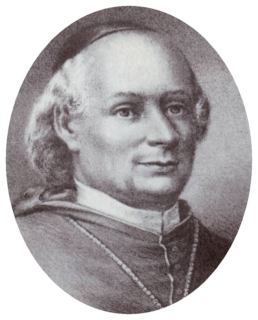
Giovanni Battista Rinuccini, an Italian Roman Catholic archbishop in the mid-seventeenth century, returns to Rome on February 23, 1649, after spending just over three years in Ireland supporting Catholics with arms, money, and diplomacy.

Rinuccini is born in Rome on September 15, 1592. He is educated by the Jesuits in Rome and studies law at the Universities of Bologna and Perugia. In due course, he is ordained a priest, having at the age of twenty-two obtained his doctor’s degree from the University of Pisa. He is named a camariere (chamberlain) by Pope Gregory XV and in 1625 becomes Archbishop of Fermo. In 1631 he carefully refuses an offer to be made Archbishop of Florence.

On September 15, 1644, a new pope, Pope Innocent X, is elected. He decides to step up the help for the Irish Catholic Confederates. He sends Rinuccini as nuncio to Ireland to replace the envoy Friar Pierfrancesco Scarampi, who had been sent to Ireland by his predecessor, Pope Urban VIII, in 1643.

Rinuccini departs France from Saint-Martin-de-Ré near La Rochelle on October 18, 1645, on the frigate San Pietro and arrives in Kenmare, County Kerry, on October 21, 1645, with a retinue of twenty-six Italians, several Irish officers, and the Confederation’s secretary, Richard Bellings. He proceeds to Kilkenny, the Confederate capital, where Richard Butler, 3rd Viscount Mountgarret, the president of the Confederation, receives him at the castle. He speaks Latin to Montgarret, but all the official business of the Confederates is done in English. He asserts in his discourse that the object of his mission is to sustain the King, but above all to help the Catholic people of Ireland in securing the free and public exercise of their religion, and the restoration of the churches and church property to the Catholic Church.

Rinuccini had sent ahead arms and ammunition: 1,000 braces of pistols, 4,000 cartridge belts, 2,000 swords, 500 muskets and 20,000 pounds of gunpowder. He arrives twelve days later with a further two thousand muskets and cartridge-belts, four thousand swords, four hundred braces of pistols, two thousand pike-heads, and twenty thousand pounds of gunpowder, fully equipped soldiers and sailors and 150,658 livres tournois to finance the Irish Catholic war effort. These supplies give him a huge input into the Confederate’s internal politics because he doles out the money and arms for specific military projects, rather than handing them over to the Confederate government, or Supreme Council.

Rinuccini hopes that by doing so he can influence the Confederates’ strategic policy away from making a deal with Charles I and the Royalists in the English Civil War and towards the foundation of an independent Catholic-ruled Ireland. In particular, he wants to ensure that churches and lands taken in the rebellion would remain in Catholic hands. This is consistent with what happened in Catholic-controlled areas during the Thirty Years’ War in Germany. His mission can be seen as part of the Counter-Reformation in Europe. He also has unrealistic hopes of using Ireland as a base to re-establish Catholicism in England. However, apart from some military successes such as the Battle of Benburb on June 5, 1646, the main result of his efforts is to aggravate the infighting between factions within the Confederates.

The Confederates’ Supreme Council is dominated by wealthy landed magnates, predominantly of “Old English” origin, who are anxious to come to a deal with the Stuart monarchy that will guarantee them their land ownership, full civil rights for Catholics, and toleration of Catholicism. They form the moderate faction, which is opposed by those within the Confederation, who want better terms, including self-government for Ireland, a reversal of the land confiscations of the plantations of Ireland and establishment of Catholicism as the state religion. A particularly sore point in the negotiations with the English Royalists is the insistence of some Irish Catholics on keeping in Catholic hands the churches taken in the war. Rinuccini accepts the assurances of the Supreme Council that such concerns will be addressed in the peace treaty negotiated with James Butler, 1st Duke of Ormond, negotiated in 1646, now known as the First Ormond Peace.

However, when the terms are published, they grant only the private practice of Catholicism. Alleging that he had been deliberately deceived, Rinuccini publicly backs the militant faction, which includes most of the Catholic clergy and some Irish military commanders such as Owen Roe O’Neill. On the other side there are the Franciscans Pierre Marchant, and later Raymond Caron. In 1646, when the Supreme Council tries to get the Ormond Peace ratified, Rinuccini excommunicates them and helps to get the Treaty voted down in the Confederate General Assembly. The Assembly has the members of the Supreme Council arrested for treason and elects a new Supreme Council.

However, the following year, the Confederates’ attempts to drive the remaining English (mainly Parliamentarian) armies from Ireland meets with disaster at the battles of Dungan’s Hill on August 8, 1647 and Knocknanuss on November 13, 1647. As a result, the chastened Confederates hastily conclude a new deal with the English Royalists to try to prevent a Parliamentarian conquest of Ireland in 1648. Although the terms of this second deal are better than those of the first one, Rinuccini again tries to overturn the treaty. However, on this occasion, the Catholic clergy are split on whether to accept the deal, as are the Confederate military commanders and the General Assembly. Ultimately, the treaty is accepted by the Confederacy, which then dissolves itself and joins a Royalist coalition. Rinuccini backs Owen Roe O’Neill, who used his Ulster army to fight against his former comrades who had accepted the deal. He tries in vain to repeat his success of 1646 by excommunicating those who support the peace. However, the Irish bishops are split on the issue and so his authority is diluted. Militarily, Owen Roe O’Neill is unable to reverse the political balance.

Despairing of the Catholic cause in Ireland, Rinnuccini leaves the country on February 23, 1649, embarking at Galway on the ship that had brought him to Ireland, the frigate San Pietro. In the same year, Oliver Cromwell leads a Parliamentarian re-conquest of the country, after which Catholicism is thoroughly repressed. Roman Catholic worship is banned, Irish Catholic-owned land is widely confiscated east of the River Shannon, and captured Catholic clergy are executed.

Rinuccini returns to Rome, where he writes an extensive account of his time in Ireland, the Commentarius Rinuccinanus. His account blames personal vainglory and tribal divisions for the Catholic disunity in Ireland. In particular, he blames the Old English for the eventual Catholic defeat. The Gaelic Irish, he writes, despite being less civilised, are more sincere Catholics.

Rinuccini returns to his diocese in Fermo in June 1650 and dies there on December 13, 1653.


Leave a comment

Death of Thomas Butler, Viscount Thurles

Thomas Butler, Viscount Thurles, drowns on December 15, 1619, off the coast of The Skerries, Isle of Anglesey. He is the son and heir apparent of Walter Butler, 11th Earl of Ormond (1559–1633), whom he predeceases. He resides at Thurles Castle, Thurles, County Tipperary. He is the father of the Irish statesman and Royalist commander James Butler, 1st Duke of Ormond.

Butler is born the eldest son of Walter Butler and his wife Helen Butler. His father is the 11th Earl of Ormond. His mother is the eldest daughter of Edmund Butler, 2nd Viscount Mountgarret and his wife Grizel FitzPatrick. His father and mother are cousins. Their common great-grandfather is Piers Butler, 8th Earl of Ormond. Their family, the Butler dynasty, is Old English and descends from Theobald Walter, who had been appointed Chief Butler of Ireland by King Henry II of England in 1177.

Some time before 1610, Butler marries Elizabeth Poyntz against his father’s wishes. She is the daughter of Sir John Pointz (died 1633) of Iron Acton in Gloucestershire and his wife Elizabeth Sydenham. He and Elizabeth had seven children, three sons and four daughters:

In 1619 after the beginning of his father’s long imprisonment in the Fleet Prison, Butler is summoned to England to answer charges of treason, specifically, of having garrisoned Kilkenny. However, on December 15 the ship conveying him is wrecked off the coast of The Skerries, Isle of Anglesey and he drowns. Like his father, he is a prominent Catholic and it seems likely that his refusal to conform to the established Anglican religion had angered King James I and may have been the true motive for his summons.

Butler predeceases his father who dies in 1634. His eldest son James, the future 1st Duke of Ormond, succeeds him as heir apparent and bearer of the courtesy title Viscount Thurles until he succeeds his grandfather as the 12th Earl of Ormond.


Leave a comment

The Battle of Lisnagarvey

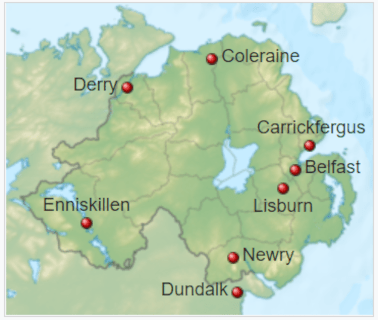
The Battle of Lisnagarvey is fought on December 6, 1649, near Lisnagarvey, County Antrim, during the Irish Confederate Wars, an associated conflict of the Wars of the Three Kingdoms (1638-51). Forces loyal to the Commonwealth of England defeat an army supporting Charles II of England, composed of Royalists and Scots Covenanters.

The Irish Confederate Wars, sparked by the Irish Rebellion of 1641, are initially fought between the predominantly Catholic Confederation, and a largely Protestant government army led by James Butler, 1st Duke of Ormond. Both claims to be loyal to Charles I, while there is a three-sided war in Ulster. The latter involves Royalists, Gaelic Catholic leader Eoghan Ó Néill, and Presbyterian militia known as the Laggan Army, supported by Scots Covenanters under Robert Monro.

In September 1643, Ormond agrees to a truce, or ‘Cessation’, with the Confederation, freeing his troops for use in England against Parliament in the First English Civil War. Some Irish Protestants object, and switch sides, including Sir Charles Coote, who becomes Parliamentarian commander in Connacht. Charles surrenders in 1646, while a Covenanter/Royalist uprising is quickly suppressed in the 1648 Second English Civil War. On January 17, 1649, the Confederation allies with Ormond’s Royalists. Following the execution of Charles on January 30, they are joined by the Laggan Army and remaining Scots troops in Ulster.

There are various reasons for this. The Covenanter government, who provides support for Scottish settlers in Ulster, considers Oliver Cromwell and other leaders of the new Commonwealth of England dangerous political and religious radicals. As Scots, they object to the execution of their king by the English; as Presbyterians, they view monarchy as divinely ordained, making it also sacrilegious, and transfer their allegiance to his son, Charles II of England.

However, this is offset by a split within the Confederation, between Catholic landowners who want to preserve the position prevailing in 1641, and those like Ó Néill, whose estates had been confiscated in 1607. As a result, he agrees a truce with Coote, and refuses to join the Alliance, depriving them of their most effective fighting force in the north. Despite this, by late July, Ormond’s combined Royalist/Confederate army controls most of Ireland.

In Ulster, Derry is the only major town still held by forces loyal to the Commonwealth. The garrison is commanded by Coote, who is besieged by the Laggan Army under George Munro, Robert’s nephew. In July, Munro is forced to lift the siege by Ó Néill, an example of the impact of the truce between two unlikely allies.

Ormond’s defeat at Rathmines on August 2 allows Cromwell and an army of 12,000 to land in Dublin unopposed. After capturing Drogheda on September 11, his main force heads south towards Wexford. Colonel Robert Venables is sent north with three regiments, or around 2,500 men, to take control of Ulster. Munro’s garrisons surrender with minimal resistance, and by the end of September, Venables has occupied Dundalk, Carlingford, Newry, and Belfast. These are accompanied by the mass expulsion of Scots settlers, as punishment for their defection. When Coote captures Coleraine on September 15, he massacres the largely Scottish garrison.

At the end of October, Coote joins Venables at Belfast. They spend November reducing remaining Royalist garrisons in the north, and in early December, assemble 3,000 men to attack Carrickfergus. After lifting the siege of Derry, Munro has retreated to Enniskillen with the remainder of the Laggan Army. Since the loss of Carrickfergus would effectively cut communications with Scotland, he is determined to prevent this if at all possible.

He combines forces with Royalist leader Lord Clandeboye, creating an army of around 5,000. However, it comprises remnants from many different regiments, its men are poorly equipped, and demoralised, while most have not been paid for over two years. As they march north, their numbers dwindle due to desertion.

Learning of their advance, Coote and Venables move to intercept Munro, and the two advance guards make contact outside Lisnagarvey, near Lisburn, on December 6. Despite superior numbers, the Royalists cannot hold their ground against their far more experienced opponents. When the main body of the Parliamentarian force appears, the retreat rapidly turns into a rout, the majority fleeing without firing a shot. In the pursuit that follows, they lose 1,500 men, killed or captured, along with their baggage train and supplies. Clandeboye and the remnants of his army surrender shortly afterwards, although Monro escapes to Enniskillen.

Lisnagarvey ends resistance by Scottish forces to the Parliamentarian army. Carrickfergus surrenders on December 13, and as with other towns, its Scottish settlers are expelled. Early in 1650, Monro agrees to evacuate Enniskillen for £500, and returns to Scotland, leaving Ó Néill’s army as the only remaining obstacle to Parliamentarian control of the north. However, his death in November 1649 proves a major blow to its morale and fighting ability. In June 1650, it is destroyed by Coote and Venables at Scarrifholis.

(Pictured: Map of key locations of the 1649 campaign in Ulster)


Leave a comment

Death of James Butler, 1st Duke of Ormonde

James Butler, 12th Earl and 1st Duke of Ormond, dies on July 21, 1688, at the Kingston Lacy estate near Wimborne Minster, Dorset, England. An Anglo-Irish Protestant, he is the leading agent of English royal authority in Ireland during much of the period from the beginning of the English Civil War (1642–51) to the Glorious Revolution (1688–89).

Butler is born at Clerkenwell, London on October 19, 1610, into the prominent Butler family, the eldest child of Thomas Butler and his wife Elizabeth Poyntz. He grows up in England and succeeds to the earldom of Ormonde in 1633. That same year he begins his active career in Ireland by offering his services to Lord Deputy of Ireland Thomas Wentworth, later Earl of Strafford. Upon the outbreak of the Irish Rebellion of 1641 in Ireland, he is appointed a lieutenant general in the English army. He defeats the rebels of the Catholic Confederacy at Kilrush, Munster on April 15, 1642, and at New Ross, Leinster on March 18, 1643. Those triumphs, however, do not prevent the confederates from overrunning most of the country.

Butlers’s attempts to conclude a peace are blocked by a Catholic faction that advocates complete independence for Ireland. The situation deteriorates further, and in July 1647, he departs from Ireland, leaving the Protestant cause in the hands of the parliamentarians, who had defeated King Charles I in the First English Civil War (1642–46).

Returning to Ireland in September 1648, Butler concludes a peace with the confederacy in January 1649. He then rallies Protestant royalists and Catholic confederates in support of Charles II, son and successor of Charles I. For several months most of Ireland is under his control. But the parliamentarian general Oliver Cromwell lands at Dublin in August 1649 and swiftly conquers the country for Parliament. Butler flees to France and becomes one of Charles II’s closest advisers at his court-in-exile in Paris.

When Charles II returns to England in the Restoration of 1660, Butler, who had urged constitutional rather than military rule, is made commissioner for the treasury and the navy. Appointed Lord Lieutenant of Ireland in 1662, he makes vigorous attempts to encourage Irish commerce and industry. Nevertheless, his enemies at court persuade Charles to dismiss him in 1669. He is restored to royal favour in 1677 and is again appointed Lord Lieutenant of Ireland. Although he is created a duke in the English peerage in 1682, he is recalled from Ireland in 1684 as a result of new intrigues at Charles’s court and because of the determination of James, Duke of York, to strengthen his supporters in Ireland.

Butler dies on July 21, 1688, at the Kingston Lacy estate, Dorset. He is buried in Westminster Abbey on August 4, 1688. His eldest son, Thomas, 6th Earl of Ossory, predeceases him, but Ossory’s eldest son James succeeds as 2nd Duke of Ormonde (1665–1745).

(Pictured: “James Butler, 1st Duke of Ormond,” oil on canvas by William Wissing, National Portrait Gallery)