seamus dubhghaill

Promoting Irish Culture and History from Little Rock, Arkansas, USA


2 Comments

Birth of Charles Kickham, Novelist, Poet, Journalist & Revolutionary

Charles Joseph Kickham, Irish revolutionary, novelist, poet, journalist and one of the most prominent members of the Irish Republican Brotherhood (IRB), is born at Mullinahone, County Tipperary, on May 9, 1828.

Kickham’s father, John Kickham, is the proprietor of the principal drapery in the locality and is held in high esteem for his patriotic spirit. His mother, Anne O’Mahony, is related to the Fenian leader John O’Mahony. He grows up largely deaf and almost blind, the result of an explosion with a powder flask when he is thirteen. He is educated locally, where it is intended that he study for the medical profession. During his boyhood the campaign for a repeal of the Acts of Union 1800 between Great Britain and Ireland is at its height, and he soon becomes versed in its arguments and is inspired by its principles. He often hears the issues discussed in his father’s shop and at home amongst all his friends and acquaintances.

From a young age Kickham is imbued with these patriotic ideals. He becomes acquainted with the teaching of the Young Irelanders through their newspaper The Nation from its foundation in October 1842. His father read the paper aloud every week for the family. Like all the young people of the time, and a great many of the old ones, his sympathies are with the Young Irelanders on their secession from the Repeal Association.

When he is 22 years old, Kickham contributes The Harvest Moon sung to the air of “The Young May Moon,” to The Nation on August 17, 1850. Other verses are to follow, but the finest of his poems according to A. M. O’Sullivan, appear in other journals. Rory of the Hill, The Irish Peasant Girl, and Home Longings, better known as Slievenamon, are published in the Celt. The First Felon appears in the Irishman. Patrick Sheehan, the story of an old soldier, is published in the Kilkenny Journal, and becomes very popular as an anti-recruiting song.

Kickham begins to write for a number of papers, including The Nation, but also the Celt, the Irishman, the Shamrock, and becomes one of the leading writers of The Irish People, the Fenian newspaper, in which many of his poems appear. His writings are signed using his initials, his full name, or the pseudonyms, “Slievenamon” and “Momonia.”

Kickham is the leading member of the Confederation Club in Mullinahone, which he is instrumental in founding. When the revolutionary spirit begins to grip the people in 1848, he turns out with a freshly made pike to join William Smith O’Brien and John Blake Dillon when they arrive in Mullinahone in July 1848. On hearing of the progress of O’Brien through the country, he sets to work manufacturing pikes and is in the forge when news reaches him that the leaders are looking for him. It is here that he meets James Stephens for the first time. At O’Brien’s request, he rings the chapel bell to summon the people and before midnight a Brigade has answered the summons. He later writes a detailed account about this period which brings his connection with the attempted Rising of 1848 to a close.

After the failed 1848 uprising at Ballingarry, Kickham has to hide for some time, as a result of the part he had played in rousing the people of his native village to action. When the excitement has subsided, he returns to his father’s house and resumes his interests in the sports of fishing and fowling and spends much of his time in literary pursuits. Some of the authors in which he is well versed are Alfred Tennyson and Charles Dickens and he greatly admires George Eliot, and after William Shakespeare, is Robert Burns.

In the autumn of 1857, a messenger arrives from New York with a message for James Stephens from members of the Emmet Monument Association, calling on him to get up an organization in Ireland. On December 23, Stephens dispatches Joseph Denieffe to the United States with his reply and outlines his conditions and his requirements from the organisation in America. Denieffe returnd on March 17, 1858, with the acceptance of Stephens’ terms and £80. That evening the Irish Republican Brotherhood commences. Those present in Langan’s, lathe-maker and timber merchant, 16 Lombard Street, for that first meeting are Stephens, Kickham, Thomas Clarke Luby, Peter Langan, Denieffe and Garrett O’Shaughnessy. Later it includes members of the Phoenix National and Literary Society, which is formed in 1856 by Jeremiah O’Donovan Rossa in Skibbereen, County Cork.

In mid-1863, Stephens informs his colleagues that he wishes to start a newspaper, with financial aid from O’Mahony and the Fenian Brotherhood in America. The offices are established at 12 Parliament Street, almost at the gates of Dublin Castle. The first issue of The Irish People appears on November 28, 1863. The staff of the paper along with Kickham are Luby and Denis Dowling Mulcahy as the editorial staff, O’Donovan Rossa and James O’Connor in charge of the business office, with John Haltigan being the printer. John O’Leary is brought from London to take charge in the role of Editor. Shortly after the establishment of the paper, Stephens departs on an America tour, and to attend to organizational matters. Before leaving, he entrusts to Luby a document containing secret resolutions on the Committee of Organization or Executive of the IRB. Though Luby intimates its existence to O’Leary, he does not inform Kickham as there seems no necessity. This document later forms the basis of the prosecution against the staff of The Irish People.

Kickham’s first contribution to The Irish People, entitled Leaves from a Journal, appears in the third issue and is based on a journal he kept on his way to America in 1863. This article leaves no doubt as to his literary capacity according to O’Leary. It falls to Kickham, as a good Catholic, to tackle the priests, though not exclusively with articles such as “Two Sets of Principles,” a rebuff to the doctrines laid down by Lord Carlisle, and “A Retrospect,” dealing with the tenant-right movement chiefly but also the events of the recent past and their bearing on the present. Kickham articulates the attitude held by the IRB in relation to priests, or more particularly in politics.

On July 15, 1865, American-made plans for a rising in Ireland are discovered when the emissary loses them at Kingstown railway station. They find their way to Dublin Castle and to Superintendent Daniel Ryan, head of G Division. Ryan has an informer within the offices of The Irish People named Pierce Nagle. He supplies Ryan with an “action this year” message on its way to the IRB unit in Tipperary. With this information, Ryan raids the offices of The Irish People on September 15, followed by the arrests of O’Leary, Luby, and O’Donovan Rossa. Kickham is caught after a month on the run. Stephens is also caught but with the support of Fenian prison warders John J. Breslin and Daniel Byrne is less than a fortnight in Richmond Bridewell when he vanishes and escapes to France. The last issue of The Irish People is dated September 16, 1865.

On November 11, 1865, Kickham is convicted of treason. Judge William Keogh, with many expressions of sympathy for the prisoner, and many compliments in reference to his intellectual attainments, sentences him to fourteen years’ penal servitude. The prisoners’ refusal to disown their opposition to British rule in any way, even when facing charges of life-imprisonment, earn them the nickname of “the bold Fenian men.” Kickham spends time from 1866 until his release in the Woking Convict Invalid Prison.

Kickham is given a free pardon from Queen Victoria on February 24, 1869, because of ill-health, and upon his release he is made Chairman of the Supreme Council of the IRB and the unchallenged leader of the reorganized movement. He is an effective orator and chairman of meetings despite his physical handicaps. He wears an ear trumpet and can only read when he holds books or papers within a few inches of his eyes. For many years he carries on conversations by means of the deaf and dumb alphabet.

Kickham is the author of three well-known stories, dealing sympathetically with Irish life and manners and the simple faith, the joys and sorrows, the quaint customs and the insuppressible humour of the peasantry. Knocknagow is deemed one of the finest tales of peasant life ever written. Sally Cavanagh is a touching story illustrating the evils of landlordism and emigration. For the Old Land deals with the fortunes of a small farmer’s family.

Kickham dies on August 22, 1882, at the house of James O’Connor, a former member of the IRB and afterward MP for West Wicklow, 2 Montpelier Place, Blackrock, Dublin, where he had been living for many years, and had been cared for by the poet Rose Kavanagh. He is buried in Mullinahone, County Tipperary.

Leave a comment

Death of Joseph Brenan, Poet, Journalist & Author

Joseph Brenan (also Brennan), poet, journalist and author, and leading member of the Young Irelanders and Irish Confederation, dies on May 27, 1857, in New Orleans, Louisiana.

Brenan is born in Cork, County Cork, on November 17, 1828. He begins to write verse at an early age and is one of the genuine poets of the Young Ireland movement. His earlier poems are published under the initials “J. B., Cork,” or “J. B—n,” and some of his American verses under the pseudonym “Gondalez.” He is also an able prose writer.

Brenan is an active member of the Cork Historical Society, and is one of the editors of the Cork Magazine, which appears in November 1847, and continues to be published until the end of 1848, when the journal ceases publication. Some of its contributors, who include Frazer, Martin MacDermott, Fitz James O’Brien, Mulchinock and Mary Savage, later either end up in jail or in exile.

In January 1848, John Mitchel visits Cork and, according to Michael Cavanagh, who publishes a sketch of Brenan’s life in Young Ireland, Dublin, in June and July 1885, Brenan for the first time “beheld the man he most admired on earth, and with whose future destiny, whether for weal or woe, he felt his own was bound up. Never had the archenemy of England a more faithful or earnest follower.”

Brenan contributes to the Mitchel’s United Irishman and sells his rifle to obtain train fare so he can take up his residence in Dublin, the headquarters of the revolutionary movement. He later publishes articles in John Martin‘s The Irish Felon urging the Confederate Clubs members, many of whom have arms, to be in readiness for action. “The sooner you realise the fact,” he writes in a letter addressed to the Members of the Provincial Confederate Clubs, “that the Confederation was got up for the purpose of doing something, the better for us all. Just think what it undertook to do. It undertook to defeat the strongest Government and to liberate the most degraded country that ever existed. It undertook to give – to a province—to strike the chains off millions of slaves and, if necessary, to wash out the iron moulds in blood.”

In another letter to “the Young Men of Ireland” on July 22, 1848, he writes, “On you I principally rely. You realise that you are very ‘rash,’ rather inclined to be ‘violent,’ and have exceedingly little prudence to spare. Brothers, let your watchword be ‘Now or never—now and forever’ rashly.”

Brenan is associated with John Savage and John O’Mahony while Savage is operating on the slopes of the Comeragh Mountains. He is arrested and kept in prison for seven months alternately in Newgate Prison, Carrickfergus and Kilmainham Gaols. During his confinement he writes some fine poems, according to T. F. O’Sullivan, one, entitled Yearnings, evidently addressed to Mary Savage, sister of John.

After his release without trial in March 1849, Brenan becomes editor of the Irishman which had been started in Dublin by Bernard Fulham, and for six months attempts to rekindle the insurrectionary flame in the country. He is implicated in the attack on the Cappoquin police barracks on September 16, 1848, and in October escapes to the United States.

In America Brenan becomes associated with a number of journals, including Horace Greeley‘s New-York Tribune, Devin Reilly’s People, The Enquirer of Newark, New Jersey, and the New Orleans Delta in which he writes a series of papers under the pen-name Ben Fox. On August 27, 1851, he marries Mary Savage, in her parents’ house, on Thirteenth Street, New York.

Brenan writes some articles and poems for John Mitchel’s Irish Citizen in 1854. He is an enthusiastic supporter of the Southern cause and founds the New Orleans Times.

Brenan dies on May 27, 1857, at the early age of twenty-nine and is buried in the old French cemetery of New Orleans. During the last year of his life, he is almost totally blind. He is attended in his last illness by Dr. Dalton Williams. There are seven children of his and Mary’s marriage, only one of whom, Florence, survives their parents. She possesses her father’s literary ability but devotes her life to religion as a member of the Mercy Order.

Brenan’s best-known poem, “Come to Me, Dearest,” is addressed to Mary Savage before their marriage. The love story of Brenan and Mary is told in the sketch by Ellen Mary Patrick Downing, afterwards Sister Mary Alphonsus.


Leave a comment

Birth of Michael Doheny, Writer, Lawyer & Co-founder of the IRB

Michael Doheny, Irish writer, lawyer, member of the Young Ireland movement, and co-founder of the Irish Republican Brotherhood (IRB), is born on May 22, 1805, at Brookhill, parish of Fethard, County Tipperary, the second son of Michael Doheny of Brookhill, a small farmer, and Ellen Doheny (née Keley).

Doheny receives a rudimentary education from an itinerant scholar while labouring on his father’s holding, and in 1826 attends Maher’s classical academy near Emly for nine months. Educating himself in the late 1820s and early 1830s while teaching the children of local farmers, he determines on a career in law to help secure political redress for the disenfranchised poor. He is admitted to Gray’s Inn in November 1834, enters the King’s Inns, Dublin, in 1835 and is called to the Irish bar in 1838. Settling later that year in Cashel, County Tipperary, he first practises in the local courts and then on the southern circuit. Appointed legal assessor to the borough of Cashel under the Municipal Corporations (Ireland) Act 1840, he successfully prosecutes former borough officers for misappropriation of funds and fraudulent transfer of property, winning wider attention. He had supported the campaign for repeal in the early 1830s, and in 1841 joins Daniel O’Connell‘s Repeal Association, becoming active in forming temperance bands and setting up town meetings. By May 1841 he is on the association’s general committee. O’Connell finds him less tractable than most and is ruffled by his queries into the association’s financial management.

During 1842 Doheny begins to associate with the more militant members of the repeal movement such as Thomas Davis. There is a marked gap in age and class between Doheny and most of this group and some look down on his lack of refinement. Others, however, admire his zeal and sincerity, and an anonymous colleague describes him as “rough, generous, bold, a son of the soil, slovenly in dress, red-haired and red-featured, but a true personification of the hopes, passions, and traditions of the people.” Assisting in the launch of The Nation in October 1842, he is chagrined to find most of his articles rejected as unfit for publication, although fifteen are published between January 1843 and September 1844. He also publishes a competent History of the American Revolution (1846) for The Nation‘s “Library of Ireland” series. More impressive as a speaker than a writer, he contributes regularly to repeal meetings at Conciliation Hall, Burgh Quay, Dublin. He enthuses at the apparent martial potential of the immense, ordered crowds attending the “monster” repeal meetings of 1843, and is one of the main organisers of the Cashel meeting of May 31, 1843, at which he is loudly cheered. However, his later claim to have deliberately set up these meetings, with Davis and John Blake Dillon, on quasi-military lines in order to prepare the peasantry for a future war with Britain, is far-fetched. His opposition to O’Connell’s decision to submit to proclamation of the proposed meeting of October 8, 1843, at Clontarf again greatly irritates O’Connell.

An active member of the Repeal Association parliamentary committee from February 1844, in February and March 1845 Doheny chairs a sub-committee of five senior barristers investigating the legality of withdrawal from the House of Commons by the body of repeal MPs, coming “reluctantly” to the verdict that such an action is open to criminal prosecution. O’Connell’s gruff dismissal of his report testifies to their awkward relationship. He further vexes O’Connell by his advocacy of non-denominational university education during debates over the Maynooth College Act 1845. Irrevocable divisions between the Young Irelanders and O’Connell open up between April and July 1846 when Doheny leads calls for endorsement of the conduct of William Smith O’Brien – imprisoned for a month for refusal to serve on a parliamentary committee – and voices Young Ireland’s martial convictions in a speech at Liverpool. After the secession of the Young Irelanders from the Repeal Association in July 1846, he opposes attempts at reconciliation and is one of the founders of the Irish Confederation on January 13, 1847.

During the summer of 1847, Doheny begins setting up “Confederate Clubs” in east Tipperary and aids James Fintan Lalor in organising a failed tenant league meeting at Holycross, County Tipperary, on September 19. He is one of the few Young Irelanders attracted to Lalor’s revolutionary agrarian philosophy, but supports Smith O’Brien against John Mitchel in January 1848, deploring irresponsible demands for insurrection. However, after Mitchel’s conviction for treason felony in May, he supports armed action. Arrested for seditious speechmaking at Cashel on July 12, he is bailed on July 20. During the confused period of “rebellion” in late July, he attempts to organise the peasantry in Tipperary but is frustrated by O’Brien’s vacillation.

After the collapse of the armed adventure at Ballingarry on July 31, Doheny takes refuge near Slievenamon and, with James Stephens, eludes pursuit for nearly two months, until he finally escapes, disguised as a clergyman, on a cattle-ship from Cork to Bristol. Some days later he reaches Paris, where he stays for two months with Stephens and John O’Mahony before leaving for New York City. Practising law in New York, he dedicates himself to the development of an Irish American republican movement. Tensions between conservative and radical Young Ireland exiles, perhaps aggravated by social snobbery, surface by late 1849, when he is arrested for attempting to push Thomas D’Arcy McGee into an open cellar on a New York street, angered by accusations of boasting, drunkenness, and incompetence. Similar criticisms are made by John Blake Dillon and appear to have some foundation.

Doheny finds time to write The Felon’s Track (1849), a polemical account of the repeal agitation and the 1848 insurrection that is highly critical of O’Connell. Despite a rambling narrative, it becomes a popular work and is reprinted several times. He also gives several lectures on historical and literary subjects to Irish American societies and contributes a memoir on Geoffrey Keating to O’Mahony’s translation (1857) of Foras Feasa ar Éirinn.

Involved with the New York Irish militia from his arrival, he is elected lieutenant colonel of the 69th Infantry Regiment in November 1851, and in September 1852 becomes colonel of a new regiment, the Irish Republican Rifles. These formations are often wracked by dissension over strategy and leadership, and in February 1856 he and O’Mahony found the Emmet Monument Association, planning to mobilise an Irish American force to invade Ireland. Efforts to acquire Russian backing fails on the close of the Crimean War in March 1857.

In autumn 1857, Doheny and O’Mahony make overtures to James Stephens to reorganise the republican movement in Ireland, and in March 1858 they accept Stephens’s demands for undisputed authority there, though by the winter of 1858–59 Doheny shows increasing distrust of Stephens’s ambitions. Adopting the organisational structure set out by Stephens in establishing the IRB in 1858, he and O’Mahony found the American equivalent, the Fenian Brotherhood, in early 1859, although he plays a subordinate part. In July 1859, he founds and edits a short-lived newspaper in New York, The Phoenix, to promote Fenian ideals. Active in opposing the national petition for self-government of 1860–61, he argues that Britain will only yield to force. He assists in making preparations for the funeral of Terence Bellew MacManus in Ireland and acts as one of the pallbearers in New York. Travelling to Ireland in October 1861, he appears to argue for using the excitement engendered by the funeral to spark an insurrection in Dublin but is thwarted by Stephens.

Doheny dies suddenly on April 1, 1862, in New York and is buried in Calvary Cemetery in the city’s borough of Queens.

(From: “Doheny, Michael” by James Quinn and Desmond McCabe, Dictionary of Irish Biography, http://www.dib.ie, October 2009)


Leave a comment

Birth of William Randall Roberts, Fenian & U.S. Representative

William Randall Roberts, Fenian Brotherhood member, United States Representative from New York (1871–1875), and a United States Ambassador to Chile, is born on February 6, 1830, in Mitchelstown, County Cork.

Roberts is the son of Randall Roberts, a baker, and Mary Roberts (née Bishop). He is educated locally and in July 1849 leaves with his family for the United States. For several years he works as a clerk for a dry goods company in New York City. In 1857, he sets up his own dry goods business, the Crystal Palace, which becomes successful. He retires in 1869 as a very wealthy man.

Having joined the American Fenian Brotherhood in 1863, Roberts gives it strong financial support for the remainder of the decade. He also supports several Irish American charitable organisations, including the Knights of St. Patrick, of which he is president. In October 1865, he is responsible for a change in the constitution of the Fenian Brotherhood, which results in a split in the movement. The majority of the Brotherhood supports his proposal to elect a “senate” to govern the organisation, with himself as president, in place of the autocratic leader, John O’Mahony. After the suppression of the Irish People and the arrest of the Irish Republican Brotherhood (IRB) leaders in Dublin in September 1865, he believes that it to be foolish to send American Fenian troops to Ireland.

Seeking to capitalise on the bad relations that develop between the United States and Britain during the American Civil War, Roberts hopes that a Fenian Brotherhood invasion Canada might provoke a war between Britain and the United States and thereby make a successful insurrection in Ireland more possible. Once the invasion takes place (May 31 – June 3, 1866), however, the American government seizes the Fenians’ supplies and reinforcements, thereby prompting him to abandon the attack. He is arrested in New York on June 7 and detained in prison but escapes prosecution and is released on June 15. Three days later, with the support of Irish American politicians, he is allowed to deliver an address to the United States Senate appealing for support for the cause of the amnesty of IRB prisoners in Ireland. Thereafter he goes on a lecture tour and argues that American politicians cannot hope to receive Irish American electoral support if they do not support the Fenian cause. In response to demands from Irish American politicians, in September 1866, President Andrew Johnson orders that the arms seized by the United States army be returned to the Fenian Brotherhood.

After the failure of the March 1867 rising in Ireland, Roberts sends men to Ireland to assume command of the IRB on his behalf. A significant number of IRB men follow his lead, and in June 1867 a convention is held in Paris over which he presides. At this he proposes the establishment of a Supreme Council to govern the IRB, a proposal that is soon accepted. He seeks to be appointed president of the new Supreme Council, but the IRB refuses owing to his being such a divisive figure within American Fenianism. In dismay he resigns as president of the Senate wing of the Fenian Brotherhood on December 31, 1867, and becomes less active in the revolutionary movement. In 1870, he opposes the attempt of Fenians to invade Canada once more, and in January 1871 organises a welcoming committee in New York for five recently released IRB leaders who had been banished from Ireland.

By that time, however, Roberts is more concerned with American politics. During 1870, he is elected to Congress as a Democratic Party candidate for New York, a seat he holds until 1874 when, due to financial difficulties, he decides not to run for reelection. As a congressman, he criticises the Republican government for its policy towards the former Confederate states, opposes the increasing power of railroad companies, demands greater protection for American citizens living in foreign countries (including the Fenians imprisoned in Canada), and supports civil rights for black people. He also attracts much praise for his strong criticism of British foreign policy.

After leaving Congress, Roberts becomes a member of the Tammany Society and attains prominence in New York municipal politics, being elected president of the New York City Board of Aldermen in 1878. The following year, he runs for the position of sheriff of New York but is defeated. Thereafter, he leaves the Tammany Society and establishes a rival organisation, the New York County Democracy. In 1882, he supports Grover Cleveland for the governorship of New York and in 1884 as the Democratic candidate for the United States presidency. He is rewarded on April 2, 1885, when President Cleveland appoints him Envoy Extraordinary and Minister Plenipotentiary to Chile.

Roberts’s term of office is cut short, however, when he suffers a paralytic stroke in May 1888. He is sent back to New York and to hospital, where he remains for nine years. He never regains his mental or physical health and dies on August 9, 1897. His funeral takes place on hospital grounds with few people in attendance. He had been separated from his wife, of whom nothing is known, except that they had at least one son, prior to being admitted to hospital. He is buried at Calvary Cemetery, Queens, New York City.

(From: “Roberts, William Randall” by Owen McGee, Dictionary of Irish Biography, http://www.dib.ie, October 2009)


Leave a comment

Death of Thomas Clarke Luby, Author, Journalist & Founding Member of the IRB

Thomas Clarke Luby, Irish revolutionary, author, journalist and one of the founding members of the Irish Republican Brotherhood, dies in Jersey City, New Jersey, on November 29, 1901.

Luby is born in Dublin on January 16, 1822, the son of a Church of Ireland clergyman from Templemore, County Tipperary, his mother being a Catholic. He is educated at Trinity College Dublin where he studies law and puts in the necessary number of terms in London and Dublin where he acquires a reputation as a scholar and takes his degree. He goes on to teach at the college for a time.

Luby supports the Repeal Association and contributes to The Nation newspaper. After the breach with Daniel O’Connell, he joins the Young Irelanders in the Irish Confederation. He is deeply influenced by James Fintan Lalor at this time. Following the suppression of the Young Irelander Rebellion of 1848, he with Lalor and Philip Gray attempt to revive the fighting in 1849 as members of the secret Irish Democratic Association. This, however, ends in failure.

In 1851 Luby travels to France, where he hopes to join the French Foreign Legion to learn infantry tactics but finds the recruiting temporarily suspended. From France he goes to Australia for a year before returning to Ireland. From the end of 1855 he edits the Tribune newspaper founded by John E. Pigot who had been a member of The Nation group. During this time, he remains in touch with the small group of ’49 men including Philip Gray and attempts to start a new revolutionary movement. Luby’s views on social issues grow more conservative after 1848 which he makes clear to James Stephens whom he meets in 1856.

In the autumn of 1857 Owen Considine arrives with a message signed by four Irish exiles in the United States, two of whom are John O’Mahony and Michael Doheny. The message conveys the confidence they have in Stephens and asks him to establish an organisation in Ireland to win national independence. Considine also carries a private letter from O’Mahony to Stephens which is a warning, and which is overlooked by Luby and Stephens at the time. Both believe that there is a strong organisation behind the letter, only later to find it is rather a number of loosely linked groups. On December 23, Stephens dispatches Joseph Denieffe to America with his reply which is disguised as a business letter dated and addressed from Paris. In his reply, Stephen’s outlines his conditions and his requirements from the organisation in America.

On March 17, 1858, Denieffe arrives in Dublin with the acceptance of Stephens’s terms by the New York Committee and the eighty pounds. On that very evening the Irish Republican Brotherhood is established in Peter Langan’s timberyard in Lombard Street.

In mid-1863 Stephens informs his colleagues he wishes to start a newspaper, with financial aid from O’Mahony and the Fenian Brotherhood in America. The offices are established at 12 Parliament Street, almost at the gates of Dublin Castle. The first issue of the Irish People appears on November 28, 1863. The staff of the paper along with Luby are Charles J. Kickham and Denis Dowling Mulcahy as the editorial staff. Jeremiah O’Donovan Rossa and James O’Connor have charge of the business office, with John Haltigan being the printer. John O’Leary is brought from London to take charge in the role of Editor.

On July 15, 1865, American-made plans for a rising in Ireland are discovered. Superintendent Daniel Ryan, head of the G Division of the Dublin Metropolitan Police at Dublin Castle, has an informer within the offices of the Irish People who supplies him with an “action this year” message on its way to the IRB unit in Tipperary. With this information, Ryan raids the offices of the Irish People on Thursday, September 15, followed by the arrests of Luby, O’Leary and O’Donovan Rossa. Kickham is caught after a month on the run. Stephens is also caught with the support of Fenian prison warders. The last number of the paper is dated September 16, 1865.

After his arrest and the suppression of the Irish People, Luby is sentenced to twenty years of penal servitude. He is released in January 1871, but is compelled to remain away from Ireland until the expiration of his sentence.

Upon his release Luby goes first to the Continent and later settles in New York City. He lectures all over the country for years and writes for a number of Irish newspapers on political topics. At the memorial meeting on the death of John Mitchel, he delivers the principal address in Madison Square Garden.

Thomas Clarke Luby dies at 109½ Oak Street, Jersey City, New Jersey of paralysis, on November 29, 1901, and is buried in a grave shared with his wife in Bayview Cemetery in Jersey City. His epitaph reads: “Thomas Clarke Luby 1822–1901 He devoted his life to love of Ireland and quest of truth.”


Leave a comment

Death of James Stephens, Fenian & Co-founder of the Irish Republican Brotherhood

James Stephens, Irish republican, dies in Blackrock, County Dublin, on March 29, 1901. He is a founding member of an originally unnamed revolutionary organisation in Dublin. This organisation, founded on March 17, 1858, is later to become known as the Irish Republican Brotherhood (IRB).

References to Stephens’s early life, according to one of his biographers, Desmond Ryan, are obscure and limited to Stephens’s own vague autobiographical recollections. He is born at Lilac Cottage, Blackmill Street, Kilkenny, County Kilkenny, on January 26, 1825, and spends his childhood there. No birth records have ever been located, but a baptismal record from St. Mary’s Parish is dated July 29, 1825. There is reason to believe that he is born out of wedlock in late July 1825. However, according to Stephens, his exact date of birth is January 26. He is educated at St. Kieran’s College, Kilkenny, for at least one quarter in 1838. He is later apprenticed to a civil engineer, and from 1844 onwards works for the Waterford–Limerick Railway Company.

When the Young Irelanders split from Daniel O’Connell‘s Repeal Association and found the Irish Confederation in January 1847, Stephens becomes involved in the activities of the Kilkenny Confederate clubs. After the government suspends habeas corpus and issues warrants of arrest against the Confederate leaders, William Smith O’Brien appears in Kilkenny on July 23, 1848, seeking support for a popular insurrection, and two days later Stephens joins him. For four days he follows O’Brien’s wanderings and takes part in all his encounters with government forces, including the affray at the home of Widow McCormack on July 29 when O’Brien’s followers besiege a party of policemen in a house near Ballingarry, County Tipperary. They are finally dispersed by gunfire and the arrival of reinforcements, thus ending O’Brien’s revolutionary efforts. Stephens reportedly receives two bullet wounds but manages to hide and evade arrest.

Three days later, Stephens proceeds to Ballyneale, near Carrick-on-Suir, County Tipperary, in search of John O’Mahony. He accompanies O’Mahony to meet Michael Doheny, and for six weeks Stephens and Doheny avoid arrest by roaming around the south of Ireland, an adventure that Doheny records in The Felon’s Track (1849). On September 12, Stephens is smuggled out of Ireland by the family of the Skibbereen attorney McCarthy Downing, and four days later manages to reach Paris. O’Mahony and Doheny join him shortly afterwards, although Doheny soon emigrates to the United States.

From their exile Stephens and O’Mahony watch the failure of the ’49 conspiracy of James Fintan Lalor and Philip Gray and witness the barricades against Louis Napoleon’s coup d’état in 1851. Stephens later claims to have joined the French republican insurgents, but according to O’Mahony this is merely a frustrated intention. Equally without foundation is the rumour that Stephens and O’Mahony at this time join a republican secret society as a training ground for their future Irish enterprise.

Stephens remains in Paris from 1848 to 1855, supporting himself by teaching English. He attends Sorbonne University and has plans to obtain a professorship that never materialises. Towards the close of his exile, he is employed by the Le Moniteur Universel, for which he allegedly translates Charles Dickens‘s Martin Chuzzlewit. Late in 1855 he returns to Ireland and undertakes a series of tours throughout the island. He later magnifies the venture as “the 3,000 miles’ walk” and reformulates it as an attempt to measure the country’s nationalist temperature. However, his primary intention at the time is to collect information for a book he is planning to write. The following autumn he returns to Dublin, becomes tutor of French to the children of several well-to-do families including that of the Young Irelander John Blake Dillon, and joins the nationalist circle of Thomas Clarke Luby, Philip Gray, and other veterans of the ’49 conspiracy.

When Gray dies in January 1857, Stephens asks O’Mahony, then living in New York, to collect funds for a funeral monument. This evidence of nationalist activity, coupled with the prospect of “England’s difficulty” awakened by the recent Crimean War and the insurrection in India, give life to O’Mahony’s and Doheny’s Emmet Monument Association (EMA). That autumn the EMA sends an envoy to Ireland with a proposal for Stephens to prepare the country for the arrival of a military expedition. Stephens offers to organise 10,000 men in three months, provided he is given at least £80 a month and absolute authority over the enterprise. On March 17, 1858, Saint Patrick’s Day, he receives the first installment and his appointment as “chief executive” of the Irish movement. The same day he and his associates take an oath to make Ireland “an independent democratic republic.” The nameless secret society thereby inaugurated eventually becomes known as the Irish Republican Brotherhood (IRB). It is organised in cells, each led by a “centre” with Stephens being known as the “head centre.”

The EMA’s failure to send a second installment prompts Stephens to travel to New York in October 1858. While in America he attempts, and fails, to engage the support of the Young Irelanders John Mitchel and Thomas Francis Meagher, but succeeds in establishing a solid partnership with Irish nationalists based in New York. Late in 1858 the surviving members of the EMA reorganise themselves into a modified replica of the IRB, and under John O’Mahony’s inspiration adopt the name of the Fenian Brotherhood (FB). Eventually the label “Fenian” comes to be applied to the members of both organisations. As part of the new arrangements, Stephens obtains a new appointment as head of the movement “at home and abroad.”

Despite Stephens’s success, his labours in America and the secrecy of his own activities in Ireland are almost spoiled in December by the arrest of Jeremiah O’Donovan Rossa and other members of the Phoenix National and Literary Society of Skibbereen, which had been incorporated into the IRB the previous May. On his return from America in March 1859 Stephens takes refuge in Paris and delegates management of the organisation to Luby. He only returns to Dublin in April 1861 when O’Mahony, then on a tour of inspection, suggests establishing an executive council to share Stephens’s power. Stephens succeeds in frustrating this plan, but from the time of O’Mahony’s visit the tension between the two leaders never subsides.

In the autumn of 1861 Stephens takes lodgings on Charlemont Street at the house of John and Rossanna Hopper, owners of a small tailoring establishment, and soon falls in love with their daughter Jane, almost twenty years his junior. The two are married on January 24, 1864, at the church of SS Michael and John, Exchange Street. The marriage produces no children.

The first success for Stephens’s IRB comes on November 10, 1861, when the IRB-dominated National Brotherhood of Saint Patrick stages the funeral for the Young Irelander Terence MacManus after an intense tug-of-war with both the Catholic church and constitutional nationalism. Stephens plays a central role in promoting IRB control of the funeral arrangements and although the event lacks the mythical nationalist significance claimed by Fenian apologists, it serves to boost Fenian self-assertion and hasten the divorce between middle-class nationalist elites and a new militant republican working class which has different interests at stake in an independent Ireland.

Despite the McManus funeral success, the IRB continues to endure financial difficulties throughout 1862. In 1863, Stephens resolves to address these difficulties and consolidate the movement’s position by founding a newspaper. The Irish People is first issued on November 28, 1863. He contributes leading articles to its first three numbers but finally abandons his literary efforts in favour of Luby, John O’Leary, and Charles J. Kickham, thereafter the paper’s leading writers and guiding spirits.

In the meantime, the relationship between Stephens and O’Mahony continues to deteriorate. In November 1863 O’Mahony has turned the tables and persuaded the FB to acknowledge Stephens merely as “its representative in Europe.” In March 1864 Stephens again travels to the United States in order to stimulate the flow of funds towards the IRB and regain some hold on the FB. As part of his new policies, he makes the sensational announcement that 1865, at latest, is to be the movement’s “year of action.” After the end of the American Civil War in April 1865, Fenian activity increases spectacularly, and demobilised soldiers travel to Ireland. However, on September 15, 1865, the government takes action, suppresses The Irish People, and arrests most of Stephens’s closest collaborators, including Luby, O’Leary and O’Donovan Rossa. Stephens himself is arrested on November 11 but, in a daring operation that proves a propaganda coup for the Fenians, is rescued from Richmond Bridewell penitentiary thirteen days later and eventually makes his way to America via Britain and France. By the time he arrives in the United States, the FB has split into two “wings,” the partisans of John O’Mahony and those of William R. Roberts, the president of the Fenian “senate,” who advocate shifting military efforts towards invading Canada. The split ends Stephens’s already slender chances of launching a successful rising before the end of December, and he calls a postponement.

On February 17, 1866, the government suspends habeas corpus in Ireland and arrests multiply. Stephens braves the members’ impatience, calls a new postponement, and in May travels to New York in order to try and solve the American crisis in the IRB’s favour. He accepts O’Mahony’s resignation, takes control of his wing, and starts an intensive campaign of propaganda and fund-raising. Again, he proclaims 1866 as the “year of action,” but by December the movement is weaker than ever, and he tries to call a new postponement. This time his lieutenants, led by Col. Thomas J. Kelly, lose patience, depose him from leadership and prepare to launch the insurrection themselves. The result is the ill-fated Fenian Rising of March 5-6, 1867.

After his deposition, Stephens spends most of his remaining years in France, in dire financial distress, but still hoping against hope to regain his position at the head of the movement. However, the IRB is now under the control of the anti-Stephens supreme council, and the FB is quickly losing its influence to the newly emerged Clan na Gael. His reputation, always tainted by his controversial personality and autocratic management, had been ruined forever by the 1866 events and his repeated failure to order the rising. With the exception of a small core of diehard partisans, the majority of his former associates and followers have grown resentful of his leadership and are vehemently opposed to his return.

Apart from occasional English tutoring and a ruinous venture as a wine merchant that takes him to the United States from 1871 to 1874, Stephens’s post-Fenian years are mainly spent in poverty while awaiting the next opportunity to resume leadership of the IRB. In 1880, after a last unsuccessful trip to the United States and a crushing defeat by John Devoy and Clan na Gael, he gives up hope, returns to Paris, and settles down to earn a living as an occasional newspaper contributor. In 1885 he is expelled from France under the unfounded suspicion of involvement in dynamiting activities with his cousins Joseph and Patrick Casey and the journalist Eugene Davis. He then takes up residence in Brussels but is able to return to Paris two years later. Finally, through Charles Stewart Parnell‘s intervention in 1891, he is allowed to return to Ireland. He moves into a cottage in Sutton, near Howth, and settles into retirement. After his wife’s death in 1895 he moves to the house of his in-laws in Blackrock, County Dublin, where he dies on March 29, 1901. Two days later he is given a solemn nationalist funeral and is interred in Glasnevin Cemetery.

Stephens’s controversial historical reputation never accords him a comfortable place in the post-independence nationalist pantheon. His egotism and defects as a leader overshadow the credit he is given as a founder and organiser. Yet his notorious personality is arguably the key to his success and ultimate historical significance. His obsessive self-confidence and single-mindedness turn the EMA’s half-matured proposal into a solid partnership that inaugurates an enduring pattern of American involvement in Irish nationalism. At the same time, by impressing the IRB with his own assertiveness he enables it to break the tacit monopoly of the middle classes on Irish political life. By the time of his downfall, Irish republicanism has acquired a definite shape and a marginal but stable position in the Irish political scene.

Stephens’s name has been incorporated into Kilkenny local heritage in institutions as diverse as a swimming pool, a military barracks, and a hurling team. In 1967 a plaque is unveiled at the site of his childhood home on Blackmill Street. The main collections of his documents are the James Stephens papers, MSS 10491–2, in the National Library of Ireland, and the Michael Davitt papers addenda, MS 9659d, in Trinity College Dublin.

(From: “Stephens, James” by Marta Ramón, Dictionary of Irish Biography, http://www.dib.ie, last revised March 2021)


Leave a comment

The Fenian Invasion of Canada

On June 1, 1866, a group of Fenian soldiers cross the border from the United States into Canadian territory. The events of the so-called Fenian invasion of Canada leave the organisation utterly discredited and cause much dismay among Irish American communities.

The roots of the invasion go back to 1865 when the Fenians in the United States break into two factions, one headed by William Roberts and the other by John O’Mahony, a founding member of the Fenian Brotherhood in the United States. It is the Roberts wing which proposes a Fenian invasion of Canada. A number of facts are put forward by Roberts and others in support of this plan. In 1865 there are tens of thousands of battle-hardened Irish veterans of the American Civil War, as well as many officers from both the Union and Confederate armies. It is initially proposed to utilise these soldiers for an incursion into Canada that would be timed to coincide with a revolution in Ireland, thus causing Great Britain to be engaged in two widely separated theatres of war.

When it becomes apparent that the hoped-for rising in Ireland is not going to take place, the goal of the invasion is changed. The Fenians now hope that they can engineer a border incident that will entangle British forces in a war with the United States.

At the time the U.S. Government has a fractious relationship with their British counterparts, a remnant of the British Empire‘s partiality towards the Confederacy during the American Civil War. During the war the British Government comes close to granting diplomatic recognition to the Confederacy and British shipyards provide raiding vessels such as the notorious USS Alabama to the South. While this ill-feeling is unlikely to lead to full-scale conflict, the U.S. Government is in no mood to provide any aid to the British in Canada. President Andrew Johnson is aware of the Fenian’s plans but does little to hinder them.

The two competing Fenian factions launch separate operations. In April 1866, the O’Mahony wing attempts to seize Campobello Island near New Brunswick but the Fenian attackers are easily dispersed by U.S. naval forces. The Roberts wing launches its attack on Canada under the command of a civil war veteran, General John Charles O’Neill, on June 1, 1866.

General O’Neill leads a force of over one thousand men into Canadian territory near Fort Erie, Ontario. His invading army has some initial success, winning two engagements including the so-called Battle of Ridgeway with around ten fatalities (with a similar number on the Canadian side). O’Neill’s troops keep their discipline and local civilians are respected, as are Canadian prisoners of war. One soldier, Lance Corporal William Ellis, later writes, “the Fenians treatment of myself and the other prisoners was kind and considerate in the extreme.”

Yet, O’Neill is aware that far larger Canadian forces are approaching and on June 3 feels it prudent to take his army back to American territory, while they await reinforcements. However, the U.S. government is now fearful that events are spiralling out of control. Once back across the border, O’Neill’s army is met by American troops who intervene to prevent the Fenians from making any further attacks. Over the following days the Fenian army is broken up by American forces. O’Neill is arrested by U.S. Marshals and temporarily incarcerated. A second, smaller, incursion into Canada follows on June 6 but this, too, makes little headway. This second Fenian army is also broken up by U.S. forces when back on American soil. By June 8 the Fenian invasion of Canada is over.

The whole invasion demonstrates the futility of the Fenian strategy. It proves that the Canadians would fight to preserve their territory and that they could mobilise thousands of their population to do so. There is little hope that the Fenians could muster the required number of troops necessary to seize and then to hold Canadian territory. Most importantly, there could be no doubt now that the U.S. Government would not, despite its tempestuous relationship with the British Empire, offer any support to a Fenian invasion. Nor would the U.S. Government allow itself to be embroiled in a border war with British or Canadian forces. Nevertheless, these lessons are ignored by some Fenians for whom the idea of attacking Canada is a worthwhile objective over the following few years.

In 1870 another convention takes place amid more internal wrangling within the Brotherhood. There, a decision is made to launch a new attack on Canada. Once again John O’Neill commands the Fenians, among whose army is John Boyle O’Reilly, a young journalist. O’Reilly makes detailed reports on the invasion, an event that proves disastrous for Fenianism in the United States.

(From: “The Fenian Invasion Of Canada, 1866” by Ian Kenneally, The Irish Story, http://www.theirishstory.com)


Leave a comment

First Issue of “The Irish People” Printed in Dublin

The Irish People, a nationalist weekly newspaper supportive of the Fenian movement, is first printed in Dublin on November 28, 1863. It is suppressed by the British Government in 1865.

Other republican newspapers namely, the United Irishman, The Irish Tribune, The Irish Felon, and then the Repeal Association-supporting paper, The Nation, are suppressed in 1848 after their writers, Young Irelanders and members of the Irish Confederation, are accused of promoting sedition. James Stephens is a Young Irelander and part of the Young Ireland rebellion of 1848 that follows the closures of these newspapers. He flees to France after the rebellion’s failure. In 1856, he returns to Ireland and makes connections with former rebels. Two years later, he founds the Irish Republican Brotherhood (IRB).

In 1863, Stephens tells friends he is to start a newspaper. With funds through John O’Mahony, founder of the Fenian Brotherhood in the United States, he sets up an office at 12 Parliament Street. John O’Leary becomes the editor, with Thomas Luby, Charles Kickham, and Denis Mulcahy as editorial staff and Luby as a proprietor. Jeremiah O’Donovan Rossa is the business manager and James O’Connor his assistant and bookkeeper. The newspaper is printed by John Haltigan. Most of the articles are written by O’Leary and Kickham. The first issue comes out on Saturday, November 28, 1863. Its sympathies are clear. A front-page advertisement offers to ship old copies of the United Irishman and The Irish Felon to any address in the UK and editorial content is critical of the political status quo. Superintendent Daniel Ryan of G Division of the Dublin Metropolitan Police, which is largely concerned with Fenianism, notes the new publication’s birth and comments on its low circulation.

Plans for a rising in Ireland, hatched in the United States, are found at Kingstown station in July 1865 in an envelope containing a £500 New York bankers’ draft payable to Stephens’ brother-in-law. This is handed over to Dublin Castle and the link proves to be decisive for what follows. Later, a letter to the Tipperary IRB calling for a nationalist uprising is found by Pierce Nagle, a police informer working for The Irish People. Nagle had visited British officials while in New York in 1864 and offers his services after being upset by Stephens’ manner. After Nagle provides the information, the offices of The Irish People are raided on September 15. The last issue comes out the following day.

The paper is suppressed by the Lord Lieutenant of Ireland, John Wodehouse. Luby, O’Leary, O’Donovan Rossa and O’Connor are arrested and held at Richmond Bridewell prison. Stephens and Kickham join them a month later. Stephens escapes from prison on November 24. A Special Commission is opened on November 27 and forty-one people are charged are ultimately charged. Luby, O’Leary, O’Connor, O’Donovan Rossa and Kickham are charged with the most serious crime of treason felony, first used against the republicans of 1848. Evidence used for the prosecution includes the letter found by Nagel and his testimony about Fenian connections, articles from The Irish People as far back as the first issue, in which Irish Catholic judges including one of the presiding judges, the current Attorney-General for Ireland and Privy Councillor William Keogh, had been strongly criticised, and a devastating secret document from 1864 written by Stephens and entrusted to Luby granting Luby, O’Leary and Kickham executive powers over the IRB. Kickham is unaware of the document. The conflicts of interest, also with the other judge, John David FitzGerald, who is involved in the defendants’ arrest, are highlighted by the defending counsel, former Tory MP Isaac Butt. Also noted is the striking, if not unusual, jury packing, an act where in a mostly Catholic land, some of the juries involved are entirely Protestant.

Luby, O’Leary and O’Connor receive sentences of twenty years. O’Donovan Rossa is sentenced to life imprisonment because of his previous convictions. The frail Kickham, lifelong near blind and deaf, gets twelve years. Judge Keogh praises his intellect and expresses sympathy with his plight, despite having refused his request for a writ of corpus to bring Luby and Charles Underwood O’Connell to his trial concerning his ignorance of the “executive document,” as Luby had already begun his sentence in Pentonville Prison.

(Pictured: The masthead of the first issue of The Irish People | This file is licensed under the Creative Commons Attribution 4.0 International license)


2 Comments

Founding of Clan na Gael in New York City

CREATOR: gd-jpeg v1.0 (using IJG JPEG v62), quality = 90

The Clan na Gael, an Irish republican organization in the United States in the late 19th and 20th centuries, is founded by John Devoy, Daniel Cohalan, and Joseph McGarrity in New York City on June 20, 1867. It is the successor to the Fenian Brotherhood and a sister organization to the Irish Republican Brotherhood (IRB). It has shrunk to a small fraction of its former size in the 21st century.

As Irish immigration to the United States begins to increase in the 18th century many Irish organizations are formed. In the later part of the 1780s, a strong Irish patriot character begins to grow in these organizations and amongst recently arrived Irish immigrants.

In 1858, the IRB is founded in Dublin by James Stephens. In response to the establishment of the IRB in Dublin, a sister organization is founded in New York City, the Fenian Brotherhood, led by John O’Mahony. This arm of Fenian activity in America produces a surge in radicalism among groups of Irish immigrants, many of whom had recently emigrated from Ireland during and after the Great Famine.

In October 1865, the Fenian Philadelphia Congress meets and appoints the Irish Republican Government in the United States. Meanwhile in Ireland, the IRB newspaper The Irish People is raided by the police and the IRB leadership is imprisoned. Another abortive uprising occurs in 1867, but the British remain in control.

After the 1865 crackdown in Ireland, the American organization begins to fracture over what to do next. Made up of veterans of the American Civil War, a Fenian army is formed. While O’Mahony and his supporters want to remain focused on supporting rebellions in Ireland, a competing faction, called the Roberts, or senate wing, wants this Fenian Army to attack British bases in Canada. The resulting Fenian raids strain U.S.–British relations. The level of American support for the Fenian cause begins to diminish as the Fenians are seen as a threat to stability in the region.

After 1867, the Irish Republican Brotherhood headquarters in Manchester chooses to support neither of the existing feuding factions, but instead promotes a renewed Irish republican organization in America, to be named Clan na Gael.

According to John Devoy in 1924, Jerome James Collins founds what is then called the Napper Tandy Club in New York on June 20, 1867, Wolfe Tone‘s birthday. This club expands into others and at one point at a picnic in 1870 is named the Clan na Gael by Sam Cavanagh. This is the same Cavanagh who killed the informer George Clark, who had exposed a Fenian pike-making operation in Dublin to the police.

Collins, who dies in 1881 on the disastrous Jeannette Expedition to the North Pole, is a science editor on the New York Herald, who had left England in 1866 when a plot he was involved in to free the Fenian prisoners at Pentonville Prison was uncovered by the police. Collins believes at the time of the founding in 1867 that the two feuding Fenians branches should patch things up.

The objective of Clan na Gael is to secure an independent Ireland and to assist the Irish Republican Brotherhood in achieving this aim. It becomes the largest single financier of both the Easter Rising and the Irish War of Independence.

Clan na Gael continues to provide support and aid to the Irish Republican Army (IRA) after it is outlawed in Ireland by Éamon de Valera in 1936 but becomes less active in the 1940s and 1950s. However, the organization grows in the 1970s. The organization plays a key part in the Irish Northern Aid Committee (NORAID) and is a prominent source of finance and weapons for the Provisional Irish Republican Army during the Troubles in Northern Ireland in 1969–1998.

The Clan na Gael still exists today, much changed from the days of the Catalpa rescue. In 1987 the policy of abstentionism is abandoned. As recently as 1997 another internal split occurs as a result of the IRA shift away from the use of physical force as a result of the 1998 Good Friday Agreement. The two factions are known to insiders as Provisional Clan na Gael (allied to Provisional Sinn Féin/IRA) and Republican Clan na Gael (associated with both Republican Sinn Féin/Continuity IRA and 32 County Sovereignty Movement/Real IRA, though primarily the former). These have been listed as terrorist organizations at various times by the UK Government.

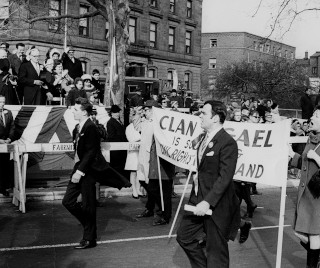
(Pictured: Clan na Gael marching in the 1970 St. Patrick’s Day Parade in Philadelphia, photograph by John Hamilton)


Leave a comment

Birth of Thomas Clarke Luby, Irish Revolutionary

thomas-clarke-luby

Thomas Clarke Luby, Irish revolutionary, author, journalist and one of the founding members of the Irish Republican Brotherhood, is born in Dublin on January 16, 1822.

Luby is the son of a Church of Ireland clergyman from Templemore, County Tipperary, his mother being a Catholic. He is educated at Trinity College Dublin where he studies law and puts in the necessary number of terms in London and Dublin where he acquires a reputation as a scholar and takes his degree. He goes on to teach at the college for a time.

Luby supports the Repeal Association and contributes to The Nation newspaper. After the breach with Daniel O’Connell, he joins the Young Irelanders in the Irish Confederation. He is deeply influenced by James Fintan Lalor at this time. Following the suppression of the Young Ireland Rebellion of 1848, he with Lalor and Philip Gray attempt to revive the fighting in 1849 as members of the secret Irish Democratic Association. This, however, ends in failure.

In 1851 Luby travels to France, where he hopes to join the French Foreign Legion to learn infantry tactics but finds the recruiting temporarily suspended. From France he goes to Australia for a year before returning to Ireland. From the end of 1855 he edits the Tribune newspaper founded by John E. Pigot who had been a member of The Nation group. During this time, he remains in touch with the small group of ’49 men including Philip Gray and attempts to start a new revolutionary movement. Luby’s views on social issues grow more conservative after 1848 which he makes clear to James Stephens whom he meets in 1856.

In the autumn of 1857 Owen Considine arrives with a message signed by four Irish exiles in the United States, two of whom are John O’Mahony and Michael Doheny. The message conveys the confidence they have in Stephens and asks him to establish an organisation in Ireland to win national independence. Considine also carries a private letter from O’Mahony to Stephens which is a warning, and which is overlooked by Luby and Stephens at the time. Both believe that there is a strong organisation behind the letter, only later to find it is rather a number of loosely linked groups. On December 23 Stephens dispatches Joseph Denieffe to America with his reply which is disguised as a business letter dated and addressed from Paris. In his reply, Stephen’s outlines his conditions and his requirements from the organisation in America.

On March 17, 1858, Denieffe arrives in Dublin with the acceptance of Stephens’s terms by the New York Committee and the eighty pounds. On that very evening the Irish Republican Brotherhood is established in Peter Langan’s timberyard in Lombard Street.

In mid-1863 Stephens informs his colleagues he wishes to start a newspaper, with financial aid from O’Mahony and the Fenian Brotherhood in America. The offices are established at 12 Parliament Street, almost at the gates of Dublin Castle. The first issue of the Irish People appears on November 28, 1863. The staff of the paper along with Luby are Charles J. Kickham and Denis Dowling Mulcahy as the editorial staff. Jeremiah O’Donovan Rossa and James O’Connor have charge of the business office, with John Haltigan being the printer. John O’Leary is brought from London to take charge in the role of Editor.

On July 15, 1865, American-made plans for a rising in Ireland are discovered. Superintendent Daniel Ryan, head of the G Division of the Dublin Metropolitan Police at Dublin Castle, has an informer within the offices of the Irish People who supplies him with an “action this year” message on its way to the IRB unit in Tipperary. With this information, Ryan raids the offices of the Irish People on Thursday, September 15, followed by the arrests of Luby, O’Leary and O’Donovan Rossa. Kickham is caught after a month on the run. Stephens is also caught with the support of Fenian prison warders. The last number of the paper is dated September 16, 1865.

After his arrest and the suppression of the Irish People, Luby is sentenced to twenty years of penal servitude. He is released in January 1871 but is compelled to remain away from Ireland until the expiration of his sentence.

Upon his release Luby goes first to the Continent and later settles in New York City. He lectures all over the country for years and writes for a number of Irish newspapers on political topics. At the memorial meeting on the death of John Mitchel, he delivers the principal address in Madison Square Garden.

Thomas Clarke Luby dies at 109½ Oak Street, Jersey City, New Jersey of paralysis, on November 29, 1901, and is buried in a grave shared with his wife in Bayview Cemetery in Jersey City. His epitaph reads: “Thomas Clarke Luby 1822–1901 He devoted his life to love of Ireland and quest of truth.”