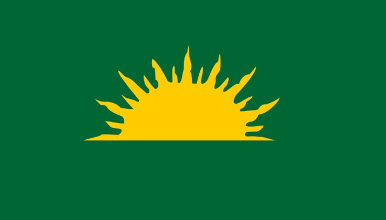
McGarry is born at 17 Pembroke Cottages, Dundrum, Dublin, on August 2, 1886. An active member of the Irish Republican Brotherhood, he is a close friend of Bulmer Hobson and is frequently arrested or imprisoned by British authorities for his activities with the IRB during the early 1900s. He participates in the 1916 Easter Rising as an aide-de-camp to Tom Clarke and is sentenced to eight years penal servitude for his role in the failed rebellion.
McGarry is sent to Frongoch internment camp in Wales but is eventually released. He assists Michael Collins in his efforts to reorganise the Irish Republican Brotherhood and, at the Volunteer Executive Meeting held in late 1917, he is elected General Secretary of the Irish Volunteers.
On the night of May 17, 1918, McGarry is arrested, along with seventy-three other Irish nationalist leaders, and deported to England, where they are held in custody without charge. The day following their arrest, he and the others are charged with conspiring “to enter into, and have entered into, treasonable communication with the German enemy.” In his absence, Harry Boland is selected for the Supreme Council and becomes his successor as president of the IRB.
McGarry is only imprisoned a short time when he takes part in the famous escape from Lincoln Jail with Seán Milroy and Éamon de Valera on February 3, 1919. He and Milroy manage to smuggle out a postcard, a comical sketch of McGarry to his wife, allowing a copy of the key to their cell to be made. They are later assisted by Harry Boland and Michael Collins who await them outside the prison.
A month later, McGarry gives a dramatic speech at a Sinn Féin concert held at the Mansion House, Dublin, before going into hiding.
Throughout the Irish War of Independence, McGarry serves as a commander and is eventually elected to Second Dáil in the 1921 Irish elections as a Sinn Féin Teachta Dála (TD) representing Dublin Mid. He, like the majority of those in the Irish Republican Brotherhood, supports the Anglo-Irish Treaty and is involved in debates against de Valera during the controversy, most especially discussing the status of Sinn Féin as a political entity.
McGarry is re-elected as a Pro-Treaty Sinn Féin TD in the 1922 Irish general election, siding with the Free State government during the Irish Civil War. Liam Lynch and other members of the anti-Treaty Irish Republican Army plan the assassination of McGarry among other TDs supporting the Public Safety Bill. As one anti-Treaty volunteer tells Ernie O’Malley, “Seán McGarry was often drunk in Amiens Street and the boys wanted to shoot him and the Staters there, but I wouldn’t let them.”
On December 10, 1922, shortly before the first meeting of the Free State parliament, a fire is deliberately set by irregulars (anti-Treatyites) at McGarry’s family home. His seven-year-old son, Emmet, is badly burned and dies as a result. McGarry is one of four targeted by anti-Treatyites during the December Free State executions. De Valera publicly denounces the attack.
After retiring from politics, McGarry works for the Irish Hospitals Trust, writes articles for newspapers and journals, and engages in broadcasting. After residing from the mid-1920s at several addresses in Dún Laoghaire, from 1938 he lives at 25 Booterstown Avenue, Blackrock, Dublin. With his wife Tomasina he has two sons and one daughter. He dies suddenly on December 9, 1958, of a heart attack in his son’s home at 44 Richmond Avenue, Monkstown, County Dublin.
Barrett is born on December 17, 1889, in Knockacullen (Hollyhill), Ballineen, County Cork, the son of Richard Barrett, farmer, and Ellen Barrett (née Henigan). Educated at Knocks and Knockskagh national schools, he enters the De La Salle College, Waterford, where he trains to be a teacher. Obtaining a first-class diploma, he first teaches at Ballinamult, County Waterford but then returns to Cork in early 1914 to take up a position at the St. Patrick’s Industrial School, Upton. Within months he is appointed principal of Gurrane National School. Devoted to the Irish language and honorary secretary of KnockavillaGAA club, he does much to popularise both movements in the southern and western districts of Cork. He appears to have been a member of the Cork Young Ireland Society.
Through planning and participating in raids and gunrunning episodes, Barrett comes into close contact with many GHQ staff during the Irish War of Independence, thereby ensuring his own rapid promotion. He is an active Irish Republican Army (IRA) brigade staff officer and occasionally acts as commandant of the West Cork III Brigade. He also organises fundraising activities for the purchase of weapons and for comrades on the run. In July 1920, following the arrest of the Cork III Brigade commander Tom Hales and quartermaster Pat Harte, he is appointed its quartermaster. He is arrested on March 22, 1921, and imprisoned in Cork jail, later being sent to Spike Island, County Cork.
As one of the senior officers held in Spike Island, Barrett is involved in many of the incidents that occur during his time there. After the truce is declared on July 11, 1921, some prisoners go on hunger strike, but he calls it off after a number of days on instructions from outside as a decision had been made that able-bodied men are more important to the cause. In November, Barrett escapes by rowboat alongside Moss (Maurice) Twomey, Henry O’Mahoney, Tom Crofts, Bill Quirke, Dick Eddy and Paddy Buckley.
Following the Irish War of Independence, Barrett supports the Anti-Treaty IRA‘s refusal to submit to the authority of Dáil Éireann (civil government of the Irish Republic declared in 1919). He is opposed to the Anglo-Irish Treaty and calls for the total elimination of English influence in Ireland. In April 1922, under the command of Rory O’Connor, he, along with 200 other hardline anti-treaty men, take over the Four Courts building in the centre of Dublin in defiance of the new Irish government. They want to provoke British troops, who are still in the country, into attacking them. They hope this will restart the war with Britain and reunite the IRA against their common enemy. Michael Collins tries desperately to persuade O’Connor and his men to vacate the building. However, on June 28, 1922, after the Four Courts garrison had kidnapped J. J. O’Connell, a general in the new National Army, Collins’s soldiers shell the Four Courts with British artillery to spark off what becomes known as the Battle of Dublin. O’Connor surrenders following two days of fighting, and Barrett, with most of his comrades, is arrested and held in Mountjoy Gaol. This incident marks the official outbreak of the Irish Civil War, as fighting escalates around the country between pro- and anti-treaty factions.
After the death of Michael Collins in an ambush, a period of tit-for-tat revenge killings ensues. The government implements martial law and enacts the necessary legislation to set up military courts. In November, the government begins to execute Anti-Treaty prisoners, including Erskine Childers. In response, Liam Lynch, the Anti-Treaty Chief of Staff, gives an order that any member of the Dáil who had voted for the ‘murder legislation’ is to be shot on sight.
On December 7, 1922, Teachta Dála (TD) Sean Hales is killed by anti-Treaty IRA men as he leaves the Dáil. Another TD, Pádraic Ó Máille, is also shot and badly wounded in the incident. An emergency cabinet meeting is allegedly held the next day to discuss the assassination of Hales. It is proposed that four prominent members of the Anti-Treaty side currently held as prisoners be executed as a reprisal and deterrent. The names put forward were Barrett, O’Connor, Liam Mellows and Joe McKelvey. It is alleged that the four are chosen to represent each of the four provinces – Munster, Connacht, Leinster and Ulster respectively, but none of the four is actually from Connacht. The executions are ordered by Minister for JusticeKevin O’Higgins. At 2:00 AM on the morning of December 8, 1922, Barrett is awoken along with the other three and informed that they are all to be executed at 8:00 that morning.
Ironies stack one upon the other. Barrett is a member of the same IRA brigade as Hales during the Anglo-Irish War, and they were childhood friends. O’Connor had been best man at O’Higgins’ wedding a year earlier. The rest of Sean Hales’ family remains staunchly anti-Treaty, and publicly denounces the executions. In reprisal for O’Higgins’ role in the executions, the Anti-Treaty IRA kills his father and burns his family home in Stradbally, County Laois. O’Higgins himself dies by an assassin’s hand on July 10, 1927.
The executions stun Ireland, but in terms of halting the Anti-Treaty assassination policy, they have the desired effect. The Free State government continues to execute enemy prisoners, and 77 official executions take place by the end of the war.
Barrett is now buried in his home county, Cork, following exhumation and reinternment by a later government. A monument is erected by old comrades of the West Cork Brigade, the First Southern Division, IRA, and of the Four Courts, Dublin, garrison in 1922 which is unveiled on December 13, 1952, by the TánaisteSeán Lemass.
O’Sullivan is a member of the Irish Republican Army and is one of three IRA men to die on hunger strike in 1923. IRA VolunteersJoseph Whitty from Wexford dies on September 2, 1923, and Denny Barry from Riverstick, County Cork, dies on November 20, 1923, in the Curragh Camp hospital. Whitty, Barry and O’Sullivan are three of the twenty-two Irish Republicans in the 20th century who die on hunger strike.
O’Sullivan is born in Denbawn, County Cavan, in 1882, the eldest of eight children. His father, Michael Sorohan, emigrates to the United States but returns to take over the family farm. O’Sullivan works on the family farm but wins a scholarship provided by the local newspaper, The Anglo-Celt, to Monaghan Agricultural College. From there he wins another scholarship to the Royal Albert College in Dublin and attends the college as a full-time student from 1907 to 1909. He graduates as one of the top students in his year and is also elected head of the student union, the highest elected position in the college. In addition, he is secretary of the college hurling team which is undefeated after fourteen games in 1909.
In 1909, O’Sullivan gets a job as an agricultural instructor in the Mallow area of County Cork. In addition to educating and advising local farmers on crops and new techniques, he also judges local agricultural shows.
O’Sullivan is a captain in the IRA in the intelligence unit during the Irish War of Independence. He begins his intelligence activities in 1917 using the code name W.N. – the last 2 letters of his first and last name.
During the Irish Civil War O’Sullivan is officer commanding (OC) Administration in the North Cork area and later in the IRA’s 1st Southern Cork Division, where he had been appointed by Liam Lynch. He dedicates his life to the establishment of an Irish Republic: “His ideal and his goal was a Republic, and he went straight ahead working to achieve it. Nothing else bothered him.” After the signing of the 1921 Anglo-Irish Treaty, he joins the anti-treaty side during the Irish Civil War.
During the Irish Civil War, O’Sullivan is arrested by Free State forces and interned in Mountjoy Prison. In 1923, after the end of the war, thousands of interned Irish republicans protest being held without trial, poor prison conditions and being treated as convicts rather than political prisoners. On October 13, 1923, Michael Kilroy, the OC of the IRA prisoners in Mountjoy Prison, announces that 300 men will go on hunger strike. This action starts the 1923 Irish hunger strikes. Within days, thousands of Irish republican prisoners are on hunger strike in multiple prisons and internment camps across Ireland. The mass hunger strike of 1923 starts at midnight on October 14, 1923. Previously, the Free State government had passed a motion outlawing the release of prisoners on hunger strike. However, because of the large numbers of Republicans on strike, at the end of October, the Government sends a delegation to speak with the IRA leadership. On November 23, 1923, the day after o’Sullivan’s death, the 41-day hunger strike is called off, setting in motion a release program for many of the prisoners. However, some are not released until as late as 1932.
O’Sullivan dies at the age of 41 on November 22, 1923, in St. Bricin’s Military Hospital, Dublin, after 40 days on hunger strike. He is buried in the republican plot in Saint Gobnait’s Cemetery, Goulds Hill, Mallow, County Cork, on November 27, 1923. His funeral cortège is reported to be a mile in length.
O’Sullivan’s name is commemorated on a statue that stands outside Cavan Courthouse in Farnham Street, Cavan, County Cavan.
Lynch is born on November 9, 1893, in Barnagurraha, Anglesboro, County Limerick, the fifth child among six sons and a daughter of Jeremiah Lynch, farmer, and Mary Lynch (neé Kelly). The family is politically active. His father’s brother, John, had taken part in the Fenian Rising of 1867 and his mother had been joint secretary of the Ballylanders branch of the Ladies’ Land League.
Lynch attends Anglesboro national school (1898–1909). In 1910 he moves to Mitchelstown, County Cork, to take up a three-year apprenticeship in the hardware store of P. O’Neill on Baldwin Street. He remains there until the autumn of 1915. While in Mitchelstown he is a member of the Gaelic League and the Ancient Order of Hibernians. He also joins the Irish Volunteers. In 1914, when that organisation splits, he does not immediately join the militant rump. He then moves to Fermoy, County Cork, where he works in the store of Messrs J. Barry & Sons Ltd. His move coincides with a period of inactivity as neither Volunteer faction is very active nor is he known. Consequently, he does not take part in the 1916 Easter Rising, but it is a turning point for him. On May 2, 1916, he watches as the Kent family are led through Fermoy, having been captured by British soldiers. Richard Kent dies from a wound sustained that day and Thomas Kent is executed a week later. Lynch becomes a committed Volunteer at this point.
Once committed, Lynch’s enthusiasm and aptitude ensures that he quickly attains positions of responsibility. From early 1917 he is first lieutenant in the small Fermoy company. In September 1917, the Irish Volunteers in east Cork are reorganised. Nine local companies are formed into the Fermoy battalion, and he is elected adjutant. In April 1918, at the height of the conscription crisis, he briefly quits his job to concentrate on organising the Volunteers. In May he is lucky to escape arrest during the sweep that accompanies the “German plot.” When the immediate danger ends, he returns to Barry & Sons.
In January 1919, at the beginning of the Irish War of Independence, the Volunteer organisation in Cork undergoes a major restructuring. Three brigades are established, and Lynch becomes brigade commandant of Cork No. 2. In April he visits Irish Republican Army GHQ in Dublin to discuss plans and to seek arms. It is a frustrating experience as the GHQ has few guns and are cautious about action. Throughout the summer of 1919 he presses GHQ to authorise attacks on British targets as a method of acquiring arms and to prevent boredom and stagnation setting in among his men. Finally, GHQ sanctions attacks if the primary aim is the capture of arms. In response, on September 7, 1919, twenty-five men from the Fermoy company, led by Lynch, ambush fourteen British soldiers on their way to service in the Wesleyan church in Fermoy. Fifteen rifles are captured, one soldier killed, and three wounded. Lynch is shot in the shoulder, probably by one of his own men. As a result, he has to leave his job and hides out in Waterford for a time. A series of arrests follow, among those is Lynch’s close friend, Michael Fitzgerald, who dies on hunger strike in Cork County Gaol in 1920.
Lynch spends the early months of 1920 at GHQ in Dublin. During this time, he is offered the position of deputy chief of staff, but turns it down, preferring to return to Cork. Although not an articulate speaker, he impresses those he meets. His organisational talents, attention to detail, ability to inspire, and intolerance for those who waste meetings endlessly discussing side issues, are noted. He has a low tolerance for politicians and at all times considers the military wing of the movement to be of primary importance. He is engaged to Bridie Keyes, but marriage is postponed pending a final settlement of hostilities.
On June 26, 1920, Lynch, Seán Moylan, and two colleagues capture Major-GeneralCuthbert Lucas while he is fishing on the Munster Blackwater. He gives a false name when he is arrested on August 12, 1920, at City Hall, Cork, with Terence MacSwiney, Lord Mayor of Cork, and ten others. All but MacSwiney are released four days later. He then sets about organising a flying column within the brigade. Ernie O’Malley arrives from headquarters to train the men. This column achieves a major coup on September 28, 1920, when they briefly capture the British Army barracks at Mallow, leaving with a large booty of rifles, ammunition, and two machine guns. The British respond to this increase in activity and the war settles into a pattern of ambush and counter-ambush. The Mallow battalion suffers severe losses in February 1921 and Lynch himself narrowly escapes when four are killed during an encounter at Nadd in March 1921.
In early 1921 Lynch seeks to encourage greater cooperation between the various brigades in the south. Senior brigade officers meet on three occasions to discuss cooperation and a plan to import arms from Italy. The importation project fails, but the First Southern Division is formed on April 26, 1921, bringing eight brigades from Cork, Kerry, Waterford, and west Limerick together. He is elected divisional commandant, making him the most powerful officer outside GHQ. His influence is further increased by his appointment as Southern Divisional Centre and Supreme Council member of the clandestine Irish Republican Brotherhood (IRB) in March 1921.
Lynch is wary when the truce is called in July 1921. He works hard to maintain order in his division and to achieve a state of readiness in case the negotiations fail. For him the Anglo-Irish Treaty is a failure. When the Supreme Council of the IRB meets on December 10, 1921, he is the only voice against the agreement. He is among the officers who insist that an army convention should be called to discuss the treaty, effectively asserting that the army no longer accepts a position subordinate to the Dáil. The army, he believes, is the army of the Republic, and no civilian body can order it to abandon the Republic. The provisional government tries to ban this convention, but it goes ahead on March 26, 1922, and elects an army executive. Lynch is elected Chief of Staff. Between March and June, he works hard to prevent a civil war. He believes unity can be maintained, even under the Treaty, if a republican constitution can be enacted. He also cooperates with Michael Collins in promoting Irish Republican Army (IRA) activity in Ulster. In his adherence to the idea of a republic, the practicalities of politics have little impact on his consciousness, and he is dismissive of the popular support for the Treaty. He is horrified at the thought of civil war but fails to see that his position is leading almost inexorably in that direction. Distrusted as too moderate by Liam Mellows and Rory O’Connor, he is locked out of the Four Courts for a time.
When the Four Courts are attacked, Lynch immediately leaves his headquarters at the Clarence Hotel to travel south. He is briefly detained, before reaching Kingsbridge Station, and has a meeting with Eoin O’Duffy. He is disgusted when Free State figures later claim that he was released, having promised not to take arms against the government. The most plausible explanation of the incident appears to be that O’Duffy interpreted Lynch’s comments, merely indicating disappointment that a war had started, as constituting a statement of intent not to involve himself.
Lynch’s initial actions seem designed to avoid full-scale conflict. He does not order an attack on Dublin, nor does he attempt to seize Limerick. He chooses a containment strategy, seeking to hold a line from Limerick to Waterford for the republican forces. This fails, as the government sends troops in from the rear by sea. The republicans have no urban base when Lynch abandons Fermoy on August 11, 1922. He continues to meet individuals who seek a way to end the war, but intransigence has set in, and he insists that armed struggle will only end with a republic or absolute defeat. As early as August many republicans believe the war is lost and urge a reassessment of tactics, but Lynch rejects all such calls. Operating from secret headquarters in Santry, he orders the shooting of pro-Treaty politicians in retaliation for the execution of republican prisoners.
Under war conditions it is impossible for the army executive to meet regularly, and this leaves Lynch in almost complete control. As the pro-surrender lobby grows within the republican forces, he delays a meeting of the executive, claiming with some justification that it is too dangerous. He leaves Santry and attends a meeting of the Southern Division Council in the last days of February 1923. Sixteen of the eighteen officers there tell him that the military position is hopeless. This forces the calling of an executive meeting on March 6, 1923. No agreement is reached. He strongly favours fighting on, but a motion from Tom Barry, calling for an immediate end to hostilities, is barely rejected. Another meeting is arranged for April 10. On that morning a group, including Lynch and Frank Aiken, suddenly find themselves in danger of capture in a farmhouse on the slopes of the Knockmealdown Mountains in County Tipperary. They flee and are pursued. During the chase Lynch is shot in the abdomen. It seems clear that he is shot by the pursuing Free State soldiers, although Irish historian Meda Ryan has considered the theory that he may have been shot by one of his own in order to remove the major stumbling block to surrender. His colleagues are forced to abandon him, and he is captured. Initially the Free State troops believe they have caught Éamon de Valera. He is taken first to a public house in Newcastle, County Tipperary, and then to St. Joseph’s Hospital in Clonmel, but dies from his wound at 8:45 p.m. that evening. His last request is to be buried beside Michael Fitzgerald in Kilcrumper Cemetery, Fermoy, County Cork. On hearing of Lynch’s death, Ernie O’Malley writes, “You who were a living force are now a battle cry.” O’Malley is wrong, however, as the peace faction within republicanism is strengthened by his death and Aiken orders the suspension of activities on April 27.
In 1935, a massive memorial, consisting of a 60-foot-tall round tower, guarded by four bronze Irish Wolfhounds, is erected at Goatenbridge, County Tipperary, near the site of his capture. It is unveiled on April 7, 1935. Separate annual commemorations are held at Goatenbridge and Kilcrumper. Three biographies have been written and the Liam Lynch memorial pipe band is based in his native Anglesboro. The Lynch family possess a substantial collection of private correspondence.
Hales is born John Hales, eldest child of five sons and four daughters of Robert Hales, a farmer, and Margaret (née Fitzgerald) Hales. He is educated at Ballinadee national school and Warner’s Lane school, Bandon. After leaving school he goes to work on his father’s farm. He plays hurling with Valley Rovers GAA club and is the Munster champion in the 56-lb. weight-throwing competition. From an early age he follows in his father’s footsteps and becomes involved in the republican movement.
Hales joins the Irish Volunteers in 1915 and becomes captain of the Ballinadee company in 1916. Arrested under the Defence of the Realm Act after the 1916 Easter Rising, he is imprisoned in Frongoch internment camp in Wales. After his release, in April 1917 he becomes executive of the short-lived Liberty League promoted by Count George Plunkett. When the League merges with Sinn Féin, he helps reorganise the Volunteers. With his brothers, Tom, William, and Donal, he continues his father’s fight on behalf of evicted tenants and becomes involved with the anti-British Bandon People’s Food Committee and the anti-landlord Unpurchased Tenants’ Association. He helps in the Sinn Féin takeover of The Southern Star newspaper and is a member of the new board of directors. In 1919 he becomes battalion commander of the first (Bandon) battalion 3rd Cork Brigade of the Irish Republican Army, the name by which the Irish Volunteers increasingly became known. He leads the attack on TimoleagueRoyal Irish Constabulary (RIC) barracks in February 1920, and the ambush of an Essex Regiment patrol at Brinny in August 1920. The military patrol at Brinny manages to surprise the ambushers and Lieutenant Tim Fitzgerald of Bandon is the first Volunteer to be killed in action in west Cork. Hales then commands the assault on two truckloads of British troops at Newcestown Cross in which a British officer is killed and several soldiers are wounded.
Hales is appointed section commander of the west Cork flying column in 1920 and takes part in the major action at Crossbarry on March 19, 1921. In retaliation for the burning of the Hales home in March 1921, he leads a contingent of Volunteers and burns Castle Bernard, the residence of the Earl of Bandon. The occupant, Lord Bandon, is held hostage until General Strickland, the British OC in Cork, guarantees he will not execute Volunteers in Cork prison. The British authorities yield and there is an end to the policy of executing prisoners of war in the Cork area.
At the 1922 Irish general election, Hales is elected to the Third Dáil as a pro-Treaty Sinn Féin Teachta Dála (TD) for the same constituency. He receives 4,374 first preference votes (7.9%). Shortly afterward, the Irish Civil War breaks out between the pro-Treaty faction, who are in favour of setting up the Irish Free State and the anti-Treaty faction, who would not accept the abolition of the Irish Republic.
On December 7, 1922, Hales is killed by anti-Treaty IRA men as he leaves the Dáil. Another TD, Pádraic Ó Máille, is also shot and badly wounded in the incident. His killing is in reprisal for the Free State’s execution of anti-treaty prisoners. In revenge for Hales’ killing, four republican leaders, Joe McKelvey, Rory O’Connor, Liam Mellows and Richard Barrett, are executed the following day, December 8, 1922.
Hales is given a military funeral to the family burial place at St. Patrick’s Cemetery, Bandon.
According to information passed on to playwrightUlick O’Connor, an anti-Treaty IRA volunteer named Owen Donnelly of Glasnevin is responsible for the killing of Hales. Seán Caffrey, an anti-treaty intelligence officer told O’Connor that Donnelly had not been ordered to kill Hales specifically but was following the general order issued by Liam Lynch to shoot all deputies and senators they could who had voted for the Public Safety Act (September 28, 1922) which established military courts with the power to impose the death penalty.
A commemorative statue of Hayes is unveiled at Bank Place in Bandon in 1930.
James Stephens formally establishes the Irish Republican Brotherhood (IRB) in Peter Lanigan’s timber yard, Lombard Street, Dublin, on Saint Patrick’s Day, March 17, 1858. It is originally named the Irish Revolutionary Brotherhood, but soon comes to be known as the Irish Republican Brotherhood. At the same time, John O’Mahoney is founding the American branch of the revolutionary group. O’Mahoney gives the organization the better-known name Fenians, in honor of the Fianna, the soldiers led by Fionn mac Cumhaill, the heroic warrior of Irish legend.
The IRB is a small, secret, revolutionary body whose sole object is to “establish and maintain a free and independent Republican Government in Ireland.” Stephens is a Young Irelander and is a lieutenant to William Smith O’Brien at the Battle of Widow McCormack’s Cabbage Patch in Ballingary, County Tipperary, in August 1848. He is wounded three times and is smuggled onto a ship to England and then to France, where he spends the next eight years. Upon his return to Dublin in 1856, he determines to organise a revolutionary movement and that leads to the founding of the IRB.
The IRB becomes known as the Fenian movement in the 1850s and 1860s and is committed to the use of force to establish an independent Irish republic. After organising an abortive rising in March 1867, it suffers deep internal divisions over its leadership and strategy in both the United States and Ireland—whether it is best to strike at England, in Ireland or in Canada. The issue is resolved after a series of failed interventions in Canada in 1866, 1867 and 1871, and after bombings in England that do not lead Ireland closer to independence. The IRB is unable to exploit the weaknesses and divisions in the constitutional movement following Charles Stewart Parnell’s divorce scandal (1890–91).
The IRB is eventually rejuvenated in Ireland about 1907, led by Bulmer Hobson and Tom Clarke, thus preparing the way for all that follows.The governing body is the Supreme Council. Before 1916 this consists of eleven members, and after the 1917 reorganisation it contains fifteen members. When not in session, all powers of the Supreme Council, except for declaring war, devolve onto an executive of three: the president, secretary and treasurer.
The constitution provides for the establishment of a military council, subordinate to the Supreme Council. The seven signatories of the 1916 Proclamation of the Irish Republic constitute the entire military council at the time. The constitution is dedicated to the use of force against England at any favourable opportunity, but this is to be a democratic decision: “The IRB shall await the decision of the Irish Nation as expressed by a majority of the Irish people as to the fit hour of inaugurating a war against England and shall, pending such an emergency, lend its support to every movement calculated to advance the cause of Irish independence, consistent with the preservation of its own integrity,” a clause adopted in 1873 in response to the controversies arising from the 1867 Fenian Rising.
The IRB plans the 1916 Easter Rising but the Irish Volunteers and the Irish Citizen Army make it possible. The establishment of the Irish Volunteers gives the IRB the great opportunity to train and equip its members as a military body for the purpose of securing independence for Ireland by force of arms and securing the cooperation of all Irish military bodies in the accomplishment of its objectives. Numerically the IRB probably never exceeds 2,000 members, but they are all extremely loyal and well trained, and there is very tight security. The executions of 1916 just about wipe out the Supreme Council, and after the prisoners are released, the IRB has to reconstitute itself.
Following the Easter Rising some republicans—notably Éamon de Valera and Cathal Brugha—leave the organization, which they view as no longer necessary, since the Irish Volunteers now perform its function. The IRB, during the Irish War of Independence (1919-21), is under the control of Michael Collins, who is secretary, and subsequently president, of the Supreme Council. Volunteers such as Séumas Robinson say afterwards that the IRB by then is “moribund where not already dead,” but there is evidence that it is an important force during the war.
When the Anglo-Irish Treaty is signed on December 6, 1921, it is debated by the Supreme Council, which votes to accept it by eleven votes to four. Those on the Supreme Council who oppose the Treaty include former leader Harry Boland, Austin Stack and Liam Lynch. Anti-Treaty republicans like Ernie O’Malley, who fought during the Irish Civil War against the Treaty, sees the IRB as being used to undermine the Irish Republic. The IRB becomes quiescent during the Irish Civil War, which ends in May 1923, but it emerges again later that year as a faction within the National Army that supports Minister for Defence Richard Mulcahy against the “Old IRA,” which fought against the recruitment of ex-British Army personnel and the demobilization of old IRA men. This comes to a head with the Irish Army Mutiny of 1924, in the wake of which Mulcahy resigns and other IRB members of the army are dismissed by acting President of the Executive CouncilKevin O’Higgins. The IRB subsequently dissolves itself, although it is not known whether a formal decision is taken, or it simply ceases to function.
O’Donoghue is born in Rathmore, County Kerry, on July 22, 1894, the son of farmer Patrick O’Donoghue and Margaret Cronin. He moves to Cork in 1910, where he works as an apprentice in the drapery trade.
The 1916 Easter Rising is a watershed in O’Donoghue’s life. In December 1916, he joins the Cork branch of the Irish Volunteers. In early 1917, he is elected unanimously First Lieutenant of the Cyclist Company and as a result devotes all his spare time to Volunteer work. He begins writing weekly for two years for TheIrish World newspaper. By May 1917, he is sworn into the Irish Republican Brotherhood (IRB) and in October, Tomás Mac Curtain appoints him head of communications of the Cork Brigade. He replaces Pat Higgins as Brigade Adjutant in February 1917. He is a key organiser in the sensational jailbreak of Captain Donnchadh Mac Niallghuis on Armistice Day 1918 and takes personal responsibility for his protection. Michael Collins is the last officer from Volunteers General Headquarters to visit Cork shortly after Christmas 1919, until the truce in 1921.
O’Donoghue builds up an intelligence network and agents which includes his future wife, Josephine Marchment. She is head female clerk at the 6th Division Headquarters at Victoria Barracks, Cork, and passes on secret British Army correspondence to him. He recruits people to open letters, tap phone lines and intercept telegrams. The Irish Republican Army has 2,000 active members in Cork which are also used for intelligence gathering. By March 1920, after killing a Royal Irish Constabulary (RIC) Inspector, he is on the run and serving full-time in the IRA. In November of that year, the Cork Brigade kills six British Army officers and executes five Cork civilians on suspicion of spying.
After two and a half years of fighting, a truce is agreed upon on July 11, 1921. When the Dáil approves the Anglo-Irish Treaty, in January 1922, the IRA splits into pro- and anti-Treaty camps. Over the coming months and after being elected onto the army’s executive as Adjutant General, O’Donoghue warns of the dangers of an Irish Civil War. In June 1922, he resigns from the army’s national executive and a month later, on July 3, 1922, from the army. Civil war does break out on June 28, 1922 between pro- and anti-Treaty factions, much to his dismay.
During the Irish Civil War, O’Donoghue remains neutral and tries to organise a truce to end the fighting. In December 1922, he forms a group called the “Neutral IRA”, along with Seán O’Hegarty, composed of pro-truce IRA men. He claims he has 20,000 members in this group. He campaigns for a month’s truce between the two sides, so that a political compromise could be reached. However, his efforts come to nothing and in March 1923, he winds up the “Neutral IRA,” judging that its objectives cannot be achieved. The Irish Civil War ends on May 24, 1923.
O’Donoghue serves as major in the Irish Army from 1939-1946. He forms a Supplementary Intelligence Service that is to remain behind enemy lines in the event of an invasion. He also teaches guerrilla warfare tactics to new army recruits.
O’Donoghue marries Josephine Brown (née Marchment) in April 1921 and they have four children. The couple also adopts two children from Josephine’s first marriage, including Reggie Brown, whom O’Donoghue kidnaps from his grandparents in Wales in 1920. He becomes a rate collector and remains outside politics.
In later years O’Donoghue becomes a respected historian. While in the army he edits An Cosantóir, the Irish Army’s magazine. He convinces Éamon de Valera to establish the Bureau of Military History to record personal accounts from the Irish War of Independence. He is a recording officer until 1948. His most famous work is his biography on Liam Lynch, entitled No Other Law.
O’Donoghue dies on December 18, 1967, and Tom Barry gives the graveside oration. His papers are in the National Library of Ireland (NLI) and his statement to the Bureau of Military History is in the Military Archives.
O’Connor is educated in St. Mary’s College, Dublin, and then in Clongowes Wood College, County Kildare, a public school run by the Jesuit order. It is also attended by the man who later condemns O’Connor to death, his close friend Kevin O’Higgins. He studies experimental physics, logic, and metaphysics. He also attends the College of Science, Merrion Street. He takes a BA (1906) and receives a B.Eng (1911). In 1910, he takes his Bachelor of Engineering and Bachelor of Arts degrees at University College Dublin (UCD), then known as the National University. Prominent in the university’s Literary and Historical Society, he advocates militant constitutional nationalism as one of the many society members active in the Young Ireland branch of the United Irish League.
During the subsequent Irish War of Independence (1919-21) O’Connor is Director of Engineering of the Irish Republican Army (IRA), a military organisation descended from the Irish Volunteers. The specialist skills of engineering and signaling are essential to the development of the 5th Battalion, Dublin Brigade. Its men are forbidden frontline duty as their contribution is regarded as vital, their number too small. But units only expand on an incremental local basis, disappointing General Richard Mulcahy.
O’Connor is also involved in the Republican breakout from Strangeways Prison in Manchester, England, on October 25, 1919. Michael Collins takes a particular interest in the escape and actually visits Austin Stack in the prison under a false name to finalise the arrangements. IRA men hold up traffic while a ladder is propped up against the outside of a prison wall. In all six prisoners escape, among them Piaras Beaslaí.
O’Connor refuses to accept the Anglo-Irish Treaty of 1921, which establishes the Irish Free State. It is ratified by a narrow vote in Dáil Éireann, the Irish parliament. He and many like him feel that the Treaty copper-fastens the partition of the six counties of Northern Ireland and undermines the Irish Republic declared in 1916.
On January 10, a meeting is held at O’Connor’s home in Monkstown, Dublin. In attendance are all senior anti-Treaty IRA officers except Liam Mellows. O’Connor is appointed to chair this grouping, known as the Republican Military Council. It is agreed that an IRA convention should be called without delay; failing this, a separate GHQ will be formed. At a further meeting in O’Connor’s office on March 20, a temporary IRA GHQ staff is elected under Liam Lynch as chief of staff. O’Connor remains in charge of engineering.
On March 26, 1922, the anti-Treaty officers of the IRA hold a convention in Dublin, in which they reject the Treaty and repudiate the authority of the Dáil. However, they are prepared to discuss a way forward. The convention meets again on April 9. It creates a new army constitution and places the army under a newly elected executive of 16 men, including O’Connor, that are to choose an army council and headquarters staff. Asked by a journalist if this development means the anti-Treatyites ware proposing a “military dictatorship” in Ireland, O’Connor replies, “You can take it that way if you want.”
On April 14, 1922, O’Connor is one of a number of IRA leaders in a 200-strong force that occupies the Four Courts building in the centre of Dublin in defiance of the Provisional Government. They intend to provoke the British troops, who are still in the country, into attacking them, which they believe will restart the war with Britain and re-unite the IRA against their common enemy. They also occupy other smaller buildings regarded as being associated with the former British administration, such as the Ballast Office and the Freemasons‘ Hall in Molesworth Street, but the Four Courts remains the focus of interest. On June 15, O’Connor sends out men to collect the rifles that belong to the mutineers of the Civic Guards.
Michael Collins tries desperately to persuade the IRA men to leave the Four Courts. At the Third IRA Convention on June 18, the Executive is split over whether the Irish Government should demand that all British troops leave within 72 hours. A motion to this effect, opposed by Lynch, is narrowly defeated, whereupon O’Connor and others leave the meeting to set up a separate GHQ. The IRA effectively splits into two factions opposed to the government.
On June 22, 1922, Sir Henry Wilson is assassinated in London by two IRA men, Reginald Dunne and Joseph O’Sullivan, each a former British soldier. Some now argue that this was done on the orders of Michael Collins, who had been a close friend of Dunne’s in the London Irish Republican Brotherhood (IRB). Prime MinisterDavid Lloyd George writes an angry letter to Collins, which includes the line “…still less can Mr. Rory O’Connor be permitted to remain his followers and his arsenal in open rebellion in the heart of Dublin… organizing and sending out from this centre enterprises of murder not only in the area of your Government…”
On June 28, 1922, after the Four Courts garrison has kidnapped J. J. “Ginger” O’Connell, a general in the National Army, Collins gives orders for the shelling of the Four Courts with borrowed artillery lent by Winston Churchill. The shelling leads to the Four Courts catching fire, damaging parts of the building in addition to destroying numerous government documents. O’Connor is one of 130 men that surrender on June 30, some of whom are arrested and imprisoned in Mountjoy Prison. This incident marks the official start of the Irish Civil War, as fighting breaks out openly around the country between pro- and anti-Treaty factions.
On December 8, 1922, along with three other republicans, Liam Mellows, Richard Barrett and Joe McKelvey, captured with the fall of the Four Courts, O’Connor is executed by firing squad in reprisal for the anti-Treaty IRA’s killing of Free State Teachta Dála (TD) Sean Hales. The execution order is signed by Kevin O’Higgins. O’Connor had been best man at O’Higgins’s wedding on October 27, 1921. Their deaths remain a symbol of the bitterness and division of the Irish Civil War. O’Connor, one of 77 republicans executed by the Provisional Government, is seen as a martyr by the Republican movement in Ireland.
On O’Connor’s execution, the equestrienne Joan de Sales La Terriere, a close friend of his, names her son in his honour. “Rory O’Connor Place” in Arklow is named in his honour. There is also a pub in Crumlin, Dublin, named after him and a housing estate near Dún Laoghaire, County Dublin, called “Rory O’Connor Park.” A Sinn Féincumann (UCD) is named after him.
(Pictured: Rory O’Connor addressing members of the IRA’s Dublin City Brigade at Smithfield, April 1922)
The first organised action against British military forces since the 1916 Easter Rising, takes place at Fermoy, County Cork, on September 7, 1919. It is carried out by the Cork No. 2 Brigade of the Irish Republican Army (IRA) under the command of Liam Lynch. Their objective is an armed party of British soldiers who attend Sunday service at the Wesleyan Church at the eastern end of the town, the church being about half a mile from their barracks. It is not known if the rifles they carry are loaded but the assumption is that they are and plans are made for that contingency.
At around 10:30 a.m. on Sunday morning, September 7, 1919, fourteen soldiers and a corporal leave their barracks and march through the town towards the Wesleyan Church. They carry their rifles at the slope. Approximately twenty-five volunteers from Fermoy company, armed with just six revolvers between them, assemble in groups of two and three in the vicinity of the church, remaining well spread out to avoid attracting attention. The main attacking party of which Larry Condon is in charge, includes John Fanning Michael Fitzgerald, Patrick Ahern and James Fitzgerald. Another group is detailed to collect the rifles and transfer them to cars parked nearby, while the remainder are to close in from the rear when the attack begins and prevent any attempt by the British to get back to their barracks. Any volunteers who are unarmed carry short clubs hidden on their person.
One of the cars, with George Power in charge, is halted near the church, with two men attending to an imaginary breakdown. The second car, which includes Liam Lynch, drives up Patrick Street behind the party of soldiers, timing it to arrive at the church at the same moment as the soldiers. A whistle blast begins the assault. Liam Lynch calls on the soldiers to surrender but they immediately resist. The attackers rush them, shots are fired and for a minute or two there is a confused struggle. A soldier swinging a rifle butt at Lynch is shot dead while three others are wounded. When the soldiers are finally overpowered, their rifles are taken from them and piled into the Buick driven by Leo O’Callaghan. Into that car also goes Liam Lynch, Owen Harold, Ned Waters, Tom Griffin, Larry Condon, Michael Fitzgerald and John Fanning while Jack Mulvey’s Ford contains Pat Leahy, John Joe Hogan, Peter O’Callaghan, George Power and Dan Hegarty. Both cars head out the Tallow road while the remaining volunteers scatter on foot.
Shortly afterwards a bugle call at the barracks raises the alarm and within minutes two lorry loads of soldiers are speeding out the Lismore road in pursuit. However, at Carrigabrick, a mile and a quarter from the town, two trees on the roadside have been partly sawn through and then held in position by ropes. The moment the cars carrying the rifles pass, the trees come down with a crash thereby forcing the pursuers to make a detour and lose the trail. At Kilmagner, five miles from Fermoy, the rifles are taken to a pre-arranged spot and safely concealed. The following night they are transferred to a dump in the Araglen company area.
Much thought had been given to the selection of officers and men for the task. It is inevitable that those of them who are well known locally would thereafter have to evade arrest. Intensive searches by military and police continue throughout the day. Parties of military in lorries scour the countryside, cars are held up and many people questioned. Two days later the district is proclaimed a military area.
On the Monday night following the raid a large party of soldiers from the British garrison at Fermoy descend upon the town. They smash the windows in most of the shops in Pearse Square, MacCurtain Street and Patrick Street and loot the contents. The following night the troops are confined to barracks, but on Wednesday night they assemble again but find a large crowd of residents waiting for them in Emmet Street. Armed with sticks, stones and other weapons, the local people attack the soldiers so furiously that they are driven back to their barracks. Many citizens barricade their homes and premises and prepare to defend them against further attack, but by Thursday the spate of lawlessness appears to be over for the time being.
However, arrests soon follow. Local Battalion Commandant Michael Fitzgerald, Vice Commandant Larry Condon and Fermoy Company Captain, John Fanning, are among those detained. Others arrested are James Fanning, John Swaine, John Joe Hogan, Martin O’Keeffe, Dick O’Keeffe, Pat Leahy, Tom Griffin, Peter O’Callaghan and Jack Mulvey. Two months later further arrests are made at Mallow. Dan Hegarty, Brian Kelly, Ned Waters, Owen Harold and Leo O’Callaghan are detained. After a series of weekly remands, the prisoners are returned for trial at the Cork Assizes in July, 1920. At Cork the Grand Jury finds against Michael Fitzgerald, John Joe Hogan and Dan Hegarty. The remainder are released.
Barrett is the son of Richard Barrett, farmer, and Ellen Barrett (née Henigan). Educated at Knocks and Knockskagh national schools, he enters the De La Salle College, Waterford, where he trains to be a teacher. Obtaining a first-class diploma, he first teaches at Ballinamult, County Waterford but then returns to Cork in early 1914 to take up a position at the St. Patrick’s Industrial School, Upton. Within months he is appointed principal of Gurrane National School. Devoted to the Irish language and honorary secretary of KnockavillaGAA club, he does much to popularise both movements in the southern and western districts of Cork. He appears to have been a member of the Cork Young Ireland Society.
Through planning and participating in raids and gunrunning episodes, Barrett comes into close contact with many GHQ staff during the Irish War of Independence, thereby ensuring his own rapid promotion. He is an active Irish Republican Army (IRA) brigade staff officer and occasionally acts as commandant of the West Cork III Brigade. He also organises fundraising activities for the purchase of weapons and for comrades on the run. In July 1920, following the arrest of the Cork III Brigade commander Tom Hales and quartermaster Pat Harte, he is appointed its quartermaster. He is arrested on March 22, 1921, and imprisoned in Cork jail, later being sent to Spike Island, County Cork.
As one of the senior officers held in Spike Island, Barrett is involved in many of the incidents that occur during his time there. After the truce is declared on July 11, 1921, some prisoners go on hunger strike, but he calls it off after a number of days on instructions from outside as a decision had been made that able-bodied men are more important to the cause. In November, Barrett escapes by rowboat alongside Moss (Maurice) Twomey, Henry O’Mahoney, Tom Crofts, Bill Quirke, Dick Eddy and Paddy Buckley.
Following the Irish War of Independence, Barrett supports the Anti-Treaty IRA‘s refusal to submit to the authority of Dáil Éireann (civil government of the Irish Republic declared in 1919). He is opposed to the Anglo-Irish Treaty and calls for the total elimination of English influence in Ireland. In April 1922, under the command of Rory O’Connor, he, along with 200 other hardline anti-treaty men, take over the Four Courts building in the centre of Dublin in defiance of the new Irish government. They want to provoke British troops, who are still in the country, into attacking them. They hope this will restart the war with Britain and reunite the IRA against their common enemy. Michael Collins tries desperately to persuade O’Connor and his men to vacate the building. However, on June 28, 1922, after the Four Courts garrison had kidnapped J. J. O’Connell, a general in the new National Army, Collins’s soldiers shell the Four Courts with British artillery to spark off what becomes known as the Battle of Dublin. O’Connor surrenders following two days of fighting, and Barrett, with most of his comrades, is arrested and held in Mountjoy Gaol. This incident marks the official outbreak of the Irish Civil War, as fighting escalates around the country between pro- and anti-treaty factions.
After the death of Michael Collins in an ambush, a period of tit-for-tat revenge killings ensues. The government implements martial law and enacts the necessary legislation to set up military courts. In November, the government begins to execute Anti-Treaty prisoners, including Erskine Childers. In response, Liam Lynch, the Anti-Treaty Chief of Staff, gives an order that any member of the Dáil who had voted for the ‘murder legislation’ is to be shot on sight.
On December 7, 1922, Teachta Dála (TD) Sean Hales is killed by anti-Treaty IRA men as he leaves the Dáil. Another TD, Pádraic Ó Máille, is also shot and badly wounded in the incident. An emergency cabinet meeting is allegedly held the next day to discuss the assassination of Hales. It is proposed that four prominent members of the Anti-Treaty side currently held as prisoners be executed as a reprisal and deterrent. The names put forward were Barrett, O’Connor, Liam Mellows and Joe McKelvey. It is alleged that the four are chosen to represent each of the four provinces – Munster, Connacht, Leinster and Ulster respectively, but none of the four is actually from Connacht. The executions are ordered by Minister for JusticeKevin O’Higgins. At 2:00 AM on the morning of December 8, 1922, Barrett is awoken along with the other three and informed that they are all to be executed at 8:00 that morning.
Ironies stack one upon the other. Barrett is a member of the same IRA brigade as Hales during the Anglo-Irish War, and they were childhood friends. O’Connor had been best man at O’Higgins’ wedding a year earlier. The rest of Sean Hales’ family remains staunchly anti-Treaty, and publicly denounces the executions. In reprisal for O’Higgins’ role in the executions, the Anti-Treaty IRA kills his father and burns his family home in Stradbally, County Laois. O’Higgins himself dies by an assassin’s hand on July 10, 1927.
The executions stun Ireland, but in terms of halting the Anti-Treaty assassination policy, they have the desired effect. The Free State government continues to execute enemy prisoners, and 77 official executions take place by the end of the war.
Barrett is now buried in his home county, Cork, following exhumation and reinternment by a later government. A monument is erected by old comrades of the West Cork Brigade, the First Southern Division, IRA, and of the Four Courts, Dublin, garrison in 1922 which is unveiled on December 13, 1952, by the TánaisteSeán Lemass.