seamus dubhghaill

Promoting Irish Culture and History from Little Rock, Arkansas, USA


Leave a comment

Birth of Timothy Lyons, Irish Republican Army Volunteer

Timothy Lyons, also known as Aero or Aeroplane, an Irish Republican Army (IRA) soldier who fights with the Anti-Treaty side during the Irish Civil War, is born in Garrynagore, County Kerry, on December 4, 1895.

Lyons is born in to Margaret (née Sullivan) and Timothy Lyons senior, who is listed on his birth certificate as a cottier. He is the oldest of six siblings. Prior to the Irish Civil War, he works as a labourer. He fights with the IRA’s Kilflynn Company during the Irish War of Independence. He is described as being slight, “adventurous” as a column leader and a marksman who shoots at small birds. He shoots a British officer in an ambush led by captain George O’Shea at Shannow Bridge where the Kilflynn road joins the R557, forcing a retreat. He gains the nickname “Aeroplane” or “Aero” because of the way he suddenly appears and his last-minute escapes. Because of regular searches by Black and Tans, his father fears the family home will be burnt out and asks him to leave.

After the ratification of the Anglo-Irish Treaty, Lyons fights against Free State forces . At the time of his death he is commandant. He is involved in fighting in Listowel and Limerick, is captured near Athea, jailed in Limerick and released in late 1922 with an undertaking not to rejoin the fight. Notwithstanding this, the column continues to operate, generally around Causeway and Ballyduff.

On April 15, 1923, Lyons’ column attacks a Free State raiding party in Meenoghane, County Kerry. The raiding party receives reinforcements. He and his men are eventually surrounded at nearby Clashmealcon on April 16 by Michael Hogan’s 1st Western Division. They descend the rugged, Atlantic cliffs to the caves and hide in Dumfort’s Cave. He shoots out searchlights with his Lee-Enfield rifle and two Free State soldiers are shot dead from the cave. The situation is under Army Emergency Powers. With no escape for the men hiding, troops try to blast them out by dropping mines and smoke them out with petrol-soaked turf.

On April 16, James McGrath, the brother of Thomas McGrath, one of Lyons’s men, is arrested and taken to the cliffs in order to enter the cave and persuade the men to surrender. On the night of April 17-18, Thomas McGrath and Patrick O’Shea, his first cousin, fall trying to scale the cliffs to escape and drown. After offering to surrender himself on the morning of the April 18, Lyons falls several metres onto rocks from a rope that is provided by National Army troops. He is then shot multiple times by troops from the cliff top and is not recovered.

Three of Lyons’ men who surrender, Edmond GreaneyJames McEnery and British deserter-turned-republican Reginald Stephen Hathaway, are executed in Ballymullen Barracks by gunshot on April 25, for breaking their undertaking not to take up arms against the Free State, attacking troops at Clashmealcon, burning the Civic Guard station at Ballyheigue, stripping the same Civic Guards and robbing the post office at Ballyduff.

Lyons’ decomposing body, minus a leg, is washed up on May 5, identifiable by a boot. He is buried alongside George O’Shea and Timothy Tuomey (both killed at Ballyseedy) in the Republican plot at Kilflynn Church (now St. Columba’s Heritage Centre).

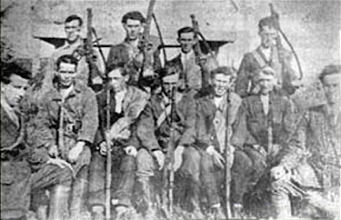
(Pictured: Kilflynn IRA Flying Column, 1922. Back (L to R): Denis O’Connell (Lixnaw), Stephen Fuller (Kilflynn), William Hartnett (Mountcoal), Tim Twomey (Kilflynn). Front (L to R): Terry Brosnan (Lixnaw), John McElligott (Leam, Kilflynn), Danny O’Shea (Kilflynn), Timothy (Aero) Lyons (Garrynagore), Tim Sheehy (Lyre), Pete Sullivan (Ballyduff), Paddy Mahony (Ballyegan, Battalion O.C.).)
Leave a comment

Birth of Horatio Herbert Kitchener, 1st Earl Kitchener

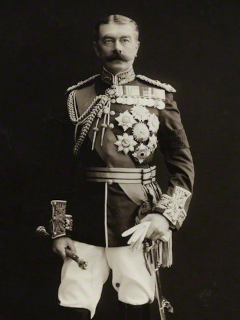
Horatio Herbert Kitchener, 1st Earl Kitchener of Khartoum and Broome in Kent, British Army officer and colonial administrator, is born on June 24, 1850, at Gunsborough Villa, north of Listowel, County Kerry.

Kitchener is the second son of Lieutenant Colonel Henry Horatio Kitchener and his first wife, Frances Anne (née Chevallier), daughter of clergyman John Chevallier. Col. Kitchener resigns his commission in 1849 and purchases Ballygoghlan House estate near Tarbert, County Kerry, in early 1850 under the provisions of the Encumbered Estates Act of 1849. Ballygoghlan House is in a state of disrepair, however, and the family lives in Gunsborough Villa until the end of 1850. In 1857, Col. Kitchener purchases Crotta House, near Kilflynn, County Kerry, and the Kitcheners divide their time between the two residences. While innovative and successful in his agricultural methods, Col. Kitchener is harsh towards his tenants and, after carrying out many evictions, becomes extremely unpopular in the area. He is a rigid disciplinarian and occasionally punishes his son severely.

Although Kitchener attends Ballylongford village school, his education is largely neglected. When examined by his cousin Francis Elliot Kitchener, fellow of Trinity College Dublin (TCD), he is found to have only the most rudimentary knowledge of grammar and arithmetic. Education by private tutors follows. In 1864, his father sells his Irish estates and moves to Switzerland for the sake of his wife’s health. After further private tuition, he passes into the Royal Military Academy, Woolwich, in 1868, and is commissioned into the Royal Engineers in December 1870.

Kitchener begins his career on survey missions and carries out such work in Palestine (1874–78) and Cyprus (1878–82). He then enters the Egyptian Army and takes part in the Sudan campaign of 1883–85, organised to relieve Genral Charles George Gordon. Subsequent appointments include governor of Suakin (1886–88), adjutant-general of the Egyptian Army (1888–92), and Sirdar (Commander-in-Chief) of the Egyptian Army (1892–96). After the Dongola Expedition in 1896, he is promoted to major-general. He commands the Khartoum Expedition of 1898, defeating Mahdist forces at Atbara and Omdurman, and is raised to the peerage.

At the outbreak of the Second Boer War in 1899, he is appointed chief of staff to Frederick Roberts, 1st Earl Roberts, and assumes total command, with the rank of lieutenant-general, in 1900. While acting as commander-in-chief in South Africa he reorganises the British forces and, using new tactics, manages finally to defeat the Boers. He is severely criticised in the world press for the conditions in the concentration camps where Boer families are confined, but is made a viscount, promoted to general, and awarded £50,000 by parliament at the end of the war.

Kitchener serves as commander-in-chief in India beginning in 1902, is promoted to Field Marshal in 1909, and is a member of the Committee of Imperial Defence (1910) and consul-general in Egypt (1911–14). At the outbreak of World War I he is made Secretary of State for War and begins to reorganise the British Army, an immense achievement, raising 1,700,000 men in service battalions by May 1915, creating an army of volunteers to reinforce the depleted regular army in Belgium and France. An archconservative, he totally opposes Home Rule for Ireland, and initially blocks plans by John Redmond for the formation of a southern Irish division from members of the National Volunteers. Convinced that an all-Irish brigade or division would be a security risk, he rejects Redmond’s suggestions in a meeting of August 1915 and originally proposes dispersing Irish recruits through the numerous regiments in the army. Impressed by Redmond’s persistence, and impelled by the recruiting crisis of late 1915, he finally reverses his decision and sanctions the establishment of the 16th (Irish) Division.

On June 5, 1916, Kitchener is making his way to Russia on HMS Hampshire to attend negotiations with Tsar Nicholas II when in bad weather the ship strikes a German mine 1.5 miles (2.4 km) west of Orkney, Scotland, and sinks. He is among 737 who perish. He is the highest-ranking British officer to die in action in the entire war.

Although he only spends his early years in Kerry, Kitchener occasionally returns to Ireland. While on leave in June 1910 he goes on a tour of County Kerry, visiting places connected to his childhood. There are numerous portraits and memorials to him in England, including a marble effigy by W. Reid Dick in St. Paul’s Cathedral in London and a statue by John Tweed in Horse Guards Parade, London. There is a commemorative bible in the Church of Ireland church at Kilflynn, County Kerry, where he regularly attended Sunday service as a boy. There are some Kitchener letters in the John Redmond papers in the National Library of Ireland.

(From: “Kitchener, Horatio Herbert” by David Murphy, Dictionary of Irish Biography, http://www.dib.ie, October 2009)


Leave a comment

Death of Timothy Lyons, Kilflynn IRA Flying Column Volunteer

Timothy Lyons, an Irish Republican Army (IRA) soldier also known as Aero or Aeroplane, is killed on April 18, 1923, at Clashmealcon caves, County Kerry. He fights with the Anti-Treaty side during the Irish Civil War. After a three-day siege by Irish Free State forces at Clashmealcon, County Kerry, he died after falling from a cliff onto rocks and then being shot.

Lyons is born on December 4, 1895, in Garrynagore, County Kerry, to Margaret (née Sullivan) and Timothy Lyons senior, who is listed on his birth certificate as a cottier. He is the oldest of six siblings. Prior to the Irish Civil War, he works as a labourer. He fights with the IRA’s Kilflynn Company during the Irish War of Independence. He is described as being slight, “adventurous” as a column leader and a marksman who shoots at small birds. He shoots a British officer in an ambush led by captain George O’Shea at Shannow Bridge where the Kilflynn road joins the R557, forcing a retreat. He gains the nickname “Aeroplane” or “Aero” because of the way he would suddenly appear and his last-minute escapes. Because of regular searches by Black and Tans, his father fears the family home will be burned out and asks him to leave.

After the ratification of the Anglo-Irish Treaty, Lyons fights against Irish Free State forces. At the time of his death, he is commandant. He is involved in fighting in Listowel and Limerick, is captured near Athea, gaoled in Limerick and released in late 1922 with an undertaking not to rejoin the fight. Notwithstanding this, the column continues to operate, generally around Causeway and Ballyduff.

On April 15, 1923, Lyons’s column attacks an Irish Free State raiding party in Meenoghane, north Kerry. The raiding party receives reinforcements. He and his men are eventually surrounded at nearby Clashmealcon on April 16 by Michael Hogan’s 1st Western Division. They descend the rugged, Atlantic cliffs to the caves and hide in Dumfort’s Cave. He shoots out searchlights with his Lee-Enfield rifle and two Irish Free State soldiers are shot dead from the cave. The situation is under Army Emergency Powers.

With no escape for the men hiding in the cave, troops try to blast them out by dropping mines and smoke them out with petrol-soaked turf. On April 16, James McGrath, the brother of Tom McGrath, one of Lyons’s men, is arrested and taken to the cliffs in order to enter the cave and persuade the men to surrender. On the night of April 17-18, McGrath and Patrick O’Shea, his first cousin, fall trying to scale the cliffs to escape and drown. After offering to surrender himself on the morning of the April 18, Lyons falls several metres onto rocks from a rope that is provided by National troops. He is then shot multiple times by troops from the cliff top and is not recovered.

Three of Lyons’s men who surrender, Edmond Greaney, James McEnery and British deserter-turned-republican Reginald Walter Stenning, are executed in Ballymullen Barracks by gunshot on April 25, for breaking their undertaking not to take up arms against the Irish Free State, attacking troops at Clashmealcon, burning the Civic Guard station at Ballyheigue, stripping the same Civic Guards and robbing the post office at Ballyduff.

Lyons’s decomposing body, minus a leg, is washed up on May 5, identifiable by a boot. He is buried alongside George O’Shea and Timothy Tuomey, both killed at Ballyseedy, in the republican plot at Kilflynn Church (now St. Columba’s Heritage Centre).

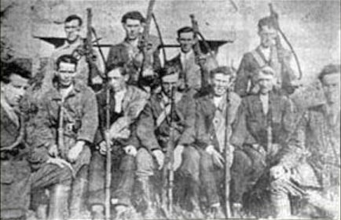
(Pictured: Kilflynn IRA Flying Column, 1922. Back (L to R): Denis O’Connell (Lixnaw), Stephen Fuller (Kilflynn), William Hartnett (Mountcoal), Tim Twomey (Kilflynn). Front (L to R): Terry Brosnan (Lixnaw), John McElligott (Leam, Kilflynn), Danny O’Shea (Kilflynn), Timothy (Aero) Lyons (Garrynagore), Tim Sheehy (Lyre), Pete Sullivan (Ballyduff), Paddy Mahony (Ballyegan, Battalion O.C.).)

Leave a comment

Birth of Kathleen Cox, Artist, Sculptor & Mystic

Kathleen Cox, Irish artist, sculptor, and mystic, is born Christina Mary Kathleen Cox in Wo-Sung, China, on July 2, 1904. Cox is considered a pioneer of contemporary Irish pottery.

Cox is the eldest daughter of Dr. R. H. Cox, originally from Dundalk, County Louth, and the port health officer in Shanghai. He is also an amateur geologist and models in clay. In his retirement, he invents a periscope later used during World War I by the Royal Navy. The years living in China leave an impression on the young Cox, visually and culturally. The family returns to Ireland in 1911, first moving to Listowel, County Kerry, and later to Howth, County Dublin. She attends Alexandra College, and later the Dublin Metropolitan School of Art in 1921. While there she studies sculpture under Oliver Sheppard and is considered one of his most talented students, winning the Royal Dublin Society Taylor prize for modelling in 1925, 1926, and 1927. The money from these prizes allows Cox to travel to Paris in 1929.

Cox exhibits in 1924 at the Tailteann exhibitions, and in 1925 submits textile designs to the Arts and Crafts Society of Ireland. She establishes a pottery studio at 7 Schoolhouse Lane, Dublin, with college friend Stella Rayner in 1929. The studio has the first electric kiln in Ireland. The first exhibited piece by Cox shown by the Royal Hibernian Academy (RHA) is in 1930, with a pair of Madonna bookends, and portrait masks of the daughter of Dermod O’Brien, Brigid O’Brien, and writer Norris Davidson. Davidson is a friend and neighbour, who commissions her to design the poster for his 1929 film, Suicide. She exhibits with the RHA from 1931 to 1933, and the Tailteann 1932, while also holding exhibitions in her studio. During this period Hilda Roberts paints her portrait, Strange Spirit. Kathleen Cox in her studio. The theme of womanhood is prominent in her work, including in the sign of her studio.

In 1932, Cox begins producing a line of more commercial figurines, drawing influence from the Royal Doulton Burslem factory, where she works for a time. One such figurine is The Lavender Man (pictured), modelled on Michael Clifford, a Dublin street trader. In the mid 1930s, she develops a frustration with her work and with her lack of impact on the wider world. In attending the Chinese exhibition in London in 1935, it is confirmed to her that pottery should be practical rather than ornamental. It spurs her to destroy all her moulds and sell her kiln upon her return to Dublin.

Cox marries Alan Palmer in 1937, the couple has two daughters and relocate to England. Palmer is a conscientious objector during World War II, with the couple running a farm at Meopham, Kent, returning to London after the war.

Cox dies in early September 1972 in London. Some of her work is held in the collections of the National Museum of Ireland and with four works featured in the exhibition Not Just Pots: Contemporary Irish Ceramics of the 21st Century.

It is during the 1920s that Cox begins to question mainstream religion and becomes a vegetarian. Finding that her personal philosophy is similar to that of theosophy, she joins the movement and speaks at meetings. She is heavily influenced by the founder of the Order of the Great Companions, the Rev. William Hayes, who is living in Dublin in the 1930s. She writes and illustrates a children’s book on world religions, A story of stories, which she publishes under the pseudonym C.M. Kay in 1970.


Leave a comment

Death of Maurice Walsh, Author of “The Quiet Man”

Maurice Walsh, Irish novelist best known for the short story The Quiet Man which is later made into an Oscar-winning movie, dies on February 18, 1964, in Blackrock, Dublin.

Walsh is born on April 21, 1879, in Ballydonoghue near Listowel, County Kerry, the third child of ten and the first son born to John Walsh, a local farmer, and his wife Elizabeth Buckley who live in a three-room thatched farmhouse. John Walsh’s main interests are books and horses and he himself does little work about the farm, preferring to have a hired man. The most famous of these hired men is Paddy Bawn Enright, whose name is immortalised by Walsh in his story The Quiet Man, although the name is not used in the later motion picture. John Walsh passes on to his son not only a love of books but also legends and folk tales that are later featured of many of Walsh’s books.

Walsh goes to school in Lisselton, a mile or so up the road from Ballydonoghue, and later goes to St. Michael’s College in Listowel to prepare for the Civil Service entrance examination. He enters the service on July 2, 1901, as an Assistant Revenue Officer in the Customs and Excise Service. He is posted to Scotland before the year is out and, although he subsequently has a number of postings outside Scotland, he spends most of his time there while in the British service.

Walsh has a life-long interest in writing and, during his early years in Scotland, this interest starts to bear fruit. He submits some of his stories and has two published in the Irish Emerald in 1908. Later that year, on August 8, 1908, Walsh marries Caroline Begg in Dufftown, Banffshire, Scotland.

When the Irish Free State is formed in 1922, Walsh transfers to its excise service and moves to Dublin. Fighting is still going on there at the time, and he leaves his family in Scotland until it is safe for them to join him in 1923. The story The Key Above the Door is written during the months of separation although it is not published until some years later, appearing first in Chambers’ Edinburgh Journal as a serial between December 1925 and May 1926 and then in book form, published by W & R Chambers Ltd., in July 1926.

Sales of Walsh’s books grow steadily, especially in the wake of an unsolicited and generous letter from J. M. Barrie, the creator of Peter Pan, praising The Key Above the Door, which Chambers is subsequently able to use on dust covers of Walsh’s books.

Walsh retires from government service in 1933 but his success as a writer continues. In that same year he sells a story to The Saturday Evening Post, then a well-known weekly magazine published in the United States. That story, later to be incorporated in the collection of stories published under the title Green Rushes, is The Quiet Man.

Director John Ford reads the story in 1933 and soon purchases the rights to it for $10. Walsh is paid another $2,500 when Republic Pictures buys the idea and receives a final payment of $3,750 when the film is actually made. Filming commences on June 7, 1951, with John Wayne and Maureen O’Hara in the leading roles. All of the outdoor scenes are shot on location in County Mayo and County Galway. The inside scenes are filmed in late July at the Republic Studios in Hollywood. The Quiet Man wins the Academy Award for Best Director for John Ford, his fourth, and for Best Cinematography.

Walsh becomes President of the Irish branch of PEN International in 1938 and visits the United States for an international meeting that year as the Irish delegate. His wife Caroline is able to accompany him although she has been in failing health for some years and ultimately dies in January 1941. Walsh himself dies on February 18, 1964, in Blackrock, a suburb of Dublin, and is buried in the Esker cemetery at Lucan, County Dublin. President Éamon de Valera attended Walsh’s funeral Mass.

In 2013, The Quiet Man is selected for preservation in the United States National Film Registry by the Library of Congress as being “culturally, historically, or aesthetically significant.”


Leave a comment

Death of Horatio Herbert Kitchener, 1st Earl Kitchener

Horatio Herbert Kitchener, 1st Earl Kitchener, Irish-born senior British Army officer and colonial administrator, drowns in the sinking of the HMS Hampshire west of Orkney, Scotland, on June 5, 1916. He wins notoriety for his imperial campaigns, especially his scorched earth policy against the Boers, his expansion of Lord Robertsinternment camps during the Second Boer War and his central role in the early part of World War I.

Kitchener is born in Ballylongford near Listowel, County Kerry, son of army officer Henry Horatio Kitchener and Frances Anne Chevallier, daughter of John Chevallier, a priest, of Aspall Hall, and his third wife, Elizabeth. The family moves to Switzerland when he is young, where he is educated at Montreux, then at the Royal Military Academy, Woolwich. He joins a French field ambulance unit in the Franco-Prussian War but is returned to England after he comes down with pneumonia.

Kitchener is credited in 1898 for winning the Battle of Omdurman and securing control of the Sudan for which he is made Baron Kitchener of Khartoum. As Chief of Staff (1900–1902) in the Second Boer War he plays a key role in Lord Roberts’ conquest of the Boer Republics, then succeeds Roberts as commander-in-chief, by which time Boer forces have taken to guerrilla warfare and British forces imprison Boer civilians in concentration camps. His term as Commander-in-Chief (1902–09) of the Army in India sees him quarrel with another eminent proconsul, the Viceroy Lord Curzon, who eventually resigns. He then returns to Egypt as British Agent and Consul General.

In 1914, at the start of World War I, Kitchener becomes Secretary of State for War, a Cabinet Minister. One of the few to foresee a long war, lasting for at least three years, and with the authority to act effectively on that perception, he organises the largest volunteer army that Britain had ever seen, and oversees a significant expansion of materials production to fight on the Western Front. Despite having warned of the difficulty of provisioning for a long war, he is blamed for the shortage of shells in the spring of 1915, one of the events leading to the formation of a coalition government and is stripped of his control over munitions and strategy.

On June 5, 1916, Kitchener is making his way to Russia on HMS Hampshire to attend negotiations with Tsar Nicholas II. At the last minute, Admiral Sir John Jellicoe changes the HMS Hampshire‘s route on the basis of a misreading of the weather forecast and ignoring (or not being aware of) recent intelligence and sightings of German U-boat activity in the vicinity of the amended route. Shortly before 7:30 PM the same day, steaming for the Russian port of Arkhangelsk during a Force 9 gale, HMS Hampshire strikes a mine laid by the newly launched German U-boat U-75 and sinks 1.5 miles west of the Orkney. Only twelve men survive. Amongst the dead are Kitchener and all ten members of his entourage. He is seen standing on the quarterdeck during the approximately twenty minutes that it takes the ship to sink. His body is never recovered.


Leave a comment

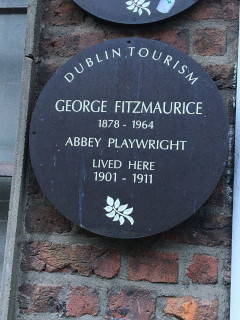
Birth of George Fitzmaurice, Playwright & Writer

George Fitzmaurice, Irish dramatist and short story writer, some of whose plays were broadcast on Radio Éireann, is born at Bedford House, Listowel, County Kerry on the January 28, 1877.

Fitzmaurice attends Duagh National School and later St. Michael’s College, Listowel. He is brought up in the Protestant faith as his father is a Protestant clergyman and is the vicar of St. John’s Church, Listowel. His father dies when he is fourteen years old and the family fortune declines. He takes a job in Dublin as a clerk in the Congested Districts Board for Ireland. In 1916 he enlists in the British Army and returns to Dublin after the war and is diagnosed with neurasthenia, rendering him fearful of crowds. On his return to Dublin, he takes up a position working for the Irish Land Commission.

Fitzmaurice and his eleven siblings are the children of a mixed marriage. He and his brothers are brought up as Protestants and his sisters are brought up as Roman Catholics. His family home at Bedford, together with its extensive lands has to be given up as collateral in respect of a £60 debt owed to the local butcher. Neither Fitzmaurice nor any of his eleven siblings are to marry or have any offspring. He is the last Fitzmaurice of Duagh. There are no photographs of him other than a sketch of him in later life.

Fitzmaurice’s first success was in 1907, with an Abbey Theatre production of his comedy The Country Dressmaker which features one of his most famous characters, Luke Quilter, “The man from the mountain.” This character proves to be a favourite with the audience, to the surprise of William Butler Yeats. The play’s commercial success brings necessary income to the Abbey Theatre in 1907. The play is ultimately broadcast by the Radio Éireann Players.

Fitzmaurice’s second play is a dramatic fantasy called The Pie Dish. It is heavily rejected and slated by critics and considered blasphemous. This leads to the rejection of another of his plays called The Dandy Dolls which is now understood as another of his best plays. It is produced in the Abbey Theatre in 1969, six years after his death.

During Fitzmaurice’s lifetime, some of his dramatic works are produced by poet Austin Clarke in Lyric Theatre, Dublin. In 1923 his play Twixt by Giltinans and the Carmodys is also performed on Abbey and eight more of his plays are printed in the literary journey The Dublin Magazine from 1924 to 1925.

The effects of having fought in World War I lead to Fitzmaurice becoming increasingly reclusive over time. With a fear of travelling and people or crowds, he spends his later years following “monotonous routines in Dublin.” On May 12, 1963, he dies in poverty at his home at 3 Harcourt Street and is buried in Mount Jerome Cemetery. In his room there are no pictures of himself, few personal mementos, but he does have a copy of almost every play he had published, as well as some unpublished drafts. Besides his personal clothing, there is little else. He dies without leaving a will.

In 1965, RTÉ reports that “the works of George Fitzmaurice are now undergoing something of a revival.” A fellow Kerry playwright, John B. Keane, states at the time that Fitzmaurice is increasingly being recognised as the great dramatist he truly was. He also describes his work as having “practical clarity of speech coupled with a great conciseness, and a tightness in his writing and in his construction.” Michael Connor, the man who owns the Fitzmaurice property in Daugh, recounts that he often saw Fitzmaurice in the town after his retirement from the civil service but by that time the dramatist had completely lost interest in seeing his own plays on the stage.

In his native Daugh, The George Fitzmaurice Library is founded, and on October 14, 1995, a headstone that is sculpted by a local and commissioned by the Duagh Historical Society, is placed over Fitzmaurice’s grave.


Leave a comment

Assassination of Sir Arthur Edward Vicars

arthur-vicars

Sir Arthur Edward Vicars, genealogist and heraldic expert, is assassinated in Kilmorna, County Kerry by the Irish Republican Army (IRA) on April 14, 1921.

Vicars is born on July 27, 1862 in Leamington Spa, Warwickshire, England, and is the youngest child of Colonel William Henry Vicars of the 61st Regiment of Foot and his wife Jane (nee Gun-Cunninghame). This is his mother’s second marriage, the first being to Pierce O’Mahony by whom she has two sons. He is very attached to his Irish half-brothers and spends much time at their residences. On completing his education at Magdalen College School, Oxford and Bromsgrove School he moves permanently to Ireland.

Vicars quickly develops an expertise in genealogical and heraldic matters and makes several attempts to be employed by the Irish heraldic administration of Ulster King of Arms, even offering to work for no pay. In 1891 he is one of the founder members of the County Kildare Archaeological Society and remains its honorary secretary until his death.

Vicars first attempts to find a post in the Office of Arms when in 1892 he applies unsuccessfully for the post of Athlone Pursuivant on the death of the incumbent, Bernard Louis Burke. In a letter dated October 2, 1892 his half-brother Pierce Mahony writes that Sir Bernard Burke, Ulster King of Arms, is dying and urges him to move at once. Burke dies in December 1892, and Vicars is appointed to the office by letters patent dated February 2, 1893. In 1896 he is knighted, in 1900 he is appointed Commander of the Royal Victorian Order (CVO) and in 1903 he is elevated to Knight Commander of the Order (KCVO). He is also a fellow of the Royal Society of Antiquaries of Ireland and a trustee of the National Library of Ireland.

In 1897 Vicars publishes An Index to the Prerogative Wills of Ireland 1536 -1810, a listing of all persons in wills proved in that period. This work becomes very valuable to genealogists after the destruction of the source material for the book in 1922 when the Public Record Office at the Four Courts is destroyed at the start of the Irish Civil War.

Vicars’ career is very distinguished until 1907 when it is hit by the scandal of the theft of the Irish Crown Jewels. As Registrar of the Order of St. Patrick, he has custody of the insignia of the order, also known as the “crown jewels.” They are found to be missing on July 6, and a Crown Jewel Commission is established in January 1908 to investigate the disappearance. Vicars and his barrister Tim Healy refuse to attend the commission’s hearings. The commission’s findings are published on January 25, 1908 and he is dismissed as Ulster five days later.

On November 23, 1912, the Daily Mail publishes serious false allegations against Vicars. The substance of the article is that Vicars had allowed a woman reported to be his mistress to obtain a copy of the key to the safe and that she had fled to Paris with the jewels. In July 1913 he successfully sues the paper for libel. The paper admits that the story is completely baseless and that the woman in question does not exist. He is awarded damages of £5,000.

Vicars leaves Dublin and moves to Kilmorna, near Listowel, County Kerry, the former seat of one of his half-brothers. He marries Gertrude Wright in Ballymore, County Westmeath on July 4, 1917. He continues to protest his innocence until his death, even including bitter references to the affair in his will.

In May 1920 up to a hundred armed men break into Kilmorna House and hold Vicars at gunpoint while they attempt to break into the house’s strongroom. On April 14, 1921, he is taken from Kilmorna House, which is set afire, and shot dead in front of his wife. According to the communiqué issued from Dublin Castle, thirty armed men took him from his bed and shot him, leaving a placard around his neck denouncing him as an informer. On April 27, as an official reprisal, four shops are destroyed by British Armed Forces in the town of Listowel. The proclamation given under Martial law and ordering their demolition states:

“For any outrage carried out in future against the lives or property of loyalist officials, reprisals will be taken against selected persons known to have rebel sympathies, although their implication has not been proved.”

Vicars is buried in Leckhampton, Gloucestershire on April 20, 1921. His wife dies in Somerset in 1946.


Leave a comment

Birth of John B. Keane, Irish Playwright & Novelist

john-b-keane

John Brendan Keane, Irish playwright, novelist and essayist, is born in Listowel, County Kerry on July 21, 1928.

Keane is the son of a national school teacher, William B. Keane, and his wife Hannah Purtill. He is educated at Listowel National School and then at St. Michael’s College, Listowel. He works as a chemist’s assistant for A.H. Jones who dabbles in buying antiques. He has various jobs in the United Kingdom between 1951 and 1955 working as a street cleaner and a bartender and lives in a variety of places including Northampton and London. It is while he is in Northampton that he is first published in an unnamed women’s magazine for which he receives £15.

After returning from the UK, Keane is a pub owner in Listowel from 1955 where he writes plays for the local theatre company and sponsors, from 1971, the annual Listowel Writers’ Week. He marries Mary O’Connor at Knocknagoshel Church on January 5, 1955 and they have four children: Billy, Conor, John and Joanna.

His first play, Sive (1959), is initially rejected by the Abbey Theatre in Dublin but goes on to win the amateur All-Ireland Drama Festival. Later plays include The Field (1965), which is released in a bowdlerized film version in 1990, and Big Maggie (1969), which is produced on Broadway in 1982. In 1998 Keane is honoured with a medal from the Abbey for his contribution to Irish theatre.

Keane is an Honorary Life Member of the Royal Dublin Society from 1991, serves as president of Irish club of PEN International and is a founder member of the Society of Irish Playwrights as well as a member of Aosdána. He is named the patron of the Listowel Players after the Listowel Drama Group fractures. He remains a prominent member of the Fine Gael party throughout his life, never being shy of political debate.

John Keane dies of prostate cancer on May 30, 2002, in Listowel at the age of 73.

Keane’s nephew is the investigative journalist Fergal Keane. His son John is a journalist with the Kilkenny People while his son Billy regularly writes a column for the Irish Independent.


Leave a comment

Death of Playwright John Brendan Keane

john-brendan-keane

John Brendan Keane, playwright, novelist and essayist, dies in Listowel, County Kerry on May 30, 2002.

Keane is born on Church Street in Listowel on July 21, 1928, the son of a national school teacher, William B. Keane, and his wife Hannah (née Purtill). He is educated at Listowel National School and then at St. Michael’s College, Listowel. He works as a chemist’s assistant for A.H. Jones who dabbles in buying antiques. He has various jobs in the UK between 1951 and 1955 working as a street cleaner and a bartender, living in a variety of places including Northampton and London. It is while he is in Northampton that Keane is first published in an unnamed women’s magazine for which he receives £15.

After returning from the United Kingdom, Keane is a pub owner in Listowel from 1955.

Keane marries Mary O’Connor at Knocknagoshel Church on January 5, 1955 and they have four children: Billy, Conor, John and Joanna. He is an Honorary Life Member of the Royal Dublin Society from 1991, serves as president of Irish PEN and is a founder member of the Society of Irish Playwrights as well as a member of Aosdána. He is named the patron of the Listowel Players after the Listowel Drama Group fractures. He remains a prominent member of the Fine Gael party throughout his life, never being shy of political debate.

Keane cites many literary influences including Bryan MacMahon and George Fitzmaurice, fellow Kerry writers and playwrights. His personal influences are numerous but, most notably he thanks his father and his wife, Mary. He is grateful for his father’s help with early editing, allowing him access to his personal library, and encouraging him to continue his work until he is successful. He is also influenced by the local population and the patrons of his pub from which he bases some of his characters.

Keane dies on May 30, 2002 of complications from prostate cancer, which he had been battling for eight years. His death comes on the eve of the annual Listowel Writers’ Festival, a week-long event at which he had long been a dominating and avuncular presence.

Keane’s nephew is the investigative journalist Fergal Keane. His son John is a journalist with the Kilkenny People while his son Billy regularly writes a column for the Irish Independent.