seamus dubhghaill

Promoting Irish Culture and History from Little Rock, Arkansas, USA


Leave a comment

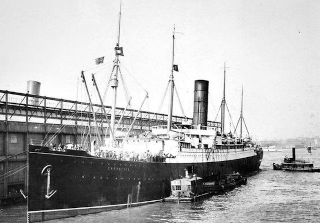
RMS Carpathia Arrives in New York City with RMS Titanic Survivors

The RMS Carpathia, a Cunard Line transatlantic passenger steamship, arrives in New York City on April 18, 1912, with 705 survivors from the RMS Titanic, which sank in the North Atlantic three days earlier.

As she is making her way from New York to Fiume, Austria-Hungary (now Rijeka, Croatia), RMS Carpathia receives a distress call from the “unsinkable” RMS Titanic. RMS Carpathia’s captain, Arthur Rostron, later testifies that the distance to RMS Titanic was 58 nautical miles (67 miles) and was expected to take three and a half hours to reach the doomed liner as its top speed, which was about 14.5 knots.

However, braving dangerous ice fields of its own, Rostron orders extra stokers to feed coal and cut off heating and hot water elsewhere in order to supply the ship’s engines with as much steam as possible. These decisions help accelerate the ship to more than 17 knots and the RMS Carpathia arrives on the scene approximately one hour and 40 minutes after RMS Titanic went down. For the next four and a half hours, the ship rescues 705 survivors from RMS Titanic‘s lifeboats.

Slowed by storms and fog since early Tuesday, April 16, RMS Carpathia arrives in New York City on the cold and rainy evening of Thursday, April 18, escorted by the scout cruiser USS Chester. RMS Carpathia first bypasses Pier 54, its Cunard Line pier, and sails up the Hudson River to Pier 59, the berth for White Star Line and where RMS Titanic was supposed to have arrived. Having dropped off the empty lifeboats, RMS Carpathia then sails back toward Pier 54.

A tugboat filled with photographers follows the ship to the pier, and the flashlight of cameras lights up the ship in the night sky to reveal that the decks are crammed with passengers.

Tens of thousands of people gather around Pier 54 to meet them and receive the first physical confirmation of the maritime disaster. On the orders of Rostron, RMS Carpathia‘s passengers disembark first, believing the scene will become tumultuous as soon as RMS Titanic survivors first appear. That moment comes when a teary-eyed woman with makeshift clothes descends a gangway and stumbles away from the boat into the arms of an officer.

The RMS Carpathia is initially a transatlantic passenger ship that makes its maiden voyage in 1903. During World War I, she is used to transfer Canadian and American Expeditionary Forces to Europe.

On July 15, 1918, under the command of Captain William Prothero, RMS Carpathia is a part of a large convoy that is making its way from Liverpool to Boston. Two days later, carrying 57 passengers and 166 crew, she is torpedoed on the port side by a German U-boat off the southwest coast of Ireland.

A second strike follows, which penetrates the engine room, killing three firemen and two trimmers. Prothero gives the order to abandon ship and all passengers and the surviving crew members board the lifeboats.

A third torpedo strike hits the gunner’s rooms, resulting in a large explosion that dooms the ship. The U-boat starts approaching the lifeboats when the HMS Snowdrop arrives on the scene and drives away the submarine with gunfire before picking up survivors.

The wreck of the RMS Carpathia is only discovered in 2000 after an 80 year-long search for the missing ship.

(From: “On This Day: Carpathia arrives in New York with Titanic survivors” by Michael Dorgan, IrishCentral, http://www.irishcentral.com, April 15, 2022)


2 Comments

The 32 County Sovereignty Movement Launches Major Recruitment Campaign

The 32 County Sovereignty Movement, often abbreviated to 32CSM or 32csm, an Irish republican group that is founded by Bernadette Sands McKevitt, launches a major recruitment campaign in west Belfast on April 17, 1999.

The objectives of the 32CSM are:

  • The restoration of Irish national sovereignty.
  • To seek to achieve unity among the Irish people on the issue of restoring national sovereignty and to promote the revolutionary ideals of republicanism and to this end involve itself in resisting all forms of colonialism and imperialism.
  • To seek the immediate and unconditional release of all Irish republican prisoners throughout the world.

The 32CSM does not contest elections but acts as a pressure group, with branches, or cumainn, organised throughout the traditional counties of Ireland. It has been described as the “political wing” of the now defunct Real Irish Republican Army (Real IRA or RIRA), but this is denied by both organisations. The group originates in a split from Sinn Féin over the Mitchell Principles.

The organisation is founded on December 7, 1997, at a meeting of like-minded Irish republicans in the Dublin suburb of Finglas. Those present are opposed to the direction taken by Sinn Féin and other mainstream republican groups in the Northern Ireland peace process, which eventually leads to the Good Friday Agreement, also known as the Belfast Agreement, the following year. The same division in the republican movement leads to the paramilitary group now known as the Real IRA breaking away from the Provisional Irish Republican Army at around the same time.

Most of the 32CSM’s founders had been members of Sinn Féin, with some having been expelled from the party for challenging the leadership’s direction, while others felt they had not been properly able to air their concerns within Sinn Féin at the direction its leadership had taken. Bernadette Sands McKevitt, wife of Michael McKevitt and a sister of hunger striker Bobby Sands, is a prominent member of the group until a split in the organisation.

The name refers to the 32 counties of Ireland which were created during the Lordship of Ireland and Kingdom of Ireland. With the partition of Ireland in 1920–22, twenty-six of these counties form the Irish Free State which is abolished in 1937 and is now known as Ireland since 1949. The remaining six counties of Northern Ireland remain part of the United Kingdom. Founder Bernadette Sands McKevitt says in a 1998 interview with The Mirror that people did not fight for “peace” – “they fought for independence” – and that the organisation reaffirms to the republican position in the 1919 Irish Declaration of Independence.

Before the referendums on the 1998 Good Friday Agreement, the 32CSM lodges a legal submission with the United Nations challenging British sovereignty in Ireland. The referendums are opposed by the 32CSM but are supported by 71% of voters in Northern Ireland and by 94% in the Republic of Ireland. It is reported in February 2000 that the group had established a “branch” in Kilburn, London.

In November 2005, the 32CSM launches a political initiative titled Irish Democracy, A Framework for Unity.

On May 24, 2014, Gary Donnelly, a member of the 32CSM, is elected to the Derry and Strabane super council. In July 2014, a delegation from the 32CSM travels to Canada to take part in a six-day speaking tour. On arrival the delegation is detained and refused entry into Canada.

The 32CSM has protested against what it calls “internment by remand” in both jurisdictions in Ireland. Other protests include ones against former Democratic Unionist Party (DUP) leader Ian Paisley in Cobh, County Cork, against former British Prime Minister John Major being given the Keys to Cork city, against a visit to the Republic of Ireland by Police Service of Northern Ireland (PSNI) head Sir Hugh Orde, and against the Israeli occupation of Palestine and Anglo-American occupation of Iraq.

In 2015, the 32CSM organises a demonstration in Dundee, Scotland, in solidarity with the men convicted of shooting Constable Stephen Carroll, the first police officer to be killed in Northern Ireland since the formation of the PSNI. The organisation says the “Craigavon Two” are innocent and are victims of a miscarriage of justice.

The 32CSM also operates outside of the island of Ireland to some extent. The Gaughan/Stagg Cumann covers England, Scotland and Wales, and has an active relationship of mutual promotion with a minority of British left-wing groups and anti-fascist organisations. The James Larkin Republican Flute Band in Liverpool and the West of Scotland Band Alliance, the largest section of which is the Glasgow-based Parkhead Republican Flute Band, are also supporters of the 32CSM. As of 2014, the 32CSM’s alleged paramilitary wing, the Real IRA, is reported to still be involved in attempts to perpetrate bombings in Britain as part of the dissident Irish republican campaign, which has been ongoing since 1998.

The 32CSM is currently considered a foreign terrorist organization (FTO) in the United States, because it is considered to be inseparable from the Real IRA, which is designated as an FTO. At a briefing in 2001, a spokesman for the U.S. Department of State states that “evidence provided by both the British and Irish governments and open-source materials demonstrate clearly that the individuals who created the Real IRA also established these two entities to serve as the public face of the Real IRA. These alias organizations engage in propaganda and fundraising on behalf of and in collaboration with the Real IRA.” The U.S. Department of State’s designation makes it illegal for Americans to provide material support to the Real IRA, requires U.S. financial institutions to block the group’s assets and denies alleged Real IRA members travel visas into the United States.


Leave a comment

Founding of Aer Lingus, the National Airline of the Republic of Ireland

Aer Lingus (Irish: Aer Loingeas) is founded by the Irish government as the national airline of the Republic of Ireland on April 15, 1936.

Aer Lingus is founded with a capital of £100,000. Its first chairman is Seán Ó hUadhaigh. Pending legislation for Government investment through a parent company, Aer Lingus is associated with Blackpool and West Coast Air Services which advances the money for the first aircraft and operates with Aer Lingus under the common title “Irish Sea Airways.” Aer Lingus Teoranta is registered as an airline on May 22, 1936. The name Aer Lingus is proposed by Richard F. O’Connor, who is County Cork Surveyor, as well as an aviation enthusiast.

On May 27, 1936, five days after being registered as an airline, Aer Lingus’s first service begins between Baldonnel Aerodrome in Dublin and Bristol (Whitchurch) Airport in Bristol, England, using a six-seater de Havilland DH.84 Dragon biplane (registration EI-ABI), named Iolar (Eagle).

Later that year, the airline acquires its second aircraft, a four-engined biplane de Havilland DH.86 Express named Éire, with a capacity of 14 passengers. This aircraft provides the first air link between Dublin and London by extending the Bristol service to Croydon. At the same time, the DH.84 Dragon is used to inaugurate an Aer Lingus service on the Dublin-Liverpool route.

Aer Lingus is established as the national carrier under the Air Navigation and Transport Act (1936). In 1937, the Irish government creates Aer Rianta, now called Dublin Airport Authority (DAA), a company to assume financial responsibility for the new airline and the entire country’s civil aviation infrastructure. In April 1937, Aer Lingus becomes wholly owned by the Irish government via Aer Rianta.

Aer Lingus is privatised between 2006 and 2015. It is a former member of the Oneworld airline alliance, which it leaves on March 31, 2007.

Ryanair owns over 29% of Aer Lingus stock and the Irish state owns over 25% before being bought out by International Airlines Group (IAG) in 2015. The state had previously held an 85% shareholding until the Government’s decision to float the company on the Dublin and London stock exchanges on October 2, 2006. The principal group companies include Aer Lingus Limited, Aer Lingus Beachey Limited, Aer Lingus (Ireland) Limited and Dirnan Insurance Company Limited, all of which are wholly owned.

On May 26, 2015, after months of negotiations on a possible IAG takeover, the Irish government agrees to sell its stake in Aer Lingus. Ryanair retains a 30% stake in the company which it agrees to sell to IAG on July 10, 2015, for €2.55 per share. In August 2015, Aer Lingus’ shareholders officially accept IAG’s takeover offer. IAG subsequently assumed control of Aer Lingus on September 2, 2015.

After the takeover by IAG, it is expected that Aer Lingus would re-enter Oneworld, however, at a press briefing on November 15, 2017, the airline’s then CEO Stephen Kavanagh states that the airline has “no plans to join Oneworld.” The airline is now a wholly owned subsidiary of IAG.

Aer Lingus has codeshare agreements with Oneworld, Star Alliance and SkyTeam members, as well as interline agreements with Etihad Airways, JetBlue and United Airlines. The airline has a hybrid business model, operating a mixed fare service on its European routes and full service, two-class flights on transatlantic routes.

Aer Lingus’s head office is on the grounds of Dublin Airport in Collinstown, County Dublin.


Leave a comment

Birth of Justin McCarthy, Historian, Novelist & Politician

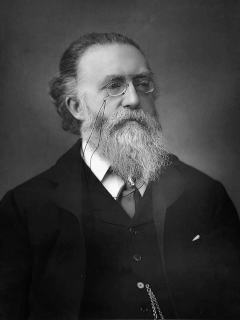
Justin McCarthy, Irish nationalist and Liberal historian, novelist and politician, is born in Cork, County Cork on November 22, 1830. He is a Member of Parliament (MP) from 1879 to 1900, taking his seat in the House of Commons of the United Kingdom of Great Britain and Ireland.

McCarthy is educated in Cork. He begins his career as a journalist at the age of 18 in Cork. From 1853 to 1859 he is in Liverpool, on the staff of the Northern Daily Times. In March 1855, he marries Charlotte Ailman. In 1860 he moves to London, as parliamentary reporter to the Morning Star, of which he becomes editor in 1864. He gives up his post in 1868 and, following a lecturing tour in the United States, joins the staff of The Daily News as leader-writer in 1870. In this capacity he becomes one of the most useful and respected upholders of the liberal politics of the time. He lectures again in America in 1870–71 and in 1886–87.

McCarthy is first elected to Parliament at a by-election on April 4, 1879, when he is returned unopposed as a Home Rule League MP for Longford. He is re-elected unopposed as a Parnellite Home Ruler in 1880, and when the two-seat Longford constituency is split into two divisions under the Redistribution of Seats Act 1885, he is elected as an Irish Parliamentary Party member for the new single-seat North Longford constituency. His sole opponent, James Mackay Wilson of the Irish Conservative Party, wins only 6% of the votes.

At the 1886 United Kingdom general election, McCarthy is returned unopposed in North Longford, but also stands in Londonderry City, where he is declared the loser to the Irish Unionist Alliance candidate by the narrow margin of 1778 votes to 1781. However, the result is later overturned on petition and McCarthy opts to sit for Londonderry City. During the divorce controversy surrounding Charles Stewart Parnell in November 1890, the British Prime Minister William Ewart Gladstone expresses a warning, given to McCarthy as intermediary, that if Parnell retains leadership of the Irish Parliamentary Party, it will mean the loss of the next election, the end of their alliance and Home Rule. When the annual party leadership election meeting is called later that month, the threat is somehow not conveyed to the members, who re-elect Parnell leader of the Party.

After a further historical meeting of the Irish Party MPs in early December, Parnell refuses to retire and the Party divides. McCarthy becomes chairman of the Anti-Parnellite group, the Irish National Federation, for a year in 1891–92. His nationalism is of a temperate and orderly kind, and though his personal distinction singles him out for the chairmanship during the party dissensions of this period, he is in no active sense the political leader.

At the 1892 United Kingdom general election, McCarthy again stands both in North Longford and in Londonderry City. In each seat there is a two-way contest between the Anti-Parnellite McCarthy and a Unionist candidate, but the narrow Unionist victory in Londonderry is not overturned, and McCarthy sits for North Longford, where he wins over 93% of the votes. He is returned unopposed for North Longford in 1895 United Kingdom general election in Ireland and stands down from Parliament at the 1900 United Kingdom general election In Ireland.

It is claimed that McCarthy’s true vocation is literature. His earliest publications are novels, some of which, such as A Fair Saxon (1873), Dear Lady Disdain (1875), Miss Misanthrope (1878), and Donna Quixote (1879), attain considerable popularity. His most important work is his History of Our Own Times, which treats of the period between Queen Victoria‘s accession and her Diamond Jubilee. He begins a History of the Four Georges (1884–1901) and the latter half is written by his son, Justin Huntly McCarthy.

Justin McCarthy dies at the age of 81 in Folkestone, Kent, England on April 24, 1912.

(Pictured: Portrait style photograph of Irish politician Justin McCarthy, taken in 1891 by Herbert Rose Barraud)


Leave a comment

Birth of John Martin Hayes, Priest & Founder of Muintir na Tíre

John Martin Hayes, Irish Catholic priest and the founder of Muintir na Tíre, a national rural community development organisation, is born on November 11, 1887, in an Irish National Land League hut at Murroe, County Limerick.

Hayes is born into a family languishing in poverty. One of ten siblings, seven of Hayes’ brothers and sisters die of malnutrition and disease over a twelve-year period. The family had been evicted from Lord Cloncurry‘s estate in 1872 for non-payment of rent, forcing them into destitution. The family returns to the estate in 1894.

Hayes is educated by the Jesuits at Crescent College, Limerick and thereafter studies for the priesthood in St. Patrick’s College, Thurles. In 1907 he goes to the Irish College in Paris where he is ordained in 1913. He enjoys this time in France greatly, a period highlighted by the beatification of Saint Joan of Arc in 1909. From 1915 to 1924 he works in Liverpool before returning to Ireland to serve as curate in Castleiney and later in Tipperary Town. Previous to 1916, he is a supporter of the Irish Volunteers, and his brother Mick becomes a leading member of the Limerick Irish Republican Army, however, he effectively misses the Irish revolutionary period as he is sent to work in Liverpool between 1915 and 1924.

During the 1920s Hayes becomes an admirer of Benito Mussolini, with whom he is granted an audience during a visit to Rome in 1930. He is intrigued by corporatism and comes to believe it can uplift rural communities. Similarly, he is influenced by continental movements such as the Belgian Boerenbond league, which encourages rural inhabitants to form cooperatives.

Hayes comes to national prominence with the foundation of Muintir na Tíre in 1931, a rural development organisation which has core principles of neighbourliness, self-help and self-sufficiency. It is to act as a rural self-help group based on collective parish organisation with a strong emphasis on the teaching of the papal encyclicals Rerum novarum (1891) and Quadragesimo anno (1931). He is successfully able to draw on the power of the media, Irish newspapers and radio, to promote Muintir na Tíre and quickly becomes a figure of national prominence in doing so. In promoting and developing Muintir na Tíre Hayes resists calls in some quarters to limit the membership to Catholics, remarking “this country is becoming so Catholic it forgets to be Christian.” Nonetheless, under his leadership, there is eventually an overlap in membership between Muintir na Tíre and the Catholic fraternal organisation the Knights of Saint Columbanus.

Hayes is appointed parish priest of Bansha and Kilmoyler in County Tipperary in 1946. Due largely to his endeavours, a factory, Bansha Rural Industries, is started and enjoys some success producing preserves for the Irish home market. Bansha is to the forefront in developing many Muintir na Tíre initiatives and for a time in the 1950s enjoys the soubriquet of The Model Parish.

A lifelong teetotaller, a highlight of Hayes’ career is his address to the Pioneer Total Abstinence Association in Croke Park in June 1949 to celebrate their 50th year of operation. The event is the largest Catholic gathering in Dublin since the Eucharistic Congress of 1932.

Hayes spearheads many initiatives including rural electrification, the “Parish Plan for Agriculture,” and the setting up of small industry in rural areas in an attempt to stop emigration. He is later made a canon of his cathedral chapter.

Hayes dies on January 30, 1957 in a Tipperary nursing home following a minor operation. His funeral in Bansha is a national occasion, attended by leaders of Church and State. His grave is at the rear of the Church of the Annunciation, Bansha. He is later commemorated on an Irish postage stamp.


Leave a comment

The Wreck of the “Stephen Whitney”

The passenger-carrying sailing ship Stephen Whitney is wrecked on West Calf Island off the southern coast of Ireland on November 10, 1847 with the loss of 92 of the 110 passengers and crew aboard.

The Stephen Whitney is a packet ship in Robert Kermit‘s Red Star Line. The ship is named after a Kermit investor, New York City merchant Stephen Whitney.

The 1,034-ton ship leaves New York City on October 18 for Liverpool, England, carrying passengers and a cargo which includes corn, raw cotton, cheese, resin, and twenty boxes of clocks. On November 10 in thick fog, the captain, C.W. Popham, mistakes the Crookhaven lighthouse for the one at the Old Head of Kinsale and the lighthouse on Cape Clear Island is obscured by fog compounding the error in navigation. At around 10:00 p.m., the ship strikes the western tip of West Calf Island, completely breaking up within about ten minutes. Conditions in the area are distressing as it is the height of the Great Famine.

The loss of the ship triggers the decision to replace the Cape Clear Island lighthouse with one on Fastnet Rock. This decision is also because the lighthouse on Cape Clear is often shrouded in fog or low level clouds, which make it hard or at times impossible to see.

(Pictured: West Calf Island, the most westerly of the three Calf Islands that lie at the heart of Roaring Water Bay, West Cork)


Leave a comment

Birth of Alice Curtayne, Writer & Lecturer

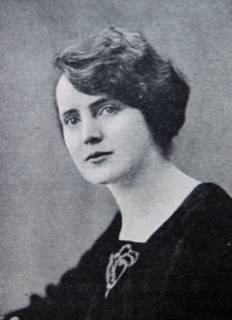
Alice Curtayne, Irish writer and lecturer, is born on November 6, 1898, in Upper Castle Street, Tralee, County Kerry.

Curtayne is the youngest child of John Curtayne, founder and proprietor of the Tralee Carriage Works, and his wife Bridget Curtayne (née O’Dwyer). She receives her initial education at local convents before attending La Sainte Union College in Southampton, England. Having taken a typing course, she is engaged as a secretary in Milan, where she remains for four and a half years. This proves to be a formative period in her life. She comes to regard Italy as a second home and is greatly influenced by the work of the Italian Catholic philosopher, Giovanni Papini.

On leaving Italy Curtayne works for a time in Liverpool. She joins the Liverpool Catholic Evidence Guild, from where she receives her diploma as a diocesan catechist. While in England she also develops an interest in public speaking. Her first book, Catherine of Siena (1929), is followed by numerous publications on religious and historical subjects, including Lough Derg (1933), Patrick Sarsfield (1934), The Trial of Oliver Plunkett (1953), Twenty Tales of Irish Saints for children (1955), and The Irish Story (1962).

Curtayne’s enthusiasm for Italy is reflected in her many publications of Italian interest, including a scholarly work on Dante, and a novel House of Cards (1940), which centres on the experiences of a young Irish woman living in Italy. In 1972 she produces Francis Ledwidge: A Life of the Poet, her well regarded biography of the poet Francis Ledwidge, and in 1974 it is followed by an edition of his complete poems, The Complete Works of Francis Ledwidge. Throughout her journalistic career she is a contributor to various magazines and papers, among them The Irish Times, Irish Independent, The Irish Press, Books on Trial, The Spectator, and The Standard.

During the 1950s and early 1960s Curtayne makes five lecture tours in the United States, speaking on Irish life, history, and literature. In 1959 she receives an honorary doctorate in Humane Letters from Anna Maria College in Paxton, Massachusetts, where she briefly teaches. She is presented with the Key to Worcester City by Mayor James D. O’Brien. She also gives a course of lectures on Dante at Craiglockhart College, Edinburgh, in 1956, and in 1965 she again speaks on Dante in a Radio Éireann Thomas Davis lecture.

In December 1954 The Irish Press sends Curtayne to Rome to write daily reports on the close of the Marian year. She goes to Rome again for the final session of the Second Vatican Council. She is commissioned to send weekly reports to local newspapers, The Nationalist (Carlow) and The Kerryman. She also sends a series of profiles of outstanding personages of this Vatican Council to The Universe and an article for Hibernia journal.

In 1935, Curtayne marries the English-born writer and broadcaster Stephen Rynne, with whom she has two sons and two daughters. They run a farm at Prosperous, County Kildare, and are well known advocates of the values of rural living. One son, Andrew Rynne, becomes a medical practitioner and well known for his liberal views on birth control. Daughter Brigid Rynne later illustrates some of her mother’s books.

Curtayne dies on August 9, 1981, in the Hazel Hall Nursing Home in Clane, County Kildare, and is buried at Killybegs Cemetery.


Leave a comment

Ireland National Football Team Becomes First to Defeat England at Home

The Republic of Ireland national football team defeats the England national football team 2-0 in a friendly international at Goodison Park, Liverpool, the home of Everton F.C., on September 21, 1949. As a result, Ireland becomes the first foreign team to beat England at home. In 1953, the Hungarian team known as the Mighty Magyars defeats England 6–3, to become the second team to do so.

During the 1940s, there are in effect, two Ireland teams, chosen by two rival associations — the Northern Ireland-based Irish Football Association (IFA) and the Republic of Ireland-based Football Association of Ireland (FAI). Both organisations claim jurisdiction over the whole of Ireland and select players from the whole island. As a result, several notable Irish players from this era play for both teams. The IFA XI had played England regularly since 1882, and claim their first victory, by a score of 3–0, on English soil at Ayresome Park, Middlesbrough, on February 14, 1914, but this is only the second time England and the FAI XI have met. Despite this, several members of the FAI XI had played against England several times before while representing the IFA XI. Striker Davy Walsh had previously scored three times against England.

The FAI XI plays England for the first time at Dalymount Park on September 30, 1946. A team, featuring Johnny Carey, Con Martin and Billy Walsh, are narrowly defeated 1–0 when Tom Finney scores the winner in the 82nd minute. Two days earlier, on September 28, Carey and Tom Aherne had been included in the IFA XI that had been heavily defeated 7–2 by the same England side. The next time the IFA XI play England, on November 5, 1947, their team includes six players — Carey, Martin, Billy Walsh, Peter Farrell, Davy Walsh and Tommy Eglington — who had previously played for the FAI XI. Davy Walsh scores the opening goal in a 2–2 draw at Goodison Park. Carey, Martin, Farrell and Walsh also play for the IFA XI in their 6–2 defeat by England at Windsor Park on October 10, 1948. Davy Walsh also scores both goals that day.

The September 21, 1949, match is used by both teams as part of their preparations for forthcoming World Cup qualifiers. Despite the absence of both Stanley Matthews and Stan Mortensen, England fields a strong team, including Billy Wright, Neil Franklin, Wilf Mannion and Tom Finney. Ireland’s team includes just seven First Division players, but these include Johnny Carey who is voted FWA Footballer of the Year in 1949. Another two Irish players, Tom Aherne and Tommy Moroney, like Finney, play in the English Football League Second Division. The remaining two Irish players, goalkeeper Tommy Godwin and Tommy O’Connor both play for Shamrock Rovers F.C. in the League of Ireland.

The early pattern of the game sees England launch wave after wave of attacks. However Tommy Godwin is in inspired form and Con Martin, Tom Aherne and Johnny Carey prove too difficult for England to get past. Carey is also effective in keeping Tom Finney quiet, while wing-halves Billy Walsh and Tommy Moroney gradually take the sting out of the English front line. Ireland takes the lead in the 33rd minute when Peter Desmond, after collecting a pass from Tommy O’Connor, bursts into the England penalty area and is brought down. Con Martin then converts the subsequent penalty kick. During the second half the wave of England attacks continues. Peter Harris hits the bar and Jesse Pye also goes close. However, Peter Farrell, playing at his club Everton’s home ground, makes victory certain in the 85th minute. O’Connor slips the ball to Farrell and as the English goalkeeper Bert Williams advances, Farrell lofts the ball into the net.

(Pictured: The Irish team which beat England 2-0 at Goodison Park in 1949. Back Row (L to R): Con Martin, Tommy Aherne, Tommy Godwin, Tommy Moroney and Willie Walsh. Seated (L to R): Peter Corr, Tommy O’Connor, Johnny Carey, Peter Desmond, Peter Farrell and Davy Walsh.)


Leave a comment

Birth of Sir Roger Casement, Diplomat & Irish Nationalist

Sir Roger Casement, in full Sir Roger David Casement, diplomat and Irish nationalist, is born on September 1, 1864, in Kingstown (now Dún Laoghaire), County Dublin. Following his execution for treason in 1916, he becomes one of the principal Irish martyrs in the revolt against British rule in Ireland.

Casement is born into an Anglo-Irish family, and lives his very early childhood at Doyle’s Cottage, Lawson Terrace, Sandycove. His father, Captain Roger Casement of the (King’s Own) Regiment of Dragoons, is the son of Hugh Casement, a Belfast shipping merchant who goes bankrupt and later moves to Australia. After the family moves to England, Casement’s mother, Anne Jephson (or Jepson), of a Dublin Anglican family, purportedly has him secretly baptised at the age of three as a Roman Catholic in Rhyl, Wales.

The family lives in England in genteel poverty. Casement’s mother dies when he is nine years old. His father takes the family back to County Antrim in Ireland to live near paternal relatives. His father dies when he is thirteen years old. He is educated at the Diocesan School, Ballymena (later the Ballymena Academy). He leaves school at 16 and goes to England to work as a clerk with Elder Dempster Lines, a Liverpool shipping company headed by Alfred Lewis Jones.

Casement is a British consul in Portuguese East Africa (1895–98), Angola (1898–1900), Congo Free State (1901–04), and Brazil (1906–11). He gains international fame for revealing atrocious cruelty in the exploitation of native labour by white traders in the Congo and the Putumayo River region of Peru. His Congo report, published in 1904, leads to a major reorganization of Belgian rule in the Congo in 1908, and his Putumayo report of 1912 earns him a knighthood, which is ultimately forfeited on June 29, 1916.

Ill health forces Casement to retire to Ireland in 1912. Although he comes from an Ulster Protestant family, he has always sympathized with the predominantly Roman Catholic Irish nationalists. Late in 1913 he helps form the National Volunteers, and in July 1914 he travels to New York City to seek American aid for that anti-British force. After World War I breaks out in August, he hopes that Germany might assist the Irish independence movement as a blow against Great Britain. On arriving in Berlin in November 1914, he finds that the German government is unwilling to risk an expedition to Ireland and that most Irish prisoners of war would refuse to join a brigade that he intends to recruit for service against England.

Later, Casement fails to obtain a loan of German army officers to lead the Irish rising planned for Easter 1916. In a vain effort to prevent the revolt, he sails for Ireland on April 12 in a German submarine. Put ashore near Tralee, County Kerry, he is arrested on April 24 and taken to London, where, on June 29, he is convicted of treason and sentenced to death. An appeal is dismissed, and he is hanged at London’s Pentonville Prison on August 3, 1916, despite attempts by influential Englishmen to secure a reprieve in view of his past services to the British government. During this time, diaries reputedly written by Casement and containing detailed descriptions of homosexual practices are circulated privately among British officials. After years of dispute over their authenticity, the diaries are made available to scholars by the British home secretary in July 1959. It is generally considered that the passages in question are in Casement’s handwriting.

In 1965 Casement’s remains are repatriated to Ireland. Despite the annulment, or withdrawal, of his knighthood in 1916, the 1965 UK Cabinet record of the repatriation decision refers to him as “Sir Roger Casement.”

Casement’s last wish is to be buried at Murlough Bay on the north coast of County Antrim, in present-day Northern Ireland, but Prime Minister Harold Wilson‘s government had released the remains only on condition that they could not be brought into Northern Ireland, as “the government feared that a reburial there could provoke Catholic celebrations and Protestant reactions.”

Casement’s remains lay in state at the Garrison Church, Arbour Hill (now Arbour Hill Prison) in Dublin for five days, close to the graves of other leaders of the 1916 Easter Rising. After a state funeral, his remains are buried with full military honours in the Republican plot in Glasnevin Cemetery in Dublin, alongside other Irish republicans and nationalists. The President of Ireland, Éamon de Valera, then the last surviving leader of the Easter Rising, attends the ceremony, along with an estimated 30,000 others.


Leave a comment

Éamon de Valera Visits Butte, Montana During His American Tour

President Éamon de Valera visits Butte, Montana, on July 25, 1919, during his American Tour of 1919-20. Montana Lieutenant Governor W. W. McDowell meets his train and rides with de Valera through the streets to where de Valera then addresses over 10,000 people who have come out to hear him. The next day, de Valera addresses a joint session of the Montana State Legislature.

De Valera’s eventful 1919 begins in Lincoln Jail and ends in New York City’s Waldorf Astoria, the largest and most luxurious hotel in the world. Smuggled aboard the SS Lapland in Liverpool in June, he sails for the United States during the closing stages of the Paris Peace Conference. As London’s Sunday Express complains in August 1919, “there is more Irish blood in America than in Ireland,” making the United States the obvious destination for a sustained propaganda and fundraising mission.

After his highly-publicised American debut at New York’s Waldorf Astoria, the self-styled “President of the Irish Republic” embarks on the first leg of what is to be an eighteen-month tour of the United States. The purpose of his mission is twofold: to gain formal recognition of the Irish Republic and to raise funds via a bond issue to support the independence movement and the newly established Dáil Éireann.

Between July and August 1919, de Valera and his entourage travel over 6,000 miles from New York to San Francisco, addressing enormous crowds at dozens of venues. He fills Madison Square Garden to capacity and receives a thirty-minute standing ovation from 25,000 people in Chicago’s Wrigley Field. Twice as many people fill Boston’s Fenway Park on June 29, cheering the arrival of the “Irish Lincoln.” The Sinn Féin envoys also visit less obvious Irish communities of the period, such as Scranton, Savannah, New Orleans and Kansas City. For de Valera’s personal secretary, Seán Nunan, the public meeting in Butte, Montana is like “an election meeting at home – there were so many first-generation Irishmen working on the mines – mainly from around Allihies in West Cork.” In San Francisco de Valera dedicates a statue of Robert Emmet by Irish-born sculptor Jerome Connor in Golden Gate Park, a replica of which stands sentinel in St. Stephen’s Green in Dublin. This is one of many symbolic gestures linking the American and Irish struggles for independence played out before the flashing bulbs of the ubiquitous press photographers. On August 15, The Cork Examiner notes that the enthusiastic American exchanges “indicate that few public missionaries from other lands – possibly only Mr. Parnell – have ever had such receptions as were accorded to the Sinn Féin leader.”

De Valera’s team deserves credit for the incredible logistical triumph that is the U.S. tour. As chief organiser, Liam Mellows travels ahead to each city, ensuring a suitable reception is prepared and a venue secured for a mass meeting. Seán Nunan is de Valera’s fastidious personal secretary and Harry Boland, Sinn Féin TD for South Roscommon and Irish Republican Brotherhood (IRB) envoy, is at his side troubleshooting, speechmaking and shaking hands. As the tour progresses, de Valera’s supporting cast expands to include Kerry-born Kathleen O’Connell who becomes de Valera’s full-time personal secretary from 1919.

The next stage of de Valera’s American odyssey begins on October 1, 1919, in Philadelphia, a city with a rich Irish heritage and rife with symbolism of America’s struggle for independence. Over the next three weeks, de Valera and his team travel from the Atlantic to the Pacific seaboard and back again, delivering seventeen major public speeches and a host of smaller ones to aggregate crowds of over half a million.

The pace is relentless as the Irish team makes its way through middle America. De Valera is received as a visiting dignitary at multiple state legislatures and presented with honorary degrees from six American universities. In line with his secondary objective to foster the interest of “wealthy men of the race in the industrial development of Ireland,” he addresses the Chambers of Commerce in a number of cities and arranges a personal meeting with Henry Ford, the son of an Irish emigrant, during his visit to Detroit in October. In the same month in Wisconsin, he is made a Chief of the Chippewa Nation, an honour he later says meant more to him than all the freedoms of all the cites he was ever given. It is not surprising that by the time they reach Denver on October 30, The Irish World reports that “the President looked tired.” Still, he musters the energy to make high profile visits to Portland, Los Angeles and San Diego before beginning the return journey to New York at the end of November.

After a short break for Christmas, the Irish team prepares for the launch of the Bond Certificate Drive. A week-long frenzy of publicity kicks off on January 17 at New York City Hall where Mayor John F. Hylan presents de Valera with the Freedom of the City. During the spring of 1920, de Valera addresses the Maryland General Assembly at Annapolis before making the swing through the southern states of America.

It is not all plain sailing for the Sinn Féin representatives in America. The tour of the west coast in late 1919 sees increasing tensions with American patriotic bodies who are critical of de Valera’s perceived pro-German stance during World War I. He is heckled during a speech in Seattle and a tricolour is ripped from his car in Portland by members of the American Legion. The trip through the southern states in the spring of 1920 coincides with rising American anti-immigration and anti-Catholic nativism. A small number of counter demonstrations are organised by right-wing Americans. Most notably, members of the Ku Klux Klan make unwelcome appearances at several rallies in the American south, making clear their opposition to de Valera’s presence.

The Irish envoys also contend with antagonism from the leaders of Friends of Irish Freedom (FOIF), the broad-based popular front of Clan na Gael headed by veteran Fenian John Devoy and Judge Daniel Cohalan. The FOIF uses its significant resources to finance de Valera’s tour and facilitate the Bond Certificate Drive, but behind the scenes there are significant personality clashes and tensions over tactics.

The increasingly public dispute comes to a head in a row over strategies at the Republican National Convention in Chicago in June 1920. Drawing on his influential political contacts, Cohalan persuades the Republican Party to include Irish self-determination in their election platform. However, much to Cohalan’s fury, de Valera leads a separate delegation to the Convention and insists on a resolution calling for recognition of the Irish Republic. The result is that two resolutions are submitted to the Platform Committee, which indicates dissension in the Irish ranks and gives the Committee the excuse to include neither in the final platform. After de Valera also fails to secure the endorsement of the Democratic convention in San Francisco in June, it is clear that the Irish question will not be a significant factor in the ensuing presidential election. Relations between the FOIF and de Valera reach a new low. In November 1920, de Valera makes the final break with the FOIF and sets up a new organisation, the American Association for the Recognition of the Irish Republic.

De Valera is in Washington, D.C. on October 25 when Terence MacSwiney dies after 74 days on hunger strike. Six days later, at the last great meeting of the American tour, 40,000 people fill New York’s Polo Grounds to commemorate MacSwiney’s death. By late November, de Valera knows that it is time to return to Ireland. Smuggled aboard SS Celtic in New York harbour on December 10, he prepares for the nine-day journey home. He had failed to obtain the recognition of the United States Government for the Republic, but his cross-continental tour and associated press coverage raised international awareness and over $5 million for the Irish cause.

(From: An article by Helene O’Keeffe that was first published in the Irish Examiner on March 24, 2020 | Photo: Eamon de Valera, center, president of the Provisional Government of the Irish Republic, in Butte, Montana, in 1919 to encourage support for Ireland’s fight for independence. Courtesy of Butte-Silver Bow Public Archives)