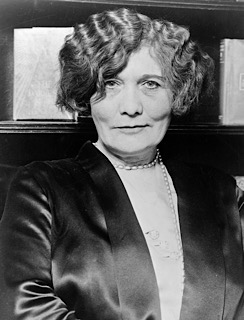
Chicago May, the nickname of Mary Anne Duignan, an Irish-born criminal who becomes notorious in the United States, United Kingdom and France, dies in Philadelphia, Pennsylvania, on May 30, 1929. She refers to herself as the “queen of crooks” and sometimes uses the name May Churchill.
Duignan is born in Edenmore, Ballinamuck, County Longford, on December 26, 1871. In 1890, at the age of 19, she steals the proceeds earned by her parents from a recent cattle fair and runs away to Liverpool, England where she buys new clothes and books a ticket to America. Upon arrival in New York City she supports herself by prostitution and picking pockets.
She moves to Chicago to take advantage of the large influx of visitors at the 1893 World’s Columbian Exposition. She teams up with another prostitute. One robs customers while the other is having sex with them. She returns to New York City, where she works as a dancer, but is soon arrested for stealing a wallet, earning her first jail sentence. She briefly marries friend Jim Sharpe but the couple soon separates. After this, she calls herself May Churchill Sharpe. She soon establishes herself with the local criminal underworld, becoming involved in various crimes, mostly of a petty nature, including fraud, assault, brawling, drunk and disorderly behaviour, beggary and pickpocketing.
Duignan has various criminal lovers, but she graduates from petty criminality to major crime when she meets Eddie Guerin, who organises a robbery of the American Express office in Paris. She is imprisoned for her role in the crime. She operates her schemes on four continents and in nine countries. She reaches the height of her career in England when she is taken up by aristocrat Sir Sidney Hamilton Gore, who supposedly proposes marriage to her, shortly before he shoots himself.
After Guerin escapes from a French prison island, he makes his way to London where he meets Duignan again, but the relationship turns sour. She takes up with a burglar named Charley Smith. In 1907, during an altercation with Guerin, Smith shoots him, wounding him in the foot. Smith and Duignan are both accused of attempted murder. She is convicted and sentenced to 15 years. She is released in 1917, and returns to the United States.
By the 1920s, Duignan is living in Detroit and has become destitute. No longer young, she is reduced to propositioning men on the streets and is repeatedly arrested for soliciting and common prostitution. She hopes to make money from her former notoriety by writing magazine articles and an autobiography with the help of a journalist, which is published in 1928 as Chicago May, Her Story, by the Queen of Crooks. Her former lover Guerin publishes his own life story at the same time, under the title I Was a Bandit. She dies at the age of 58 in Philadelphia on May 30, 1929.
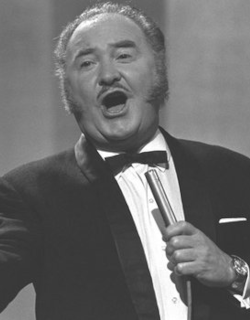
McLaughlin is one of ten children of Patrick McLaughlin, butcher and cattle dealer, and Annie McLaughlin (née Doherty). He starts singing in local churches in the Bogside at the age of seven, and as a teenager adds two years to his age to enlist in the Irish Guards, later serving abroad with the Palestine Police Force, before returning in the late 1930s to join the Royal Ulster Constabulary (RUC).
Known as The Singing Bobby, McLaughlin becomes a local celebrity before starting to work in the UK variety circuit, where he also plays summer seasons in English seaside resorts. The renowned Irish tenor John McCormack (1884–1945) advises him that his voice is better suited to a lighter repertoire than the operatic one he has in mind and urges him to find an agent. He finds the noted impresario Jack Hylton (1892–1965) who books him but is unable to fit his full name on the bill, thus Joseph McLaughlin becomes Josef Locke.
Locke makes an immediate impact when featured in “Starry Way,” a twenty-week summer show at the Opera House Theatre in Blackpool, Lancashire, England in 1946 and is rebooked for the following summer, then starring for three seasons at the Blackpool Hippodrome. He appears in ten Blackpool seasons from 1946 to 1969, not the nineteen seasons he later claims.
Locke makes his first radio broadcast in 1949 and subsequently appears on television programmes such as Rooftop Rendezvous, Top of the Town, All-star Bill and The Frankie Howerd Show. He is signed to the Columbia label in 1947, and his first releases are the two Italian songs “Santa Lucia” and “Come Back to Sorrento.”
In 1947, Locke releases “Hear My Song, Violetta,” which becomes forever associated with him. It is based on a 1936 tango “Hör’ mein Lied, Violetta” by Othmar Klose and Rudolf Lukesch. The song “Hör’ mein Lied, Violetta” is often covered, including by Peter Alexander and is itself based on Giuseppe Verdi‘s La traviata. His other songs are mostly a mixture of ballads associated with Ireland, excerpts from operettas, and familiar favourites.
In 1948, Locke appears in several films produced by Mancunian Films, usually as versions of himself. He plays himself in the film Holidays with Pay. He also appears as “Sergeant Locke” in the 1949 comedy What a Carry On!
In 1958, after Locke has appeared in five Royal Variety Performancetelecasts, and while he is still at the peak of his career, the British tax authorities begin to make substantial demands that he declines to meet. Eventually he flees the country for Ireland, where he lays low for several years. When his differences with the taxman are eventually settled, he relaunches his career in England with tours of the northern variety clubs and summer seasons at Blackpool’s Queen’s Theatre in 1968 and 1969, before retiring to County Kildare, emerging for the occasional concert in England. He later appears on British and Irish television, and in November 1984 is given a lengthy 90-minute tribute in honour of the award he is to receive at the Olympia Theatre commentating his career in show business on Gay Byrne‘s The Late Late Show. He also makes many appearances on the BBC Television‘s long running variety show The Good Old Days.
In 1991, the Peter Chelsom film Hear My Song is released. It is a fantasy based on the notion of Locke returning from his Irish exile in the 1960s to complete an old love affair and save a Liverpool-based Irish night-club from ruination. Locke is played by Ned Beatty, with the singing voice of Vernon Midgley. The film leads to a revival in Locke’s career. A compilation CD is released, and he appears on This Is Your Life in March 1992. He performs in front of the Prince and Princess of Wales at the 1992 Royal Variety Performance, singing “Goodbye,” the final song performed by his character in the film. He announces prior to the song that this will be his final public appearance.
Locke dies at the age of 82 at a nursing home in Clane, County Kildare on October 15, 1999, and is cremated at Glasnevin Cemetery. He is survived by his wife, Carmel, and a son.
On March 22, 2005, a bronze memorial to Locke is unveiled outside the City Hotel on Queen’s Quay in Derry by Phil Coulter and John Hume. The memorial is designed by Terry Quigley. It takes the form of a spiraling scroll divided by lines, representing a musical stave. The spiral suggests the flowing melody of a song and is punctuated by images illustrating episodes in his life, including Locke in police uniform, Blackpool Tower, Carnegie Hall, and the musical notes of the opening lines of “Hear My Song.”
A biography of the singer, entitled Josef Locke: The People’s Tenor, by Nuala McAllister Hart is published in March 2017, the centenary of his birth. The book corrects many myths that the charismatic Locke circulated about his career.
Bracken is the third child and second of three sons of Joseph Kevin (J. K.) Bracken and Hannah Bracken (née Ryan). The family moves to Kilmallock, County Limerick, in 1903, the year before his father’s death. By 1908, his mother takes the family to live in Glasnevin, a new suburb in north Dublin, and subsequently off the North Circular Road. He is educated in St. Patrick’s National School, Drumcondra, and at the Christian Brothers‘ O’Connell School in North Richmond Street. He is a mischievous, delinquent child, one time throwing a schoolfellow into the Royal Canal. In February 1915 he is sent to Mungret College, a Jesuit boarding school near Limerick. He is not amenable to the regime and runs away on several occasions, finding accommodation in local hotels under a false name.
At the end of 1915 Bracken goes to Australia with £14 in his pocket. He is first based in Echuca, Victoria, where he is put up in a convent. Later he moves to other houses run by religious orders. A voracious reader, he claims that he is doing research for a life of CardinalPatrick Francis Moran, and signs himself “Brendan Newman Bracken.” He seeks admission as a pupil to Riverview, the fashionable Jesuit school in Sydney, claiming that he had been educated at Clongowes Wood College. Unfortunately for him, a priest who had just come out from Clongowes exposes him. Opinionated and argumentative, he does not conceal his skepticism about the Catholic religion. For a time, he teaches in a Protestant school in Orange, New South Wales.
Bracken returns to Ireland in 1919. By this time his mother has remarried and is living with her new husband, Patrick Laffan, on a farm in Beauparc, County Meath. After a short stay there, he moves to Liverpool and finds employment as a teacher at the Liverpool Collegiate School, claiming that he had been to the University of Sydney. He teaches at the school for two terms in 1920, earning extra money as tutor to a young boy. With his savings he is able to gain admission to Sedbergh School, a public school in the town of Sedbergh in Cumbria, North West England, giving his name as Brendan Rendall Bracken, born 1904, and stating that his parents had perished in a bush fire in Australia, leaving him money to complete his education. He remains only one term but distinguishes himself by winning a prize for history. After Sedbergh, Bracken teaches at Rottingdean preparatory school and then at Bishops Stortford School. He cuts a flamboyant figure and drops the name of famous acquaintances with gay abandon. He stands over 6 feet and has a powerful presence and a domineering personality; his mop of red hair and pale freckled skin combine with black teeth to give him a bizarre appearance.
In 1922 Bracken moves to London. He takes charge of the Illustrated Review when its editor, Hilaire Belloc, resigns. Renamed English Life and covering political and social events, it affords Bracken an opportunity to meet prominent people, including J. L. Garvin, editor of The Observer. In autumn 1923 Garvin introduces him to Winston Churchill, who had lost his parliamentary seat in 1922 and decided to contact Leicester West in the 1923 United Kingdom general election. Bracken offers his services as campaign manager. The friendship between Churchill and Bracken is soon so close that Bracken is rumoured to be Churchill’s natural son. Churchill’s wife Clementine dislikes Bracken and discourages the friendship.
Meanwhile Bracken enjoys the life of a ubiquitous socialite and builds up his career in publishing. He becomes a director of Eyre & Spottiswoode in 1926, starting The Banker, a monthly magazine, for them, and acquiring the Financial News in 1928 and a half-share in The Economist. To these are added in due course the Investors Chronicle and The Practitioner. His success in business enables him to acquire a home in North Street in 1928, near the Houses of Parliament. He is driven about in a chauffeured Hispano-Suiza car.
In 1929, Bracken has himself adopted as conservative candidate for Paddington North, a marginal seat. After a hard-fought campaign characterised by minor violence provoked by Bracken’s intemperate language, he wins the seat by 528 votes. At one point a rumour is put about that Bracken is in reality a Polish Jew, which he has to disprove by exhibiting a copy of his birth certificate. His background is a subject of speculation among acquaintances, and in throwaway remarks he gives different fictitious versions of it, Ireland figuring in none of them. He does however remain in constant touch with his mother, to whom he seems to have been deeply devoted, until her death in 1928. However, he has as little contact as possible with his brother and sisters, although he does give assistance to some of them and their families at various times.
In parliament Bracken voices right-wing views on economic issues and is an enthusiastic imperialist. After Churchill resigns from the conservative front bench in 1930 because they would not oppose the Labour government’s proposal for Indian self-government, he is supported by Bracken. During the 1930s, when Churchill is in the wilderness, disagreeing with the party leadership on India and on what he sees as a policy of appeasement toward Hitler‘s Germany, Bracken is his sole political ally. Stanley Baldwin calls him Churchill’s “faithful chela.”
In September 1939, Churchill joins Neville Chamberlain‘s war cabinet as First Lord of the Admiralty. Bracken is appointed his parliamentary private secretary, continuing in that role when Churchill becomes Prime Minister. Despite the king’s opposition, Churchill insists in June 1940 that Bracken should be appointed a privy councillor. Bracken shuts up his house and moves to the Prime Minister’s residence for the duration of the war. As a confidant of the Prime Minister, he often acts as a go-between with other politicians and newspapermen. He is allowed to oversee patronage and takes a special interest in ecclesiastical appointments. In July 1941, he is persuaded by Lord Beaverbrook and Churchill to become Minister for Information. He wins over most of the proprietors by giving them more news, often on a confidential basis, and censorship is kept to a minimum. The BBC is also allowed a fair measure of freedom as long as it behaves responsibly; under the leadership of Cyril Radcliffe, the civil service head of the ministry, it operates more smoothly. Bracken was generally acclaimed for that success.
After the resignation of the Labour ministers from the government at the end of the war in Europe, Bracken joins the cabinet as First Lord of the Admiralty. He is prominent in the general election campaign that follows and is the only conservative minister apart from Churchill to give more than one radio broadcast. He is accused, probably unjustly, of provoking Churchill to take extreme positions, and blamed when the conservatives are heavily defeated at the polls. Bracken himself loses Paddington North to Lt. Gen. Sir Noel Mason-MacFarlane. However, he is soon back in parliament representing Bournemouth, and as front-bench spokesman is an uncompromising opponent of the nationalisation measures of the Labour government (1945–51). He is out of sympathy with the leftward drift of the conservative party associated with Rab Butler and Harold Macmillan.
In December 1951, when Churchill is again Prime Minister, Bracken declines an invitation to serve as Colonial Secretary, pleading that his recurring sinusitis makes it impossible. He resigns his seat in the House of Commons and is created a peer, Viscount Bracken of Christchurch in Hampshire, but never takes his seat in the House of Lords. Although he retires from politics, he remains close to political events through his friendship with Churchill. He is deeply involved in concealing the severe stroke that Churchill suffers in 1953, so that he can carry on as Prime Minister.
In the postwar period, Bracken has important business interests. The Financial News group acquires the Financial Times in 1945, and he is returned as chairman of the expanded company. He writes a weekly Financial Times column until 1954. He oversees the building near St. Paul’s of a new head office, named “Bracken House” after his death. He is also chairman of the Union Corporation mining house, with interests in South Africa, which he frequently visits. From 1950 he is chairman of the board of governors of Sedbergh School, where he goes frequently and often walks for miles across the fells. He organises and finances the restoration of the eighteenth-century school building as a library, with a commemoratory inscription, “Remember Winston Churchill.”
From 1955 Bracken is a trustee of the National Gallery. He is an unrelenting opponent of the proposal to return to Ireland the impressionist paintings bequeathed to it by Hugh Lane, because a codicil willing them to Dublin has not been witnessed. Throughout the postwar period he carries on a prolific correspondence with friends such as Lord Beaverbrook, the American ambassador Lewis Douglas, and the Australian entrepreneur W. S. Robinson. These are a valuable and entertaining source on the political history of the time.
In January 1958, Bracken, who has always been a heavy smoker, is diagnosed with throat cancer. He lingers on until August 8, 1958, when he dies at the flat of his friend Sir Patrick Hennessy in Park Lane. He resists efforts made to reconcile him to the church of Rome. By his own wish he is cremated, and his ashes are scattered on Romney Marsh, Kent. On his instructions his papers are burned by his chauffeur. His estate comes to £145,032.
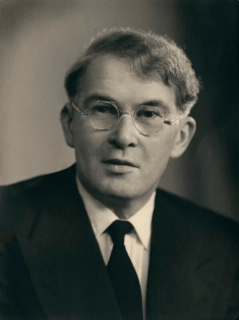
(From: “Bracken, Brendan” by Charles Lysaght, Dictionary of Irish Biography, www. dib.ie, October 2009 | Pictured: Brendan Bracken, bromide print by Elliott & Fry, January 13, 1950, National Portrait Gallery, London)
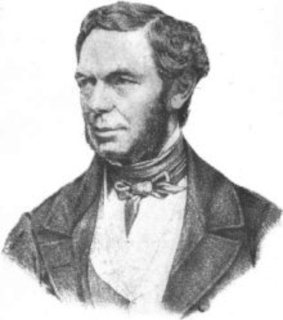
Willes is born on February 13, 1814, in Cork, County Cork, the eldest among six children of James Willes, physician, and his wife, Elizabeth Aldworth, daughter of John Shaw, mayor of Cork in 1792. Educated at Dr. Porter’s school in Cork and Trinity College Dublin (TCD), he graduates BA in 1836, having entered the King’s Inns the previous year. In 1837, he goes to London and joins the Inner Temple as a pupil of the noted barrister Thomas Chitty (1802–78), in whose chambers he remains as a salaried assistant and special pleader before being called to the English bar on June 12, 1840. The Willes and Chitty families are connected, and James’s younger sister, Mary, later marries Thomas Chitty’s son.
Willes joins the home circuit, though his practice is chiefly in London in mercantile and maritime law. A leading junior in the Court of Exchequer, he holds the post of tubman from 1851, an honorary position in the gift of the Lord Chief Baron. Known for his erudition, he is persuaded to edit, with Sir Henry Singer Keating, the third and fourth editions of John William Smith‘s Leading Cases (1849, 1856). In 1850, his reputation is such that he is appointed one of the commissioners to draft the common law procedure bill (1854) and is credited with having effected most of the reform therein. On July 3, 1855, he is appointed judge of the Court of Common Pleas, though he has not yet taken silk and is only 41, the youngest lawyer but one to have been appointed to the bench since 1778.
A classical scholar and linguist who knows oriental as well as European languages, who travels widely, loves poetry, and frequents literary men, and whose judgments are clear and philosophical, Willes is accounted among the best common law judges of his day, and is celebrated for the simplicity and lucidity of his style. Notable judgments include Esposito v. Bowden (1857), which lays down that the force of a declaration of war is equal to that of an act of parliament prohibiting commercial transactions with the enemy. In the law of torts, he gives an oft-cited judgment in the case of Indermaur v. Dames (1866), which has been accepted almost as statutory, on the liability of the occupier of a building for the safety of a visitor. In 1868, as one of the first judges appointed to try election petitions, he lays down the rules of practice generally followed afterward. A strong British patriot, he serves in the Inns of Court Volunteers from 1859 until shortly before his death.
On November 3, 1871, Willes is sworn of the privy council. However, his health has deteriorated through overwork and an emotional temperament, and he has long suffered heart disease and gout. In August 1872, after a heavy assize at Liverpool, he returns to his house, Otterspool, Watford, Hertfordshire, and succumbs to a nervous breakdown, which leads to his shooting himself on October 2, 1872. He is buried on October 7 at Brompton Cemetery in London. He is survived fifteen years by his wife, Helen, daughter of Thomas Jennings of Cork, whom he married on May 17, 1856. There have no children.
A tall, reserved man, with a prominent nose and sad eyes, Willes has great affection for children and animals and is singularly emotional. He is known to return to his room and shed tears before passing sentence on a criminal. He never loses his Irish accent. His marriage is allegedly unhappy, as he had been forced into it after he had fallen out of love. Sir Frederick Pollock (1845–1937), author of the magisterial History of English Law before the Time of Edward I and sometime marshal to Willes, dedicates to him his first textbook on torts in 1879, writing that he was “one of those whose knowledge is radiant and kindles answering fire.” A century later, A. W. B. Simpson maintains that “his reputation as a jurist will last as long as the law reports of England are read.”
(From: “Willes, Sir James Shaw” by Bridget Hourican, Dictionary of Irish Biography, http://www.dib.ie, October 2009)
Doheny receives a rudimentary education from an itinerant scholar while labouring on his father’s holding, and in 1826 attends Maher’s classical academy near Emly for nine months. Educating himself in the late 1820s and early 1830s while teaching the children of local farmers, he determines on a career in law to help secure political redress for the disenfranchised poor. He is admitted to Gray’s Inn in November 1834, enters the King’s Inns, Dublin, in 1835 and is called to the Irish bar in 1838. Settling later that year in Cashel, County Tipperary, he first practises in the local courts and then on the southern circuit. Appointed legal assessor to the borough of Cashel under the Municipal Corporations (Ireland) Act 1840, he successfully prosecutes former borough officers for misappropriation of funds and fraudulent transfer of property, winning wider attention. He had supported the campaign for repeal in the early 1830s, and in 1841 joins Daniel O’Connell‘s Repeal Association, becoming active in forming temperance bands and setting up town meetings. By May 1841 he is on the association’s general committee. O’Connell finds him less tractable than most and is ruffled by his queries into the association’s financial management.
During 1842 Doheny begins to associate with the more militant members of the repeal movement such as Thomas Davis. There is a marked gap in age and class between Doheny and most of this group and some look down on his lack of refinement. Others, however, admire his zeal and sincerity, and an anonymous colleague describes him as “rough, generous, bold, a son of the soil, slovenly in dress, red-haired and red-featured, but a true personification of the hopes, passions, and traditions of the people.” Assisting in the launch of The Nation in October 1842, he is chagrined to find most of his articles rejected as unfit for publication, although fifteen are published between January 1843 and September 1844. He also publishes a competent History of the American Revolution (1846) for The Nation‘s “Library of Ireland” series. More impressive as a speaker than a writer, he contributes regularly to repeal meetings at Conciliation Hall, Burgh Quay, Dublin. He enthuses at the apparent martial potential of the immense, ordered crowds attending the “monster” repeal meetings of 1843, and is one of the main organisers of the Cashel meeting of May 31, 1843, at which he is loudly cheered. However, his later claim to have deliberately set up these meetings, with Davis and John Blake Dillon, on quasi-military lines in order to prepare the peasantry for a future war with Britain, is far-fetched. His opposition to O’Connell’s decision to submit to proclamation of the proposed meeting of October 8, 1843, at Clontarf again greatly irritates O’Connell.
An active member of the Repeal Association parliamentary committee from February 1844, in February and March 1845 Doheny chairs a sub-committee of five senior barristers investigating the legality of withdrawal from the House of Commons by the body of repeal MPs, coming “reluctantly” to the verdict that such an action is open to criminal prosecution. O’Connell’s gruff dismissal of his report testifies to their awkward relationship. He further vexes O’Connell by his advocacy of non-denominational university education during debates over the Maynooth College Act 1845. Irrevocable divisions between the Young Irelanders and O’Connell open up between April and July 1846 when Doheny leads calls for endorsement of the conduct of William Smith O’Brien – imprisoned for a month for refusal to serve on a parliamentary committee – and voices Young Ireland’s martial convictions in a speech at Liverpool. After the secession of the Young Irelanders from the Repeal Association in July 1846, he opposes attempts at reconciliation and is one of the founders of the Irish Confederation on January 13, 1847.
During the summer of 1847, Doheny begins setting up “Confederate Clubs” in east Tipperary and aids James Fintan Lalor in organising a failed tenant league meeting at Holycross, County Tipperary, on September 19. He is one of the few Young Irelanders attracted to Lalor’s revolutionary agrarian philosophy, but supports Smith O’Brien against John Mitchel in January 1848, deploring irresponsible demands for insurrection. However, after Mitchel’s conviction for treason felony in May, he supports armed action. Arrested for seditious speechmaking at Cashel on July 12, he is bailed on July 20. During the confused period of “rebellion” in late July, he attempts to organise the peasantry in Tipperary but is frustrated by O’Brien’s vacillation.
After the collapse of the armed adventure at Ballingarry on July 31, Doheny takes refuge near Slievenamon and, with James Stephens, eludes pursuit for nearly two months, until he finally escapes, disguised as a clergyman, on a cattle-ship from Cork to Bristol. Some days later he reaches Paris, where he stays for two months with Stephens and John O’Mahony before leaving for New York City. Practising law in New York, he dedicates himself to the development of an Irish Americanrepublican movement. Tensions between conservative and radical Young Ireland exiles, perhaps aggravated by social snobbery, surface by late 1849, when he is arrested for attempting to push Thomas D’Arcy McGee into an open cellar on a New York street, angered by accusations of boasting, drunkenness, and incompetence. Similar criticisms are made by John Blake Dillon and appear to have some foundation.
Doheny finds time to write The Felon’s Track (1849), a polemical account of the repeal agitation and the 1848 insurrection that is highly critical of O’Connell. Despite a rambling narrative, it becomes a popular work and is reprinted several times. He also gives several lectures on historical and literary subjects to Irish American societies and contributes a memoir on Geoffrey Keating to O’Mahony’s translation (1857) of Foras Feasa ar Éirinn.
Involved with the New York Irish militia from his arrival, he is elected lieutenant colonel of the 69th Infantry Regiment in November 1851, and in September 1852 becomes colonel of a new regiment, the Irish Republican Rifles. These formations are often wracked by dissension over strategy and leadership, and in February 1856 he and O’Mahony found the Emmet Monument Association, planning to mobilise an Irish American force to invade Ireland. Efforts to acquire Russian backing fails on the close of the Crimean War in March 1857.
In autumn 1857, Doheny and O’Mahony make overtures to James Stephens to reorganise the republican movement in Ireland, and in March 1858 they accept Stephens’s demands for undisputed authority there, though by the winter of 1858–59 Doheny shows increasing distrust of Stephens’s ambitions. Adopting the organisational structure set out by Stephens in establishing the IRB in 1858, he and O’Mahony found the American equivalent, the Fenian Brotherhood, in early 1859, although he plays a subordinate part. In July 1859, he founds and edits a short-lived newspaper in New York, The Phoenix, to promote Fenian ideals. Active in opposing the national petition for self-government of 1860–61, he argues that Britain will only yield to force. He assists in making preparations for the funeral of Terence Bellew MacManus in Ireland and acts as one of the pallbearers in New York. Travelling to Ireland in October 1861, he appears to argue for using the excitement engendered by the funeral to spark an insurrection in Dublin but is thwarted by Stephens.
Doheny dies suddenly on April 1, 1862, in New York and is buried in Calvary Cemetery in the city’s borough of Queens.
(From: “Doheny, Michael” by James Quinn and Desmond McCabe, Dictionary of Irish Biography, http://www.dib.ie, October 2009)
The second of two bombing attacks in early 1993 in Warrington, Cheshire, England, takes place on March 20, 1993. The first attack takes place on February 26, when a bomb explodes at a gas storage facility. This explosion causes extensive damage, but no injuries. In the March 20 attack, two smaller bombs explode in litter bins outside shops and businesses on Bridge Street. Two children are killed and 56 people are injured.
The attacks are carried out by the Provisional Irish Republican Army (IRA). From the early 1970s, the IRA had been carrying out attacks in both Northern Ireland and England with the stated goal of putting pressure on the UK Government to withdraw from Northern Ireland. The IRA is designated a terrorist organisation in the United Kingdom.
Shortly before midday on Saturday, March 20, 1993, the Samaritans in Liverpool receive a bomb warning by telephone. According to police, the caller says only that a bomb has been planted outside a Boots shop. Merseyside Police send officers to branches of Boots in Liverpool and warn the Cheshire Constabulary, who patrols nearby Warrington. About 30 minutes later, at about 12:25 p.m., two bombs explode on Bridge Street in Warrington, about 100 yards apart. The blasts happen within a minute of each other. One explodes outside Boots and McDonald’s, and the other outside the Argos catalogue store. The area is crowded with shoppers. Witnesses say that shoppers flee from the first explosion into the path of the second. It is later found that the bombs had been placed inside cast iron litter bins, causing large amounts of shrapnel. Buses are organised to ferry people away from the scene and twenty paramedics and crews from seventeen ambulances are sent to deal with the aftermath.
Three-year-old Johnathan Ball dies at the scene. He had been in town with his babysitter, shopping for a Mother’s Day card. The second victim, 12-year-old Tim Parry, is gravely wounded. He dies on March 25, 1993, when his life support machine is switched off, after tests find only minimal brain activity. Another 54 people are injured, four of them seriously. One of the survivors, 32-year-old Bronwen Vickers, the mother of two young daughters, has to have a leg amputated, and dies just over a year later from cancer.
The Provisional IRA issues a statement the day after the bombing, acknowledging its involvement but saying:
“Responsibility for the tragic and deeply regrettable death and injuries caused in Warrington yesterday lies squarely at the door of those in the British authorities who deliberately failed to act on precise and adequate warnings.”
A day later, an IRA spokesman says that “two precise warnings” had been given “in adequate time,” one to the Samaritans and one to Merseyside Police. He adds, “You don’t provide warnings if it is your intention to kill.” Cheshire’s assistant chief constable denies there had been a second warning and says, “Yes, a warning was given half-an-hour before, but no mention was made of Warrington. If the IRA think they can pass on their responsibility for this terrible act by issuing such a nonsensical statement, they have sadly underestimated the understanding of the British public.”
The deaths of two young children ensures that the March 20 bombings receive major coverage in the media and cause widespread public anger. Shortly after the bombings, a group called “Peace ’93” is set up in Dublin. The main organiser is Susan McHugh, a Dublin housewife and mother. On March 25, 1993, thousands hold a peace rally in Dublin. They sign a condolence book outside the General Post Office and lay bouquets and wreaths, with messages of sorrow and apology, to be taken to Warrington for the boys’ funerals. Some criticise Peace ’93 for focusing only on IRA violence and for not responding to the deaths of children in Northern Ireland.
On September 19, 1994, Irish rock band The Cranberries release the song “Zombie,” which is written in protest of the bombings. The song goes on to become their biggest hit.
On November 14, 1996, the Duchess of Kent officially inaugurates a memorial called The River of Life, depicting “a symbol of hope for future generations,” in Bridge Street. It is developed in the aftermath of the bomb attack and commissioned by the Warrington Borough Council. The project, consisting of a symbolic water sculpture that features a commemorative plaque, is designed by the local primary school and Stephen Broadbent.
The parents of Tim Parry set up the Tim Parry Trust Fund to promote greater understanding between Great Britain and Ireland. The Tim Parry Johnathan Ball Foundation for Peace works jointly with the National Society for the Prevention of Cruelty to Children (NSPCC) to develop The Peace Centre, close to Warrington town centre, which opens on the seventh anniversary of the attack in 2000. Its purpose is to promote peace and understanding amongst all communities affected by conflict and violence. The centre hosts an annual peace lecture, as well as being home to the local NSPCC and is the home of Warrington Youth Club until 2022.
The bombings receive further attention in 2019 after the Brexit Party selects former Living Marxism writer Claire Fox as their lead candidate in the North West England constituency for the 2019 European Parliament election. The Revolutionary Communist Party, of which Fox is a leading member in 1993, defends the IRA’s bombing in their party newsletter. Despite the controversy, which sees another Brexit Party candidate resign from the party list in protest at the comments, Fox and the Brexit Party top the poll in several areas of the North West, including in Warrington.
The killing of Ball and Parry is still on Cheshire Police’s list of unsolved murders.
A piece on BBC North West‘s Inside Out programme in September 2013 speculates that the bombing may have been the work of a “rogue” IRA unit, which was supported by the IRA but operated independently and who used operatives who were from England to avoid suspicion. The programme also examines a possible link between the attack and British leftist political group Red Action, though nothing is ever proven.
(Pictured: Army bomb disposal at the Warrington Bomb scene in March 1993, photo credit: Walker Howard)
St. John is the eldest of six children born to Tommy and Lottie Mooney. He is educated at Scoil Muire Gan Smál and Synge Street CBS. He emigrates to Ontario, Canada in 1958 where he takes what labouring jobs he can find. Within six months he meets a woman named Gert Gorman who has an electrical contracting company in the United States. She and her husband sponsor him to move to Washington, D.C., where he is able to work as an electrician. He marries his sweetheart, Susie Bourke, who is from a well-known Dublin theatrical family with links to both the Gaiety and the Olympia theatres. They have two sons, Kieron and Brian. He travels widely and becomes involved in the peace movement and the civil rights movement. He remains in the United States until 1970, returning to settle in Collins Avenue in north Dublin.
The Dublin city that St. John returns to is a changed place from the one he had grown up in and proves to be the spur that inspires his songwriting. He chooses “St. John” as his nom de plume, inspired by a middle name he had been given while at school when all the boys in his class were assigned saints’ names. In 1975, he is running a theatre in Petticoat Lane on Marlborough Street, and while fixing an alarm outside a window on the first floor, the ledge on which he is leaning gives way, resulting in a bad fall. He breaks his elbow and hip and spends six months in the hospital recuperating. It is during this time that he takes to songwriting in earnest.
St. John is an extrovert who loves people. He is a voracious reader with a particular interest in Irish history. His son Kieron recalls his father writing “The Rare Aul Times” during this recovery period and singing it to his family. The Dublin City Ramblers is the first band to cover the song, but it is Danny Doyle’s version that achieves a real breakthrough, spending eleven weeks in the Irish Singles Chart, reaching No. 1 in 1978.
In 1978, St. John writes “The Fields of Athenry,” a tale of a man exiled to Botany Bay for stealing food to feed his family during the Famine. It has been recorded by several artists, charting in the Irish Singles Chart on a number of occasions. A recording by Paddy Reilly, which is released in 1982, remains in the Irish charts for 72 weeks.
St. John pays close attention to the melding of lyric and melody and has particular form in writing memorable melodies that sound timeless, resonating deeply with listeners across all walks of life. His songs sometime express regret for the loss of old certainties, for example, the loss of Nelson’s Pillar and the Metropole Ballroom, two symbols of old Dublin, as progress makes a “city of my town.”
St. John describes his chosen craft with affection. “Songs are magic carpets. They can tell a story over and over again without boring the pants off the listener and maybe take us out of ourselves for a few moments of peaceful escapism. With easy to remember melody lines, the words can tell of times and events in our daily lives that are worth noting or remembering.”
St. John’s songbook consists of hundreds of compositions, including “The Ferryman,” “Waltzing on Borrowed Time” and “The Furey Man” and are recorded by over 2,500 artists. He is a founding member of the Irish Music Rights Organisation (IMRO) and is always generous and supportive of younger writers, some of whom he continues to mentor well into his 80s.
St. John is surprised and delighted at the affiliation that emerges between “The Fields of Athenry” and rugby and football sporting events. He is present in Croke Park in 2007 when Ireland beats England in the Six Nations, and where the song is sung three times over. It is a song often heard in Anfield in Liverpool, and at Glasgow Celtic games, and reverberates around the stadium at Chicago’s Soldier Field when Ireland beats the All Blacks on November 5, 2016.
St. John wins several awards, including the Irish Music Rights Organisation “Irish Songwriter of the Year.”
St. John lives life to the fullest, and while he suffers ill health in his later years with both diabetes and Parkinson’s disease, he never loses his zest for life. His son Kieron describes his father with affection as a man who had nine lives and lived them all to the fullest. He lives independently at home until his admission to Beaumont Hospital in Dublin. He dies peacefully there at the age of 90 on March 12, 2022. After his funeral, Paddy Reilly and Glen Hansard perform “The Fields of Athenry” at Beaumont House in Dublin as a tribute.
In June 1919, de Valera arrives in the United States for what is to be an 18-month visit. He has recently escaped from Lincoln Gaol in England in sensational fashion, after a duplicate key is smuggled into the jail in a cake and he escapes dressed as a woman. A few months later he is a stowaway aboard the SS Lapland from Liverpool bound for America.
De Valera’s plan is to secure recognition for the emerging Irish nation, tap into the huge Irish American community for funds, and to pressurize the U.S. government to take a stance on Irish independence. Playing on his mind is the upcoming Versailles conference where the nascent League of Nations is preparing to guarantee “existing international borders” – a provision that will imply Ireland remaining within the United Kingdom.
De Valera also has a challenge in winning over PresidentWoodrow Wilson, who is less than sympathetic to Ireland’s cause.
De Valera’s interest in America is of course personal. He is born in New York City on October 14, 1882, and his U.S. citizenship is one of the reasons he is spared execution after the 1916 Easter Rising.
At first de Valera keeps a low profile in America. Though he is greeted by Harry Boland and others when he docks in New York City, he first goes to Philadelphia and stays with Joseph McGarrity, the County Tyrone-born leader of Clan na Gael and a well-known figure in Irish America. He also quietly pays a visit to his mother in Rochester, New York.
De Valera’s first major engagement is on June 23, 1919, when he is unveiled to the American public at a press conference in the Waldorf-Astoria hotel in New York City. Crowds throng the streets around the hotel, and de Valera proclaims, “I am in America as the official head of the Republic established by the will of the Irish people in accordance with the principle of self-determination.”
De Valera then embarks upon a tour across America. Vast crowds turn out to see the self-proclaimed “president of the Irish republic.” In Boston an estimated crowd of 70,000 people hear him talk in Fenway Park. In San Francisco he unveils a statute of Irish revolutionary hero Robert Emmet in Golden Gate Park.
Later in the year, de Valera holds a huge rally in Philadelphia, where he is welcomed by the mayor at Independence Hall. He also visits smaller towns and cities across the United States, and his trip garners huge press coverage – an invaluable boon for his campaign to heighten awareness of the Irish issue in America.
But difficulties soon emerged during de Valera’s visit. He becomes embroiled in a bitter split among Irish Americans. He finds himself at odds with Judge Daniel Cohalan and John Devoy, central figures in the Friends of Irish Freedom (FOIF) association. Part of the dispute centers around money. De Valera had settled on an idea for a bond sale as a way of raising money for the cause – investors would be given bond certificates that would be exchangeable for bonds of the Irish Republic once it gets international recognition. But Cohalan and Devoy, who have already raised thousands through the Friends of Irish Freedom, are opposed, concerned about the scheme’s legality for one.
De Valera’s claim in an interview that Irish-British relations can be analogous to the relationship between Cuba and America also enrages the Cohalan-Devoy camp, who accuse him of surrendering the idea of full Irish sovereignty.
De Valera’s increasingly acrimonious relationship with Cohalan and Devoy spills over into the 1920 Republican and Democratic conventions. Against the advice of Cohalan and Devoy, he advances a resolution about Irish independence which is rejected 12-1 at the Republican convention in June of that year. A rival resolution by Cohalan squeezes through but ultimately is overturned. Similarly, he fails to secure the inclusion of the Irish issue in the Democratic Party’s policy platform during the Democrats’ convention in San Francisco.
De Valera leaves the United States in December 1920 with mixed results. Though he has raised millions of dollars through the bond sale, he has made little progress in co-opting official America to Ireland’s cause. Much as division is to characterise the next chapter of his political career in Ireland, de Valera’s sojourn in America leaves Irish America more divided than it has ever been.
(From: “Éamon de Valera’s US trip that left Irish America divided” by Suzanne Lynch, The Irish Times, http://www.irishtimes.com, June 1, 2019 | Pictured: Éamon de Valera (center) in New York with Friends of Irish Freedom’s Judge Daniel Cohalan and John Devoy in July 1919, Topical Press Agency/Getty)
The 32CSM has been described as the “political wing” of the now defunct Real Irish Republican Army (RIRA), but this is denied by both organisations. The group originates in a split from Sinn Féin over the Mitchell Principles.
Those present at the initial meeting are opposed to the direction taken by Sinn Féin and other mainstream republican groups in the Northern Ireland peace process, which leads to the Belfast Agreement (also known as the Good Friday Agreement) the following year. The same division in the republican movement leads to the paramilitary group now known as the Real IRA breaking away from the Provisional Irish Republican Army at around the same time.
Most of the 32CSM’s founders had been members of Sinn Féin. Some had been expelled from the party for challenging the leadership’s direction, while others felt they had not been properly able to air their concerns within Sinn Féin at the direction its leadership had taken. Bernadette Sands McKevitt, wife of Michael McKevitt and a sister of hunger strikerBobby Sands, is a prominent member of the group until a split in the organisation.
The name refers to the 32 counties of Ireland which are created during the Lordship and Kingdom of Ireland. With the partition of Ireland in 1920–22, twenty-six of these counties form the Irish Free State which is abolished in 1937 and is now known as Ireland since 1949. The remaining six counties of Northern Ireland remain part of the United Kingdom. Founder Bernadette Sands McKevitt says in a 1998 interview with the Irish Mirror that people did not fight for “peace” – “they fought for independence” – and that the organisation reaffirms to the republican position in the 1919 Irish Declaration of Independence.
Before the referendums on the 1998 Good Friday Agreement, the 32CSM lodges a legal submission with the United Nations challenging British sovereignty in Ireland. The referendums are opposed by the 32CSM but are supported by 71% of voters in Northern Ireland and by 94% in the Republic of Ireland. It is reported in February 2000 that the group established a “branch” in Kilburn, London.
In November 2005, the 32CSM launches a political initiative titled Irish Democracy, A Framework for Unity.
On May 24, 2014, Gary Donnelly, a member of the 32CSM, is elected to the Derry City and Strabane District Council. In July 2014, a delegation from the 32CSM travels to Canada to take part in a six-day speaking tour. On arrival the delegation is detained and refused entry into Canada.
In 2015, the 32CSM organises a demonstration in Dundee, Scotland, in solidarity with the men convicted of shooting Constable Stephen Carroll, the first police officer to be killed in Northern Ireland since the formation of the PSNI. The organisation says the “Craigavon Two” are innocent and have been victims of a miscarriage of justice.
The group is currently considered a Foreign Terrorist Organization (FTO) in the United States, because the group is considered to be inseparable from the Real IRA, which is designated as an FTO. At a briefing in 2001, a spokesman for the U.S. Department of State states that “evidence provided by both the British and Irish governments and open-source materials demonstrate clearly that the individuals who created the Real IRA also established these two entities to serve as the public face of the Real IRA. These alias organizations engage in propaganda and fundraising on behalf of and in collaboration with the Real IRA.” The U.S. Department of State’s designation makes it illegal for Americans to provide material support to the Real IRA, requires U.S. financial institutions to block the group’s assets and denies alleged Real IRA members visas into the U.S.
The 32CSM also operates outside of the island of Ireland to some extent. The Gaughan/Stagg Cumann covers England, Scotland and Wales, and has an active relationship of mutual promotion with a minority of British left-wing groups and anti-fascist organisations. The James Larkin Republican Flute Band in Liverpool, and the West of Scotland Band Alliance, the largest section of which is the Glasgow-based Parkhead Republican Flute Band, are also supporters of the 32CSM. As of 2014, the 32CSM’s alleged paramilitary wing, the Real IRA, is reported to have been still involved in attempts to perpetrate bombings in Britain as part of the Dissident Irish Republican campaign, which has been ongoing since 1998.
Craig is born at Sydenham, Belfast, on January 8, 1871, the seventh of nine children of James Craig (1828–1900), a wealthy whiskey distiller who had entered the firm of Dunville & Co. as a clerk and by age 40 is a millionaire and a partner in the firm. Craig Snr. owns a large house called Craigavon, overlooking Belfast Lough. His mother, Eleanor Gilmore Browne, is the daughter of Robert Browne, a prosperous man who owned property in Belfast and a farm outside Lisburn. Craig is educated at Merchiston Castle School in Edinburgh, Scotland. After school he begins work as a stockbroker, eventually opening his own firm in Belfast.
Craig enlists in the 3rd (Militia) battalion of the Royal Irish Rifles on January 17, 1900, to serve in the Second Boer War. He is seconded to the Imperial Yeomanry, a cavalry force created for service during the war, as a lieutenant in the 13th battalion on February 24, 1900, and leaves Liverpool for South Africa on the SS Cymric in March 1900. After arrival he is soon sent to the front and is taken prisoner in May 1900, but released by the Boers because of a perforated colon. On his recovery he becomes deputy assistant director of the Imperial Military Railways, showing the qualities of organisation that are to mark his involvement in both British and Ulster politics. In June 1901 he is sent home suffering from dysentery, and by the time he is fit for service again the war is over. He is promoted to captain in the 3rd Royal Irish Rifles on September 20, 1902, while still seconded to South Africa.
On June 7, 1921, Craig is appointed the first Prime Minister of Northern Ireland by the Lord Lieutenant of Ireland. The House of Commons of Northern Ireland assembles for the first time later that day.
Craig had made his career in British as well as Northern Irish politics, but his premiership shows little sign of his earlier close acquaintance with the British political world. He becomes intensely parochial and suffers from his loss of intimacy with British politicians in 1938, when the British government concludes agreements with Dublin to end the Anglo-Irish trade war between the two countries. He never tries to persuade Westminster to protect Northern Ireland‘s industries, especially the linen industry, which is central to its economy. He is anxious not to provoke Westminster, given the precarious state of Northern Ireland’s position. In April 1939, and again in May 1940 during World War II, he calls for conscription to be introduced in Northern Ireland (which the British government, fearing a backlash from nationalists, refuses). He also calls for Winston Churchill to invade Ireland using Scottish and Welsh troops in order to seize the valuable ports and install a Governor-General at Dublin.
While still prime minister, Craig dies peacefully at his home at Glencraig, County Down at the age of 69 on November 24, 1940. He is buried on the Stormont Estate on December 5, 1940, and is succeeded as the Prime Minister of Northern Ireland by the Minister of Finance, J. M. Andrews.
(Pictured: James Craig, 1st Viscount Craigavon, bromide print by Olive Edis, National Portrait Gallery, London)