A Church of Ireland landowner, his family had originally migrated to Ireland from Congleton in Cheshire. Although not from an Irish Roman Catholic background, Parnell, the only son of Sir John Parnell, 1st Baronet, is renowned in Irish history for his efforts to bring about a more emancipated country. He is the great-grandfather of Charles Stewart Parnell, known as the uncrowned king of Ireland and best known for opposing the Acts of Union 1800 between the two kingdoms of Great Britain and Ireland.
From a line of politically astute ancestors who had moved to Ireland in the 17th century, Parnell rises to the highest positions in Irish politics as Commissioner of the Revenue (1780), Chancellor of the Exchequer of Ireland (1787), and Lord of the Treasury (1793).
Henry Grattan describes Parnell as “an honest, straightforward, independent man, possessed of considerable ability and much public spirit; as Chancellor of the Exchequer, he was not deficient, and he served his country by his plan to reduce the interest of money. He was amiable in private, mild in disposition, but firm in mind and purpose. His conduct at the Union did him honour, and proved how warmly he was attached to the interests of his country, and on this account, he was dismissed.”
(Pictured: Oil painting on canvas, The Right Hon. Sir John Parnell, 2nd Bt (1744–1801) by Pompeo Girolamo Batoni (Lucca 1708 – Rome 1787))
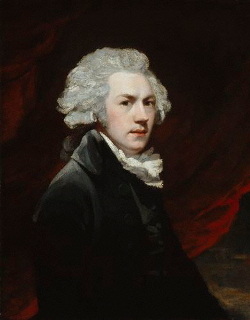
Shee is born into an old Irish Catholic family, the son of Martin Shee, a merchant, who regards the profession of a painter as an unsuitable occupation for a descendant of the Shees. He nevertheless studies art in the Royal Dublin Society and comes to London. There, in 1788, he is introduced by Edmund Burke to Joshua Reynolds, on whose advice he studies in the schools of the Royal Academy of Arts.
In 1789 Shee exhibits his first two pictures, the “Head of an Old Man” and “Portrait of a Gentleman.” Over the next ten years he steadily increases in practice. In 1798 he is chosen an associate of the Royal Academy and in 1800 he is elected a Royal Academician. He moves to George Romney‘s former house at 32 Cavendish Square and sets up as his successor.
Shee continues to paint with great readiness of hand and fertility of invention, although his portraits are eclipsed by more than one of his contemporaries, and especially by Thomas Lawrence. His earlier portraits are carefully finished, easy in action, with good drawing and excellent discrimination of character. They show an undue tendency to redness in the flesh painting, a defect which is still more apparent in his later works, in which the handling is less square, crisp and forcible. In addition to his portraits, he executes various subjects and historical works, such as Lavinia, Belisarius, his diploma picture “Prospero and Miranda,” and the “Daughter of Jephthah.”
In 1805 Shee publishes a poem consisting of Rhymes on Art, and a second part follows in 1809. Lord Byron speaks well of it in his English Bards and Scotch Reviewers. He publishes another small volume of verse in 1814, entitled The Commemoration of Sir Joshua Reynolds, and other Poems, but this is less successful. He also produces a tragedy, Alasco, set in Poland. The play is accepted at Covent Garden, but is refused a licence, on the grounds that it contains treasonable allusions, and Shee angrily resolves to make his appeal to the public. He carries out his threat in 1824, but Alasco is still on the list of unacted dramas in 1911. He also publishes two novels – Oldcourt (1829, in three volumes) and Cecil Hyde (1834).
On the death of Sir Thomas Lawrence in 1830, Shee is chosen president of the Royal Academy in his stead and shortly afterwards receives a knighthood. In 1831 he is elected a Fellow of the Royal Society. In an examination before the parliamentary committee of 1836 concerning the functions of the Royal Academy, he ably defends its rights. He continues to paint until 1845, when illness makes him retire to Brighton. He is deputised for at the Academy by J. M. W. Turner, who had appointed him a trustee of the projected Turner almshouse.
Martin Archer Shee dies in Brighton, Sussex, England on August 13, 1850, and is buried in the western extension to St. Nicholas’ Churchyard in Brighton. His headstone remains but has been laid flat and moved to the perimeter of the site.
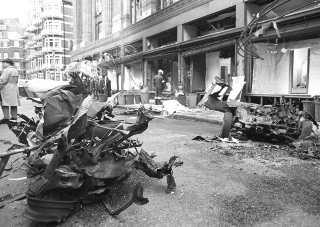
A Provisional Irish Republican Army (PIRA) car bomb kills six and injures ninety outside London‘s Harrods department store, a large, upmarket department store in the affluent Knightsbridge district near Buckingham Palace on December 17, 1983. The IRA Army Council claims that it has not authorised the attack and expresses regret for the civilian casualties. After the bombing, the IRA changes its tactic to focus on military targets on the mainland.
Harrods had been the target of an earlier IRA bomb on December 21, 1974, which was placed in the northeast corner of the first floor. There was a very short warning, and the store was in the process of being cleared when it exploded. It was also the target of a much smaller IRA bomb almost ten years later, in January 1993, which injured four people.
From 1973 the Provisional IRA has carried out waves of bombing attacks on commercial targets in London and elsewhere in England as part of its “economic war.” The goal is to damage the economy and cause disruption, which would put pressure on the British government to withdraw from Northern Ireland. On December 10, 1983, the IRA carries out its first attack in London in some time when a bomb explodes at the Royal Artillery Barracks, injuring three British soldiers.
One week later, on the afternoon of December 17, IRA members park a car bomb near the side entrance of Harrods, on Hans Crescent. The bomb contains 25 to 30 lbs. of explosives and is set to be detonated by a timer. It is left in a 1972 blue Austin 1300 GT four-door sedan. At 12:44 PM a man using an IRA codeword phones the central London branch of the Samaritans charity. The caller says there is a car bomb outside Harrods and another bomb inside Harrods and gives the car’s registration plate. According to police, he does not give any other description of the car.
The bomb explodes at about 1:21 PM, as four police officers in a car, an officer on foot and a police dog-handler near the suspect vehicle. Three officers and three bystanders are killed, and 90 others are injured, including 14 police officers. The blast damages 24 cars and all five floors on the side of Harrods, sending a shower of glass down onto the street. The police car absorbs much of the blast and this likely prevents further casualties.
Five people die at the scene of the bombing and a sixth later dies in the hospital. The bystanders who die are Philip Geddes (24), a journalist who had heard about the alert and went to the scene, Jasmine Cochrane-Patrick (25) and Kenneth Salvesen (28), a United States citizen. The Metropolitan Police Service officers killed are Sergeant Noel Lane (28) and Constable Jane Arbuthnot (22). A third officer, Inspector Stephen Dodd (34), dies in the hospital from his injuries on December 24. Constable Jon Gordon survives but loses both legs and part of a hand in the blast.
At the time of the explosion, a second warning call is made by the IRA. The caller says that a bomb has been left in the C&A department store at the east end of Oxford Street. Police clear the area and cordon it off, but this claim is found to be false. In the aftermath of the attack, hundreds of extra police and mobile bomb squads are drafted into London. Aleck Craddock, chairman of Harrods, reports that £1 million in turnover has been lost as a result of the bombing. Despite the damage, Harrods re-opens three days later, proclaiming it will not be “defeated by acts of terrorism.” Denis Thatcher, the husband of British Prime MinisterMargaret Thatcher, visits the store and tells reporters “no damned Irishman is going to stop me going there.”
The Anglo-Irish Treaty, commonly known as “The Treaty” and officially the “Articles of Agreement for a Treaty Between Great Britain and Ireland,” is an agreement between the government of the United Kingdom of Great Britain and Ireland and representatives of the Irish Republic that concludes the Irish War of Independence. It provides for the establishment of the Irish Free State within a year as a self-governing dominion within the “community of nations known as the British Empire,” a status “the same as that of the Dominion of Canada.” It also provides Northern Ireland, which had been created by the Government of Ireland Act 1920, an option to opt out of the Irish Free State, which it exercises.
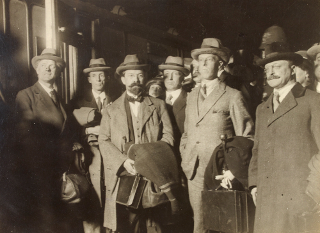
The agreement is signed in London on December 6, 1921, by representatives of the Government of the United Kingdom, which includes Prime MinisterDavid Lloyd George, who is head of the British delegates, and by representatives of the Irish Republic including Michael Collins and Arthur Griffith. The Irish representatives have plenipotentiary status (negotiators empowered to sign a treaty without reference back to their superiors) acting on behalf of the Irish Republic, though the British government declines to recognise that status. As required by its terms, the agreement is ratified by “a meeting” of the members elected to sit in the House of Commons of Southern Ireland and separately by the British Parliament.
Éamon de Valera calls a cabinet meeting to discuss the treaty on December 8, where he comes out against the treaty as signed. The cabinet decides by four votes to three to recommend the treaty to Dáil Éireann on December 14. Though the treaty is narrowly ratified, the split leads to the Irish Civil War, which is won by the pro-treaty side.
O’Brien is the youngest child of “a strict, religious family.” From 1941 to 1946 she is educated by the Sisters of Mercy, a circumstance that contributes to a “suffocating” childhood. “I rebelled against the coercive and stifling religion into which I was born and bred. It was very frightening and all pervasive. I’m glad it has gone.” She is fond of a nun as she deeply misses her mum and tries to identify the nun with her mother.
In 1950, O’Brien is awarded a licence as a pharmacist. In Ireland, she reads such writers as Leo Tolstoy, William Makepeace Thackeray, and F. Scott Fitzgerald. In 1954, she marries, against her parents’ wishes, the Irish writer Ernest Gébler and the couple moves to London. They have two sons, but the marriage is dissolved in 1964. Gébler dies in 1998.
In London, O’Brien purchases Introducing James Joyce, with an introduction written by T. S. Eliot. When she learns that James Joyce‘s A Portrait of the Artist as a Young Man is autobiographical, it makes her realise where she might turn, should she decide to write herself. In London she starts work as a reader for Hutchinson, where on the basis of her reports she is commissioned, for £50, to write a novel. Her first novel, The Country Girls (1960), is often credited with breaking silence on sexual matters and social issues during a repressive period in Ireland following World War II.
This novel is the first part of a trilogy of novels which includes The Lonely Girl (1962) and Girls in Their Married Bliss (1964). Shortly after their publication, these books are banned and, in some cases burned, in her native country due to their frank portrayals of the sex lives of their characters. Her novel A Pagan Place (1970) is about her repressive childhood. Her parents are vehemently against all things related to literature and her mother strongly disapproves of her daughter’s career as a writer.
O’Brien is a panel member for the first edition of the BBC‘s Question Time in 1979. In 2017, she becomes the sole surviving member.
Other works include a biography of James Joyce, published in 1999, and one of the poet Lord Byron, Byron in Love (2009). House of Splendid Isolation (1994), her novel about a terrorist who goes on the run, marks a new phase in her writing career. Down by the River (1996) concerns an under-age rape victim who seeks an abortion in England, the “Miss X case.” In the Forest (2002) deals with the real-life case of Brendan O’Donnell, who abducts and murders a woman, her three-year-old son, and a priest, in rural Ireland.
Christie Hennessy, Irish folk singer-songwriter, dies in London on December 11, 2007. Although Hennessy is unable to read or write due to severe dyslexia, he still writes his own songs such as “Roll back the Clouds” and “All the lies that you told me.”
Hennessy is born in Tralee, County Kerry on November 19, 1945. His first guitar is made, especially for him, from a tea chest when he is six years old by his friend Jerry Quirke. He leaves school at the age of eleven.
Hennessy’s first job is as a messenger boy, and it is then that he discovers that it is important to be able to read. He is unable to read or write due to severe dyslexia, but still enjoys his library of books. He later works on building sites in London.
In 1972 Hennessy releases his first record, The Green Album, on Westwood, a small label. With scant publicity or promotion, the album makes little impact and only 500 copies of the record are pressed. He returns to labouring on building sites in the UK and does not release another album for twenty years. When he does, his 1992 release The Rehearsal outsells U2 in Ireland, eventually attaining triple platinum status. His following albums, A Year in the Life and Box also sell extremely well in Ireland.
A renowned songwriter as well as performer, Hennessy writes several songs that become hits for other singers including Don’t Forget your Shovel, made famous by Christy Moore, and All the Lies that You Told Me, recorded by Frances Black. He also composes the theme tune and incidental music for the BBC TV series Get Well Soon written by Ray Galton (of Steptoe & Son fame) and composes and writes a musical/feature film about his native Ireland, Two Stops to Paradise.
In 2005, Christy Moore’s rendition of Hennessy’s Don’t Forget Your Shovel is referenced in a UK Number One single JCB by Nizlopi. It is further referenced in the video for the same song. As the line is sung, the characters in the JCB pass a shop called “Christie’s Shovels.”
Hennessy returns to the studio in 2007, one final time to record an album with both Luka Bloom and Christy Moore sharing vocals on one of the tracks.
Christie Hennessy dies on December 11, 2007 in a London hospice, at the age of 62. He is reported to have died from pleuralmesothelioma, a rare form of lung cancer, which has been attributed to his younger years spent working on building sites in London where he was exposed to asbestos dust. Just before he dies he had been touring in Ireland but had to cancel due to the illness. His ashes are buried in Old Rath Cemetery, Tralee. A commemorative statue of Christie is erected in Central Plaza, just off the town square in Tralee in November 2009.
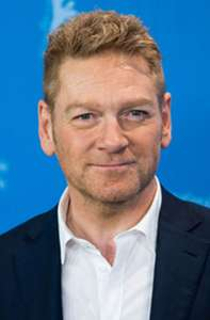
Branagh is the middle of three children of working-class Protestant parents Frances (née Harper) and William Branagh, a plumber and joiner who runs a company that specialises in fitting partitions and suspended ceilings. He lives in the Tiger’s Bay area of the city and is educated at Grove Primary School.
In the 1977 general election he is elected to the 21st Dáil for the new constituency of Dublin Ballyfermot. With the party’s loss of power in 1977, the new leader, Garret FitzGerald appoints Mitchell to the Party’s Front Bench as spokesman on Labour. At the 1981 general election Mitchell is elected for the Dublin West and Fine Gael dramatically increases its number of seats, forming a coalition government with the Labour Party. On his appointment as Taoiseach, Garret FitzGerald causes some surprise by excluding some of the older conservative ex-ministers from his cabinet. Instead, young liberals like Mitchell are appointed, with Mitchell receiving the high-profile post of Minister for Justice, taking responsibility for policing, criminal and civil law reform, penal justice, etc. The Fine Gael-Labour government collapses in January 1982 but regains power in December of that year. Mitchell again is included in a FitzGerald cabinet, as Minister for Transport.
As Minister for Transport, Mitchell grants the aviation license to a fledgling airline called Ryanair on November 29, 1985. This is granted despite strong opposition by Ireland’s national carrier Aer Lingus. The issue of the license breaks Aer Lingus’ stranglehold on flights to London from the Republic of Ireland.
Mitchell, who is seen as being on the social liberal wing of Fine Gael, is out of favour with John Bruton when he becomes Fine Gael leader in 1990. When Bruton forms the Rainbow Coalition in December 1994, Mitchell is not appointed to any cabinet post.
Mitchell contests and wins Dáil elections in 1977, 1981, (February and November) 1982, 1987, 1989, 1992, 1997. He runs for his party as its candidate to become a member of the European Parliament in the 1994 and 1998 elections. He also is director of elections for Austin Currie, the Fine Gael candidate, in the 1990 presidential election.
In 2001, Bruton is deposed as Fine Gael leader and replaced by Michael Noonan. Mitchell serves as his deputy from 2001 to 2002. He also chairs the key OireachtasPublic Accounts Committee. The Committee’s work under his chairmanship is widely praised for its inquiry into allegations of corruption and wide-scale tax evasion in the banking sector.
Though regarded in politics as one of Fine Gael’s “survivors,” who holds onto his seat amid major boundary changes, constituency changes and by attracting working class votes in a party whose appeal is primarily middle class, Mitchell loses his Dublin Central seat in the 2002 general election. That election witnesses a large-scale collapse in the Fine Gael vote, with the party dropping from 54 to 31 seats in Dáil Éireann. Although Mitchell suffers from the swing against Fine Gael in Dublin, he is not aided by the fact that Inchicore, which is considered his base in the constituency has been moved to Dublin South-Central. He chooses not to run in that constituency as his brother, Gay, is a sitting Teachta Dála (TD) running for re-election for that constituency.
Mitchell earlier has a liver transplant in an attempt to beat a rare form of cancer which had cost the lives of a number of his siblings. Though the operation is successful, the cancer returns. Although he appears to be making a recovery, Jim Mitchell ultimately dies of the disease on December 2, 2002.
His former constituency colleague and rival, Taoiseach Bertie Ahern, describes Jim Mitchell as having made an “outstanding contribution to Irish politics.”
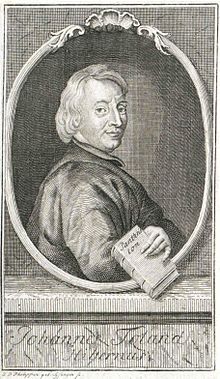
Very little is known of Toland’s early life. His parents are unknown. He later writes that he had been baptised Janus Junius, a play on his name that recalls both the Roman two-faced god Janus and Lucius Junius Brutus, reputed founder of the Roman Republic. According to his biographer, Pierre des Maizeaux, he adopts the name John as a schoolboy with the encouragement of his schoolteacher.
In Toland’s first and best-known book, Christianity not Mysterious (1696), he argues that the divine revelation of the Bible contains no true mysteries. Rather, all the dogmas of the faith can be understood and demonstrated by properly trained reason from natural principles. For this argument he is prosecuted by a grand jury in London. As he is a subject of the Kingdom of Ireland, members of the Parliament of Ireland propose that he should be burned at the stake. In his absence three copies of the book are burned by the public hangman in Dublin as the content is contrary to the core doctrines of the Church of Ireland. Toland bitterly compares the Protestant legislators to “Popish Inquisitors who performed that Execution on the Book, when they could not seize the Author, whom they had destined to the Flames.”
After his departure from Oxford, Toland resides in London for most of the rest of his life but is also a somewhat frequent visitor to Continental Europe, particularly Germany and the Netherlands. He lives on the Continent from 1707 to 1710.
John Toland dies in Putney on March 10, 1722. Just before he dies, he composes his own epitaph: “He was an assertor of liberty, a lover of all sorts of learning … but no man’s follower or dependent. Nor could frowns or fortune bend him to decline from the ways he had chosen.” The 1911 Encyclopædia Britannica says of him that at his death in London at age 51 “he died… as he had lived, in great poverty, in the midst of his books, with his pen in his hand.”
Very shortly after his death a lengthy biography of Toland is written by Pierre des Maizeaux.
Sterne is born to a British military officer stationed in County Tipperary. Following his father’s postings, the family moves briefly to Yorkshire before returning to Ireland, where they live largely in poverty and move frequently throughout the rest of Sterne’s youth. When the elder Sterne is dispatched to Jamaica, where he would die in 1731, he places his son with a wealthy uncle who supports the boy’s education.
Sterne attends Jesus College, Cambridge, following in the footsteps of his grandfather, Richard Sterne, who had been Master of the College. After being ordained as an Anglican priest, he takes up the vicarship of Sutton-on-the-Forest, where he marries Elizabeth Lumley. The couple lives there for the next 20 years.
Through his paternal family line, Sterne is connected to several powerful clergymen. His uncle, Archdeacon Jacques Sterne, encourages him to contribute to Whig political journals, and consequently he writes several articles supporting Sir Robert Walpole. However, when his political fervency fails to match his uncle’s, prompting him to abandon the role of political controversialist, Jacques Sterne cuts ties with his nephew and refuses to support his career. Nevertheless, Sterne continues writing.
Sterne’s first long work, a sharp satire of the spiritual courts entitled A Political Romance, makes him as many enemies as allies. Though the work is not widely distributed and indeed is burned at the request of those targeted by its Swiftian-style criticism, it represents Sterne’s first foray into the kind of humorous satire for which he would become famous. At age 46, he steps back from managing his parishes and turns his full attention to writing.
Sterne begins what becomes his best-known work, The Life and Opinions of Tristram Shandy, Gentleman, at a moment of personal crisis. He and his wife are both ill with tuberculosis and, in the same year that the first volumes of his long comic novel appear, his mother and uncle Jacques die. The blend of sentiment, humour and philosophical exploration that characterises his works matures during this difficult period. Tristram Shandy is an enormous success, and Sterne becomes, for the first time in his life, a famous literary figure in London. Still suffering from tuberculosis, he leaves England for Continental Europe, where his travels influence his second major work, A Sentimental Journey Through France and Italy (1768).
Sterne’s narrator in A Sentimental Journey is Parson Yorick, a sensitive but also comic figure who first appears in Tristram Shandy and who becomes Sterne’s fictive alter ego. In A Sentimental Journey, Parson Yorick wears a “little picture of Eliza around his neck,” and in the last year of his life Sterne writes the autobiographical Journal to Eliza under the pseudonym Yorick. Eliza is Eliza Draper, the wife of an East India Company official, and the literary and emotional muse of Sterne’s final years. After Draper returns to India, the two continue to exchange letters, some of which Draper allows to be published after Sterne’s death in the volume Letters from Yorick to Eliza.
In early 1768, less than a month after A Sentimental Journey is published, Sterne’s strength fails him and he dies in his lodgings at 41 Old Bond Street in London on March 18, 1768, at the age of 54. He is buried in the churchyard of St. George’s Hanover Square Church.
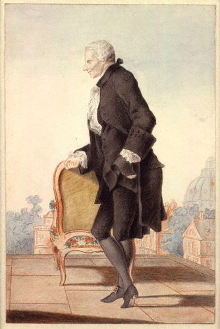
(Pictured: Laurence Sterne painted in watercolour by French artist Louis Carrogis Carmontelle, ca. 1762)


 The
The 


 seamus dubhghaill