seamus dubhghaill

Promoting Irish Culture and History from Little Rock, Arkansas, USA


Leave a comment

Birth of Composer Geoffrey Molyneux Palmer

Geoffrey Molyneux Palmer (Irish: Seathrún de Pámar), Irish composer, is born to Protestant Irish parents in Staines, Middlesex, England, on October 8, 1882. His compositions consist mainly of operas and vocal music, among them the first musical settings of poems by James Joyce.

Palmer grows up in South Woodford, an area of East London, where his father, Abram Smythe Palmer, is vicar at Holy Trinity Church. He studies at the University of Oxford where, in 1901, he is the youngest Bachelor of Music (BMus) in college history. Between 1904 and 1907 he studies composition with Charles Villiers Stanford at the Royal College of Music, London. He moves to Ireland in 1910 where he is initially active as a church organist in Dublin suburbs. From his early twenties he suffers from multiple sclerosis, which makes a professional independence increasingly difficult.

Palmer’s music includes at least three operas, a number of choral pieces and many songs. His strong interest in opera comes during a politically difficult period in Irish history. Ireland is struggling for independence, and cultural politicians often regard opera (and classical music in general) as alien to Irish culture. Initially, however, he is successful, his earliest stage work being Finn Varra Maa (a transliteration from the Gaelic meaning “good Finbar”), subtitled The Irish Santa Claus. It survives as a libretto only, published in a drama series by Talbot Press, Dublin, in 1917. Contrary to what the (sub-)title may suggest, the work is a political satire that is much criticised for its nationalismSruth na Maoile (“The Sea of Moyle”) is first performed in July 1923 and restaged by the O’Mara Opera Company in the cultural by-programme of the Tailteann Games in August 1924. Its story is based on the legend of the Children of Lir, while the music relies on numerous references to Irish traditional music, including the song Silent O Moylefrom Thomas Moore‘s Irish Melodies. A third work, Grania Goes (1924), conceived as a light, comic opera, cannot be performed in the years following Irish independence. The manuscript scores of the Sruth na Maoile and Grania Goes are in the National Library of Ireland.

Between 1925 and 1930, Palmer embarks on a cycle of three full-scale operas on the Cuchullain cycle to words by William Mervyn Crofton. In one of them, Deirdre of the Sorrows (1925), Crofton acknowledges Palmer’s “beautiful music.” Despite this, Palmer’s illness prevents the completion of the score, which is later handed over to the composer Staf Gebruers (1902–70), but they are never performed. The manuscript scores of the operas Cuchullain and Deirdre of the Sorrows composed by Gebruers are held by his son Adrian. Unfortunately, despite extensive searching, the score of The Wooing of Emer has not been located, though it is referenced in Gebruers’ own inventories and mentioned as being of three hours duration. In addition, there is a copy of The King’s Song, also composed by Gebruers with lyrics by Crofton and described as from Act 1 of The Black Hag, but whether or not this has any connection with Palmer is unknown.

Palmer is mainly known as the composer of light songs and ballads, often in a folkloristic style, that find publishers in England and are frequently performed. “They show a skilled hand with a talent for vocal harmony but little originality.” His choral music is mainly on a similar miniature scale, an exception being the early cantata The Abbot of Innisfallen (1909). There are some isolated examples of orchestral music performed by the orchestra of Radio Éireann, but the surviving references may not give a full picture of his output.

In the last decades of his life, Palmer was confined to a wheelchair and depends upon the care of his two sisters, who were running Hillcourt, a private girls’ boarding school in Glenageary, near their home in Sandycove (south Dublin). Palmer dies in Dublin on November 29, 1957.


Leave a comment

Birth of Margaret Pearse, Politician & Mother of Patrick Pearse

Margaret Pearse (née Brady), Irish politician and mother of Patrick and Willie Pearse, who are both executed after the 1916 Easter Rising, is born in Dublin on February 12, 1857.

Margaret Brady is born to Patrick Brady, a coal merchant whose family are from County Meath, and Brigid Brady (née Savage) of Oldtown, Dublin. She is baptised in St. Lawrence O’Toole’s parish. At the time, her parents are living at 1 Clarence Street. She has three known siblings and is educated by the Sisters of St. Vincent de Paul. She is employed as a stationery shop assistant where she meets her future husband, James Pearse.

In 1877, she marries James Pearse at St. Agatha’s Church, off the North Strand. James is born in Bloomsbury, Middlesex, on December 8, 1839, and later lives in Birmingham. He comes to Ireland to work as a sculptor in the late 1850s with his first wife, Emily Susanna Fox, who dies in 1876. They have four children together. The first three children are Margaret Mary (born on August 4, 1878), Patrick (born on November 10, 1879) and William (born on November 15, 1881). All three children are born while the family lives in 27 Great Brunswick Street. Their youngest child, Mary Brigid, is born on September 29, 1888, by which time the family has moved to Newbridge Avenue, Sandymount. Pearse’s aunt, Margaret Brady, an Irish speaker, is a frequent visitor to the family home and encourages the children’s interest in the Irish language and culture. Her husband dies in 1900. Pearse does not permit her children to play with other children, however, she supports her children in all their aspirations. She has a very strong relationship and consequent effect on her eldest son, Patrick, who founds St. Enda’s School in 1908 and is the headmaster up until the time of his execution. She takes over the responsibility of Housekeeper at the school.

Pearse supports her sons’ political beliefs. After their execution, she wishes to maintain their legacy and becomes involved in political life. She joins Sinn Féin after the Rising and gives support and endorsement to candidates during the 1918 Westminster election. During the 1920 Poor Law Elections for the Rathmines area of Dublin, she stands as a Sinn Féin candidate and is elected on the first count. She is elected to Dáil Éireann as a Sinn Féin Teachta Dála (TD) for the Dublin County constituency at the 1921 Irish elections.

Pearse strongly opposes the Anglo-Irish Treaty, as do all the female TDs. She states during the Treaty debate that:

“I rise to support the motion of our President for the rejection of the Treaty. My reasons for doing so are various, but my first reason for doing so I would like to explain here today is my son’s account. It has been said here on several occasions that Patrick Pearse would have accepted this Treaty. I deny it. As his mother I deny it, and on his account, I will not accept it.”

Later she continues in a similar vein:

“Always we had to be on the alert. But even the Black and Tans alone would not frighten me as much as if I accepted this Treaty; because I feel in my heart – and I would not say it only I feel it – that the ghosts of my sons would haunt me.”

Following the ratification of the Treaty Pearse leaves the Dáil with the other anti-Treaty deputies. She is defeated at the 1922 Irish general election. She supports those who oppose the Treaty during the Irish Civil War and continues to be a member of Sinn Féin until 1926. In 1926 she leaves the party conference with Éamon de Valera and becomes a founder member of Fianna Fáil. She never stands for election again.

At the launch of The Irish Press newspaper, Pearse is asked to press the button to start the printers rolling. At many public occasions she states that were her sons alive they too would have joined Fianna Fáil. Accordingly, Patrick Pearse is recognised as the spiritual figurehead of the party to this day.

After Patrick’s death, the responsibility for running the school falls to Pearse and her two daughters. As Patrick Pearse had died without a will, the school is left in a precarious financial position. In May 1924, when she is aged 70, she undertakes a trip to the United States to raise funds for the school, alongside showing support for Éamon de Valera and the Irish Republic. At an event in Brooklyn on May 19, 1924, when referencing the execution of her two sons, she declares herself the “proudest mother in Ireland.” She also states that Michael Collins had attempted to “bribe” her with an offer to subsidise the school, which she refused. During a meeting in Seattle on August 11, 1924, she again discusses her sons and how she believes “the best way to honour their memory was to carry on their work for Ireland.” She raises over $10,000 in donations for the school during the trip. Notwithstanding her fundraising activities, St. Enda’s continues to decline and eventually closes in 1935. Great Brunswick Street, where she and the Pearse family originally lived, is renamed Pearse Street in 1920 by a resolution passed at the Dublin City Council meeting.

Pearse dies on April 22, 1932. She is honoured with a large state funeral and a motion is passed at the meeting of Dublin City Council expressing sympathy with the Pearse family. On April 26, 1932, sizeable crowds pay their respects as her funeral procession makes its way through the streets of Dublin. At the General Post Office (GPO), where Patrick and William fought during the Easter Rising, the funeral cortege pauses for a minute of silence before proceeding to Glasnevin Cemetery. Éamon de Valera gives an oration as she is laid to rest, which praises her inspiring courage, charity and cheerfulness during the years after her son’s death.

After Pearse’s death, her daughter, Mary Margaret, continues to reside at St. Enda’s. She also joins Fianna Fáil, and serves as a TD from 1933 to 1937 and later serves in Seanad Éireann as a Senator from 1938 until her death in 1968. Upon her death, as per her mother’s request, she passes St. Enda’s on to the people of Ireland.


Leave a comment

Death of Francis Jack Needham, 1st Earl of Kilmorey

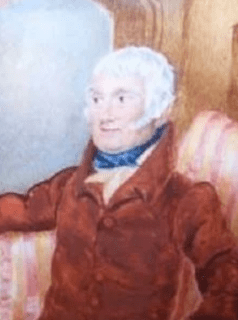
Francis Jack Needham, 1st Earl of Kilmorey, Anglo-Irish soldier and Member of Parliament, dies on November 21, 1832, at Shavington Hall, Shropshire, England.

Needham is born April 15, 1748, in County Down, third and youngest son of John Needham, 10th Viscount Kilmorey, and his wife Anne, daughter of John Hurleston of Newton, Cheshire, and widow of Geoffrey Shakerley of Cheshire. He enters the British Army as a cornet in the 18th Dragoons in 1762, exchanging into the 1st Dragoons in 1763. In 1773, he is promoted to lieutenant and, exchanging into the 17th Dragoons, is made captain in 1774. He serves throughout the American Revolutionary War and is engaged in the blockade of Boston and the New Jersey and Yorktown campaigns. Exchanging into the 76th Foot as a major, he is taken prisoner at the Siege of Yorktown, and at the peace of 1783 is placed on half-pay.

Returning to England, Needham purchases a majority in the 80th Foot and then in February 1783 a lieutenant-colonelcy in the 104th Foot. In April 1783, he exchanges into the 1st Foot Guards. Promoted to full colonel in 1793, he is appointed aide-de-camp to King George III and in 1794 serves with Francis Rawdon-Hastings, 2nd Earl of Moira, on the expedition to the Netherlands. He also serves with General Sir John Doyle in the expedition to Quiberon Bay and the Isle Dieu (1795). In February 1795, he is appointed third major of the 1st Foot Guards and promoted to major general, taking an appointment on the home staff in April 1795.

Needham then holds a staff appointment in Ireland, and during the Irish Rebellion of 1798 commands the crown forces at the Battle of Arklow on June 9, 1798. He places his approximately 1,600 troops in strong positions at the eastern and western ends of the town, where they can sweep the Arklow Rock Road and the Coolgreany Road with fire if the rebels approach along them. Ultimately, this is what the United Irish force, estimated at 5,000–9,000 strong, does, repeatedly attacking Needham’s right flank, which is in fact his strongest position. Estimates of the United Irish dead range from 200 to 1,000, and the failure of the attack ensures that the rebels lose the military initiative. He is also present at the Battle of Vinegar Hill on June 21, 1798, but his force arrives late, leaving a gap in the British line through which many rebels escape. This is later christened “Needham’s gap,” earning him the nickname of “the late General Needham” among his fellow officers.

Promoted to lieutenant-general in 1802, Needham is made colonel of the 5th Royal Veteran Battalion in 1804, entering House of Commons as MP for Newry in 1806. He is made full general in 1812, and, following the death of his two older brothers, succeeds as 12th Viscount Kilmorey in November 1818, resigning his parliamentary seat. On January 12, 1822, he is created 1st Earl of Kilmorey (Queen’s County) and Viscount Newry and Mourne. He dies on November 21, 1832, at the family seat, Shavington Hall, Shropshire, and is buried in St. Peter’s Church, Adderley.

Needham marries Anne Fisher, daughter of Thomas Fisher of Acton, Middlesex, on February 20, 1787. They have two sons, Francis Jack Needham, who succeeds as 2nd Earl, and the Hon. Francis Henry William Needham, lieutenant-colonel in the Grenadier Guards, and seven daughters. There are Needham letters in the Public Record Office (PRO), Kew, and in the Rebellion Papers in the National Archives of Ireland in Dublin.


Leave a comment

Birth of Vincent Fovargue, IRA Officer & British Army Spy

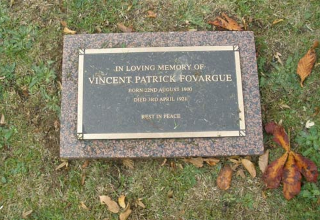
Vincent Patrick Fovargue, a company officer in the Dublin brigade of the Irish Republican Army (IRA) during the Irish War of Independence, is born on August 22, 1900, at 2 Rutland Place, Clontarf, Dublin, to Robert Fovargue, an engineer/fitter, and Elizabeth (Lillie) Larkin.

An intelligence officer with the 4th Battalion of the Dublin Brigade of the IRA in the Ranelagh area, Fovargue is captured by the British Army in Dublin. Under interrogation, he allegedly leaks information that results in the arrest of the other members of his unit a few days later. In return for this information, the Intelligence Corps allegedly allows him to escape during a staged ambush in Dublin’s South Circular Road.

This attempted ruse however does not go unnoticed by Michael Collins‘s many moles inside the Crown’s security forces. On the night of the escape, Detective Constable David Neligan of the Dublin Metropolitan Police‘s G Division is on duty in Dublin Castle when a telephone message on a police form is passed to him. The message, issued by the British Military Headquarters, states that a “Sinn Féin” suspect named Fovargue has escaped from three Intelligence Corps officers in a car while en route to prison. It gives a description of his appearance and asks that the British Army be notified in the event of his recapture by the Dublin Metropolitan Police.

Joe Kinsella is the I/O of the 4th Battalion. He is temporarily transferred to take care of munitions under Seán Russell for a few weeks and Fovargue is put in his place. From Joe Kinsella’s own statement to the Irish Bureau of Military History:

“From the outset I personally did not place a lot of trust in him, because on the morning that he took over from me he appeared to me, to be too inquisitive about the movements of Michael Collins and the G.H.Q. staff generally. He wanted to know where they could be located at any time. He said that he had big things in view, and that it would be to the advantage of the movement generally if he was in a position to get in touch with the principal men with the least possible delay. From his attitude I there and then formed the opinion, rightly or wrongly, that he was inclined to overstep his position. I did not feel too happy about him and I discussed him with Sean Dowling. It transpired that my impressions of this man were correct. I told him of two meeting places of Intelligence staff, one of Company Intelligence held at Rathmines Road and one of Brigade Intelligence held at Saville Place. A short time after giving him this information both these places were raided…I was now confirmed in my suspicions that Fovargue was giving away information. He was later shot in England by the IRA.”

Neither was Neligan fooled by this, as he explains:

“Now if they had said that this man (who was completely unknown to both of us) had escaped from one I.O. it might have sounded reasonable enough. But to tell us that an unarmed man had escaped out of a motorcar in the presence of three presumably armed men was imposing a strain on our credulity. Both of us thought this story too good to be true.”

The two men retype the message and pass it to Collins the following day. Meanwhile, Fovargue has been sent to England where he adopts the alias of Richard Staunton. He has in fact been sent to England by Intelligence Corps Colonel Ormonde Winter to infiltrate the IRA in Britain.

Sean Kavanagh, a Kilkenny IRA man, claims that Fovargue is put in a cell with him in Kilmainham Gaol in 1921 in order to try to extract information from him.

On April 2, 1921, a boy walking on the golf links of the Ashford Manor Golf Club in Ashford, Middlesex discovers the body of Fovargue, who had been shot through the chest. Discovered near the corpse is a small piece of paper on which has been scribbled in blue pencil the words “Let spies and traitors beware – IRA.”

In the Neil Jordan film Michael Collins, Fovargue’s assassination is depicted onscreen. Fovargue is tracked down while working out at the golf course, allowed to say the Act of Contrition, and then fatally shot by Liam Tobin (Brendan Gleeson).

(Pictured: Dublin Brigade IRA officer’s cap badge in white metal, “FF” (Fianna Fáil) at centre, surrounded by a garter bearing the motto “Drong Átha Cliath” (Dublin Brigade), all on an eight-pointed rayed star)


Leave a comment

Birth of Joseph O’Sullivan, Irish Republican Army Volunteer

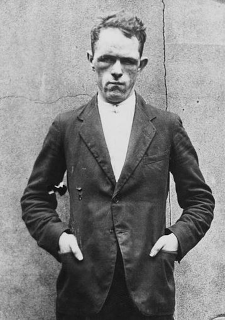
Joseph O’Sullivan, Irish Republican Army (IRA) volunteer, is born in London on January 25, 1897. Along with fellow IRA (London Battalion) volunteer Reginald Dunne, shoot dead Field Marshal Sir Henry Wilson outside Wilson’s home at 36 Eaton Place, Belgravia, London on June 22, 1922. Convicted by a jury, he is sentenced to death by Justice Montague Shearman. Despite a petition of 45,000 signatures, and a plea for clemency from many prominent figures at the time, including playwright George Bernard Shaw, O’Sullivan and Dunne are hanged for the murder on August 10, 1922, at Wandsworth Prison. The event provides the inspiration for the 1947 film Odd Man Out.

O’Sullivan’s father, John, is originally from Bantry, County Cork, and moves to London as a young man where he eventually becomes a successful tailor. His mother, Mary Ann O’Sullivan (née Murphy), is born in Inniscarra, County Cork. He is the youngest of thirteen children, all born in London, although only eleven survive to adulthood. As a boy he attends St. Edmund’s College, Ware. On January 25, 1915, his eighteenth birthday, he enlists into the Royal Munster Fusiliers, and later transfers to the London Regiment and serves with the rank of lance corporal during World War I, losing a leg at Ypres in 1917.

Upon being discharged from the army in 1918, O’Sullivan is employed by the Ministry of Munitions and, when the war ends, is transferred to the Ministry of Labour where he works as a messenger. The Ministry of Labour is located in Montagu House, adjacent to Scotland Yard, and later demolished and replaced by the present-day Ministry of Defence.

O’Sullivan becomes a member of the IRA detachment in London and is named by Rex Taylor as being responsible for the execution of Vincent Fovargue as a British spy at the Ashford Golf Links, Middlesex, on April 2, 1921. Fovargue is left with a label pinned to his body stating, “Let spies and traitors beware, IRA.” Fovargue had been an officer in the Dublin brigade of the IRA.

O’Sullivan’s brother, Patrick, is the first Vice-Commandant of the London IRA during its early days in 1919 but is seconded to the Cork No. 1 Brigade during the Irish War of Independence. Patrick also serves in the London Regiment during World War I, along with another brother, Aloysius, who is discharged from the army in 1916 suffering from shell shock. Patrick is also wounded in a gas attack during World War I. He fights with the Anti-Treaty IRA during the Irish Civil War and is wounded ten days after his brother is executed. Shortly before that, he crosses over to England to participate in an abortive attempt to rescue Dunne and his brother.

In 1923, John O’Sullivan tries to have the remains of his son and Dunne released for a funeral Mass. But it is not until after the abolition of capital punishment in the United Kingdom that Patrick O’Sullivan, with the assistance of the Irish Republican National Graves Association, is able to arrange for the bodies of O’Sullivan and Dunne to be sent to Ireland for burial. In mid-August 1929, Irish Republicans in London unveil a plaque commemorating Dunne and O’Sullivan. In 1967, after some political and diplomatic debate by the British and Irish governments, the British Government allows the bodies of Dunne and O’Sullivan to be exhumed. They are subsequently reburied in Dean’s Grange Cemetery, County Dublin.

(Pictured: Photograph of IRA member Joseph O’Sullivan taken before his 1922 execution)


Leave a comment

Death of James Maclaine, “The Gentleman Highwayman”

“Captain” James Maclaine, an Irish man of a respectable Presbyterian family who has a brief but notorious career as a mounted highwayman in London with his accomplice William Plunkett, is hanged at Tyburn Gallows in Middlesex, London, on October 3, 1750.

Maclaine is born in County Monaghan in 1724, second son among two sons and one daughter of the Rev. Lauchlin Maclaine, a Presbyterian minister from Scotland, and Elizabeth Maclaine (née Milling). His brother, Archibald Maclaine, later becomes a minister. Educated locally, he is reckless, headstrong, and dismissive of his parents’ attempts to make him respectable. When his father dies he squanders his inheritance on a dissolute lifestyle and is forced to find work in London.

Maclaine considers joining the Irish Brigade in the French Royal Army, but is told that he would make little progress with them unless he becomes a Roman Catholic, which he is unwilling to do. Instead he enlists in Lord Albemarle‘s horse troops. Again his propensity for fast living costs him dearly, and he suffers a thrashing after he is discovered having an affair with an officer’s wife.

Around 1746 Maclaine marries the daughter of a publican on Oxford Road, London, and with her dowry of five hundred pounds establishes himself as a grocer and chandler in Welbeck Street, Cavendish Square. His wife dies in 1748, leaving one daughter.

Frustrated by his lack of opportunities, Maclaine decides to embark on a life of crime. Together with William Plunkett, an Irish apothecary who had attended to his wife, he decides to find a rich heiress to marry. Pretending to be a high-living gentleman, with Plunkett as his liveried servant, he exhausts all his money dancing and gambling but has little success in his quest. Undaunted, he now turns his hand to robbery and becomes a highwayman. This proves extremely profitable and he takes lodgings at St. James’s Street, where he passes himself off as an Irish squire, with Plunkett again in attendance.

A dashing, handsome man, Maclaine soon becomes a popular figure in London. His most infamous adventure occurs in November 1749 when he robs the famous diarist and politician Horace Walpole at Hyde Park. For the first and only time in his career, he fires a shot, as one of his pistols discharges accidentally, scorching Walpole’s face. He later insists that he would have committed suicide if he had killed his victim. Walpole’s retort is that he would be satisfied if Maclaine just allowed himself to be hanged. Overcome with guilt, Maclaine afterwards sends two letters to Walpole apologising for the injury and suggesting a duel if he wants satisfaction. Walpole wisely ignores the correspondence.

After visiting his brother at The Hague, where he impresses with his extravagant gifts and lifestyle, Maclaine again decides to seek an heiress. Together with Plunkett, who is visiting Ireland, he sets his sights on a woman with an income of £40,000, but the scheme comes to nothing.

Returning to his career as a highwayman, Maclaine commits a number of daring robberies in the summer of 1750. On June 26, 1750, he and Plunkett hold up the coach of the Earl of Eglinton on Hounslow Heath, which proves to be his undoing. One passenger makes public a list of his stolen possessions, and when Maclaine sells some of the items on July 19 the crime is traced to him. On July 27 he is arrested and immediately breaks down in prison, confessing everything. Weeping in his cell, he consistently blames Plunkett, who evaded capture, for leading him astray.

Maclaine’s trial on September 13 attracts enormous interest, especially from women who are enamoured of his romantic image. The jury finds him guilty without leaving the box. Sentenced to death, he attempts to read a plea for mercy but loses his nerve and is only able to speak a few words. After a few minutes of embarrassed silence he cries, “My lord, I can go no further.” His brother denounces him, and from his cell he writes a number of letters expressing regret for his actions.

Maclaine is executed at Tyburn on October 3, 1750, having informed a minister that he went to his execution “without being daunted but rather with eagerness.” A great crowd attends the execution, before whom he maintains a steady composure, and his last words to them are, “O God, forgive my enemies, bless my friends and receive my soul!” A later publication tells that, as the cart is about to be drawn from under him, a witness hears him say, “I must never more behold this beauteous sun! Do thou, O sun of righteousness, shine on my departing soul.” After his death an enduring legend develops around the story of “the gentleman highwayman” and “the ladies’ hero.”

The film Plunkett and Macleane (1999) is an innovative retelling of his story, with Robert Carlyle as Plunkett and Johnny Lee Miller as the dashing highwayman.


2 Comments

Murder of Vincent Patrick Fovargue

Vincent Patrick Fovargue, a company officer in the Dublin brigade of the Irish Republican Army (IRA) during the Irish War of Independence, is shot dead at a golf course near London, England by the IRA on April 2, 1921. The IRA accuses him of being a British spy.

Fovargue is born on August 22, 1900, at 2 Rutland Place, Clontarf, Dublin, to Robert Fovargue, an engineer/fitter, and Elizabeth (Lillie) Larkin.

An intelligence officer with the 4th Battalion of the Dublin Brigade of the IRA in the Ranelagh area, he is captured by the British Army in Dublin. Under interrogation, he allegedly leaks information that results in the arrest of the other members of his unit a few days later. In return for this information, the Intelligence Corps allegedly allow him to escape during a staged ambush in Dublin’s South Circular Road.

This attempted ruse however does not go unnoticed by Michael Collins‘ informants in the Crown’s security forces. On the night of the escape, Detective Constable David Neligan of the Dublin Metropolitan Police‘s “G” Division is on duty in Dublin Castle when he is passed a telephone message on a police form. The message, issued by the British Military Headquarters, states that a “Sinn Féin” suspect named Fovargue had escaped from three Intelligence Corps officers in a car while en route to prison. It gives a description of his appearance and asks that the British Army be notified in the event of his recapture by the Dublin Metropolitan Police.

Joe Kinsella is the I/O of the 4th Battalion. He is temporarily transferred to take care of munitions under Seán Russell for a few weeks and Fovargue is put in his place. In Kinsella’s statement to the BMH, he writes:

“From the outset I personally did not place a lot of trust in him, because on the morning that he took over from me he appeared to me, to be too inquisitive about the movements of Michael Collins and the GHQ staff generally. He wanted to know where they could be located at any time. He said that he had big things in view, and that it would be to the advantage of the movement generally if he was in a position to get in touch with the principal men with the least possible delay. From his attitude I there and then formed the opinion, rightly or wrongly, that he was inclined to overstep his position. I did not feel too happy about him and I discussed him with Sean Dowling. It transpired that my impressions of this man were correct. I told him of two meeting places of Intelligence staff, one of Company Intelligence held at Rathmines Road and one of Brigade Intelligence held at Saville Place. A short time after giving him this information both these places were raided…I was now confirmed in my suspicions that Fovargue was giving away information. He was later shot in England by the IRA.”

Neligan is not fooled by this either, as he explains:

“Now if they had said that this man (who was completely unknown to both of us) had escaped from one I.O. it might have sounded reasonable enough. But to tell us that an unarmed man had escaped out of a motor-car in the presence of three presumably armed men was imposing a strain on our credulity. Both of us thought this story too good to be true.”

The two men retype the message and pass it to Collins the following day. Meanwhile, Fovargue has been sent to England where he adopts the alias of Richard Staunton. Fovargue has in fact been sent to England by Intelligence Corps Colonel Ormonde Winter to infiltrate the IRA in Britain.

Sean Kavanagh, a Kilkenny IRA man, claims that Fovargue is put in a cell with him in Kilmainham in 1921 in order to try to extract information from him.

On April 2, 1921, a boy walking on the golf links of the Ashford Manor Golf Club in Ashford, Middlesex discovers the body of Fovargue, who had been shot through the chest. Discovered near the corpse is a small piece of paper on which had been scribbled in blue pencil the words “Let spies and traitors beware – IRA.”

In the Neil Jordan film Michael Collins, Fovargue’s assassination is depicted onscreen. Fovargue is tracked down while working out at the golf course, allowed to say the Act of Contrition, and then fatally shot by Liam Tobin (Brendan Gleeson).


Leave a comment

Birth of Professional Footballer Paul McGrath

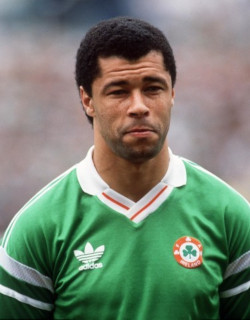
Paul McGrath, former professional footballer for St. Patrick’s Athletic F.C., Manchester United F.C., Aston Villa F.C., Derby County F.C., and the Republic of Ireland national football team, is born in Greenford, Middlesex on December 4, 1959.

McGrath is born to an Irish mother and a Nigerian father. His father disappears soon after his conception. His mother, Betty McGrath, is terrified that her father will find out she had become pregnant outside marriage and in an interracial relationship. She travels in secret to London to have her child, who is considered illegitimate, and gives him up for fostering when he is four weeks old. When he is five years old, the family he had been fostered by comes to Betty saying they cannot control him. Betty places him into an orphanage.

McGrath begins as a schoolboy with Pearse Rovers and plays junior football for Dalkey United. While at the latter, he attracts the attention of Manchester United scout Billy Behan. Before becoming a full-time professional with League of Ireland club St. Patrick’s Athletic in 1981, he briefly works as an apprentice metal worker and a security guard in Dublin.

McGrath makes his debut in a League of Ireland Cup clash with the Shamrock Rovers F.C. in August at Richmond Park. He ultimately excels at St. Patrick’s, earning the nickname “The Black Pearl of Inchicore” and receiving the PFAI Players’ Player of the Year Award in his first and only season, scoring four goals in 31 total appearances.

In 1982, McGrath moves to Manchester United, then managed by Ron Atkinson. He misses out on a place in the FA Cup victory over Brighton & Hove Albion F.C. the following year. He is named man of the match for the 1985 FA Cup Final, which United wins 1–0 against Everton F.C. In his early years at Manchester United, he is frequently used as a midfielder, changing to defender while still at Old Trafford.

In 1985–86, it appears that McGrath is on course to pick up a league title medal after United wins their first 10 league games of the season, but injuries to key players including Bryan Robson soon take their toll on the side and they eventually finish fourth in the table, 12 points behind champions Liverpool F.C. Despite a dismal start to the 1986–87 season and a managerial change, McGrath remains a regular member of the first team. United finishes second behind Liverpool in the league a year later.

By the 1988–89 season, McGrath is struggling with knee injuries and is becoming a less regular member of the first team. His relationship with manager Alex Ferguson is becoming strained, as McGrath’s alcohol addiction and physical problems lead to United offering him a retirement package of £100,000. He refuses and Ferguson begins to inform clubs of his availability. Aston Villa’s offer is accepted and McGrath signs on August 3, 1989 for a fee of £400,000.

While at Aston Villa, McGrath plays some of the best football of his career, despite recurrent knee problems. Villa comes close to winning the title in his first season, finishing second to Liverpool. In the inaugural season of the Premier League (1992-93), Aston Villa again finishes as runners-up, behind Manchester United. As a sign of the regard he is now held in by his fellow professionals, McGrath wins the PFA Players’ Player of the Year award at the end of the season. He wins his first trophy with Villa, defeating Manchester United in the 1993–94 Football League Cup. In 1996 he wins a second League Cup for Villa. By the end of his Villa career he has chalked up 323 appearances for the club.

McGrath departs Aston Villa in the autumn of 1996, leaving a legacy as one of the greatest players in the club’s history. He is sold to Derby County for £200,000 and helps the newly promoted Rams finish 12th in its first Premier League season. He then drops down a division to sign for Sheffield United F.C. in the summer of 1997. He plays his final game as a professional for Sheffield United against Ipswich Town F.C. on November 9, 1997. He officially retires at the end of the season.

In McGrath’s international career he wins his first full cap against Italy in 1985, last playing 12 years later, against Wales. During that time, he is often regarded as the single most influential player Ireland has in the national team’s glory days.

In McGrath’s international career he is a major part of the breakthrough of Ireland’s national team of the late 1980s and early 1990s. During the early part of Jack Charlton‘s era, he plays as a defensive midfielder, due to the wealth of talent Ireland has in defence. In UEFA Euro 1988, as the national side first qualifies for an international tournament, he is present in the 1–0 group stage win against England.

In 1990, Ireland qualifies for its first FIFA World Cup, eventually reaching the quarter-finals, where they lose to Italy 1-0, with McGrath ever present in the lineups. He captains the team four times in 1992 after the retirement of Mick McCarthy, and ignores a painful shoulder virus to play in the 1994 FIFA World Cup.

In Ireland’s opening game of the 1994 World Cup, a 1–0 win against favourites Italy, in a perfect example of his commitment to the game, McGrath puts up an astonishing defensive performance in spite of excruciating knee problems. Even after his retirement from international football in 1997, he is still regarded today as one of the greatest players ever to put on Ireland’s green shirt.

Upon retiring, McGrath settles in Monageer, County Wexford. In 2004, one year after being taken to court, charged with a breach of the peace, he returns to the football world after five years, moving to Waterford F.C. in Ireland as director of football.

In 2011, McGrath launches a singing career with a cover version of the Gerry Goffin and Carole King song “Goin’ Back.” The recording is followed by the planning of an album of covers by the footballer, with a percentage of the album’s proceeds going to the Acquired Brain Injury Foundation and the Cystic Fibrosis Foundation of Ireland.


Leave a comment

Assassination of Ross McWhirter

ross-mcwhirter

Alan Ross McWhirter, co-founder of The Guinness Book of Records and a contributor to Record Breakers, is murdered by the Provisional Irish Republican Army (IRA) on November 27, 1975.

McWhirter is the youngest son of William McWhirter, editor of the Sunday Pictorial, and Margaret “Bunty” Williamson. He is born at Winchmore Hill, Middlesex, England on August 12, 1925. Like his two brothers, he is educated at Marlborough College and Trinity College, Oxford. Between 1943 and 1946 he serves as a sub-lieutenant with the Royal Naval Volunteer Reserve on board a minesweeper in the Mediterranean Sea.

Ross and his twin brother Norris become sports journalists in 1950. In 1951, they found an agency to provide facts and figures to Fleet Street, setting out, in Norris McWhirter’s words “to supply facts and figures to newspapers, yearbooks, encyclopaedias and advertisers.” In the same year they publish Get to Your Marks.

While building up their accounts, they both work as sports journalists. One of the athletes they know and cover is runner Christopher Chataway, an employee at Guinness who recommends them to Hugh Beaver. After an interview in 1954 in which the Guinness directors enjoy testing the twins’ knowledge of records and unusual facts, the brothers agree to start work on the book that becomes The Guinness Book of Records. In August 1955, the first 198-page green volume is at the bookstalls, and in four more months it is the UK’s number one non-fiction best-seller. Both brothers are regulars on the BBC show Record Breakers. They are noted for their encyclopedic memories, enabling them to provide detailed answers to questions from the audience about entries in The Guinness Book of Records. Norris continues on the programme after Ross’s death.

In the early 1960s, McWhirter is a Conservative Party activist and seeks, unsuccessfully, the seat of Edmonton in the 1964 general election. Following his killing, his brother and others found the National Association for Freedom (later The Freedom Association).

McWhirter advocates various restrictions on the freedom of the Irish community in Britain, such as making it compulsory for all of them to register with the local police and to provide signed photographs of themselves when renting flats or booking into hotels and hostels. In addition, he offers a £50,000 reward for information leading to a conviction for several recent high-profile bombings in England that were publicly claimed by the Provisional Irish Republican Army (IRA). In doing so, he recognises that he might then be a target himself. This is considered a “bounty” by the IRA Army Council, a view that leads directly to the events that follow, although the idea is not originally his, but that of John Gouriet.

At 6:45 PM on November 27, 1975, McWhirter is shot and killed by two IRA volunteers, Harry Duggan and Hugh Doherty, both of whom are members of what becomes known as the Balcombe Street Gang, the group for whose capture McWhirter had offered the reward. He is shot with a .357 Magnum revolver at close range in the head and chest outside his home in Village Road, Bush Hill Park. He is taken to Chase Farm Hospital but dies soon after being admitted. His killers are captured and charged with his and nine other murders. They are sentenced to life imprisonment but freed in 1999 under the terms of the Good Friday Agreement.


Leave a comment

Birth of Admiral Sir Francis Leopold McClintock

Admiral Sir Francis Leopold McClintock, Irish explorer in the British Royal Navy who is known for his discoveries in the Canadian Arctic Archipelago, is born on July 8, 1819 in Dundalk, County Louth.

McClintock is the eldest son of Henry McClintock, formerly of the 3rd Dragoon Guards, by his wife Elizabeth Melesina, daughter of the Ven. George Fleury, D.D., archdeacon of Waterford. His uncle is John McClintock (1770–1855) of Drumcar House.

In 1835 McClintock becomes a member of the Royal Navy as a gentleman volunteer, and joins a series of searches for Sir John Franklin between 1848 and 1859. He masters traveling by using human hauled sleds, which remain the status quo in Royal Navy Arctic and Antarctic overland travel until the death of Captain Robert Falcon Scott RN in his bid to reach the South Pole. In 1848-49, McClintock accompanies James Clark Ross on his survey of Somerset Island. As part of Capt. Henry Kellett‘s expedition 1852 to 1854, McClintock travels 1,400 miles by sled and discovers 800 miles of previously unknown coastline.

In 1854 the explorer John Rae travels west from Repulse Bay, Nunavut and learns from the Inuit that a ship has been abandoned somewhere to the west. Previous expeditions have not searched the area because they believe it to be ice-blocked. In April 1857 McClintock agrees to take command of the Fox, which belongs to Lady Franklin, and searches for her husband in the area west of Repulse Bay. At Disko Bay he hires thirty sled dogs and an Inuit driver. It is a bad year for ice and from September he is frozen in for eight months. The following year, 1858, is another bad year and he does not reach Beechey Island until August. He enters Peel Sound, finds it blocked by ice, backs up, enters Prince Regent Inlet in the hope of passing Bellot Strait. He is glad to extricate himself from this narrow passage and finds winter quarters near its entrance.

In February 1859, when sledging becomes practical, he goes south to the North Magnetic Pole which had been found by James Clark Ross in 1831. Here he meets some Inuit who tell him that a ship has been crushed by ice off King William Island, the crew has landed safely and that some white people have starved to death on an island. In April he goes south again and on the east coast of King William Island meets other Inuit who sell him artifacts from Franklin’s expedition. William Hobson, who has separated from him, finds the only written record left by Franklin on the northwest corner of the island. They also find a skeleton with European clothes and a ships boat on runners containing two corpses. They get as far south as Montreal Island and the mouth of the Back River.

McClintock returns to England in September 1859 and is knighted. The officers and men of the Fox share a £5,000 parliamentary reward. The tale is published in The Voyage of the ‘Fox’ in the Arctic Seas: A Narrative of the Discovery of the Fate of Sir John Franklin and His Companions. London, 1859.

In 1872–1877 McClintock is Admiral-Superintendent of Portsmouth Dockyard. In 1879 he is appointed Commander-in-Chief, North America and West Indies Station with the flagship HMS Northampton. McClintock leaves the Royal Navy in 1884 as a Rear Admiral. He dies on November 17, 1907. He is buried in Kensington Cemetery, Hanwell, Middlesex.

On October 29, 2009 a special service of thanksgiving is held in the chapel at the Old Royal Naval College in Greenwich, to accompany the rededication of the national monument to Sir John Franklin there. It also marks the 150th anniversary of Sir Francis Leopold McClintock’s voyage aboard the yacht Fox.

Admiral Sir Frances Leopold McClintock has several portraits in the National Portrait Gallery, London.