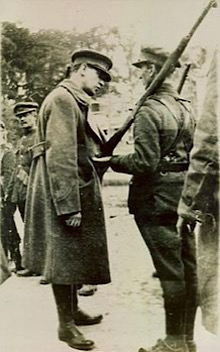
Nationalist forces enter Newcastle West, County Limerick, on Monday, August 7, 1922, after a twelve-hour battle, in which twelve anti-Treaty Irish Republican Army (IRA) members, sometimes referred to as Irregulars, are killed. The casualties of the Nationalists are less than those of the Irregulars.
Taking little respite after Sunday’s labors, the Nationals advance from Rathkele on Monday morning, and by midday are in sight of their fresh objective. Armored cars enter the town and machine gun fire is directed against a party of Irregulars, causing many casualties.
When the artillery goes into action against the headquarters of the Irregulars, the Irregulars flee precipitately along Cord road.
Owing to the slow progress in the operations in Southern Ireland, the meeting of Dáil Éireann, scheduled to open Saturday, is postponed again.
The official army bulletin announces that the Nationals captured Castle Island on Saturday, August 5. It says that the counties of Cork and Kerry with a part of South Tipperary and a small area in County Waterford are the only districts held by the Irregulars with any degree of security.
The streets of Dublin are lined with great crowds of people on Tuesday, August 8, for the military funeral of nine National Army soldiers who were killed in fighting the Republican Irregulars in County Kerry. Michael Collins, Chairman of the Provisional Government, and all the leading officers of the army in Dublin march beside the hearses. Each coffin is covered with the Republican tricolour. There are many clergymen and other civilians in the funeral procession.
Prominent Catholics of Dublin and Belfast are trying to effect a better understanding between the Ulster and Free State Governments, according to the Daily Mail. This newspaper further states that all efforts to this end, which have all been taken with the advice and approval of leading English Catholics, are without official character.
A message from Strabane, County Tyrone, received by the Exchange Telegraph Company on August 8 states that a settlement between the Ulster Government and the Free State authorities is imminent, the terms of agreement having been practically arranged in negotiations proceeding in London.
In Downing Street, however, all knowledge of any such Irish negotiations is disclaimed and a telegram from Belfast quotes Ulster Government officials as denying that a settlement with the Free State is imminent.
The Free State Government is also unaware of any negotiations for a settlement between the Ulster Government and the Free State authorities. It is further states that such negotiations are unlikely to take place.
(From: “Irish Irregulars Routed With Loss,” The New York Times, August 9, 1922 | Pictured: General Michael Collins inspects a soldier at Newcastle West, County Limerick, August 8, 1922)
The battle consists of ten days of fighting in the countryside around Kilmallock in County Limerick, in which the National Army of the Irish Free State, advancing south from Limerick city, find their path blocked by anti-Treaty IRA troops, dug into a number of villages at Bruff, Bruree and Patrickswell. The fighting end with the retreat of the anti-Treaty fighters and the occupation of Kilmallock by Free State forces.
The prelude to the battle is the fall of Limerick city to Free State forces. The Republican forces in the city under Liam Deasy withdraw from their positions after a week of fighting and concentrate in Kilmallock and the nearby towns of Bruff and Bruree. The Free State forces, advancing south from the city, find their path blocked by the Republicans dug in at the three hilltop towns.
The National Army’s attempt to break through this position produces the only “line battle” of the war with the two sides facing each other along clear front-lines. The Kilmallock-Bruff-Bruree triangle sees some of the war’s most intense fighting.
Whereas in the fighting in Dublin, Limerick and Waterford, Free State troops equipped with artillery overcome Anti-Treaty resistance relatively easily, at Kilmallock they have a much harder time. The main reason for this is that the Free State troops, most of whom are new recruits, are facing some of the best of the IRA forces without an advantage in numbers or firepower. General Eoin O’Duffy complains of shortage of arms and ammunition. He estimates that while his forces have about 1,300 rifles, the Republicans could muster over 2,000. He is also critical of the quality of the troops at his disposal, whom he describes as, “a disgruntled, undisciplined and cowardly crowd.”
The Republicans know this and are confident of success. Nevertheless, the Republican commanders have their own issues with logistical support and lack of co-operation between forces from different counties. Deasy’s command includes Volunteers from counties Limerick itself, Cork and Kerry, all of whom have their own commanders. They have three improvised armoured cars, some mortars and heavy machine guns but no artillery.
O’Duffy draws up plans for the advance on Kilmallock with the assistance of his second-in-command Major GeneralW. R. E. Murphy who had been a lieutenant colonel in World War I. His experience in the trenches has a major effect on his approach – pre-disposing him to cautious advances and use of trenches for cover.
The Republican forces have the better of the first clashes. On Sunday, July 23, Free State forces take Bruff and begin their advance on Kilmallock, but are twice beaten back by determined Republican resistance. The following day, the Republicans manage to retake Bruff in a counter-attack, taking 76 prisoners. As a result of this setback, O’Duffy calls off the advance for the time being and waits for reinforcements.
National Army forces quickly retake Bruff after reinforcements arrive. However, things get worse for the National Army as the week goes on. They make slow progress in taking the Republican strongpoints, and their casualties also mount. On Tuesday, July 25, a unit of the Dublin Guard under Tom Flood is ambushed on a narrow road. They fight their way clear, but only after losing four men. Three more Free State soldiers are killed two days later. On July 30, Major General Murphy launches an attack to take Bruree. The Dublin Guards attack the town from the southeast, supported by armoured cars and an 18-pound field gun. The Republicans hold out for five hours until Free State artillery is brought into action. At least 13 Free State soldiers and nine Anti-Treaty fighters are killed in the action and more are wounded before the Free State troops secure Bruree.
The Republican commander, Deasy, knows how important Bruree is to the defence of Kilmallock and draws up plans to recapture the town using three armoured cars, trench mortars and machine guns. On August 2, Republicans capture Patrickswell south of Limerick. The armoured cars then attack Bruree, taking Free State forces by surprise. One car attacks Commandant Flood’s headquarters at the Railway Hotel. The Commandant and his men manage to escape out the back of the building under the cover of Lewis gun fire. The second armoured car rams the front door of another post in the school house, which persuades the twenty-five troops inside to surrender.
However, when Free State reinforcements, along with armoured cars arrive, the Republican counter-attack stalls. The Free State reinforcements are led by Commandant General Seamus Hogan, who personally leads his forces, riding in the armoured car nicknamed “The Customs House.” Having failed to secure the surrender of the town, Republican forces retreat.
Having held Bruree against a Republican counterattack, Free State forces prepare to capture Kilmallock itself, but anticipate there will be heavy fighting. Republican Adjutant General Con Moloney comments on August 2, “Up to yesterday we have had the best of the operations there [the Kilmallock area]. There will, I fear, be a big change there now as the enemy have been reinforced very considerably.” In the 3rd Western Division area they have all but disbanded, unwilling to fight Free Staters, destroy roads, and now discouraged by the Catholic church.
On Thursday, August 3, a force of 2,000 Free State troops, backed up by armoured cars and artillery, advance on Kilmallock from Bruree, Dromin and Bulgaden. Seven hundred troops arrive the next day with an armoured car and a field gun. By Saturday, the town is surrounded by Free State forces. The Dublin Guard are also on hand to prevent Republican forces from escaping. Three miles away, Free State artillery is deployed and shells Republican forces on Kilmallock Hill and Quarry Hill. The two hills are soon controlled by Free State forces.
The National Army has, therefore, assembled sufficient force to smother resistance at Kilmallock. They are still, however, expecting hard fighting before they take the town. To their surprise, when the Free State troops enter the town, they encounter only light resistance from a Republican rearguard (volunteers from Cork). Most of the Republican troops have already abandoned their positions and retreated to Charleville.
They departed not because the Free State troops are stronger, but because they have been outflanked by Free State seaborne landings on the coasts of County Kerry and County Cork on August 2 and 8 respectively. The landings in Cork and Kerry force Commandant General Deasy to release units from this area to return home to their own areas. Although the landings in Cork occur after the retreat from Kilmallock, the subsequent loss of brigades from Cork adds to Commandant General Deasy’s problems. The final phase of the fighting in County Limerick comes when the Free State advance south is held up at Newcastle West. Another day of heavy fighting ensues in which the National Army troops have to bring up armoured cars and artillery to dislodge the Republicans, who reportedly lose up to 12 men before they retreat in the direction of Cork.
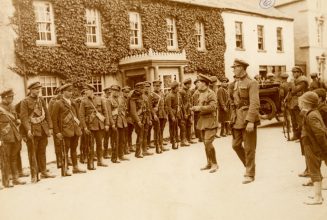
(Pictured: National Army troops lined up for a roll call during the Irish Civil War with local children casting an eye over the proceedings)
Butler succeeds to the title at the age of fifteen and was educated at the University of Oxford, taking the degree of LL.D. in 1677. In 1678, he is commissioned as a captain in Colonel Thomas Dongan‘s regiment, which is disbanded before he takes up his post.
In 1692, Butler is created Earl of Newcastle in County Limerick in the Jacobite peerage of Ireland. In France he is named Colonel of the 2nd Queen’s Regiment of Irish Horse in the service of that country and serves with distinction in various battles of the War of the Spanish Succession, also becoming a Lieutenant-General in the Spanish army. He is at the Siege of Roses in 1693, and in 1694 is a Brigadier attached to the army of Germany. He serves in Italy and other parts of Continental Europe from 1701 to 1703, sharing all the fortunes of the Irish Brigade. He later serves in the French army as a Lieutenant-General. He is created Brigadier of Cavalry in 1694.
Butler dies at the age of eighty-eight in Paris on June 18, 1740, and is buried at St. Paul’s there. John C. O’Callaghan writes in Irish Brigades in the Service of France (Glasgow, 1870): “The successive claimants of the title of Galmoy were officers in France down to the Revolution; in whose armies, as well as in others, various gentlemen have honourably represented a name, of which the illustrious General Lafayette is related to have said, in the war for the independence of the United States of America, that ‘whenever he wanted anything well done, he got a Butler to do it.'”
Notwithstanding the attainder, the viscountcy is assumed by his nephew, James Butler of the Irish Brigade in France, the son of the Viscount’s brother, Richard Butler of Galmoye.
Hartnett is born in Croom Hospital in Croom, County Limerick, on September 18, 1941. He is one of the most significant voices in late 20th-century Irish writing and has been called “Munster‘s de facto poet laureate.”
Although Hartnett’s parents’ name is Harnett, he is registered in error as Hartnett on his birth certificate. In later life he declines to change this as his legal name is closer to the Irish Ó hAirtnéide. He grows up in the Maiden Street area of Newcastle West, County Limerick, spending much of his time with his grandmother, Bridget Halpin, who resides in the townland of Camas, in the countryside nearby. He claims that his grandmother is one of the last native speakers to live in County Limerick, though she is originally from northern County Kerry. Although she speaks to him mainly in English, he listens to her conversing with her friends in Irish, and as such, he is quite unaware of the imbalances between English and Irish. When he begins school, he is made aware of the tensions between both languages and is surprised to discover that Irish is considered an endangered language, taught as a contrived, rule-laden code, with little of the literary attraction which it holds for him. He is educated in the local national and secondary schools in Newcastle West. He emigrates to England the day after he finishes his secondary education and goes to work as a tea boy on a building site in London.
Hartnett has started writing by this time and his work comes to be known of the poet John Jordan, who is professor of English at University College Dublin (UCD). Jordan invites him to attend the university for a year. While back in Dublin, he co-edits the literary magazine Arena with James Liddy. He also works as curator of James Joyce‘s tower at Sandycove for a time. He returns briefly to London, where he meets Rosemary Grantley on May 16, 1965, and they are married on April 4, 1966. His first book, Anatomy of a Cliché, is published by Poetry Ireland in 1968 to critical acclaim and he returns to live permanently in Dublin that same year.
Hartnett works as a night telephonist at the telephone exchange on Exchequer Street. He now enters a productive relationship with New Writers Press, run by Michael Smith and Trevor Joyce. They publish his next three books. The first of these is a translation from the Irish, The Old Hag of Beare (1969), followed by Selected Poems (1970) and Tao (1972). This last book is a version of the Chinese Tao Te Ching. His Gypsy Ballads (1973), a translation of the Romancero Gitano of Federico García Lorca, is published by the Goldsmith Press.
In 1974 Hartnett decides to leave Dublin and return to his rural roots, as well as deepen his relationship with the Irish language. He goes to live in Templeglantine, five miles from Newcastle West, and works for a time as a lecturer in creative writing at Thomond College of Education, Limerick.
In his 1975 book, A Farewell to English, Hartnett declares his intention to write only in Irish in the future, describing English as “the perfect language to sell pigs in.” A number of volumes in Irish follow including Adharca Broic (1978), An Phurgóid (1983) and Do Nuala: Foighne Chrainn (1984). A biography on this period of his life entitled A Rebel Act Michael Hartnett’s Farewell To English by Pat Walsh is published in 2012 by Mercier Press.
In 1984 Hartnett returns to Dublin to live in the suburb of Inchicore. The following year marks his return to English with the publication of Inchicore Haiku, a book that deals with the turbulent events in his personal life over the previous few years. This is followed by a number of books in English including A Necklace of Wrens (1987), Poems to Younger Women (1989) and The Killing of Dreams (1992).
Hartnett also continues working in Irish, and produces a sequence of important volumes of translation of classic works into English. These include Ó Bruadair, Selected Poems of Dáibhí Ó Bruadair (1985) and Ó Rathaille The Poems of Aodhaghán Ó Rathaille (1999). His Collected Poems appear in two volumes in 1984 and 1987 and New and Selected Poems in 1995.
Hartnett dies in St. Vincent’s Hospital, Dublin, from Alcoholic Liver Syndrome on October 13, 1999. A new Collected Poems appears in 2001.
Every April a literary and arts festival is held in Newcastle West in honour of Hartnett. Events are organised throughout the town and a memorial lecture is given by a distinguished guest. Former speakers include Nuala O’Faolain, Paul Durcan, David Whyte and Fintan O’Toole. The annual Michael Hartnett Poetry Award of € 4,000 also forms part of the festival. Funded by the Limerick City and County Council Arts Office and the Arts Council of Ireland, it is intended to support and encourage poets in the furtherance of their writing endeavours. Previous winners include Sinéad Morrissey and Peter Sirr.
During the 2011 Éigse, Paul Durcan unveils a bronze life-sized statue of Hartnett sculpted by Rory Breslin, in the Square, Newcastle West. Hartnett’s son Niall speaks at the unveiling ceremony.
Béaslaí is born Percy Frederick Beazley in Liverpool, England on February 15, 1881, to Irish Catholic parents, Patrick Langford Beazley, originally from Killarney, County Kerry, and Nannie Hickey, from Newcastle West, County Limerick. During his summer holidays in his younger years, he spends time in Ireland (near Kenmare, County Kerry) with his paternal uncle, Father James Beazley, where he begins to learn the Irish language. He is educated at St. Francis Xavier’s College in Liverpool, where he develops his keen interest in Irish. By the time he is aged 17 his Irish proficiency is exceptional.
After finishing his education at St. Francis Xavier’s, Béaslaí is encouraged to begin Irish poetry by Tadhg Ó Donnchadha. He follows his father’s footsteps into journalism, initially working for the local Wallasey News. In 1906 he moves to Dublin, and within a year becomes a freelance writer for the Irish Peasant, Irish Independent, Freeman’s Journal and Express. He is offered a permanent position with Independent Newspapers, as assistant leader writer and special reporter for the Dublin Evening Telegraph. He writes regularly for the Freeman’s Journal, including a daily half-column in Irish.
After his early introduction to Irish poetry Béaslaí becomes involved in staging Irish-language amateur drama at the Oireachtas annual music festival. He begins to write both original works and adaptations from foreign languages. One of these works, Eachtra Pheadair Schlemiel (1909), is translated from German into Irish.
Later Béaslaí continues to write poetry, such as the collection “Bealtaine 1916” agus Dánta Eile (1920), and short stories such as “Earc agus Aine agus Scéalta Eile.” Between 1913 and 1939 he writes many plays, including Cliuche Cartaí (1920), An Sgaothaire agus Cúig Drámaí Eile (1929), An Danar (1929) and An Bhean Chródha (1931). He writes two books about his comrade Michael Collins: Michael Collins and the Making of a New Ireland (2 volumes, 1926) and Michael Collins: Soldier and Statesman (1937).
Béaslaí’s works revolve around the Irish language movement and the Irish Republican Army (IRA), focusing on the independence struggle of Ireland. He writes about these topics in newspapers such as the Standard and The Kerryman. His most notable work in newspapers during his later life includes his contribution to the Irish Independent, which publishes a section called ‘A Veteran Remembers’ five days a week from May 16 to June 1957, as well as a weekly section called ‘Moods and Memories’ on Wednesdays from May 24, 1961, to June 16, 1965.
One of the awards Béaslaí gains during his career is on August 14, 1928, a gold medal at the Tailteann Literary Awards. While in Dublin, he joins the Keating Branch of the Gaelic League, and after he moves to Ireland, he begins using the Irish form of his name, Piaras Béaslaí, rather than Percy Beazley.
Béaslaí is a founding member of the Irish Volunteers in 1913. In January 1916 he serves as a courier for political activist and revolutionary leader Seán Mac Diarmada. By the time of the Easter Rising that year, he is deputy commanding officer of the 1st Dublin Battalion. In an audio recording to which he contributes in 1958, he details his experience in the Rising, describing the rebels assembling before noon in Blackhall Street at battalion headquarters. After midday they march out to the Four Courts, erecting barricades as they do so. The Four Courts is his main station.
In the audio, Béaslaí recalls a green flag with a gold harp in the centre. This is the non-Sinn Féin flag at the time. He is in direct charge of the Four Courts area, and at one point during the fight he orders a complete blackout. He recalls, “things were going badly for the English soldiers” and describes the whole event as “a weird experience.” He remembers the streets being lit up with fires in the darkness as if it were bright as day. He speaks of the intensity of the firing line and then how it suddenly ceases on the Friday. He remembers falling asleep and when he awakens being presented with Patrick Pearse‘s order to surrender. The rebels are brought to Richmond Barracks. He then spends fifteen months in English prisons.
Béaslaí serves three years of penal servitude divided between a stringent HM Prison Portland and a more lenient HM Prison Lewes. He is then imprisoned two times within four months during 1919, both terms ending in celebrated escapes. After his final prison release, Michael Collins approaches him about editing An tOglach, the Irish Volunteer newspaper. This sees communication between GHQ and local volunteers drastically improve.
Later, Béaslaí becomes director of publicity for the Irish Republican Army, and at the 1918 Irish general election he is elected to the First Dáil as Sinn Féin MP for East Kerry. Sinn Féin MPs elected in the Westminster elections of 1918 refuse to recognise the Parliament of the United Kingdom, and instead assemble the following January at the Mansion House in Dublin as a revolutionary parliament, Dáil Éireann. Béaslaí is noted for his translation of the democratic programme of the First Dáil, which he reads aloud at the inaugural sitting.
Béaslaí and Con Collins share the distinction of having been elected in three Irish general elections unopposed by any other candidates.
During Béaslaí’s time in London, he gives a lot of his time to the Gaelic League. In the Keating branch of the league, in Ireland, he develops an interest in the IRB. Cathal Brugha, a branch member, asks him to join the IRB. The Keating branch is where Béaslaí meets Michael Collins, eventually introducing Collins to his cousin and fellow branch member, Elizabeth Mernin. He is also instrumental in establishing An Fáinne, an Irish-speaking league whose members vow to speak solely Irish among themselves and wear a membership badge of a circle. This coincides with his involvement in the IRB. His love of the Irish language gives him an opportunity to delve into his other hobbies. He writes for Banba, an Irish journal published by the Gaelic League. He is able to express his love for theatre, in the Gaelic League, forming a group of men called “Na hAisteoirí.”
Michael Hartnett, Irish poet who writes in both English and Irish, is born in Croom Hospital in Croom, County Limerick, on September 18, 1941. He is one of the most significant voices in late 20th-century Irish writing and has been called “Munster‘s de facto poet laureate.”
Although Hartnett’s parents’ name is Harnett, he is registered in error as Hartnett on his birth certificate. In later life he declines to change this as his legal name is closer to the Irish Ó hAirtnéide. He grows up in the Maiden Street area of Newcastle West, County Limerick, spending much of his time with his grandmother, Bridget Halpin, who resides in the townland of Camas, in the countryside nearby. He claims that his grandmother is one of the last native speakers to live in County Limerick, though she is originally from northern County Kerry. Although she speaks to him mainly in English, he listens to her conversing with her friends in Irish, and as such, he is quite unaware of the imbalances between English and Irish. When he begins school, he is made aware of the tensions between both languages, and is surprised to discover that Irish is considered an endangered language, taught as a contrived, rule-laden code, with little of the literary attraction which it holds for him. He is educated in the local national and secondary schools in Newcastle West. He emigrates to England the day after he finishes his secondary education and goes to work as a tea boy on a building site in London.
Hartnett has started writing by this time and his work comes to be known of the poet John Jordan, who is professor of English at University College Dublin. Jordan invites him to attend the university for a year. While back in Dublin, he co-edits the literary magazine Arena with James Liddy. He also works as curator of James Joyce‘s tower at Sandycove for a time. He returns briefly to London, where he meets Rosemary Grantley on May 16, 1965, and they are married on April 4, 1966. His first book, Anatomy of a Cliché, is published by Poetry Ireland in 1968 to critical acclaim and he returns to live permanently in Dublin that same year.
Hartnett works as a night telephonist at the telephone exchange on Exchequer Street. He now enters a productive relationship with New Writers Press, run by Michael Smith and Trevor Joyce. They publish his next three books. The first of these is a translation from the Irish, The Old Hag of Beare (1969), followed by Selected Poems (1970) and Tao (1972). This last book is a version of the Chinese Tao Te Ching. His Gypsy Ballads (1973), a translation of the Romancero Gitano of Federico García Lorca, is published by the Goldsmith Press.
In 1974 Hartnett decides to leave Dublin and return to his rural roots, as well as deepen his relationship with the Irish language. He goes to live in Templeglantine, five miles from Newcastle West, and works for a time as a lecturer in creative writing at Thomond College of Education, Limerick.
In his 1975 book, A Farewell to English, Hartnett declares his intention to write only in Irish in the future, describing English as “the perfect language to sell pigs in.” A number of volumes in Irish follow including Adharca Broic (1978), An Phurgóid (1983) and Do Nuala: Foighne Chrainn (1984). A biography on this period of his life entitled A Rebel Act Michael Hartnett’s Farewell To English by Pat Walsh is published in 2012 by Mercier Press.
In 1984 Hartnett returns to Dublin to live in the suburb of Inchicore. The following year marks his return to English with the publication of Inchicore Haiku, a book that deals with the turbulent events in his personal life over the previous few years. This is followed by a number of books in English including A Necklace of Wrens (1987), Poems to Younger Women (1989) and The Killing of Dreams (1992).
Hartnett also continues working in Irish, and produces a sequence of important volumes of translation of classic works into English. These include Ó Bruadair, Selected Poems of Dáibhí Ó Bruadair (1985) and Ó Rathaille The Poems of Aodhaghán Ó Rathaille (1999). His Collected Poems appear in two volumes in 1984 and 1987 and New and Selected Poems in 1995.
Hartnett dies from Alcoholic Liver Syndrome on October 13, 1999. A new Collected Poems appears in 2001.
Every April a literary and arts festival is held in Newcastle West in honour of Hartnett. Events are organised throughout the town and a memorial lecture is given by a distinguished guest. Former speakers include Nuala O’Faolain, Paul Durcan, David Whyte and Fintan O’Toole. The annual Michael Hartnett Poetry Award of € 4,000 also forms part of the festival. Funded by the Limerick City and County Council Arts Office and the Arts Council of Ireland, it is intended to support and encourage poets in the furtherance of their writing endeavours. Previous winners include Sinéad Morrissey and Peter Sirr.
During the 2011 Éigse, Paul Durcan unveils a bronze life-sized statue of Hartnett sculpted by Rory Breslin, in the Square, Newcastle West. Hartnett’s son Niall speaks at the unveiling ceremony.
When Peirce-Evans is one year old, her father, John Peirce-Evans, bludgeons her mother, Kate Theresa Dooling, to death with a heavy stick. He is found guilty of murder and declared insane. She is taken to the home of her grandfather in Newcastle West where she is brought up by two maiden aunts, who discourage her passion for sports.
After schooldays in Rochelle School in Cork, Princess Garden Belfast and St. Margaret’s Hall on Mespil Road in Dublin, where she plays hockey and tennis, Peirce-Evans enrolls in the Royal College of Science for Ireland. The college is designed to produce the educated farmers which the country then needs. One of the few women in the college, she duly takes a top-class degree in science, specialising in agriculture. She also plays with the college hockey team and contributes to a student magazine, copies of which are held in the National Library of Ireland.
Before becoming a pilot, Peirce-Evans has already made her mark. She spends two years as a dispatch rider during World War I, based in England and later France. By that time, she has married the first of her three husbands, Major William Elliot Lynn, and, as Sophie Mary Eliott-Lynn, is one of the founders of the Women’s Amateur Athletic Association after her move to London in 1922. She is Britain’s first women’s javelin champion and sets a disputed world record for the high jump. Alleging cruelty, her marriage to Elliot Lynn ends in divorce.
In 1925, Elliot-Lynn takes her first flying lessons and two years later becomes the first woman to hold a commercial flying licence in Britain. Along the way, she set records for altitude in a small plane and later a Shortsseaplane and is the first woman to parachute from an aeroplane.
In an era when the world has gone aviation-mad due to the exploits of Charles Lindbergh and Amelia Earhart, Elliot-Lynn is more than able to hold her own. “Britain’s Lady Lindy,” as she is known in the United States, makes front-page news as the first pilot, male or female, to fly a small open-cockpit aircraft from Cape Town to London. A scale model of the plane is on display at The Little Museum of Dublin. She writes about the experience later in the book Woman and Flying, which she co-authors with Stella Wolfe Murray. After her great flight from the Cape, she takes a mechanic’s qualification in the United States, the first woman to do so.
On October 11, 1927, Peirce-Evans marries Sir James Heath at Christ Church in Mayfair, London, and assumes the title Lady Heath. In July 1928, she spends a few weeks volunteering as a co-pilot with a civil airline, KLM. She is hoping to be appointed to the newly created Batavia route, which would make her the first female pilot with a commercial airline. The world is not ready for female pilots and her hope is not fulfilled.
In 1929, just when her fame is at its height, with her life a constant whirl of lectures, races and long-distance flights, Lady Heath is badly injured in a crash just before the National Air Races in Cleveland, Ohio. Before the accident Lady Heath applies for American citizenship, intending to remain in the United States where she has made a good living on the lecture circuit and as an agent for Cirrus engines. She is never the same after her accident.
Lady Heath divorces Sir James Heath in Reno, Nevada in January 1930. On 12 November 12, 1931, in Lexington, Kentucky, she marries G.A.R Williams, a horseman and pilot of Caribbean origin. They return to Ireland, and she becomes involved in private aviation, briefly running her own company at Kildonan, near Dublin in the mid-1930s, and helping produce the generation of pilots that would help establish the national airline Aer Lingus.
Lady Heath dies in St Leonard’s Hospital, Shoreditch, London on May 9, 1939, following a fall inside a double-decker tram. Although alcoholism had been a problem in previous years, a pathologist finds no evidence of alcohol but detailed evidence of an old blood clot which might have caused the fall. On May 15, 1939, according to newspaper reports, her ashes are scattered over Surrey from an aircraft flown by her estranged husband although legend has it that her ashes are returned to Ireland where they are scattered over her native Newcastle West.




 seamus dubhghaill