McCartney takes part in the civil rights march in Derry on January 30, 1972, an event widely known as Bloody Sunday. One of his cousins, James Wray, is one of fourteen men shot and killed by the 1st Battalion, Parachute Regiment of the British Army on that march. As a result of this incident, he joins the Provisional IRA several months later. In 1974, Martin McGuinness, who commands the IRA in Derry, instructs him to beat up an Irish National Liberation Army (INLA) man, Patsy O’Hara, who McGuinness calls a “scumbag” and a “hood.” On January 12, 1979, at Belfast‘s Crown Court, he and another man, Eamonn MacDermott, are convicted of the murder of Detective Constable Patrick McNulty of the Royal Ulster Constabulary (RUC), who was shot several times outside a garage in Derry on January 27, 1977. He is also convicted of IRA membership and the murder of businessman Jeffery Agate in February 1977 and is sentenced to life imprisonment. The murder convictions are overturned in 2007.
McCartney spends 53 days on hunger strike, from October 27 to December 18. From 1989–91 he is Officer Commanding of the IRA prisoners in the H-Blocks and is released in 1994.
Following his release, McCartney is active with ex-prisoners’ groups Tar Abhaile and Coiste na n-Íarchimí, and is the first member of Sinn Féin to hear his own voice heard on television after the lifting of the British broadcasting ban in 1994. He is arrested on April 4, 2002, following a breach of security at Belfast’s police headquarters, but is released without charge the following day. Later that year, on September 5, he is the first former IRA member to appear before the Bloody Sunday Inquiry, and encourages anyone with information, including paramilitaries, to come forward. He is a member of the Legislative Assembly (MLA) for Foyle from July 15, 2004, until February 3, 2020.
On February 15, 2007, McCartney and MacDermott have their murder convictions quashed by the Court of Appeal, following an investigation by the Criminal Cases Review Commission (CCRC) in 2002. The Secretary of State for Northern Ireland declines to compensate McCartney and MacDermott on the grounds that they have not proven themselves innocent. The decision is appealed to the Supreme Court of the United Kingdom which, in May 2011, finds in favour of the applicants, opening the way for a substantial compensation claim from both for their prison terms of 15 and 17 years.
McKee joins Fianna Éireann in 1936. He is arrested following a raid on a Gaelic Athletic Association (GAA) club in 1938, being imprisoned in Crumlin Road Gaol for several months. Following his release from prison, he joins the Irish Republican Army (IRA) in 1939. During World War II, the IRA carries out a number of armed actions in Northern Ireland known as the Northern Campaign. He is arrested and imprisoned in Crumlin Road Gaol until 1946 for his role in this campaign. In 1956, the IRA embarks on another armed campaign against partition, known as the Border Campaign. He is again arrested and interned for the duration of the campaign. He is released in 1962.
As the 1960s proceed, McKee drifts away from the IRA. He grows very disillusioned with the organisation’s increasing emphasis on socialism and reformist politics over “armed struggle.” He is a devout Roman Catholic, who attends Mass daily. As a result, he is very uncomfortable with what he feels are “communist” ideas coming into the republican movement.
During the 1969 Northern Ireland riots, severe rioting breaks out in Belfast between Irish Catholicnationalists, Protestantloyalists, and the RUC. McKee is highly critical of the IRA’s failure to defend Catholic areas during these disturbances. On August 14, 1969, McKee, Joe Cahill and a number of other Irish Republican activists occupy houses at Kashmir Street, however, being poorly armed they fail to prevent Irish Catholics in Bombay Street and parts of Cupar Street and Kashmir Street being driven from their homes in the sectarian rioting that engulfs parts of the city. In the aftermath of the riots, he accuses Billy McMillen, the IRA’s Belfast commander, and the Dublin-based IRA leadership, of having failed to direct a clear course of action for the organization in civil disturbances. On September 22, 1969, he and a number of other IRA men arrive with weapons at a meeting called by McMillen and try to oust him as head of the Belfast IRA. They are unsuccessful but announce that they will no longer be taking orders from the IRA leadership in Dublin. In December 1969, the IRA splits into the Provisional IRA which is composed of traditional militarists like McKee, and the Official IRA which is composed of the remnants of the pre-split Marxist leadership and their followers. He sides with the Provisionals and joins the IRA Army Council in September 1970.
McKee becomes the first OC of the Provisional IRA Belfast Brigade. From the start, there is intermittent feuding between McKee’s men and his former comrades in the Official IRA, as they vie for control of nationalist areas. However, the Provisionals rapidly gain the upper hand, due to their projection of themselves as the most reliable defenders of the Catholic community.
McKee himself contributes greatly to this image by an action he undertakes on June 27, 1970, the Battle of St Matthew’s. Rioting breaks out in the Ardoyne area of north Belfast after an Orange Order parade, and three Protestants are killed in gun battles between the Provisional IRA and loyalists. In response, loyalists prepare to attack the vulnerable Catholic enclave of Short Strand in east Belfast. When McKee hears about this, he drives to Short Strand with some men and weapons and takes up position at St Matthew’s Church. In the ensuing five-hour gun battle, he is wounded and one of his men is killed, along with at least four Protestants.
On April 15, 1971, McKee, along with Proinsias Mac Airt, is arrested by the British Army when found in possession of a handgun. He is charged and convicted for possession of the weapon and imprisoned in Crumlin Road Gaol, and Joe Cahill takes over as OC of the Belfast Brigade.
In 1972, McKee leads a hunger strike protest in an effort to win recognition of IRA prisoners as political prisoners. Republicans who are interned already have special status, but those convicted of crimes do not. On June 19, the 35th day of hunger strike, he is close to death, William Whitelaw concedes Special Category Status (SCS) which, although not officially awarding political status, is tacit recognition of the political nature of the incarceration. Prisoners wear their own clothes, have no prison work, can receive one visit and food parcel per week and unlimited letters.
McKee is released on September 4, 1974, and resumes his position as OC of the Belfast Brigade. At this time the Provisional IRA calls a ceasefire, and he is involved, with Ruairí Ó Brádaigh, in secret peace talks in Derry with the Northern Ireland Office. He is also involved in talks with Protestant clergy in Feakle, County Clare, in December 1974, where he voices his desire to end the violence.
However, in the same period, McKee authorises a number of sectarian attacks on Protestants as well as renewed attacks on rival republicans in the Official IRA. For this he is heavily criticised by a group of Provisional IRA activists grouped around Gerry Adams.
A faction led by Adams manages to get McKee voted off the IRA Army Council in 1977, effectively forcing him out of the leadership of the organisation. His health suffers in this period, and he does not resume his IRA activities. He joins Republican Sinn Féin after a split in Sinn Féin in 1986. At age 89, reflecting on his involvement in the Republican cause he says, “From the time I was 15 until 65 I was in some way involved. I have had plenty of time since to think if I was right or I was wrong. I regret nothing.”
In later years McKee, Brendan Hughes and Tommy McKearney are critical of the Belfast Agreement and of the reformist politics of Sinn Féin. In 2016 he sends a message of support to the launch of the hardline new Republican party Saoradh, reportedly the political wing of the New IRA.
McKee dies in Belfast at the age of 97 on June 11, 2019. His funeral takes place on June 15, 2019, in west Belfast. His coffin is carried on a gun carriage. He is buried in Milltown Cemetery.
McCaughey, from Aughnagar, Galbally, County Tyrone, Northern Ireland, is born on February 24, 1967, the oldest son of Owen and Bridget McCaughey. He is a boyhood friend of several of the “Loughgall Martyrs” including Declan Arthurs, Seamus Donnelly, Tony Gormley and Eugene Kelly, with whom he travels to local discos and football matches when they are growing up.
McCaughey is elected as a Sinn Féin councillor for Dungannon and South Tyrone Borough Council and at the time is the youngest elected representative on the island of Ireland.
Two months prior to his shooting, McCaughey is disqualified from holding his office on the council as he had failed to appear for a monthly council meeting. After his death, the Royal Ulster Constabulary (RUC) reveals the explanation behind his disappearance. He had been shot and wounded in a shoot-out with undercover British Army security forces near Cappagh, County Tyrone. He is then taken south across the Irish border into the Republic of Ireland where he is given hospital treatment and therefore unable to attend the meetings.
Ulster UnionistMP and fellow Dungannon councillor Ken Maginnis alleges that McCaughey had conspired to kill him while both sat as councillors.
McCaughey is shot dead on October 9, 1990, along with Dessie Grew, in an operation by undercover British soldiers. A secret undercover intelligence unit named 14 Intelligence Company, also known as the DET, are monitoring three AK-47s at a farm building in a rural part of County Armagh and are aware that the pair are due to remove the guns.
As McCaughey and Grew are approaching an agricultural shed which is being used to grow mushrooms and also thought to be an IRA arms dump, as many as 200 shots are fired at the two men. British Army reports of the shooting state that the two men left the shed holding two rifles. Republican sources state the men were unarmed.
McCaughey is buried at Galbally Cemetery in October 1990.
The family of McCaughey claims that he and Grew were ambushed after a stakeout by the Special Air Service (SAS). In January 2002, Justice Weatherup, a Northern Ireland High Court judge, orders that official military documents relating to the shooting should be disclosed. However, Police Service of Northern Ireland (PSNI) Chief ConstableHugh Orde has the ruling overturned on appeal in January 2005.
Fellow Sinn Féin representative, Francie Molloy, replaces McCaughey on Dungannon Council after a by-election is held following McCaughey’s death.
In January 2007, the lawyers representing McCaughey and another volunteer, Pearse Jordan, apply to the House of Lords to challenge the details of how the inquests into their deaths are to proceed.
McCaughey’s father, Owen, seeks to compel Chief Constable Hugh Orde to produce key documents including intelligence reports relevant to the shooting and the report of the RUC’s investigating officer.
In 2010, a commemorative portrait of McCaughey is unveiled in the mayor’s parlour at Dungannon council.
McNamee is arrested on August 16, 1986, at his home in Crossmaglen by the British Army and Royal Ulster Constabulary (RUC), then flown to London and charged with conspiracy to cause explosions. At his trial at the Old Bailey, he denies even having sympathy for the IRA, and no evidence is ever presented that he has any paramilitary links. Additionally, the IRA itself states that he is not a member, and never claimed him as a “prisoner of war.” However, his fingerprint is found on electronic circuits in an arms cache that is linked to the Hyde Park bombing. At his trial, he explains that he may have handled the circuits when working for a previous employer, whom he did not know had IRA connections. After five hours of deliberation by the jury, he is found guilty on all charges and sentenced to 25 years in prison.
In September 1994, McNamee and Paul Magee are among six prisoners who escape from Whitemoor Prison, shooting and wounding a prison officer as they do so, before being captured two hours later.
In 1997, McNamee’s case is examined by Channel 4‘s Trial and Error programme. He is later to be the first case referred to the Court of Appeal by the Criminal Cases Review Commission (CCRC), and his conviction is overturned on December 17, 1998, because of other, much more prominent, fingerprints on the same circuits, belonging to known IRA bomb-maker Dessie Ellis, which were not disclosed at McNamee’s original trial. Despite quashing McNamee’s conviction, the appeal judges state, “The Crown makes a strong case that the appellant [McNamee] was guilty of a conspiracy to cause explosions.” Supporters of the campaign to clear his name include the comedianJeremy Hardy.
In February 1999, McNamee reads the IRA Roll of Honour at the Burns and Moley commemoration and the following month he sits with the Caraher family during the trial of Michael Caraher and other members of the Provisional IRA South Armagh Brigadesniper team.
Living in the nationalist Beechmount neighbourhood of the Falls, he stands for the Falls as a candidate for the Dock Labour Party in a city council by-election in 1956, but loses to Paddy Devlin of the Irish Labour Party, who later becomes his close ally. In 1958, he is elected to Belfast City Council as a member of the Irish Labour Party.
Many sympathetic British Members of Parliament (MPs) are present at a civil rights march in Derry on October 5, 1968, when Fitt and others are beaten by the Royal Ulster Constabulary. Fitt also supports the 1969 candidacy of Bernadette Devlin in the Mid Ulster by-election who runs as an anti-abstentionist ‘Unity‘ candidate. Devlin’s success greatly increases the authority of Fitt in the eyes of many British commentators, particularly as it produces a second voice on the floor of the British House of Commons who challenge the Unionist viewpoint at a time when Harold Wilson and other British ministers are beginning to take notice.
In August 1970, Fitt becomes the first leader of a coalition of civil rights and nationalist leaders who create the Social Democratic and Labour Party (SDLP). By this time Northern Ireland is charging headlong towards near-civil war and the majority of unionists remain hostile.
After the collapse of Stormont in 1972 and the establishment of the Northern Ireland Assembly in 1973 Fitt becomes deputy chief executive of the short-lived Power-Sharing Executive created by the Sunningdale Agreement.
Fitt becomes increasingly detached from both his own party and also becomes more outspoken in his condemnation of the Provisional Irish Republican Army. He becomes a target for republican sympathisers in 1976 when they attack his home. He becomes disillusioned with the handling of Northern Ireland by the British government. In 1979, he abstains from a crucial vote in the House of Commons which brings down the Labour government, citing the way that the government had failed to help the nationalist population and tried to form a deal with the Ulster Unionist Party.
In 1979, Fitt is replaced by John Hume as leader of the SDLP and he leaves the party altogether after he agrees to constitutional talks with British Secretary of StateHumphrey Atkins without any provision for an ‘Irish dimension’ and then sees his decision overturned by the SDLP party conference. Like Paddy Devlin before him, he claims the SDLP has ceased to be a socialist force.
In 1981, he opposes the hunger strikes in the Maze prison in Belfast. His seat in Westminster is targeted by Sinn Féin as well as by the SDLP. In June 1983, he loses his seat in Belfast West to Gerry Adams, in part due to competition from an SDLP candidate. The following month, on October 14, 1983, he is created a UK life peer as Baron Fitt, of Bell’s Hill in County Down. His Belfast home is firebombed a month later and he moves to London.
Gerry Fitt dies in London on August 26, 2005, at the age of 79, after a long history of heart disease.
Colonel Frederick Hugh Crawford, CBE, JP, an officer in the British Army, is born in Belfast on August 21, 1861. A staunch Ulster loyalist, he is one of the lesser-known figures in Ulster Unionist history but one who is hugely influential because of his involvement in what is known as the Larne gun-running incident, when he is responsible for smuggling over 25,000 guns and ammunition into the North on the night of April 24, 1914. This makes him a hero for Northern Ireland‘s unionists.
According to the 1911 census for Ireland, Crawford is living in Marlborough Park, Belfast, with his wife of 15 years, Helen, and four of their five children: Helen Nannie, Marjorie Doreen, Ethel Bethea and Malcolm Adair Alexander. His other child, Stuart Wright Knox, is recorded as a pupil at Ballycloghan National School, Belfast. Stuart would become a lieutenant colonel in the British Army, before being invalided in 1944. Malcolm, after being a member of the Colonial Police, joins the Royal Ulster Constabulary (RUC), advancing to District Inspector. In 1931, Malcolm becomes a Justice of the Peace for Singapore.
Crawford works as an engineer for White Star Line in the 1880s, before returning from Australia in 1892. In 1894, he enlists with the Mid-Ulster Artillery regiment of the British Army, before being transferred to the Donegal Artillery, with which he serves during the Boer Wars, earning himself the rank of major.
In 1898, Crawford is appointed governor of Campbell College, Belfast. Two of his children, Stuart Wright Knox and Malcolm Adair Alexander, both attend Campbell College.
In 1911, Crawford becomes a member of the Ulster Unionist Council. On September 28, 1912, he is in charge of the 2,500 well-dressed stewards and marshals that escort Sir Edward Carson and the Ulster Unionist leadership from the Ulster Hall in central Belfast to the nearby City Hall on Donegall Square for the signing of the Ulster Covenant, which he allegedly signs in his own blood. With the formation of the Ulster Volunteers in 1913, he is made their Director of Ordnance.
With regard to Irish Home Rule, Crawford is strongly partisan and backs armed resistance to it, being contemptuous of those who use political bluffing. His advocation of armed resistance is evident when he remarks, at a meeting of the Ulster Unionist Council, that his heart “rejoiced” when he heard talk of looking into using physical force. At another meeting he even goes as far as asking some attendees to step into another room where he has fixed bayonets, rifles and cartridges laid out.
In 1910, the Ulster Unionist Council plans for the creation of an army to oppose Home Rule and approaches Crawford to act as their agent in securing weapons and ammunition. He tries several times to smuggle arms into Ulster, however, vigilant customs officials seize many of them at the docks. Despite this, the meticulously planned and audacious Larne gun-running of April 1914, devised and carried out by Crawford, is successful in bringing in enough arms to equip the Ulster Volunteer Force.
By the 1920s Crawford remains as stoic in his beliefs, remarking in a letter in 1920 that “I am ashamed to call myself an Irishman. Thank God I am not one. I am an Ulsterman, a very different breed.” In March 1920, he begins to reorganize the UVF and in May 1920 he appeals to Carson and James Craig for official government recognition. He states, “We in Ulster will not be able to hold our men in hand much longer…we will have the Protestants…killing a lot of the well-known Sinn Féin leaders and hanging half a dozen priests.” In 1921, he attempts to create an organisation intended to be a “Detective Reserve,” but called the “Ulster Brotherhood,” the aims of which are to uphold the Protestant religion and political and religious freedom, as well as use all means to “destroy and wipe out the Sinn Féin conspiracy of murder, assassination and outrage.” This organisation only lasts for a few months after failing to gain acceptance from the political authorities.
In 1921, Crawford is included in the Royal Honours List and appointed a CBE. In 1934, he writes his memoirs, titled Guns for Ulster.
Crawford dies on November 5, 1952, and is buried in the City Cemetery, Falls Road, Belfast. Upon news of his death, he is described by the then Prime Minister of Northern Ireland, Sir Basil Brooke, as being “as a fearless fighter in the historic fight to keep Ulster British.”
The Provisional IRA, officially known as the Irish Republican Army (Irish: Óglaigh na hÉireann) and informally as the Provos, is an Irish republicanparamilitary force that seeks to end British rule in Northern Ireland, facilitate Irish reunification and bring about an independent republic encompassing all of Ireland. It is the most active republican paramilitary group during the Troubles. It argues that the all-island Irish Republic continues to exist, and it sees itself as that state’s army, the sole legitimate successor to the original IRA from the Irish War of Independence (1919-21). It is designated a terrorist organisation in the United Kingdom and an unlawful organisation in the Republic of Ireland, both of whose authority it rejects.
The Provisional IRA emerges in December 1969, due to a split within the previous incarnation of the IRA and the broader Irish republican movement. It is initially the minority faction in the split compared to the Official IRA but becomes the dominant faction by 1972. The Troubles begin shortly before when a largely Catholic, nonviolent civil rights campaign is met with violence from both Ulster loyalists and the Royal Ulster Constabulary (RUC), culminating in the August 1969 riots and deployment of British soldiers. The IRA initially focuses on defence of Catholic areas, but it begins an offensive campaign in 1970 that is aided by external sources, including Irish diaspora communities within the Anglosphere, and the Palestine Liberation Organization (PLO) and Libyan leader Muammar Gaddafi. It uses guerrilla tactics against the British Army and RUC in both rural and urban areas and carries out a bombing campaign in Northern Ireland and England against military, political and economic targets, and British military targets in mainland Europe. They also target civilian contractors to the British security forces. The IRA’s armed campaign, primarily in Northern Ireland but also in England and mainland Europe, kills over 1,700 people, including roughly 1,000 members of the British security forces and 500–644 civilians.
The Provisional IRA issues the following statement to news media on the morning of July 19, 1997:
“On August 31, 1994, the leadership of Oglaigh na hEireann (Gaelic for Irish Republican Army) announced a complete cessation of military operations as our contribution to the search for a lasting peace.
After 17 months of cessation, in which the British government and the (pro-British Protestant) unionists blocked any possibility of real or inclusive negotiations, we reluctantly abandoned the cessation.
It is the root cause of division and conflict in our country. We want a permanent peace and therefore we are prepared to enhance the search for a democratic peace settlement through real and inclusive negotiations.
So, having assessed the current political situation, the leadership of Oglaigh na hEireann are announcing a complete cessation of military operations from 12 o’clock midday on Sunday the 20th, July 1997.
We have ordered the unequivocal restoration of the ceasefire of August 1994. All IRA units have been instructed accordingly.”
As a teenager, Foster is on a school bus that is bombed by the IRA, the vehicle targeted because its driver is a soldier in the Ulster Defence Regiment (UDR). A girl sitting near her is seriously injured. She is a pupil at Enniskillen Collegiate Grammar School in Enniskillen from 1982 to 1989, and attends Queen’s University Belfast (QUB), where she graduates with an LLB degree. Her political career begins at QUB when she joins the Queen’s Unionist Association, part of the Ulster Unionist Party (UUP). She serves as the association’s chair from 1992 to 1993.
After leaving QUB Foster remains active in the UUP, chairing its youth wing, the UYUC, in 1995. In 1996, she becomes an Honorary Secretary of the UUP’s ruling body, the Ulster Unionist Council, a position which she holds until her resignation from the UUP on December 18, 2003. She is a councillor on Fermanagh District Council representing Enniskillen from 2005 to 2010.
McGuinness resigns as deputy First Minister in January 2017 amid the Renewable Heat Incentive scandal, which involves a green energy scheme that Foster set up during her time as Minister for Enterprise and Investment. The scheme is set to cost the taxpayer £490 million and there are allegations of corruption surrounding her role in implementing the scheme. McGuinness asks her to step aside as First Minister while her involvement in the scheme is investigated, but she refuses to step aside or resign and says that the voices calling for her resignation are those of “misogynists and male chauvinists.” Under the terms of the Northern Ireland power-sharing agreement, the First and deputy First Ministers are equal and, therefore, she cannot remain in her post as First Minister and is subsequently removed from office. McGuinness’s resignation causes a 2017 snap assembly election to be held, in which the DUP loses ten seats. After no party receives an outright majority in the 2017 United Kingdom general election, the DUP enters into an agreement with the Conservative Party to support Prime MinisterTheresa May‘s government. In January 2020, she becomes First Minister of Northern Ireland again after the Executive is reinstated under the terms of the New Decade, New Approach agreement.
On April 28, 2021, after more than twenty DUP MLAs and four DUP MPs sign a letter “…voicing no confidence in her leadership,” Foster announces that she will resign as party leader and as First Minister. She is succeeded by Edwin Poots as DUP leader on May 28, 2021. She leaves office as First Minister on June 14, 2021, and is succeeded by Paul Givan as First Minister on June 17, 2021. She resigns from the Northern Ireland Assembly in October 2021 and becomes a presenter on GB News.
In May 2024, it is confirmed that Foster will be appointed chairperson of Intertrade UK, a new body to promote trade within the UK which is announced as part of the UK government package to restore devolution.
Foster and her husband, Brian, have three children. They live on the outskirts of Brookeborough, a village in the east of County Fermanagh. In 2008, she is recognised as Assembly member of the year at the Women in Public Life Awards.
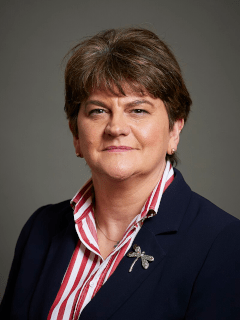
(Pictured: Official portrait of Baroness Foster of Aghadrumsee, January 30, 2024)
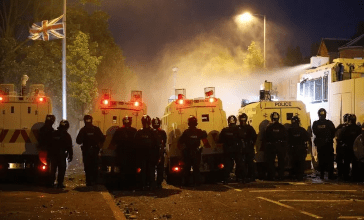
Major rioting and civil disorder break out in Ardoyne, north Belfast, Northern Ireland, on July 12, 2001. In some of the worst rioting in years, 113 police officers are injured in clashes which follow a July 12 parade. Police are attacked when trying clear the path for about 100 Orangemen returning from the parade to go along a main road passing the Catholic Ardoyne area.
In the seven-hour riot which involves about 250 nationalist youth, two blast bombs and 263 petrol bombs are exploded, while a dozen vehicles are hijacked, and 48 plastic bullets are shot by the police. Riot police also use water cannons. There are also incidents in east Belfast, Derry and Ballycastle, but the clashes in Ardoyne are by far the most serious.
The Royal Ulster Constabulary (RUC) says the riots are orchestrated by the Provisional Irish Republican Army, a claim denied by Sinn Féin, who believe the RUC’s heavy response escalates tensions. The incident also intensifies a row over the use of plastic bullets. Forty-eight of them are fired by the RUC in Ardoyne, and Sinn Féin claims fifty of them hit civilians, ten of which are badly injured. Chief ConstableRonnie Flanagan strongly rejects calls from the Northern Ireland Human Rights Commission (NIHRC) to halt its use in riots. Nationalist politicians see the ban on plastic bullets as a vital reform to make Catholics trust the police force more. Gerry Kelly from Sinn Féin says that the RUC “started the riot in Ardoyne. They are a sectarian force, using a very lethal weapon predominantly against nationalists and they should not be allowed to do so.”
A few days later another riot breaks out involving petrol bombs and acid being thrown by loyalists at police in north and west Belfast. Loyalists claim shots are fired at them from the Catholic Short Strand. A buffer zone is created by riot police in North Queen Street. Well-known Ulster Defence Association (UDA) members are spotted. From September 2001 the area sees fresh violence during the Holy Cross dispute and on the 23rd, with rioting also occurring in October and November.
Frazer grows up in the village of Whitecross, County Armagh, Northern Ireland, as one of nine children, with his parents Bertie and Margaret. He is an ex-member of the Territorial Army and a member of the Free Presbyterian Church of Ulster. He attends a local Catholic school and plays Gaelic football up to U14 level. He describes his early years as a “truly cross-community lifestyle.” Growing up, he is a fan of the American actor John Wayne and wrestling. His father, who is a part-time member of the British Army‘s Ulster Defence Regiment (UDR) and a council worker, is killed by the Provisional Irish Republican Army (IRA) on August 30, 1975. The family home had previously been attacked with petrol bombs and gunfire which Frazer claims were IRA men, due to his father’s UDR membership. He states that his family is well respected in the area including by “old-school IRA men” and receives Mass cards from Catholic neighbours expressing their sorrow over his father’s killing. Over the next ten years, four members of Frazer’s family who are members or ex-members of the Royal Ulster Constabulary (RUC) or British Army are killed by the IRA. An uncle who is also a member of the UDR is wounded in a gun attack.
Soon after his father’s death, the IRA begins targeting Frazer’s older brother who is also a UDR member. Like many South Armagh unionists, the family moves north to the village of Markethill. After leaving school, he works as a plasterer for a period before serving in the British Army for nine years. Following this he works for a local haulage company, then sets up his own haulage company, which he later sells.
During the Drumcree conflict, Frazer is a supporter of the PortadownOrange Order who demand the right to march down the Garvaghy Road against the wishes of local residents. He is president of his local Apprentice Boys club at the time.
For a brief period after selling his haulage firm, Frazer runs “The Spot,” a nightclub in Tandragee, County Armagh, which closes down after two Ulster Protestant civilians who had been in the club, Andrew Robb and David McIlwaine, are stabbed to death in February 2000 by the Ulster Volunteer Force (UVF), after one of them had allegedly made derogatory remarks about dead UVF Mid-Ulster Brigade leader Richard Jameson. Frazer is confronted in an interview on BBC Radio Ulster about the murders by the father of one of the victims, Paul McIlwaine. During the Smithwick Tribunal, set up to investigate allegations of collusion in the 1989 Jonesborough ambush, it is alleged by a member of Garda Síochána that Frazer is a part of a loyalist paramilitary group called the Red Hand Commando. Frazer denies this allegation, saying they put his life in danger.
Frazer applies for a licence to hold a firearm for his personal protection and is turned down, a chief inspector says, in part because he is known to associate with loyalist paramilitaries.
FAIR, founded by Frazer in 1998, claims to represent the victims of IRA violence in South Armagh. It has been criticised by some for not doing the same for victims of loyalist paramilitary organisations or for those killed by security forces.
In February 2006, Frazer is an organiser of the Love Ulster parade in Dublin that has to be cancelled due to rioting. In January 2007, he protests outside the Sinn FéinArd Fheis in Dublin that votes to join policing structures in Northern Ireland. He expresses “outrage at the idea that the ‘law-abiding population’ would negotiate with terrorists to get them to support democracy, law and order.”
In January 2007, Frazer dismisses Police OmbudsmanNuala O’Loan‘s report into security force collusion with loyalist paramilitaries.
In March 2010, Frazer claims to have served a civil writ on deputy First MinisterMartin McGuinness, of Sinn Féin, seeking damages arising from the killing of his father by the Provisional IRA. Both Sinn Féin and the courts deny that any such writ had been served, but in June 2010 Frazer announces that he will seek to progress his claim in the High Court. There has since been no report of any such litigation. He previously pickets McGuinness’s home in Derry in 2007 to demand support for calls for Libya to compensate victims of IRA attacks. Accompanied by two other men, he attempts to post a letter to the house but is confronted by local residents and verbally abused. When McGuinness stands for election in the 2011 Irish presidential election, Frazer announces that he and FAIR will picket the main Sinn Féin election events, however, no such pickets take place.
In September 2010, the Special EU Programmes Body (SEUPB) revokes all funding to FAIR due to “major failures in the organisation’s ability to adhere to the conditions associated with its funding allocation” uncovered following a “thorough audit” of the tendering and administration procedures used by FAIR.
In November 2011, the SEUPB announces that it is seeking the return of funding to FAIR and another Markethill victims’ group, Saver/Naver. FAIR is asked to return £350,000 while Saver/Naver is asked to return £200,000. Former Ulster Unionist Party (UUP) leader Reg Empey demands that the conclusions about FAIR’s finances be released into the public domain.
In January 2012, Frazer announces a protest march to be held on February 25 through the mainly Catholic south Armagh village of Whitecross, to recall the killing of ten Protestant workmen by the South Armagh Republican Action Force (SARAF) in January 1976 in the Kingsmill massacre. He also names individuals whom he accuses of responsibility for the massacre. He later announces that the march is postponed “at the request of the Kingsmills families.” A 2011 report by the Historical Enquiries Team finds that members of the Provisional IRA carried out the attack despite the organisation being on ceasefire.
A delegation including Frazer, UUP politician Danny Kennedy and relatives of the Kingsmill families travel to Dublin in September 2012 to seek an apology from the Taoiseach, Enda Kenny. The apology is sought for what they describe as the Irish government‘s “blatant inaction” over the Kingmills killings. The Taoiseach says he cannot apologise for the actions of the IRA but assures the families there is no hierarchy for victims and their concerns are just as important as any other victims’ families. The families express disappointment although Frazer states he is pleased to have met the Taoiseach.
On November 16, 2012, Frazer announces that he is stepping down as director of FAIR, after he had reviewed a copy of the SEUPB audit report which, he claims, shows no grounds for demanding the reimbursement of funding. He adds, “I will still be working in the victims sector.”
In 2019, the BBC investigative journalism programme Spotlight reports that Frazer distributed assault rifles and rocket launchers from Ulster Resistance to loyalist terror groups who used them in more than 70 murders. A police report on the activities of the former Ulster Defence Association (UDA) boss Johnny Adair states he was receiving weapons from Ulster Resistance in the early 1990s and his contact in Ulster Resistance was Frazer.
In addition to his advocacy for Protestant victims, Frazer contests several elections in County Armagh. He is not elected and, on most occasions, loses his deposit. He runs as an Ulster Independence Movement candidate in the 1996 Forum Elections and the 1998 Assembly elections, and as an independent in the 2003 Assembly elections and a council by-election.
In the 2011 Northern Ireland Assembly election Frazer is listed as a subscriber for the Traditional Unionist Voice (TUV) candidate for the Newry and Armagh constituency, Barrie Halliday, who secures 1.8% of the vote. At Newry Crown Court on Wednesday, June 21, 2017, Pastor Barrie Gordon Halliday is sentenced to nine months in prison, suspended for eighteen months, when he pleads guilty to seventeen counts of VAT repayment fraud.
In November 2012, Frazer announces his intention to contest the 2013 Mid Ulster by-election necessitated by Martin McGuinness’s decision to resign the parliamentary seat to concentrate on his Assembly role. He is quoted in The Irish News in January 2013 as stating that he will not condemn any paramilitary gunman who shoots McGuinness.
Despite his earlier advocacy of Ulster nationalism, in 2013 Frazer declares himself in favour of re-establishing direct rule in Northern Ireland.
Frazer dies of cancer in Craigavon, County Armagh, Northern Ireland, on June 28, 2019. Traditional Unionist Voice (TUV) leader Jim Allister and DUP Assembly member Jim Wells pay tribute to his memory.




 seamus dubhghaill