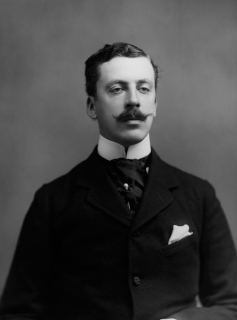
Hamilton is born in Hamilton Place, Piccadilly, London, on November 30, 1869. Styled Marquess of Hamilton between 1885 and 1913, he is a British peer and Unionist politician. He serves as the first Governor of Northern Ireland, a post he holds between 1922 and 1945. He is a great-grandfather of Diana, Princess of Wales.
In early 1901 he accompanies his father on a special diplomatic mission to announce the accession of King Edward to the governments of Denmark, Sweden and Norway, Russia, Germany, and Saxony.
Hamilton dies at his London home on September 12, 1953, and is buried at Baronscourt in County Tyrone.
(Pictured: “James Albert Edward Hamilton, 3rd Duke of Abercorn” by Alexander Bassano, Collodion Negative, 1894, Photographs Collection, National Portrait Gallery, London)
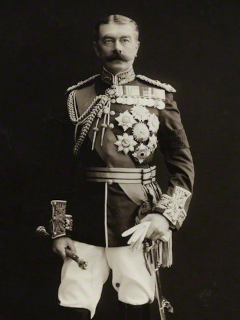
Kitchener is credited in 1898 for winning the Battle of Omdurman and securing control of the Sudan for which he is made Baron Kitchener of Khartoum. As Chief of Staff (1900–1902) in the Second Boer War he plays a key role in Lord Roberts’ conquest of the Boer Republics, then succeeds Roberts as commander-in-chief, by which time Boer forces have taken to guerrilla warfare and British forces imprison Boer civilians in concentration camps. His term as Commander-in-Chief (1902–09) of the Army in India sees him quarrel with another eminent proconsul, the Viceroy Lord Curzon, who eventually resigns. He then returns to Egypt as British Agent and Consul General.
In 1914, at the start of World War I, Kitchener becomes Secretary of State for War, a Cabinet Minister. One of the few to foresee a long war, lasting for at least three years, and with the authority to act effectively on that perception, he organises the largest volunteer army that Britain had ever seen, and oversees a significant expansion of materials production to fight on the Western Front. Despite having warned of the difficulty of provisioning for a long war, he is blamed for the shortage of shells in the spring of 1915, one of the events leading to the formation of a coalition government and is stripped of his control over munitions and strategy.
On June 5, 1916, Kitchener is making his way to Russia on HMS Hampshire to attend negotiations with Tsar Nicholas II. At the last minute, Admiral Sir John Jellicoe changes the HMS Hampshire‘s route on the basis of a misreading of the weather forecast and ignoring (or not being aware of) recent intelligence and sightings of GermanU-boat activity in the vicinity of the amended route. Shortly before 7:30 PM the same day, steaming for the Russian port of Arkhangelsk during a Force 9 gale, HMS Hampshire strikes a mine laid by the newly launched German U-boat U-75 and sinks 1.5 miles west of the Orkney. Only twelve men survive. Amongst the dead are Kitchener and all ten members of his entourage. He is seen standing on the quarterdeck during the approximately twenty minutes that it takes the ship to sink. His body is never recovered.
Wellesley is born to Garret Wesley, 1st Earl of Mornington and Anne Wellesley, Countess of Mornington. Fatherless at an early age and neglected by his mother, he is a reserved, withdrawn child. He fails to shine at Eton College and instead attends private classes in Brussels, followed by a military school in Angers, France. Ironically, he has no desire for a military career. Instead, he wishes to pursue his love of music. Following his mother’s wishes, however, he joins a Highland regiment.
Wellesley fights at Flanders in Belgium in 1794, and directs the campaign in India in 1796, where his elder brother Richard is Governor-General. Knighted for his efforts, he returns to England in 1805.
After the Battle of Waterloo, Wellesley becomes Commander in Chief of the army in occupied France until November 1818. He then returns to England and Parliament, and joins Robert Jenkinson, 2nd Earl of Liverpool’s government in 1819 as Master-General of the Ordnance. He undertakes a number of diplomatic visits overseas, including a trip to Russia.
In 1828, after twice being overlooked in favour of George Canning and F. J. Robinson, 1st Viscount Goderich, Wellesley is finally invited by King George IV to form his own government and set about forming his Cabinet. As Prime Minister, he is very conservative; known for his measures to repress reform, his popularity sinks a little during his time in office. Yet one of his first achievements is overseeing Catholic emancipation in 1829, the granting of almost full civil rights to Catholics in the United Kingdom. Feelings run very high on the issue. George Finch-Hatton, 10th Earl of Winchilsea, an opponent of the bill, claims that by granting freedoms to Catholics Wellesley “treacherously plotted the destruction of the Protestant constitution.”
Wellesley has a much less enlightened position on parliamentary reform. He defends rule by the elite and refuses to expand the political franchise. His fear of mob rule is enhanced by the riots and sabotage that follow rising rural unemployment. His opposition to reform causes his popularity to plummet to such an extent that crowds gathered to throw missiles at his London home.
The government is defeated in the House of Commons and Wellesley resigns on November 16, 1830, to be replaced by Charles Grey, 2nd Earl Grey. Wellesley, however, continues to fight reform in opposition, though he finally consents to the Great Reform Act in 1832.
Two years later Wellesley refuses a second invitation to form a government because he believes membership in the House of Commons has become essential. The king reluctantly approves Robert Peel, who is in Italy at the time. Hence, Wellesley acts as interim leader for three weeks in November and December 1834, taking the responsibilities of Prime Minister and most of the other ministries. In Peel’s first cabinet (1834–1835), he becomes Foreign Secretary, while in the second (1841–1846) he is a Minister without portfolio and Leader of the House of Lords. Upon Peel’s resignation in 1846, he retires from politics.
In 1848 Wellesley organises a military force to protect London against possible Chartist violence at the large meeting at Kennington Common.
(From: “Arthur Wellesley, 1st Duke of Wellington,” GOV.UK (wwww.gov.uk) | Pictured: “Arthur Wellesley, 1st Duke of Wellington (1769-1852)” by Thomas Lawrence, oil on canvas)
Robinson describes the resources available to her office as inadequate and says there was a striking contrast between the fine words used at the annual United Nations Commission on Human Rights meeting in Geneva and the realities on the ground.
Robinson’s announcement comes as a surprise to senior staff and diplomats who had believed she might follow the example of other UN chiefs and seek a second term. Only the second person to serve in the post, she is scheduled to step down in September at the conclusion of her four-year term.
“I will continue to work wholeheartedly for human rights in the way that I know best, as an advocate,” Robinson says. “I believe that I can, at this stage, achieve more outside of the constraints that a multilateral organisation inevitably imposes.”
Robinson tells the 53-member nation commission at the start of its six-week session, “I know some will feel that I should have sought to continue working from within the United Nations and I ask them to respect my decision.”
“Racism and xenophobia, manifesting themselves through discrimination and all forms of intolerance, are the wellspring of many of the world’s conflicts,” Robinson says in her address to the commission.
The 2001 forum in Geneva focuses on alleged human rights abuses in hotspots including China, the breakaway Russian republic of Chechnya as well as the West Bank and Gaza Strip.
Robinson has been a high-profile and outspoken UN commissioner, on occasion angering governments with criticism of their human rights record. She says Secretary-General of the United Nations, Kofi Annan, had advised her to “stay an outsider” while working within the organisation in as far as she could. And this, she says, had at times made her “an awkward voice,” both for colleagues in the UN and governments. “I make no apology for this,” she adds.
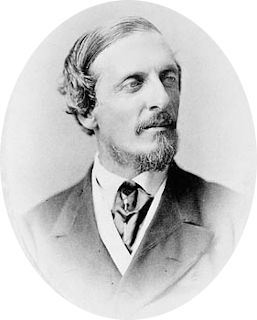
In 1872 Lord Dufferin becomes the third Governor General of Canada, bolstering imperial ties in the early years of the Dominion. After leaving Ottawa in 1878 at the end of his term, he returns to Great Britain to continue his diplomatic career. He serves as British ambassador to Imperial Russia from 1879 to 1881. In 1881 he becomes ambassador to the Ottoman Empire and deals with the problems raised by the British occupation of the Ottoman dependency of Egypt. In 1884 he reaches the pinnacle of his diplomatic career when he succeeds George Robinson, 1st Marquess of Ripon as Viceroy and Governor-General of India and placates the British community there, which had been antagonized by Ripon’s reforms.
By the annexation of Burma (Myanmar) in 1886, Lord Dufferin consolidates British territories. For his services he is made Marquess of Dufferin and Ava when, in 1888, he retires from India. He then spends three years (1889–91) as Britain’s ambassador to Italy and four years (1892–96) as ambassador to France. He retires in 1896.
Following his retirement from the diplomatic service, Lord Dufferin’s final years are marred by personal tragedy and a misguided attempt to secure his family’s financial position. In 1897, worried about the family financial situation, he is persuaded to become chairman of the London and Globe Finance Corporation, a mining promotion and holding company controlled by Whitaker Wright. It subsequently transpires that Wright is a consummate fraudster and the firm goes bankrupt, although Lord Dufferin is not guilty of any deception and his moral standing remains unaffected. Soon after the misfortune, his eldest son, Lord Ava, is killed in the Second Boer War and another son is badly wounded.
Following the death of his son and in poor health, Lord Dufferin returns to his country house at Clandeboye, near Bangor, County Down, and dies there on February 12, 1902.
Lord Dufferin’s biographer Richard Davenport-Hines says he was “imaginative, sympathetic, warm-hearted, and gloriously versatile.” He was an effective leader in Lebanon, Canada and India, averted war with Russia, and annexed Burma. He was careless with money but charming in high society on three continents.
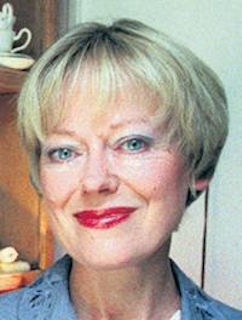
Clare Boylan, Irish author, journalist and critic for newspapers, magazines and many international broadcast media, is born in Dublin on April 21, 1948.
After leaving St. Louis convent, Boylan takes a job as a sales assistant in a bookshop before beginning her career as a journalist at The Irish Press, now defunct. In 1974 she wins the Journalist of the Year award when working in the city for the Evening Press. Later in her career she edits the glossy magazine Image, before largely giving up journalism to focus on a career as an author.
Boylan’s novels are Holy Pictures (1983), Last Resorts (1984), Black Baby (1988), Home Rule (1992), Beloved Stranger (1999), Room for a Single Lady (1997), which wins the Spirit of Light Award and is optioned for a film, and Emma Brown (2003). The latter work is a continuation of a 20-page fragment written by Charlotte Brontë before her death.
Boylan’s short stories are collected in A Nail on the Head (1983), Concerning Virgins (1990) and That Bad Woman (1995). The film Making Waves, based on her short story “Some Ladies on a Tour”, is nominated for an Oscar in 1988.
Boylan’s non-fiction includes The Agony and the Ego (1994) and The Literary Companion to Cats (1994). She writes introductions to the novels of Kate O’Brien and Molly Keane and adapts Keane’s novel Good Behaviour as the classic serial for BBC Radio 4 (2004). Her work has been translated as far afield as Russia and Hong Kong.
In later life, Boylan lives in County Wicklow with her husband Alan Wilkes. When she is diagnosed with ovarian cancer, she faces her illness with characteristic strength. She takes up kickboxing and spends time in France, shopping, cooking and entertaining friends. She succumbs to cancer at the age of 58 on May 16, 2006.
Sterling’s post in Ireland ends on March 7, 1934, when he becomes U.S. minister to Bulgaria, a position he remains in until 1936. In 1937, he is appointed to minister roles for both Latvia and Estonia, however he does not accept the post. In 1938, he becomes U.S. minister to Sweden and remains in that role until 1941.
MacGahan’s father is an immigrant from Ireland who had served on the Northumberland, the ship which took Napoleon into exile on Saint Helena. He moves to St. Louis, where he briefly works as a teacher and as a journalist. There he meets his cousin, General Philip Sheridan, an American Civil War hero also of Irish parentage, who convinces him to study law in Europe. He sails to Brussels in December 1868.
MacGahan does not get a law degree, but he discovers that he has a gift for languages, learning French and German. He runs short of money and is about to return to America in 1870 when the Franco-Prussian War breaks out. Sheridan happens to be an observer with the German Army, and he uses his influence to persuade the European editor of the New York Herald to hire MacGahan as a war correspondent with the French Army.
MacGahan’s vivid articles from the front lines describing the stunning defeat of the French Army win him a large following, and many of his dispatches to the Herald are reprinted by European newspapers. When the war ends, he interviews French leader Léon Gambetta and Victor Hugo and, in March 1871, he hurries to Paris and is one of the first foreign correspondents to report on the uprising of the Paris Commune. He is arrested by the French military and nearly executed and is only rescued through the intervention of the U.S. Minister to FranceElihu B. Washburne.
In 1871 MacGahan is assigned as the Herald‘s correspondent to Saint Petersburg. He learns Russian, mingles with the Russian military and nobility, covers the Russian tour of General William Tecumseh Sherman and meets his future wife, Varvara Elagina, whom he marries in 1873. In 1874 he spends ten months in Spain, covering the Third Carlist War.
In 1876 MacGahan quarrels with James Gordon Bennett Jr., the publisher of the New York Herald, and leaves the newspaper. He is invited by his friend, Eugene Schuyler, the American Consul-General in Constantinople, to investigate reports of large-scale atrocities committed by the Turkish Army following the failure of an attempted uprising by Bulgarian nationalists in April 1876. He obtains a commission from The Daily News, then the leading liberal newspaper in England, and leaves for Bulgaria on July 23, 1876.
MacGahan reports that the Turkish soldiers have forced some of the villagers into the church, then the church is burned, and survivors tortured to learn where they have hidden their treasures. He says that of a population of seven thousand, only two thousand survive. According to his account, fifty-eight villages in Bulgaria are destroyed, five monasteries demolished, and fifteen thousand people in all massacred. These reports, published first in The Daily News, and then in other papers, cause widespread popular outrage against Turkey in Britain. The government of British Prime MinisterBenjamin Disraeli, a supporter of Turkey, tries to minimize the massacres and says that the Bulgarians are equally to blame, but his arguments are refuted by the newspaper accounts of MacGahan.
In the wake of the massacres and atrocities committed by the Ottoman forces during the suppression of the April Uprising, as well as centuries-long conflicts between Russia and Turkey in Crimea, the Russian Government, stirred by anti-Turkish and Pan-Slavism sentiment, prepare to invade the Ottoman Empire, and declare war on it on April 24, 1877. The Turkish Government of SultanAbdul Hamid II appeals for help to Britain, its traditional ally against Russia, but the British government responds that it cannot intervene “because of the state of public feeling.”
MacGahan is assigned as a war correspondent for The Daily News and, thanks to his friendship with General Skobelev, the Russian commander, rides with the first units of the Russian Army as it crosses the Danube into Bulgaria. He covers all the major battles of the Russo–Turkish War, including the Siege of Plevna and the Battle of Shipka Pass. He reports on the final defeat of the Turkish armies and is present at the signing of the Treaty of San Stefano, which ends the war.
MacGahan is in Constantinople, preparing to travel to Berlin for the conference that determines the final borders of Bulgaria, when he catches typhoid fever. He dies on June 9, 1878, and is buried in the Greek cemetery, in the presence of diplomats, war correspondents, and General Skobelev. Five years later his body is returned to the United States and reburied in New Lexington and a statue is erected in his honor by a society of Bulgarian Americans.
Initially sent by editor John Delane to Malta to cover British support for the Ottoman Empire against Russia in 1854, Russell despises the term “war correspondent” but his coverage of the conflict brings him international renown, and Florence Nightingale later credits her entry into wartime nursing to his reports. The Crimean medical care, shelter and protection of all ranks by Mary Seacole is also publicised by Russell and by other contemporary journalists, rescuing her from bankruptcy.
His dispatches are hugely significant as for the first time the public can read about the reality of warfare. Shocked and outraged, the public’s backlash from his reports leads the Government to re-evaluate the treatment of troops and leads to Florence Nightingale’s involvement in revolutionising battlefield treatment.
On September 20, 1854, Russell covers the battle above the Alma River, writing his missive the following day in an account book seized from a Russian corpse. The story, written in the form of a letter to Delane, is supportive of the British troops and pays particular attention to the battlefield surgeons’ “humane barbarity” and the lack of ambulance care for wounded troops. He later covers the Siege of Sevastopol where he coins the phrase “thin red line” in referring to British troops at Balaclava.
Following Russell’s reports of the appalling conditions suffered by the Allied troops conducting the siege, including an outbreak of cholera, Samuel Morton Peto and his partners build the Grand Crimean Central Railway, which is a major factor leading to the success of the siege.
Russell spends December 1854 in Constantinople on holiday, returning in early 1855. He leaves Crimea in December 1855 to be replaced by the Constantinople correspondent of The Times.
In 1856 Russell is sent to Moscow to describe the coronation of Tsar Alexander II and in the following year is sent to India where he witnesses the final re-capture of Lucknow.
Russell retires as a battlefield correspondent in 1882 and founds the Army and Navy Gazette. He is knighted in May 1895 and is appointed a Commander of the Royal Victorian Order (CVO) by King Edward VII on August 11, 1902.
Sir William Howard Russell dies on February 11, 1907, and is buried in Brompton Cemetery, London.
Fenians propose a “New Departure,” an alliance with the Parnellites, on October 27, 1878. The term New Departure is used to describe several initiatives in the late 19th century by which Irish republicans, who are committed to independence from Britain by physical force, attempt to find a common ground for co-operation with groups committed to Irish Home Rule by constitutional means. The term refers to the fact that Fenians are to some extent departing from their orthodox doctrine of noninvolvement with constitutional politics, especially the British parliament.
John O’Connor and Dr. Mark Ryan, both members of the IRB’s Supreme Council, believe O’Connor Power has some hand in the new departure. John O’Connor suspects that Michael Davitt of the IRB has been influenced by O’Connor Power, and that the new departure proposals conceal some sinister scheme of Power’s devising, assumptions that Davitt hotly rejects. The precedent for constitutional agitation set by Power is not lost on orthodox Fenians such as Dr. Ryan, who sees behind the new departure the nefarious influence of the member for Mayo.
In late 1878 Michael Davitt makes a fund-raising political lecture tour of the United States, promoted by William Carroll and John Devoy of Clan na Gael. On October 13 in Brooklyn, New York, Davitt first presents, in a lecture titled “Ireland in parliament from a nationalist’s point of view,” a doctrine that Irish republicans cannot prevent Irishmen voting or being elected to the British parliament, but they can influence who is sent to that parliament. He states that the Home Rule League, especially Isaac Butt and John O’Connor Power, are failing to prevent Ireland from being “imperialised” or “West Britainised.” Davitt however believes that Parnell and Joseph Biggar are acceptable Irish MPs, and Irish republicans should ensure that more such strong nationalists are voted in. John Devoy follows and points out that if Irish republicans are to gain the support of Britain’s potential enemies, such as Russia, they need to provide far stronger opposition to Britain both inside and outside parliament. He points out that Russia has not yet seen the Irish as providing any such meaningful opposition, in fact to Russia they appear loyal to Britain. Hence it is necessary to replace representatives in all Irish public bodies with suitable committed nationalists. Both Davitt and Devoy at this meeting stress that resolution of the Irish land question by transfer of ownership to the farmers themselves is integral to Irish demands on Britain.
On October 27, 1878, Devoy, without first consulting Davitt, summarises these ideas in what he terms a “new departure” in the New York Herald, and it is reported in Ireland on November 11. He also states that Irish participation in the British parliament is to be temporary, and that at a suitable time Irish nationalist MPs will withdraw to Dublin and form an independent Irish legislature. Davitt is at first worried that perceived connections to the Fenians will threaten Parnell in parliament, but Devoy convinces him that Parnell will not be affected. IRB leaders John O’Leary and Charles Kickham reject the overture to constitutionalists and Parnell gives no comment. He does however adopt the militant rhetoric of land ownership to be transferred to the Irish farmers themselves in various public speeches in Ireland. Hence the stage is set for the successful collaboration in 1879 over the Land War.





 seamus dubhghaill