seamus dubhghaill

Promoting Irish Culture and History from Little Rock, Arkansas, USA


Leave a comment

Birth of Kathleen Behan, Irish Republican & Folk Singer

Kathleen Behan (née Kearney), Irish republican and folk singer, and mother of Irish authors BrendanBrian and Dominic, is born on September 18, 1889, at 49 Capel StreetDublin.

She is the fifth child and youngest daughter of pork butcher and grocer, John Kearney (1854–97), and his wife Kathleen Kearney (née McGuinness) (1860–1907). She has four brothers and two sisters. Her father is from Rosybrook, County Louth and her mother is from Rathmaiden, Slane, County Meath, both coming from prosperous farming families. Her father has a business on Lower Dorset Street, with a grocery, pub and a row of houses. Owing to his own poor management, by the time she is born he has a smaller business on Dolphin’s Barn Lane. Following his death in 1897, she and her sisters are placed in the Goldenbridge orphanage at Inchicore by their mother. She is there from 1898 to 1904 where she becomes an avid reader. When she leaves, she rejoins her family in a one-room tenement flat on Gloucester Street.

Her oldest sibling, Peadar Kearney, is an ardent republican who writes the lyrics to the song that becomes the Irish national anthem, ”Amhrán na bhFiann”(English: “The Soldier’s Song”). It is through him that she meets a printer’s compositor and member of the Irish Volunteers, Jack Furlong. They marry in 1916. She is an active member of Cumann na mBan, and serves as a courier to the General Post Office, Dublin and other outposts during the 1916 Easter Rising. At the same time, Furlong fights in the Jacob’s factory garrison. The couple has two sons: Roger Casement (Rory) Furlong (1917–87) and Sean Furlong (born March 1919). Sean is born six month’s after she is widowed when Furlong dies in the Spanish flu epidemic of 1918. She lives with her mother-in-law, who is also a republican and seamstress who makes Irish Volunteer uniforms. She is arrested for running an Irish Republican Army (IRA) safe house. She works for a short time for Maud Gonne as a housekeeper, where she meets W. B. Yeats and Sarah Purser. A study painted of her by Purser (above) is now in the National Gallery of Ireland entitled The Sad Girl. From 1918 to 1922 she works as a clerk in the Dublin Corporation, while also a caretaker in the Harcourt Street branch of the Irish White Cross republican aid association.

In 1922 she marries Stephen Behan, house painter, trade unionist and fellow republican. The couple has four sons and one daughter: Brendan (b. 1923), Seamus (b. 1925), Brian (b. 1926), Dominic (b. 1928), and Carmel (b. 1932). Brendan is born while his father is imprisoned during the Irish Civil War, and Behan claims that Michael Collins gives her money while she is pregnant. Stephen’s mother owns three slum tenements, so the Behans live rent-free in a one-room basement flat at 14 Russell Street. Owing to her disdain at gossiping on the house steps, she is nicknamed “Lady Behan” by her neighbours. When Stephen’s mother dies in 1936, the Behans moved to a newly built council house in Crumlin, living at 70 Kildare Road. The family finds the new house far from work and school, and the local area devoid of community.

The family experiences extreme poverty frequently, owing to Stephen’s unemployment and during the nine month long building strike of 1936. Behan attempts to claim a pension as her first husband had served in 1916, but her application is rejected. She had said the exposure to flour had effected Furlong’s lungs negatively. It is declined as she had remarried before the enactment of the Army Pensions Act 1923. Despite their circumstances, the house attracts conversation, music, books and politics. The Behan’s republican, socialist, labour activist and anti-clericalism have a strong effect on their sons, particularly Brendan and Dominic. Such is the volume of radical meetings that take place at the Behan home, it is dubbed “the Kremlin” by their neighbours, and a “madhouse” by Stephen. During The Emergency of 1939 to 1945 she fights against local shopkeepers who ignore price controls, and is labelled as “red” for her anti-Franco and pro-Stalin sympathies. Her reply to the branding of her as such is “I’m not red, I’m scarlet.”

From the 1950s onwards, Behan shares international fame with her sons Dominic and Brendan. She often travels to London to see their plays, eventually appearing on British and Irish television and cultivating her own following. She is badly injured when she is struck by a motorcycle, a day before Stephen’s death in 1967. Owing to the effect of these injuries, she moves in 1970 to the Sacred Heart Residence of the Little Sisters of the Poor, Sybil Hill, Raheny.

In 1981, she records an album When All the World Was Young. Taped conversations of her reminiscences are made into an autobiographic book, Mother of all the Behans, by her son Brian in 1984. A one-woman stage adaptation of the book by Peter Sheridan and starring Rosaleen Linehan is acclaimed in Ireland, Britain and North America.

Behan dies in the nursing home in Raheny on April 26, 1984, and is buried in Dean’s Grange Cemetery.

(Pictured: Portrait of Kathleen Behan by Sarah Purser, National Gallery of Ireland)


Leave a comment

Death of Wilhelmina Geddes, Stained Glass Artist

Wilhelmina Geddes, Irish stained glass artist who is an important figure within the Irish Arts and Crafts movement and also the twentieth-century British stained glass revival, dies in London, England, on August 10, 1955. Her notable works include windows at St. Bartholomew’s Anglican Church (Ottawa, Canada), St. Peter’s Church (LampeterWales), and the King Albert Memorial Window, St. Martin’s Cathedral (Ypres, Belgium).

Geddes is born on her maternal grandparent’s farm at Drumreilly Cottage in Leitrim, County Leitrim, on May 25, 1887. She is the eldest of four children, three girls and a boy, of William Geddes and his wife Eliza Jane Stafford. The family, who migrates to Ireland from Scotland, has mainly been farmers. Her father, a Methodist, who is born near his father’s farm at TandrageeCounty Armagh, emigrates to the United States as a young man, working as a labourer for the railway construction business. This serves a useful purpose as he had worked as a site engineer at the Cavan, Leitrim and Roscommon Railway Company. When she is still an infant her parents move to their native home in Belfast, so her father can set up in business as a building contractor.

Geddes begins drawing subjects from life and nature from the age of four. She learns first how to draw from the school mistress in Ayrshire, where her father occasionally goes shooting. She begins her studies at Methodist College Belfast along with her three younger sisters. She later moves to the Belfast School of Art. She is encouraged by Rosamond Praeger, a sculptor from County Down, to continue with her studies. She is accepted as a student to study at the Belfast School of ArtUlster University. This is where she adapts and improves her style and is introduced to a professional standard of art work.

While still studying at the Belfast School of Art, Geddes takes part in the Arts and Crafts Society of Ireland‘s fourth exhibition. For this exhibition, she contributes a glowingly coloured illustration of the book Cinderella Dressing the Ugly Sister (Dublin City Gallery), which she had created. It is at this exhibition that her work is spotted by Sarah Purser, a well established painter seeking newly trained students to introduce to stained glass artistry. Purser, who goes on to be her lifelong mentor, invites the young Geddes to join her in Dublin, working under the established stained glass artist William Orpen.

Geddes contributes a watercolour illustration of a Ballad Seller with the Belfast Art Society in 1907. She is elected as an Associate of the Belfast Art Society’s successor, the Ulster Academy of Arts, in 1933 before promotion to Honorary Academician in 1935. She shows five illustrations in the 1911 Oireachtas Exhibition. It is some twenty-one years before she returns to the Oireachtas when she exhibits three cartoons and three sketches for stained glass in 1932.

Geddes joins Purser at the acclaimed stained glass workshop called An Túr Gloine in 1910. The workshop is held in Dublin’s Metropolitan School of Art. It is here that she discovers her passion for the craftsmanship of stained glass artistry and creates her most important works.

During her early years at An Túr Gloine, Geddes’s originality shines, and important commissions come from St. Ann’s Church, Dawson Street, Dublin and the Presbyterian church in Rathgar. Dogged by illness, she returns to Belfast before 1916 and lives between there and Dublin until moving in 1925, as she has long wanted, to work in London at The Glass House, Fulham. While working at The Glass House, she instructs the Irish painter and stained glass artist Evie Hone.

Geddes’s work is considered pioneering and represents a rejection of the Late Victorian approach. She creates a new view of men in stained glass windows, portraying them with close-shaven crew cuts. The muscularity and tension of her portraiture is matched by the radical design of her constructions. Ambitious large-scale projects, as at the cathedral in Ypres, are equalled by the drama of smaller-scale work at Wallasey (Lancashire) and Wallsend (Northumberland), or war memorial windows in obscure country churches.

Despite the hardships of living in London during World War II, poverty, and ill health, Geddes designs seventeen full-scale stained glass masterpieces, sixteen of which she completes.

Geddes dies on August 10, 1955 in London of a pulmonary embolism. She is buried in Carnmoney Cemetery, County Antrim, along with her mother and sister Ethel. Even after moving to London, she claims that her native identity never wavered as she says she was always “a Belfast woman.”


Leave a comment

Birth of Catherine O’Brien, Irish Stained Glass Artist

Catherine Amelia “Kitty” O’Brien, Irish stained glass artist and a member and director of An Túr Gloine, is born in Durra House, Spancill Hill, County Clare, on June 19, 1881.

O’Brien is one of five children of Pierce O’Brien, a gentleman landowner, and Sophia Angel St John O’Brien. Her first cousin is woodcarver Sophia St John Whitty. She attends the Mercy Convent in Ennis, going on to win a scholarship to the Dublin Metropolitan School of Art. While there she studies under William Orpen and Alfred E. Child who teach her the art of stained glass.

Among O’Brien’s first commissions is the St. Ita window for St. Brendan’s cathedral in Loughrea, County Galway, in 1904, which is designed by Sarah Purser. She joins An Túr Gloine in 1906, beginning her career there by designing Angel of the Annunciation window in the Enniskillen convent chapel. For a window in the Wilson private chapel at Coolcarrigan House, NaasCounty Kildare, in 1912, she incorporates Celtic design, some drawing on the Book of Durrow. In 1914, she tours the cathedrals of ParisRouen, and Chartres with Purser and Wilhelmina Geddes. She designs three windows depicting St. John, St. Flannan, and St. Munchin, for the Honan Chapel at University College Cork in 1916. Her 1923 design of the centenary memorial window in St. Andrew’s church, Lucan, represents the parable of the Good Shepherd. When in 1925 An Túr Gloine becomes a cooperative society, she becomes a shareholder along with Ethel RhindEvie Hone, and Michael Healy.

O’Brien’s 1926 lunette The Spirit of Night represents night, twilight, and dawn, and is for the private home of Keng Chee in Singapore, which is later demolished. The window of St. Catherine of Siena for the Sacred Heart convent chapel in Newton, Massachusetts dates from 1927. Her 1931 St. Patrick window, for the De La Salle school, East Coast Rd., Singapore, commissioned by architect Denis Santry, is the only extant stained-glass work by an Irish artist in that country. Much like Rhind, O’Brien also employs opus sectile, such as in her 1936 Mass in Penal Days in the Franciscan friary, AthloneCounty Westmeath. She contributes two windows, Pelican and Lamb and Host and Chalice: Wheat and Grapes, to the ten windows An Túr Gloine produces for Brophy College ChapelPhoenix, Arizona in 1937. From 1937 until 1947, she works on 22 opus sectile panels for the Protestant Church in Ennis.

Purser retires from An Túr Gloine in 1940, and O’Brien succeeds her as director, going on to purchase it and the contents in 1944. She rents a section of the premises to fellow stained-glass artist Patrick Pollen from 1954 onwards. She exhibits at the 1953 Irish Exhibition of Living Art, and the 1958 exhibition of the Arts and Crafts Society of Ireland. When the An Túr Gloine studios are damaged by fire in 1958, she rebuilds them and reopens by 1959. She is an active member of the Soroptimists and the Guild of Irish Art Workers. The last work she completes is a three-light window for the Church of St. MultoseKinsale, County Cork, in 1962. A commission for two windows for the private chapel of Áras an Uachtaráin for President Éamon de Valera is left unfinished at her death.

O’Brien dies in Dublin on July 18, 1963, and is buried in Whitechurch Parish Graveyard, County Dublin. She is commemorated in a window designed by Pollen in St. Laurence O’Toole chapel, Christ Church Cathedral, Dublin, where for forty years she made floral arrangements. Over 150 of her An Túr Gloine drawings from notebooks are now in the National Gallery of Ireland.

(Pictured: Stained glass window in the south wall of Ferns Cathedral, Ferns, County Wexford)


Leave a comment

Birth of Lilian Davidson, Artist, Teacher & Writer

Lilian Davidson ARHA, Irish landscape and portrait artist, teacher and writer, is born on January 26, 1879, at Castle Terrace, Bray, County Wicklow.

Davidson is the sixth of ten children of clerk of petty session, Edward Ellice Davidson, and Lucy Rising Davidson (née Doe). Her mother dies in 1888, and it is presumed that she receives a private education but as the family are not affluent, the details are unclear. She goes on to attend the Dublin Metropolitan School of Art (DMSA) from 1895 to 1905. While at the DMSA, she wins prizes in 1895 and 1896 and is awarded a scholarship and free studentship at the Royal Dublin Society (RDS) in 1897, the same year her father dies. She completes her studies in 1905. In the early 1910s, she is living in Rathmines and spends some time in England and Wales.

Davidson is commissioned by Switzer’s department store on Grafton Street to draw costumes in 1899. In 1909, her painting After Rain is exhibited by the Dublin Sketching Club, with her continuing to show work there until 1920. She exhibits The Bonfire with the Water Colour Society of Ireland in 1912, becoming a committee member in 1934 and continuing to exhibit with them until 1954. In 1914, she is one of the artists included in a sale of paintings to aid Belgian refugees. She is first exhibited at the Royal Hibernian Academy (RHA) in 1914, with The Student. Her painting exhibited by the RHA in 1916, The Harbour, St. Ives, demonstrates an influence from Stanhope Forbes and the Newlyn School, with a bright palette and contrasting illumination, which become characteristic of her work. She illustrates C. H. Bretherton’s collection of humorous poems and recollections about London Zoo, A Zoovenir (1919).

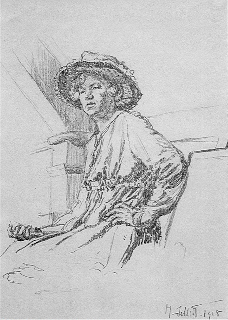
Davidson holds a joint exhibition with Mainie Jellett in 1920, at Mill’s Hall, Merrion Row, Dublin. Jellett produces a pencil portrait of Davison (pictured above), which shows her in a straw hat she frequently wears. The RHA exhibits Davidson’s oil painting, The Flax Pullers, in 1921. This work shows an influence from Paul Henry and French Impressionism in her use of colour-blocking. In the early 1920s, she travels to Switzerland, Belgium, and France, producing works such as Fish Market, Bruges. She lives in Paris in the late 1920s, exhibiting at the Salon de la Societé Nationale in 1924 and 1930. She places a self-portrait in her depiction of a peasant gathering, The Country Races. Reproductions of her drawing of Leinster House and Christ Church Cathedral by Bulmer Hobson are included in A Book of Dublin (1929). Her landscape, Low Tide, Wicklow, which is exhibited at the RHA in 1934, and Boats at Wicklow, Dusk show her ability to depict reflections in water. She continues to paint scenes of rural life, including Cottages – Keel, Achill, which shows an influence from Jack Butler Yeats in her use of space and colour. The fact that her family is not wealthy likely influences her choice of poorer people as her subjects, depicting them in a sympathetic manner. Her work is part of the painting event in the art competitions at the 1928 Summer Olympics.

Davidson’s paintings are exhibited at the Contemporary Picture Galleries, Dublin in 1930, alongside Yeats, Evie Hone, and Harry Kernoff. She is a member of the Picture Hire Club, 24 Molesworth Street, Dublin from 1941 to 1942, and is a frequent contributor to the Munster Fine Arts Club. Her work is exhibited at the Salon des Beaux Arts, Paris, the Royal Academy of Arts, London, and in Amsterdam. A large number of her works from the 1930s show the Irish-speaking area of Galway, Claddagh, such as Night in Claddagh, exhibited with the RHA in 1933. Her Irish landscapes, such as Claddagh Cottages, are included in the Oireachtas Art Exhibitions from 1932 to 1946. From around 1934, she is a member of the Society of Dublin Painters, exhibiting with them from 1939 to 1954. She influences the Society’s move toward the avant-garde in the 1940s. She is elected associate to the RHA in 1940 and continues to exhibit there until her death. Her 1946 work, Gorta, shows influence from Zola, Rilke, Dostoyevsky and Picasso.

Davidson teaches drawing at her studio at 1 Earlsfort Terrace, Dublin. Her pupils include Bea Orpen, Anne Yeats, and Mo Irwin. She also is a teacher at a number of Dublin schools, such as Belgrave school, Rathmines, Wesley College, St. Stephen’s Green, and Castle Park School, Dalkey. She travels to Abbeyleix, County Laois, once a week to teach at Glenbawn boarding school.

As well as painting, Davidson writes a number of plays, short stories, and monologues under a pseudonym, “Ulick Burke.” In 1927, a collection of her poems and Donegal rhymes is published. In 1931, Hilton Edwards directs her stage play Bride, at the Gate Theatre. Her short story, Her Only Son, is published in The Bell under a pseudonym in 1942. In 1935, she is a founder-member of the Torch Theatre, Dublin. She designs scenery, and is the co-director with Hugh Hyland in 1936, under the stage name “Jennifer Maude.”

Davidson dies at her home at 4 Wilton Terrace, Dublin on March 29, 1954. She is buried in an unmarked grave in Mount Jerome Cemetery. The National Gallery of Ireland (NGI) holds her 1938 portrait of Yeats, as well as her crayon drawing of Sarah Purser. She is a regular attendee at Purser’s “Second Tuesdays” gatherings. The Abbey Theatre holds her portrait of Joseph Holloway. She bequeaths The Golden Shawl to the Hugh Lane Gallery, which is a large self-portrait. Two of her works are included in the NGI’s 1987 exhibition, Irish Women Artists from the Eighteenth Century to the Present Day.


Leave a comment

Death of Elizabeth Burke-Plunkett, Countess of Fingall

The Rt. Hon. Elizabeth Mary Margaret Burke-Plunkett, Countess of Fingall, dies in Dublin on October 28, 1944.

Burke is born in Moycullen, County Galway, a daughter of George Edmond Burke of Danesfield and his wife Theresa Quin. She becomes an activist in Irish industrial, charitable and cultural groups, serving as second president of the Camogie Association and first president of the Irish Countrywomen’s Association. She is also a noted literary hostess, whose salon at Earlsfort House is a centre of Dublin intellectual life for many years.

In 1883, Burke marries Arthur James Francis Plunkett, 11th Earl of Fingall, 4th Baron Fingall (1859–1929), state steward to the administration in Dublin Castle and one of the few Catholics to hold an Irish peerage, thus becoming Countess of Fingall.

Burke-Plunkett befriends unionists such as Field Marshal Douglas Haig, 1st Earl Haig, and Chief Secretary for Ireland George Wyndham and also nationalist leaders such as Charles Stewart Parnell, Michael Collins and Éamon de Valera, as well as activists like the cooperative pioneer Sir Horace Plunkett. Her colourful memoir of those circles is published in 1937. She establishes a famous literary salon and for many years she is “at home” every Thursday at Earlsfort House to the leading figures in Dublin intellectual circles. Her main rival as a literary hostess is the artist Sarah Purser, who is “at home” every Tuesday.

A friendship with Máire Ní Chinnéide, forged through theatrical circles, leads to Burke-Plunkett accepting the patronage of Camogie Association of Ireland from 1910 to 1923. She also presents a cup and medals for the winners of the Dublin League. She serves largely in an honorary role, attending a few meetings of what is then known as Cualacht Luithchleas na mBan Gaedheal.

A liberal unionist, Burke-Plunkett becomes active in the promotion of Irish agriculture, industry and culture. She is a founder member of Horace Plunkett’s Irish co-operative movement, is the first president of the Society of United Irishwomen from 1912 to 1921, and of its successor, the Irish Countrywomen’s Association until 1942. She presides at suffragette meetings in Dublin, is a founder of the Irish Distressed Ladies Committee, and serves on the board of the Irish Industries Association. She is also the chairperson of the Irish Central Committee for the Employment of Women.

Burke-Plunkett dies on October 28, 1944, at Earlsfort House, her Dublin home, where she had held her famous Thursdays “at home” for many years. She is buried on the grounds of Killeen Castle, County Meath, following a Requiem Mass at University Church in Dublin.


Leave a comment

Death of John Purser, Mathematician & Professor

John Purser, Irish mathematician and professor at Queen’s College, Belfast, dies in Dublin on October 18, 1903.

Purser is born in Dublin on August 24, 1835, the son of John Tertius Purser (1809–1893), the general manager of the well-known A Guinness, Son & Co. brewery, and Anna Benigna Fridlezius (1803-1881). He is educated in a wealthy family, which includes artists, as his cousin Sarah Purser, or engineers, as his brother-in-law John Purser Griffith. He is the brother of mathematician Frederick Purser. He receives his early education at the private boarding school run by his uncle, Dr. Richard W. Biggs, at Devizes, Wiltshire. He completes his schooling at Devizes and begins his university studies at Trinity College, Dublin, graduating BA in mathematics in 1856. He is the best mathematician of his year at the University and in 1855 he gains the Lloyd Exhibition.

Purser becomes a tutor to the four sons of William Parsons, 3rd Earl of Rosse (1800-1867) in 1857. Lord Rosse’s 72-inch reflecting telescope, built in 1845 and colloquially known of as the “Leviathan of Parsonstown,” is the world’s largest telescope when it is built and continues to hold this distinction until the early 20th century. As well as acting as tutor to the children, Purser does become involved in Lord Rosse’s interest in astronomy but never does any observing.

In 1863, Purser is appointed professor of mathematics at Queen’s College, Belfast, a position he maintains until his retirement in 1901.

Purser is much better known as a teacher than as a researcher, and he has a good number of notable students, including Sir Joseph Larmor, theoretical physicist who serves as Lucasian Professor of Mathematics at the University of Cambridge; Charles Parsons, the inventor of the steam turbine; Sir John Henry MacFarland, who becomes Chancellor of the University of Melbourne; and William McFadden Orr.

Purser never marries. When his father dies on April 5, 1893, Rathmines Castle passes to him. He dies at Rathmines Castle on October 18, 1903, a very wealthy man. In his will he leaves £100,000 to his brother Frederick Purser, £40,000 to his sister Anna Griffith and £5,000 to each of her children. In addition to the money, he owns property in Blessington Street, Essex Street and Eustace Street which he leaves to his brother-in-law John Purser Griffith. Other properties and interests that he owns he divides between his brother Frederick and his sister Anna. After his death, his sister Anna and her husband John Purser Griffith move into Rathmines Castle although, at this time, its ownership has gone to Frederick Purser. After Frederick dies in August 1910, the Castle and his considerable wealth passes to Anna.

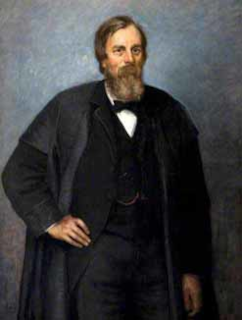
(Pictured: Portrait of John Purser painted by the artist Sarah Purser, daughter of Tertius Purser’s brother Benjamin Purser. The portrait hangs in Queen’s College, Belfast.)


Leave a comment

Birth of Sir John Purser Griffith, Civil Engineer & Politician

Sir John Purser Griffith, a Welsh-born Irish civil engineer and politician, is born at Holyhead, Wales, on October 5, 1848.

Griffith is educated at Trinity College Dublin and gains a licence in civil engineering in 1868. He serves a two-year apprenticeship under Dr. Bindon Blood Stoney, the Engineer in Chief of the Dublin Port and Docks, before working as assistant to the county surveyor of County Antrim. He returns to Dublin in 1871 and works as Dr. Stoney’s assistant, becoming the Chief Engineer in 1898 before retiring in 1913.

Griffith serves as president of the Institution of Civil Engineers of Ireland between 1887 and 1889 and of the Institution of Civil Engineers between 1919 and 1920. He is elected Commissioner of Irish Lights in 1913 and is a member of the Royal Commission on Canals and Waterways between 1906 and 1911.

Griffith purchases and drains the bogland at Pollagh, part of the Bog of Allen. A peat fueled power station is built which drives an excavator and excess peat is taken via the Grand Canal for sale in Dublin. The site is sold to the Turf Development Board in 1936 who use it as a basis for all of their later peat fueled power stations. The area is now a nature reserve.

Griffith receives a knighthood in 1911 and becomes vice-president of the Royal Dublin Society in 1922. He serves as Honorary Professor of Harbour Engineering at Trinity College, his alma mater, and receives an honorary M.A.I. degree from the University of Dublin in 1914. From 1922 he is an elected member of the Seanad Éireann, the Irish Free State senate, until its abolition in 1936. In the 1930s he and Sarah Purser endow the Purser Griffith Travelling Scholarship and the Purser Griffith Prize to the two best performing students in European Art History at University College Dublin.

Griffith dies at Rathmines Castle in Dublin on October 21, 1938.


Leave a comment

Death of Sir John Purser Griffith, Civil Engineer & Politician

Sir John Purser Griffith, Irish civil engineer and politician, dies at Rathmines Castle in Dublin on October 21, 1938.

Griffith is born on October 5, 1848, in Holyhead, Wales. He is educated at Trinity College Dublin and gains a license in civil engineering in 1868. He serves a two-year apprenticeship under Dr. Bindon Blood Stoney, the Engineer in Chief of the Dublin Port and Docks, before working as assistant to the county surveyor of County Antrim. He returns to Dublin in 1871 and works as Dr. Stoney’s assistant, becoming the Chief Engineer in 1898 before retiring in 1913.

Griffith serves as president of the Institution of Civil Engineers of Ireland between 1887 and 1889 and of the Institution of Civil Engineers between 1919 and 1920. He is elected Commissioner of Irish Lights in 1913 and is a member of the Royal Commission on Canals and Waterways between 1906 and 1911.

Griffith purchases and drains the bogland at Pollagh, part of the Bog of Allen. A peat fueled power station is built which drives an excavator, with excess peat being taken by the Grand Canal for sale in Dublin. The site is sold to the Turf Development Board in 1936 who uses it as a basis for all of their later peat fueled power stations. The area is now a nature reserve.

Griffith receives a knighthood in 1911 and becomes vice-president of the Royal Dublin Society in 1922. He serves as Honorary Professor of Harbour Engineering in Trinity College, his alma mater, and receives an honorary M.A.I. degree from the University of Dublin in 1914. From 1922 he is an elected member of the Seanad Éireann, the Irish senate, until its abolition in 1936. In the 1930s he and his niece, Sarah Purser, endow the Purser Griffith Travelling Scholarship and the Purser Griffith Prize to the two best performing students in European Art History at University College Dublin.

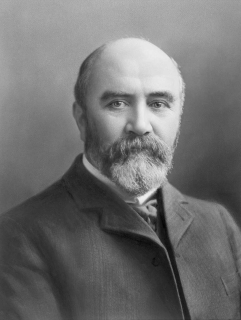
Griffith dies at Rathmines Castle in Dublin on October 21, 1938, having rightly earned the epithet ‘Grand Old Man of Irish engineering.’ A portrait in oils by his niece Sarah Purser, RHA, hangs in the Museum Building in Trinity College Dublin.


Leave a comment

Birth of John Purser, Mathematician & Professor

John Purser, Irish mathematician and professor at Queen’s College, Belfast, is born in Dublin on August 24, 1835.

Purser is the son of John Tertius Purser (1809–1893), the general manager of the well known A Guinness, Son & Co. brewery, and Anna Benigna Fridlezius (1803-1881). He is educated in a wealthy family, which includes artists, as his cousin Sarah Purser, or engineers, as his brother-in-law John Purser Griffith. He is the brother of mathematician Frederick Purser. He receives his early education at the private boarding school run by his uncle, Dr. Richard W. Biggs, at Devizes, Wiltshire. He completes his schooling at Devizes and begins his university studies at Trinity College, Dublin, graduating BA in mathematics in 1856. He is the best mathematician of his year at the University and in 1855 he gains the Lloyd Exhibition.

Purser becomes a tutor to the four sons of William Parsons, 3rd Earl of Rosse (1800-1867) in 1857. Lord Rosse’s 72-inch reflecting telescope, built in 1845 and colloquially known of as the “Leviathan of Parsonstown,” is the world’s largest telescope when it is built and continues to hold this distinction until the early 20th century. As well as acting as tutor to the children, Purser does become involved in Lord Rosse’s interest in astronomy but never does any observing.

In 1863, Purser is appointed professor of mathematics at Queen’s College, Belfast, a position he maintains until his retirement in 1901.

Purser is much better known as a teacher than as a researcher, and he has a good number of notable students, including Sir Joseph Larmor, theoretical physicist who serves as Lucasian Professor of Mathematics at the University of Cambridge; Charles Parsons, the inventor of the steam turbine; Sir John Henry MacFarland, who becomes Chancellor of the University of Melbourne; and William McFadden Orr.

Purser never marries. When his father dies on April 5, 1893, Rathmines Castle passes to him. He dies at Rathmines Castle on October 18, 1903, a very wealthy man. In his will he leaves £100,000 to his brother Frederick Purser, £40,000 to his sister Anna Griffith and £5,000 to each of her children. In addition to the money, he owns property in Blessington Street, Essex Street and Eustace Street which he leaves to his brother-in-law John Purser Griffith. Other properties and interests that he owns he divides between his brother Frederick and his sister Anna. After his death, his sister Anna and her husband John Purser Griffith move into Rathmines Castle although, at this time, its ownership has gone to Frederick Purser. After Frederick dies in August 1910, the Castle and his considerable wealth passes to Anna.

(Pictured: Portrait of John Purser painted by the artist Sarah Purser, daughter of Tertius Purser’s brother Benjamin Purser. The portrait hangs in Queen’s College, Belfast.)


Leave a comment

Birth of Mary Swanzy, Landscape & Genre Artist

Mary Swanzy, Irish landscape and genre artist, is born in Dublin on February 15, 1882. Noted for her eclectic style, she paints in many styles including cubism, futurism, fauvism, and orphism, she is one of Ireland’s first abstract painters.

Swanzy is the second of three daughters of Sir Henry Rosborough Swanzy, an eye surgeon, and his wife Mary (née Denham). She attends Alexandra College, Earlsfort Terrace, a finishing school at the Lycée in Versailles, France, and a day school in Freiburg, Germany. This education means that she is fluent in French and German. She goes on to take art classes at Mary Manning‘s studio, under the direction of John Butler Yeats. Manning encourages her to study modelling with John Hughes at the Dublin Metropolitan School of Art.

Living within walking distance of the National Gallery of Ireland, she spends a lot of time studying and copying the great masters. Her first exhibition is with the Royal Hibernian Academy (RHA) in 1905 with Portrait of a child, continuing to exhibit portraits every year until 1910. In 1905 she goes to Paris and works at the Académie Delécluse, an atelier-style art school. She goes on to attend the studio of Antonio de La Gándara in 1906 and takes classes at Académie de la Grande Chaumière and Académie Colarossi. While in Paris she is exposed to the works of Gauguin, Matisse, and Picasso, which make a lasting impression on her.

On her return to Dublin, Swanzy paints portraits and genre scenes and holds her first show at Mill’s Hall, Merrion Row in 1913. She holds another show there in 1919, where she exhibits nearly 50 pieces. This exhibition is reviewed by Sarah Purser who notes the lack of melancholy and light optimism in Swanzy’s Irish landscapes. Swanzy paints in a number of styles, often reflecting the major art developments in Paris.

After the deaths of her parents, she is financially independent and can travel, spending her time between Dublin and Saint-Tropez during World War I while continuing to paint. She also exhibits with the Société des Artistes Indépendants in 1914 and 1916, being elected to the committee in 1920. While visiting her sister who is involved with the Protestant relief mission in Yugoslavia and Czechoslovakia, she paints landscapes, village life, and peasant scenes. These works are shown in the autumn of 1921 in the Dublin Painters’ Gallery with six other artists including Jack Butler Yeats, Paul Henry, and Clare Marsh with whom she shares a studio.

Swanzy begins to travel to more exotic countries from the 1920s, Honolulu around 1923, and later Samoa. As a result, she paints local tropical flowers, trees, and native women, with a palette and style similar to that of Fauvism. She stays for a time in Santa Barbara, California, working in a local studio and exhibiting some of her Samoan work at the Santa Barbara Arts Club Gallery. She returns to Ireland in February 1925 and exhibits three of her Samoan paints at the RHA, and 14 at her one-woman show in the Galerie Bernheim-Jeune, Paris in October 1925. Gertrude Stein writes her to congratulate her on her Paris exhibition.

In the mid 1920s Swanzy settles in Blackheath, London, making regular trips to Dublin and abroad. In 1932 Purser holds an exhibition of Swanzy’s work for invited guests in her house. At this time her painting is influenced by orphism and is reviewed positively. Her work becomes more allegorical in later years, with The message in the Hugh Lane Gallery demonstrating this. During World War II she stays with her sister in Coolock for three years. In 1943, she holds a one-woman show at the Dublin Painters’ Gallery, and is also featured at the first Irish Exhibition of Living Art. She is exhibited at St. George’s Gallery, London in 1946 along with Henry Moore, Marc Chagall, and William Scott.

Swanzy is made an honorary member of the RHA in 1949, showing with them in 1950 and 1951. She does not exhibit in Ireland for a number of years, but the Hugh Lane Gallery holds a major retrospective of her work in 1968. Following this she holds two one-woman shows at the Dawson Gallery in 1974 and 1976. In 1975 she is featured at the Cork ROSC art exhibition and resumes showing with the RHA. She continues to paint until her death at her home in London on July 7, 1978.

In 1982 the Taylor Galleries holds an exhibition to mark the centenary of Swanzy’s birth. More recently she is featured in the Irish Museum of Modern Art (IMMA) 2013 exhibition Analysing Cubism. From October 2018-February 2019, also in IMMA, she is the subject of the solo exhibition Mary Swanzy Voyages.

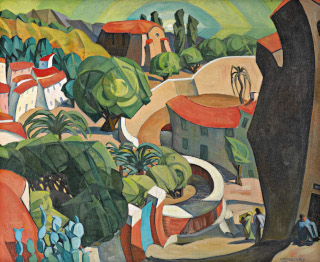
(Pictured: Sunlit Landscape, oil-on-canvas, by Mary Swanzy)