On December 9, 1994, Sinn Féin, the political wing of the Irish Republican Army (IRA), holds its first formal talks with the British Government in over 70 years. The negotiations take place in Belfast, almost one year after Britain and Ireland began an uncertain program to try to resolve the conflict in Northern Ireland. The first session is held at Stormont, a gigantic, columned edifice on top of a hill on the outskirts of Belfast that houses the old Northern Ireland parliament.
Although the announcement of the negotiations is not a surprise, it still sets off an exciting ripple that history is in the making. British officials have conducted secret talks with Sinn Féin leaders in the past, but never before have they sat down openly at the same table with them.
In both a letter to the Sinn Féin leader, Gerry Adams, and in a three-paragraph statement, Downing Street pointedly refers to the meeting as “exploratory dialogue.” This is in keeping with London‘s position that it is simply joining in “talks about talks,” not a full negotiating session, which must involve all parties to the conflict.
For 25 years the IRA has been fighting in the name of the Roman Catholic minority of 650,000 in Northern Ireland. It wants to link Ulster, the six counties of Northern Ireland that remain British after partition, to the Irish Republic, a move opposed by most of the province’s 950,000 Protestants.
The announcement of talks evoke a predictable pattern of responses across Northern Ireland’s political spectrum. Adams, who works to persuade the IRA to go along with a unilateral cease-fire that was declared on September 1, welcomes it. “The opportunity to realize a lasting peace, which will benefit all of the people of Ireland, has never been greater,” he says in a statement. Adams had been accusing London of foot-dragging on the peace effort. Now, he says, it is time to move on to “the next phase of dialogue — multilateral talks led by both Governments.”
The Ulster Unionist Party (UUP), the main Protestant political group in Northern Ireland, is skeptically accepting, as it has been all along. John Taylor, a UnionistMember of Parliament, says the talks will at least establish whether “Sinn Féin really is to become a normal political party.”
The Rev. Ian Paisley, a Member of Parliament whose Democratic Unionist Party (DUP) has become a rejectionist front, continues to oppose talks or any move smacking of compromise. He tells the House of Commons that “a vast majority of people” resent the decision to talk to “the men of blood.”
Sinn Féin is represented at the talks by Martin McGuinness, a veteran IRA political leader who took part in secret contacts that broke up the previous year. In 1972, together with Adams, he was flown to London for a meeting with William Whitelaw, who was then Secretary of State for Northern Ireland. Those talks eventually failed.
Adams is in Washington, D.C. on Wednesday, December 7. He attends a meeting at the White House, his first one there, with Anthony Lake, President Bill Clinton‘s National Security Advisor. Seven weeks earlier, Britain protests vigorously at the thought of Adams visiting the White House. But events moved so swiftly that he gains a kind of legitimacy that is hard for Whitehall to deny. His visa to the United States, good for three months, allows several visits.
The Government team of civil servants, in contrast to higher-level ministers, are led by Quentin Thomas, deputy secretary of the British administration called the Northern Ireland Office.
Going into the negotiations, the key question is what will be discussed. On the British side, the top of the agenda is how to get the IRA to turn over its considerable stash of 100 tons of arms and explosives. There is nothing, of course, that Sinn Féin is less likely to agree to at the outset. So should the British make this a condition for multilateral talks to begin, the two sides will meet an obstacle right away.
McGuinness says that the issue of IRA weapons has to be considered “in the context of us removing the causes of conflict, the reason why people use armed force in our society.”
From its side, Adams says Sinn Féin wants to discuss being treated with “a parity of esteem” with the other parties, and “the release of all political prisoners.”
The British Government says that it will soon hold talks with the so-called loyalist paramilitaries on the Protestant side. And it indicates it will have no objection if elected Sinn Féin councillors attend a major international investment conference in Belfast on December 13 and 14.
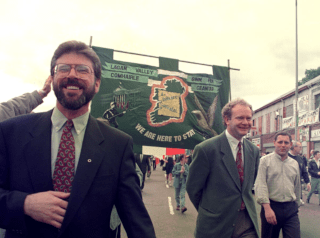
(From: “Britain and I.R.A. Group to Begin Talks in Northern Ireland” by John Darnton, The New York Times, December 2, 1994 | Pictured: Gerry Adams and Martin McGuinness lead a Republican parade in Belfast, commemorating 25 years of British troops on the streets of Northern Ireland in 1994)
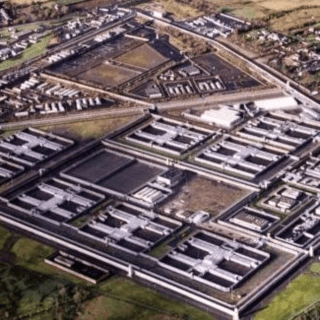
The Maze Prison escape, known to Irish republicans as the Great Escape, takes place on September 25, 1983, in County Antrim, Northern Ireland. HM Prison Maze, also known as Long Kesh, is a maximum-security prison considered to be one of the most escape-proof prisons in Europe, and holds prisoners suspected of taking part in armed paramilitary campaigns during the Troubles. In the biggest prison escape in UK history, 38 Provisional Irish Republican Army (IRA) prisoners escaped from H-Block 7 (H7) of the prison. One prison officer dies of a heart attack during the escape and twenty others are injured, including two who are shot with guns that had been smuggled into the prison. The escape is a propaganda coup for the IRA, and a British government minister faces calls to resign. The official inquiry into the escape places most of the blame onto prison staff, who in turn blame the escape on political interference in the running of the prison.
IRA volunteers regard themselves as prisoners of war with a duty to escape. During the Troubles, Irish republican prisoners escape from custody en masse on several occasions between 1971 and 1981.
Prisoners had been planning the 1983 escape for several months. Bobby Storey and Gerry Kelly start working as orderlies in H7, which allows them to identify weaknesses in the security systems. Six handguns are also smuggled into the prison. Shortly after 2:30 PM on September 25, prisoners seize control of H7 by simultaneously taking the prison officers hostage at gunpoint in order to prevent them from triggering an alarm. One officer is stabbed with a craft knife, and another is knocked down by a blow to the back of the head. One officer who attempts to prevent the escape is shot in the head by Gerry Kelly but survives. By 2:50 PM the prisoners are in control of H7 without an alarm being raised. A dozen prisoners also take uniforms from the officers, and the officers are forced to hand over their car keys and details of where their cars are, for possible later use during the escape. A rearguard is left behind to watch over hostages and keep the alarm from being raised until they believe the escapees are clear of the prison, at which time they return to their cells. At 3:25 PM, a lorry delivering food supplies arrives at the entrance to H7, whereupon Brendan McFarlane and other prisoners take the occupants hostage at gunpoint and move them inside H7. The lorry driver is told the lorry is being used in the escape, and he is instructed what route to take and how to react if challenged.
At 3:50 PM the prisoners leave H7, and the driver and a prison orderly are taken back to the lorry. Thirty-seven prisoners climb into the back of the lorry, while Gerry Kelly lay on the floor of the cab with a gun pointed at the driver, who is also told the cab has been booby trapped with a hand grenade. At nearly 4:00 PM the lorry drives toward the main gate of the prison, where the prisoners intend to take over the gatehouse. Ten prisoners dressed in guards’ uniforms and armed with guns and chisels dismount from the lorry and enter the gatehouse, where they take the officers hostage.
At 4:05 PM the officers begin to resist, and an officer presses an alarm button. When other staff respond via an intercom, a senior officer says while being held at gunpoint that the alarm had been triggered accidentally. By this time the prisoners are struggling to maintain control in the gatehouse due to the number of hostages. Officers arriving for work are entering the gatehouse from outside the prison, and each is ordered at gunpoint to join the other hostages. Officer James Ferris runs from the gatehouse toward the pedestrian gate attempting to raise the alarm, pursued by Dermot Finucane. Ferris had already been stabbed three times in the chest, and before he can raise the alarm he collapses.
Finucane continues to the pedestrian gate where he stabs the officer controlling the gate, and two officers who had just entered the prison. This incident is seen by a soldier on duty in a watchtower, who reports to the British Army operations room that he has seen prison officers fighting. The operations room telephones the prison’s Emergency Control Room (ECR), which replies that everything is all right and that an alarm had been accidentally triggered earlier.
At 4:12 PM the alarm is raised when an officer in the gatehouse pushes the prisoner holding him hostage out of the room and telephones the ECR. However, this is not done soon enough to prevent the escape. After several attempts the prisoners open the main gate and are waiting for the prisoners still in the gatehouse to rejoin them in the lorry. At this time two prison officers block the exit with their cars, forcing the prisoners to abandon the lorry and make their way to the outer fence which is 25 yards away.
Four prisoners attack one of the officers and hijack his car, which they drive toward the external gate. They crash into another car near the gate and abandon the car. Two escape through the gate, one is captured exiting the car, and another is captured after being chased by a soldier. At the main gate, a prison officer is shot in the leg while chasing the only two prisoners who have not yet reached the outer fence. The prisoner who fires the shot is captured after being shot and wounded by a soldier in a watch tower, and the other prisoner is captured after falling. The other prisoners escape over the fence, and by 4:18 PM the main gate is closed and the prison secured, after 35 prisoners had breached the prison perimeter. The escape is the biggest in British history, and the biggest in Europe since World War II.
Outside the prison the IRA has planned a logistical support operation involving 100 armed members, but due to a miscalculation of five minutes, the prisoners find no transport waiting for them and are forced to flee across fields or hijack vehicles. The British Army and Royal Ulster Constabulary immediately activate a contingency plan and by 4:25 PM a cordon of vehicle checkpoints are in place around the prison, and others are later in place in strategic positions across Northern Ireland, resulting in the recapture of one prisoner at 11:00 PM. Twenty prison officers are injured during the escape, thirteen are kicked and beaten, four stabbed, and two shot. One prison officer, James Ferris, who had been stabbed, dies after suffering a heart attack during the escape.
The escape is a propaganda coup and morale boost for the IRA, with Irish republicans dubbing it the “Great Escape.” Leading unionist politician Ian Paisley calls on Nicholas Scott, the Parliamentary Under-Secretary of State for Northern Ireland, to resign. The British Prime MinisterMargaret Thatcher makes a statement in Ottawa during a visit to Canada, saying “It is the gravest [breakout] in our present history, and there must be a very deep inquiry.” The day after the escape, Secretary of State for Northern IrelandJames Prior announces an inquiry to be headed by Her Majesty’s Chief Inspector of Prisons, James Hennessy. The Hennessy Report is published on January 26, 1984, placing most of the blame for the escape on prison staff, and making a series of recommendations to improve security at the prison. The report also places blame with the designers of the prison, the Northern Ireland Office and successive prison governors who had failed to improve security. Prior announces that the prison’s governor has resigned, and that there will be no ministerial resignations as a result of the report’s findings. Four days after the Hennessy Report is published, the Minister for Prisons Nicholas Scott dismisses allegations from the Prison Governors Association and the Prison Officers Association that the escape is due to political interference in the running of the prison.
Fifteen escapees are captured on the day, including four who are discovered hiding underwater in a river near the prison using reeds to breathe. Four more escapees are captured over the next two days, including Hugh Corey and Patrick McIntyre who are captured following a two-hour siege at an isolated farmhouse. Out of the remaining 19 escapees, 18 end up in the republican stronghold of South Armagh where two members of the IRA’s South Armagh Brigade are in charge of transporting them to safehouses and given the option of either returning to active service in the IRA’s armed campaign or a job and new identity in the United States.
On October 25, 1984, nineteen prisoners appear in court on charges relating to the death of prison officer James Ferris, sixteen charged with his murder. A pathologist determines that the stab wounds Ferris suffered would not have killed a healthy man. The judge acquits all sixteen as he cannot correlate the stabbing to the heart attack.
McNamara retains his seat at the 1966 general election, and at subsequent elections until the constituency is abolished for the February 1974 general election, when he transfers to the new Kingston upon Hull Central constituency. When that constituency is abolished for the 1983 election, he is re-elected for the re-created Kingston upon Hull North constituency.
During the 2005 general election campaign McNamara claims some of the policies regarding illegal travelers’ sites of the leader of the Conservative Party, Michael Howard, had a “whiff of the gas chambers” about them. Howard’s grandmother died at Auschwitz.
McNamara is known throughout his parliamentary career as a supporter of Irish nationalism and favours a United Ireland. After entering parliament, he soon becomes interested in reports of discrimination against the Catholic minority in Northern Ireland and supports the Campaign for Democracy in Ulster (CDU). He serves as a frontbench spokesman for the Labour Party, including Shadow Secretary of State for Northern Ireland under Neil Kinnock, 1987–94, an appointment that is widely criticised by Unionists.
After Tony Blair becomes Labour leader, he replaces McNamara as Northern Ireland spokesman with Mo Mowlam. In 1997, he helps persuade the newly elected Labour government to donate £5,000 (thereby matching the contribution of the Irish government) for the erection of a memorial in Liverpool to the victims of the Great Irish Famine. He also supports Republicanism in the United Kingdom and joins the All-Party Parliamentary Republic Group.
McNamara is a Roman Catholic and a Knight of the Pontifical Order of Saint Gregory the Great. He is married to Nora McNamara, and is the father of four sons and a daughter.
In 2006, McNamara receives the honorary degree of Doctor of Laws from the University of Hull in recognition of his long service in politics. He graduates with a Ph.D from the University of Liverpool in 2007 having completed a thesis on the MacBride Principles at the Institute of Irish Studies, where he gives the 2008 John Kennedy Lecture in Irish Studies, Perhaps It Will All Go Away – an Examination of the British Response to the Civil Rights Movement in Northern Ireland.
In 2017, McNamara is diagnosed with pancreatic cancer while on holiday in Spain. He dies on August 6, 2017 at Formby, England, at the age of 82.
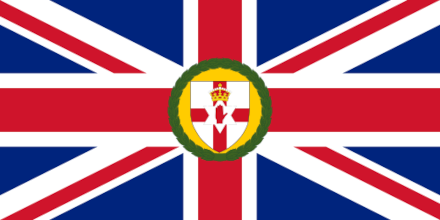
The office of the Governor of Northern Ireland is established on 9 December 9, 1922 under Letters Patent to “do and execute in due manner as respects Northern Ireland all things which by virtue of the [1920] Act and our said Letters Patent of 27 April 1921 or otherwise belonged to the office of Lord Lieutenant at the time of the passing of the Irish Free State Constitution Act 1922.”
The Governor has possession of the Great Seal of Northern Ireland and is the successor to the Lord Lieutenant of Ireland in Northern Ireland, itself established on May 3, 1921. The official residence of the Governor of Northern Ireland is Hillsborough Castle in County Down. Following refurbishment of the Castle, James Hamilton, 3rd Duke of Abercorn, takes up residence in 1925. It remained the official residence until the abolition of the office of governor in 1973. Henceforth it has been the official residence of the Secretary of State for Northern Ireland.
The government had set this date as a final deadline for a restoration of power-sharing before direct rule from London is restored permanently and now has to rush emergency legislation through the House of Commons to prevent this.
“After a long and difficult time in our province, I believe that enormous opportunities lie ahead for our province,” Paisley tells reporters, as he sits at a conference table next to Adams. The agreement “marks the beginning of a new era of politics on this island,” Adams agrees, but adds that he finds it “disappointing” that Northern Ireland‘s political institution cannot be restored immediately.
British prime minister Tony Blair hails the agreement, saying “This is a very important day for the people of Northern Ireland but also for the people and the history of these islands.” After talking by phone with his Irish counterpart, Taoiseach Bertie Ahern, he tells reporters, “In a sense, everything we have done over the last ten years has been a preparation for this moment, because the people of Northern Ireland have spoken through the election. They have said we want peace and power-sharing, and the political leadership has then come in behind that and said we will deliver what people want.”
In Ireland, Ahern calls the day’s developments “unprecedented and very positive,” and says both governments will cooperate with the new May 8 date for devolution.
The Secretary of State for Northern Ireland, Peter Hain, says a one clause emergency bill will be put through parliament with the agreement of opposition parties, and will need royal assent before midnight the following evening to prevent the dissolution of the Stormont assembly. He describes the day’s events as “really, really momentous.”
“Today the clouds have lifted, and the people can see the future,” Hain tells BBC Radio 4‘s The World at One. “These pictures of Ian Paisley and Gerry Adams will resonate around the world. They are a graphic manifestation of the power of politics over bigotry and conflict, bitterness and horror.”
The crucial meeting sees delegations from the DUP and Sinn Féin spend an hour together inside a room at Stormont to hammer out the final agreement for a return to power-sharing. Afterwards, both leaders talk about the work still needing to be done, including regular meetings between Paisley and Sinn Féin’s Martin McGuinness as the de facto first and deputy first ministers.
Clearly conscious of the historical significance of their talks, Paisley and Adams speak of the suffering caused by the decades of inter-community violence and their responsibility to ensure permanent peace and reconciliation. Northern Ireland’s politicians must “never forget those who have suffered during the dark period from which we are, please God, emerging,” Paisley says. “I want to make it clear that I am committed to delivering not only for those who voted for the DUP but for all the people of Northern Ireland. We must not allow our justified loathing for the horrors and tragedies of the past to become a barrier to creating a better and more stable future for our children,” he adds.
Adams says there is now new hope for the future, following the previous “sad history of orange and green.” He adds, “There are still many challenges, many difficulties, to be faced. But let us be clear: the basis of the agreement between Sinn Féin and the DUP follows Ian Paisley’s unequivocal and welcome commitment to support and participate fully in the political institutions on May 8. We’ve all come a very long way in the process of peace making and national reconciliation. We are very conscious of the many people who have suffered. We owe it to them to build the best future possible.”
The proposal for the historic meeting comes after a frantic weekend of consultation in Belfast and Berlin, where Blair and Ahern are attending a ceremony to mark 50 years of the European Union. Both prime ministers had repeatedly insisted the assembly would be dissolved if no agreement on an executive had been reached by today’s legal deadline. Britain is forced into a last-minute change of strategy after Paisley’s DUP agrees in principle on March 24 to share power with Sinn Féin but demands an extension of the deadline for the formation of the executive until May.
The DUP, which is badly split, says they need the additional time to see if Sinn Féin will comply with its commitment to cooperate with the Police Service of Northern Ireland. Until now Paisley’s DUP has always refused to meet Sinn Féin. Each represents what used to be seen as the two extremes of Northern Ireland sectarian politics.
(From: “Paisley and Adams agree deal” by Peter Walker and Owen Bowcott, The Guardian (www.theguardian.com), March 26, 2007 | Pictured: Ian Paisley and Gerry Adams hold their first face-to-face talks. Photograph: Paul Faith/ PA)
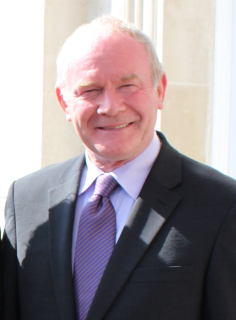
McGuinness is born James Martin Pacelli McGuinness on May 23, 1950 in Derry. He attends St. Eugene’s Primary School and later the Christian Brothers technical college, leaving school at the age of 15.
McGuinness joins the IRA about 1970, and by 1971 he is one of its leading organizers in Derry. In 1973 a Special Criminal Court in the Republic of Ireland sentences him to six months in prison after he is caught in a car containing large quantities of explosives and ammunition. Although the IRA keeps secret the membership of its seven-person Army Council, few doubt that McGuinness is one of its most important members from the 1970s through the 1990s. Even while reportedly planning attacks on civilians in Northern Ireland and on the British mainland, McGuinness is involved in spasmodic secret talks with British government ministers and officials to end the conflict. In 1972 McGuinness, with fellow IRA leader Gerry Adams, privately negotiates with British Secretary of State for Northern IrelandWilliam Whitelaw, but these and other talks over the next two decades are unsuccessful.
McGuinness contests seats in the British House of Commons on several occasions, losing in 1983, 1987, and 1992. However, in 1997 he is elected to the House of Commons to represent the constituency of Mid Ulster and, in line with party policy, he does not take his seat. He subsequently wins reelection to the seat in 2001, 2005, and 2010.
McGuinness is the IRA’s chief negotiator in the deliberations, also secret at first, that culminate in the Good Friday Agreement in 1998. This pact finally ends the conflict and eventually brings Sinn Féin into a coalition government to rule Northern Ireland. He is elected to the new Northern Ireland Assembly and in 1999 is appointed Minister of Education. In this post he eliminates the controversial eleven-plus examination, which determines which type of secondary school a child should attend. The test had been abolished in most of the rest of the United Kingdom more than 25 years earlier.
Disagreements over such issues as policing and the decommissioning of arms causes Northern Ireland’s Executive and Assembly to be suspended for some years, but a fresh agreement in 2006 paves the way for them to be revived. In elections in March 2007, both Sinn Féin and the antirepublican Democratic Unionist Party (DUP) gain seats, becoming the two largest parties in the Northern Ireland Assembly. McGuinness becomes Deputy First Minister, working with First Minister Ian Paisley, leader of the DUP. The two men, previously bitter enemies, perform so well together that they are dubbed the “Chuckle brothers.”
When Paisley retires in 2008, he is succeeded by the DUP’s Peter Robinson, who is considered to be even more militantly antirepublican. Once again, however, a shared need to rebuild the economy and attract international investment leads to cooperation between former opponents. In 2009 their government is in jeopardy as Sinn Féin and the DUP argue over the devolution of the police and justice system in Northern Ireland. McGuinness and Robinson are involved in the ensuing negotiations, and in February 2010 an agreement is reached for the transfer of powers from Britain to Northern Ireland in April.
In the Assembly elections in May 2011, McGuinness and Robinson are a formidable pair, and voters respond to their call for stability in a time of economic uncertainty. Sinn Féin gains an additional seat and increases its overall share of the vote, and McGuinness is assured an additional term as Deputy First Minister. In the autumn he steps down to run as Sinn Féin’s candidate for the presidency of Ireland. After finishing third in the election held on October 28, he returns to the position of Deputy First Minister a few days later. On June 27, 2012, in an event widely seen as having great symbolic importance for the ongoing reconciliation efforts in Northern Ireland, McGuinness and Elizabeth II shake hands twice, once in private and again in public, during a visit by the British monarch to Belfast.
In January 2017 McGuinness resigns as Deputy First Minister in response to First Minister Arlene Foster’s refusal to temporarily step down from her position during the investigation of a scandal relating to the government’s Renewable Heat Incentive (RHI), a mishandled program under which large amounts of state funds allegedly had been squandered. Foster had served as head of the department that oversaw the RHI before becoming First Minister. Under the power-sharing agreement the posts of First Minister and Deputy First Minister constitute a single joint office so that the resignation of one minister results in termination of the other’s tenure. When Sinn Féin chooses not to nominate a replacement for McGuinness within the required seven-day period, authority reverts to the British government’s Secretary of State for Northern Ireland in advance of a snap election on March 2.
Even before McGuinness’s resignation there had been speculation late in 2016 that he might step down for health reasons, and soon after resigning he confirms that he is suffering from amyloidosis, a rare disease brought about by deposits of abnormal protein in organs and tissue. With McGuinness removing himself from “frontline politics,” Michelle O’Neill leads Sinn Féin into the election. The disease claims McGuinness’s life only months later on March 21, 2017.
The Northern Ireland Constitutional Convention is an elected body set up in 1975 by the United KingdomLabour government of Harold Wilson as an attempt to deal with constitutional issues surrounding the status of Northern Ireland.
The idea for a constitutional convention is first mooted by the Northern Ireland Office in its white paperThe Northern Ireland Constitution, published on July 4, 1974. The paper lays out plans for elections to a body which would seek agreement on a political settlement for Northern Ireland. The proposals become law with the enactment of the Northern Ireland Act 1974 later that month. With Lord Chief Justice of Northern IrelandRobert Lowry appointed to chair the new body, elections are announced for May 1, 1975.
The elections are held for the 78-member body using the single transferable vote system of proportional representation in each of Northern Ireland’s twelve Westminster constituencies. Initially the body is intended to be purely consultative, although it is hoped that executive and legislative functions can be devolved to the NICC once a cross-community agreement has been reached. Unionists opposed to the NICC once again band together under the umbrella of the United Ulster Unionist Council (UUUC) and this coalition proves the most successful, taking 46 seats.
A number of leading Northern Ireland politicians are elected to the NICC, increasing hope that the body might achieve some of its aims. Also elected are some younger figures who go on to become leading figures in the future of Northern Ireland politics.
The elections leave the body fundamentally weakened from its inception as an overall majority has been obtained by those Unionists who oppose power sharing as a concept. As a result, the Northern Ireland Constitutional Convention Report published on November 20, 1975, recommends only a return to majority rule as had previously existed under the old Parliament of Northern Ireland government. As such a solution is completely unacceptable to the nationalist parties, the NICC is placed on hiatus.
Hoping to gain something from the exercise, Secretary of State for Northern Ireland Merlyn Rees announces that the NICC would be reconvened on February 3, 1976. However, a series of meetings held between the UUUC and the Social Democratic and Labour Party (SDLP) fail to reach any agreement about SDLP participation in government, and so the reconvened NICC once again fails to achieve a solution with cross-community support. As a result, Rees announces the dissolution of the body on March 5, 1976, and Northern Ireland remains under direct rule.
On the face of it, the NICC is a total failure as it does not achieve its aims of agreement between the two sides or of introducing ‘rolling devolution’ (gradual introduction of devolution as and when the parties involved see fit to accept it). Nevertheless, coming as it does not long after the Conservative-sponsored Sunningdale Agreement, the NICC indicates that no British government will be prepared to re-introduce majority rule in Northern Ireland. During the debates William Craig accepts the possibility of power-sharing with the SDLP, a move that splits the UUUC and precipitates the eventual collapse of the Vanguard Unionist Progressive Party (VUPP).
The idea of electing a consultative body to thrash out a deal for devolution is also retained and in 1996 it is revived when the Northern Ireland Forum is elected on largely the same lines and with the same overall purpose. The Forum forms part of a process that leads to the Good Friday Agreement and the Northern Ireland Assembly.
Stronge (86) and his son, James (48), are watching television in the library of Tynan Abbey when members of the Provisional Irish Republican Army, armed with machine guns, use grenades to break down the locked heavy doors to the home.
The Stronge family home is then burned to the ground as a result of two bomb explosions. On seeing the explosions at the house, as well as a flare Stronge lit in an attempt to alert the authorities, the Royal Ulster Constabulary and British Army troops arrive at the scene and establish a roadblock at the gate lodge. They encounter at least eight fleeing gunmen. A twenty-minute gunfight ensues in which at least two hundred shots are fired. There are no casualties among the security forces but the gunmen escape. The bodies of the father and son are later discovered in the library of their burning home, each with gunshot wounds in the head. It is not known who died first, Norman or James. Under the legal fiction known as the doctrine of survival, James is still listed as succeeding to the baronetcy.
The village of Tynan is crowded for the joint funeral of Stronge and his son. Mourners come from throughout the province and from England, including lords, politicians, policemen, judges and church leaders. The coffin is carried by the 5th Battalion the Royal Irish Rangers, the successors to his old regiment. The sword and cap of the Lord Lieutenant of Tyrone, Major John Hamilton-Stubber, are placed on his coffin in lieu of his own, which had been destroyed with his other possessions in the fire. During the service, a telegram sent from Queen Elizabeth II to one of Sir Norman’s daughters, is read. After the service, the chief mourners move out into the churchyard where the “Last Post” is sounded, and a Royal British Legion farewell is given. The two coffins are laid in the family plot, where Lady Stronge, Sir Norman’s wife and mother of James, was buried a year previously.
The IRA releases a statement in Belfast, quoted in The Times, claiming that “This deliberate attack on the symbols of hated unionism was a direct reprisal for a whole series of loyalist assassinations and murder attacks on nationalist peoples and nationalist activities.” This follows the loyalist attempted murder of Bernadette McAliskey and her husband Michael McAliskey on January 16, and the loyalist assassinations of four republican activists (Miriam Daly, John Turnley, Noel Lyttle and Ronnie Bunting) which had taken place since May 1980.
Stronge is described at the time of his death by Social Democratic and Labour Party politician Austin Currie as having been “even at 86 years of age … still incomparably more of a man than the cowardly dregs of humanity who ended his life in this barbaric way.”
The ruins of Tynan Abbey are demolished in 1998, having stood for 249 years.
Although there are no discussions between the pair, Kenny confirms he will meet with Foster in Dublin on Tuesday, November 15. The pair are also due to meet in Armagh on Friday, November 18 for a North/South ministerial meeting, where Brexit-related issues are expected to dominate the agenda.
Speaking afterwards, Fitzgerald, whose grandfather served as a soldier in the British army and whose father was a colonel in the Irish Army, says it has been an important engagement. “So many people across the island lost their lives; 50,000 families affected by loss of a loved one during the First World War. We have had a government minister here since 2012 and I think it is really important to come together, to remember together and to look at our shared histories.”
Meanwhile, Heather Humphreys, the Minister for Arts, Heritage, Regional, Rural and Gaeltacht Affairs, dedicates the France-Ireland Memorial at Glasnevin Cemetery. Humphreys is joined by the French Minister of State for Veterans and Remembrance at the Ministry of Defence Jean-Marc Todeschini for the ceremony. The memorial is a gift to Ireland from France in recognition of Irish sacrifices made “in the defence and freedom of France, particularly in the First World War.”
(From: “Taoiseach, Tánaiste attend Remembrance Sunday ceremonies,” Raidió Teilifís Éireann (RTÉ), http://www.rte.ie, November 13, 2016 | Pictured: Taoiseach Enda Kenny lays a wreath of green laurels in Enniskillen)
The province’s institutions are suspended on October 14 following a row over allegations of Irish Republican Army (IRA) activity, including alleged spying within the Northern Ireland Office (NIO).
Speaking after a 40-minute meeting with Trimble, Adams says they had had a “useful exchange of views.” But he adds, as expected, “there were very few conclusions in terms of the big picture….I asked Mr. Trimble how he thought things could be sorted out and Mr. Trimble had no particular suggestion to offer. But it was a good meeting.”
The Sinn Féin president says he had suggested to Trimble that each leader could address the executive of the opposite’s party. “He declined. But I hope he will think about the suggestion.”
Trimble says no significant developments came out of the meeting. He adds that the onus is on the republican movement to move the process forward. He dismisses Adams’s suggestion that they should address each other’s parties as a “stunt.”