seamus dubhghaill

Promoting Irish Culture and History from Little Rock, Arkansas, USA


Leave a comment

Birth of David Ford, Northern Irish Politician

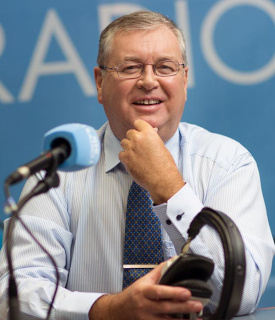
David Ford, former Northern Irish politician, is born on February 24, 1951, to Irish and Welsh parents in Orpington, Kent, England. He serves as leader of the Alliance Party of Northern Ireland from October 2001 until October 2016 and is Northern Ireland Minister of Justice from April 2010 until May 2016. He is a Member of the Northern Ireland Assembly (MLA) for South Antrim from 1998 to 2018.

Ford is educated at Warren Road Primary School, Orpington, and Dulwich College, London. He spends summer holidays on his uncle’s farm in Gortin, County Tyrone, and moves to Northern Ireland permanently in 1969 when he goes to study Economics at Queen’s University Belfast (QUB). There he joins the university’s student Alliance Party grouping. After graduating, he takes a year out to work as a volunteer at the ecumenical Corrymeela Community in Ballycastle, County Antrim, before starting work as a social worker in 1973.

Ford stands unsuccessfully for Antrim Borough Council in 1989 and enters politics full-time when he becomes general secretary of the Alliance Party. In that role, he is best known as a strong supporter of the then-leader John Alderdice and an advocate of better political organisation and community politics. He is elected to Antrim Borough Council in 1993, 1997 and – after leaving the Council in 2001 to concentrate on Assembly business – again in 2005.

In 1996, Ford stands unsuccessfully for election to the Northern Ireland Forum in South Antrim. In 1997, he obtains 12% of the vote in the general election in South Antrim, and in 1998 is elected to the Northern Ireland Assembly in the constituency of the same name. He sought South Antrim again in the 2000 South Antrim by-election and in the 2001 and 2005 United Kingdom general elections.

In 2001, Seán Neeson resigns from the Party leadership following poor election results. Ford wins the leadership election on October 6 by 86 votes to 45, ahead of Eileen Bell.

Ford gives Alliance a stability which it has lacked since the departure of John Alderdice, but the Party has declined seriously in the late 1990s and all he can do is stabilise the situation. Within a month of taking over the leadership, however, he has a chance to establish Alliance’s relevancy in the post-Good Friday Agreement environment. On November 6, 2001, the Northern Ireland Executive is to be re-established. Due to defections within his own Ulster Unionist Party (UUP), First Minister David Trimble has insufficient support within the Unionist bloc in the Assembly to be re-elected to his post. Ford and two of his five colleagues re-designate as Unionist for just 22 minutes in order to secure Trimble’s position and thereby enable the devolved institutions to operate for another year. However, Alliance fails to make any political gains from their move, and the UUP and Sinn Féin fail to reach agreement on the decommissioning issue, ensuring that the institutions collapse again in October 2002.

In the 2003 Northern Ireland Assembly election, Ford’s seat in the Assembly is perceived to be under severe threat from Sinn Féin’s Martin Meehan, with many commentators expecting him to lose it. However, his expertise in nuts-and-bolts electioneering stands him in good stead. Although Alliance’s vote almost halved, his own vote in South Antrim increases from 8.6% to 9.1%. Meehan’s vote increases dramatically, from 7.3% to 11.5%, and he starts the election count ahead. Ford has much greater transfer appeal and finishes 180 votes ahead of Meehan at the end of a dramatic three-way fight for the last two seats, with Thomas Burns of the Social Democratic and Labour Party (SDLP) just 14 votes ahead of Ford. Despite the dramatic fall in vote, Alliance holds on to its six seats in the Assembly, which remains suspended.

In 2004, Ford makes good his leadership election pledge to work with other parties, as Alliance joins with the Workers’ Party, Northern Ireland Conservatives and elements of the Northern Ireland Women’s Coalition to support Independent candidate John Gilliland in the European elections, achieving the best result for the centre ground for 25 years.

Ford’s greatest triumph comes in the 2007 Northern Ireland Assembly election, when the party achieves its highest vote share since Alderdice’s departure and picks up a seat in what is an otherwise poor election for the moderates. Despite media predictions once again of his demise, Ford himself is elected third in South Antrim, with over 13% of the poll.

On April 12, 2010, Ford is chosen by the Assembly to become Northern Ireland’s first Justice Minister in 38 years. He is supported in the Assembly by the Democratic Unionist Party (DUP), Sinn Féin, the Alliance Party, the Green Party and the Progressive Unionist Party (PUP). Separate candidates for the position are put forward by both the UUP and the SDLP, being Danny Kennedy and Alban Maginness respectively.

In the 2011 Northern Ireland Assembly election, the Alliance Party manages to increase their vote by 50% gaining an extra seat in Belfast East and surpassing the UUP in Belfast.

Ford announces his resignation as Leader in October 2016 on the fifteenth anniversary of his election as leader noting, “The team is working well, and I think it’s an appropriate time to hand over to a new leader who will lead the party forward in the next stage of its development and growth.”

Ford and his wife Anne have four grown children and live in rural County Antrim. Until the spring of 2013, he is an elder in the Second Donegore congregation of the Presbyterian Church in Ireland. He is removed from his role as a ruling elder over differences with fellow congregants on the subject of same-sex marriage. In a 2016 interview he says he is still hurt by the decision by his fellow elders who chose not to work with him because of his support for equal marriage. “It saddened me that there was, if I may put it, a lack of understanding from some people about the role I had as a legislator, compared to the role I have within the church.”


Leave a comment

Birth of Mick Moloney, Irish American Musician & Scholar

Michael “Mick” Moloney, Irish-born American musician and scholar, is born in Limerick, County Limerick, on November 15, 1944. He is the artistic director of several major arts tours and co-founds Green Fields of America.

Moloney is the son of Michael Moloney, the head air traffic control officer of Shannon Airport, and his wife, Maura, who works as the principal of a Limerick primary school. He first plays tenor banjo during his teenage years. He studies at University College Dublin (UCD), graduating with a bachelor’s degree in economics. He then relocates to London to be a social worker assisting immigrant communities, before joining The Johnstons. After playing with the group for five years, he immigrates to the United States in 1973. He initially settles in Philadelphia, Pennsylvania, and eventually becomes an American citizen.

Three years after moving to the United States, Moloney co-founds Green Fields of America, an ensemble of Irish musicians, singers, and dancers which tour across the country on several occasions. He also serves as the artistic director for several major arts tours. One of these is the 1985 festival in Manhattan titled “Cherish the Ladies” to highlight female musicians in the area of Irish traditional music, which had been dominated by men until that decade. He produces an album for the female group by the same name titled Irish Women Musicians in America. The group’s leader, Joanie Madden, is one of several future fellows of the National Endowment for the Arts (NEA) to be mentored by Moloney. He produces and performs on over 70 albums and serves as advisor for numerous festivals and concerts across America, with ethnomusicologist and musician Daniel T. Neely putting the figure as high as 125 albums.

Moloney undertakes postgraduate studies at the University of Pennsylvania, obtaining a master’s degree before being awarded a Doctor of Philosophy in folklore and folk life in 1992. He goes on to teach ethnomusicology, folklore, and Irish studies at Penn, Georgetown University, and Villanova University. He is also global distinguished professor of music and Irish studies at New York University (NYU) until his death. In recognition of his work in public folklore, he receives a 1999 National Heritage Fellowship from the NEA.

In addition to music performance, Moloney writes Far from the Shamrock Shore: The Story of Irish American History Through Song, which is published by Crown Publications in February 2002 with a supplementary CD on Shanachie Records. He hosts three nationally syndicated series covering folk music on American Public Television (APT). He works as a consultant, performer, and interviewee on the RTÉ special Bringing It All Back Home, and is also a participant, consultant, and music arranger for Out of Ireland, a documentary film by PBS. He performs on the PBS special The Irish in America: Long Journey Home.

Moloney is married three times over the course of his life. His first marriage is to Miriam Murphy. His second marriage is to Philomena Murray. Together, they have one child but eventually divorce. His third marriage to Judy Sherman also ends in divorce. He is in a domestic partnership with Sangjan Chailungka at the time of his death. During his later years, he divides his time between Bangkok, where he resides with Chailungka, and his apartment in Greenwich Village. In Bangkok, he volunteers as a music therapist and teacher for abandoned children with HIV at the Mercy Center in the Khlong Toei district, which is founded by the Redemptorist priest Joseph H. Maier.

Moloney dies at the age of 77 on July 27, 2022, at his home in Manhattan, having played at the Maine Celtic Festival less than a week before. The cause of death is not announced.


1 Comment

Final Rally of the Peace People’s Campaign

A rally of twelve to fifteen thousand Peace People from both north and south takes place at the new bridge over the River Boyne at Drogheda, County Louth, on December 5, 1976. In general, the Peace People’s goals are the dissolution of the Irish Republican Army (IRA) and an end to violence in Northern Ireland. The implicit goals of the Peace People rallies are delegitimization of violence, increasing solidarity, and gaining momentum for peace.

In the 1960s, Northern Ireland begins a period of ethno-political conflict called the Troubles. Through a series of social and political injustices, Northern Ireland has become a religiously divided society between historically mainland Protestants and Irish Catholics. Furthermore, the Irish people have become a fragmented body over a range of issues, identities, circumstances and loyalties. The conflict between Protestants and Catholics spills over into violence, marked by riots and targeted killings between the groups beginning in 1968. In addition, paramilitary groups, including the prominent IRA, launch attacks to advance their political agendas.

The violence continues to escalate. On August 10, 1976, Anne Maguire and her children are walking along Finaghy Road North in Belfast. Suddenly, a Ford Cortina slams into them. The car is being driven by Danny Lennon, who moments before had been shot dead by pursuing soldiers.  The mother is the only survivor. The collision kills three of her four children, Joanne (8), John (2), and Andrew (6 months). Joanne and Andrew die instantly while John is injured critically.

The next day, immediately following John’s death, fifty women from the Republican neighborhoods of Andersonstown and Stewartstown protest Republican violence by marching with baby carriages. That evening, Mairead Corrigan, Anne Maguire’s sister, appears on television pleading for an end to the violence. She becomes the first leader of the Peace People to speak publicly.

However, she was not the only one to initiate action. As soon as she hears Mairead speak on the television, Betty Williams begins petitioning door-to-door for an end to sectarian violence. She garners 6,000 signatures of support within a few days.  This support leads directly into the first unofficial action of the Peace People. On 14 August, only four days after the incident, 10,000 women, both Protestant and Catholic, march with banners along Finaghy Road North, the place of the children’s death, to Milltown Cemetery, their burial site.  This march mostly includes women along with a few public figures and men. The marchers proceed in almost utter silence, only broken by short bouts of singing from the nuns in the crowd and verbal and physical attacks by Republican opposition.

The following day, the three who become leaders of the Peace People – Mairead Corrigan, Betty Williams, and journalist Ciaran McKeown – come together for their first official meeting.  During these initial meetings they establish the ideological basis of nonviolence and goals for the campaign.  The essential goals for the movement are the dissolution of the IRA and an end to the violence in Northern Ireland.  The goals of the campaign implicit in their declaration are awareness, solidarity, and momentum. 
Peace People’s declaration:

“We have a simple message to the world from this movement for Peace. We want to live and love and build a just and peaceful society. We want for our children, as we want for ourselves, our lives at home, at work, and at play to be lives of joy and peace. We recognise that to build such a society demands dedication, hard work, and courage. We recognise that there are many problems in our society which are a source of conflict and violence. We recognise that every bullet fired, and every exploding bomb make that work more difficult. We reject the use of the bomb and the bullet and all the techniques of violence. We dedicate ourselves to working with our neighbours, near and far, day in and day out, to build that peaceful society in which the tragedies we have known are a bad memory and a continuing warning.”

During the four-month campaign, Peace People and partners organize and participate in 26 marches in Northern Ireland, Britain, and the Republic of Ireland. In order to organize these marches effectively they establish their main headquarters in Belfast.

After the initial Finaghy Road March, the Peace People, both Protestants and Catholics, rally in Ormeau Park on August 21. The official Declaration of the Peace People is first read at this rally, the largest rally of the entire campaign.   The group numbers over 50,000. The rally even includes some activists from the Republic of Ireland, most notably Judy Hayes from the Glencree Centre of Reconciliation near Dublin. After the rally, she and her colleagues return to the south to organize solidarity demonstrations.     

In the few days before the next march, the organization “Women Together” request Peace People to call off the march, disapproving of Catholics and Protestants participating in a joint march. The Peace People are not dissuaded. The next Saturday, 27,000 people march along Shankill Road, the loyalist/Protestant neighborhood.

In the next three months, Peace People organize and participate in a rally every Saturday; some weeks even have two. Some of the most notable marches include the Derry/Londonderry double-march, the Falls march, the London march, and the Boyne march.

The Saturday following the Shankill march marks the Derry/Londonderry double-march. At this march, Catholics march on one side of the River Foyle and Protestants on the other.  The groups meet on the Craigavon Bridge.  Simultaneously, 50,000 people march in solidarity in Dublin.

On October 23, marchers meet in the Falls, Belfast, in the pouring rain on the same Northumberland street corner where the Shankill March had started.  The Falls Road rally is memorable for the fear and violence that ensues. During this rally Sinn Féin supporters throw stones and bottles at the marchers.  The attackers escalate the violence as the marchers near Falls Park. The marchers are informed by others that more attackers await them at the entrance to the park, inciting fear within the body of the rally.  The leaders decide that this is an important moment of conflict in the rally and that they must push on.  They continue verbally encouraging the marchers through the cloud of bottles, bricks, and stones.

The leaders plan to escalate the campaign momentum for the last two major symbolic rallies in London and Boyne, Drogheda.  A week before the rallies, on November 20-21, they plan a membership drive. Over 105,000 people sign within two days.

The symbolic week of the culminating rallies begins on November 27 at the glamorous London Rally. They begin to march at Hyde Park, cut through Westminster Abbey, and end at Trafalgar Square. Some groups sing “Troops Out,” and others resound with civil rights songs.  

On December 5, Peace People holds its final march of the campaign, along the River Boyne. The Northern and Southern Ireland contingents met at the Peace Bridge. This is an important point in the legacy of the Peace People movement. Now that the enthusiastic rallies are over, the people are responsible for the tedious local work and continuing the momentum and solidarity that the rallies have inspired. The shape of the Peace People is changing.

After the planned marches are over, the rally portion of the campaign fades and the Peace People take a new shape. Corrigan, Williams, and McKeown stop planning marches, but continue to be involved in action that takes the form of conferences and traveling overseas. However, the leaders begin doing more separated work. Ciaran McKeown increases his focus on radical political restructuring.

In 1977, Betty Williams and Mairead Corrigan receive the Nobel Peace Prize.  Issues regarding the use of the monetary award impact the two leaders’ relationships in an irreconcilable manner.  

Due to the fact that many people, unlike McKeown, are less interested in the political side of the equation, the People continue actions along the lines of rallies and social work. Actions continue through the People’s initiative in the form of Peace Committees that each does separate work in local areas.

The Peace People makes a substantial impact.  They help to de-legitimize violence, increase solidarity across sectarian lines, and develop momentum for peace.  Although the violence does not fully subside until 1998 with the negotiation of political change, Ireland sees in 1976 one of its most dramatic decreases in political violence, accompanying the Peace People’s marches and rallies. The campaign dramatizes how tired the people are of bloodshed, their desperate desire for peace, and the clear possibility of alternatives.

(From: “Peace People march against violence in Northern Ireland, 1976” by Hannah Lehmann, Global Nonviolent Action Database, https://nvdatabase.swarthmore.edu/, 2011 | Pictured: The Peace People organisation rally in Drogheda, County Louth, December 5, 1976)


Leave a comment

Birth of Robert Greacen, Poet & Critic

Robert Henry Greacen, poet and critic, is born on October 24, 1920, in Bennett Street, Derry, County Londonderry.

Greacen is the only child of Henry Greacen and his wife Elizabeth (née McCrea). His father comes from a Presbyterian farming background in County Monaghan and, at one time, holds a position as a creamery manager, but is a heavy drinker and fails in several businesses. Most of his childhood is spent with his maternal grandmother and aunts when his parents temporarily separate. He briefly attends two local primary schools in Belfast, but when his father receives insurance compensation after his Belfast business burned down, he takes his family to the Castleblayney area in County Monaghan and for a short time goes back to farming. He goes to a national school there, but after another fire destroys the farmhouse, the Greacens return to Belfast to run the Kenilworth, a tobacconist’s shop on the Newtownards Road. He attends Templemore primary school and then enters Methodist College Belfast in 1933.

Greacen mostly enjoys school, though he is too short-sighted to participate with success in any sport, and sometimes, because of his background, feels out of his depth among middle-class children. He is always ashamed of his father’s drunken outbursts and is terrified of the violent temper which accompanies them. Literature provides both a temporary escape and the promise of future success. His first poems are published in school magazines, and he decides at a young age to try to make a career as a writer. He fails examinations and interviews for positions in a bank and an insurance company and instead starts studying history and English at Queen’s University Belfast.

At Queen’s, as earlier at Methodist College, the interests which characterise Greacen’s later career are apparent. Largely thanks to meeting John Boyd, he develops sympathies with left-wing political ideas, as well as a deepened commitment to poetry. His youthful 1930s enthusiasm for Marxism disappears after the Molotov-Ribbentrop Pact of 1939 between the Soviet Union and Nazi Germany, but up to his later years he describes himself as a socialist. The formation of enduring friendships and mutually supportive coteries, a phenomenon particularly characteristic of the Ulster literary scene of the period, continues to be of great importance throughout his life. He makes friends with almost all the significant figures in Belfast, especially Roy McFadden, John Hewitt and Sam Hanna Bell. At Queen’s, he and a friend take over in 1940 the editing of a student magazine, The Northman. They try with short-lived, limited success to make it a literary journal for the whole region, so as to enable aspiring poets to get work into print. His own early poems appear in The Bell, and he writes some pieces for the left-wing Irish Democrat newspaper. His poem The Bird (1941) is well reviewed and later appears in anthologies. In 1942 he publishes Poems from Ulster, a small anthology including work by his friends.

For several months, Greacen worships from afar a fellow student named Irene. When he fails to form a relationship with her, he stops going to lectures so that he does not have to see her and does not finish his degree. His McCrea relatives pay for him to go to Trinity College Dublin in 1943 to take a diploma in social work. He is glad to get away from wartime Belfast and never lives there again. At first, he enjoys Dublin, and again makes many friends, among them Brendan and Beatrice Behan, Blanaid Salkeld, Cecil ffrench Salkeld, Joseph and Mary O’Neill, Douglas Gageby, Arland Ussher and Hubert Butler. He and Patrick Kavanagh live in the same boarding house on Raglan Road for several months in 1945, but Kavanagh takes offence at a review in Horizon by Greacen of his poem The Great Hunger and calls him a “Protestant bastard.” Greacen is upset, as he had thought the review favourable, and is disappointed but not surprised when Kavanagh refuses to allow any of his poems to appear in the prestigious Faber and Faber book Contemporary Irish Poetry, edited by Greacen and Valentin Iremonger in 1949.

The collaborative compilation of anthologies of poetry is Greacen’s characteristic way of working. In 1942, he and Alex Comfort edit Lyra: An Anthology of New Lyric. With Roy McFadden, he edits Ulster Voices in 1943. He is sole editor of Northern Harvest in 1944 and, in the same year, he, Bruce Williamson and Valentin Iremonger publish their own work in On the Barricades. His own first solo collection, One Recent Evening, is also a 1944 imprint. In 1946, with support from Maurice Fridberg, a Jewish Dublin and London bookseller, his publishing company, New Frontiers Press, produces Irish Harvest, which, though designed on more ambitious lines, still consists chiefly of poems by his friends. He feels much more affinity with the modernism and social protest that he finds in contemporary English poetry, especially in the “new apocalypse” movement associated with Herbert Read, and later the “new romantics,” than with what he regards as the outmoded Celtic nationalism of W. B. Yeats and his followers. Like others of his contemporaries, he comes to resent the unquestioned shibboleths of life in Ireland, and particularly objects to the censorship of literature and film.

Consequently, when Greacen’s second small volume of poems, The Undying Day (1948), sells badly, and other avenues seem unpromising, he and his wife give up on Dublin and move to London. He finds a job with the United Nations Association, which suits his outlook and ideals. However, when he is made redundant, he has to take various jobs in adult education, in creative-writing courses, and in teaching English as a foreign language, in the City of London College, the City Literary Institute, and West London College. He retires in 1986. His involvement with the London literary world continues throughout his career, as he gets to know many of the leading figures, including Stephen Spender and T. S. Eliot, and he organises poetry readings and other projects, though he himself writes no poetry for more than twenty years. At one time he considers taking up journalism and continues to produce book reviews and articles in journals, as well as many letters to newspapers. He writes several, well-received short works of criticism, in particular, The Art of Noël Coward (1953) and The World of C. P. Snow (1962). After returning to Dublin in 1986, he writes an interesting memoir about his many friends and acquaintances, Brief Encounters: Literary Dublin and Belfast in the 1940s (1991) and Rooted in Ulster: Nine Northern Writers (2000).

Greacen marries Patricia Hutchins in Fisherwick Presbyterian Church in Belfast on April 10, 1946. She is from a Protestant family who has a small estate at Ardnagashel, near Bantry, County Cork, and is related to the botanist Ellen Hutchins. They have one daughter, Arethusa, but, after four years of separation, the marriage ends in divorce in 1966. He resents his wife’s conversion to vegetarianism and seems also to disapprove of her desire to achieve her own career goals. Probably also the depression he experiences throughout the 1950s contributes to the breakdown of the marriage, but he feels that twelve experiences in the early 1960s with the hallucinogenic drug LSD, under the guidance of a psychiatrist, had cured him. After the LSD treatments he feels that he is ready to begin working on an autobiography, Even Without Irene, published several years later in 1969. This comes out again in an enlarged version in 1995, and, still further augmented, as The Sash My Father Wore (1997).

Greacen begins to publish poetry again in his fifties, in A Garland for Captain Fox (1975). Poems about the career and friends of an imaginary, sophisticated adventurer do not always strike the exactly right note but are popular and mark a new beginning for him, who increasingly writes elegiacally about personalities, real and fictional, in more restrained diction and with careful irony. In interviews, he denies that Captain Fox is his own alter ego, but the interplay between the character of Fox and elements of his creator’s own life suggests a metaphor for the poet’s creative process, as well as reminding the reader of the poet friends whose support means much to his writing in real life. At the very least, Captain Fox becomes what could be called a character of virtual reality for his creator.

Greacen’s later poetry collections include Young Mr. Gibbon (1979), A Bright Mask (1985), Carnival at the River (1990), Collected Poems 1944–1994 (1995; awarded The Irish Times Literature Prize for Poetry in that year), Protestant Without a Horse (1997), Captain Fox: A Life (2000), Lunch at the Ivy (2002), Shelley Plain (2002), and Selected and New Poems (2006).

On his return to Dublin in 1986, Greacen for a time shares a flat on Anglesea Road with Beatrice Behan, until he finds her dead in her bed in 1993. In later years he lives in a flat in Sandymount. He is elected to membership of Aosdána in 1986, and during his later years in Dublin enjoys the status of a senior figure in the world of literature. He gives readings in the United States, appears often on RTÉ radio programmes, and has poems republished in anthologies. There was even one poem displayed on the Dublin Dart suburban rail network, St. Andrew’s Day: An Elegy for Patricia Hutchins, perhaps his best work. Perhaps only a few of his poems have been lodged in the public memory, but it is appropriate, given the themes of his career, that his work will be read with most attention by poets and by scholars, and that his reputation in the future may largely be based on his friendships with other poets.

Greacen dies in St. Vincent’s University Hospital, Dublin, on April 13, 2008. His body is cremated. His papers are in the library of Ulster University at Coleraine.

(From” “Greacen, Robert Henry” by Linde Lunney, Dictionary of Irish Biography, http://www.dib.ie, December 2014)


Leave a comment

Birth of RTÉ Broadcaster Joe Duffy

Joseph Duffy, Irish broadcaster employed by Raidió Teilifís Éireann (RTÉ), is born in Mountjoy Square, Dublin, on January 27, 1956. One of RTÉ’s highest-earning stars, he is the current presenter of Liveline, an interview and phone-in chat show broadcast on RTÉ Radio 1.

Duffy is brought up in Ballyfermot, one of five siblings. His father is Jimmy and his mother Mabel. His father, who has problems with alcohol, dies aged 58 in 1984. His 25-year-old brother Aidan is killed in a road accident on the Maynooth Road in 1991, with Duffy first learning of the “horrific accident” on the news on RTÉ Radio. His brother Brendan is described by him as “crippled, ruined and wrecked by a savage addiction” to sniffing glue which he develops as a teenager.

Duffy attends De La Salle Boys’ primary school, St. Lorcan’s B.N.S and St. John’s De La Salle College. He enrolls at Trinity College, Dublin (TCD) in 1977 to study Social Work and is elected President of Trinity College Students’ Union in 1979, becoming President of the Union of Students in Ireland (USI) four years later.

Duffy considers resigning from RTÉ in 2007 after the broadcaster forces him to give Minister for Justice Michael McDowell a platform on Liveline to make a “party political broadcast.” He considers it “direct party-political interference” in Liveline. However, he goes ahead with the broadcast and does not resign or make any protest on air.

In October 2008, Duffy is proactive as a supporter of Irish pensioners who march on Leinster House to protest at the proposed means testing of their medical cards in the Government Budget. However, earlier that month, he is reportedly censored by the government when he attempts to continually discuss the effects of the global financial crisis in Ireland. This follows on from the outrage caused when he is held responsible by Minister for Finance Brian Lenihan Jnr for inciting widespread public fear that Irish citizens are on the verge of losing their savings. Several callers freely speak of their lack of confidence in the banking system, of how they have withdrawn their money from banks, some of which are identified, and are either carrying it around on their person, or considering keeping it “under the mattress,” or burying it in their garden. Lenihan personally calls Cathal Goan, the Director-General of RTÉ, to express his outrage at the sudden increase in potentially disastrous speculation following the show.

The extent of the Finance Minister’s concern first publicly emerges the following morning when he is interviewed by RTÉ’s economics editor George Lee. In that interview, Lenihan insists that deposits are not in any danger and says that people should not be going to banks to shift their deposit accounts “on the basis of unfounded allegations made on radio programmes.”

Rival broadcaster TV3 accuses Raidió Teilifís Éireann (RTÉ) and Duffy of waging a “dirty tricks” war against them after a late-night game show run by TV3 is berated by callers to Liveline and saying several times on air that he has been unable to get a representative from the station to reply to callers’ concerns. TV3 says a lengthy statement is sent to the Liveline office almost two hours before the September 2009 show goes on air but is ignored, despite the fact that it clarifies some of the issues. The Play TV service is discontinued by TV3 in March 2010 after 29 complaints to the Broadcasting Authority of Ireland (BAI), though TV3 says it is because of a decline in viewership.

Duffy is famous for taking up the causes of the disadvantaged on Liveline, and examples of this include Berry Fleming who lost her job in 2010, and Aubrey McCarthy, who is trying desperately to get his removal business off the ground in 2012/2013.

Duffy is frequently lampooned at length on the satirical TV programme The Savage Eye. It portrays him as a fetish garment clad sado-masochist who derives perverse pleasure by urging his call-in radio listeners in a strong working-class Dublin accent, to express excesses of degradation and misery as he “empathizes” verbally and plays with his nipple clamps. He has since questioned viewership figures for The Savage Eye on his daily radio show and has questioned whether it is “blasphemous” on his Sunday afternoon religious affairs TV show Spirit Level.

Duffy is married and is the father of triplets. He currently resides on Dublin’s Northside. His autobiography, Just Joe, is launched by Gay Byrne in Harry’s Bar in October 2011. In 2014, he makes a cameo in Mrs. Brown’s Boys D’Movie as himself. The film is negatively received but is a moderate box office success.

In 1992, Duffy wins a Jacob’s Award for his reports on RTÉ Radio 1’s The Gay Byrne Show. He is named 11th most influential person of 2009 by Village.


Leave a comment

Death of Sister Catherine McAuley, Founder of the Sisters of Mercy

Catherine Elizabeth McAuley, Irish religious sister who founds the Sisters of Mercy in 1831, dies in Dublin on November 11, 1841. The Sisters of Mercy has always been associated with teaching, especially in Ireland, where the sisters teach Catholics, and at times Protestants, at a time when education is mainly reserved for members of the established Church of Ireland.

McAuley is born on September 29, 1778, at Stormestown House in Dublin to James and Elinor (née Conway) McAuley. Her father dies in 1783 when she is five and her mother dies in 1798. She first goes to live with a maternal uncle, Owen Conway, and later joins her brother James and sister Mary at the home of William Armstrong, a Protestant relative on her mother’s side. In 1803, she becomes the household manager and companion of William and Catherine Callaghan, an elderly, childless, and wealthy Protestant couple and friends of the Armstrongs, at their estate in Coolock, a village northeast of Dublin. For 20 years she gives catechetical instruction to the household servants and the poor village children. Catherine Callaghan, who is raised in the Quaker tradition, dies in 1819. When William Callaghan dies in 1822, McAuley becomes the sole residuary legatee of their estate.

McAuley inherits a considerable fortune and chooses to use it to build a house where she and other compassionate women can take in homeless women and children to provide care and education for them. A location is selected at the junction of Lower Baggot Street and Herbert Street in Dublin, and in June 1824, the cornerstone is laid by the Rev. Dr Blake. As it is being refurbished, she studies current educational methods in preparation for her new endeavour. On the feast of Our Lady of Mercy, September 24, 1827, the new institution for destitute women, orphans, and schools for the poor is opened and McAuley, with two companions, undertake its management.

For three years, McAuley and her companions continue their work as lay women. She never intends to found a community of religious women. Her initial intention is to assemble a lay corps of Catholic social workers. In 1828 Archbishop of Dublin Daniel Murray permits the staff of the institute to assume a distinctive dress and to publicly visit the sick. The uniform adopted is a black dress and cape of the same material reaching to the belt, a white collar and a lace cap and veil – such a costume as is now worn by the postulants of the congregation. In the same year the archbishop desires McAuley to choose some name by which the little community might be known, and she chooses that of “Sisters of Mercy,” having the design of making the works of mercy the distinctive feature of the institute.

McAuley is desirous that the members should combine with the silence and prayer of the Carmelites, with the active labours of a Sister of Charity. The position of the institute is anomalous, its members are not bound by vows nor are they restrained by rules. The clergy and people of the church of the time, however, are not supportive of groups of laywomen working independently of church structures. The main concern is for the stability and continuity of the works of mercy which the women had taken on. Should any of them get married or lose interest, the poor and the orphans whom they are caring for would then be at a loss.

McAuley’s clerical mentor urges her to form a religious institute. Along with two other women, Mary Ann Doyle and Mary Elizabeth Harley, she enters the novitiate of the Presentation Sisters to formally prepare for life as women religious in September 1830. On December 12, 1831, they profess vows and return to the House of Mercy. The Sisters of Mercy consider December 12, 1831, as the day of their founding as a religious community. Archbishop Murray assists McAuley in founding the Sisters of Mercy and professes the first three members. He then appoints her Mother Superior.

Between 1831 and 1841 McAuley founds additional Convents in Tullamore, Charleville, Cork, Carlow, Galway, Limerick, Birr, Bermondsey and Birmingham and branch houses in Kingstown and Booterstown. A cholera epidemic hits Dublin in 1832, and she agrees to staff a cholera hospital on Townsend Street.

The rule of the Sisters of Mercy is formally confirmed by Pope Gregory XVI on June 6, 1841. McAuley lives only ten years as a Sister of Mercy, Sister Mary Catherine.

McAuley dies of tuberculosis at the age of sixty-three on November 11, 1841, at Baggot Street. She is buried at Baggot Street Cemetery. At the time of her death, there are 100 Sisters of Mercy in ten foundations. Shortly thereafter, small groups of sisters leave Ireland to establish new foundations on the east and west coasts of the United States, in Newfoundland, Australia, New Zealand, and Argentina.

Total worldwide membership consists of about 5,500 Sisters of Mercy, 5,000 Associates, and close to half a million partners in ministry. The Mercy International Centre in Dublin is the international “home” of Mercy worldwide and the mercyworld.org website is the virtual home.

In 1978, the cause for the beatification of the Servant of God Catherine McAuley is opened by Pope Paul VI. In 1990, upon recognition of her heroic virtues, Pope John Paul II declares her Venerable.


Leave a comment

1990 Armagh City Roadside Bomb Attack

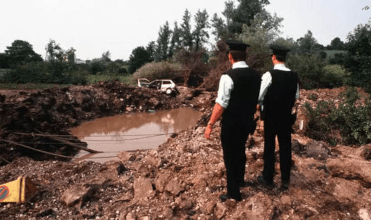
The Provisional Irish Republican Army (IRA) carries out an IED roadside bomb attack at the Killylea Road on the outskirts of Armagh, County Armagh, Northern Ireland, on July 24, 1990. An IRA active service unit detonates a large bomb as an unmarked Royal Ulster Constabulary (RUC) vehicle and a civilian car pass, killing three RUC officers and a Catholic nun.

Leading up to the attack, on April 9, 1990 four Ulster Defence Regiment (UDR) soldiers (Michael Adams, John Birch, John Bradley, Steven Smart) are killed in a similar attack when the IRA detonates a land mine under their patrol vehicle on Ballydugan Road, Downpatrick, County Down. The land mine contains over 1,000 lbs. of explosives.

On the afternoon of July 24, 1990, 37-year-old nun Catherine Dunne is driving an Austin Metro car with a passenger, Cathy McCann, a 25-year-old social worker. Some hours previously, members of the IRA take over a house close to Killylea Road, two miles outside Armagh, County Armagh, holding its occupants, a married couple and their children, at gunpoint.

A detonating wire is placed from the house to a 1,000 lb. bomb, placed in a culvert under Killylea Road. At approximately 2:00 PM, as Dunne’s car is driving to Armagh, a Royal Ulster Constabulary patrol car is traveling in the opposite direction. Dunne’s car passes by the patrol car just as the police drive over the culvert, at which point the IRA detonate the bomb. Constable William James Hanson (37), and reserve officers Joshua Cyril Willis (35) and David Sterritt (34), are all killed instantly. Their car is blown into the air and lands upside down. Dunne and McCann are both severely injured with Dunne later dying of her injuries.

Witness Paul Corr, owner of a petrol filling station nearby, says, “The ground shook beneath us and it was accompanied by a very large explosion. At first we did not see the police car. The whole place was a terrible mess. Then we saw two young girls in the [Austin Metro]. They were unconscious and looked in a pretty bad way. There was nothing we could do for the policemen. Nobody could have come out of that car alive. It was dreadful.”

The bomb leaves a 20-foot-diameter crater in the two-lane road.

Taoiseach Charles Haughey is quoted as saying, “I know all the people of Ireland join me in my condemnation of this atrocity.”

The IRA releases a message claiming responsibility for the attack, and calls Dunne a victim of “unforeseen and fluke circumstances.” The statement is rejected in advance by political and Catholic and Protestant leaders alike and politicians in Ireland and Great Britain.

Sinn Féin‘s Martin McGuinness says, “Our sorrow at these deaths is genuine and profound, but will be abused by our political opponents who will cynically exploit yesterday’s events for their own political purpose.”

Pope John Paul II sends a message to be read at Dunne’s funeral in which he condemns the “grievous injustice and futility” of the murders that leave him “deeply shocked and saddened.” He implores “the men and women who espouse violence to recognise the grievous injustice and futility of terrorism.”

Two men, Henry McCartney (26) and Tarlac Connolly (29), are charged with the killings. They are later given life sentences but are released in 2000 under the terms of the Good Friday Agreement.


Leave a comment

Death of Philanthropist Thomas John Barnardo

Thomas John Barnardo, philanthropist and founder and director of homes for poor children, dies in London on September 19, 1905. From the foundation of the first Barnardo’s home in 1867 to the date of his death, nearly 60,000 children are taken in.

Barnardo is born in Dublin on July 4, 1845. He is the fourth of five children of John Michaelis Barnardo, a furrier who is of Sephardic Jewish descent, and his second wife, Abigail, an Englishwoman and member of the Plymouth Brethren. In the early 1840s, John emigrates from Hamburg to Dublin, where he establishes a business. Barnardo moves to London in 1866. At that time he is interested in becoming a missionary.

Barnardo establishes “Hope Place” ragged school in the East End of London in 1868, his first attempt at aiding the estimated 30,000 ‘destitute’ children in Victorian London. Many of these children are not only impoverished, but orphaned, as the result of a recent cholera outbreak. For those unable to afford private education, the school offers education which, although Christian-based in nature, is not exclusively religion-focused, and works to provide tutelage on various common trades of that time.

In 1870, Barnardo is prompted to form a boys’ orphanage at 18 Stepney Causeway after inspecting the conditions within which London’s orphaned population sleep. This is the first of 122 such establishments, caring for over 8,500 children, founded before his death in 1905. Significant provisions are available to occupants. Infants and younger children are sent to rural districts in attempt to protect them from industrial pollution. Teenagers are trained in skills such as carpentry and metalworking, to provide them a form of basic financial stability.

In June 1873, Barnardo marries Sara Louise Elmslie, known as Syrie, the daughter of an underwriter for Lloyd’s of London. She shares her husband’s interests in evangelism and social work. The couple settles at Mossford Lodge, Essex, where they have seven children, three of whom die in early childhood.

Barnardo’s homes do not just accommodate boys. In 1876 the “Girls’ Village Home” is established and by 1905 accommodates 1,300 girls, who are trained for “domestic occupation.” Another establishment, the “rescue home for girls in serious danger,” aims to protect girls from the growing tide of child prostitution.

Barnardo’s work is carried on by his many supporters under the name Dr. Barnardo’s Homes. Following societal changes in the mid-20th century, the charity changes its focus from the direct care of children to fostering and adoption, renaming itself Dr. Barnardo’s. Following the closure of its last traditional orphanage in 1989, it takes the still simpler name of Barnardo’s.

Barnardo dies of angina pectoris in London on September 19, 1905, and is buried in front of Cairn’s House, Barkingside, Essex. The house is now the head office of the children’s charity he founded, Barnardo’s. A memorial stands outside Cairn’s House.

After Barnardo’s death, a national memorial is instituted to form a fund of £250,000 to relieve the various institutions of all financial liability and to place the entire work on a permanent basis. At the time of his death, his charity is caring for over 8,500 children in 96 homes.

At the time of the Whitechapel murders, due to the supposed medical expertise of the Ripper, various doctors in the area are suspected. Barnardo is named a possible suspect long after his death. Ripperologist Gary Rowlands theorises that due to Barnardo’s lonely childhood he had anger which may have led him to murder prostitutes. However, there is no evidence whatsoever that he committed the murders. Critics have also pointed out that his age and appearance do not match any of the descriptions of the Ripper.