Guinness is the third son of Arthur Guinness II (1768–1855), and his wife Anne Lee, and a grandson of the first Arthur (1725–1803), who had bought the St. James’s Gate Brewery in 1759. He joins his father in the business in his late teens, without attending university, and from 1839 he takes sole control within the family. From 1855, when his father dies, he has become the richest man in Ireland, having built up a huge export trade and by continually enlarging his brewery.
In 1851 Guinness is elected the first Lord Mayor of Dublin under the reformed corporation. In 1863 he is made an honorary LL.D. (Doctor of Laws) by Trinity College Dublin, and on April 15, 1867, is created a baronet by patent, in addition to which, on May 18, 1867, by royal licence, he has a grant of supporters to his family arms.
From 1860 to 1865, Guinness undertakes at his own expense, and without hiring an architect, the restoration of the city’s St. Patrick’s Cathedral, an enterprise that costs him over £150,000. In 1865 the building is restored to the dean and chapter and reopens for services on February 24. The citizens of Dublin and the dean and chapter of St. Patrick’s present him with addresses on December 31, 1865, expressive of their gratitude for what he has done for the city. The addresses are in two volumes, which are afterwards exhibited at the Paris Exhibition.
In recognition of his generosity, Guinness is made a baronet in 1867. He is one of the ecclesiastical commissioners for Ireland, a governor of Simpson’s Hospital, and vice-chairman of the Dublin Exhibition Palace. He dies the following year, on May 19, 1868, at his Park Lane home in London. At the time of his death, he is engaged in the restoration of Marsh’s Library, a building which adjoins St. Patrick’s Cathedral. The restoration is completed by his son Arthur.
Guinness is buried in Mount Jerome Cemetery, Dublin, in the family vault, on May 27, 1868. His personalty is sworn under £1,100,000 on August 8, 1868. A bronze statue of him by John Henry Foley is erected by the Cathedral Chapter in St. Patrick’s churchyard, on the south side of the cathedral, in September 1875, which is restored in 2006.
Though a member of a very artistic family, Hone’s initial training is as an engineer at Trinity College Dublin followed by a brief period of work for the Irish Railway before going to Paris in 1853 to study painting. He first studies under Adolphe Yvon, the French military painter, and later Thomas Couture, who is one of the earliest exponents of realism and from whom he learns principles which influence his work throughout his career.
Most of Hone’s later paintings are landscapes, very often enlivened with animals and occasionally with figures. In France he is influenced by the painter Gustav Courbet who is taking a new and quite revolutionary realistic approach. His closest painting tips are, however, from another French impressionist, Jean-Baptiste-Camille Corot. He becomes a close friend of one of Corot’s followers at the Barbizon school of landscape painting. At Barbizon he learns to appreciate colour, texture and tone in the landscape and applies it in strong and confident brushworks to the painting of Irish subjects on his return. In Paris he also works closely with artist Édouard Brandon, also a follower of Corot.
Hone’s paintings which are completed in France have many similarities to those that he completes at his country farm in County Dublin, but the finish is perhaps more polished and professional in the later Irish works.
From 1876, except for four years, Hone exhibits at the Royal Hibernian Academy (RHA). He is elected a full member in 1880 and in 1894 becomes Professor of Painting. His exhibition with John Butler Yeats in 1901 is one of the turning points for the history of Irish art as it is their paintings which convince Sir Hugh Lane that Dublin should have a gallery of modern art.
Nathaniel Hone dies in Dublin on October 14, 1917. After his death his widow bequeaths the contents of his studio to the National Gallery of Ireland. He rarely dates his work, so it is difficult to establish chronology. The similarity of many of his motifs and subjects often make it difficult to tell whether a view is Irish or French. Equally it is difficult to chart his developments on stylistic grounds alone.
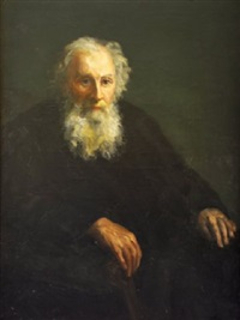
(Pictured: Nathaniel Hone, the younger, self-portrait as an old man)
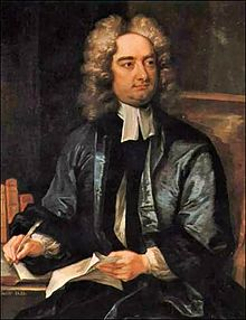
Swift is born in Dublin on November 30, 1667. His father, an attorney, also named Jonathan Swift, dies just two months before he is born. Without steady income, his mother struggles to provide for her newborn. Moreover, he is a sickly child. It is later discovered that he suffers from Ménière’s disease, a condition of the inner ear that leaves the afflicted nauseous and hard of hearing. In an effort to give her son the best upbringing possible, Swift’s mother gives him over to Godwin Swift, her late husband’s brother and a member of the respected professional attorney and judges group Gray’s Inn. Godwin Swift enrolls his nephew in the Kilkenny Grammar School (1674–1682), which is perhaps the best school in Ireland at the time. His transition from a life of poverty to a rigorous private school setting proves challenging. He does, however, make a fast friend in William Congreve, the future poet and playwright.
At age 14, Swift commences his undergraduate studies at Trinity College, Dublin. In 1686, he receives a Bachelor of Arts degree and goes on to pursue a master’s degree. Not long into his research, huge unrest breaks out in Ireland. The king of Ireland, England and Scotland is soon to be overthrown. What becomes known as the Glorious Revolution of 1688 spurs him to move to England and start anew. For 10 years, Swift works in Surrey‘s Moor Park and acts as an assistant to Sir William Temple.
During his Moor Park years, Swift met the daughter of Temple’s housekeeper, an 8-year-old named Esther Johnson. They become lovers for the rest of their lives until Johnson’s death. It is rumored that they marry in 1716, and that Swift keeps of lock of Johnson’s hair in his possession at all times.
During his decade of work for Temple, Swift returns to Ireland twice. On a trip in 1695, he takes all necessary requirements to become an ordained priest in the Anglican tradition. Under Temple’s influence, he also begins to write, first short essays and then a manuscript for a later book. Temple dies in 1699. Swift completes the task of editing and publishing Temple’s memoirs. He then leans on his priestly qualifications and finds work ministering to a pea-sized congregation just 20 miles outside of Dublin. For the next ten years, he gardens, preaches and works on the house provided to him by the church. He also returns to writing. His first political pamphlet is titled A Discourse on the Contests and Dissentions in Athens and Rome.
In 1704, Swift anonymously releases A Tale of a Tub and The Battle of the Books. Tub, although widely popular with the masses, is harshly disapproved of by the Church of England. Ostensibly, it criticizes religion, but Swift means it as a parody of pride. Nonetheless, his writings earn him a reputation in London and when the Tories come into power in 1710, they ask him to become editor of The Examiner, their official paper. After a time, he becomes fully immersed in the political landscape and begins writing some of the most cutting and well-known political pamphlets of the day, including The Conduct of the Allies, an attack on the Whigs. Privy to the inner circle of Tory government, he lays out his private thoughts and feelings in a stream of letters to his beloved Stella. They are later published as The Journal to Stella.
When he sees that the Tories will soon fall from power, Swift returns to Ireland. In 1713, he takes the post of dean at St. Patrick’s Cathedral in Dublin. While leading his congregation at St. Patrick’s, he begins to write what would become his best-known work. In 1726, at last finished with the manuscript, he travels to London and benefits from the help of several friends, who anonymously publish it as Travels into Several Remote Nations of the World, in Four Parts. By Lemuel Gulliver, First a Surgeon, and then a Captain of Several Ships, more simply known as Gulliver’s Travels. The book is an immediate success and has not been out of print since its first run.
Not long after the celebration of this work, Swift’s longtime love, Esther Johnson, falls ill. She dies in January 1728. Her death moves Swift to write The Death of Mrs. Johnson.
In 1742, Swift suffers a stroke and loses the ability to speak. On October 19, 1745, Jonathan Swift dies. He is laid to rest next to Esther Johnson inside Dublin’s St. Patrick’s Cathedral.
In 1866 Monck becomes a peer with the title Baron Monck. When the Canadian colonies become a semi-independent confederation the next year, he becomes the country’s first Governor General. He is also responsible for establishing Rideau Hall as the residence of the Governor General in Ottawa.
Stanford is born into a well-off and highly musical family, the only son of John James Stanford, a prominent Dublin lawyer, Examiner to the Court of Chancery in Ireland and Clerk of the Crown for County Meath, and his second wife, Mary, née Henn. He is educated at the University of Cambridge before studying music in Leipzig and Berlin. He is instrumental in raising the status of the Cambridge University Musical Society, attracting international stars to perform with it.
While still an undergraduate, Stanford is appointed organist of Trinity College, Cambridge. In 1882, at the age of 29, he is one of the founding professors at the Royal College of Music, where he teaches composition for the rest of his life. From 1887 he is also Professor of Music at Cambridge. As a teacher, he is skeptical about modernism and bases his instruction chiefly on classical principles as exemplified in the music of Johannes Brahms. Among his pupils are rising composers whose fame go on to surpass his own, such as Gustav Holst and Ralph Vaughan Williams. As a conductor, he holds posts with the Bach Choir and the Leeds Triennial Music Festival.
Stanford composes a substantial number of concert works, including seven symphonies, but his best-remembered pieces are his choral works for church performance, chiefly composed in the Anglican tradition. He is a dedicated composer of opera, but none of his nine completed operas has endured in the general repertory. Some critics regard him, together with Hubert Parry and Alexander Mackenzie, as responsible for a renaissance in music from the British Isles. However, after his conspicuous success as a composer in the last two decades of the 19th century, his music is eclipsed in the 20th century by that of Edward Elgar as well as former pupils.
In September 1922, Stanford completes the sixth Irish Rhapsody, his final work. Two weeks later he celebrates his 70th birthday and thereafter his health declines. On March 17, 1924, he suffers a stroke and dies on March 29 at his home in London, survived by his wife and children. He is cremated at Golders Green Crematorium on April 2 and his ashes are buried in Westminster Abbey the following day.
Stanford’s last opera, The Travelling Companion, composed during World War I, is premiered by amateur performers at the David Lewis Theatre, Liverpool in 1925 with a reduced orchestra. The work is given complete at Bristol in 1928 and at Sadler’s Wells Theatre, London, in 1935.
On September 5, 1798, Teeling clears the way for the advancing Irish-French army by single handedly disabling a British gunner post during the Battle of Collooney in Sligo when he breaks from the French ranks and gallops towards Union Rock. He is armed with a pistol and shoots the cannon’s marksman and captures the cannon. The French and Irish advance and the British, after losing the cannon position, retreat towards their barracks at Sligo, leaving 60 dead and 100 prisoners.
During the Battle of Ballinamuck at Longford, Teeling and approximately 500 other Irishmen are captured along with their French allies. The French troops are treated as prisoners of war and later returned to France, however the Irish troops are executed by the British.
Teeling is court-martialled by Britain as an Irish rebel and for committing treason. To positively identify him, the authorities enlist William Coulson, a damask manufacturer from Lisburn, who identifies him as a son of Luke Teeling, a linen merchant who lived in Chapel Hill, Lisburn. Bartholomew Teeling is hanged at Arbour Hill Prison in Dublin on September 24, 1798.
In 1898, the centenary year of the battle, a statue of Teeling is erected in Carricknagat. One of the main streets in Sligo, which accommodates the Sligo Courthouse and main Garda Síochána barracks, is later named Teeling Street also in honour of Bartholomew Teeling.
Born in New York City on April 23, 1926, to Irish immigrants Margaret and Patrick Donleavy, Donleavy receives his education at various schools in the United States. He declares himself to be an atheist at the age of 14. He serves in the United States Navy during World War II. After the war ends, he moves to Ireland. In 1946 he begins studying at Trinity College, Dublin, but leaves in 1949 before taking a degree. Also in 1946, he marries Valerie Heron, and the couple has two children: Philip (born 1951) and Karen (born 1955). They divorce in 1969 and he remarries in 1970 to Mary Wilson Price. That union also ends in divorce in 1989.
Donleavy’s first published work is a short story entitled A Party on Saturday Afternoon, which appears in the Dublin literary periodical, Envoy, A Review of Literature and Art in 1950. He gains critical acclaim with his first novel, The Ginger Man (1955), which is one of the Modern Library 100 best novels. The novel, of which his friend and fellow writer Brendan Behan is the first person to read the completed manuscript, is banned in Ireland and the United States by reason of obscenity. Lead character Sebastian Dangerfield is in part based on Trinity College companion Gainor Crist, an American Navy veteran also studying at Trinity College on the G.I. Bill, whom Donleavy once describes in an interview as a “saint,” though of a Rabelaisian kind.
In 2011, it is reported that Donleavy had not fathered his two children with Mary Wilson Price. A DNA test in the early 1990s confirms that Rebecca is the daughter of brewing scion Kieran Guinness, and Rory is the son of Kieran’s older brother Finn, whom Price marries after her divorce from Donleavy. “My interest is only to look after the welfare of the child,” Donleavy tells The Times, “And after a certain stage, you can’t worry about their parentage.”
J.P. Donleavy dies of an apparent stroke in Mullingar, County Westmeath on September 11, 2017, at the aged of 91.
O’Riordan is the youngest of nine children, two of whom die in infancy. Her father, Terence Patrick “Terry” O’Riordan (1937–2011), is a farm labourer who is left unable to work due to brain damage caused by a motorbike accident in 1968. Her mother, Eileen, is a school caterer. She attends Laurel Hill Coláiste FCJ school in Limerick. She leaves school without any qualifications.
In 1989, brothers Mike and Noel Hogan form The Cranberry Saw Us with drummer Fergal Lawler and singer Niall Quinn, in Limerick. Less than a year later, Quinn leaves the band. The remaining band members then place an advertisement for a female singer. O’Riordan responds to the advertisement and auditions by writing lyrics and melodies to some existing demos. When she returns with a rough version of “Linger,” she is hired, and they record Nothing Left At All, a three-track EP released on tape by local record label Xeric Records, which sells 300 copies. The group changes their name to “The Cranberries.” The owner of Xeric Studios, Pearse Gilmore, becomes their manager and provides the group with studio time to complete another demo tape, which he produces. It features early versions of “Linger” and “Dreams,” which are sent to record companies throughout the United Kingdom (UK).
Are You Listening? is released in Ireland on May 4, 2007, in Europe on May 7, and in North America on May 15. In 2008, O’Riordan wins a European Border Breakers Award (EBBA) which is presented annually to recognize the success of ten emerging artists or groups who reach audiences outside their own countries with their first internationally released album in the past year. Her second album, No Baggage, featuring eleven tracks, is released in August 2009.
In January 2009, the University Philosophical Society at Trinity College, Dublin invites The Cranberries to reunite for a concert celebrating O’Riordan’s appointment as an honorary member of the Society, which leads the band members to consider reuniting for a tour and a recording session. On August 25, 2009, while promoting her solo album No Baggage in New York City on 101.9 RXP radio, O’Riordan announces the reunion of the Cranberries for a world tour. The tour begins in North America in mid-November, followed by South America in mid-January 2010 and Europe in March 2010. She remains in the band until her unexpected death.
She appears as a judge on RTÉ‘s The Voice of Ireland during the 2013–2014 season. In April 2014, O’Riordan joins and begins recording new material with the trio D.A.R.K.
On January 15, 2018, at the age of 46, while in London for a recording session, O’Riordan dies suddenly at the London Hilton on Park Lane hotel in Mayfair. The cause of death is not immediately made public. Police say it is not being treated as suspicious. The coroner’s office says the results of its inquiry would not be released until April 3 at the earliest. On April 3 the inquest is cancelled with no new date announced.
A three-day memorial in her hometown, with O’Riordan lying in repose, lasts from January 20-22 at St. Joseph’s church. On January 23, she is buried after a service at Saint Ailbe’s Roman Catholic Church, Ballybricken, County Limerick. It begins with the studio recording of “Ave Maria” as sung by O’Riordan and Luciano Pavarotti. She is buried alongside her father.
In 1761, O’Brien enters the Irish House of Commons as the member for Ennis, sitting until 1768. Subsequently he successfully runs for Clare, a seat previously held by his father, holding it until 1776. He is then again elected for Ennis, but following the unseating of Hugh Dillon Massy as Member of Parliament for Clare, he returns to represent that constituency in 1778. In the election of 1783, he becomes the representative for Tuam. He is sworn of the Privy Council of Ireland in 1786. He serves for the latter constituency until 1790, when he is re-elected for Ennis. He holds this seat finally until his death on January 15, 1795.
O’Brien marries Anne French, the daughter of Robert French, in 1768 and has by her seven children, three sons and four daughters. He is succeeded in the baronetcy as well as in the constituency of Ennis by his oldest son Edward.
The Museum of Science and Art, Dublin on Kildare Street opens on August 29, 1890. The museum is founded on August 14, 1877, by act of Parliament. The decision to establish a state-run museum arises from requests by the Royal Dublin Society for continued government funding for its expanding museum activities.
A number of developments lead to the Science and Art Museums Act of 1877, which has the effect of transferring the buildings and collections of the Royal Dublin Society to state ownership. The collections are further enhanced by the transfer of other notable collections from institutions such as the Royal Irish Academy and Trinity College Dublin.
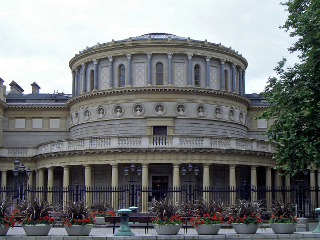
The Museum is the responsibility of the Department of Science and Art, which is also responsible for the South Kensington museums in London. State support for the institution is manifested in the construction of the new building on Kildare Street. It is built in the VictorianPalladian style and has been compared with the Altes Museum in Berlin, designed by Karl Friedrich Schinkel in the 1820s. Neoclassical influences can be seen in the colonnaded entrance and the domed rotunda, which rises to a height of 20 metres, and is modeled on the Pantheon in Rome.
The new museum houses coins, medals and significant Irish antiquities from the Royal Irish Academy including the Tara Brooch and Ardagh Chalice, ethnographical collections with material from Captain James Cooke‘s voyages from Trinity College Dublin, and the collections of the Geological Survey of Ireland.
These are joined by material from the decorative arts and ethnographical collections of the Royal Dublin Society along with their Irish collections of antiquities, minerals and plants. The old Royal Dublin Society museum on the Merrion Street side of Leinster House, erected with government assistance and opened in 1856, is devoted to natural history. It is dominated by zoology throughout much of its subsequent history and has an annex devoted to geology.
The building on Kildare Street is designed by Thomas Newenham Deane and is used to show contemporary Irish, British and Continental craftsmanship in its construction. State involvement in the running of the Museum allows for steady funding and a connection with other state museums in London and Edinburgh which is of considerable benefit. The collections grow with material acquired through purchase, public donation and shares of significant collections acquired by the state and dispersed by the London museums.
Catalogues are prepared by leading experts in various disciplines and printed in the Museum’s own press. In 1900 control passes to the Department of Agriculture and Technical Instruction and in 1908 its name is changed from “The Dublin Museum of Science and Art” to the “National Museum of Science and Art.” The name of the institution is changed again in 1921 to the “National Museum of Ireland.”




 seamus dubhghaill