seamus dubhghaill

Promoting Irish Culture and History from Little Rock, Arkansas, USA


Leave a comment

Birth of Peig Sayers, Author & Seanchaí

peig-sayers

Peig Sayers, Irish author and seanchaí, is born in the townland of Vicarstown, Dunquin, County Kerry, on March 29, 1873. Seán Ó Súilleabháin, the former archivist for the Irish Folklore Commission, describes her as “one of the greatest woman storytellers of recent times.”

Sayers is born Máiréad (Margaret) Sayers, the youngest child of the family. She is called Peig after her mother, Margaret “Peig” Brosnan, from Castleisland. Her father Tomás Sayers is a renowned storyteller who passes on many of his tales to Peig. At age 12, she is taken out of school and goes to work as a servant for the Curran family in the nearby town of Dingle. She spends two years there before returning home due to illness.

She spends the next few years as a domestic servant working for members of the growing middle class produced by the Land War. She plans to join her best friend, Cáit Boland, in the United States, but Boland writes that she has had an accident and can not forward the cost of the fare. Peig moves to the Great Blasket Island after marrying Pádraig Ó Guithín, a fisherman and native of the island, on February 13, 1892. She and Pádraig have eleven children, of whom six survive.

The Norwegian scholar Carl Marstrander, who visits the island in 1907, urges Robin Flower of the British Museum to visit the Blaskets. Flower is keenly appreciative of Sayers’ stories and tales. He records them and brings them to the attention of the academic world.

In the 1930s, a Dublin teacher, Máire Ní Chinnéide, who is a regular visitor to the Blaskets, urges Sayers to tell her life story to her son Micheál. She is illiterate in the Irish language, although she receives her early schooling through the medium of English. She dictates her biography to Micheál. He then sends the manuscript pages to Máire Ní Chinnéide in Dublin, who edits them for publication. It is published in 1936.

Over several years beginning in 1938 she dictates 350 ancient legends, ghost stories, folk stories, and religious stories to Seosamh Ó Dálaigh of the Irish Folklore Commission.

Sayers continues to live on the island until 1942, when she leaves the Island and returns to her native Dunquin. She is moved to a hospital in Dingle, County Kerry where she dies on December 8, 1958. She is buried in the Dún Chaoin Burial Ground on the Dingle Peninsula. Her surviving children, except for her son Micheál, emigrate to the United States and live with their descendants in Springfield, Massachusetts.

Leave a comment

Death of Olympic Gold Medalist Martin John Sheridan

martin-john-sheridan

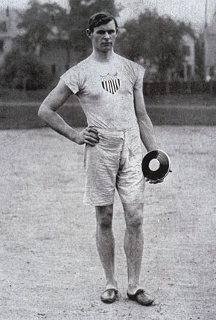
Martin John Sheridan, “one of the greatest athletes the United States has ever known” according to his obituary in The New York Times, dies in St. Vincent’s Hospital in Manhattan, New York City on March 27, 1918, the day before his 37th birthday.

Sheridan is born in Bohola, County Mayo on March 28, 1881. At 6’3″ and 194 lbs., Sheridan is the best all-around athlete of the Irish American Athletic Club, and like many of his teammates, serves with the New York City Police Department from 1906 until his death. He is so well respected in the NYPD, that he serves as the Governor’s personal bodyguard when the governor is in New York City.

A five-time Olympic gold medalist, with a total of nine Olympic medals, Sheridan is called “one of the greatest figures that ever represented this country in international sport, as well as being one of the most popular who ever attained the championship honor.” He wins the discus throw event at the 1904, 1906, and 1908 Summer Olympic Games as well as the shot put at the 1906 Olympics and the Greek discus in 1908. At the 1906 Intercalated Games in Athens, Greece he also wins silver medals in the standing high jump, standing long jump and the stone throw.

In 1907, Sheridan wins the National Amateur Athletic Union discus championship and the Canadian championship, and in 1908 he wins the Metropolitan, National and Canadian championships as well as two gold medals in the discus throw and bronze in the standing long jump at the 1908 Olympic Games.

Two of Sheridan’s gold medals from the 1904 Summer Olympic Games in St. Louis, Missouri, and one of his medals from the 1906 Intercalated Games in Athens, Greece, are currently located in the USA Track & Field‘s Hall of Fame History Gallery, in Washington Heights, Manhattan.

There are claims that Sheridan fuels a controversy in London in 1908, when flagbearer Ralph Rose refuses to dip the flag to King Edward VII. Sheridan supports Rose by explaining “This flag dips to no earthly king,” and it is claimed that his statement exemplifies both Irish and American defiance of the British monarchy. However, careful research has shown that this is first reported in 1952. Sheridan himself makes no mention of it in his published reports on the Games and neither does his obituary.

Martin Sheridan dies in Manhattan, New York City on March 27, 1918, a very early casualty of the 1918 flu pandemic. He is buried in Calvary Cemetery, Queens, New York. The inscription on the granite Celtic Cross monument marking his grave says in part: “Devoted to the Institutions of his Country, and the Ideals and Aspirations of his Race. Athlete. Patriot.” He is part of a group of Irish American athletes known as the “Irish Whales.”


Leave a comment

Birth of Harry Furniss, Artist & Illustrator

harry-furniss

Harry Furniss, artist and illustrator, is born in Wexford, County Wexford on March 26, 1854. His father is English and his mother Scottish, Furniss identifying himself as English. He is educated at Wesley College in Dublin.

Furniss’s first job as an illustrator is for the Illustrated Sporting and Dramatic News, and when it is purchased by the owner of The Illustrated London News he moves to that magazine. There he produces illustrations of social events such as the The Boat Race, Goodwood Racecourse and even the annual fancy dress ball at Brookwood Asylum, as well as acting as a special correspondent reporting on less pleasant aspects of life in contemporary England, such as the scandalous divorce trial of Lady Colin Campbell.

After some years Furniss moves to The Graphic, initially writing and illustrating a series of supplements titled “Life in Parliament,” and he comments that “from this time forward it would be difficult to name any illustrated paper with which I have not at some time or other been connected.”

Furniss’s most famous humorous drawings are published in Punch, for which he starts working in 1880, and to which he contributes over 2,600 drawings. He leaves Punch in 1894 when its owners discover that he has sold one of his Punch drawings to Pears Soap for use in an advertising campaign.

He illustrates Lewis Carroll‘s novel Sylvie and Bruno in 1889 and Sylvie and Bruno Concluded in 1893. Carroll and Furniss sometimes produce both pictures and text simultaneously. Carroll exerts strong control over Furniss’s illustration, to such an extent that Furniss pretends to be out when Carroll calls at his home. After completing Sylvie and Bruno Concluded Furniss vows never to work for the author again. In 1890, he illustrates the Badminton Library‘s volume on Golf.

Upon leaving Punch, Furniss brings out his own humorous magazine, Lika Joko, but when this fails, he moves to the United States where he works as a writer and actor in the fledgling film industry and where, in 1914, he pioneers the first animated cartoon film for Thomas Edison.

His two-volume autobiography, titled The Confessions of a Caricaturist is published in 1902, and a further volume of personal recollections and anecdotes, Harry Furniss At Home, is published in 1904.

Furniss writes and illustrates 29 books of his own, including Some Victorian Men and Some Victorian Women and illustrates 34 works by other authors, including the complete works of Charles Dickens and William Makepeace Thackeray. On some projects, like his illustrations for G. E. Farrow‘s Wallypug books, Furniss collaborates with his daughter, fellow artist Dorothy Furniss.

Harry Furniss dies on January 14, 1925, in London, England.


Leave a comment

Birth of Boxer Jack McAuliffe

jack-mcauliffe

Jack McAuliffe, Irish American boxer who fights mostly out of Williamsburg, Brooklyn, is born in Cork, County Cork, on March 24, 1866. Nicknamed “The Napoleon of the Ring,” he is one of only fifteen world boxing champions to retire without a loss. He is the World Lightweight champion from 1886 to 1893. He is posthumously inducted into The Ring magazine Hall of Fame in 1954 and the International Boxing Hall of Fame in 1995.

McAuliffe’s parents are Cornelius McAuliffe and Jane Bailey, who are living at 5 Christ Church Lane, Cork, at the time of Jack’s birth. He emigrates to the United States in 1871, where he spends his early years in Bangor, Maine.

McAuliffe makes his first appearance as an amateur boxer in 1883. He turns professional soon after, fighting Jem Carney 78 rounds to a draw at Revere Beach, Massachusetts. He fights Billy Dacey for the lightweight championship and a $5,000 purse in 1888, knocking him out in eleven rounds. He is known as a strong two-handed fighter with “cat-like” reflexes.

McAuliffe is married twice, both times to stage actresses. His first wife is Katie Hart, who plays in farce comedies. After her death, he marries Catherine Rowe in 1894, whose stage name is Pearl Inman, of the song and dance team The Inman Sisters. Between marriages he dates a third actress, Sadie McDonald. McAuliffe and Rowe move back to Bangor, Maine, in 1894, where he undertakes preliminary training for a fight later that year at the Seaside Athletic Club on Coney Island.

McAuliffe retires in 1897. According to the International Boxing Hall of Fame, he has 36 professional fights. He finishes his career with 30 victories with 22 by knockout, five draws and one no decision.

Jack McAuliffe dies on November 5, 1937, at his home on Austin Street in Forest Hills, Queens.


Leave a comment

Birth of Production Designer Cedric Gibbons

cedric-gibbons

Austin Cedric Gibbons, Irish American art director and production designer for the film industry, is born in Dublin on March 23, 1893. He also makes a significant contribution to motion picture theater architecture from the 1930s to 1950s.

Gibbons was born to architect Austin P. Gibbons and Veronica Fitzpatrick Simmons. He is privately tutored and studies at the Art Students League of New York. In 1911 he begins working in his father’s office as a junior draftsman. From 1915 he serves as art director at Edison Studios in New Jersey and then serves in the United States Navy during World War I. He then joins Goldwyn Studios and begins a long career with Metro-Goldwyn-Mayer in 1924, the year the studio is founded.

Gibbons is one of the original 36 founding members of the Academy of Motion Picture Arts and Sciences and oversees the design of the Academy Awards statuette in 1928, a trophy for which he himself would be nominated 38 times for Best Production Design, winning eleven.

In 1930, Gibbons marries actress Dolores del Río and co-designs their house in Santa Monica, an intricate Art Deco residence influenced by Rudolf Schindler. They divorce in 1941. Three years later he marries actress Hazel Brooks, with whom he remains until his death.

Gibbons’s set designs, particularly those in such films as Born to Dance (1936) and Rosalie (1937), heavily inspire motion picture theater architecture in the late 1930s through 1950s. The style is found very clearly in the theaters that are managed by the Skouras brothers, whose designer Carl G. Moeller uses the sweeping scroll-like details in his creations. Among the more classic examples are the Loma Theater in San Diego, The Crest in Long Beach and Fresno, and the Culver Theater in Culver City. The style is sometimes referred to as Art Deco and Art Moderne.

Gibbons retires in 1956 with about 1,500 films credited to him, however, his contract with MGM dictates that he receives credit as art director for every MGM film released in the United States, even though other designers might do the bulk of the work. Even so, his actual hands-on art direction is believed to be about 150 films.

Gibbons’ second cousin, Frederick Gibbons, a musician, orchestra conductor, and entertainer who works with him at MGM, is the father of Billy Gibbons of the rock band ZZ Top.

Cedric Gibbons dies in Los Angeles on July 26, 1960, at the age of 67. He is buried in the Calvary Cemetery, East Los Angeles.


Leave a comment

Initial Publication of “At Swim-Two-Birds”

at-swim-two-birds

At Swim-Two-Birds, a novel by Irish writer Brian O’Nolan writing under the pseudonym Flann O’Brien, is published on March 13, 1939. It is widely considered to be O’Brien’s masterpiece, and one of the most sophisticated examples of metafiction.

At Swim-Two-Birds is accepted for publication by Longman on the recommendation of Graham Greene, who is a reader for them at the time. It is published under the pseudonym of Flann O’Brien, a name O’Nolan had already used to write hoax letters to The Irish Times. O’Nolan suggests using “Flann O’Brien” as a penname during negotiation with Longman. The novel’s title derives from Snámh dá Én, a ford on the River Shannon, between Clonmacnoise and Shannonbridge, reportedly visited by the legendary King Sweeney, a character in the novel.

The book does not sell well after it is published. By the outbreak of World War II, it has sold scarcely more than 240 copies. In 1940, Longman’s London premises are destroyed during a bombing raid by the Luftwaffe and almost all the unsold copies are incinerated. The novel is republished by Pantheon Books in New York City in 1950, on the recommendation of James Johnson Sweeney, but sales remain low. In May 1959 Timothy O’Keeffe, while editorial director of the London publishing house MacGibbon & Kee, persuades O’Nolan to allow him to republish At Swim-Two-Birds. More recently, the novel is republished in the United States by Dalkey Archive Press.

The initial reviews for At Swim-Two-Birds are not enthusiastic. The Times Literary Supplement says that the book’s only notable feature is a “schoolboy brand of mild vulgarity.” The New Statesman complains that “long passages in imitation of the Joycean parody of the early Irish epic are devastatingly dull” and the Irish novelist Seán Ó Faoláin comments in John O’London’s Weekly that although the book had its moments, it “had a general odour of spilt Joyce all over it.”

However, most of the support for At Swim-Two-Birds comes not from newspaper reviewers but from writers. Dylan Thomas, in a remark that would be quoted on dust jackets in later editions of the book, says “This is just the book to give your sister – if she’s a loud, dirty, boozy girl.” Anthony Burgess considers it one of the ninety-nine greatest novels written between 1939 and 1984. Graham Greene’s enthusiastic reader’s report is instrumental in getting the book published in the first place.

Stephen Fry has declared At Swim-Two-Birds one of his favourite books. In 2011, the book is placed on Time‘s top 100 fiction books written in English since 1923.


Leave a comment

Birth of Poet John Montague

john-montague

Irish poet John Montague is born on Bushwick Avenue at St. Catherine’s Hospital in Brooklyn, New York City, New York, on February 28, 1929. His father, James Montague, an Ulster Catholic, from County Tyrone, had come to the United States in 1925.

Life in New York is difficult during the Great Depression, so John and his two brothers are shipped back to Ireland in 1933. The two eldest are sent to their maternal grandmother’s house in Fintona, County Tyrone, but John is sent to his father’s ancestral home at Garvaghey, then maintained by two spinster aunts.

John studied at University College Dublin in 1946. Stirred by the example of other student poets he begins to publish his first poems in The Dublin Magazine, Envoy, and The Bell, edited by Peadar O’Donnell. But the atmosphere in Dublin is constrained and he leaves for Yale University on a Fulbright Fellowship in 1953.

A year of graduate school at University of California, Berkeley convinces Montague that he should return to Ireland. He settles in Dublin working at the Irish Tourist Office. In 1961 he moves to Bray, County Wicklow. A regular rhythm of publication sees his first book of stories, Death of a Chieftain (1964) after which the musical group The Chieftains is named, his second book of poems, A Chosen Light (1967), Tides (1970).

All during the 1960s, Montague continues to work on his long poem, The Rough Field, a task that coincides with the outbreak of the Northern Ireland civil rights movement. A Patriotic Suite appears in 1966, Hymn to the New Omagh Road and The Bread God in 1968, and A New Siege, dedicated to Bernadette Devlin which he reads outside Armagh Jail in 1970.

In 1972, Montague takes a teaching job at University College Cork, at the request of his friend, the composer Seán Ó Riada, where he inspires an impressive field of young writers including Gregory O’Donoghue, Seán Dunne, Thomas McCarthy, William Wall, Maurice Riordan, Gerry Murphy, Greg Delanty and Theo Dorgan.

Montague settles in Cork in 1974 and publishes an anthology, the Faber Book of Irish Verse (1974) with a book of lyrics, A Slow Dance (1975). Recognition is now beginning to come, with the award of the Irish American Cultural Institute in 1976, the first Marten Toonder Award in 1977, and the Alice Hunt Bartlett Award for The Great Cloak in 1978.

In 1987, Montague is awarded an honorary doctor of letters by the State University of New York at Buffalo. He serves as distinguished writer-in-residence for the New York State Writers Institute during each spring semester, teaching workshops in fiction and poetry and a class in the English Department of the University at Albany. In 1998, he is named the first Irish professor of poetry, a three-year appointment to be divided among Queen’s University Belfast, Trinity College Dublin, and University College Dublin. In 2008, he publishes A Ball of Fire, a collection of all his fiction including the short novella The Lost Notebook.

John Montague dies at the age of 87 in Nice, France on December 10, 2016, after complications from a recent surgery.


Leave a comment

UCC Students Protest Henry Kissinger Visit

kissingers-arrival-in-dublin

Former United States Secretary of State Henry Kissinger visits University College Cork (UCC) on February 27, 2002 where he is confronted by more than 400 angry students protesting his presence.

The protesters chant and wave banners bearing the slogan “The Milosevic of Manhattan” prior to the arrival of the 56th U.S. Secretary of State, who was in office during the controversial administration of Richard Nixon. Kissinger says he is pleased to discover that even in Ireland people are not indifferent to him. However, he denies being a war criminal claiming it is an insult to human intelligence for protesters in Cork to compare him with Slobodan Milošević.

“These people are throwing around allegedly criminal charges without a shred of real evidence. I don’t know who they represent but I wish their knowledge equalled their passion.”

Kissinger, who is visiting the university to deliver a speech at an MBA Association of Ireland business conference, says he has never replied to derogatory remarks in the media. He adds, “I consider them (the accusations) fundamentally beneath contempt. They are based on distortions and misrepresentations.”

The focus of Kissinger’s address is on United States foreign policy particularly in aftermath of the September 11, 2001 terrorist attacks.

Kissinger says the international scene is experiencing an extraordinary period of change for which there is no historical precedent. One of the biggest challenges facing the U.S. administration, he says, is to bring countries together to prevent the spread of biological and chemical weapons.

Kissinger’s visit is condemned by human rights organisations who claim he flouted international law in his dealings with Bangladesh, Chile and East Timor. Cork Sinn Féin councillor Jonathan O’Brien tells an earlier council meeting that Kissinger is not welcome in the city, and calls on UCC to cancel his invitation.


2 Comments

Deportation of Joe Doherty

joseph-doherty

Joe Doherty, a volunteer in the Belfast Brigade of the Provisional Irish Republican Army (IRA) who escapes during his 1981 trial for killing a member of the Special Air Service (SAS) in 1980, is arrested in the United States in 1983 and is deported to Northern Ireland by the U.S. government on February 19, 1992. A first season episode of Law & Order entitled “The Troubles” is based on his case.

The trial of Doherty and the other members of their four-man active service unit nicknamed the “M60 gang” begins in early May 1981, on charges including three counts of murder. On June 10, Doherty and seven other prisoners, including Angelo Fusco and the other members of the IRA unit, take a prison officer hostage at gunpoint in Crumlin Road Gaol and ultimately escape in waiting cars. Two days after the escape, Doherty is convicted in absentia and sentenced to life imprisonment with a minimum recommended term of thirty years.

Doherty escapes across the border into the Republic of Ireland, and then travels to the United States on a false passport. He lives with an American girlfriend in Brooklyn and New Jersey, working on construction sites and as a bartender at Clancy’s Bar in Manhattan, where he is arrested by the FBI on June 28, 1983. He is imprisoned in the Metropolitan Correctional Center in Manhattan, and a legal battle ensues with the British government seeking to extradite him back to Northern Ireland. Doherty claims he is immune from extradition as the killing of Royal Irish Constabulary Captain Herbert Westmacott was a political act. In 1985 federal judge John E. Sprizzo rules Doherty cannot be extradited as the killing is a “political offense.” Doherty’s legal battle continues as the United States Department of Justice then attempts to deport him for entering the country illegally.

Doherty remains in custody at the Metropolitan Correctional Center and attempts to claim political asylum, and on June 15, 1988, Attorney General Edwin Meese overturns an earlier ruling by the Federal Board of Immigration Appeals that Doherty can be deported to the Republic of Ireland and orders his deportation to Northern Ireland. In February 1989 new Attorney General Dick Thornburgh chooses not to support the decision made by his predecessor and asks lawyers for Doherty and the Immigration and Naturalization Service to submit arguments for a review of the decision and Doherty’s claim for asylum. By this time Doherty’s case is a cause célèbre with his sympathisers including over 130 Congressmen and a son of then President of the United States George H. W. Bush. In 1990 a street corner near the Metropolitan Correctional Center is named after him.

In August 1991, Doherty is transferred to a federal prison in Lewisburg, Pennsylvania, and on January 16, 1992, the Supreme Court of the United States overturns a 1990 Federal Appeals Court ruling by a 5-to-3 decision, paving the way for his deportation. On February 19, 1992, Doherty is deported to Northern Ireland, despite pleas to delay the deportation from members of Congress, Mayor of New York City David Dinkins, and the Cardinal Archbishop of New York, John Joseph O’Connor.

Doherty is returned to Crumlin Road Gaol before being transferred to HM Prison Maze. He is released from prison on November 6, 1998, under the terms of the Good Friday Agreement. After his release Doherty becomes a community worker specialising in helping disadvantaged young people. In 2006, he appears in the BBC television show Facing the Truth opposite the relatives of a soldier killed in the Warrenpoint ambush.


Leave a comment

Birth of Singer Delia Murphy Kiernan

delia-murphy

Delia Murphy Kiernan, singer and collector of Irish ballads, is born on February 16, 1902, in Ardroe, Roundfort, County Mayo. She records several 78 rpm records in the 1930s, 1940s and 1950s. In 1962 she records her only LP, The Queen of Connemara, for Irish Prestige Records, New York, on the cover of which her name appears alongside the LP title.

Delia’s father, John Murphy, from nearby Hollymount, makes his fortune in the Klondike Gold Rush. While in America, he marries Ann Fanning from Roscrea, County Tipperary. They return to Ireland in 1901 and purchase the large Mount Jennings Estate in Hollymount. John encouraged Delia’s interest in singing ballads from a young age. He also allows Irish travelers to camp on the estate. According to her own account, she learns her first ballads at their campfires.

Delia is educated at Presentation Convent in Tuam, Dominican College in Dublin and University College Galway (UCG), where she graduates with a Bachelor of Commerce degree. In UCG she meets Dr. Thomas J. Kiernan, and they marry in 1924, on her 22nd birthday. Kiernan then joins the Irish diplomatic service, where his first posting is to London. While there Delia sings at many venues including many gatherings of Irish emigrants and becomes quite well-known. In 1939 she records The Blackbird, The Spinning Wheel and Three Lovely Lassies for HMV.

In 1941 Kiernan is appointed Irish Minister Plenipotentiary to the Holy See in Rome. The Irish legation is the only English-speaking legation to remain open after the United States enters World War II. Delia becomes one of those who assist Hugh O’Flaherty in hiding Jews and escapes allied soldiers from the Nazis. In 1943, when Italy changes sides, many escaped POWs are helped by the legation to leave Italy. In 1946 she is awarded to Dame Commander of the Equestrian Order of the Holy Sepulchre.

Kiernan later serves as Irish High Commissioner and later first Ambassador in Australia, and later to West Germany, Canada, and the United States. In 1961, while she is living in Ottawa, Delia makes the recording of The Queen of Connemara produced by Ken Goldstein. The Kiernans purchase a farmhouse in Jasper, Ontario, near the Rideau Canal where she spends most of her time, even after Kiernan is posted to Washington, D.C. Tom Kiernan dies in December 1967.

By 1969 Delia’s health is in decline. In November of that year, she sells her farmhouse in Canada and returns to Ireland. She lives in a cottage in Strawberry Beds, Chapelizod, County Dublin. She dies of a massive heart attack on February 11, 1971, five days before her 69th birthday. She records upwards of 100 songs during her lifetime.