seamus dubhghaill

Promoting Irish Culture and History from Little Rock, Arkansas, USA


Leave a comment

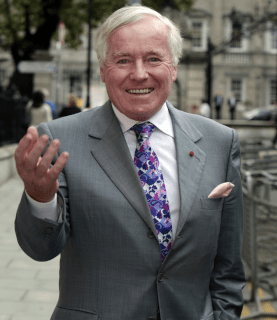
Birth of Feargal Quinn, Businessman, Politician & TV Personality

Feargal Quinn, Irish businessman, politician and television personality, is born in Dublin on November 27, 1936. He is the founder of the Superquinn supermarket chain and serves as a Senator in Seanad Éireann representing the National University of Ireland constituency from 1993 to 2016.

Quinn’s father, Eamonn, founds a grocery brand and later the Red Island resort in Skerries, Dublin. He is a first cousin of Labour Party politician Ruairi Quinn and of Lochlann Quinn, former chairman of Allied Irish Banks (AIB). He is educated at Newbridge College and is a commerce graduate of University College Dublin (UCD). He builds a career in business and later takes on a range of public service roles.

Quinn founds the national supermarket chain Superquinn (originally Quinn’s Supermarkets), of which he remains non-executive president for some years after his family sells out their interest in August 2005 for over €400 million. Superquinn is known for its focus on customer service and pioneers a number of innovations, including Ireland’s first supermarket loyalty card in 1993, SuperClub. It also introduces self-scanning of goods by customers in a number of its outlets. Superquinn becomes the first supermarket in the world to guarantee the absolute traceability of all its beef from pasture to plate, using DNA TraceBack, a system developed at Trinity College, Dublin by IdentiGEN.

Quinn becomes the chairman of the Interim Board for Posts and serves as chairman of its successor An Post (the Irish postal administration) until 1989. He also serves on several other public authorities and boards. From 1993 to 1998, he chairs the steering committee which oversees the development of the Leaving Certificate Applied. In 2006, he is appointed an Adjunct Professor in Marketing at National University of Ireland Galway. He is also chairman of Springboard Ireland.

Quinn is a former President of EuroCommerce, the Brussels-based organisation which represents the retail, wholesale and international trade sectors in Europe. He also serves on the board of directors of CIES, the Food Business Forum based in Paris, as well as the American-based Food Marketing Institute.

In 2009, Quinn works with independent shops and helps them to revamp, modernise and stave off stiff competition from multi-national retailers. It airs as RTÉ‘s six-part television series, Feargal Quinn’s Retail Therapy. A second series airs in 2011, and a third series airs in 2012. In 2011, he fronts RTÉ’s Local Heroes campaign in Drogheda, County Louth, which is an assembled team of experts to kick-start the local economy. It airs as RTÉ One‘s six-part television series, Local Heroes – A Town Fights Back.

Quinn is first elected as a senator in 1993 from the National University of Ireland constituency and is re-elected in 1997, 2002, 2007 and 2011. He is a member of the Joint Oireachtas Committee on European Affairs, the Joint Committee on Finance and Public Service and is an Oireachtas member of the National Economic and Social Forum, along with the Joint Committee on Jobs and Innovation.

Quinn is one of the co-founders and is a driving force behind Democracy Matters – a civil society group that is formed to oppose the Government’s plans to abolish Seanad Éireann. In May 2013, with Senators Katherine Zappone and Mary Ann O’Brien, he introduces the Seanad Bill 2013 to reform the system of electing the elected members of Seanad Éireann (as provided for in Article 18.10 of the Constitution of Ireland) through a one-person, one vote franchise. The Seanad Bill 2013 succeeds in being passed at Second Stage in the Seanad. During the Seanad abolition referendum campaign, the Bill demonstrates to the electorate, in a very palpable way, that reform of the Seanad is achievable if they vote for its retention. In a referendum held in October 2013 on the Abolition of Seanad Éireann, the people vote to retain the Seanad by 51.7%.

In 2014, Quinn reveals that since being first elected to Seanad Éireann, he has donated his entire salary to charity and in more recent years he has refused to accept any salary. In March 2015, he opposes the Marriage Equality bill in the Seanad, and votes ‘No’ in the referendum. He serves as Chairman of the Independent Alliance. He does not contest the 2016 Seanad election.

Quinn is the recipient of five honorary doctorates from education institutions, including NUI Galway in 2006, a papal knighthood along with a fellowship and the French Ordre National du Mérite. He shares with Oprah Winfrey the 2006 “Listener of the Year” award of the International Listening Association.

Quinn dies peacefully at his home in Howth, County Dublin, on April 24, 2019, following a short illness. His funeral Mass takes place at St. Fintan’s Church in Sutton, north County Dublin. In attendance is President Michael D. Higgins, a representative for Taoiseach Leo Varadkar, Minister for Children Katherine Zappone, Senator Michael McDowell, and a host of other current and former politicians, business figures, and past colleagues of the “Superquinn family.” Fittingly, the coffin is carried from the church to the tune of Frank Sinatra’s “My Way.”

Leave a comment

Birth of Marina Carr, Irish Playwright

Irish playwright Marina Carr is born in Dublin on November 17, 1964. She has written almost thirty plays, including By the Bog of Cats (1998) which is revived at the Abbey Theatre in 2015.

Carr spends the majority of her childhood in Pallas Lake, County Offaly, adjacent to the town of Tullamore. Her father, Hugh Carr, is a playwright and studies music under Frederick May, while her mother, Maura Eibhlín Breathnach, is the principal of the local school and writes poetry in Irish. It is said that “there were a lot of literary rivalries.” As a child, she and her siblings build a theater in their shed.

Carr attends University College Dublin (UCD), studying English and philosophy. She graduates in 1987. In 2011, she receives an honorary degree of Doctorate of Literature from her alma mater.

Carr has held posts as writer-in-residence at the Abbey Theatre and has taught at Trinity College Dublin, Princeton University, and Villanova University. She lectures in the English department at Dublin City University in 2016. She is considered one of Ireland’s most prominent playwrights and is a member of Aosdána.

The Mai wins the Dublin Theatre Festival‘s Best New Irish Play award (1994-1995) and Portia Coughlan wins the nineteenth Susan Smith Blackburn Prize (1996-1997). Other awards include The Irish Times Playwright award 1998, the E. M. Forster Award from the American Academy of Arts and Letters and The American Ireland Fund Award, the Macaulay Fellowship and The Hennessy Award. Carr is named a recipient of the Windham-Campbell Literature Award, administered by the Beinecke Rare Book & Manuscript Library at Yale University. The award, which includes a financial prize of $165,000 (or €155,000), is formally presented in September 2017. She is the second Irish author to receive the prize, following playwright Abbie Spallen in 2016.


Leave a comment

Birth of Emma Donoghue, Playwright, Historian, Novelist & Screenwriter

Emma Donoghue, an Irish Canadian playwright, literary historian, novelist, and screenwriter, is born in Dublin on October 24, 1969. Her 2010 novel Room is a finalist for the Man Booker Prize and an international best-seller. Her 1995 novel Hood wins the Stonewall Book Award and Slammerkin (2000) wins the Ferro-Grumley Award for Lesbian Fiction. She is a 2011 recipient of the Alex Awards. Room is adapted by Donoghue into a film of the same name. For this, she is nominated for the Academy Award for Best Adapted Screenplay.

Donoghue is the youngest of eight children, the daughter of Frances (née Rutledge) and academic and literary critic Denis Donoghue. She has a first-class honours Bachelor of Arts degree from University College Dublin (UCD) in English and French as well as a PhD in English from Girton College, Cambridge. While at Cambridge she lives in a women’s co-operative, an experience which inspires her short story “The Welcome.” Her thesis is on friendship between men and women in 18th-century fiction.

At Cambridge, she meets her future wife, Christine Roulston, a Canadian who is now professor of French and Women’s Studies at the University of Western Ontario. They move permanently to Canada in 1998 and Donoghue becomes a Canadian citizen in 2004. She lives in London, Ontario, with Roulston and their two children.

Donoghue has spoken of the importance of the writing of Emily Dickinson, of Jeanette Winterson‘s novel The Passion and Alan Garner‘s Red Shift in the development of her work. She says that she aims to be “industrious and unpretentious” about the process of writing, and that her working life has changed since having children.

Donoghue’s novels include Stir Fry (1994), a finalist for the Lambda Literary Award in 1994, Slammerkin (2000), a finalist in the 2001 Irish Times Irish Literature Prize for Fiction and winner of the 2002 Ferro-Grumley Award for Lesbian Fiction, Landing (2007), The Sealed Letter (2008), joint winner of the 2009 Lambda Literary Award for Lesbian Fiction, Room (2010), winner of the Irish Book Award 2010, Frog Music (2014), The Wonder (2016), shortlisted for the Scotiabank Giller Prize, Akin (2019), The Pull of the Stars (2020), longlisted for the Giller Prize in 2020, and Haven (2022).


Leave a comment

Birth of George Colley, Fianna Fáil Politician

George Colley, an Irish Fianna Fáil politician, is born in the Dublin suburb of Fairview on October 18, 1925.

Colley is the son of Harry and Christina Colley. His father is a veteran of the 1916 Easter Rising and a former adjutant in the Irish Republican Army (IRA), who is elected to Dáil Éireann in 1944, as a Fianna Fáil candidate. He is educated at St. Joseph’s Secondary C.B.S. in Fairview, where one of his classmates and closest friends is Charles Haughey, who later becomes his political archrival. He studies law at University College Dublin (UCD) and qualifies as a solicitor in the mid-1940s. He remains friends with Haughey after leaving school and, ironically, encourages him to become a member of Fianna Fáil in 1951. Haughey is elected to Dáil Éireann in the 1957 Irish general election, ousting Colley’s father in the process. This puts some strain on the relationship between the two young men.

Colley is elected to the Dáil at the 1961 Irish general election, reclaiming his father’s old seat in the Dublin North-East constituency. Furthermore, he is elected in the same constituency as Haughey, thereby accentuating the rivalry. Thereafter, he progresses rapidly through the ranks of Fianna Fáil. He becomes a member of the Dáil at a time when a change from the older to the younger generation is taking place, a change facilitated by Taoiseach Seán Lemass.

Colley is active in the Oireachtas as chairman of some of the Joint Labour Committees, which are set up under the Labour Court, to fix legally enforceable wages for groups of workers who have not been effectively organised in trade unions. He is also leader of the Irish parliamentary delegation to the Consultative Assembly of the Council of Europe. His work as a backbencher is rewarded by his appointment as Parliamentary Secretary to the Minister for Lands in October 1964.

Following the return of Lemass’s government at the 1965 Irish general election, Colley joins the cabinet as Minister for Education. He introduces a plan to establish comprehensive schools, set up an advisory council on post-primary school accommodation in Dublin, and introduces a school psychological service.

Colley is promoted as Minister for Industry and Commerce in a cabinet reshuffle in July 1966, and he continues the government policy of economic expansion that had prevailed since the late 1950s.

In November 1966, Seán Lemass resigns suddenly as party leader. Colley contests the subsequent leadership election. He is the favoured candidate of party elders such as Seán MacEntee and Frank Aiken, the latter managing Colley’s campaign. Charles Haughey and Neil Blaney also declare their interest in the leadership; however, both withdraw when the Minister for Finance, Jack Lynch, announces his candidacy. Colley does not back down, and the leadership issue goes to a vote for the first time in the history of the Fianna Fáil party. The leadership election takes place on November 9, 1966, and Lynch beats Colley by 59 votes to 19. When the new Taoiseach announces his cabinet, Colley retains the Industry and Commerce portfolio.

In the wake of the Arms Crisis in 1970, a major reshuffle of the cabinet takes place, with four Ministers either removed, or resigned, or simply retired from the government due to the scandal. Colley remains loyal to the party leader and is rewarded by his appointment as Minister for Finance, the second most important position in government.

In 1973, Fianna Fáil are ousted after sixteen years in government when the national coalition of Fine Gael and the Labour Party come to power. Colley is appointed opposition Spokesman on Finance, in the new Fianna Fáil front bench. As the 1977 Irish general election approaches, Colley and Martin O’Donoghue are the main architects of Fianna Fáil’s election manifesto.

Fianna Fáil sweeps to power at the 1977 Irish general election, with a 20-seat Dáil majority, contrary to opinion polls and political commentators. Colley is re-appointed as Minister for Finance and Minister for the Public Service, and is also appointed as Tánaiste, establishing him firmly as the heir apparent to Taoiseach Jack Lynch.

In December 1979, Jack Lynch resigns unexpectedly as Taoiseach and as Fianna Fáil leader. Colley and Charles Haughey seek the leadership position and are evenly matched. A secret ballot is taken on December 7, 1979. The Minister for Foreign Affairs, Michael O’Kennedy, announces his support for Haughey on the eve of the election. This apparently swings the vote, and Haughey beats Colley by 44 votes to 38. Colley remains as Tánaiste but demands and receives a veto on Haughey’s ministerial appointments to the departments of Justice and Defence.

Fianna Fáil loses power at the 1981 Irish general election. Haughey delays naming a new opposition front bench, but Colley remains a key member of the Fianna Fáil hierarchy. The party regains office at the February 1982 Irish general election. He demands the same veto as before on Haughey’s Defence and Justice appointments but is refused. When it is revealed that Ray MacSharry is to be appointed Tánaiste in his stead, he declines another ministerial position. This effectively brings his front bench political career to an end, but he remains a vocal critic of the party leadership from the backbenches.

When the Fianna Fáil government collapses and are replaced by another coalition government after the November 1982 Irish general election, a number of TDs and Senators express lack of confidence in Haughey’s leadership once again. Several unsuccessful leadership challenges take place in late 1982 and early 1983, with Colley now supporting Desmond O’Malley and the Gang of 22 who oppose Haughey.

Colley dies suddenly on September 17, 1983, aged 57, while receiving treatment for a heart condition at Guy’s Hospital, Southwark, London. He is survived by his wife, three sons, and four daughters, one of whom, Anne Colley, becomes a TD as a member of the Progressive Democrats party.


Leave a comment

Birth of Paul Durcan, Contemporary Irish Poet

Paul Durcan, contemporary Irish poet, is born in Dublin on October 16, 1944.

Durcan grows up in Dublin and in Turlough, County Mayo. His father, John, is a barrister and circuit court judge. He has a difficult and formal relationship with his father. He enjoys a warmer and more natural relationship with his mother, Sheila MacBride Durcan, through whom he is a great-nephew of both Maud Gonne, the Irish social and political activist, and John MacBride, one of the leaders of the Easter Rising, which begins the Irish War of Independence leading to the foundation of the Irish Free State.

In the 1970s Durcan studies Archaeology and Medieval History at University College Cork (UCC). Earlier, in the 1960s, he studies at University College Dublin (UCD). While at college there, he is kidnapped by his family and committed against his will to Saint John of God psychiatric Hospital in Dublin, and later to a Harley Street clinic where he is subjected to electric shock treatment and heavy dosages of barbiturates and Mandrax.

In 1966, Durcan moves to London, where he works at the North Thames Gas Board. He meets Nessa O’Neill in 1967 and they marry and have two daughters, Sarah and Siabhra. They live in South Kensington, then move to Cork, where his wife teaches in a prison. The marriage ends in early 1984.

Durcan’s main published collections include A Snail in my Prime, Crazy About Women, Greetings to Our Friends in Brazil and Cries of an Irish Caveman. He appears on the 1990 Van Morrison album Enlightenment, giving an idiosyncratic vocal performance on the song “In The Days Before Rock’n’Roll,” which he also co-writes.

In 2003, Durcan publishes a collection of his weekly addresses to the nation, Paul Durcan’s Diary, on RTÉ Radio 1 programme Today with Pat Kenny. He gets his inspiration from Paidraig Whitty, a local Wexford poet. He is shortlisted in 2005 for the Poetry Now Award for his collection The Art of Life (The Harvill Press, 2004). In 2009, he is conferred with an honorary degree by Trinity College, Dublin. He is the Ireland Fund Artist-in-Residence in the Celtic Studies Department of St. Michael’s College at the University of Toronto in October 2009. In 2011 he is conferred with an honorary doctorate from University College Dublin.

Between 2004 and 2007 Durcan is the third Ireland Professor of Poetry. He is a member of Aosdána. Awards he has received include the Patrick Kavanaugh Poetry Award (1974), the Irish American Culture Institute Poetry Award (1989), the Whitbread Prize for Daddy, Daddy (1990) and the London Poetry Book Society choice for The Berlin Wall Café.

A number of poems from Durcan’s poetry career are studied by Irish students who take the Leaving Certificate.


Leave a comment

Death of Edward Cecil Guinness, 1st Earl of Iveagh

Edward Cecil Guinness, 1st Earl of Iveagh, Irish businessman and philanthropist, dies at his London home in Grosvenor Place on October 7, 1927

Guinness is born on November 10, 1847 at St. Anne’s, Clontarf, County Dublin, the youngest of three sons of Sir Benjamin Lee Guinness, brewer, of Dublin, and Elizabeth, third daughter of Edward Guinness of Dublin. He is not sent to public school but is taught at home by a private tutor before entering Trinity College Dublin, where he takes his degree in 1870. His father dies in 1868, leaving him a share in the brewery, and he takes over management of the business with his brother Arthur, who in 1876 sells his shares, making Edward sole proprietor.

Guinness is also prominent in municipal life, holding the offices of Sheriff of Dublin City in 1876 and High Sheriff of the County of Dublin in 1885, the year in which he is created a baronet. He is a brilliantly effective businessman, with close attention to detail and a focus solely on the brewery, to the extent of remaining independent from the rest of the brewing trade. In 1888 he bluntly tells the Country Brewers’ Association, “I have always declined to identify myself with any trade question, or to take any side in a controversy on the liquor question, and to this I must adhere.” In 1886 Guinness is floated as a public company, a superbly successful venture with applications for shares exceeding £100 million, and Edward remains as chairman until 1890, although his formal retirement in that year brings little reduction in his involvement with the company, and he continues to make the final decision on many minor matters as well as all major questions of policy.

Socially innovative, with a concern for the welfare of employees, from as early as 1870 Guinness establishes a free dispensary for his workforce and makes provisions for pension and other allowances – acts of social reform that are remarkable for the time. To mark his retirement in 1890 he places in trust £250,000 to be expended in the erection of working-class housing in London and Dublin. Both funds are administered from London until 1903, when the Dublin fund is amalgamated by the Iveagh Trust act with other schemes carried out in Dublin by Edward, who had been raised to the peerage of the United Kingdom in 1891 as Baron Iveagh of Iveagh, County Down. The funds, which increase considerably from the original amount, are thereafter managed entirely in Dublin as a separate undertaking under the name of the Iveagh Trust, still in existence in the early twenty-first century.

As one of the pioneers of the voluntary housing movement Guinness is essentially carrying on the tradition of “merchant prince and city father” established by his father and shared by his brother. Wealthy, ambitious, and resolutely unionist, he gives generous financial support to the Irish Unionist Alliance, and is also public-spirited, religious, and devoted to duty. Acknowledging that the Iveagh Trust is essentially ameliorative, he believes that major social change will only be achieved if numerous other wealthy people follow his example. He insists that gifts of money from the fund are permissible only to assist individuals to improve their condition “without placing them in the position of being the recipients of a bounty.” Numerous other philanthropic donations follow, including another £250,000 for slum clearance in the Bull Alley district of Dublin; various contributions to Dublin hospitals, particularly in 1903 and 1911 on the occasion of royal visits; and in 1907 the opening of the Iveagh Markets, situated in the Francis Street and Patrick Street areas of Dublin, are made possible with his financial backing. Generous contributions are also made to Trinity College Dublin, of which he is elected chancellor in 1908, and he donates land in Iveagh Gardens to University College Dublin (UCD).

In 1905 Guinness is raised to a viscountcy and in September 1909 the nationalist corporation of Dublin presents him with an address of thanks for his many gifts, and even discusses the possibility of offering him the lord mayoralty of the city, which he declines owing to his political affiliations. By this time he lives chiefly in England, having bought Elveden Hall in Suffolk, where he frequently entertains royalty. He also purchases Lord Kensington’s London estate and makes many donations to medical research societies in England, and in conjunction with Sir Ernest Cassel he founds the London Radium Institute, as well as donates £250,000 to the Laster Institute of Tropical Medicine for the endowment of bacteriological research.

In 1919 Guinness is elevated to an earldom and in 1925 purchases the remainder of the Kenwood estate to the north of Hampstead Heath and arranges for it to become public property, ensuring the estate will not be sold for building purposes, and also bequeaths to the nation a valuable collection of art for use in the gallery at the same location. As well as being elected a fellow of the Royal Society, he is awarded honorary doctorates from the University of Dublin and the University of Aberdeen.

In 1873, Guinness marries his third cousin Adelaide Maud, nicknamed “Dodo.” She is descended from the banking line of Guinnesses, and is the daughter of Richard Samuel Guinness, barrister and MP, and his wife Katherine, a daughter of Sir Charles Jenkinson. They have three sons, the eldest of whom, Rupert Edward Cecil Lee, succeeds his father as 2nd Earl of Iveagh.

Guinness dies at his London home in Grosvenor Place on October 7, 1927, and is buried at Elveden, Suffolk. He leaves an estate valued at £11 million.


Leave a comment

Birth of Sir John Purser Griffith, Civil Engineer & Politician

Sir John Purser Griffith, a Welsh-born Irish civil engineer and politician, is born at Holyhead, Wales, on October 5, 1848.

Griffith is educated at Trinity College Dublin and gains a licence in civil engineering in 1868. He serves a two-year apprenticeship under Dr. Bindon Blood Stoney, the Engineer in Chief of the Dublin Port and Docks, before working as assistant to the county surveyor of County Antrim. He returns to Dublin in 1871 and works as Dr. Stoney’s assistant, becoming the Chief Engineer in 1898 before retiring in 1913.

Griffith serves as president of the Institution of Civil Engineers of Ireland between 1887 and 1889 and of the Institution of Civil Engineers between 1919 and 1920. He is elected Commissioner of Irish Lights in 1913 and is a member of the Royal Commission on Canals and Waterways between 1906 and 1911.

Griffith purchases and drains the bogland at Pollagh, part of the Bog of Allen. A peat fueled power station is built which drives an excavator and excess peat is taken via the Grand Canal for sale in Dublin. The site is sold to the Turf Development Board in 1936 who use it as a basis for all of their later peat fueled power stations. The area is now a nature reserve.

Griffith receives a knighthood in 1911 and becomes vice-president of the Royal Dublin Society in 1922. He serves as Honorary Professor of Harbour Engineering at Trinity College, his alma mater, and receives an honorary M.A.I. degree from the University of Dublin in 1914. From 1922 he is an elected member of the Seanad Éireann, the Irish Free State senate, until its abolition in 1936. In the 1930s he and Sarah Purser endow the Purser Griffith Travelling Scholarship and the Purser Griffith Prize to the two best performing students in European Art History at University College Dublin.

Griffith dies at Rathmines Castle in Dublin on October 21, 1938.


Leave a comment

Birth of Thomas Kilroy, Playwright & Novelist

Thomas F. Kilroy, Irish playwright and novelist, is born on September 23, 1934, in Green Street, Callan, County Kilkenny. He is a difficult writer to categorize, having written plays ranging from the conventional The Death and Resurrection of Mr. Roche to more technically innovative and avant-garde works such as Talbot’s Box and The Secret Fall of Constance Wilde. Nevertheless, common thematic concerns run throughout many of his plays, including the issue of personal and cultural—specifically, Irish versus English—identity and the mythologizing of the past. Best known as a playwright, he is also the author of the Booker Prize-shortlisted novel The Big Chapel (1971).

Kilroy is the son of Thomas and Mary (née Devine) Kilroy. He attends St. Kieran’s College and plays hurling for the school team, captaining the senior team in 1952. He studies at University College Dublin, where his first play, The Death and Resurrection of Mr. Roche, is produced to great success at the Olympia Theatre. In his early career he is play editor at the Abbey Theatre in Dublin. In the 1980s, he sits on the board of Field Day Theatre Company, founded by Brian Friel and Stephen Rea in 1980, and is Director of its touring company.

In 1978, Kilroy is appointed Professor of English at University College Galway, a post from which he resigns in 1989 to concentrate on writing.

In 2008, Kilroy receives the Irish PEN Award, given to honour an Irish-born writer who has made an outstanding contribution to Irish literature.

While some of Kilroy’s plays hit a lighter note than others, the common thread in most of them is his attempt to address some of the social upheavals that have occurred in Ireland in the past and present. This has been a concern of his since he was in his twenties and wrote in the 1959 essay “Groundwork for an Irish Theatre” that his contemporaries were “inclined to shirk the painful, sometimes tragic problems of a modern Ireland which is undergoing considerable social and ideological stress.” Although he has not been one of Ireland’s most prolific playwrights, his plays may certainly be considered important contributions to the modern stage.

Kilroy now lives in County Mayo and is a member of the Irish Academy of Letters, the Royal Society of Literature, and Aosdána.

The Thomas Kilroy Collection, his personal archive, is deposited at the James Hardiman Library at the National University of Ireland Galway (NUI Galway). Kilroy addresses the launch event in March 2011, which is attended by, amongst others, Brian Friel and the future President of Ireland Michael D. Higgins.


Leave a comment

Birth of Bertie Ahern, 11th Taoiseach of Ireland

Bartholemew Patrick “Bertie” Ahern, former Fianna Fáil politician who serves as Taoiseach from 1997 to 2008, is born in Drumcondra, Dublin, on September 12, 1951. He also serves as Leader of Fianna Fáil (1994-2008), Leader of the Opposition (1994-97), Tánaiste and Minister for Arts, Culture and the Gaeltacht (Nov.1994-Dec.1994), Deputy Leader of Fianna Fáil (1992-94), Minister for Industry and Commerce (Jan. 1993), Minister for Finance (1991-94), Minister for Labour (1987-1991), Government Chief Whip and Minister of State at the Department of Defence (Mar. 1982-Dec. 1982), Lord Mayor of Dublin (1986-1987) and as a Teachta Dála (TD) (1977-2011).

Ahern is educated at St. Patrick’s National School, Drumcondra and at St. Aidan’s Christian Brothers, Whitehall. He receives his third level education at the College of Commerce, Rathmines, part of the Dublin Institute of Technology. He claims or it has been claimed by others in circulated biographies that he was educated at University College Dublin (UCD), and the London School of Economics, but neither university has any records that show Ahern was ever one of their students. He subsequently works in the Accounts Department of Mater Misericordiae University Hospital in Dublin.

By 1972, Ahern has met his future wife, Miriam Kelly, a bank official who lives near the Aherns’ family home. They marry in St. Columba’s Church, Iona Road in 1975. They have two daughters from the marriage, Georgina and Cecelia. Georgina is the wife of Westlife member Nicky Byrne. Cecelia is a best-selling author. The Aherns separate in 1992.

Ahern is elected to the Dáil, the lower house of the Oireachtas, in 1977 as a member of the Fianna Fáil party for the newly created Dublin Finglas constituency. He is elected to the Dublin City Council in 1979, later becoming Lord Mayor of Dublin (1986–87). An assistant whip (1980–81) in the first government of Taoiseach Charles Haughey, he becomes a junior minister in Haughey’s second government (1982) and Minister for Labour in his third (1987–89) and fourth (1989–91) governments.

Ahern’s success in establishing general economic agreements with employers, unions, and farmers in 1987 and 1990 and his role in constructing the first Fianna Fáil coalition government (with the Progressive Democrats) in 1989 confirms his reputation as a skillful negotiator. He is made Minister for Finance in 1991. In the contest to choose Haughey’s successor, Ahern withdraws in favour of Albert Reynolds, and he remains Minister for Finance in each of Reynolds’s two governments (February–November 1992 and 1993–94). In November 1994, following the fall of the Fianna Fáil–Labour Party government, Reynolds resigns, and Ahern is elected party leader. He is set to become Taoiseach in a new coalition with the Labour Party, but at the eleventh-hour Labour opts to join a government with Fine Gael and Democratic Left.

Ahern forms a Fianna Fáil–Progressive Democrats minority government following elections in 1997. Credited with overseeing a thriving economy, he is reelected Taoiseach in 2002. He plays a major role in securing peace in Northern Ireland, participating in the signing of the Good Friday Agreement in 1998 and helping negotiate the return of devolution to Northern Ireland in 2007. On May 15, 2007, he becomes the first Taoiseach to address a joint session of the Parliament of the United Kingdom.

Soon afterward Ahern wins a third term as Taoiseach. He is reelected despite implications of his involvement in an influence-peddling scandal. The Tribunal of Inquiry into Certain Planning Matters & Payments, ultimately better known as the Mahon Tribunal, which is investigating alleged illegal payments by developers to politicians to influence zoning decisions in and around Dublin during the early 1990s, subsequently questions Ahern about his personal finances during his tenure as Minister for Finance. In early April 2008, as the investigation of Ahern’s involvement mounts, he announces that he will step down as Taoiseach and Leader of Fianna Fáil in May. He is succeeded in both posts by Brian Cowen. In the Mahon Tribunal’s final report, issued on March 22, 2012, it indicates that it does not believe Ahern had told the truth when questioned by the commission about alleged financial improprieties, though it does not directly accuse him of corruption. Ahern, threatened with expulsion from Fianna Fáil in the wake of the report, resigns from the party later in March while still maintaining that he had testified truthfully to the tribunal.

Ahern says in April 2018 that he is considering running for President of Ireland in 2025 as an independent candidate. That same month he walks out of an interview with DW News after being questioned on the findings of the Mahon Tribunal.

In October 2018, Ahern is appointed to chair the Bougainville Referendum Commission, which is responsible for preparing an independence referendum in Bougainville, Papua New Guinea, which takes place in December 2019.


Leave a comment

Birth of Frank Ryan, Politician, Journalist & Paramilitary Activist

Frank Ryan, politician, journalist, intelligence agent and paramilitary activist, is born in the townland of Bottomstown, Elton, County Limerick, on September 11, 1902. A fascinating, somewhat mythical figure, he lives during turbulent times when Ireland finally disposes of tyrannical British rule in Ireland and becomes an icon for socialist republicans in Europe during the 1930s and 40s.

Ryan’s parents, Vere Foster Ryan and Annie Slattery, are National School teachers at Bottomstown with a taste for Irish traditional music, and they live in a house full of books. He attends St. Colman’s College, Fermoy. From then on, he is devoted to the restoration of the Irish language. He studies Celtic Studies at University College Dublin (UCD), where he is a member of the Irish Republican Army (IRA) training corps. He serves as a flying column member during the murderous Irish War of Independence (1919-21), thereby interrupting his studies. He leaves UCD before graduating to join the IRA’s East Limerick Brigade in 1922.

Ryan fights on the Anti-Treaty side in the Irish Civil War (1922-23) and is wounded and interned. In November 1923 he is released and returns to UCD. He secures his degree in Celtic Studies and further secures the editorship of An Phoblacht (The Republic), the newspaper of the anti-Treaty Irish Republican Army (IRA).

The split in the Irish independence party, Sinn Féin, results in regular fist fights between pro and anti-Treaty forces. Cumann na nGaedhael, the pro-Treaty political party in government, recruits the Army Comrades Association (Blueshirts) under former Garda Commissioner Eoin O’Duffy to protect their members from anti-Treaty IRA protesters at annual Armistice Day and Wolfe Tone commemorations. Ryan is a forceful orator at these events and is frequently arrested and beaten up by the Gardai. The fractious politics results in Dáil members Sean Hales and Kevin O’Higgins being shot dead in public.

Ryan resigns from the IRA and founds the Republican Congress with Peadar O’Donnell and George Gilmore. Worker’s strikes unite Northern Protestant and Southern Catholic workers protesting against low wages and long hours.

The outbreak of the Spanish Civil War (1936-39) inspires Ryan to lead the first contingent of Irish volunteers to support the Popular Front government of Republican Spain. A brave and inspiring leader, he serves with Italian and German Republican divisions. He is seriously wounded at the Battle of Jarama in February 1937. Following recuperation in Ireland, he is appointed adjutant to republican General José Miaja. During the Aragon Offensive he is captured with 150 of his men in April 1938 and sentenced to death. Irish President, Éamon de Valera, intervenes with General Francisco Franco and Ryan’s sentence is commuted to thirty years. His health suffers severely in Burgos Prison, Spain during his two-year incarceration.

Franco refuses to release Ryan because he is considered his most dangerous prisoner. In August 1940 he is transferred to Berlin, where he is re-united with IRA Chief of Staff Seán Russell. An attempt to return both men to Ireland by U-boat ends with Russell dying from a perforated ulcer. Ryan voluntarily returns to Germany where he serves as the unofficial IRA ambassador for German intelligence. Irishman Francis Stuart, son-in-law of Maud Gonne, who writes some of William Joyce’s propaganda, takes good care of Ryan until his untimely death at a hospital in Loschwitz in Dresden on June 10, 1944.

Ryan’s funeral in Dresden is attended by Elizabeth Clissmann, wife of Helmut Clissmann, and Francis Stuart. Clissmann eventually forwards details of Ryan’s fate to Leopold Kerney in Madrid. According to Stuart and Clissmann, the cause of death is pleurisy and pneumonia.

In 1963, historian Enno Stephan locates Ryan’s grave in Dresden. Three volunteers of the International Brigades, Frank Edwards, Peter O’Connor and Michael O’Riordan travel to East Germany as a guard of honour to repatriate Ryan’s remains in 1979. On June 21, 1979, his remains arrive in Whitefriar Street Carmelite Church, his local church when he lived in Dublin. The church is packed with all shades of Republican and left-wing opinion, as well as those from his past such as the Stuarts, the Clissmanns, Peadar O’Donnell, George Gilmore, and ex-comrades and sympathizers from all over the world. The cortège on its way to Glasnevin Cemetery halts at the GPO in memory of the dead of the 1916 Easter Rising. His coffin is borne to the grave in Glasnevin Cemetery by Irish veterans of the Spanish Civil War, Frank Edwards, Peter O’Connor, Michael O’Riordan and Terry Flanagan. Con Lehane delivers the funeral oration while a piper plays “Limerick’s Lamentation.” He is buried next to Éamonn Mac Thomáis.

Ryan leads a vicarious life in pursuit of human rights, socialism and republicanism. His life story remains more colourful than fiction.