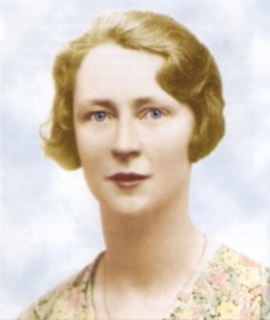
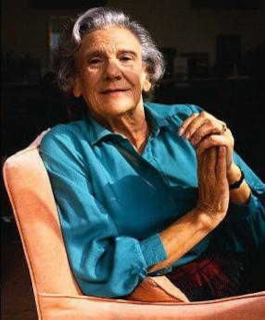
Quinn is the eldest child of bank official Charles Quinn and Louisa Burke Browne of County Clare. She is a great-granddaughter of William Quinn, a native of County Tyrone who settled in Tuam to build St. Mary’s Cathedral.
During Quinn’s childhood, her father’s career brought the family to various towns in Ireland, including Tralee, County Kerry, where a plaque is unveiled in May 2009 at Bank of Ireland House in Denny Street commemorating her residence there between 1921 and 1924. She attends the Presentation Convent in the town between 1921-1925.
Quinn feels a call to religious life at a young age. She wishes to join the Poor Clares but is prevented by advanced tuberculosis. After spending eighteen months in a sanatorium, her condition unchanged, she decides to become active in the Legion of Mary, which she joins in Dublin at the age of 20. She gives herself completely to its work in the form of helping the poor in the slums of Dublin.
In 1936, at the age of 29 and dying of tuberculosis, Quinn becomes a Legion of Mary Envoy, a very active missionary to East and Central Africa, departing in December 1936 for Mombasa. She settles in Nairobi having been told by Bishop Heffernan that this is the most convenient base for her work. By the outbreak of World War II, she is working as far off as Dar es Salaam and Mauritius. In 1941, she is admitted to a sanatorium near Johannesburg. Fighting her illness, in seven and a half years she establishes hundreds of Legion branches and councils in today’s Tanzania, Kenya, Uganda, Malawi, and Mauritius. John Joseph “J.J.” McCarthy, later Bishop of Zanzibar and Archbishop of Nairobi, writes of her:
“Miss Quinn is an extraordinary individual; courageous, zealous and optimistic. She wanders around in a dilapidated Ford, having for sole companion an African driver. When she returns home, she will be qualified to speak about the Missions and Missionaries, having really more experience than any single Missionary I know.”
All this time Quinn’s health is never good, and in 1943 she takes a turn for the worse, dying in Nairobi, Kenya of tuberculosis on May 12, 1944. She is buried there in the Missionaries’ Cemetery.
The cause for her beatification is introduced in 1956. She is declared venerable by Pope John Paul II on December 15, 1994, since when the campaign for her beatification has continued.
John Joseph “Rinty” Monaghan, world flyweightboxing champion from Belfast, is born on August 21, 1918. He becomes famous in the post-war period, eventually rising to become undisputed world champion and a hero to many people in his home city.
Born in Lancaster Street in north Belfast, Monaghan attends St. Patrick’s Christian Brothers’ School in Donegall Street. A noted fighter at boys’ level, he entereds the paid ranks in his mid-teens. After a short period of wartime service, he resumes his career and his burgeoning reputation draws huge crowds from all parts of Belfast. In particular, bouts at Belfast’s King’s Hall are the highlight with that venue normally packed to the rafters.
In October 1947, the National Boxing Association world crown becomes Monaghan’s after outpointing American Salvador “Dado” Marino at Harringay Stadium for the vacant title. The mantle of undisputed champion of the world rests on his shoulders after he defeats the tough Scottish fighter Jackie Paterson on March 23, 1948. Paterson is to prove one of his major adversaries.
By the time that a long-standing chest complaint forces his retirement as champion in 1950, Monaghan’s trophy cabinet contains the British, European, Commonwealth and World crowns. Of the 66 official bouts he fights during his illustrious career, he wins 51, draws 6 and loses 9. He endears himself to his supporters after his fights by singing “When Irish Eyes Are Smiling” to the King’s Hall audience, which joins in the singing.
Monaghan’s nickname “Rinty” comes from his fondness for dogs. According to his daughter Martha, he brought home injured dogs so often that his grandmother called him Rin Tin Tin, after the film dog, and shortened it to Rinty.
Monaghan marries Frances Thompson in 1938 and moves to nearby Sailortown. He has three daughters, Martha, Rosetta and Collette, and one son, Sean. In later life he has a variety of jobs but remains true to his working-class roots and stays in Belfast. He dies at his home in Little Corporation St. on March 3, 1984, at the relatively young age of 65. He is buried in Belfast City Cemetery.
To mark the influence of this “home-town hero”, the Ulster History Circle and Belfast City Council provide a plaque in Monaghan’s honour at the King’s Hall that is unveiled, in the presence of many of his family circle and friends, on May 3, 2007.
Belfast City Council erects a statue to Monaghan at Cathedral Gardens on August 20, 2015. The 10-foot high bronze statue on a granite plinth is designed by Alan Beattie Herriot and features Monaghan holding a microphone and singing “When Irish Eyes Are Smiling.”
Valerie Hamilton, Hon. Lady Goulding, Irish senator and campaigner for disabled people, dies in a Dublin nursing home on July 28, 2003. She, alongside Kathleen O’Rourke, sets up the Central Remedial Clinic (CRC) in 1951 which is now the largest organisation in Ireland looking after people with physical disabilities. She served as a member of Seanad Éireann from 1977 to 1981.
Hamilton’s father is a British lawyer and politician, and becomes chief legal adviser to Edward VIII during the Abdication Crisis in 1936. She acts as her father’s secretary and courier during the crisis, carrying letters between the King and Prime MinisterStanley Baldwin.
In 1951, Lady Goulding co-founds, with Kathleen O’Rourke, the Central Remedial Clinic located in a couple of rooms in central Dublin to provide non-residential care for disabled people. The Clinic later moves to a purpose building in Clontarf in 1968, where it is located today. The Clinic’s foundation initiates a revolution in the treatment of physical disability and rapidly grows to by far the largest centre dealing with the needs of disabled people. She remains chairman and managing director of the CRC until 1984.
Lady Goulding dies at the age of 84 in a nursing home in Dublin on July 28, 2003. She is predeceased by her husband in 1982, but is survived by her sons, the eldest of whom, Sir William Goulding, known as Lingard Goulding, serves as Headmaster of Headfort School in County Meath. The other sons are Hamilton and Timothy, who is a founding member of the experimental Irish folk group Dr. Strangely Strange.
Vanston’s time in Paris leaves a lasting impression on her work, including use of primary colours and a strong Cubist influence. She belongs to what critic Brian Fallon calls the “Franco-Irish generation of painters who looked to Paris,” along with Mainie Jellett, Evie Hone, and Norah McGuinness. Her time spent living in Costa Rica in the late 1920s and early 1930s imbues her work with tropical and highly toned colours. In Dublin in 1935, she exhibits 17 paintings, largely Costa Rican landscapes, at Daniel Egan’s gallery on St. Stephen’s Green. This is the closest thing to a solo show she would mount, with this show also featuring Grace Henry, Cecil Ffrench Salkeld, and Edward Gribbon.
Meeting the English artist Basil Rakoczi, who is also living in Dublin during World War II, leads Vanston to become associated with The White Stag group. In November 1941, she exhibits for the first time at a group show with 24 other artists, including Patrick Scott. One work that is shown at this exhibition is the painting Keel dance hall, which demonstrates that she spends time in the west of Ireland. The most important event staged by the group is the Exhibition of subjective art, which takes place at 6 Lower Baggot St. in January 1944. The Dublin Magazine notes her work at this show as the most effective of the experimental vanguard. This work, Dying animal, is a Cubist work with semi-representation forms rendered in bold colours. In 1945, her work is featured in a White Stag exhibition in London of young Irish painters at the Arcade gallery, Old Bond St.
In 1947, Vanston spends almost a year in Costa Rica where she paints primarily in watercolours. Apart from this period, she lives and works in Dublin, living at 3 Mount Street Crescent near St. Stephen’s Church. At the inaugural Irish Exhibition of Living Art in 1943, she exhibits five works. At the first Exhibition of Independent Artists in 1960, of which she is a founder, she exhibits three landscapes and a work entitled War. She largely exhibits with the Independent Artists, the Irish Exhibition of Living Art, and the Oireachtas na Gaeilge, and does not exhibit with the Royal Hibernian Academy. Later in life, she exhibits with the Figurative Image exhibitions in Dublin, and is amongst the first painters chosen for Aosdána. A number of her works are featured in the 1987 exhibition, Irish women artists, from the eighteenth century to the present arranged by the National Gallery of Ireland and The Douglas Hyde Gallery.
Vanston dies on July 12, 1988, in a nursing home in Enniskerry, County Wicklow. Her work is greatly admired, but has received little by way of critical attention, which may have been to do with her slow rate of output. A number of her works have proved difficult to trace. She was a private person, even refusing to cooperate with the Taylor Galleries in the 1980s when they wanted to mount a retrospective of her work. The National Self-Portrait Collection in Limerick holds a work by Vanston.
(Pictured: “Landscape with Lake and Hills” (1964), oil on paper (monotype) by Dairine Vanston)
Potter receives his commission as District Inspector on April 27, 1901, having completed his cadetship at the Depot, Phoenix Park, Dublin. His first assignment is to Castlepollard, County Westmeath. During the 1909 ITGWU strike in Cork, he is temporarily posted there from Dublin and is also involved in policing the August 14 marches in Portadown. Having had charge of No. 4 Company at the Depot, he is assigned to Cahir in 1912.
On April 23, 1921, District Inspector Potter is captured by the 3rd Tipperary Brigade, IRA, following the Hyland’s Cross Ambush. This occurs near Curraghcloney, close to the village of Ballylooby. The ambush party is initially made up of a combination of the 1st and 2nd Flying Columns 3rd Tipperary Brigade. This is the largest force assembled to date by the Tipperary IRA in anticipation of a major battle. However, the convoy of military lorries that is expected never materialises. Dan Breen and Con Moloney return to Battalion Headquarters, while Seán Hogan‘s Column withdraws northward in the direction of the Galtee Mountains.
As Dinny Lacey‘s No.1 Column prepares to leave towards the south, a small party of British soldiers accompanying two horse-drawn carts unexpectedly approaches from Clogheen and are immediately fired upon. Amid some confusion Lacey’s scattered men withdraw southwards towards the Knockmealdown Mountains. One British soldier, Frank Edward Conday, is fatally wounded and two others from the relieving party are wounded.
By chance, Potter, who is returning by car from police duties at Ballyporeen, drives into a section of the withdrawing No.1 Column. Although in civilian attire, he is recognised by one of the IRA Volunteers and taken prisoner. As part of a new strategy, he is held as a hostage for the safe release of Thomas Traynor, an IRA volunteer and father of ten young children, then under sentence of death at Mountjoy Gaol. The IRA offers to release Potter in exchange for Traynor’s release. Traynor is executed. Traynor has since been honoured by the Irish state as one of “The Forgotten Ten.”
The Column, under sporadic fire from soldiers, alerted at the nearby Clogheen barracks, follow the contours of the mountains to the village of Newcastle. Losing their pursuers, they stay for a period of time at the townland of Glasha. Here Potter is detained in an out-building of a farm which is regularly used by the IRA as a safe house. From there the party is guided into the Nire Valley by a contingent of local Waterford Volunteers and on to the Comeragh Mountains.
Accounts from Rathgormack, County Waterford suggest he is kept for at least one night at a nearby Ringfort before being taken down the hill to a field then owned by Powers of Munsboro, where he meets his ultimate fate. At 7:00 PM, on April 27, following news of Traynor’s execution by hanging, he is shot to death, and hastily buried in a shallow grave on the banks of the River Clodiagh. A diary he kept during his period of captivity and some personal effects and farewell letters, are returned anonymously to his wife. It is the first confirmation she has that he has been killed. The artifacts are later lost when his son’s ship is torpedoed in 1942, during World War II.
(Pictured: Photo of District Inspector Gilbert Potter R.I.C. that appeared in the Press during his time in captivity)
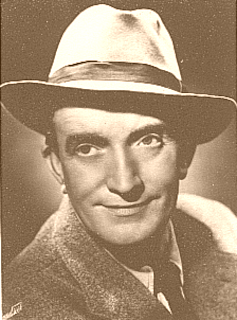
Clarence Patrick O’Connor, British singer of Irish heritage known professionally as Cavan O’Connor, is born on July 1, 1899 in Carlton, Nottinghamshire, England. He is most popular in the 1930s and 1940s, when he is billed as “The Singing Vagabond” or “The Vagabond Lover.”
O’Connor is born to parents of Irish origin. His father dies when he is young, and he leaves school at an early age to work in the printing trade. He serves in World War I as a gunner and signaler in the Royal Artillery, after first being rejected by the Royal Navy when it is discovered that he had pretended to be three years older than his real age. He is wounded in the war, aged 16, while serving with the Royal Artillery. After the war he returns to Nottingham where he works in a music shop. He starts singing in clubs and at concerts, before deciding to turn professional in the early 1920s.
O’Connor wins a scholarship to the Royal College of Music in London, where he meets his wife, Rita Tate (real name Margherita Odoli), a niece of the opera singer Maggie Teyte. He makes his first recordings, as Cavan O’Connor, for the Vocalion label in 1925, including “I’m Only a Strolling Vagabond” from the operetta The Cousin from Nowhere, which becomes his signature song. Noted for his fine tenor voice, well suited for recording, he appears on many British dance band recordings in the 1920s and 1930s, and uses a wide variety of pseudonyms, including Harry Carlton, Terence O’Brien, and Allan O’Sullivan. He also joins Nigel Playfair‘s revue company at the Lyric Theatre in Hammersmith, before moving on to playing lead roles in opera productions at The Old Vic, often performing in French, Italian and Spanish.
O’Connor turns increasingly toward light entertainment, largely for financial reasons. He starts appearing in variety shows around the country, often performing Irish folk songs. Having made his first radio broadcasts for BBC Radio in 1926, he continues to feature occasionally, but makes his breakthrough when he is billed, initially anonymously, as “The Strolling Vagabond” and “The Vagabond Lover” on a series of radio programmes produced by Eric Maschwitz in 1935. This is the first British radio series based around a solo singer, and when it becomes known that he is the performer, makes him a star, “one of Britain’s highest paid radio personalities.” The series continues for over ten years. From 1946, his Sunday lunchtime radio series, The Strolling Vagabond, is heard by up to 14 million listeners.
O’Connor consistently tours and continues to broadcast regularly. During World War II he settles in Bangor, Gwynedd, north Wales, and regularly appears on the Irish Half Hour radio programmes. His most popular songs include “The World Is Mine Tonight,” written for O’Connor by Maschwitz and George Posford, “Danny Boy” and “I’ll Take You Home Again, Kathleen,” an American song widely assumed to be Irish. He records frequently for at least 15 record labels over his career, including Decca Records, at one point recording 40 songs in five days. He makes over 800 recordings in total, both under his own name and pseudonyms, and also appears in two films, Ourselves Alone (1936) and Under New Management (known in the U.S. as Honeymoon Hotel, 1946).
After the war, O’Connor returns to live in London, and tours in Australia and South Africa as well as in Don Ross‘s Thanks for the Memory tours. He retires at one point to set up an electrical goods business, but then resumes his music career in the Avonmore Trio with his wife and son, to give occasional performances and make recordings, the last in 1984.
O’Connor dies at the age of 97 in London on January 11, 1997.
Joss Lynam, Irish civil engineer who is well known as a mountaineer, hillwalker, orienteer, writer and sports administrator, is born James Perry O’Flaherty Lynam in London on June 29, 1924. He is one of Ireland’s most influential figures in outdoor activities.
Lynam is born to Irish parents Edward and Martha (née Perry), both Galway natives. He and his older sister, Biddy, are both raised in London where his father works as curator of maps in the British Museum. This is where he is first introduced to orienteering and cartography. The family frequently returns to the west coast of Ireland to holiday. Here he finds his love for mountaineering and climbs his first mountain, Knocknarea in County Sligo, with his aunt.
Lynam is a civil engineer by profession but devotes most of his life developing the sport of mountaineering in Ireland. He climbs extensively in Ireland, Great Britain, the Alps and in India. He is leader, or deputy leader, of expeditions to Greenland, the Andes, Kashmir, Tian Shan, Garhwal, Tibet and India, including the 1987 expedition to Changtse, that is the forerunner to the successful first Irish ascent of Mount Everest in 1993.
With his involvement in developing adventure sport in Ireland Lynam is active in promoting access and developing waymarked trails. He is involved in the creation and administration of the Federation of Mountaineering Clubs in Ireland (now Mountaineering Ireland), the Association for Adventure Sports, Bord Oiliúint Sléibhte (Irish Mountain Training Board), Tiglin (National Outdoor Training Centre), Outdoor Education Ireland, and Cospóir (now Sport Ireland) and the National Waymarked Ways Advisory Committee (part of Sport Ireland).
Lynam is a founder member of the Irish Mountaineering Club (IMC) serving as president from 1982-1984. He is also a founder member of both the Irish Orienteers and Three Rock Orienteering club. He is president of the Union Internationale des Associations d’Alpinisme‘s expeditions commission in the 1990s.
Lynam writes and edits many guide books on walking and climbing in Ireland and helps create and is editor of The Mountain Log (the journal of Mountaineering Ireland).
In 2001, Lynam is awarded an honorary degree from Trinity College Dublin in acknowledgment of his volunteer work and remarkable achievements. He celebrates his 80th birthday by climbing the Paradise Lost Route and then goes on to abseil down Winder’s Slab for his 82nd birthday, both routes in Dalkey Quarry. Both climbs are to raise funds for cancer research, as he had been undergoing chemotherapy for Hodgkin’s Disease.
After Lynam’s death, his two daughters, Clodagh and Ruth, donate his papers to his alma mater, Trinity College Dublin. These papers cover a vast range of topics such as his life and career, family, childhood, experience of war, his involvement with different mountaineering clubs, and his many writings. The collection also contains photos and slides that he captures himself of landscapes and mountaineering, and consists of maps that are collected by him and his father. There is so much material in the collection that it takes a year for the collection to be catalogued by an archivist.
Lynam’s ashes are scattered by his daughters over the Knocknarea Mountain on the February 12, 2011, being the first mountain he climbed. The Lynam Lecture is introduced in 2011 by Mountaineering Ireland in his memory and his achievements in climbing, hillwalking and mountaineering in Ireland and around the world. Every December the Lynam Lecture is held by leading national and international mountaineers and discusses the development and future of mountaineering in Ireland. Past speakers include Ines Papert, Frank Nugent and Paddy O’Leary.
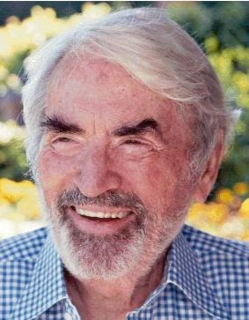
Peck is born in La Jolla, California on April 5, 1916, to Bernice Mary (Ayres) and Gregory Pearl Peck, a chemist and pharmacist in San Diego. Through his Irish-born paternal grandmother, Catherine Ashe, Peck is related to Thomas Ashe, who takes part in the Easter Rising fewer than three weeks after Peck’s birth and dies while on hunger strike in 1917.
Peck’s parents divorce when he is five years old. An only child, he is sent to live with his grandmother. He never feels as though he has a stable childhood. His fondest memories are of his grandmother taking him to the movies every week and of his dog, which follows him everywhere.
At the age of ten Peck is sent to a Catholic military school, St. John’s Military Academy in Los Angeles. While he is a student there, his grandmother dies. At 14, he moves back to San Diego to live with his father and attends San Diego High School. After graduating he enrolls for one year at San Diego State Teacher’s College (now known as San Diego State University).
With a string of hits to his credit, Peck makes the decision to only work in films that interest him. He continues to appear as the heroic, larger-than-life figures in such films as Captain Horatio Hornblower R.N. (1951) and Moby Dick (1956). He works with Audrey Hepburn in her debut film, Roman Holiday (1953).
Peck finally wins the Oscar, after four nominations, for his performance as lawyer Atticus Finch in To Kill a Mockingbird (1962). In the early 1960s, he appears in two darker films than he usually makes, Cape Fear (1962) and Captain Newman, M.D. (1963), which deal with the way people live. He also gives a powerful performance as Captain Keith Mallory in The Guns of Navarone (1961), one of the biggest box-office hits of that year.
In the early 1970s, Peck produces two films, The Trial of the Catonsville Nine (1972) and The Dove (1974), when his film career stalled. He makes a comeback playing, somewhat woodenly, Robert Thorn in the horror film The Omen (1976). After that, he returns to the bigger-than-life roles he is best known for, such as MacArthur (1977) and the monstrous Nazi Dr. Josef Mengele in the huge hit The Boys from Brazil (1978). In the 1980s, he moves into television with the miniseriesThe Blue and the Gray (1982) and The Scarlet and the Black (1983). In 1991, he appears in the remake of his 1962 film, playing a different role, in Martin Scorsese‘s Cape Fear (1991). He is also cast as the progressive-thinking owner of a wire and cable business in Other People’s Money (1991).
In 1967, Peck receives the Academy’s Jean Hersholt Humanitarian Award. He has also been awarded the Presidential Medal of Freedom. Always politically progressive, he is active in such causes as anti-war protests, workers’ rights and civil rights. In 2003, Peck’s portrayal of Atticus Finch is named the greatest film hero of the past 100 years by the American Film Institute.
Peck dies in his sleep at his home in Los Angeles, California from bronchopneumonia at the age of 87 on June 12, 2003. He is entombed in the Cathedral of Our Lady of the Angels mausoleum in Los Angeles. His eulogy is read by Brock Peters, whose character, Tom Robinson, was defended by Peck’s Atticus Finch in To Kill a Mockingbird.
Bowen is baptised in St. Stephen’s Church on Upper Mount Street. Her parents, Henry Charles Cole Bowen and Florence (née Colley) Bowen, later bring her to Bowen’s Court at Farahy, near Kildorrery, County Cork, where she spends her summers. When her father becomes mentally ill in 1907, she and her mother move to England, eventually settling in Hythe. After her mother dies in 1912, she is raised by her aunts. She is educated at Downe House School under the headship of Olive Willis. After some time at art school in London she decides that her talent lay in writing. She mixes with the Bloomsbury Group, becoming good friends with Rose Macaulay who helps her seek out a publisher for her first book, a collection of short stories entitled Encounters (1923).
In 1923 Bowen marries Alan Cameron, an educational administrator who subsequently works for the BBC. The marriage has been described as “a sexless but contented union.” She has various extra-marital relationships, including one with Charles Ritchie, a Canadiandiplomat seven years her junior, which lasts over thirty years. She also has an affair with the Irish writer Seán Ó Faoláin and a relationship with the American poet May Sarton. She and her husband first live near Oxford, where they socialize with Maurice Bowra, John Buchan and Susan Buchan, and where she writes her early novels, including The Last September (1929). Following the publication of To the North (1932) they move to 2 Clarence Terrace, Regent’s Park, London, where she writes The House in Paris (1935) and The Death of the Heart (1938). In 1937, she becomes a member of the Irish Academy of Letters.[3]
In 1930 Bowen becomes the first (and only) woman to inherit Bowen’s Court, but remains based in England, making frequent visits to Ireland. During World War II she works for the British Ministry of Information, reporting on Irish opinion, particularly on the issue of neutrality. Her political views tend towards Burkean conservatism. During and after the war she writes among the greatest expressions of life in wartime London, The Demon Lover and Other Stories (1945) and The Heat of the Day (1948). She is awarded the CBE the same year.
Bowen’s husband retires in 1952 and they settle in Bowen’s Court, where he dies a few months later. Many writers visit her at Bowen’s Court from 1930 onwards, including Virginia Woolf, Eudora Welty, Carson McCullers, Iris Murdoch, and the historian Veronica Wedgwood. For years Bowen struggles to keep the house going, lecturing in the United States to earn money. In 1957 her portrait is painted at Bowen’s Court by her friend, painter Patrick Hennessy. She travels to Italy in 1958 to research and prepare A Time in Rome (1960), but by the following year she is forced to sell her beloved Bowen’s Court, which is demolished in 1960. In the following months, she writes for CBS the narrative of the documentary titled Ireland the Tear and the Smile which is realized in collaboration with Robert Monks as cameraman and associate producer. After spending some years without a permanent home, she finally settles at “Carbery”, Church Hill, Hythe, in 1965.
In 1972 Bowen develops lung cancer. She dies at the age of 73 in University College Hospital in London on February 22, 1973. She is buried with her husband in St. Colman’s churchyard in Farahy, close to the gates of Bowen’s Court, where there is a memorial plaque to the author at the entrance to St. Colman’s Church, where a commemoration of her life is held annually.
Kennedy meets his future wife, Jacqueline Lee “Jackie” Bouvier (1929–1994), while he is a congressman. Charles L. Bartlett, a journalist, introduces the pair at a dinner party. They are married a year after he is elected senator, on September 12, 1953. Following a miscarriage in 1955 and a stillbirth in 1956, they produce three children, Caroline, John, Jr., and Patrick, who dies of complications two days after birth.
In the 1960 presidential election, Kennedy narrowly defeats Republican opponent Richard Nixon, who is the incumbent vice president. His humor, charm, and youth in addition to his father’s money and contacts are great assets in the campaign. His campaign gains momentum after the first televised presidential debates in American history. He is the first Catholic elected president of the United States.
Kennedy’s administration includes high tensions with communist states in the Cold War. As a result, he increases the number of American military advisors in South Vietnam. The Strategic Hamlet Program begins in Vietnam during his presidency. In April 1961, he authorizes an attempt to overthrow the Cuban government of Fidel Castro in the failed Bay of Pigs Invasion. He authorizes the Cuban Project, also known as Operation Mongoose, in November 1961. He rejects Operation Northwoods, plans for false flag attacks to gain approval for a war against Cuba, in March 1962. However, his administration continues to plan for an invasion of Cuba in the summer of 1962.
In October 1962, U.S. spy planes discover Soviet missile bases have been deployed in Cuba. The resulting period of tensions, termed the Cuban Missile Crisis, nearly results in the breakout of a global thermonuclear conflict. He also signs the first nuclear weapons treaty in October 1963.
After Kennedy’s death, Congress enacts many of his proposals, including the Civil Rights Act of 1964 and the Revenue Act of 1964. Despite his truncated presidency, he ranks highly in polls of U.S. presidents with historians and the general public. His personal life has also been the focus of considerable sustained interest following public revelations in the 1970s of his chronic health ailments and extramarital affairs. He is the last U.S. President to have been assassinated as well as the last U.S. president to die in office.
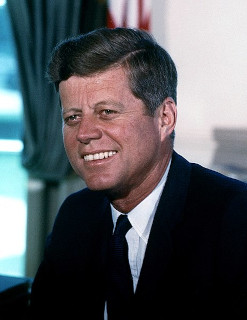
(Pictured: John F. Kennedy, photograph in the Oval Office, July 11, 1963)






 seamus dubhghaill