seamus dubhghaill

Promoting Irish Culture and History from Little Rock, Arkansas, USA


Leave a comment

The Glenanne Barracks Bombing

The Glenanne barracks bombing is a large truck bomb attack carried out by the Provisional Irish Republican Army (IRA) against a British Army (Ulster Defence Regiment) base at Glenanne, near Mountnorris, County Armagh, on May 31, 1991. The bombing leaves three soldiers dead and 14 people wounded, four of them civilians.

The bombing takes place at a time when the Northern Ireland Office arranges multi-party talks, known as the Brooke/Mayhew talks, on the future of Northern Ireland. Sinn Féin members are not invited to attend because of their links with the IRA, which prevents them from being recognised as a “constitutional” party. The talks end in failure soon after.

Built in 1972, the barracks house two companies of the 2nd Battalion, Ulster Defence Regiment (UDR). Seen as an outpost, it sits on the dividing line between a Protestant area and a Catholic area. Although the military barracks itself had not been attacked by the IRA previously, seven UDR soldiers from the base had already been killed during the Troubles.

At 11:30 PM, a driverless truck loaded with 2,500 lb (1,100 kg) of a new type of homemade explosive is rolled down a hill at the rear of the barracks and crashes through the perimeter fence. According to a witness, a UDR lance corporal who alerts the base, the truck is a Mercedes, and a Toyota HiAce van carrying at least two men acts as a support vehicle. The men are seen outside the parked van, masked and armed, one with a handgun and the other with a submachine gun. This same witness alerts the base believing the IRA team are about to carry out a mortar attack, and debris thrown up on the roof by the lorry as it plunges down the hill is misinterpreted by some inside the base as a mortar projectile. Automatic fire is heard by other witnesses just before the main blast. A Reuters report claims that IRA members trigger the bomb by firing upon the driverless vehicle. It is later determined that the lorry had been stolen the day before in Kingscourt, County Cavan, in the Republic of Ireland.

The blast leaves a crater 200 ft. (61 m) deep and throws debris and shrapnel as far as 300 yards (270 m). The explosion can be heard over 30 miles (48 km) away, as far as Dundalk. This is the biggest bomb detonated by the IRA up to this point. Most of the UDR base is destroyed by the blast and the fire that follows. At first, a massive mortar attack is suspected. Some livestock are killed and windows broken around the nearby Mossfield housing as a result of the explosion. The cars parked outside the base are obliterated. Ceilings are brought down and the local primary school is also damaged.

The barracks is usually manned by eight soldiers, but at the time there are 40 people in the complex, attending a social event. Three UDR soldiers – Lance Corporal Robert Crozier (46), Private Sydney Hamilton (44) and Private Paul Blakely (30) – are killed and ten are wounded. Two of them are caught by the explosion when they come out to investigate after a sentry gives the alarm. A third dies inside the base. Four civilians are also wounded. The Provisional IRA claims responsibility two days later.

Author Kevin Toolis lists the destruction of Glenanne UDR barracks in County Armagh as part of the cycle of violence and tit-for-tat killings in neighbouring County Tyrone. The IRA later claims that the death of three of its men in the town of Coagh is a Special Air Service (SAS) retaliation for the Glenanne bombing.

The base is never rebuilt. It had outlived its operational usefulness and a decision had already been taken to close it down. The decision not to rebuild the compound raises some controversy among unionists. A memorial stone is erected by the main entrance road with the names of the UDR soldiers killed over the years while serving in Glenanne.

Leave a comment

Death of Henry Capell, 1st Baron Capell of Tewkesbury

Henry Capell, 1st Baron Capell of Tewkesbury KB, PC, English politician who sits in the House of Commons of England between 1660 and 1692, dies in Chapelizod, Dublin, on May 30, 1696.

Capell is born in Little Hadham, Hertfordshire, England, in 1638. He is the son of Arthur Capell, 1st Baron Capell of Hadham, and Elizabeth Morrison. He is baptised on March 6, 1638. His father is raised to the peerage in 1641, and he dies fighting for the King in the English Civil War in 1649 as one of the commanders of the Colchester garrison. His eldest brother is Arthur Capell, 1st Earl of Essex.

Capell founds the Kew Gardens at Kew, a district in the London Borough of Richmond upon Thames. Later he is elected Member of Parliament for Tewkesbury in the Convention Parliament. He is invested as a Knight of the Order of the Bath, on April 23, 1661. In 1661, he is re-elected MP for Tewkesbury in the Cavalier Parliament. He is a member of the Privy Council of Ireland from April 1673 to March 1684/85. He is re-elected MP for Tewkesbury in the two elections of 1679, is a member of the Privy Council of England from April 22, 1679, to January 31, 1680, and is First Lord of the Admiralty, between 1679 and 1680.

In 1689, Capell is elected MP for Cockermouth and is Lord of the Treasury, between 1689 and 1690. He is invested again as Privy Councillor, on February 14, 1689. He is elected MP for Tewkesbury in 1690, and sits until April 11, 1692, when he is ennobled as Baron Capell of Tewkesbury, in the County of Gloucester. One year later, he becomes Lord Justice of Ireland and in turn a Privy Councillor of Ireland, in June 1693. In 1695 and 1696, he is Lord Deputy of Ireland. His term as Lord Deputy is not considered successful because of him being a firm Whig and presiding over an administration which is deeply divided between Whigs and Tories. He does nothing to help change this situation.

Capell dies at the age of 58 in Chapelizod, County Dublin, on May 30, 1696. He is buried on September 8, 1696, in Little Hadham, Hertfordshire. The barony dies with him.

On February 16, 1659, Capell marries Dorothy Bennet, daughter of Richard Bennet. The marriage is childless but does bring part of what later becomes Kew Palace into the Capell family, leading to its becoming known as Capel House. Dorothy dies in 1721, and through her will endows a number of charities.

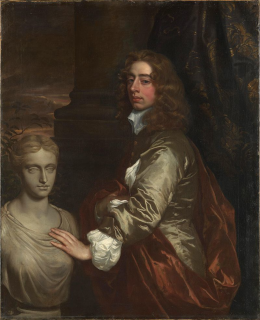
(Pictured: “Sir Henry Capel (1638-1696),” oil on canvas by Peter Lely, Metropolitan Museum of Art)


Leave a comment

Birth of Donal Murray, Former Roman Catholic Bishop of Limerick

Donal Brendan Murray, the Roman Catholic Bishop of Limerick from 1996 to 2009, is born in Dublin on May 29, 1940. He previously serves as an Auxiliary Bishop of the Dublin diocese.

Murray is educated at Blackrock College, a voluntary day and boarding Catholic secondary school for boys aged 13–18, in Williamstown, Blackrock, County Dublin. He studies for a BA and master’s degrees in philosophy at University College Dublin (UCD), obtains a B.Div at St. Patrick’s College, Maynooth, and his License and Doctorate in theology at the Pontifical University of Saint Thomas Aquinas (Angelicum). He is ordained on May 22, 1966.

Murray lectures in the Mater Dei Institute of Education from 1969, becoming professor of moral theology at Holy Cross College, located in Clonliffe Road, Drumcondra, Dublin. He also lectures at University College Dublin from 1973 to 1982 in Catechetics and from 1978 to 1982 in Medical Ethics.

In 1981, Murray is appointed Titular Bishop of Glenndálocha and Auxiliary Bishop of Dublin, making him the youngest bishop at the time, aged only 41. He is appointed as Bishop of Limerick on February 10, 1996, by Pope John Paul II. He is installed as Bishop of Limerick on March 24, 1996.

In November 2009, Murray is pressured to resign from his post after the Murphy Report finds that he had mishandled child sexual abuse allegations within his diocese.

Murray announces his resignation to a congregation, including priests of the Diocese, people working in the Diocesan Office and the Diocesan Pastoral Centre, at 11:00 a.m. (noon in Rome, the hour of the publication of the decision) in St. John’s Cathedral, Limerick.


Leave a comment

Death of Brendan Bowyer, Royal Showband Frontman

Brendan Bowyer, Irish singer best known for fronting the Royal Showband and The Big Eight and who has five number one hits in Ireland, dies in Las Vegas, Nevada, on May 28, 2020.

Born in Waterford, County Waterford on October 12, 1938, Bowyer is renowned for having The Beatles open for the Royal Showband at a concert on April 2, 1962 at the Pavilion Theatre, Liverpool, England, some six months before the release of The Beatles debut single “Love Me Do” in October 1962. He is regarded as one of the first headlining Elvis impersonators. Elvis Presley himself is a big fan of Bowyer’s performances and often attends his concerts in the Stardust Resort and Casino in Las Vegas during the 1970s.

Bowyer begins his career with the Royal Showband in 1957. His ability to tailor American rock and roll music to the tastes of Irish audiences, and his athletic, spirited on-stage performances make him a popular vocalist of the 1960s Irish showband era. On September 6, 1963, he and the Royal Showband become the first Irish artists to top the Irish Singles Chart, with the hit “Kiss Me Quick,” which stays at the number one position for seven weeks. They return to the top position later that year with “No More,” and repeat the feat in 1964 with “Bless You.”

Bowyer takes part in the 1965 Irish National Song Contest for a chance to represent Ireland at the Eurovision Song Contest in Naples with the song “Suddenly in Love,” but can only manage fifth place. The Royal Showband’s greatest success is to come in 1965 with “The Hucklebuck,” which spends a further seven weeks at the top of the Irish Singles Chart, and is a hit in Australia, but fails to appear in the UK Singles Chart. “Don’t Lose Your Hucklebuck Shoes” returns the band to the number one position later in 1965.

In the summer of 1971, Bowyer, along with singer Tom Dunphy, leave the Royal Showband and form the Big Eight Showband. The band spends the summers playing the ballroom circuit in Ireland but also spends six months of the year in Las Vegas. Within a short time, the band makes the decision to relocate to Las Vegas permanently. He is based in Las Vegas from then on, though he makes frequent trips back to Ireland. In 1977 he makes a brief return to the Irish charts with his tribute, “Thank You Elvis.”

Having enjoyed a semi-retirement phase, Bowyer returns to the spotlight, touring Ireland each year, some for months on end, with his daughter Aisling Bowyer, and a six-piece band. They perform his showband era hits, dance numbers, nationalist songs, modern contemporary songs and concert hits.

A covers album, Follow On, is released in 2001, where Bowyer performs some of the most popular Irish songs, such as “Summer in Dublin,” “What’s Another Year,” “Past the Point of Rescue,” and “I Don’t Like Mondays.”

In 2005, Bowyer and Aisling headline the entertainment list for the Tall Ships Festival in Waterford, performing in the open air to an estimated crowd of 12,000. In 2015, Bowyer is the star of the “Ireland’s Showbands – Do You Come Here Often?” concert series.

Bowyer dies at the age of 81 in Las Vegas, Nevada on May 28, 2020.


Leave a comment

Death of Melesina Chenevix Trench, Writer, Poet & Diarist

Melesina Trench (née Chenevix), Irish writer, poet and diarist, dies in Malvern, Worcestershire, England, on May 27, 1827. During her lifetime she is known more for her beauty than her writing. It is not until her son, Richard Chenevix Trench, publishes her diaries posthumously in 1861 that her work receives notice.

Chenevix is born in Dublin on March 22, 1768, to Philip Chenevix and Mary Elizabeth Gervais. She is orphaned before her fourth birthday and is brought up by her paternal grandfather, Richard Chenevix (1698–1779), the Anglican Bishop of Waterford and Lismore. The family is of Huguenot extraction.

After the death of Richard Chenevix, Chenevix goes to live with her other grandfather, the Archdeacon Gervais. On October 31, 1786, she marries Colonel Richard St. George, who dies only four years later in Portugal, leaving one son, Charles Manners St. George, who becomes a diplomat.

Between 1799 and 1800, Melesina travels around Europe, especially Germany. It is during these travels that she meets Lord Horatio Nelson, Lady Hamilton and the cream of European society, including Antoine de Rivarol, Lucien Bonaparte, and John Quincy Adams while living in Germany. She later recounts anecdotes of these meetings in her memoirs.

On March 3, 1803, in Paris she marries her second husband, Richard Trench, who is the sixth son of Frederick Trench and brother of Frederick Trench, 1st Baron Ashtown.

After the breakdown of the Peace of Amiens, Richard Trench is detained in France by Napoleon‘s armies, and in August 1805 Melesina takes it upon herself to petition Napoleon in person and pleads for her husband’s release. Her husband is released in 1807, and the couple settles at Elm Lodge in Bursledon, Hampshire, England.

Their son, Francis Chenevix Trench, is born in 1805. In 1807, when they are on holiday in Dublin, their son Richard Chenevix Trench is born. He goes on to be the Archbishop of Dublin, renowned poet and contemporary of Alfred, Lord Tennyson. Her only daughter dies a few years later at the age of four.

Trench corresponds with, amongst others, Mary Leadbeater, with whom she works to improve the lot of the peasantry at her estate at Ballybarney. She dies at the age of 59 in Malvern, Worcestershire on May 27, 1827.

Melesina Trench’s diaries and letters are compiled posthumously by Richard Chenevix Trench as The remains of the late Mrs. Richard Trench in 1861 with an engraving of her taken from a painting by George Romney. Another oil painting, The Evening Star by Sir Thomas Lawrence, has her as a subject, and she is reproduced in portrait miniatures – one in Paris by Jean-Baptiste Isabey and another by Hamilton that is copied by the engraver Francis Engleheart.

Copies of a number of her works are held at Chawton House Library.

(Pictured: “Melesina Chenevix, Mrs. George, later Mrs. Trench,” attributed to George Romney (British, 1734–1802), oil on canvas)


Leave a comment

The Execution of Fenian Michael Barrett

Michael Barrett, Irish activist and a member of the Fenians, is executed on May 26, 1868, for his part in the Clerkenwell Gaol explosion in December 1867. From all the evidence, it is likely he is not guilty. He is the last man to be publicly hanged in England.

Barrett is born in 1841 in Drumnagreshial in the Ederney area of County Fermanagh. As a young man and in search of work, he moves to Glasgow where, at the age of 27, he joins the Irish Republican Brotherhood (IRB), often referred to as Fenians. In the 1860s, the IRB is a political movement that dominates Irish Republican politics and defies the Catholic Church, middle-class nationalists who advocate milder approaches and Irish Unionists. Tens of thousands of Irishmen in both Ireland and Great Britain are recruited into its ranks.

The Clerkenwell bombing is the most infamous action carried out by the Fenians in mainland Britain. It results in a long-lived backlash that foments much hostility against the Irish community in Britain.

The events that lead up to the bombing start with the arrest in November 1867 of Ricard O’Sullivan Burke, a senior Fenian arms agent who planned the “prison-van escape” in Manchester a few months earlier. O’Sullivan-Burke is subsequently imprisoned on remand in the Middlesex House of Detention, Clerkenwell. On December 13, an attempt to rescue him is made by blowing a hole in the prison wall. The explosion is seriously misjudged. It demolishes not only a large section of the wall, but also a number of tenement houses opposite in Corporation Lane (now Corporation Row), killing 12 people and wounding up to 120 more.

The bombing has a traumatic effect on British working-class opinion. The radical, Charles Bradlaugh, condemns the incident in his newspaper, the National Reformer, as an act “calculated to destroy all sympathy, and to evoke the opposition of all classes.”

The day before the explosion, Prime Minister Benjamin Disraeli bans all political demonstrations in London in an attempt to put a stop to the weekly meetings and marches that are being held in support of the Fenians. He fears that the ban might be challenged, but the explosion has the effect of turning public opinion in his favour.

Months earlier, Barrett had been arrested in Glasgow for illegally discharging a firearm and allegedly false evidence is used to implicate him in the Clerkenwell Prison explosion. In court, he produces witnesses who testify that he had been in Scotland on the date of the incident. The main case against him rests on the evidence of Patrick Mullany, a Dubliner known to have given false testimony before and whose price is a free passage to Australia, who tells the court that Barrett had informed him that he had carried out the explosion with an accomplice by the name of Murphy. After two hours of deliberation the jury pronounces Barrett guilty. On being asked if he has anything to say before sentence is passed, he delivers an emotional speech from the dock.

Many people, including a number of radical MPs, press for clemency. In Fermanagh, Barrett’s aged mother walks several miles in the snow to appeal to the local Irish Conservative Party MP, Captain Mervyn Edward Archdale, a staunch Orangeman, who rejects her.

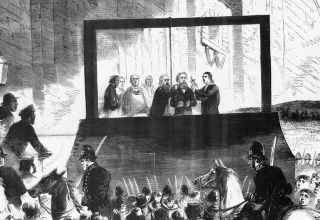
Barrett is executed outside the walls of Newgate Prison on May 26, 1868, before a crowd of two thousand who boo, jeer and sing “Rule, Britannia!” and “Champagne Charlie” as his body drops. His execution is the last public hanging to take place in England. The hangman is William Calcraft.

Until their transfer to the City of London Cemetery, Barrett’s remains lay for 35 years in a lime grave inside the walls of Newgate Prison. When the prison is demolished in 1903 his remains are taken to their present resting place. Today the grave is a place of Fenian pilgrimage and is marked by a small plaque.

After the explosion, the Prime Minister Disraeli advocates the suspension of the Habeas Corpus Act 1862 in Great Britain, as is already the case in Ireland. Greater security measures are quickly introduced. Thousands of special constables are enrolled to aid the police and at Scotland Yard a special secret service department is established to meet the Fenian threat. Although a number of people are arrested and brought to trial, Barrett is the only one to receive the death sentence.

Within days of the explosion, the Liberal Party leader, William Ewart Gladstone, then in opposition, announces his concern about Irish Nationalist grievances and says that it is the duty of the British people to remove them. Later, he says that it is the Fenian action at Clerkenwell that turned his mind towards Home Rule. When Gladstone discovers at Hawarden later that year that Queen Victoria had invited him to form a government, he famously states, “my mission is to pacify Ireland.”


Leave a comment

Death of Bill O’Herlihy, Broadcaster & Public Relations Executive

Bill O’Herlihy, Irish television broadcaster and public relations executive, dies in Dublin on May 25, 2015. He is best known for his broadcasts for Raidió Teilifís Éireann (RTÉ), primarily in the sporting arena.

Born and raised in Glasheen in Cork, County Cork, O’Herlihy is the son of a local government official and the grandson of William O’Herlihy, a news editor for The Cork Examiner. He is educated at Glasheen boys’ national school and later at St. Finbarr’s College, Farranferris.

After finishing his schooling at fifteen, O’Herlihy follows his grandfather into journalism and secures a job in the reading room of The Cork Examiner. He is only seventeen years-old when he subsequently becomes sub-editor of the Evening Echo, a position he holds for five years. He also graduates to the positions of news, features and sports reporter.

In the early 1960s O’Herlihy begins his broadcasting career when he starts to do local association football reports from Cork for Radio Éireann. In 1965, he makes his first television broadcast in a programme commemorating the sinking of the RMS Lusitania off the Cork coast. After three years O’Herlihy is asked to join RTÉ’s current affairs programme 7 Days to add the required field-reporting skills to the studio-based interviews. The programme has a reputation for its hard-hitting investigative reporting, and he reports on many varying stories from illegal fishing in Cork to the outbreak of the crisis in Northern Ireland. In November 1970, the 7 Days programme comes into controversy when O’Herlihy reports a story on illegal money lending. The report is unconventional as it is one of the first television pieces to use hidden cameras, it claims the government is not responding to illegal moneylending. A tribunal of inquiry follows, and O’Herlihy is forced to move away from current affairs.

Following this controversy, while O’Herlihy is not sacked as he has fifteen months left on his contract with RTÉ, he is moved to the RTÉ Sports department. There he works under Michael O’Hehir, who dislikes him and his broadcasting style. In spite of this O’Herlihy fronts RTÉ’s television coverage of the Olympic Games that year. He also becomes involved in the production of various sports programmes.

O’Herlihy is not long in the RTÉ Sports department when he becomes a regular presenter for such programmes as Sunday Sport and Sports Stadium. In 1978 he becomes RTÉ Soccer host alongside Eamon Dunphy and, in 1984, Johnny Giles joins the panel and Liam Brady follows in 1998. Since 1974 O’Herlihy becomes RTÉ’s chief sports presenter for such events as all Olympic Games until 2012, FIFA World Cups until 2014, UEFA European Football Championships until 2012 and European and World Track and Field Championships. He hosts RTÉ highlights of the Ryder Cup in 2006 when it is at the K Club in County Kildare and continues to present coverage of Ireland’s soccer internationals for RTÉ, along with Dunphy, Giles and Brady.

O’Herlihy hosts RTÉ’s coverage of rugby union in the 1980s and early 1990s. However, when RTÉ attains the rights to cover the English Premier League in 1992, Tom McGurk takes over as host of RTÉ’s coverage of rugby union. O’Herlihy covers the Premier League, Irish Internationals and The Champions League before dropping the Premier League in 2008. He continues to cover the Olympic Games and International Athletic Championships such as the European and World Athletics. He presents the first Rugby World Cup on RTÉ television in 1987 and, with Jim Carney, co-presents the first edition of The Sunday Game in 1979.

In 2012, while covering Chloe Magee‘s progress at the 2012 Summer Olympics O’Herlihy remarks that badminton was once considered “a mainly Protestant sport.” RTÉ subsequently receives a number of complaints, and while Magee criticises the remarks, the argument is made that the incident inadvertently reflected a complex historical reality.

O’Herlihy presents RTÉ Sport‘s coverage of the 2010 FIFA World Cup, his ninth FIFA World Cup. He fronts 18 European Championships and FIFA World Cups for RTÉ, the last of which comes in 2014. This proves to be the final tournament with O’Herlihy at the helm. He retires at its conclusion and dies the following year.

O’Herlihy attends the 12th Irish Film & Television Awards on Sunday, May 24, 2015. He dies peacefully in his sleep at his home the following day at the age of 76 nearly a year after his retirement. He is survived by wife Hillary and daughters Jill and Sally. Giles, Brady and Dunphy appear on The Late Late Show in tribute later that week. At the time of his death O’Herlihy is working on a sports version of Reeling in the Years, which RTÉ immediately cancels.


Leave a comment

The Battle of Prosperous

The Battle of Prosperous, a military engagement between British Crown forces and United Irishmen rebels, takes place in the town of Prosperous, County Kildare, on May 24, 1798, during the Irish Rebellion of 1798.

Prosperous is founded by Sir Robert Brooke in 1780 as a village for processing cotton produced in the Americas. When a rebellion spearheaded by the United Irishmen breaks out against British rule in Ireland, rebel forces led by John Esmonde make plans to capture Prosperous. Esmonde has 200 rebels under his command, while Prosperous is garrisoned by elements of the Royal Cork City Militia under the command of Captain Richard Swayne and reinforced by detachments of a Welsh mounted fencible regiment, the Ancient British Regiment of Fencible Cavalry Dragoons (also known as the Ancient Britons), numbering 150 men in all.

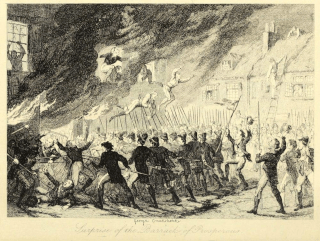
On May 24, 1798, Esmonde leads his forces to attack Prosperous. Their entry is preceded by the infiltration of a small rebel vanguard, who with the possible help of female sympathisers residing in Prosperous, scale the walls of the town’s barracks, kill the sentries and open the town gates. The barracks are quickly surrounded and attacked by the rebels who repulse an attempt by the garrison to break out. “Swayne himself was surprised in bed, shot and piked to death and his body burned in a tar barrel.” The remainder of the garrison are trapped in the upper floors of the barracks, which is set on fire by the rebels, causing them to jump in desperation onto the ground below, where they are summarily executed with pikes. While the rebels suffer no known casualties, approximately 40 members of the garrison are killed in the battle.

Ten members of the garrison, all belonging to the Ancient Britons, manage to escape from Prosperous to Dunlavin, County Wicklow, where they participate in the Dunlavin Green executions on May 26. Esmonde is later captured by Crown forces and brought to Dublin for trial. As he had previously enlisted at the rank of lieutenant in the Clane Yeomanry, Esmonde is court-martialled on June 13 and found guilty of being a deserter. He is executed by hanging on June 14 on Carlisle Bridge (now the O’Connell Bridge) with his coat being worn reversed to indicate that he had been convicted of desertion. Prosperous remains under the control of the United Irishmen until June 19, when a detachment of the 5th Dragoon Guards under the command of Lieutenant Colonel Stewart recaptures the town.


Leave a comment

Birth of Shelah Richards, Actress, Manager, Director & Producer

Shelah Geraldine Richards, Irish actress, manager, director and producer, is born in Dublin on May 23, 1903.

Richards is born to John William Richards, a lawyer, and Adelaide Roper, suffragist who had chained herself to the railings in St. Stephen’s Green. She goes to school at Alexandra College, Dublin, and after that she attends a finishing school in Paris. Though her family is not in the arts, her godmother is Beatrice Elvery. Shes attends Elvery’s salons with her parents as a child. She meets W. B. Yeats when she is sixteen. Her niece, Geraldine Fitzgerald, daughter of her sister, Edith Catherine Richards, is also one of Ireland’s pre-eminent actresses.

Richards’s acting career starts while attending the Dublin drama league and she is asked at short notice to replace Eileen Crowe in Juno and the Paycock, playing the role of Mary Boyle in the Abbey Theatre production. Richards gets the role of Nora Clithero in the 1926 production of The Plough and the Stars, Seán O’Casey‘s next production. This role means that she ends up with police protection for the duration of the run due to the disturbances the play engenders. Another important role is to take on playing the lead in The Player Queen by Yeats. Maire O’Neill had previously made the role her own and Yeats had let no one perform the part since then so taking on such a challenge is intimidating. Richards continues to take on leading roles with the Abbey Theatre but in 1926 she also begins to direct.

On December 28, 1928, Richards marries playwright Denis Johnston in St. Anne’s Church in Dublin. She tours the United States with the Abbey players in 1932 and with the Irish Players in the mid 1930s. A role in 1938 in Molly Keane‘s Spring Meeting starring Gladys Cooper and A. E. Matthews takes her to Broadway in New York City. War in Europe breaks out while the run is still going on and Richards is advised to stay in the United States. However, by then she has two children, producer Micheal and novelist Jennifer Johnston, so she returns to Dublin. There she runs her own theater company at the Olympia Theatre with Nigel Heseltine. Her marriage to Johnston, broken in 1938, ends with divorce in February 1945.

Richards next challenge is to take over the Abbey School of Acting. During her time there one of the designers she works with is Louis le Brocquy. With Siobhán McKenna she produces The Playboy of the Western World in Edinburgh to huge success allowing her to stage it in London and Dublin and later in Toronto‘s Library Theater. She brings Marcel Marceau to Dublin for the first time. She continues to act and has some film roles.

In 1961 Ireland launches its first television service, Raidió Teilifís Éireann. Richards is one of the first producers, recommended to the station by Hilton Edwards. She is one of the few women in the new station. The first Irish play produced during the opening week is directed by her and she is nominated for a Best Actress award in another production, Inquiry at Lisieux. She works as producer on a wide number of programs for the station including documentaries, soap operas and religious programming. Both Tolka Row and The Riordans are produced by her as well as Denis Johnston’s The Moon on the Yellow River, George Bernard Shaw‘s Arms and the Man and John Millington Synge‘s Riders to the Sea.

Richards retires from her RTÉ career in the early 1970s though she continues to raise funds for the Gate Theatre through the Edwards–MacLiammóir Playhouse Society. In 1983, for her 80th birthday, the Abbey puts on a party for her which includes a special rendition of “Nora” from The Plough and the Stars. Richards is the last living member of the original 1926 cast. The song is repeated at her funeral in 1985. She died in Ballybrack, County Dublin, on January 19, 1985. Her funeral is held in St. Anne’s Church in Dublin and she is cremated in Glasnevin Cemetery.


Leave a comment

Birth of Betty Williams, Peace Activist and Nobel Peace Prize Recipient

Elizabeth “Betty” Williams (née Smyth), peace activist and co-recipient of the Nobel Peace Prize in 1976, is born in Belfast, Northern Ireland, on May 22, 1943.

Williams’s father works as a butcher and her mother is a housewife. She receives her primary education from St. Teresa Primary School in Belfast and attends St. Dominic’s Grammar School for Girls for her secondary school studies. Upon completing her formal education, she takes up a job of office receptionist.

Rare for the time in Northern Ireland, Williams’s father is Protestant and her mother is Catholic, a family background from which she later says she derived religious tolerance and a breadth of vision that motivated her to work for peace. Early in the 1970s she joins an anti-violence campaign headed by a Protestant priest. She credits this experience for preparing her to eventually found her own peace movement, which focuses on creating peace groups composed of former opponents, practicing confidence-building measures, and the development of a grassroots peace process.

Williams is drawn into the public arena after witnessing the death of three children on August 10, 1976, when they are hit by a car whose driver, an Irish Republican Army (IRA) paramilitary named Danny Lennon, had been fatally shot in return fire by a soldier of the King’s Own Royal Border Regiment. As she turns the corner to her home, she sees the three Maguire children crushed by the swerving car and rushes to help. Their mother, Anne Maguire, who is with the children, dies by suicide in January 1980.

Williams is so moved by the incident that within two days of the tragic event, she obtains 6,000 signatures on a petition for peace and gains wide media attention. With Mairead Corrigan, she co-founds the Women for Peace which, with Ciaran McKeown, later becomes the Community of Peace People.

Williams soon organises a peace march to the graves of the slain children, which is attended by 10,000 Protestant and Catholic women. However, the peaceful march is violently disrupted by members of the IRA, who accuse them of being “dupes of the British.” The following week, she leads another march in Ormeau Park that concludes successfully without incident – this time with 20,000 participants.

In recognition of her efforts for peace, Williams, together with Corrigan, become joint recipients of the Nobel Peace Prize for 1976.

The Peace Prize money is divided equally between Williams and Corrigan. Williams keeeps her share of the money, stating that her intention is to use it to promote peace beyond Ireland, but faces criticism for her decision. She and Corrigan have no contact after 1976. In 1978, Williams breaks off links with the Peace People movement and becomes instead an activist for peace in other areas around the world.

Williams receives the People’s Peace Prize of Norway in 1976, the Golden Plate Award of the American Academy of Achievement in 1977, the Schweitzer Medallion for Courage, the Martin Luther King, Jr. Award, the Eleanor Roosevelt Award in 1984, and the Frank Foundation Child Care International Oliver Award. In 1995, she is awarded the Rotary International “Paul Harris Fellowship” and the Together for Peace Building Award.

At the 2006 Earth Dialogues forum in Brisbane, Williams tells an audience of schoolchildren during a speech on Iraq War casualties that “Right now, I would like to kill George W. Bush.” From September 17 to 20, 2007, she gives a series of lectures in Southern California. On September 18, she presents a lecture to the academic community of Orange County entitled “Peace in the World Is Everybody’s Business” and on September 20 she gives a lecture to 2,232 members of the general public, including 1,100 high school sophomores, at Soka University of America. In 2010, she gives a lecture at WE Day Toronto, a WE Charity event that empowers students to be active within their communities, and worldwide.

Speaking at the University of Bradford before an audience of 200 in March 2011, Williams warns that young Muslim women on campus are vulnerable to attacks from angry family members, while the university does little to help protect them. “If you had someone on this campus these young women could go to say, ‘I am frightened’ – if you are not doing that here, you are dehumanising them by not helping these young women, don’t you think?”

At the time she receives the Nobel Prize, Williams works as a receptionist and is raising her two children with her first husband Ralph Williams. This marriage is dissolved in 1981. She marries businessman James Perkins in December 1982 and they live in Florida in the United States.

In 2004, Williams returns to live in Northern Ireland. She dies on March 17, 2020, at the age of 76 in Belfast.