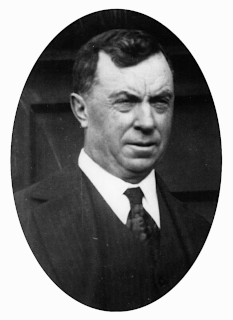
Cohalan graduates from Manhattan College in 1885, takes a master’s degree in 1894, and is given an honorary LL.D. in 1911. He is admitted to the bar in 1888, and practices law in New York City. In September 1889, he removes to the Bronx, practices law there, and enters politics, joining Tammany Hall, becoming an adviser to party boss Charles F. Murphy and later to John F. Curry. He is Grand Sachem of the Tammany Society from 1908 to 1911.
Cohalan is active in Democratic Party politics by 1900, drafting state party platforms and serving as a delegate to the national conventions in 1904 and 1908.
On May 18, 1911, Cohalan is appointed by Gov. John Alden Dix to the New York Supreme Court, to fill the vacancy caused by the election of James Aloysius O’Gorman as U.S. Senator from New York. In November 1911, he is elected to succeed himself. On December 28, 1923, he tenders his resignation, to become effective on January 12, 1924, claiming that the annual salary of $17,500 is not enough to provide for his large family.
Cohalan is a close associate of Irish revolutionary leader John Devoy and is influential in many Irish American societies including Clan na Gael. He helps to form the Sinn Féin League in 1907 and is a key organiser of the Irish Race Convention and the Friends of Irish Freedom (FOIF) on March 4-5, 1916. He is involved with the financing and planning of the Easter Rising in Dublin and is instrumental in sending Roger Casement to Germany in 1914. He is Chairman of the Irish Race Convention held in Philadelphia on February 22-23, 1919, and active in the Friends of Irish Freedom (1916–34).
When the United States enters World War I, Cohalan’s earlier work to obtain German assistance for Ireland becomes a liability, but he urges Irish Americans to support the war effort and to insist that self-determination for Ireland be included among the war aims. He opposes the peace treaty and the League of Nations and leads an Irish American delegation to the United States Senate Committee on Foreign Relations hearings, contributing to the defeat of the treaty in the Senate.
State Senator John P. Cohalan (1873–1950) is one of Cohalan’s eleven siblings, and church historian Monsignor Florence Daniel Cohalan (1908–2001) is one of his nine children.
Browne is an important and outspoken member of the Irish hierarchy. His time as Bishop has been described by the historian James S. Donnelly Jr. as “far-reaching and … controversial,” while the historian of Irish CatholicismJohn Henry Whyte claims that Browne’s “readiness to put forward his views bluntly is welcome at least to the historian.”
On August 6, 1937, at the relatively young age of 41, Browne is appointed Bishop of Galway and Kilmacduagh by Pope Pius XI, receiving his episcopal consecration from Archbishop Thomas Gilmartin on the following August 10. He supports TaoiseachÉamon de Valera‘s defence of arrests and police searches for cached Irish Republican Army (IRA) arms, declaring, “Any Irishman who assists any foreign power to attack the legitimate authority of his own land is guilty of the most terrible crime against God’s law, and there can be no excuse for that crime – not even the pretext of solving partition or of securing unity.”
In 1939, Browne is selected by Éamon de Valera to chair the Commission on Vocational Organisation.
Browne is attentive to the state of public morality in the diocese, and James S. Donnelly Jr. has noted his role in directing episcopal and clerical censorship of newsagents and county librarians. He is also concerned about public intoxication and other misconduct at the Galway Races, controversies over dancing and the commercial dance halls, as well as immodesty in dress and the closely related issue of so-called “mixed bathing” in Galway and Salthill.
In 1957, in response to a growing tension between Catholics and Protestants at Fethard-on-Sea, including the Fethard-on-Sea boycott, Browne says, “non-Catholics do not protest against the crime of conspiring to steal the children of a Catholic father, but they try to make political capital when a Catholic people make a peaceful and moderate protest.”
The most enduring monument or physical legacy of Browne’s time as Bishop is the Cathedral of Our Lady Assumed into Heaven and St Nicholas, commonly known as Galway Cathedral, which is dedicated in 1965 by CardinalRichard James Cushing of Boston, Massachusetts. The site of the old jail had come into the possession of the diocese in 1941 and Browne leads the campaign to construct a new Cathedral. This includes a 1957 audience with Pope Pius XII where the plans are approved.
Browne attends the Second Vatican Council from 1962 to 1965 and retires in 1976. He dies four years later, at the age of 84, on February 24, 1980.
Browne is parodied in Breandán Ó hÉithir`s novel Lig Sinn i gCathu, which fictionalises late 1940s Galway as “Baile an Chaisil” and Browne as “An tEaspag Ó Maoláin.”
The Irish cabinet minister Noël Browne (no known relation) in his 1986 memoir Against the Tide describes the physical attributes of his episcopal namesake:
“The bishop had a round soft baby face with shimmering clear cornflower-blue eyes, but his mouth was small and mean. Around his great neck was an elegant glinting gold episcopal chain with a simple pectoral gold cross. He wore a ruby ring on his plump finger and wore a slightly ridiculous tiny scullcap on his noble head. The well-filled semi-circular scarlet silk cummerbund and sash neatly divided the lordly prince into two.”
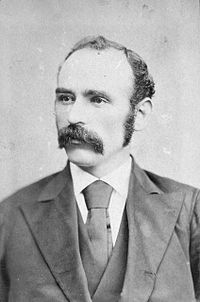
Davitt is born in Straide, County Mayo, on March 25, 1846. He is the founder of the Irish National Land League, which organizes resistance to absentee landlordism and seeks to relieve the poverty of the tenant farmers by securing fixity of tenure, fair rent, and free sale of the tenant’s interest.
Davitt is the son of an evicted tenant farmer. After their eviction, the family emigrates to England. In 1856, at the age of 10, he starts work in a cotton mill, where he loses an arm in a machinery accident a year later. In 1865, he joins the revolutionary Fenian Brotherhood, an international secret society that seeks to secure political freedom for Ireland. He becomes secretary of its Irish analogue, the Irish Republican Brotherhood (IRB), in 1868. Arrested in Paddington Station in London for sending firearms to Ireland on May 14, 1870, he is sentenced to 15 years in Dartmoor Prison and there lays plans to link Charles Stewart Parnell’s constitutional reform with Fenian activism to achieve political-agrarian agitation.
Paroled from prison in 1877, Davitt rejoins the IRB and goes to the United States, where the Fenian movement originated. There he is deeply influenced by Henry George’s ideas about the relationship between land monopoly and poverty.
Back in Ireland, using funds raised by John Devoy and Clan na Gael in the United States, Davitt wins Parnell’s cooperation in organizing the Land League in 1879, which leads, however, to his expulsion from the supreme council of the IRB in 1880. He is elected member of Parliament for North Meath in 1882 but is disqualified as he is a convict. He is also imprisoned for seditious speeches in 1881 and 1883.
Because of his public championing of Henry George’s theories of land reform, Parnell repudiates him. Davitt actively defends the Nationalists before the Parnell Commission, which meets between 1887 and 1889. When the Irish party splits in 1890 over Parnell’s involvement in Capt. William Henry O’Shea’s divorce case, Davitt is among the first to oppose Parnell’s continuance as leader.
Davitt is elected to Parliament in 1892 and 1893 but is unseated in both cases. He is elected again, for South Mayo in 1895, but resigns in 1899 in protest against the Second Boer War.
Davitt dies in Elphis Hospital, Dublin on May 30, 1906, at the age of 60, from blood poisoning. The fact that the Lord Lieutenant of Ireland attends his funeral is a public indication of the dramatic political journey this former Fenian prisoner has taken. There is no plan for public funeral, and hence Davitt’s body is brought quietly to the Carmelite Friary, Clarendon Street, Dublin. However, the next day over 20,000 people file past his coffin. His remains are taken by train to Foxford, County Mayo, and buried in the grounds of Straide Abbey at Straide, near his place of birth.
Davitt’s book, The Fall of Feudalism in Ireland (1904), is a valuable record of his time.
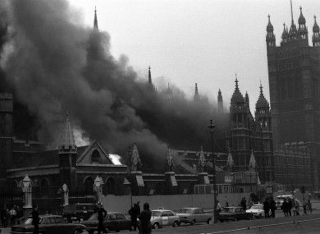
The explosion injures up to 60 people. The bomb is planted in a car, which is known to have been stolen in London the previous night. It is parked outside Horseferry House, a building occupied by the Home Office, and opposite Thames House, which is mainly occupied by the Department of Trade and Industry, when it explodes. Both buildings, and others nearby, are extensively damaged.
Two warnings are given prior to the bombing. The first is by means of an anonymous telephone call to the offices of The Evening News at 8:22 a.m. The caller says that there is a bomb in Horseferry Road and Marshall Street and that these streets should be cleared immediately. It is presumed that the caller must have meant Marsham Street and not Marshall Street. The police are informed and start their search in these streets. While the search is in progress there, the bomb explodes in Thorney Street.
The second warning, also anonymous, is received by the telephone operator in Horseferry House at 8:45 a.m., saying that there is a car bomb outside, timed to explode in half an hour. Precautionary action is being taken when the bomb explodes only about five minutes later.
The Westminster bombing is one of many IRA car bombings in Northern Ireland and England during the almost 30-year conflict in Northern Ireland known as the Troubles.
In the week following the Westminster car bombing, several more IRA bombs explode in London. On December 19, the day after the Westminster bombing, one person is injured when an IRA letter bomb explodes at a London postal sorting office. Five days later, on Christmas Eve 1973, the IRA bombs two London pubs, first the North Star public house, where six people are injured, and secondly at the Swiss Cottage Tavern, in which an unspecified number of people are injured. The last bombs explode on Boxing Day, December 26, 1973, when the Stage Door public house is bombed, injuring one person, and another bomb explodes at the Sloane Square tube station where there are no injuries.
At the Lambeth Conference in 1988, Neill proposes all the approved resolutions in respect of Women in the Episcopate and is chairman of the Church of Ireland General Synod Committee on Ordination of Women (1988–91). He serves on many central committees of the Church of Ireland covering issues such as liturgical reform, education, communications, ministry, Christian unity and synodical structures.
Neill serves as President of the Council of Churches for Britain and Ireland (1990-94) and as President of Churches Together in Britain and Ireland (1999-2002) and is co-founder and chairman of the Church of Ireland/Methodist Church Joint Theological Working Party.
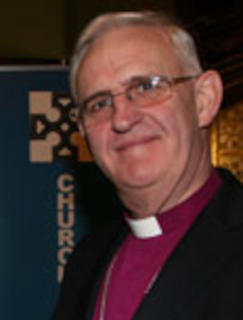
On August 29, 2002, the Church of Ireland announces that the Right Reverend John Neill, Bishop of Cashel and Ossory, is to succeed the Most Reverend Dr. Walton Empey as Archbishop of Dublin. The announcement is made at a meeting of the Church of Ireland Episcopal Electoral College in Christ Church Cathedral, Dublin.
Neill and his wife Betty have three sons, The Reverend Canon Stephen Neill, Rector of Celbridge, Andrew Neill, a member of Garda Síochána, and Peter Neill, a photographer.
Price and her sister, Marian, also an IRA member, are the daughters of Albert Price, a prominent Irish republican and former IRA member from Belfast. Their aunt, Bridie Dolan, is blinded and loses both hands in an accident while handling IRA explosives.
Price becomes involved in Irish republicanism in the late 1960s and she and Marian participate in the Belfast to Derrycivil rights march in January 1969 and are attacked in the Burntollet Bridge incident.
In 1971 Price and her sister join the Provisional Irish Republican Army (IRA). In 1972 she joins an elite group within the IRA called “The Unknowns” commanded by Pat McClure. The Unknowns are tasked with various secretive activities and transport several accused traitors across the border into the Republic of Ireland where they are “disappeared.” She personally states that she had driven Joe Lynskey across the border to face trial. In addition, she states that she, Pat McClure and a third Unknown were tasked with killing Jean McConville, with the third Unknown actually shooting her.
Price leads the car bombing attacks in London on March 8, 1973, which injure over 200 people and is believed to have contributed to the death of one person who suffers a fatal heart attack. The two sisters are arrested, along with Gerry Kelly, Hugh Feeney and six others, on the day of the bombing as they are boarding a flight to Ireland. They are tried and convicted at the Great Hall in Winchester Castle on November 14, 1973. Although originally sentenced to life imprisonment, which is to run concurrently for each criminal charge, their sentence is eventually reduced to 20 years. She serves seven years for her part in the bombing. She immediately goes on a hunger strike demanding to be moved to a prison in Northern Ireland. The hunger strike lasts for 208 days because the hunger strikers are force-fed by prison authorities to keep them alive.
On the back of the hunger-striking campaign, Price’s father contests Belfast West at the February 1974 United Kingdom general election, receiving 5,662 votes (11.9%). The Price sisters, Hugh Feeney, and Gerry Kelly are moved to Northern Ireland prisons in 1975 as a result of an IRA truce. In 1980 she receives the royal prerogative of mercy and is freed on humanitarian grounds in 1981, purportedly suffering from anorexia nervosa due to the invasive trauma of daily force feedings.
After her release in 1980, Price marries Irish actor Stephen Rea, with whom she has two sons, Danny and Oscar. They divorce in 2003.
The Price sisters remain active politically. In the late 1990s, Price and her sister claim that they have been threatened by their former colleagues in the IRA and Sinn Féin for publicly opposing the Good Friday Agreement (i.e. the cessation of the IRA’s military campaign). she is a contributor to The Blanket, an online journal, edited by former Provisional IRA member Anthony McIntyre, until it ceases publication in 2008.
In 2001, Price is arrested in Dublin and charged with possession of stolen prescription pads and forged prescriptions. She pleads guilty and is fined £200 and ordered to attend Alcoholics Anonymous meetings.
In February 2010, it is reported by The Irish News that Price had offered help to the Independent Commission for the Location of Victims’ Remains in locating graves of three men, Joe Lynskey, Seamus Wright, and Kevin McKee. The bodies of Wright and McKee are recovered from a singular grave in County Meath in August 2015. It is unclear if Price played a role in their recovery. The remains of Joe Lynskey have not been recovered as of April 2021.
Price is the subject of the 2018 feature-length documentary I, Dolours in which she gives an extensive filmed interview.
In 2010, Price claims Gerry Adams had been her officer commanding (OC) when she was active in the IRA. Adams, who has always denied being a member of the IRA, denies her allegation. She admits taking part in the murder of Jean McConville, as part of an IRA action in 1972. She claims the murder of McConville, a mother of ten, was ordered by Adams when he was an IRA leader in West Belfast. Adams subsequently publicly further denies Price’s allegations, stating that the reason for them is that she is opposed to the Provisional Irish Republican Army’s abandonment of paramilitary warfare in favour of politics in 1994, in the facilitation of which Adams has been a key figure.
Oral historians at Boston College interview both Price and her fellow IRA paramilitary Brendan Hughes between 2001 and 2006. The two give detailed interviews for the historical record of the activities in the IRA, which are recorded on condition that the content of the interviews is not to be released during their lifetimes. Prior to her death in May 2011, the Police Service of Northern Ireland (PSNI) subpoena the material, possibly as part of an investigation into the disappearance of a number of people in Northern Ireland during the 1970s. In June 2011, the college files a motion to quash the subpoena. A spokesman for the college states that “our position is that the premature release of the tapes could threaten the safety of the participants, the enterprise of oral history, and the ongoing peace and reconciliation process in Northern Ireland.” In June 2011, U.S. federal prosecutors ask a judge to require the college to release the tapes to comply with treaty obligations with the United Kingdom. On July 6, 2012, the United States Court of Appeals for the First Circuit agrees with the government’s position that the subpoena should stand. On October 17, 2012, the Supreme Court of the United States temporarily blocks the college from handing over the interview tapes. In April 2013, after Price’s death, the Supreme Court turns away an appeal that seeks to keep the interviews from being supplied to the PSNI. The order leaves in place a lower court ruling that orders Boston College to give the Justice Department portions of recorded interviews with Price. Federal officials want to forward the recordings to police investigating the murder of Jean McConville.
Price dies in her Malahide, County Dublin, home on January 23, 2013, from a toxic effect of mixing prescribed sedative and anti-depressant medication. Her body is found the following day. The inquest returns a verdict of death by misadventure. She is buried at Milltown Cemetery in West Belfast.
O’Brien is the youngest child of “a strict, religious family.” From 1941 to 1946 she is educated by the Sisters of Mercy, a circumstance that contributes to a “suffocating” childhood. “I rebelled against the coercive and stifling religion into which I was born and bred. It was very frightening and all pervasive. I’m glad it has gone.” She is fond of a nun as she deeply misses her mum and tries to identify the nun with her mother.
In 1950, O’Brien is awarded a licence as a pharmacist. In Ireland, she reads such writers as Leo Tolstoy, William Makepeace Thackeray, and F. Scott Fitzgerald. In 1954, she marries, against her parents’ wishes, the Irish writer Ernest Gébler and the couple moves to London. They have two sons, but the marriage is dissolved in 1964. Gébler dies in 1998.
In London, O’Brien purchases Introducing James Joyce, with an introduction written by T. S. Eliot. When she learns that James Joyce‘s A Portrait of the Artist as a Young Man is autobiographical, it makes her realise where she might turn, should she decide to write herself. In London she starts work as a reader for Hutchinson, where on the basis of her reports she is commissioned, for £50, to write a novel. Her first novel, The Country Girls (1960), is often credited with breaking silence on sexual matters and social issues during a repressive period in Ireland following World War II.
This novel is the first part of a trilogy of novels which includes The Lonely Girl (1962) and Girls in Their Married Bliss (1964). Shortly after their publication, these books are banned and, in some cases burned, in her native country due to their frank portrayals of the sex lives of their characters. Her novel A Pagan Place (1970) is about her repressive childhood. Her parents are vehemently against all things related to literature and her mother strongly disapproves of her daughter’s career as a writer.
O’Brien is a panel member for the first edition of the BBC‘s Question Time in 1979. In 2017, she becomes the sole surviving member.
Other works include a biography of James Joyce, published in 1999, and one of the poet Lord Byron, Byron in Love (2009). House of Splendid Isolation (1994), her novel about a terrorist who goes on the run, marks a new phase in her writing career. Down by the River (1996) concerns an under-age rape victim who seeks an abortion in England, the “Miss X case.” In the Forest (2002) deals with the real-life case of Brendan O’Donnell, who abducts and murders a woman, her three-year-old son, and a priest, in rural Ireland.
In 1918, a system called plural voting is in place in both Britain and Ireland. Plural voting is a practice whereby one person might be able to vote multiple times in an election. Property and business owners can vote both in the constituency where their property lay and that in which they live, if the two are different. In the newly formed Irish Free State this system is ended by the Electoral Act 1923 and is abolished in the United Kingdom by the Representation of the People Act 1948. Plural voting remains in effect in Northern Ireland until 1969.
Sinn Féin is founded by Arthur Griffith in 1905. He believes that Irish nationalists should emulate the Ausgleich of Hungarian nationalists who, in the 19th century under Ferenc Deák, had chosen to boycott the imperial parliament in Vienna and unilaterally establish their own legislature in Budapest.
Griffith initially favours a peaceful solution based on “dual monarchy” with Britain, that is two separate states with a single head of state and a limited central government to control matters of common concern only. However, by 1918, under its new leader, Éamon de Valera, Sinn Féin has come to favour achieving separation from Britain by means of an armed uprising if necessary and the establishment of an independent republic.
In the aftermath of the 1916 Easter Rising, the party’s ranks are swelled by participants and supporters of the rebellion as they are freed from British gaols and internment camps. At its 1917 Ardfheis (annual conference) de Valera is elected leader, and the new, more radical policy is adopted.
Prior to 1916, Sinn Féin had been a fringe movement having a limited cooperative alliance with William O’Brien‘s All-for-Ireland League and enjoyed little electoral success. However, between the Easter Rising of that year and the 1918 general election, the party’s popularity increases dramatically. This is due to the failure to have the Home Rule Bill implemented when the IPP resists the partition of Ireland demanded by Ulster Unionists in 1914, 1916 and 1917, but also popular antagonism towards the British authorities created by the execution of most of the leaders of the 1916 rebels and by their botched attempt to introduce Home Rule on the conclusion of the Irish Convention linked with military conscription in Ireland (see Conscription Crisis of 1918).
Sinn Féin demonstrates its new electoral capability in four by-election successes in 1917 in which George Noble Plunkett, Joseph McGuinness, de Valera and W. T. Cosgrave are each elected, although it loses three by-elections in early 1918 before winning two more with Patrick McCartan and Arthur Griffith. In one case there are unproven allegations of electoral fraud. The party benefits from a number of factors in the 1918 elections, including demographic changes and political factors.
Long first takes political office in 2001 when she is elected to Belfast City Council for the Victoria ward. In 2003, she is elected to the Northern Ireland Assembly for Belfast East, succeeding her fellow party member John Alderdice. In 2006, she is named deputy leader of her party. In the 2007 Northern Ireland Assembly election, she more than doubles the party’s vote in the constituency, being placed second ahead of the leader of the Ulster Unionist Party (UUP). The overall UUP vote, however, is 22%. At 18.8%, her vote share is higher than that for Alderdice in 1998.
On December 10, 2012, Long receives a number of death threats, and a petrol bomb is thrown inside an unmarked police car guarding her constituency office. This violence erupts as a reaction by Ulster loyalists to the decision by Alliance Party members of Belfast City Council to vote in favour of restricting the flying of the Union flag at Belfast City Hall to designated days throughout the year, which at the time constitutes 18 specific days.
In January 2016, Long announces that she will return as an Assembly candidate in the 2016 Northern Ireland Assembly election having been nominated in place of incumbent Judith Cochrane. She is subsequently elected on the first count with 14.7% of first-preference votes. Following her return to the Assembly, she assumes positions on the Committee for Communities, the All-Party Group on Fairtrade, the All-Party Group for Housing, and chairs the All-Party Group on Science, Technology, Engineering and Mathematics.
In August 2016, Long calls for Sinn Féin‘s Máirtín Ó Muilleoir to stand aside as Minister of Finance during an investigation of the Stormont Finance Committee’s handling of its Nama inquiry, while Ó Muilleoir is a committee member. This follows allegations that his party had “coached” loyalist blogger Jamie Bryson prior to his appearance before the committee.
In November 2016, Long criticises Sinn Féin and the DUP for delaying the publication of a working group report on abortion, which recommends legislative changes in cases of fatal foetal abnormality, calling on the Executive “to act without further delay to help women who decide to seek a termination in these very difficult circumstances.”
On October 26, 2016, Long is elected Alliance leader unopposed following the resignation of David Ford. In the first manifesto released under her leadership, she affirms her commitment to building a “united, open, liberal and progressive” society. Her party’s legislative priorities are revealed to include the harmonisation and strengthening of equality and anti-discrimination measures, the introduction of civil marriage equality, development of integrated education and a Northern Ireland framework to tackle climate change.
In the 2017 Northern Ireland Assembly election, Long tops the poll in Belfast East and is returned to the Assembly with 18.9% of first-preference votes. The election is widely viewed as a success for Alliance, with the party increasing its vote share by 2 percentage points and retaining all of its seats in a smaller Assembly. The party subsequently holds the balance of power at Stormont.
Following the collapse of talks to restore devolution in February 2018, Long reiterates her view that the pay of MLAs should be cut in the absence of a functioning Executive. In March 2018, Alliance launches its “Next Steps Forward” paper, outlining a number of proposals aimed at breaking the deadlock and Stormont. At the 2019 Alliance Party Conference, she accuses Secretary of State for Northern IrelandKaren Bradley of an “appalling dereliction of duty” over the ongoing stalemate, saying that she had made “no concerted effort to end this interminable drift despite it allegedly being her top priority.”
In the 2019 Northern Ireland local elections, Alliance sees a 65% rise in its representation on councils. Long hails the “incredible result” as a watershed moment for politics in Northern Ireland.
Long is elected to the European Parliament as a representative for Northern Ireland in May 2019 with 18.5% of first-preference votes, the best ever result for Alliance. She is subsequently replaced in the Assembly by Máire Hendron, a founding member of the party and former deputy lord mayor of Belfast. She then replaces Hendron in the Assembly with effect from January 9, 2020.
In 2019, Long becomes the first Northern Ireland politician to have served at every level of government.
On January 11, 2020, following the restoration of the Northern Ireland Assembly after three years of stalemate, Long is elected Minister of Justice in the Northern Ireland Executive. On January 28, she announces that she will progress new domestic abuse legislation through the Assembly which will make coercive control a criminal offence in Northern Ireland. In June 2020, she commissions a review into the support available for prison officers following concerns about absence rates. That same month, she announces her intention to introduce unexplained wealth orders in Northern Ireland to target paramilitary and criminal finances.
In November 2020, Long says she is seriously reconsidering her position within the Executive following the DUP’s deployment of a cross-community vote to prevent an extension of COVID-19 regulations. She tells BBC News, “I have asked people to desist from this abuse of power because it will make my position in the executive unsustainable.”
In March 2022, Long tells the Alliance Party Conference that “some politicians are addicted to crisis and conflict and simply not up to the job of actually governing.” Long leads Alliance into the 2022 Northern Ireland Assembly election on a platform of integrated education, health reform, a Green New Deal, tackling paramilitarism and reform of the Stormont institutions.
Long is a member of Bloomfield Presbyterian Church. Following the Church’s decision to exclude those in same-sex relationships from being full members, she expresses “great concern” and states that she “didn’t know” if she would remain a member herself. She is married to Michael Long, an Alliance councillor on Belfast City Council and former Lord Mayor of Belfast, and son of the engineer Professor Adrian Long. Long and her husband are the first husband and wife to have both served as Lord Mayors of Belfast.
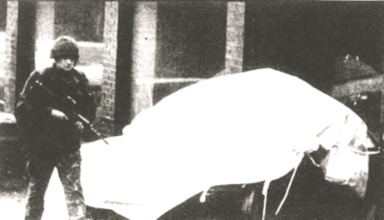
On December 12, 1993, a unit of the Provisional Irish Republican Army‘s (IRA) East Tyrone Brigade ambushes a two-men unmarked mobile patrol of the Royal Ulster Constabulary (RUC) in Fivemiletown, County Tyrone. Two constables, Andrew Beacom and Ernest Smith, are shot and killed instantly. A military helicopter is also fired at by a second IRA unit in the aftermath of the incident, during a follow-up operation launched in the surroundings of the town by both the British Army and the RUC. A number of suspects are questioned, but the perpetrators make good their escape. The action occurs just three days before the Downing Street Declaration.
Fivemiletown lays in the western edge of the Clogher Valley, near the border between County Fermanagh and County Tyrone. No deaths directly related with paramilitary activity has occurred there during the Troubles prior to the 1993 IRA shootings, though there are a number of incidents in the region in the previous months.
On May 7, 1992, members of the IRA South Fermanagh Brigade detonate a 1,000-pound bomb delivered by a tractor after crossing through a hedge outside the local RUC part-time barracks. The huge explosion leaves ten civilians wounded and causes widespread damage to the surrounding property. The security base itself is heavily damaged and the blast is heard 30 miles away. According to a later IRA statement, the destruction of the security base compels the British forces to organise their patrols from the nearby RUC barracks at Clogher, allowing the East Tyrone Brigade to study their pattern and carry out the 1993 ambush at Fivemiletown’s main street.
A secondary incident occurs some hours later, on May 9, when a British soldier kills his company’s sergeant major in a blue-on-blue shooting at the same place while taking part in a security detail around the wrecked facilities.
On January 20, 1993, the RUC base in Clogher is hit and severely damaged by a Mark-15 “barrack buster” mortar bomb launched by the IRA’s East Tyrone Brigade. A number of constables receive minor injuries.
Constable Andrew Beacom and Reserve Constable Ernest Smith are patrolling Fivemiletown’s Main Street in a civilian-type, unmarked Renault 21 on the early hours of December 12, 1993. Both men are part of the RUC Operational Support Unit, which surveils the border along with the British Army. The constables are based at Clogher RUC barracks.
The IRA reports that two active service units from the East Tyrone Brigade had taken up positions in the centre of Fivemiletown and identified the RUC unmarked vehicle before the ambush.
At 1:30 a.m., up to the junction of Main Street and Coneen Street, at least two IRA volunteers open fire from both sides of the road with automatic weapons, hitting the vehicle with more than 20 rounds. Beacom and Smith die on the spot. Constable Beacom lives in Fivemiletown, just a hundred metres from the site of the ambush, where his wife owns a restaurant. She is one of the first persons to arrive to the scene of the shooting. Smith resides with his family at Augher.
According to a colleague in the Operational Support Unit, himself a reserve constable deployed at Lisnaskea and a former Ulster Defence Regiment (UDR) soldier, their deaths “hit the unit very hard.” The men are appreciated for their in-depth knowledge of the area.
A “major” follow-up security operation is mounted between Fivemiletown and the border with the Republic of Ireland, supported by airborne troops and RUC reinforcements, in an attempt to block the attacker’s escape.
Approximately an hour after the ambush, an Army Air Corps (AAC) Westland Lynx helicopter comes upon a number of IRA volunteers in the searching area, just a few miles from the site of the shooting, but the aircraft becomes the target of automatic rifle fire and is forced to disengage. Though the helicopter is not hit, the assailants break contact successfully. The IRA East Tyrone Brigade report claims that the attack on the Westland Lynx is carried out by a second active service unit, which set up a firing position on the predicted path of the British helicopters carrying reinforcements into Fivemiletown after the initial shooting. A number of people are arrested and questioned about the killings, but the perpetrators manage to slip away.
The shootings are widely condemned. RUC Chief Constable Sir Hugh Annesley says that “At a time when the whole community is looking toward peace, the Provisional IRA has yet again shown they have absolutely nothing to offer but deaths and suffering.”
Presbyterian Moderator Rev. Andrew Rodgers calls on the governments to break any contact with Sinn Féin and other “men of blood in both sections of the community.”
A former IRA member cites instead the answer of an IRA volunteer in the area when questioned by him about the futility of the actions at Fivemiletown. He replies that “The war must go on.”
(Pictured: A photograph showing a British Army sentry guarding the scene of the IRA ambush on a Royal Ulster Constabulary mobile patrol, December 12, 1993)





 seamus dubhghaill