McCourt is born to Malachy McCourt, Sr., who falsely claims to have been in the Irish Republican Army (IRA) during the Irish War of Independence, and Irish Catholic mother Angela Sheehan from Limerick. In the midst of the Great Depression, the family moves back to Ireland. Unable to find steady work in Belfast or Dublin and beset by his father’s alcoholism, the family returns to their mother’s native Limerick, where they sink even deeper into poverty.
In October 1949, at the age of 19, McCourt leaves Ireland, taking a boat from Cork to New York City. In 1951, he is drafted during the Korean War and sent to Bavaria for two years initially training dogs, then as a clerk. Upon his discharge from the US Army, he returned to New York City, where he held a series of jobs on docks, in warehouses, and in banks. Using his G.I. Bill education benefits, he talks his way into New York University by claiming he is intelligent and reads a great deal. He is admitted on one year’s probation provided he maintains a B average. He graduates in 1957 from NYU with a bachelor’s degree in English.
A New York city schoolteacher for more than thirty years, McCourt achieves literary fame later in life with his best-selling childhood memoir of the misery and squalor of his childhood, Angela’s Ashes. With a first printing of just 25,000 copies, the book becomes an instant favourite with critics and readers and is perhaps the ultimate case of the non-celebrity memoir, the extraordinary life of an ordinary man.
McCourt is also the author of ‘Tis (1999), which continues the narrative of his life, picking up from the end of Angela’s Ashes and focusing on his life after returning to New York. He subsequently writes Teacher Man (2005) which details his teaching experiences and the challenges of being a teacher.
It is announced in May 2009 that McCourt has been treated for melanoma and that he is in remission, undergoing home chemotherapy. On July 19, 2009, he dies from the cancer, with meningeal complications, at a hospice in Manhattan, New York City.
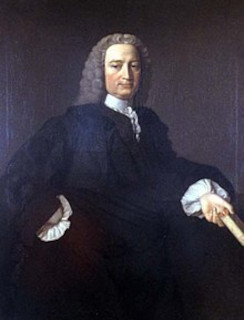
Francis Hutcheson, Scotch-Irishphilosopher and major exponent of the theory of the existence of a moral sense through which man can achieve right action, is born on August 8, 1694, in Saintfield, County Down, Ulster. He is remembered for his book A System of Moral Philosophy. He is an important influence on the works of several significant Enlightenment thinkers, including David Hume and Adam Smith.
Hutcheson is licensed as a preacher in 1719 by Irish Presbyterians in Ulster, but in 1738 the Glasgow presbytery challenges his belief that people can have a knowledge of good and evil without, and prior to, a knowledge of God. His standing as a popular preacher is undiminished, however, and the celebrated Scottish philosopher David Hume seeks his opinion of the rough draft of the section “Of Human Morals” in Hume’s A Treatise of Human Nature.
Hutcheson’s ethical theory is propounded in his Inquiry into the Original of Our Ideas of Beauty and Virtue (1725), in Essay on the Nature and Conduct of the Passions and Affections (1728) and Illustrations upon the Moral Sense (1728), and in the posthumous A System of Moral Philosophy (1755). In his view, besides his five external senses, man has a variety of internal senses, including a sense of beauty, of morality, of honour, and of the ridiculous. Of these, Hutcheson considers the moral sense to be the most important. He believes that it is implanted in man and pronounces instinctively and immediately on the character of actions and affections, approving those that are virtuous and disapproving those that are vicious. His moral criterion is whether or not an act tends to promote the general welfare of mankind. He thus anticipates the utilitarianism of the English thinker Jeremy Bentham, even to his use of the phrase “the greatest happiness for the greatest number.” Hutcheson is also influential as a logician and theorist of human knowledge.
Hutcheson spends time in Dublin and dies while on a visit to the city on August 8, 1746, his fifty-second birthday. He is buried in the churchyard of Saint Mary’s, which is also the final resting place of his cousin William Bruce. Today Saint Mary’s is a public park located in what is now Wolfe Tone Street. He lies in what is now an unmarked grave in the Dublin he loved and where his best work was done.
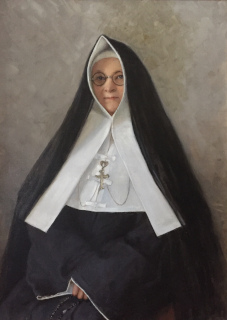
Butler is the seventh child of John Butler, gentleman farmer, and Ellen (née Forrestal). She attends the Sisters of Mercy school in New Ross, County Wexford, entering the Congregation of the Sacred Heart of Mary in Béziers, France in 1876. She takes the name Marie Joseph when she is sent to Porto, Portugal in 1879, professing in 1880. From 1880 to 1903 she teaches in Porto and Braga, becoming superior of the school in 1893.
In 1903 Butler is appointed head of the congregation’s school at Sag Harbor, Long Island, New York, with the responsibility to extend the influence of the order in there. Her cousin, James Butler, gives her a site in Tarrytown, New York in 1907 where she founds the first Marymount school that year, and then the first Marymount college in 1918. She acts as president of the college, with the institution being granted a charter from the University of the State of New York to award bachelor’s degrees in 1924. She is elected Mother General of her order in 1926 and serves until her death, being the first American superior elected to the international congregation of the Catholic Church. She introduces a unique educational system incorporating high religious and academic standards with the aim of preparing young women for a changing society. She becomes a citizen of the United States in 1927.
Under her influence, the order founds fourteen schools, including a novitiate in New York, three Marymount schools and three colleges, and 23 foundations internationally with Marymount schools in Rome, Paris, and Quebec, and a novitiate in Ferrybank, Waterford, County Waterford.
Butler dies on April 23, 1940, in Tarrytown and is buried there. In 1954 her spiritual writings are published as As an eagle: the spiritual writings of Mother Butler R.S.H.M. by J.K. Leahy. She is put forward as a candidate for canonisation in 1948.
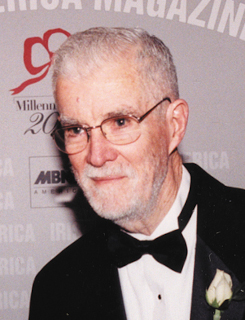
Born John Thomas McKiernan in New York City on May 10, 1915, McKiernan adopts the old Irish form of his name, Eoin, early in his life. While in college, he wins a scholarship to study Irish language in the ConnemaraGaeltacht in the west of Ireland. In 1938, he marries Jeannette O’Callaghan, whom he met while studying Irish at the Gaelic Society in New York City. They raise nine children.
Passion for Irish culture is the dominant undercurrent of a distinguished teaching career in secondary (Pittsfield, NH, 1947–49) and university levels (State University of New York at Geneseo, 1949–59, and University of St. Thomas in Saint Paul, MN, 1959–72). McKiernan serves as an officer of the National Council of College Teachers of English, is appointed by the Governor of New York to a State Advisory Committee to improve teacher certification standards and serves as a Consultant to the U.S. Department of Education in the early 1960s.
McKiernan suggests to the Irish government in 1938 that a cultural presence in the United States would promote a deeper understanding between the two countries, but he eventually realises that if this is to happen, he will have to lead the way. His opportunity comes in 1962, when he is asked to present a series on public television. Entitled “Ireland Rediscovered,” the series is so popular that another, longer series, “Irish Diary,” is commissioned. Both series air nationwide. The enthusiastic response provides the impetus to establish the Irish American Cultural Institute (IACI) in 1962. In 1972 he resigns from teaching to devote his energy entirely to the IACI.
Under McKiernan’s direction, the IACI publishes the scholarly journal Eire-Ireland, with subscribers in 25 countries, and the informational bi-monthly publication Ducas. The IACI still sponsors the Irish Way (an immersion program for U.S. teenagers), several speaker series, a reforestation program in Ireland (Trees for Ireland), theatre events in both countries and educational tours in Ireland. He continues these educational Ireland tours well into his retirement. At his suggestion, the Institute finances the world premiere of A. J. Potter‘s Symphony No. 2 in Springfield, Massachusetts.
Troubled by the biased reporting of events in Northern Ireland in the 1970s, McKiernan establishes an Irish News Service, giving Irish media and public figures direct access to American outlets. In the 1990s, he is invited by the Ditchley Foundation to be part of discussions aimed at bringing peace to that troubled area and is a participant in a three-day 1992 conference in London dealing with civil rights in Northern Ireland. Organized by Liberty, a London civil rights group, the conference is also attended by United Nations, European Economic Community, and Helsinki representatives.
McKiernan also founds Irish Books and Media, which is for forty years the largest distributor of Irish printed materials in the United States. In his eighth decade, he establishes Irish Educational Services, which funds children’s TV programs in Irish and provided monies for Irish language schools in Northern Ireland. Irish America magazine twice names him one of the Irish Americans of the year. In 1999, they choose him as one of the greatest Irish Americans of the 20th century.
McKiernan dies on July 18, 2004, in Saint Paul, Minnesota. On his death, The Irish Times refers to him as the “U.S. Champion of Irish culture and history . . . a patriarch of Irish Studies in the U.S. who laid the ground for the explosion of interest in Irish arts in recent years.”
De Paor is born Máire MacDermott to Eamonn MacDermott and Delia MacVeigh. She is educated in the Convent of Mercy in Buncrana before going to University College Dublin, where she completes a master’s degree and a doctorate on early Christian archaeology and metalwork.
De Paor works in the Department of Archeology at UCD from 1946 to 1958. She marries Liam de Paor in 1946, and they have a daughter and four boys. They collaborate on a number of publications. She publishes her papers in the Proceedings of the Royal Irish Academy, Archaeologia, Seanchas Armagh and Comhar. Her husband also works at the university and, as a result of policies about married women, she is forced to leave. Initially she lectures in the United States, Canada, Scandinavia, France and the United Kingdom. She works as lecturer in archaeology at Trinity College, Dublin. The de Paors spend a year in Nepal on a UNESCO project in 1963.
De Paor works as a freelance researcher for Raidió Teilifís Éireann until she is given a full-time position in the 1970s.
De Paor is elected a member of the Royal Irish Academy in 1960 and is a member of the Arts Council from 1973. She becomes a member of Conradh na Gaeilge from 1962. From 1968 she is working with Cumann Merriman, the Irish cultural organisation named after Brian Merriman, working with the group as a director of the schools and spends four years as chairperson. In 1992 she is appointed to the board of Amharclann de hÍde.
Máire de Paor dies on December 6, 1994, at the age of 69.
University College Dublin has created the Dr. Máire de Paor Award for best PhD thesis. Her biographer identifies her as a committed republican, socialist and feminist.
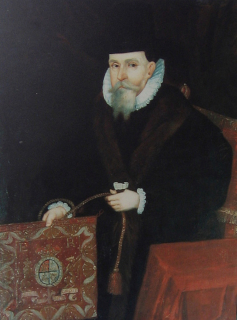
Loftus is born in 1533, the second son of a monastic bailiff, Edward Loftus, in the heart of the English Yorkshire Dales. He embraces the Protestant faith early in his development. He is an undergraduate at Trinity College, Cambridge, where he reportedly attracts the notice of the young Queen Elizabeth, as much by his physique as through the power of his intellect. Although this encounter may never have happened, Loftus certainly meets with the Queen more than once, and she becomes his patron for the rest of her reign. At Cambridge Loftus takes holy orders as a Catholic priest and is appointed rector of Outwell St. Clement in Norfolk. He comes to the attention of the Catholic Queen Mary, who names him vicar of Gedney, Lincolnshire. On Elizabeth’s accession in 1558 he declares himself Anglican.
Loftus makes the acquaintance of the Queen’s favourite Thomas Radclyffe, 3rd Earl of Sussex and serves as his chaplain in Ireland in 1560. In 1561 he becomes chaplain to Alexander Craike, Bishop of Kildare and Dean of St. Patrick’s Cathedral in Dublin. Later that year he is appointed rector of Painstown in Meath and evidently earns a reputation as a learned and discreet advisor to the English authorities in Dublin. In 1563, he is consecrated Archbishop of Armagh at the unprecedented age of 28 by Hugh Curwen, Archbishop of Dublin.
Following a clash with Shane O’Neill, the real power in Ulster during these years, he comes to Dublin in 1564. To supplement the meager income of his troubled archbishopric he is temporarily appointed to the Deanery of St. Patrick’s Cathedral by the queen in the following year. He is also appointed president of the new commission for ecclesiastical causes. This leads to a serious quarrel with the highly respected Bishop of Meath, Hugh Brady.
In 1567 Loftus, having lobbied successfully for the removal of Hugh Curwen, who becomes Bishop of Oxford, and having defeated the rival claims of the Bishop of Meath, is appointed Archbishop of Dublin, where the queen expects him to carry out reforms in the Church. On several occasions he temporarily carries out the functions of Lord Keeper of the Great Seal, and in August 1581 he is appointed Lord Chancellor of Ireland after an involved dispute with Nicholas White, Master of the Rolls in Ireland. He is constantly occupied in attempts to improve his financial position by obtaining additional preferment and is subject to repeated accusations of corruption in public office.
In 1582 Loftus acquires land and builds a castle at Rathfarnham, which he inhabits from 1585. In 1569–1570 the divisions in Irish politics take on a religious tinge with the First Desmond Rebellion in Munster and Pope Pius V‘s 1570 papal bullRegnans in Excelsis. The bull questions Elizabeth’s authority and thereafter Roman Catholics are suspected of disloyalty by the official class unless they are discreet.
Loftus takes a leading part in the execution of Dermot O’Hurley, Archbishop of Cashel. When O’Hurley refuses to give information, Francis Walsingham suggests he should be tortured. Although the Irish judges repeatedly decide that there is no case against O’Hurley, on June 19, 1584, Loftus and Sir Henry Wallop write to Walsingham “We gave warrant to the knight-marshal to do execution upon him, which accordingly was performed, and thereby the realm rid of a most pestilent member.”
Between 1584 and 1591 Loftus has a series of clashes with Sir John Perrot on the location of an Irish University. Perrot wants to use St. Patrick’s Cathedral, Dublin as the site of the new University, which Loftus seeks to preserve as the principal place of Protestant worship in Dublin, as well as a valuable source of income for himself. The archbishop wins the argument with the help of his patron, Queen Elizabeth I, and Trinity College, Dublin is founded at its current location, named after his old college at Cambridge, leaving the Cathedral unaffected. Loftus is named as its first Provost in 1593.
The issue of religious and political rivalry continues during the two Desmond Rebellions (1569–83) and the Nine Years’ War (1594–1603), both of which overlap with the Anglo-Spanish War (1585–1604), during which some rebellious Irish nobles are helped by the Papacy and by Elizabeth’s arch-enemy Philip II of Spain. Due to the unsettled state of the country Protestantism makes little progress, unlike in Celtic Scotland and Wales at that time. It comes to be associated with military conquest and is therefore hated by many. The political-religious overlap is personified by Loftus, who serves as Archbishop and as Lord Chancellor of Ireland. An unlikely alliance forms between Gaelic Irish families and the Norman “Old English“, who had been enemies for centuries but who now mostly remain Roman Catholic.
Adam Loftus dies in Dublin on April 5, 1605, and is interred in the building he had helped to preserve for future generations, while many of his portraits hang today within the walls of the University which he helped found. Having buried his wife Jane (Purdon) and two sons (of their 20 children) in the family vault at St. Patrick’s, Loftus dies at his Episcopal Palace in Kevin Street “worn out with age” and joins his family in the same vault. His zeal and efficiency are commended by James I upon the king’s accession.
McCarrison is credited with being the first to experimentally demonstrate the effect of deficient dietaries upon animal tissues and organs. He also carries out human experiments aimed at identifying the cause of goitre, and includes himself as one of the experimental subjects. Much of his work is pioneering. His 1921 book Studies in Deficiency Disease is considered notable at the time, being published at a time when knowledge of vitamins and their role in nutrition is crystallizing.
McCarrison qualifies in Medicine at Queen’s College, Belfast in 1900. At age 23, he goes to India, where he spends 30 years on nutritional problems. His research in India on the cause of goitre wins widespread recognition and in 1913 he is promoted to do research. He attains the rank of major-general in the Indian Medical Service and founds the Nutritional Research Laboratories in Coonoor, where he remains until his retirement from the Indian Medical Service in 1935. After retiring, he returns to England and gives a series of three Cantor lectures on successive Mondays at the Royal Society of Arts, about the influence of diet on health. The first lecture focuses on the processes of nutrition; the second, on food essentials and their relationship to bodily structure and function; the third on disease prevention and physique improvement by attention to diet. The lectures are subsequently published in book form under the title Nutrition and Health, and at the time of the third edition in 1962, are still seen as relevant, with the advances of the preceding 25 years largely filling the details of the principles previously recognised by McCarrison.
Bryant’s father is Rev. Dr. William Willock DD, Fellow and Tutor of Trinity College, Dublin. She is educated at home, largely by her father. As a teenager she moves to London when her father is appointed Professor of Geometry at the University of London in 1863, and she attends Bedford College. At the age of nineteen she marries Dr. William Hicks Bryant, a surgeon ten years her senior, who dies of cirrhosis within a year.
In 1875 Bryant becomes a teacher and is invited by Frances Mary Buss to join the staff of North London Collegiate School. In 1895 she succeeds Buss as headmistress of North London Collegiate, serving until 1918.
When the University of London opens its degree courses to women in 1878, Bryant becomes one of the first women to obtain First Class Honours, in Mental and Moral Sciences, together with a degree in mathematics in 1881, and three years later is awarded the degree of Doctor of Science. In 1882 she is the third woman to be elected to the London Mathematical Society and is the first active female member, publishing her first paper with the Society in 1884. Together with Charles Smith, Bryant edits three volumes of Euclid‘s Elements, for the use of schools (Euclid’s Elements of Geometry, books I and II (1897); Euclid’s Elements of Geometry, books III and IV (1899); Euclid’s Elements of Geometry, books VI and IX (1901)).
Bryant is a pioneer in education for women. She is the first woman to receive a Doctor of Science in England, one of the first three women to be appointed to a Royal Commission, the Bryce commission on Secondary Education in 1894–1895, and one of the first three women to be appointed to the Senate of the University of London. When Trinity College Dublin opens its degrees to women, she is one of the first to be awarded an honorary doctorate. She is also instrumental in setting up the Cambridge Training College for Women, now Hughes Hall, Cambridge. She is also said to be one of the first women to own a bicycle.
Bryant is interested in Irish politics, writes books on Irish history and ancient Irish law (Celtic Ireland (1889), The Genius of the Gael (1913)), and is an ardent ProtestantIrish nationalist. She is president of the Irish National Literary Society in 1914. She supports women’s suffrage but advocates postponement until women were better educated.
Bryant loves physical activity and the outdoors. She rows, cycles, swims, and twice climbs the Matterhorn. She dies at the age of 72 in a hiking accident in the Alps near Chamonix, France on August 14, 1922.
Samuel Haughton, scientist, mathematician, and doctor, is born in Carlow, County Carlow on December 21, 1821. He is “famous” for calculating the drop required to kill a hanged man instantly.
Haughton has a distinguished career at Trinity College, Dublin and in 1844 he is elected a fellow. Working on mathematical models under James MacCullagh, he is awarded in 1848 the Cunningham Medal by the Royal Irish Academy. In 1847 he has his ordination to the priesthood, but he is not someone who preaches. He is appointed as professor of geology at Trinity College in 1851 and holds the position for thirty years. He begins to study medicine in 1859. He earns his MD degree in 1862 from the University of Dublin.
Haughton becomes registrar of the Medical School. He focuses on improving the status of the school and representing the university on the General Medical Council from 1878 to 1896. In 1858 he is elected fellow of the Royal Society. He gains honorary degrees from Oxford, Cambridge and Edinburgh. At Trinity College Dublin he moves the first-ever motion at the Academic Council to admit women to the University on March 10, 1880. Through his work as Professor of Geology and his involvement with the Royal Zoological Society, he has witnessed the enthusiasm and contribution of women in the natural sciences. Although thwarted by opponents on the Council he continues to campaign for the admission of women to TCD until his death in 1897. It is 1902 before his motion is finally passed, five years after his death.
In 1866, Haughton develops the original equations for hanging as a humane method of execution, whereby the neck is broken at the time of the drop, so that the condemned person does not slowly strangle to death. “On hanging considered from a Mechanical and Physiological point of view” is published in the London, Edinburgh, and Dublin Philosophical Magazine and Journal of Science, Vol. 32 No. 213 (July 1866), calling for a drop energy of 2,240 ft-lbs. From 1886 to 1888, he serves as a member of the Capital Sentences Committee, the report of which suggests an Official Table of Drops based on 1,260 ft-lbs. of energy.
Haughton is president of the Royal Irish Academy from 1886 to 1891, and secretary of the Royal Zoological Society of Ireland for twenty years. In 1880 he gives the Croonian Lecture on animal mechanics to the Royal Society.
Haughton is also involved in the Dublin and Kingstown Railway company, in which he looks after the building of the first locomotives. It is the first railway company in the world to build its own locomotives.
Samuel Haughton dies on October 31, 1897, and is buried in the Church of the Holy Cross Cemetery in Killeshin, County Laois.
Hayes is first elected to Dáil Éireann as a Sinn Féin TD for the National University of Ireland constituency at the 1921 Irish elections. At the 1922 general election he is elected as a Pro-Treaty Sinn Féin TD. He serves as Minister for Education from January to September 1922, as part of the Dail Aireacht ministry as opposed to the Provisional Government. He has special responsibility for secondary education. He is also acting Minister for Foreign Affairs from August to September 1922. He supports the Anglo-Irish Treaty during the crucial debates in 1922. That same year he is elected Ceann Comhairle of the First Dáil of the Irish Free State. He holds that post for ten years until 1932.
Hayes loses his Dáil seat at the 1933 general election but is elected to Seanad Éireann in 1938 for Fine Gael. He remains a Senator until 1965, acting as leader of government and opposition there.
Hayes becomes Professor of Irish at University College Dublin in 1951.
Michael Hayes dies at the age of 86 on July 11, 1976, in Dublin.





 seamus dubhghaill