seamus dubhghaill

Promoting Irish Culture and History from Little Rock, Arkansas, USA


Leave a comment

The Dromcollogher Burning

drumcollogher-cinema-fire

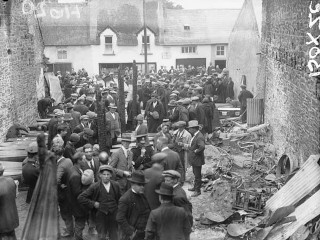
Forty-eight people die when a fire breaks out in a make-shift cinema on the upper floor of the village hall in Dromcollagher, County Limerick, on September 5, 1926.

The conversion of village halls into makeshift cinemas is a common practice in many rural villages in Ireland, right up to the 1940s. Prints are often borrowed from cinemas in larger towns or in Cork city and then bicycled over to smaller venues (sometimes surreptitiously).

During the Irish Free State period (1922-1937), the exhibition of films is still governed by legislation put in place by the British government in 1909. The Cinematograph Act 1909 stipulates that cinema owners must apply for a license to screen films, and that venues must observe strict safety standards. Such standards include encasing projectors in fireproof booths, ensuring that the highly unstable nitrate film, then the industry standard, be properly stored and handled, and fitting out venues with several fire exits. The regulations are generally observed by established cinemas, but they are often ignored by operators of ad hoc venues/makeshift conversions.

The consequences of such indifference to patron safety are tragically realized in the small town of Dromcollogher in West Limerick in 1926. Situated a few miles from the County Cork border, its population is around 500 at the time, hardly enough to sustain a full-time cinema. However, local hackney driver, William Forde, identifies a business opportunity that seems too good to pass up. Through a contact, Patrick Downey, who works as a projectionist in Cork city’s Assembly Rooms cinema, he arranges for a print of Cecil B. DeMille’s Biblical epic The Ten Commandments to be bicycled over for an unofficial one-off screening.

Forde rents the upstairs room of a venue on Church Street, later described by the Leinster Express as a wooden two-story structure and advertises his evening’s entertainment. He finds a readymade audience among the churchgoers that come out of the service in the adjacent Catholic Church and straight into the hall, many with their rosary beads still entwined in their hands. It is estimated that 150 people crowd into the room and ascend the ladder to the upstairs room. Though Forde has been informed by one local Garda that he cannot run a screening unless the venue is equipped with fire blankets and exits, he and Downey disregard the advice and, in a bid to reduce the weight for the cyclist bringing the reels from Cork, instruct that the fireproof metal cases be left behind in the city.

A generator hooked up to a lorry is used to power the borrowed projector, and candles to illuminate the makeshift box-office. It is one of those candles, placed in close proximity to an exposed film reel, which sparks off a series of small fires that quickly developed into an inferno. Some of those seated closest to the main exit manage to escape, but those nearer the screen find themselves trapped and iron bars that had been placed on the few windows in the hall windows seal their fate. Whole families are wiped out and the final death toll comes to 48. As newspapers of the time report, 1/10th of the town’s population is lost.

Newspapers around the world carry reports of the tragedy and a relief fund is set up for the survivors with Hollywood star Will Rogers being one of the contributors. President of the Executive Council of the Irish Free State William T. Cosgrave later travels to the town to attend the mass funeral service held for the victims.

As for Forde and Downey, they are later charged with manslaughter, but the State chooses not to pursue the prosecutions. Forde apparently later immigrates to Australia and possibly accidentally poisons himself, and two others, while working as a cook in the Outback.

The “Dromcollogher Burning”, as it becomes known, holds the dubious honour of Ireland’s worst cinema fire. Sadly, it is not the last time safety regulations are disregarded in an entertainment venue: 75 years later the devastating Stardust Nightclub fire in Dublin also claims the lives of 48 patrons.

(From: “The Dromcollogher Cinema Fire,” http://www.corkmoviememories.com | Image Source: National Library of Ireland)


Leave a comment

Birth of John Rocha, Hong Kong Born Fashion Designer

john-rocha

John Rocha, fashion designer of Chinese and Portuguese (Macanese) descent, is born in Hong Kong on August 23, 1953. He has been based mainly in Dublin since the late 1970s.

Rocha moves to Ireland after graduating from the Croydon School of Art, London. Known for his hand-crafting, beading and appliqué to garments, he first establishes a name for himself with his Chinatown label in Dublin in the 1980s and later designing clothing for both men and women in the Irish high street stores A Wear and their luxury stores Brown Thomas. He designs a range of cut crystal stemware and vases for Waterford Crystal in collaboration with glass designer Marcus Notley, until that firm’s closure in 2008. The brand relaunches in 2010 and Rocha’s crystal product ranges become available again.

By 1993, Rocha is named Designer of the Year at the British Fashion Awards. He runs his own “John Rocha,” “John Rocha Jeans,” “Rocha John Rocha” and “John Rocha Jewellery” labels alongside a diffusion clothing, homeware and accessories label for the department store Debenhams. He also designs the interiors of the Morrison Hotel in Dublin and the Orion Building in Birmingham. He is awarded the ‘Special Award’ at the Ernst & Young Irish Entrepreneur of the Year Awards 2008 which takes place in the City West Hotel in Dublin on October 23, 2008.

Rocha continues to produce a ‘pret-a-porter’ womenswear and menswear range which he showcases twice annually at the British Fashion Council sponsored London Fashion Week (February & September). His John Rocha lifestyle boutique opens on Dover Street, London, in 2006. His design business, operating as Three Moon Design, is located at Dublin’s Ely Place with a turnover of €200 million per year.

In 2014 Rocha showcases another Spring/Summer collection at London Fashion Week and announces his retirement from the event, stating, “At this point in my life I want to live by my calendar and not the Fashion Week calendar. Stopping allows me to do that.”

Rocha is made a Commander of the Order of the British Empire (CBE) in 2002 for his contributions to the British fashion industry. In April 2015 he is awarded the Outstanding Achievement in Art & Design at The Asian Awards.

In 2010 Rocha is one of six contemporary, internationally renowned Irish fashion designers featured on a set of Irish postage stamps issued by An Post. The other designers featured are Paul Costelloe, Louise Kennedy, Lainey Keogh, Philip Treacy and Orla Kiely.

Rocha resides in Dublin with his wife. The Rocha family keep a second home in Saint-Jean-Cap-Ferrat in southern France. His daughter, Simone Rocha, is also a successful designer.


Leave a comment

Death of Professional Footballer Johnny Carey

john-joseph-carey

John Joseph “Johnny” Carey, professional footballer, manager and one of Manchester United F.C.’s great captains, dies in Macclesfield, Cheshire, England on August 22, 1995.

Carey is born in Dublin on February 23, 1919. As a schoolboy, he plays football for Home Farm F.C. As a youth, he also plays Gaelic football and is selected to represent Dublin GAA at minor level before he signs for St. James’s Gate F.C. at the start of the 1936–1937 season.

After just two months of League of Ireland football, he is spotted by Billy Behan, a Dublin-based Manchester United scout. In November 1936 United signs him for a then League of Ireland record fee of £250. He makes his debut as an inside left for United on September 23, 1937, against Southampton F.C. During his first season with United, Carey, together with Harry Baird, Jack Rowley, Tommy Bamford, Tommy Breen and Stan Pearson, help United gain promotion to the First Division.

As a player Carey spends most of his career with Manchester United, where he is team captain from 1946 until he retires as a player in 1953. He also plays as a guest for several other clubs including Cardiff City F.C., Manchester City F.C., Everton F.C., Liverpool F.C. and Middlesbrough F.C.

Carey is also a dual internationalist, playing for and captaining both Ireland teams – the FAI XI and the IFA XI. In 1947 he also captains a Europe XI which plays a Great Britain XI at Hampden Park. In 1949 he is voted the Football Writers’ Association Footballer of the Year and in the same year captains the FAI XI that defeats England 2–0 at Goodison Park, becoming the first non-UK team to beat England at home.

Carey is also the first non-UK player and the first Irishman to captain a winning team in both an FA Cup Final and the First Division. Like his contemporary Con Martin, he is an extremely versatile footballer and plays in nine different positions throughout his career. He even plays in goal for United on one occasion.

(Pictured: Manchester United captain Johnny Carey is carried on the shoulders of his teammates, after they win the FA Cup final of 1948 against Blackpool. Date: April 24, 1948)


Leave a comment

Birth of Frank McCourt, Teacher & Writer

frank-mccourt

Francis “Frank” McCourt, Irish American teacher and writer, is born in New York City‘s Brooklyn borough on August 19, 1930.

McCourt is born to Malachy McCourt, Sr., who falsely claims to have been in the Irish Republican Army (IRA) during the Irish War of Independence, and Irish Catholic mother Angela Sheehan from Limerick. In the midst of the Great Depression, the family moves back to Ireland. Unable to find steady work in Belfast or Dublin and beset by his father’s alcoholism, the family returns to their mother’s native Limerick, where they sink even deeper into poverty.

In October 1949, at the age of 19, McCourt leaves Ireland, taking a boat from Cork to New York City. In 1951, he is drafted during the Korean War and sent to Bavaria for two years initially training dogs, then as a clerk. Upon his discharge from the US Army, he returned to New York City, where he held a series of jobs on docks, in warehouses, and in banks. Using his G.I. Bill education benefits, he talks his way into New York University by claiming he is intelligent and reads a great deal. He is admitted on one year’s probation provided he maintains a B average. He graduates in 1957 from NYU with a bachelor’s degree in English.

A New York city schoolteacher for more than thirty years, McCourt achieves literary fame later in life with his best-selling childhood memoir of the misery and squalor of his childhood, Angela’s Ashes. With a first printing of just 25,000 copies, the book becomes an instant favourite with critics and readers and is perhaps the ultimate case of the non-celebrity memoir, the extraordinary life of an ordinary man.

McCourt wins the annual Pulitzer Prize for Biography or Autobiography in 1997 and one of the annual National Book Critics Circle Awards for the book, which is eventually published in 25 languages and 30 countries. It is a bestseller and makes him a millionaire. Three years later, a movie version of Angela’s Ashes opens to mixed reviews with Northern Irish actor Michael Legge playing McCourt as a teenager.

McCourt is also the author of ‘Tis (1999), which continues the narrative of his life, picking up from the end of Angela’s Ashes and focusing on his life after returning to New York. He subsequently writes Teacher Man (2005) which details his teaching experiences and the challenges of being a teacher.

McCourt writes the book for a 1997 musical entitled The Irish…and How They Got That Way, which features an eclectic mix of Irish music – everything from the traditional Danny Boy to U2‘s I Still Haven’t Found What I’m Looking For.

It is announced in May 2009 that McCourt has been treated for melanoma and that he is in remission, undergoing home chemotherapy. On July 19, 2009, he dies from the cancer, with meningeal complications, at a hospice in Manhattan, New York City.


Leave a comment

Death of Irish Artist Sarah Henrietta Purser

sarah-purser-by-john-butler-yeats

Sarah Henrietta Purser, Irish artist mainly noted for her work with stained glass, dies in Dublin on August 7, 1943.

The Purser family had come to Ireland from Gloucestershire in the eighteenth century. Purser is born in Kingstown (now Dún Laoghaire) in County Dublin on March 22, 1848. She is raised in Dungarvan, County Waterford, one of the numerous children of Benjamin Purser, a prosperous flour miller and brewer, and his wife Anne Mallet. She is related to Sir Frederic William Burton, RHA (1816-1900), who is a son of Hannah Mallet. Two of her brothers, John and Louis, become professors at Trinity College Dublin. Her niece Olive Purser, daughter of her brother Alfred, is the first woman scholar at Trinity.

At thirteen Purser attends the Moravian school, Institution Evangélique de Montmirail, Switzerland where she learns to speak fluent French and begins painting. In 1873 her father’s business fails and she decides to become a full-time painter. She attends classes at the Dublin Metropolitan School of Art and joins the Dublin Sketching Club, where she is later appointed an honorary member. In 1874 she distinguishes herself in the National Competition. In 1878 she again contributes to the Royal Hibernian Academy, and for the next fifty years becomes a regular exhibitor, mainly portraits, and shows an average of three works per show.

In 1878-1879, Purser studies at the Académie Julian in Paris where she meets the German painter Louise Catherine Breslau, with whom she becomes a lifelong friend.

Purser becomes wealthy through astute investments, particularly in Guinness, for which several of her male relatives have worked over the years. She is very active in the art world in Dublin and is involved in the setting up of the Municipal Gallery of Modern Art, persuading the Irish government to provide Charlemont House in Parnell Square to house the gallery.

Purser works mostly as a portraitist. Through her talent and energy and owing to her friendship with the Gore-Booths, she is very successful in obtaining commissions. When the Lord Lieutenant of Ireland commissions her to portray his children in 1888, his choice reflects her position as the country’s foremost portraitist. Various portraits painted by Purser are held in the National Gallery of Ireland.

Purser finances An Túr Gloine (The Tower of Glass), a stained-glass cooperative, at 24 Upper Pembroke and runs it from its inauguration in 1903 until her retirement in 1940. Michael Healy is the first of a number of distinguished recruits, such as Catherine O’Brien, Evie Hone, Wilhelmina Geddes, Beatrice Elvery and Ethel Rhind. She is determined the stained-glass workshop should adhere to true Arts and Crafts philosophy. An Túr Gloine archive is held in the Centre for the Study of Irish Art, National Gallery of Ireland.

Purser does not produce many items of stained glass herself. Most of the stained-glass works are painted by other members of the co-operative, presumably under her direction. Two early works are St. Ita (1904) for St. Brendan’s Cathedral, Loughrea and The Good Shepard (1904) for St. Columba’s College, Dublin. Her last stained-glass work is believed to be The Good Shepard and the Good Samaritan (1926) for the Church of Ireland at Killucan, County Westmeath.

Until her death Purser lives for many years in Mespil House, a Georgian mansion with beautiful plaster ceilings on Mespil Road, on the banks of the Grand Canal. Here she is “at home” every Tuesday afternoon to Dublin’s writers and artists. Her afternoon parties are a fixture of Dublin literary life.

Purser dies in Dublin on August 7, 1943, and is buried in Mount Jerome Cemetery beside her brothers John and Louis. Mespil House is demolished after her death and developed into apartments.

Purser is the second woman to sit on the Board of Governors and Guardians, National Gallery of Ireland, 1914-1943. She is made an Honorary Member of the Royal Hibernian Academy in 1890, becoming the first female Associate Member in 1923 and the first female Member in 1924. Also, in 1924 she initiates the movement for the launching of the Friends of the National Collection of Ireland. Archives relating to Sarah Purser are housed in the Centre for the Study of Irish Art, National Gallery of Ireland.

(Pictured: Portrait of Sarah Purser by John Butler Yeats, c. 1880–1885)


Leave a comment

Death of John Dillon, Irish Parliamentary Party Leader

john-dillon

John Dillon, a Member of Parliament (MP) for over 35 years and the last leader of the Irish Parliamentary Party in the struggle to secure Home Rule by parliamentary means, dies in a London nursing home on August 4, 1927. Through the 1880s he is perhaps the most important ally of the greatest 19th-century Irish nationalist, Charles Stewart Parnell, but, following Parnell’s involvement as co-respondent in a divorce case, he repudiates Parnell for reasons of political prudence.

Dillon is born in Blackrock, Dublin, a son of the former “Young IrelanderJohn Blake Dillon (1814–1866). Following the premature death of both his parents, he is partly raised by his father’s niece, Anne Deane. He is educated at Catholic University School, at Trinity College, Dublin and at the Catholic University of Leuven in Belgium. He afterwards studies medicine at the Royal College of Surgeons in Dublin, then ceases active involvement in medicine after he joins Isaac Butt‘s Home Rule League in 1873

Dillon is a member of the British House of Commons during 1880–1883 and 1885–1918. For his vigorous work in the Irish National Land League, which seeks fixed tenure, fair rents, and free sale of Irish land, he is imprisoned twice between May 1881 and May 1882. He is Parnell’s fellow inmate in Kilmainham Gaol in Dublin from October 1881. For six months in 1888 he is imprisoned for aiding William O’Brien, author of the “plan of campaign” against high rent charges by English absentee landlords in Irish farming districts.

When Parnell is named co-respondent in Captain William Henry O’Shea’s divorce suit in 1890, Dillon and O’Brien at first affirm their support of him, but they finally decide that he will thenceforth be a liability as party leader. The party then splits, the anti-Parnellite majority forming the Irish National Federation, of which Dillon serves as chairman from 1896. In 1900, however, he agrees to join a reunited party under the Parnellite John Redmond.

During the prime ministry of Arthur James Balfour (1902–1905), Dillon comes to believe that the British Conservative government intends to grant Irish reforms without independence, thereby “killing Home Rule by kindness.” In 1905 he advises Irishmen to vote for Liberal Party candidates for Parliament, and, after the Liberals had taken office that year, he supports their reform program.

Throughout World War I Dillon vehemently opposes the extension of British military conscription to Ireland, both because that measure would strengthen the agitation by the more extreme nationalist Sinn Féin party and because he never accepted the view that British imperial interests necessarily coincided with those of Ireland. After the Easter Rising in Dublin in 1916, he protests against the harsh measures that ensue and, in the House of Commons, makes a passionate speech in defense of the Irish rebels.

Upon Redmond’s death on March 6, 1918, Dillon, who had broken with him over Irish support for the British war effort, succeeds him as Irish Parliamentary Party leader. By that time, however, the party has been discredited and in the 1918 Irish general election Sinn Féin wins easily. On losing his House of Commons seat to Éamon de Valera, the future president of the Republic of Ireland, he retires from politics.

Dillon dies in a London nursing home at the age of 76, on August 4, 1927. He is buried four days later in Glasnevin Cemetery in Dublin. There is a street named after him in Dublin’s Liberties area, beside the old Iveagh Markets. One of his six children is James Mathew Dillon (1902–1986), a prominent Irish politician and leader of the National Centre Party and of Fine Gael (1957–1966) and also serves as Minister for Agriculture (1954-1957).


Leave a comment

The Ealing Bombing

ealing-bombing

The Real Irish Republican Army (IRA), a dissident Irish republican organisation and splinter of the Provisional Irish Republican Army, detonates a car bomb containing 100 lbs. of homemade plastic explosives in Ealing, West London, England on August 3, 2001.

The bomb is in a grey Saab 9000 near the Ealing Broadway station, restaurants and pubs on Uxbridge Road, which explodes shortly after midnight, injuring seven people. Debris from the blast spreads more than 220 yards. The bomb is timed to target leaving karaoke pub-goers, but while most escape injury, the explosion still causes significant damage to property, estimated to be around £200,000. The adjacent Ealing Broadway shopping centre is also damaged by flooding arising from the water main under the car bomb being ruptured.

Experts regard the bomb to be designed to look spectacular on CCTV for the purposes of “armed propaganda” rather than to cause large numbers of injuries. However, anti-terrorist detectives claim that the attack is planned to be a massacre and to cause as much carnage as the Omagh bombing three years earlier.

The bombing is the last successful Irish republican bombing on British soil outside Northern Ireland, of whom dissidents have waged an armed campaign since the Good Friday Agreement was signed in 1998, ending the Troubles.

The attack is condemned by British Prime Minister Tony Blair, Sinn Féin President Gerry Adams and others. It also comes during a crucial time for the Northern Ireland peace process with disagreements regarding the Provisional IRA’s decommissioning process. The attack comes months after the Real IRA bombed the BBC Television Centre three miles away. Two days prior to the attack, a 20 kg Real IRA bomb is discovered at Belfast International Airport. After Ealing, the bombers target a new attack on Birmingham on November 3, which ultimately fails.

In November 2001, three men, Noel Maguire, Robert Hulme and his brother Aiden Hulme, are arrested in connection with the Ealing, BBC and Birmingham bomb attacks. They are all later convicted at the Old Bailey on April 8, 2003. Robert and Aiden Hulme are each jailed for twenty years. Noel Maguire, whom the judge says played “a major part in the bombing conspiracy,” is sentenced to twenty-two years.

Two other men, James McCormack of County Louth and John Hannan of Newtownbutler, County Fermanagh, had already admitted the charge at an earlier hearing. McCormack, who plays the most serious part of the five, is jailed for twenty-two years. John Hannan, who is seventeen at the time of the incidents, is given sixteen years of detention.


Leave a comment

Birth of Jonathan Rhys Meyers, Actor & Model

CREATOR: gd-jpeg v1.0 (using IJG JPEG v62), quality = 82

Jonathan Rhys Meyers, Irish actor and model, is born Jonathan Michael Meyers on July 27, 1977, in Dublin.

Rhys Meyers is born to Geraldine (née Meyers) and folk musician John O’Keeffe. The family moves to County Cork when he is almost a year old. At the age of three, his father leaves the family, leaving his mother alone to care for him and his three younger brothers.

Rhys Meyers grows up with a tumultuous childhood and attends North Monastery Christian Brothers school, from which he is permanently expelled at age sixteen. Happy to be out of school, he begins spending time in a local pool hall where he is discovered by Hubbard Casting. The casting agents are talent-spotting for the David Puttnam production of War of the Buttons (1994) and ask him to appear for an audition. After three days of auditions, however, he does not get the role and gives up on his acting aspirations. Soon after the failed audition, he receives a call to audition for a national ad campaign for Knorr soup, and though embarrassed by the attention from the ad, he soon finds himself considered for a major film.

Rhys Meyers movie acting debut is a very small role in the film A Man of No Importance (1994), where his simple cast credit is as “First Young Man.” His first lead role is in the film The Disappearance of Finbar (1996). During a 6-month postponement in production, he returns home to Cork and there receives a call about the film Michael Collins (1996). He travels to Dublin to meet with director Neil Jordan and successfully wins the role of Collins’s assassin. Jordan writes about his meeting with the actor, “I have found someone to play Collins’s killer. Jonathan Rhys Meyers, from County Cork, apparently, who looks like a young Tom Cruise. He comes into the casting session with alarming certainty. Obviously gifted.”

In addition to his role in Michael Collins, Rhys Meyers is also known for his roles in the films Velvet Goldmine (1998), Bend It Like Beckham (2002), Alexander (2004), Match Point (2005), Mission: Impossible III (2006) and his television roles as Elvis Presley in the biographical miniseries Elvis (2005), for which he wins a Golden Globe Award and earns a Primetime Emmy Award nomination, as King Henry VIII in the historical drama The Tudors (2007–10), which earns him two Golden Globe Award nominations, and in the NBC drama series Dracula (2013–14) as the title character. He also stars as Bishop Heahmund in the History Channel television series Vikings.

Rhys Meyers continues to star in other films, such as Albert Nobbs in 2011. In 2013, he appears as the villain Valentine Morgenstern in The Mortal Instruments: City of Bones, based on Cassandra Clare‘s novel, The City of Bones. He appears in the 2015 film Stonewall, directed by Roland Emmerich, in 2017, stars in The 12th Man, and in 2018 wins the Best Actor award at the Manchester Film Festival for his starring role in Damascus Cover.

Rhys Meyers has been the face of several Hugo Boss advertising campaigns. He has also been involved in several charitable causes, including the Hope Foundation, and the children’s charity, Barretstown. He is married to Mara Lane, and they have one son together. He still resides in County Cork.

In 2020, Rhys Meyers is listed as number 44 on The Irish Times list of Ireland’s greatest film actors.


Leave a comment

Birth of Mairéad Ní Mhaonaigh, Irish Fiddler & Vocalist

Compressed by jpeg-recompress

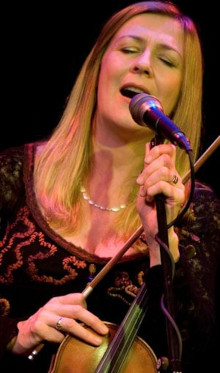
Mairéad Ní Mhaonaigh, Irish fiddler and lead vocalist for the Irish traditional music band Altan, is born on July 26, 1959 in Gweedore, County Donegal, where Gaeilge is her primary language and she learns her songs and tunes from her family and neighbours.

Ní Mhaonaigh’s father, Proinsias Ó Maonaigh, is a noted fiddler, song writer and school teacher and is her first main influence. Her mother, Kitty Rua is also raised in a musical house that holds frequent house dances. It is no surprise that she and her siblings, Gearóid and Anna, all play music together.

In the early 1980s, Ní Mhaonaigh qualifies as a Primary school teacher and teaches in Saint Oliver Plunkett National School in Malahide, County Dublin. She and her husband, Frankie Kennedy, record Ceol Aduaidh (Music from the North) for Irish label Gael Linn in 1983. This timeless recording is the genesis of what later becomes Altan. The recording features her brother Gearóid Ó Maonaigh on guitar, Fintan Mc Manus on bouzouki, Ciaran Curran on bouzouki and Eithne Ní Bhraonáin (now known as Enya) on keyboards. The album quietly gains praise among enthusiasts of traditional Irish music worldwide, which leads the way for a career in music.

Ní Mhaonigh’s teaching career comes to a halt after she and her husband take a career break in 1987 and formed Altan. The band goes on to become one of the most acclaimed Irish traditional bands touring the world. They record for Green Linnet Records in the United States and tour North America extensively.

In 1994, Frankie Kennedy passes away to cancer, which is a tremendous loss to Ní Mhaonigh. She continues with the band at her late husband’s request and signs to multinational record label Virgin Records London in late 1994. This marks the first traditional Irish band to be signed to a major record label and propels Altan and Ní Mhaonigh into a wider audience of followers.

Altan travels all over the world headlining shows from Tokyo, the Sydney Opera House, the Hollywood Bowl to the National Concert Hall, Dublin.

Ní Mhaonaigh, along with fronting Altan, remains close her roots between touring and returns to her native County Donegal to play, sing and teach her music to a new generation. She helps set up Cairdeas na bhFidléirí (The Fellowship / Friendship of Fiddlers) in the early 1980s to promote and preserve the fiddle music of County Donegal.

In 2009, Ní Mhaonaigh releases her first solo album, Imeall (Edge/Theshold), as a limited edition. After many years of playing with the band and numerous requests for a solo recording she finally gets time to record the album after parting with her second husband Dermot Byrne, with whom she has her daughter Nia. She tours the album between Altan commitments with her co-producer and recording engineer Manus Lunny.

The album prompts one reviewer, Paul O’Connor, to remark, “Her identified success as the leader of Altan has dominated our sense of her to the point that we aren’t cognisant of how good she is as an artist, musician, composer in her own right.”

This new focus on Ní Mhaonaigh as an artist in her own right, prompts The Donegal Association in Dublin to grant her “Donegal Person of the Year 2009” at a gala dinner in Dublin’s prestigious Burlington Hotel.

Ní Mhaonaigh is awarded the top recognition in traditional Irish music by her fellow peers in 2018, when she is awarded TG4 Gradam Ceoil’s Traditional Musician of the Year. The following year, she is honoured in her own county at the now world famous “Cup o’Tae Festival” which is held annually in Ardara, County Donegal.

Ní Mhaonaigh is also a member of String Sisters, which is a Grammy listed folk supergroup of six of the world’s leading female fiddlers. Together they have released two albums – the Grammy-longlisted Live and Between Wind and Water. She is a member of T with the Maggies, which is a vocal supergroup of Donegal singers comprised of Maighread and Tríona Ní Dhomhnaill and Moya Brennan of Clannad fame.

Recently Ní Mhaonaigh has recorded with a group of thirteen County Donegal-based female fiddlers which is called ‘SíFiddlers.’

(From: Mairéad Ní Mhaonaigh’s website, http://www.mairead.ie)


Leave a comment

National Day of Commemoration 2017

national-day-of-commemoration-2017

President Michael D. Higgins and Taoiseach Leo Varadkar lead the ceremony to mark the National Day of Commemoration at the Royal Hospital Kilmainham in Kilmainham, Dublin on July 9, 2017. The event is a multi-faith service of prayer and a military service honouring all Irish people who died in past wars or on service with the United Nations. Events are also held in Cork, Galway, Limerick, Sligo, Kilkenny and Waterford.

The National Day of Commemoration is held on the Sunday closest to July 11, the anniversary of the date the truce was signed in 1921 to end the Irish War of Independence.

Leaders from Christian, Coptic Christian, Jewish and Islamic denominations read or sing prayers and readings, and President Higgins lays a laurel wreath. The service is observed by more than 1,000 guests, including Government Ministers, the Council of State, which advises the Taoiseach, members of the judiciary, members of the diplomatic corps, TDs and Senators, representatives of ex-servicemen’s organisations and relatives of the leaders of the 1916 Easter Rising.

The national flag is lowered to half-mast while the “Last Post” and “Reveille” are sounded. After a minute of silence, a gun salute is sounded, and the flag is raised again before the national anthem is played with a fly-by by three Pilatus PC-9 aircraft.

The Army band of the 1st Brigade and pipers play music including “Limerick’s Lament” and “A Celtic Lament” as guests arrive at the quadrangle of the former British Army veterans’ hospital, now the Irish Museum of Modern Art.

The prayer service begins with Imam Sheikh Hussein Halawa of the Islamic Cultural Centre of Ireland, father of Ibrahim Halawa, who is in prison in Cairo, singing verses from the Quran in Arabic and praying in English, “I ask Allah, the Mighty, the Lord, to bless our country, Ireland, and give the people of our country a zeal for justice and strength for forbearance.”

Soloist Sharon Lyons sings hymns between prayers and readings from all denominations, ending with Rabbi Zalman Lent: “May the efforts and sacrifice of those we honour today be transformed into the blessing of people throughout the world.”

Speaking to reporters, Chief of Staff of the Defence Forces Vice Admiral Mark Mellett says more than 650 personnel are serving in eleven countries and on the Mediterranean Sea. “In the Defence Forces we have over 80 people who have given their lives in the cause of peace internationally, and I think it’s a sign of a State that recognises those who give this service,” he says. “The military of our State serve the political and serve the people. And it’s this loyalty to the State which is actually critical, and I’m delighted that we have a day like this.”

Mellett’s views are echoed by former sergeant Denis Barry, who says 47 Irish soldiers died in Lebanon and it is important to pay respects for that sacrifice. “None of us who served ever thought we would see the day we could travel in Lebanon without weapons, heavy armaments or flak jackets.” That United Nations mission paid off, he says.

Former British soldier Ron Hammond says the event reflects positive developments, such as the creation of the veterans’ Union of British and Irish Forces. He served from 1960 to 1980 in the Royal Irish Fusiliers and Royal Irish Rangers, spending time in Germany, Canada, Yemen and north and south Africa. He joined the British rather than the Irish forces because at the time “a home posting in the Defence Forces was Collins Barracks and an overseas posting was the Curragh encampment.”

(From: “Irish military dead honoured in National Day of Commemoration” by Marie O’Halloran, The Irish Times, July 9, 2017)