seamus dubhghaill

Promoting Irish Culture and History from Little Rock, Arkansas, USA


Leave a comment

The Cork Opera House Fire

cork-opera-house-fire-1955

The Cork Opera House is destroyed by fire on December 12, 1955. It is originally built in 1855 and is built on a template that the architect had used for the exhibition buildings at the Irish Industrial Exhibition. Since then, it survives the burning of much of Cork by British forces in 1920.

“The final curtain has fallen. The Cork Opera House is no more. A hundred years of stage history has come to an end. Never had the last moments of any drama, played on this stage, such an audience as last night’s farewell one. In heavy rain, a vast crowd stood silently as flames enveloped a proud landmark in our city. They watched it from the short first burst of fire on its roof until the building crumbled before their eyes.”

So reads the main news in The Cork Examiner on Tuesday, December 13, 1955, after the disastrous fire tore at the heartstrings of the people of Cork, leaving the city without a major theatre for the first time in 250 years. It is the boast of the Opera House that its tradition is continuous. When fighting in the South was at its bitterest, even when most of Cork was burned down, the Opera House kept running, only closing for pantomime rehearsals and in Holy Week. It is during the rehearsals for the forthcoming Christmas pantomime that the fatal fire starts. Fortunately, all people are evacuated, but the building built entirely from wood does not stand a chance from the merciless fire. What begins as an electrical fault, blazes into an inferno within minutes. Soon the skyline of the city is lit up as the fire does its worst.

Ten years later, on February 23, 1963, the tender of Messrs. O’Shea, South Mall is accepted for the rebuilding of the Opera House. A month later the work begins, and the foundation stone is laid by Lord Mayor Seán Casey on June 21, 1963. The citizens watch the building construction with keen interest as the new building gradually takes shape. Finally, the day arrives for the casting aside of hoardings and scaffoldings.

Immediately controversy begins regarding the much-disputed North-Wall. Unfavorable comment and criticism are levelled at the lack of architectural or artistic embellishment on the exterior of the new building and the square, squat tower on top of the roof designed to ease set changing. This is a very natural reaction as the old Opera House had a very special place in the hearts of Corkonians of every generation during its existence. Most of the criticism is uninformed, for few are aware of the difficulties, financially and technically, that the project incurred. Despite the criticism about the exterior appearance, everyone who has an opportunity to inspect the interior of the theatre can find no fault. There is nothing but praise for the design, the decor, the layout of the seating accommodation and, above all, the intimate atmosphere which has been a traditional part of the venerable old building, and which is now faithfully preserved in the new.

Leave a comment

Birth of Actress Fionnghuala Flanagan

fionnula-flanagan

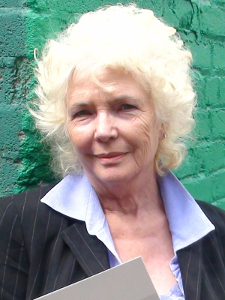
Fionnghuala Manon “Fionnula” Flanagan, Irish actress and political activist, is born in Dublin on December 10, 1941.

Flanagan is the daughter of Rosanna (née McGuirk) and Terence Niall Flanagan, an Irish Army officer and Communist who had fought in the International Brigade in the Spanish Civil War against General Francisco Franco. Although her parents are not Irish speakers, they want Fionnula and her four siblings to learn the Irish language, thus she grows up speaking English and Irish fluently. She is educated in Switzerland and England. She trains extensively at the Abbey Theatre in Dublin and travels throughout Europe before settling in Los Angeles, California in early 1968.

Flanagan comes to prominence in Ireland in 1965 as a result of her role as Máire in the Telefís Éireann production of the Irish language play An Triail, for which she receives the Jacob’s Award in Dublin for her “outstanding performance.” With her portrayal of Gerty McDowell in the 1967 film version of Ulysses, she establishes herself as one of the foremost interpreters of James Joyce. She makes her Broadway debut in 1968 in Brian Friel‘s Lovers, then appears in The Incomparable Max (1971) and such Joycean theatrical projects as Ulysses in Nighttown and James Joyce’s Women (1977-1979), a one-woman show written by Flanagan and directed for the stage by Burgess Meredith. It is subsequently filmed in 1983, with Flanagan both producing and playing all six main female roles.

Flanagan is a familiar presence in American television, as she has appeared in several made-for-TV movies including The Legend of Lizzie Borden (1975) starring Elizabeth Montgomery, Mary White (1977), The Ewok Adventure (1984) and A Winner Never Quits (1986). She wins an Emmy Award for her performance as Clothilde in the 1976 network miniseries Rich Man, Poor Man. Her weekly-series stints include Aunt Molly Culhane in How the West Was Won (1977), which earns her a second Emmy Award nomination. She does multiple appearances on Murder, She Wrote. She plays Lt. Guyla Cook in Hard Copy (1987), and as Kathleen Meacham, wife of a police chief played by John Mahoney in H.E.L.P. (1990).

Flanagan makes guest appearances in three of the Star Trek spin-offsStar Trek: Deep Space Nine episode “Dax,” Star Trek: The Next Generation episode “Inheritance,” and Star Trek: Enterprise episode “Fallen Hero.”

Flanagan guest-stars in several episodes of Lost as Eloise Hawking, a recurring character. She appears in such films as The Others opposite Nicole KidmanDivine Secrets of the Ya-Ya Sisterhood as the eldest Teensy and Waking Ned. She appears in television series and stage productions including the Emmy-nominated miniseries Revelations, starring Bill Pullman and Natascha McElhone, and in Transamerica, starring Felicity Huffman. From 2006–08, she plays Rose Caffee, the matriarch of an Irish American Rhode Island family on the Showtime drama Brotherhood.


Leave a comment

Irish Ferries Protest

irish-ferries-protest

Nearly 150,000 people take to the streets on December 9, 2005, as the Irish Ferries protest mushrooms into the largest public demonstration the country has seen for two decades.

The national day of protest is called by the Irish Congress of Trade Unions, which is demanding Government action to combat exploitation of migrant workers and the displacement of jobs. There are rallies in Dublin, Cork, Waterford, Limerick, Galway, Sligo, Athlone and Rosslare.

An Garda Síochána estimate that 40,000 people take part in the march in Dublin, although organisers claim the figure is far higher. Gerry Adams of Sinn Féin, Pat Rabbitte of the Labour Party and John Gormley of the Green Party participate in the march in the capital. Staff on board the MS Isle of Inismore in Pembroke and the four engineers holed up in the ships control room say they are overwhelmed by the level of support shown by marchers in the rallies.

Bus and rail services are disrupted during the protest but return to normal for evening rush hour.

The Irish Small & Medium Enterprises Association (ISME) strongly criticises the National Day of Protest. In a statement, ISME Chief Executive Mark Fielding says the protest is undermining the industrial relations process in this country and has very little to do with the Irish Ferries dispute and is in fact an attempt by the unions to influence negotiations in advance of any new national pay agreement.

Speaking on RTÉ Radio’s Morning Ireland, Services Industrial Professional Technical Union (SIPTU) President Jack O’Connor says the rallies give workers the chance to take a stand.

Director General of the Irish Business and Employers Confederation (IBEC) Turlough O’Sullivan says there is nothing to be gained from disrupting business and the general public. He adds that whatever one’s views on the Irish Ferries dispute, nothing can justify calling a national work stoppage when discussions are already underway in a bid to resolve the row.


Leave a comment

Execution of Irish Republican Liam Mellows

liam-mellows

Liam Mellows, Irish republican and Sinn Féin politician, is executed by firing squad by Free State forces on December 8, 1922, in reprisal for the shooting of Teachta Dála (TD) Seán Hales.

Mellows is born at Hartshead Military Barracks, Ashton-Under-Lyne, Lancashire, England, to William Joseph Mellows, a British Army non-commissioned officer, and Sarah Jordan, of Inch, County Wexford. His family moves to 10 Annadale Avenue, Fairview, Dublin, in February 1895 when Sergeant Mellows is transferred there, however Liam remains in Wexford with his grandfather Patrick Jordan due to ill health. He attends the military school in Wellington Barracks in Cork and the Portobello garrison school in Dublin but ultimately refuses a military career much to his father’s disappointment, instead working as a clerk in several Dublin firms, including the Junior Army & Navy Stores on D’Olier Street.

A nationalist from an early age, Mellows approaches Thomas Clarke, who recruits him to Fianna Éireann, an organisation of young republicans.

Mellows is introduced to socialism when he meets James Connolly at Countess Markiewicz’s residence, recuperating after his hunger strike. He is active in the Irish Republican Brotherhood (IRB) and is a founder member of the Irish Volunteers, being brought onto its Organising Committee to strengthen the Fianna representation. He is arrested and jailed on several occasions under the Defence of the Realm Act. Eventually escaping from Reading Gaol, he returns to Ireland to command the “Western Division” of the Irish Republican Army (IRA) during the Easter Rising of 1916.

Mellows leads roughly 700 Volunteers in abortive attacks on Royal Irish Constabulary stations at Oranmore and Clarinbridge in County Galway and takes over the town of Athenry. However, his men are very badly armed and supplied and they disperse after a week, when British troops and the cruiser HMS Gloucester are sent west to attack them.

After this insurrection fails, Mellows escapes to the United States, where he is arrested and detained without trial in The Tombs in Lower Manhattan, New York, on a charge of attempting to aid the German side in World War I. After his release in 1918, he works with John Devoy and helps to organise Éamon de Valera’s fund-raising visit to America in 1919–1920.

Mellows returns to Ireland to become Irish Republican Army “Director of Supplies” during the Irish War of Independence, responsible for buying arms. At the 1918 general election of December, he is elected to the First Dáil as a Sinn Féin candidate for both East Galway and for North Meath. He considers the Anglo-Irish Treaty as signed to be a betrayal of the Irish Republic. A conference of 9 TDs is deputed to meet privately on January 5, 1922, to resolve the dispute and to achieve a unified front by compromise. The four other anti-Treaty TDs say there is agreement but Mellows does not and is seen thereafter by pro-Treaty TDs as one of their most implacable opponents. The following day the Dáil votes to approve the Treaty by a majority of 64 to 57.

Mellows is one of the more strident TDs on the approach to the Irish Civil War. In June 1922, he and fellow republicans Rory O’Connor, Joe McKelvey and Richard Barrett, among others, enters the Four Courts, which has been occupied by anti-Treaty forces since April. However, they are bombarded by pro-Treaty Free State forces and surrender after two days. Mellows has a chance to escape along with Ernie O’Malley but does not take it. Imprisoned in Mountjoy Gaol, Mellows, O’Connor, McKelvey and Barrett are executed by firing squad on December 8, 1922, in reprisal for the shooting of TD Seán Hales. Mellows is buried in Castletown cemetery, County Wexford, a few miles from Arklow. An annual commemoration ceremony is held at his grave site, in which a wreath is laid by a member of the Liam Mellows Commemoration committee.

Mellows is commemorated by statues in Oranmore and Eyre Square in Galway, in the official name of the Irish Defence Forces army barracks at Renmore and in the naming of Mellows Bridge in Dublin. Mellows Avenue in Arklow is named in his honour. He is also commemorated in the names of two hurling clubs, one in Galway and one in Wexford, and by Unidare RFC in Ballymun and their “Liam Mellows Perpetual Cup.”


Leave a comment

Patrick J. Hillery Inaugurated Sixth President of Ireland

Patrick John Hillery, Irish politician, is inaugurated as the sixth President of Ireland on December 3, 1976. He serves two terms in the presidency and, though widely seen as a somewhat lacklustre President, is credited with bringing stability and dignity to the office. He also wins widespread admiration when it emerges that he has withstood political pressure from his own Fianna Fáil party during a political crisis in 1982.

Hillery is born in Spanish Point, County Clare on May 2, 1923. He is educated locally at Milltown Malbay national school before later attending Rockwell College. At third level he attends University College Dublin where he qualifies with a degree in medicine. Upon his conferral in 1947 he returns to his native town where he follows in his father’s footsteps as a doctor.

Hillery is first elected at the 1951 general election as a Fianna Fáil Teachta Dála (TD) for Clare and remains in Dáil Éireann until 1973. During this time, he serves as Minister for Education (1959–1965), Minister for Industry and Commerce (1965–1966), Minister for Labour (1966–1969) and Minister for Foreign Affairs (1969–1973).

Following Ireland’s successful entry into Europe in 1973, Hillery is rewarded by becoming the first Irishman to serve on the European Commission, serving until 1976 when he becomes President. In 1976 the Fine GaelLabour Party National Coalition under Liam Cosgrave informs him that he is not being re-appointed to the Commission. He considers returning to medicine; however, fate takes a turn when Minister for Defence Paddy Donegan launches a ferocious verbal attack on President Cearbhall Ó Dálaigh, calling him “a thundering disgrace” for referring anti-terrorist legislation to the courts to test its constitutionality. When a furious President Ó Dálaigh resigns, a deeply reluctant Hillery agrees to become the Fianna Fáil candidate for the presidency. Fine Gael and Labour decide it is unwise to put up a candidate in light of the row over Ó Dálaigh’s resignation. As a result, Hillery is elected unopposed, becoming President of Ireland on December 3, 1976.

When Hillery’s term of office ends in September 1983, he indicates that he does not intend to seek a second term, but he changes his mind when all three political parties plead with him to reconsider. He is returned for a further seven years without an electoral contest. After leaving office in 1990, he retires from politics.

Hillery’s two terms as president, from 1976 to 1990, end before the 1998 Good Friday Agreement, which sets terms for an end to violence in Northern Ireland. But he acts at crucial moments as an emollient influence on the republic’s policies toward the north and sets a tone that helps pave the way for eventual peace.

Patrick Hillery dies on April 12, 2008, in his Dublin home following a short illness. His family agrees to a full state funeral for the former president. He is buried at St. Fintan’s Cemetery, Sutton, Dublin. In the graveside oration, Tánaiste Brian Cowen says Hillery was “A humble man of simple tastes, he has been variously described as honourable, decent, intelligent, courteous, warm and engaging. He was all of those things and more.”


Leave a comment

Death of C.S. Lewis, Novelist & Poet

Clive Staples Lewis, novelist, poet, academic, medievalist, literary critic, essayist, lay theologian, broadcaster, lecturer, and Christian apologist, dies in Oxford, England, on November 22, 1963.

Lewis is born in Belfast on November 29, 1898. When he is seven, his family moves into “Little Lea,” the family home of his childhood, in the Strandtown area of East Belfast. He was schooled by private tutors until age 9, when his mother dies from cancer. His father then sends him to live and study at Wynyard School in Watford, Hertfordshire. The school closes soon afterwards due to a lack of pupils. He then attends Campbell College in the east of Belfast about a mile from his home, but leaves after a few months due to respiratory problems. He is then sent to the health-resort town of Malvern, Worcestershire, where he attends the preparatory school Cherbourg House. It is during this time that Lewis abandons his childhood Christian faith and becomes an atheist. In September 1913, he enrolls at Malvern College, where he remains until the following June. After leaving Malvern, he studies privately with William T. Kirkpatrick, his father’s old tutor and former headmaster of Lurgan College.

Lewis holds academic positions at both Oxford University (Magdalen College, 1925–1954) and Cambridge University (Magdalene College, 1954–1963). He is best known for his works of fiction, especially The Screwtape Letters, The Chronicles of Narnia, and The Space Trilogy, and for his non-fiction Christian apologetics, such as Mere Christianity, Miracles, and The Problem of Pain.

Lewis and fellow novelist J.R.R. Tolkien are close friends. They both serve on the English faculty at Oxford University, and are active in the informal Oxford literary group known as the Inklings. According to Lewis’s memoir Surprised by Joy, he is baptised in the Church of Ireland, but fell away from his faith during adolescence. He returns to Anglicanism at the age of 32, owing to the influence of Tolkien and other friends, and he becomes an “ordinary layman of the Church of England.” His faith profoundly affects his work, and his wartime radio broadcasts on the subject of Christianity bring him wide acclaim.

Lewis writes more than 30 books, which have been translated into more than 30 languages and have sold millions of copies. The books that make up The Chronicles of Narnia have sold the most and have been popularised on stage, TV, radio, and cinema. His philosophical writings are widely cited by Christian apologetics from many denominations.

In early June 1961, Lewis begins suffering from nephritis, which results in blood poisoning. His illness causes him to miss the autumn term at Cambridge, though his health gradually begins improving in 1962 and he returns that April. His health continues to improve and he is fully himself by early 1963. On July 15 of that year he falls ill and is admitted to hospital. At 5:00 PM the following day he suffers a heart attack and lapses into a coma, unexpectedly awaking the following afternoon. After he is discharged from the hospital he is too ill to return to work. As a result, he resigns from his post at Cambridge in August. His condition continues to decline, and in mid-November he is diagnosed with end-stage renal failure. On November 22, exactly one week before his 65th birthday, he collapses in his bedroom at 5:30 PM and dies a few minutes later. He is buried in the churchyard of Holy Trinity Church, Headington, Oxford.

Media coverage of Lewis’s death is almost completely overshadowed by news of the assassination of U.S. President John F. Kennedy, which occurs on the same day approximately 55 minutes following Lewis’s collapse, as does the death of English writer Aldous Huxley, author of Brave New World.

In 2013, on the 50th anniversary of his death, Lewis is honoured with a memorial in Poets’ Corner in Westminster Abbey. His works enter the public domain in 2014 in countries where copyright expires 50 years after the death of the creator, such as Canada.


Leave a comment

Birth of Comedian & Actor Niall Tóibín

Niall Tóibín, Irish comedian and actor, is born into an Irish speaking family in Cork, County Cork, on November 21, 1929. He is the sixth of seven children born to Siobhán (née Ní Shúileabháin) and Seán Tóibín.

Tóibín’s father is born in Passage West, County Cork, and his parents come from Waterford and West Cork. His father is a teacher in the School of Commerce in Cork city and the author of two books, Blátha an Bhóithrín and Troscán na mBánta, on wayside and meadowland flowers, both written in the Irish language. His mother comes from Beaufort, County Kerry.

Tóibín is born on the south side of Cork city in Friars’ Walk. He is raised with Irish and uses the language in his professional career, notably in the film Poitín. As a child he sings in the cathedral choir and the Opera House in Cork. In his teens he joins a drama society attached to the Keating Branch of the Gaelic League. He is educated by the Irish Christian Brothers at the North Monastery after which he leaves Cork in January 1947 for a job in the Civil Service in Dublin.

Tóibín starts acting in the 1950s and spends fourteen years with the Radio Éireann Players. From Ryan’s Daughter and Bracken in the 1970s, to The Ballroom of Romance, The Irish R.M., Brideshead Revisited (TV serial) and Caught in a Free State in the 1980s, and Far and Away, Ballykissangel and Veronica Guerin in the 1990s and 2000s, Toibin’s entertainment career in television, film and theatre spans over four decades.

Tóibín plays Dr. Paul O’Callaghan in the first series of the Irish TV programme The Clinic. He also plays Judge Ballaugh, alongside Cate Blanchett, in Jerry Bruckheimer‘s film Veronica Guerin. He also acts for the radio, such as his guest appearance in the BBC Radio 4 series Baldi.

In 1973, Tóibín wins a Jacob’s Award for his performance in the RTÉ comedy series, If the Cap Fits. He receives an Honorary Doctor of Arts Degree from University College Cork (UCC) on June 4, 2010, and is honoured with the Irish Film and Television Academy‘s (IFTA) Lifetime Achievement Award at a ceremony at the Irish Film Institute on November 3, 2011.


Leave a comment

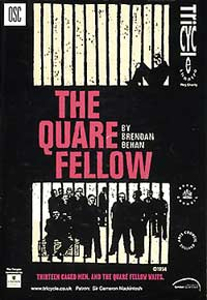
Premiere of “The Quare Fellow”

Brendan Behan’s first play, The Quare Fellow, premieres at the Pike Theatre in Dublin on November 19, 1954, to critical success. The title is taken from a Hiberno-English pronunciation of queer.

The Quare Fellow is initially offered to Dublin’s Abbey Theatre but is turned down. The play has its London première in May 1956 at Joan Littlewood‘s Theatre Workshop at the Theatre Royal Stratford East. On July 24, 1956, it transfers to the Comedy Theatre, London. In September 1956 the Abbey Theatre finally performs The Quare Fellow. It has such success that the Abbey’s artistic director, Ria Mooney, pushes the next play back to allow The Quare Fellow to run for six weeks. Its first New York performance is on November 27, 1958, at the Circle in the Square Theatre.

The play is set in Mountjoy Prison, Dublin. The antihero of the play, the Quare Fellow, is never seen or heard but rather functions as the play’s central conceit. He is a man condemned to die on the following day, for an unmentioned crime. Whatever it is, it revolts his fellow inmates far less than that of the Other Fellow, a very camp, almost Wildean, gay man.

There are three generations of prisoners in Mountjoy including boisterous youngsters who can irritate both other inmates and the audience and the weary old lags Neighbour and “methylated martyr” Dunlavin.

The first act is played out in the cramped area outside five cells and is comedic, sometimes rather like an Irish episode of Porridge. After the interval, the pace slows considerably and the play becomes much darker, as the time for the execution approaches. The focus moves to the exercise yard and to the workers who are digging the grave for the soon-to-be-executed Quare Fellow.

The play is a grimly realistic portrait of prison life in Ireland in the 1950s, and a reminder of the days in which homosexuality was illegal and the death penalty relatively common. The play is based on Behan’s own prison experiences, and highlights the perceived barbarity of capital punishment, then in use in Ireland. The play also attacks the false piety in attitudes to sex, politics and religion.

The Auld Triangle“, a song from the opening of the play, has become an Irish music standard and is known by many who are unaware of its link to The Quare Fellow.

In 1962 the play is adapted for the screen by Arthur Dreifuss and stars Patrick McGoohan, Sylvia Syms and Walter Macken. Although the film receives some favourable reviews, it is not regarded as a faithful adaptation of the play.


Leave a comment

Death of Erskine Hamilton Childers, 4th President of Ireland

Erskine Hamilton Childers, Fianna Fáil politician who serves as the 4th President of Ireland, dies on November 17, 1974. He also serves as Tánaiste and Minister for Health from 1969 to 1973, Minister for Transport and Power from 1959 to 1969, Minister for Posts and Telegraphs from 1951 to 1954 and 1966 to 1969. He served as a Teachta Dála (TD) from 1938 to 1973.

Childers is born on December 11, 1905, in the Embankment Gardens, London, to a Protestant family originally from Glendalough, County Wicklow. He is educated at Gresham’s School, Holt, and the University of Cambridge. In 1922, when Childers is sixteen, his father, Robert Erskine Childers, is executed by the new Irish Free State on politically inspired charges of gun-possession. After attending his father’s funeral, Childers returns to Gresham’s, then two years later he goes on to Trinity College, Cambridge.

After finishing his education, Childers works for a period in a tourism board in Paris. In 1931, Éamon de Valera invites him to work for his recently founded newspaper, The Irish Press, where Childers becomes advertising manager. He becomes a naturalised Irish citizen in 1938. That same year, he is first elected as a Fianna Fáil Teachta Dála (TD) for Athlone–Longford. He remains in the Dáil Éireann until 1973, when he resigns to become President.

Childers joins the cabinet in 1951 as Minister for Posts and Telegraphs in the de Valera government. He then serves as Minister for Lands in de Valera’s 1957–59 cabinet, as Minister for Transport and Power under Seán Lemass, and, successively, as Transport Minister, Posts and Telegraphs Minister, and Health Minister under Jack Lynch. He becomes Tánaiste in 1969.

Fine Gael TD Tom O’Higgins, who had almost won the 1966 presidential election, is widely expected to win the 1973 election when he is again the Fine Gael nominee. Childers is nominated by Fianna Fáil at the behest of de Valera, who pressures Jack Lynch in the selection of the presidential candidate. He is a controversial nominee, owing not only to his British birth and upbringing but to his Protestantism. However, on the campaign trail his personal popularity proves enormous, and in a political upset, Childers is elected the fourth President of Ireland on May 30, 1973, defeating O’Higgins by 635,867 votes to 578,771.

Childers quickly gains a reputation as a vibrant, extremely hard-working president, and becomes highly popular and respected. However, he has a strained relationship with the incumbent government, led by Taoiseach Liam Cosgrave of Fine Gael. Childers had campaigned on a platform of making the presidency more open and hands-on, which Cosgrave views as a threat to his own agenda as head of government. Childers considers resigning from the presidency but is convinced to remain by Cosgrave’s Minister for Foreign Affairs and Trade, Garret FitzGerald.

Though frustrated about the lack of power he has in the office, Childers’ daughter Nessa believes that he plays an important behind-the-scenes role in easing the Northern Ireland conflict, reporting that former Prime Minister of Northern Ireland Terence O’Neill meets secretly with her father at Áras an Uachtaráin on at least one occasion.

Prevented from transforming the presidency as he desired, Childers instead throws his energy into a busy schedule of official visits and speeches, which is physically taxing. On November 17, 1974, just after making a speech to the Royal College of Physicians of Ireland in Dublin, Childers suffers a heart attack. He dies the same day at Mater Misericordiae University Hospital.

Childers’s state funeral in St. Patrick’s Cathedral, Dublin is attended by world leaders including the Louis Mountbatten, 1st Earl Mountbatten of Burma (representing Queen Elizabeth II), the Prime Minister of the United Kingdom and leader of the Opposition, and presidents and crowned heads of state from Europe and beyond. He is buried in the grounds of the Church of Ireland Derralossary church in Roundwood, County Wicklow.


Leave a comment

Birth of Tom Clifford, Irish Rugby Union Player

Tom Clifford, Irish rugby union player who plays in the prop position, is born in Phippsboro, County Tipperary, on November 15, 1923. Clifford plays club rugby with Young Munster, represents the Munster Rugby provincial team, is capped fourteen times for Ireland, and is a member of the British and Irish Lions team that tours in 1950.

When Clifford is three years old, his family moves to Limerick. He attends CBS Sexton Street secondary school, where he participates in the school hurling team.

Clifford, at the age of fifteen, makes his senior début for Young Munster at fullback in a friendly match against Constitution. He makes his Munster Senior Cup début in 1943 as a wing forward. During his time at the club, Young Munster wins the Munster Senior League on two occasions, 1944 and 1952 and twice reaches the final of the Munster Senior Cup in 1947 and 1948, but loses both times.

Clifford makes his début for Ireland against France at Landsdowne Road on January 29, 1949 in Ireland’s first game of the 1949 Five Nations Championship. He plays in all four of Ireland’s matches in the 1949 tournament which ends with Ireland being crowned the champions and winning the Triple Crown. He also plays in all of Ireland’s games during the 1950 Five Nations Championship.

Clifford is named in the squad for the 1950 British Lions tour to New Zealand and Australia, the first post-war tour by a British Isles combined team and the first where the team is officially called British Lions. The touring party travels by boat, departing in April and not returning until October. Out of the 29 games played during the tour, Clifford is featured in twenty of them, including all five test matches – three against New Zealand and two against Australia. On his return to Limerick, a crowd of around 8,000 people turn out at Limerick railway station to greet him.

The 1951 Five Nations Championship is again won by Ireland, with Clifford playing in the games against France and England. Clifford’s only appearance at home outside of the Five Nations Championship comes in December 1951, as South Africa plays Ireland as part of their European tour. His final international appearances come during the 1952 Five Nations Championship, with his last game being against Wales on March 8.

Clifford retires from playing rugby in 1957. He dies in Phippsboro on October 1, 1990, at the age of 66. Young Munster’s home group, Tom Clifford Park, is named after him.