Keaveney’s first sporting interest is in soccer, however, he is later introduced to Gaelic games by his Belfast-born father. He is educated at St. Joseph’s Secondary School in Fairview, Dublin where he favours hurling over Gaelic football.
Keaveney makes his debut on the inter-county scene when he is selected for the Dublin minor and under-21 teams, however, he ends his underage career without success. He makes his senior debut during the 1964-1965 league. Over the course of the following sixteen seasons, he wins three All-Ireland medals, beginning with a lone triumph in 1974, followed by back-to-back championships in 1976 and 1977. He also wins seven Leinster medals, two National Football League medals and is named Footballer of the Year in 1976 and 1977. He plays his last game for Dublin in February 1980.
The team is returning from a European Cup match in Belgrade, Yugoslavia, having eliminated Red Star Belgrade to advance to the semi-finals of the competition. The flight stops to refuel in Munich because a non-stop flight from Belgrade to Manchester is beyond the Airspeed Ambassador‘s range. After refuelling, pilots James Thain and Kenneth Rayment twice abandon take-off because of boost surging in the left engine. Fearing they will get too far behind schedule, Captain Thain rejects an overnight stay in Munich in favour of a third take-off attempt. By then snow is falling, causing a layer of slush to form at the end of the runway. After the aircraft hits the slush, it ploughs through a fence beyond the end of the runway and the left wing is torn off after hitting a house. Fearing the aircraft might explode, Thain begins evacuating passengers while Manchester United goalkeeperHarry Gregg helps pull survivors from the wreckage.
An investigation by West German airport authorities originally blames Thain, saying he did not de-ice the aircraft’s wings, despite eyewitness statements to the contrary. It is later established that the crash is caused by the slush on the runway, which slows the plane too much to take off. Thain is cleared in 1968, ten years after the incident.
At the time of the disaster, Manchester United is trying to become the third club to win three successive English Football League titles. They are six points behind League leaders Wolverhampton Wanderers with 14 games to go. They also hold the Charity Shield and have just advanced into their second successive European Cup semi-final. The team has not been beaten in eleven consecutive matches. The crash not only derails their title ambitions that year but also virtually destroys the nucleus of what promised to be one of the greatest generations of players in English football history. It takes ten years for the club to recover, with Busby rebuilding the team and winning the European Cup in 1968 with a new generation of “Babes.”
Clancy is born into a musical family in the outskirts of Milltown Malbay, County Clare on December 24, 1918. His parents, Gilbert Clancy and Ellen Killeen, both sing and play concertina, and his father also plays the flute. Clancy’s father has been heavily influenced by local blind piper Garret Barry and passes much of Barry’s music on to Willie.
Clancy starts playing the tin whistle at age five, and later takes up the flute. He first sees a set of pipes in 1936 when he sees Johnny Doran playing locally. He obtains his first set of pipes two years later. His influences include Leo Rowsome, Séamus Ennis, John Potts and Andy Conroy. Clancy wins the Oireachtas competition in 1947. Unable to earn a living from music he emigrates to London where he works as a carpenter.
Returning to Milltown Malbay in 1957 he records some influential 78 rpm recordings for the Gael Linn label, among them the classic reel selection “The Old Bush/The Ravelled Hank of Yarn.” The next decades he stayed in Milltown Malbay. He marries Dóirín Healy in 1962.
Willie Clancy dies suddenly at the early age of 55 on January 24, 1973, leaving a great void. Cór Cúl Aodha sings at his funeral mass, just as Clancy had played at Seán Ó Riada’s funeral only a year earlier. Others who take part include Seán Ach Donnchadha, John Kelly and Séamus Ennis. His funeral cortege to Ballard Cemetery is led by pipers from the Tulla Pipe Band.
The Willie Clancy Summer School is established in his honour in 1973, by Clancy’s friends Junior Crehan, Martin Talty, Seán Reid, Paddy Malone, Paddy McMahon, Frankie McMahon, Jimmy Ward, JC Talty, Harry Hughes, Michael O Friel, Séamus Mac Mathúna and Muiris Ó Rócháin. He is also the subject of a major television documentary “Cérbh É? Willie Clancy” on TG4, first broadcast in November 2009. In this programme, one of a series in which major figures in contemporary traditional music, profile and pay homage to a master of their craft from a bygone age, Peter Browne traces the life and legacy of Clancy.
(Photo courtesy of Mick O’Connor, flute player and friend of Willie Clancy)
Brambell is the youngest of three sons born to Henry Lytton Brambell, a cashier at the Guinness Brewery, and his wife, Edith Marks, a former opera singer. His first appearance is as a child, entertaining the wounded troops during World War I. Upon leaving school he works part-time as a reporter for The Irish Times and part-time as an actor at the Abbey Theatre before becoming a professional actor for the Gate Theatre. He also does repertory at Swansea, Bristol and Chesterfield. In World War II, he joins the British military forces entertainment organisation Entertainments National Service Association (ENSA).
It is this ability to play old men that leads to his casting in his best remembered role, as Albert Steptoe, the irascible father in Steptoe and Son. This begins as a pilot on the BBC’s Comedy Playhouse, and its success leads to a full series being commissioned, running from 1962 to 1974 including a five-year hiatus. There are two feature film spin-offs, a stage show, and an American incarnation entitled Sanford and Son, some episodes of which are almost exact remakes of the original British scripts.
The success of Steptoe and Son makes Brambell a high-profile figure on British television, and earns him the supporting role of Paul McCartney‘s grandfather in The Beatles‘ first film, A Hard Day’s Night (1964). In 1965, Brambell tells the BBC that he does not want to do another series of Steptoe and Son and, in September that year, he goes to New York City to appear in the Broadway musical Kelly at the Broadhurst Theatre, however, it closes after just one performance.
Apart from his role as the older Steptoe, Brambell achieves recognition in many films. His performance in The Terence Davies Trilogy wins him critical acclaim, far greater than any achieved for Steptoe and Son. Although he appears throughout the full 94-minute piece, Brambell does not speak a single word.
After the final series of Steptoe and Son is made in 1974, Brambell has some guest roles in films and on television. He and Harry H. Corbett also undertake a tour of Australia in 1977 in a Steptoe and Son stage show.
Brambell dies of cancer in Westminster, London, on January 18, 1985, at the age of 72. He is cremated on January 25, 1985 at Streatham Park Cemetery, where his ashes are scattered.
(Pictured: Henry Wilfrid Brambell and John Lennon in The Beatles’ first motion picture, A Hard Day’s Night)
Pauline Delaney, accomplished stage, TV and film actress who is best known for her role in Circle of Friends and Into The West, dies in London from complications caused by Parkinson’s disease on January 15, 2007.
Delany is born in Dublin on June 8, 1925. Her mother, a keen theatregoer, inspires her love of the stage, taking her on regular visits to the Abbey Theatre and the Gate Theatre. She learns her craft through evening classes at the Brendan Smith Academy in Dublin and later gives up her job as a trainee fashion buyer to tour with a production of Charlie’s Aunt, starring Leslie Phillips.
In the mid-1950s, she marries actor Norman Rodway, and they become members of the Globe company, together with Anna Manahan, Maureen Toal and Milo O’Shea, presenting new plays at a small Gas Company theatre in Dún Laoghaire. When financial problems force the Globe to close, she helps form Gemini Productions and stars in its 1960s Dublin Theatre Festival success, The Poker Session, by Hugh Leonard.
When the play transfers to London, Delany moves there. Her marriage to Rodway ends and she subsequently forms a relationship with Gerry Simpson, an Irish-born playwright. She is a familiar figure on the London stage, appearing in several productions, including The Hostage at the Royal Court, A Day in the Death of Joe Egg at the King’s Head Theatre and Cross Purpose at Hampstead Theatre.
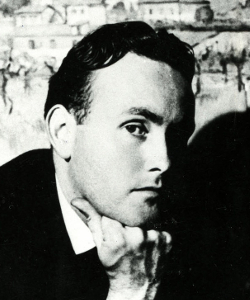
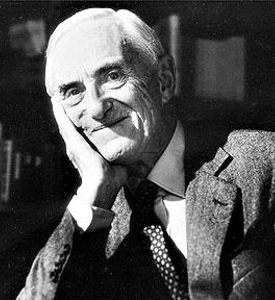
Hill is born at Southampton, Hampshire, on December 6, 1916, the son of a wealthy sugar trader. He first works as a theatre designer in Leningrad in the 1930s and later as an historian. In World War II he registers as a conscientious objector and works on a farm.
Hill’s long association with Ireland begins when he visits Glenveagh Castle in County Donegal to paint the portrait of the Irish American art collector Henry McIlhenny, whose grandfather had emigrated to the United States from the nearby village of Milford, and who subsequently made a fortune from his patent gas meter.
Hill begins to enjoy increased success as a portrait painter from the 1960s. His subjects include many notable composers, musicians, politicians and statesmen, such as broadcaster Gay Byrne, Jerusalem mayor Teddy Kollek and The Prince of Wales. He is also an enthusiastic art collector and traveller, with a wide range of friends such as Bryan Guinness and Isaiah Berlin. Greta Garbo visits Hill in the 1970s, a visit which forms inspiration for Frank McGuinness‘ 2010 play Greta Garbo Came to Donegal.
An exhibition of his work and personal art collection can be seen at the House and associated Glebe Gallery at Churchill, near Letterkenny. Another collection of his work is held at Mottisfont Abbey. Many of his landscapes portray scenes from Tory Island, where he has a painting hut for years, and starts and then mentors the artists’ community there, teaching the local fishermen how to paint. This leads to the informal but busy “Tory School” of artists such as James Dixon and Anton Meenan, who find that they have the time to paint and use their wild surroundings as a dramatic subject.
Hill is made a CBE in 1997. A Retrospective exhibition is arranged for and by him at the Royal Hibernian Academy (RHA) in 1998. On January 13, 1999, he is made an honorary Irish citizen by the President of Ireland Mary McAleese.
Arthur Derek Hill dies at the age of 83 at a London hospital on July 30, 2000. He is buried in Hampshire in the South of England with his parents. Memorial services are held for him in Dublin at St. Patrick’s Cathedral, as well as St. James’s Church, Piccadilly, London, and his local Church in Trentagh, County Donegal.
Raftery is born in Dublin on December 21, 1957. Her father, Adrian, is in the Irish foreign service, and she spends much of her childhood abroad. Though she enters University College Dublin to study engineering, she is derailed by an interest in journalism and never finishes her degree.
Raftery starts her investigative journalism career with In Dublin magazine in the 1970s, before moving on to Magill magazine and then to the Irish television channel Raidió Teilifís Éireann (RTÉ) in 1984. Her documentary series States of Fear is broadcast on RTÉ in 1999. A book she writes later that year called Suffer the Little Children adds more detail to her claim that the Irish childcare system between the 1930s and 1970s was guilty of widespread persecution and abuse.
Raftery is nominated for “NNI National Journalist of the Year” in 2011 for her work in exposing clerical abuse of children.
Mary Frances Thérèse Raftery dies of ovarian cancer at the age of 54 at St. Vincent’s University Hospital in Dublin on January 10, 2012. She is survived by her mother, three siblings, her husband and her son.
O’Brian is born Richard Patrick Russ, in Chalfont St. Peter, Buckinghamshire, to Charles Russ, an English physician of German descent, and Jessie Russ (née Goddard), an English woman of Irish descent. His literary career begins in his childhood with the publishing of his earliest works, including several short stories, the book Hussein, An Entertainment, and the short story collection Beasts Royal. The latter two bring him considerable critical praise especially considering his youth. He publishes his first novel, Caesar: The Life Story of a Panda Leopard, at the age of 15 with help from his father.
O’Brian is best known for his Aubrey–Maturin series of sea novels set in the Royal Navy during the Napoleonic Wars, and centered on the friendship of the English naval captain Jack Aubrey and the Irish–Catalan physician Stephen Maturin. The 20-novel series, the first of which is Master and Commander, is known for its well-researched and highly detailed portrayal of early 19th-century life, as well as its authentic and evocative language. A partially finished 21st novel in the series is published posthumously containing facing pages of handwriting and typescript.
O’Brian write a number of other novels and short stories, most of which were published before he achieves success with the Aubrey–Maturin series. He also translates works from French to English, and writes two biographies.
O’Brian’s major success as a writer comes late in life, when the Aubrey-Maturin series catches the eye of an American publisher. The series draws more readers and favourable reviews when the author is in his seventies. Near the end of his life, and in the same year he loses his beloved wife, British media reveals details of O’Brian’s early life, first marriage, and post-war change of name, causing distress to the very private author and to many of his readers at that time.
Between 1946 and 1949 O’Brian and his wife Mary live in Cwm Croesor, a remote valley in north Wales, where they initially rent a cottage from Clough Williams-Ellis. In 1949 they move to Collioure, a Catalan town in southern France. He and Mary remain together in Collioure until her death in 1998.
O’Brian dies on January 2, 2000 at Trinity College, Dublin where he had been living and working on his next book. His body is returned to Collioure, where he is buried next to his wife.
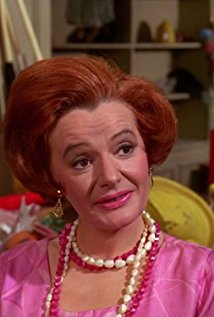
Caffrey is also well regarded for his role as a transvestite in the film Night Train, and for his role as an unlikely protagonist in I Went Down. He is also known for playing the role of the judge in the Irish comedy Father Ted on the episode A Song For Europe and for voicing a popular Christmas radio advertisement for Barry’s Tea in 1994.
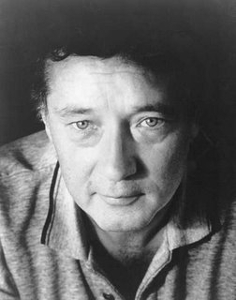
Caffrey is born in Dublin on April 18, 1949. He studies at a seminary for two years before switching to an English degree. He works for a year as a primary school teacher, before becoming involved with Dublin’s Project Theatre. He appears in nearly thirty television and film roles, and also has a solid theatre career in both Dublin and London. After moving to London in 1983 he becomes a familiar face on UK television, with minor roles in Casualty, The Bill and Peak Practice. His success in Ballykissangel comes after overcoming oral cancer for which he is diagnosed in 1990, and, despite suffering a stroke in 2000 which leaves him paralysed on the right side, he manages to play a similarly afflicted character in the unreleased film Sweet Dancer in 2005.
Caffrey never fully recovers from the stroke and dies at the age of 58 on January 1, 2008, in Shrewsbury. His body is returned to Ireland for cremation in Mount Jerome Cemetery and Crematorium, Dublin, on January 8, 2008. Caffrey is survived by three sisters, Linda, Carol, and Sheila. His brother David pre-deceases him in July 2007.
Caffrey marries Brenda Banks in 1980 but the marriage ends in divorce in 1990.
Marcus O’Sullivan, Irish middle distance runner, is born in Cork, County Cork, on December 22, 1961. Although he does not plan to enroll at any of Ireland’s universities, his running encourages him to go to Villanova University. After four years of education at Villanova, he graduates with a degree in accounting and later attains an MBA and a CPA.
O’Sullivan quickly becomes a world class runner and takes part in four summer Olympic Games. He wins three gold medals at the IAAF World Indoor Championships over 1500m in Indianapolis (1987), Budapest (1989), and Toronto (1993). In his victories in 1987 and 1989, he sets championship records. He is third all-time in total sub-4 minute miles with 101, trailing Steve Scott (137) and John Walker (127).
O’Sullivan sets an indoor 1500 metres world record of 3:35.4 on February 10, 1989, and is generally regarded as a better competitor running indoors. This is evidenced by the fact that he wins the prestigious Wanamaker Mile in Madison Square Garden‘s Millrose Games six times (1986, 1988, 1989, 1990, 1992, and 1996).
O’Sullivan’s personal best for the mile, which is set indoors in 1988, is 3:50.94. His personal best for the 1500 metres, which is set outdoors in 1996, is 3:33.61.
O’Sullivan, along with Irish runners Ray Flynn, Eamonn Coghlan, and Frank O’Mara (who ran collegiately at the University of Arkansas) establish the still standing world record in the 4 x 1 mile relay, when they combine in Dublin on August 17, 1985 to run 15:49.08.
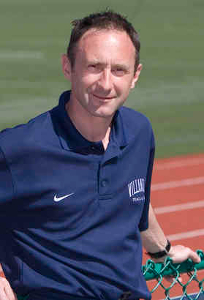
O’Sullivan now runs the Running Works cross country summer camp in Canadensis, Pennsylvania, along with Cricket Batz, and is the head coach of Villanova cross country and track and field. He is coached by Tom Donnelly of Haverford College and advises Bob Kennedy in the later years before Kennedy’s retirement.
In addition to his ties to American record holder Bob Kennedy, O’Sullivan has coached elite professional runners such as Canadian indoor world silver medalist Carmen Douma-Hussar and New Zealander Adrian Blincoe.