seamus dubhghaill

Promoting Irish Culture and History from Little Rock, Arkansas, USA


2 Comments

Birth of Charles Kickham, Novelist, Poet, Journalist & Revolutionary

Charles Joseph Kickham, Irish revolutionary, novelist, poet, journalist and one of the most prominent members of the Irish Republican Brotherhood (IRB), is born at Mullinahone, County Tipperary, on May 9, 1828.

Kickham’s father, John Kickham, is the proprietor of the principal drapery in the locality and is held in high esteem for his patriotic spirit. His mother, Anne O’Mahony, is related to the Fenian leader John O’Mahony. He grows up largely deaf and almost blind, the result of an explosion with a powder flask when he is thirteen. He is educated locally, where it is intended that he study for the medical profession. During his boyhood the campaign for a repeal of the Acts of Union 1800 between Great Britain and Ireland is at its height, and he soon becomes versed in its arguments and is inspired by its principles. He often hears the issues discussed in his father’s shop and at home amongst all his friends and acquaintances.

From a young age Kickham is imbued with these patriotic ideals. He becomes acquainted with the teaching of the Young Irelanders through their newspaper The Nation from its foundation in October 1842. His father read the paper aloud every week for the family. Like all the young people of the time, and a great many of the old ones, his sympathies are with the Young Irelanders on their secession from the Repeal Association.

When he is 22 years old, Kickham contributes The Harvest Moon sung to the air of “The Young May Moon,” to The Nation on August 17, 1850. Other verses are to follow, but the finest of his poems according to A. M. O’Sullivan, appear in other journals. Rory of the Hill, The Irish Peasant Girl, and Home Longings, better known as Slievenamon, are published in the Celt. The First Felon appears in the Irishman. Patrick Sheehan, the story of an old soldier, is published in the Kilkenny Journal, and becomes very popular as an anti-recruiting song.

Kickham begins to write for a number of papers, including The Nation, but also the Celt, the Irishman, the Shamrock, and becomes one of the leading writers of The Irish People, the Fenian newspaper, in which many of his poems appear. His writings are signed using his initials, his full name, or the pseudonyms, “Slievenamon” and “Momonia.”

Kickham is the leading member of the Confederation Club in Mullinahone, which he is instrumental in founding. When the revolutionary spirit begins to grip the people in 1848, he turns out with a freshly made pike to join William Smith O’Brien and John Blake Dillon when they arrive in Mullinahone in July 1848. On hearing of the progress of O’Brien through the country, he sets to work manufacturing pikes and is in the forge when news reaches him that the leaders are looking for him. It is here that he meets James Stephens for the first time. At O’Brien’s request, he rings the chapel bell to summon the people and before midnight a Brigade has answered the summons. He later writes a detailed account about this period which brings his connection with the attempted Rising of 1848 to a close.

After the failed 1848 uprising at Ballingarry, Kickham has to hide for some time, as a result of the part he had played in rousing the people of his native village to action. When the excitement has subsided, he returns to his father’s house and resumes his interests in the sports of fishing and fowling and spends much of his time in literary pursuits. Some of the authors in which he is well versed are Alfred Tennyson and Charles Dickens and he greatly admires George Eliot, and after William Shakespeare, is Robert Burns.

In the autumn of 1857, a messenger arrives from New York with a message for James Stephens from members of the Emmet Monument Association, calling on him to get up an organization in Ireland. On December 23, Stephens dispatches Joseph Denieffe to the United States with his reply and outlines his conditions and his requirements from the organisation in America. Denieffe returnd on March 17, 1858, with the acceptance of Stephens’ terms and £80. That evening the Irish Republican Brotherhood commences. Those present in Langan’s, lathe-maker and timber merchant, 16 Lombard Street, for that first meeting are Stephens, Kickham, Thomas Clarke Luby, Peter Langan, Denieffe and Garrett O’Shaughnessy. Later it includes members of the Phoenix National and Literary Society, which is formed in 1856 by Jeremiah O’Donovan Rossa in Skibbereen, County Cork.

In mid-1863, Stephens informs his colleagues that he wishes to start a newspaper, with financial aid from O’Mahony and the Fenian Brotherhood in America. The offices are established at 12 Parliament Street, almost at the gates of Dublin Castle. The first issue of The Irish People appears on November 28, 1863. The staff of the paper along with Kickham are Luby and Denis Dowling Mulcahy as the editorial staff, O’Donovan Rossa and James O’Connor in charge of the business office, with John Haltigan being the printer. John O’Leary is brought from London to take charge in the role of Editor. Shortly after the establishment of the paper, Stephens departs on an America tour, and to attend to organizational matters. Before leaving, he entrusts to Luby a document containing secret resolutions on the Committee of Organization or Executive of the IRB. Though Luby intimates its existence to O’Leary, he does not inform Kickham as there seems no necessity. This document later forms the basis of the prosecution against the staff of The Irish People.

Kickham’s first contribution to The Irish People, entitled Leaves from a Journal, appears in the third issue and is based on a journal he kept on his way to America in 1863. This article leaves no doubt as to his literary capacity according to O’Leary. It falls to Kickham, as a good Catholic, to tackle the priests, though not exclusively with articles such as “Two Sets of Principles,” a rebuff to the doctrines laid down by Lord Carlisle, and “A Retrospect,” dealing with the tenant-right movement chiefly but also the events of the recent past and their bearing on the present. Kickham articulates the attitude held by the IRB in relation to priests, or more particularly in politics.

On July 15, 1865, American-made plans for a rising in Ireland are discovered when the emissary loses them at Kingstown railway station. They find their way to Dublin Castle and to Superintendent Daniel Ryan, head of G Division. Ryan has an informer within the offices of The Irish People named Pierce Nagle. He supplies Ryan with an “action this year” message on its way to the IRB unit in Tipperary. With this information, Ryan raids the offices of The Irish People on September 15, followed by the arrests of O’Leary, Luby, and O’Donovan Rossa. Kickham is caught after a month on the run. Stephens is also caught but with the support of Fenian prison warders John J. Breslin and Daniel Byrne is less than a fortnight in Richmond Bridewell when he vanishes and escapes to France. The last issue of The Irish People is dated September 16, 1865.

On November 11, 1865, Kickham is convicted of treason. Judge William Keogh, with many expressions of sympathy for the prisoner, and many compliments in reference to his intellectual attainments, sentences him to fourteen years’ penal servitude. The prisoners’ refusal to disown their opposition to British rule in any way, even when facing charges of life-imprisonment, earn them the nickname of “the bold Fenian men.” Kickham spends time from 1866 until his release in the Woking Convict Invalid Prison.

Kickham is given a free pardon from Queen Victoria on February 24, 1869, because of ill-health, and upon his release he is made Chairman of the Supreme Council of the IRB and the unchallenged leader of the reorganized movement. He is an effective orator and chairman of meetings despite his physical handicaps. He wears an ear trumpet and can only read when he holds books or papers within a few inches of his eyes. For many years he carries on conversations by means of the deaf and dumb alphabet.

Kickham is the author of three well-known stories, dealing sympathetically with Irish life and manners and the simple faith, the joys and sorrows, the quaint customs and the insuppressible humour of the peasantry. Knocknagow is deemed one of the finest tales of peasant life ever written. Sally Cavanagh is a touching story illustrating the evils of landlordism and emigration. For the Old Land deals with the fortunes of a small farmer’s family.

Kickham dies on August 22, 1882, at the house of James O’Connor, a former member of the IRB and afterward MP for West Wicklow, 2 Montpelier Place, Blackrock, Dublin, where he had been living for many years, and had been cared for by the poet Rose Kavanagh. He is buried in Mullinahone, County Tipperary.


Leave a comment

Birth of John Henry MacFarland, Irish Australian University Chancellor

Sir John Henry MacFarland, Irish Australian educationist and churchman, is born in Omagh, County Tyrone, on April 19, 1851.

MacFarland is the elder son of John MacFarland, draper, and his second wife Margaret Jane, daughter of Rev. William Henry, a famous Covenanting Church minister. Both parents are devout Presbyterians, well educated, with strong intellectual interests.

MacFarland attends the local national school until he is 13 when he moves to the Royal Belfast Academical Institution. He is senior scholar in Mathematics and Natural Philosophy at Queen’s College, Belfast, where he is taught by John Purser. There he earns a BA in 1871 and MA in 1872. He goes on to St. John’s College, Cambridge, for three more years of undergraduate study of mathematics and physics. There he is elected a foundation scholar and earns a second BA, as 25th wrangler, in 1876. He also earns an MA there in 1879.

MacFarland teaches at Repton School in Derbyshire from 1876 to 1880. A decade later, his younger brother Robert, also a Queen’s Belfast and Cambridge mathematics graduate, also teaches at Repton.

The emissaries of the provisional council of Ormond College in the University of Melbourne are impressed with MacFarland. He negotiates a salary of £600 plus the profit from “farming” the college. On March 18, 1881, he becomes the first master of Ormond College, passing the opening-day ordeal in the presence of 440 Presbyterian grandees, clergy and their ladies.

On Sir John Madden‘s death in 1918, MacFarland becomes chancellor of the university and is knighted in 1919. He presides over a period of considerable expansion, working closely with Sir John Monash, vice-chancellor from 1923, and Sir James Barrett.

MacFarland is immensely and properly proud of his careful financial management, but the erstwhile reformers are hardly tender enough in balancing economy with humanity. The professors become increasingly restive about the limited responsibility for academic matters and allocation of resources council allows them. When the issues come to a head in 1928, MacFarland’s prestige is too much for the professoriate who have great respect for his administrative capacity, humanity and reasonableness. Even in his eighties he does not retire as chancellor, probably wisely concluding that his likely successor, Barrett, will prove to be too divisive.

In 1892, MacFarland receives and honorary LLD degree from the Royal University of Ireland.

MacFarland’s reputation as a business manager leads to his directorship from about 1905 of the National Mutual Life Association, serving as chairman from 1928, and of the Trustees Executors and Agency Company. From 1913 he represents the Trustees Executors on the Felton Bequests Committee. He is also the popular chairman from its foundation in 1908 of the Alexandra Club Co. as the members of the leading female social club prefer men to control their finances.

In his younger days MacFarland is a vigorous cyclist and walker in the Australian Alps, Tasmania and New Zealand. By the age of 40 he is spending a month each summer trout-fishing in the South Island of New Zealand. He is also a regular golfer at Royal Melbourne and belongs to the Melbourne Club.

MacFarland dies in Melbourne, Victoria, Australia, on July 22, 1935. His remains are cremated following a service at Scots’ Church. The university council minutes:

“Few men in any community, and almost no man in this community, can have won such universal esteem. No evil was ever spoken of him or could be thought of in connection with him; before him evil quailed. The greatest disciple of the greatest of the Greeks called his dead master ‘our friend whom we may truly call the wisest, and the justest, and the best of all men we have ever known’. And many of us can sincerely say that of John Henry MacFarland.”

(From: “Sir John Henry MacFarland (1851-1935)” by Geoffrey Serle, Australian Dictionary of Biography, http://www.adb.anu.edu.au, 1986)


Leave a comment

Death of Stephen Moylan, Patriot During the American Revolutionary War

Stephen Moylan, Irish American patriot leader during the American Revolutionary War, dies in Philadelphia, Pennsylvania, on April 11, 1811. He holds several positions in the Continental Army including Muster-Master General, Secretary and Aide to General George Washington, 2nd Quartermaster General, Commander of The Fourth Continental Light Dragoons and Commander of the Cavalry of the Continental Army.

Moylan is born to a Catholic family in Cork, County Cork, in 1737. His father, John Moylan, is a well-to-do merchant in Shandon, County Cork. His older brother Francis becomes Bishop of Cork. His family sends him to be educated in Paris. He then works in Lisbon for three years in the family shipping firm. He settles in Philadelphia in 1768 to organize his own firm. He is one of the organizers of the Friendly Sons of St. Patrick, an Irish American fraternal organization, and serves as its first president.

Moylan joins the American Continental Army in 1775 and upon the recommendation of John Dickinson, is appointed Muster-Master General on August 11, 1775. His brother John acts as United States Clothier General during the war. His experience in the shipping industry affords the United States a well-qualified ship outfitter, who helps fit out the first ships of the Continental Navy. On March 5, 1776, he becomes secretary to General George Washington with the rank of lieutenant colonel. He is appointed Quartermaster General in the American Continental Army on June 5, 1776, succeeding Thomas Mifflin. He resigns from this office on September 28, 1776. However, he continues to serve as a volunteer of General Washington’s staff through December 1776.

In January 1776, Moylan writes a letter using the term “United States of America,” the earliest known use of that phrase.

Moylan then raises a troop of light dragoons, the 4th Continental Light Dragoons, also known as Moylan’s Horse, on January 3, 1777, at Philadelphia, and is appointed colonel in the Continental Army on January 5. The regiment is be noted for taking the field in captured British red coats. However, they see action in green coats at the Battle of Brandywine on September 11, 1777, and the Battle of Germantown on October 4, 1777, and end the year by protecting the Cantonment at Valley Forge. He succeeds General Casimir Pulaski as Commander of the Cavalry in March 1778. Moylan’s Horse sees action at the Battle of Monmouth on June 28, 1778.

In the campaign of 1779 Moylan and the 4th Dragoons are stationed at Pound Ridge, New York, and see action when the British raid Norwalk, Connecticut, on July 11, 1779. He and the 4th Dragoons take part in the Battle of Springfield in New Jersey, on June 23, 1780, and General Anthony Wayne‘s expedition at Bull’s Ferry, New Jersey, on July 20, 1780. He commands his Dragoons at the Siege of Yorktown in October 1781, after which he is to take the cavalry to the Southern Campaign. However, his failing health causes him to leave the field and return to Philadelphia, where he constantly appeals to the Continental Congress to man, equip and maintain the Continental Dragoon Regiments.

Moylan is rewarded for his service by being breveted to brigadier general on November 3, 1783.

Moylan is married to Mary Ricketts Van Horne on September 12, 1778, and has two daughters, Elizabeth Catherine, and Maria. His two sons die as children. He dies in Philadelphia on April 11, 1811, and is buried there in the churchyard at St. Mary’s Roman Catholic Church.


Leave a comment

Death of Denis Florence MacCarthy, Poet & Translator

Denis Florence MacCarthy, Irish poet, translator, and biographer, dies at 7 Herbert Terrace, Blackrock, Dublin, on April 7, 1882.

MacCarthy is born in Lower O’Connell Street, Dublin, on May 26, 1817, and educated there and at St. Patrick’s College, Maynooth. He acquires an intimate knowledge of Spanish from a learned priest, who had spent much time in Spain, which he is later to turn to good advantage. In April 1834, before turning seventeen, he contributes his first verses to the Dublin Satirist. He is one of a coterie of writers whose works appear in The Nation, which is started by Charles Gavan Duffy in 1842. Writing under the pseudonym “Desmond,” most of MacCarthy’s patriotic verse appears in this organ.

In 1846, MacCarthy is called to the Irish bar but never practises. In the same year he edits The Poets and Dramatists of Ireland, which he prefaces with an essay on the early history and religion of his countrymen. About this time, he also edits The Book of Irish Ballads (by various authors), with an introductory essay on ballad poetry in general. His Ballads, Poems, and Lyrics appears in 1850, original and translated. His attention is first directed to Pedro Calderón de la Barca by a passage in one of Percy Bysshe Shelley‘s essays, and from then on, the interpretation of the “Spanish Shakespeare” claims the greater part of his attention.

The first volume of MacCarthy’s translations, containing six plays, appears in 1853, and is followed by further instalments in 1861, 1867, 1870, and 1873. His version of Daybreak in Capacabana is completed only a few months before his death.

Until 1864, MacCarthy resides principally on Killiney Hill, overlooking Dublin Bay. The delicate health of some members of his family then renders a change of climate imperative, and he pays a prolonged visit to continental Europe. On his return, he settles in London in 1871, where he publishes – in addition to his translations – Shelley’s Early Life, which contains an account of that poet’s visit to Dublin in 1812.

During MacCarthy’s final illness he returns to Dublin, settling at 7 Herbert Terrace, Blackrock, and died there on Good Friday, April 7, 1882. He is buried in Glasnevin Cemetery. His memorial committee includes Cardinals John Henry Newman and Edward McCabe, a lifelong friend, Thomas (Lord) O’Hagan, Gavan Duffy, Timothy Daniel Sullivan, and the poets Aubrey Thomas de Vere and Sir Samuel Ferguson. The committee finances the publication of his Poems (1882), edited by his eldest son, John, a minor poet living in London, and commission a bust by Thomas Farrell which is displayed at City Hall, Dublin. His poetical gifts are inherited by his daughter, who becomes a nun and writes as Sister Mary Stanislaus.

MacCarthy’s poems are distinguished by a sense of harmony and sympathy with natural beauty. Such poems as “The Bridal of the Year,” “Summer Longings” (alias “Waiting for the May”), and his long narrative poem, “The Voyage of St. Brendan,” are among his most enduring works. The last-mentioned, which paraphrases the “Ave Maria Stella” as the evening song of the sailors, is also marked by the earnest religious feeling which mark its author throughout life. But it is by his version of Calderon that he is considered to have won a permanent place in English letters. His success is sufficiently testified by George Ticknor, who declares in his History of Spanish Literature that MacCarthy “has succeeded in giving a faithful idea of what is grandest and most effective in [Calderon’s] genius… to a degree which I had previously thought impossible. Nothing, I think, in the English language will give us so true an impression of what is most characteristic of the Spanish drama, and of Spanish poetry generally.”


Leave a comment

The Wreck of the RMS Royal Adelaide

The RMS Royal Adelaide, a paddle steamship owned and operated by the City of Dublin Steam Packet Company, sinks in a storm on March 30, 1850, with the loss of two hundred lives. Its principal route runs between London and Cork, County Cork.

The RMS Royal Adelaide, captained by John Batty, leaves Cork fully laden with cargo and about 250 passengers on Wednesday, March 27,1850, touching off at Plymouth, Devon, England, on Thursday evening. By the time the ship leaves Plymouth for London at 3:00 a.m. on Friday, March 29, there are almost three hundred deck passengers.

The ship is totally lost at about 11:00 p.m. on Saturday, March 30 on Tongue Sands north of Margate, Kent, England, with the loss of all on board. News only reaches London late on Sunday as the river pilot waiting for the ship happens to meet a Deal, Kent, pilot, Charles Gillham, who reports seeing a ship of a similar description in distress the previous evening (The Illustrated London News, April 6 and 13, 1850).

The dead include more than one hundred fifty deck passengers from Ireland, during a time when the Great Famine is at its height.

(Pictured: “The Wreck of the Royal Adelaide,” illustration for The Illustrated London News, April 13, 1850)


Leave a comment

Death of Sir Robert Prescott Stewart, Organist, Conductor & Composer

Sir Robert Prescott Stewart, organist, conductor, composer, teacher, and academic, dies in Dublin on March 24, 1894. He is one of the most influential (classical) musicians in 19th-century Ireland.

Stewart is born on December 16, 1825, the second of two sons of Charles Frederick Stewart of 6 Pitt Street (now Balfe Street), Dublin, librarian of King’s Inns. Nothing is known of his mother other than that she studies music with one of the Logier family, presumably the noted military musician and piano teacher Johann Bernhard Logier, a resident of Dublin from 1809.

Stewart is educated at Christ Church Cathedral school in Dublin, where he is a chorister. He begins to accompany choral services in his early teens, and in 1844 is appointed organist of Christ Church Cathedral and the Trinity College Dublin (TCD) chapel. In addition, in 1852 he becomes de facto organist of St. Patrick’s Cathedral, and holds all three positions concurrently for the rest of his life.

Stewart’s first conducting appointment is with the Dublin University Choral Society in 1846, to which he later adds similar appointments in Dublin, Bray, and Belfast. He is active as a teacher, both privately and from 1869 at the Royal Irish Academy of Music (RIAM), and as a critic with the Dublin Daily Express. On occupying the University of Dublin‘s chair of music in 1862, he takes steps to formalise requirements for the music baccalaureate, introducing examinations in a modern language, Latin (or a second modern language), English (literature and composition), arithmetic, and music history. As a result, though not until 1878, similar examinations are introduced at the University of Oxford and the University of Cambridge. In his professorial capacity he delivers in the 1870s public lectures on Bach, Handel, Wagner, church music, music education, organology, and, most notably, Irish music, in which he reveals an uncanny knowledge of the wire-strung harp and the uilleann pipes. He also contributes entries on Irish music and musicians to the first edition of George Grove‘s A Dictionary of Music and Musicians.

By all accounts, Stewart is a very adept musician, having perfect pitch, a formidable memory, and astonishing facility in transposition. Apparently an autodidact, he is the first Irish organist to cultivate pedal technique, while in the art of improvisation both Joseph Robinson and Sir John Stainer hold him to be the equal of Mendelssohn.

Intent on broadening his musical horizons, Stewart travels widely. From 1851 he is a regular visitor to London, and from 1857 makes frequent trips to Continental Europe, attending the Beethoven and Schumann festivals at Bonn in 1871 and 1873 respectively and Wagner’s first Bayreuth Festival in 1876. On the initiative of the Dublin University Choral Society, he is conferred with the simultaneous degrees of Mus.B. and Mus.D. at a special ceremony on April 9, 1851. On February 28, 1872, he is knighted at Dublin Castle by John Poyntz Spencer, 5th Earl Spencer, a social climb that Stewart, who has no independent income, can afford only by accumulating professional appointments and by relentless private teaching. In addition to successive townhouses in the vicinity of Merrion Square, he owns a smaller property on Bray Esplanade, named Holyrood.

Among Stewart’s compositions, his disciple James Culwick lists about forty part songs (of which several win prizes), more than twenty solo songs, fifteen anthems, several church services, a quantity of shorter liturgical music, and sixteen choral cantatas with orchestra. Three of the cantatas set texts by John Francis Waller: the 24-movement A Winter Night’s Wake (1858), The Eve of St. John (1860) and Inauguration Ode for the Opening of the National Exhibition of Cork (1852) for the opening of the Irish Industrial Exhibition in Cork. Other occasional pieces are Who Shall Raise the Bell? (The Belfry Cantata) for the inauguration of Trinity College campanile in 1854, Ode to Shakespeare (1870) for the Birmingham Triennial Music Festival, Orchestral Fantasia (1872) for the Boston Peace Festival, How Shall We Close Our Gates? (1873) for the Dublin Exhibition and Tercentenary Ode (1892) for the tercentenary of Trinity College Dublin.

Though Stewart destroys many of his works, his surviving music is consistently well crafted, and the rapid decline in the popularity of the odes is at least partly attributable to the tawdry and ephemeral character of their texts. Yet despite his esteem for Wagner, he never shakes off the conservative stylistic influences of Handel, Beethoven, and Mendelssohn, and the posthumous performance of his music has been restricted almost entirely to the Dublin cathedrals.

In August 1846 Stewart marries Mary Emily Browne, the daughter of Peter Browne of Rahins House, Castlebar, County Mayo. They have four daughters, of whom the eldest dies in 1858. Following Mary’s death on August 7, 1887, he marries on August 9, 1888, Marie Wheeler of Hyde, Isle of Wight, the daughter of Joseph Wheeler of Westlands, Queenstown (now Cobh).

Stewart dies in Dublin on March 24, 1894, and is buried at Mount Jerome Cemetery alongside his first wife and eldest daughter. Portraits of him are in the possession of the Dublin University Choral Society and the Royal Irish Academy of Music (RIAM), and his statue, erected on Leinster Lawn in 1898, still stands.

(From: “Stewart, Sir Robert Prescott” by Andrew Johnstone, Dictionary of Irish Biography, http://www.dib.ie, October 2009)


Leave a comment

Death of Sir Richard Church, Anglo-Irish British Army Officer

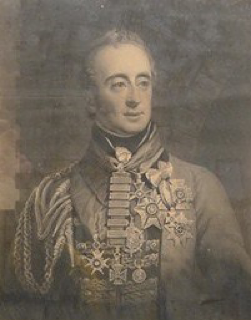
Sir Richard Church CB GCH, Anglo-Irish military officer in the British Army and commander of the Greek forces during the last stages of the Greek War of Independence after 1827, dies in Athens, Kingdom of Greece, on March 20, 1873. After Greek independence, he becomes a general in the Hellenic Army and a member of the Greek Senate.

Church is born on February 23, 1784, the second son of Matthew Church, a Quaker merchant in the North Mall area of Cork, County Cork, and Anne Dearman, originally from Braithwaith, Yorkshire, England. At the age of sixteen, he runs away from home and enlists in the British Army. For this violation of its principles, he is disowned by the Religious Society of Friends, but his father buys him a commission, dated July 3, 1800, in the 13th Somerset Light Infantry. He serves in the demonstration against Ferrol, Spain, and in the expedition to Egypt under Sir Ralph Abercromby in 1801, where he takes part in the Battle of Abukir and the taking of Alexandria. After the expulsion of the French from Egypt he returns home but goes back to the Mediterranean in 1805 among the troops sent to defend the island of Sicily. He accompanies the expedition which lands in Calabria and fights a successful battle against the French at the Battle of Maida on July 4, 1806. He is present on this occasion as captain of a recently raised company of Royal Corsican Rangers. His zeal attracts the notice of his superiors, and he has begun to show his capacity for managing and drilling foreign levies. His Corsicans form part of the garrison of Capri from October 1806 until the island is taken by an expedition directed against it by Joachim Murat, in September 1808, at the very beginning of his reign as king of Naples. Church, who has distinguished himself in the defence, returns to Malta after the capitulation.

In the summer of 1809 Church sails with the expedition sent to occupy the French-occupied Ionian Islands. Here he increases the reputation he has already gained by forming a Greek regiment in British pay. On September 9, 1809, he takes the position of Major in the 1st Regiment Greek Light Infantry. On November 19, 1812, he becomes Lieutenant-Colonel of the unit, by then renamed The Duke of York’s Greek Light Infantry Regiment. Having gained the experience of managing foreign troops, he commands the regiments made up of Greeks he recruits himself in 1813, when he forms a second regiment composed of 454 Greeks (2nd Regiment Greek Light Infantry) to occupy Paxoi islands. These regiments include many of the men who are afterward among the leaders of the Greeks in the Greek War of Independence including Theodoros Kolokotronis, with whom he keeps a friendship and correspondence. He commands this regiment at the taking of the island of Santa Maura (Lefkada), on which occasion his left arm is shattered by a bullet.

During his slow recovery Church travels in northern Greece, in Macedonia, and to Constantinople. In the years of the fall of Napoleon (1813 and 1814) he is present as British military representative with the Austrian troops until the campaign which terminates in the expulsion of Murat from Naples. He draws up a report on the Ionian Islands for the Congress of Vienna, in which he argues in support, not only of the retention of the islands under the British flag, but of the permanent occupation by Britain of Parga and other formerly Venetian coastal towns on the mainland, then in the possession of Ali Pasha of Ioannina. The peace and the disbanding of his Greek regiment leaves him without employment, though his reputation is high at the war office, and his services are recognized by the grant of a Companion of the Order of the Bath.

In 1817, Church enters the service of King Ferdinand I of Naples as lieutenant-general, with a commission to suppress the brigandage then rampant in Apulia. Ample powers are given him, and he attains a full measure of success. In 1820 he is appointed governor of Palermo and commander-in-chief of the troops in Sicily. The revolution which breaks out in that year leads to the termination of his services in Naples. He escapes from violence in Sicily with some difficulty. At Naples he is imprisoned and put on trial by the government but is acquitted and released in January 1821. King George IV confers on him a Knight Commander of the Royal Guelphic Order in 1822. He is further promoted to Knight Grand Cross by William IV in 1837.

The rising of the Greeks against the Turks has his full sympathy from the beginning. But for some years he has to act only as the friend of the insurgents in England. In 1827 he takes the honourable but unfortunate step of accepting the commandership-in-chief of the Greek army. At the point of anarchy and indiscipline to which they have now fallen, the Greeks can no longer form an efficient army and can look for salvation only to foreign intervention. Church, who lands in March, is sworn archistrategos on April 15, 1827, but cannot secure loyal co-operation or obedience. The rout of his army in an attempt to relieve the Acropolis of Athens, then besieged by the Ottomans, proves that it is incapable of conducting regular operations. With the acropolis capitulated, he turns to partisan warfare in western Greece.

After the Battle of Navarino, and during the Kapodistrias period, Church is placed commander-in-chief of the Greek regular forces in Central Greece, together with Demetrios Ypsilantis. However, he surrenders his commission as a protest against the unfriendly government of Capodistrias on August 25, 1829. He lives the remainder of his life in Greece.

Church’s activity has beneficial results and leads to a rectification in 1832, in a sense favourable to Greece, of the frontier drawn by the Great Powers in the London Protocol (1830). Under King Otto, he occupies senior military positions. On October 3, 1833, he is promoted to lieutenant general in the Hellenic Army, and in January 1835 becomes commander of the forces in Continental Greece. On June 10, 1835, he is appointed head of the Secretariat of State for Military Affairs (Army Minister), becoming Inspector-General of the Army on October 28, 1836. He serves as a senator from 1844 to 1845. He is promoted to full general in February 1854, the grade being established for the first time for this purpose in the Hellenic Army.

Church dies following an illness on March 20, 1873. The funeral service takes place in the Anglican Church in Filellinon Street in the presence of King George I and a large number of official guests. Panagiotis Chalkiopoulos, the Minister of Justice, gives the funeral speech in Greek, while John Gennadius gives a speech in English. He is buried at the First Cemetery of Athens at public expense on March 27. The funeral monument has an inscription in English on the front and Greek on the back.

(Pictured: Portrait of Sir Richard Church, oil on cardboard by an unidentified artist, 1873)


Leave a comment

Death of Sir Thomas Drew, Architect & Antiquarian

Sir Thomas Drew, Anglo-Irish architect and antiquarian, dies in Dublin on March 13, 1910.

Drew is born on September 18, 1838, in Victoria Place, Belfast, into the large family of Rev. Thomas Drew, son of a Limerick grocer, and Isabella Drew (née Dalton). He is one of four sons and eight daughters of the couple, although most of the children die young. His sister, Catherine Drew, is a prominent London journalist and an early champion of women’s rights.

Drew is educated in Belfast and in 1854 articled to the Antrim county surveyor and architect Sir Charles Lanyon, before moving to work in Dublin in 1862, where he becomes principal assistant to William George Murray. In 1865, he becomes the diocesan architect of the united dioceses of Down, Connor and Dromore. From this point forward, church architecture is his principal activity. He is consulting architect for both St. Patrick’s Cathedral and Christ Church Cathedral in Dublin.

Drew marries Adelaide Anne, sister of William George Murray, in 1871.

Among other projects, Drew is responsible for the design of the Ulster Bank on Dame Street, Rathmines Town Hall and the Graduates’ Building at Trinity College Dublin (TCD). He takes an interest in historic buildings and is the first to draw serious attention to the architectural and historic importance of the St. Audoen’s Church, Dublin’s oldest parish church, in 1866. He produces detailed plans of the church for which he wins the Fitzgerald medal from the Royal Institute of the Architects of Ireland (RIAI), carries out excavations and draws up a paper on the church and its history.

From 1885 to 1892, Richard Orpen works with Drew as a managing assistant. Drew’s most significant work in Belfast is St. Anne’s Cathedral, completed in 1899.

Drew is knighted in the 1900 Birthday Honours and is the inaugural president of the Royal Society of Ulster Architects (RSUA), serving from 1901 to 1903. In addition, he is president of the Royal Institute of the Architects of Ireland (RIAI), the Royal Society of Antiquaries of Ireland (RSAI) and the Royal Hibernian Academy (RHA) and holds the chair in architecture at the National University of Ireland (NUI).

From 1879 onward Drew lives in Gortnadrew, one half of a pair of semi-detached houses of his own design, on Alma Road in Monkstown, County Dublin. For many years he serves as a commissioner of the local township of Blackrock, Dublin. He dies on March 13, 1910, a month after an unsuccessful operation for appendicitis. He is buried in Dean’s Grange Cemetery in the suburban area of Deansgrange in Dún Laoghaire–Rathdown, County Dublin.
Drew is commemorated in a memorial brass in Christ Church Cathedral, Dublin. His wife survives him by three years and in her will bequeaths back to the RIAI the loving cup presented to her husband in commemoration of his knighthood, and to the Belfast Municipal Museum and Art Gallery (Ulster Museum since 1962) an 1852 portrait of his father Thomas. A portrait of Drew by Walter Osborne is held in the National Gallery of Ireland (NGI) in Dublin.


Leave a comment

Death of Timothy Harrington, Journalist, Barrister & Politician

Timothy Charles Harrington, Irish journalist, barrister, nationalist politician and Member of Parliament (MP) in the House of Commons of the United Kingdom, dies in Dublin on March 12, 1910, following a stroke.

Harrington is born on September 20, 1851, in Castletownbere, County Cork, son of Denis Harrington and his wife, Eileen (née O’Sullivan). He is educated at the Catholic University of Ireland and Trinity College Dublin (TCD).

As a member of the Irish Parliamentary Party (IPP), Harrington represents Westmeath from February 1883 to November 1885. In 1885 he is elected for the new constituency of Dublin Harbour, which he represents until his death. He serves as Lord Mayor of Dublin three times from 1901 to 1904.

Harrington owns two newspapers, United Ireland and the Kerry Sentinel, and is a member of the so-called Bantry band of prominent nationalist politicians from the Bantry vicinity. They are also more pejoratively known as the Pope’s brass band. Tim Healy is another prominent member of this unofficial group.

In 1884, Harrington publishes a pamphlet, “Maamtrasna Massacres – Impeachment of the Trials,” in which he dismantles the Crown Prosecution’s case against the eight men accused of the murders of the Joyce family on August 17, 1882. He provides evidence that Crown Prosecutor George Bolton had deliberately suppressed evidence that would have acquitted Maolra Seoighe (English: Myles Joyce), who was hanged, and four men who were sentenced to twenty years of penal servitude.

Harrington is secretary and chief organiser of the Irish National League (INL), a supporter of Charles Stewart Parnell and is largely responsible for devising the agrarian Plan of Campaign in 1886. He becomes a Parnellite Nationalist when the party splits in 1891, continuing as secretary of the INL. In 1897 he proclaims himself an Independent Nationalist and sides with William O’Brien‘s United Irish League (UIL) from its early days. He is briefly considered as a possible alternative to John Redmond as leader of the re-united Irish Parliamentary Party in 1900 when he stands in the 1900 United Kingdom general election Ireland as a Nationalist again.

Thereafter Harrington becomes excluded from Redmond’s closed circle of confidants, retains sympathy with O’Brien, and represents the interests of the tenant farmers at the 1902 Land Conference negotiations which lead to the enactment of the unprecedented Wyndham Land Purchase (Ireland) Act 1903.

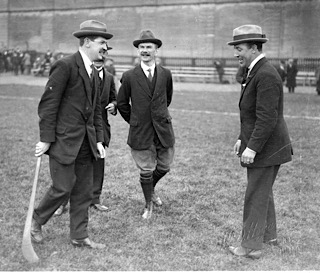
On September 7, 1901, as the Lord Mayor of Dublin, Harrington kicks off at the official ceremony to open Bohemian F.C.‘s new home, Dalymount Park.

Harrington retains the party nomination for the Dublin Harbour constituency in the January 1910 United Kingdom general election, largely because of local divisions about who should succeed him and because an O’Brienite offer to pay his election expenses deters rivals from going to the polls. He decides that the finely balanced result of the general election means that every nationalist vote would be required at Westminster. He therefore travels to London, but shortly after attending the parliamentary party meeting on February 23 he suffers a stroke. After some days’ recuperation he is brought home to Dublin, but his condition deteriorates and he dies on March 12, 1910, at his home, 70 Harcourt Street. He is buried near the Parnell circle at Glasnevin Cemetery.

Harrington is celebrated by a statue erected in 2001 at the east end of Castletownbere near the Millbrook bar.


Leave a comment

Birth of Eamonn Duggan, Lawyer & Politician

Eamonn Seán Duggan, Irish lawyer and politician, is born in Richhill, County Armagh, on March 2, 1878. He serves as Minister for Home Affairs (Jan 1922-Sep 1922), Minister without portfolio (Sep 1922-Dec 1922), Parliamentary Secretary to the Executive Council (1922-26), Parliamentary Secretary to the Minister for Finance (1926-27) and Government Chief Whip and Parliamentary Secretary to the Minister for Defence (1927-32). He serves as a Teachta Dála (TD) (1918-33) and a Senator (1933-36).

Duggan is the son of William Duggan, a Royal Irish Constabulary (RIC) officer, and Margaret Dunne. He is a cousin of revolutionaries Thomas Burke and Christopher Burke through his mother. His parents meet when his father, a native of County Wicklow, is stationed in Longwood, County Meath, where they marry on October 19, 1874. His father is transferred to County Armagh the following year as officers cannot serve in their wife’s native county.

In 1911, Duggan is living with his parents on St. Brigid’s Road Upper in Drumcondra, Dublin. After his school education, he begins work as a law clerk. During his early years, he becomes heavily involved in politics after he qualifies as a solicitor and sets up a practice at 66 Dame Street in Dublin. He marries Evelyn Kavanagh, and they have one son.

In 1916, as a keen supporter of Irish independence, Duggan is serving in the North Dublin Union in the days approaching the 1916 Easter Rising. One of his close friends, Thomas Allen, is shot while Duggan is at the Four Courts. His efforts to get medical assistance are unsuccessful at Richmond Hospital as the British officer who responds to the call declines the message and does not allow it to go through. Eventually medical assistance is received but it is too late for Allen. In Duggan’s region, the volunteers suffer very few injuries with the most violent fighting taking place on Friday night and Saturday morning.

Duggan suffers the consequences and is subject to court-martial and then sentenced to three years penal servitude. He is interned in Maidstone, Portland and Lewes prisons. Under the general amnesty of 1917, he is released after fourteen months in prison and returns to Dublin where he goes back to studying law.

Duggan is elected to the First Dáil Éireann as a Sinn Féin TD for South Meath following the 1918 United Kingdom general election in Ireland. The Drogheda Independent reports “Never before was a successful candidate accorded such a princely reception.”

Duggan engages in the Irish War of Independence in the role of IRA Director of Intelligence, which comes to an end in November 1920 when he is imprisoned again and is not released until the Anglo-Irish Truce of July 1921. When the truce concludes, he is authorised as one out of the five envoys to discuss and finalise the treaty with the British Prime Minister David Lloyd George. He signs the Anglo-Irish Treaty at 22 Hans Place, London.

Duggan retains numerous ministerial posts in the Cumann na nGaedheal government. In 1921, he plays a role in the Irish delegation throughout the Anglo-Irish discussions, then playing a dominant role in liaising with British officials.

After the post-treaty government, Duggan is appointed the Minister for Home Affairs and shortly afterward he becomes the Parliamentary Secretary for the Executive Council and the Minister for Defence. He continues in various roles as a TD until 1933. These include Government Chief Whip from 1927 to 1932. Until 1933, he is a Cumann na nGaedheal TD for Meath. In 1933, he declines to go forward for the general election but is elected to Seanad in April 1933. He also is involved in local politics in Dún Laoghaire as the chairman of the borough council until his death in 1936.

Duggan writes papers which reflect on his engagement in the Easter Rising. In his letters, he writes about the tough times of imprisonment. He also writes about his participation in Sinn Féin and his triumph in being a candidate for the South Meath constituency. Most of his papers consist of letters to his fiancée and later wife, May Duggan, which are written while in prison. His time as a TD is also included. In one letter, which he writes on April 25, 1916, he references “the whole damn family” consisting of information as to how his volunteers and he are being “treated as princes” by the nuns in the nearby convent, receiving help from the children in the area and building barricades. In his letter, he also writes about morale among his comrades and hearing of rumours about a German who had landed in County Kerry. In the note, he states that the letter should be sent to May Duggan who is his fiancée at the time. At the end of the letter he refers to himself as “Edmund” by which he is also known.

Duggan dies suddenly at his home in Dún Laoghaire, Dublin, on June 6, 1936, at the age of 58, and is buried in Glasnevin Cemetery on the north side of Dublin.