seamus dubhghaill

Promoting Irish Culture and History from Little Rock, Arkansas, USA


Leave a comment

The Ebrington Barracks Bombing

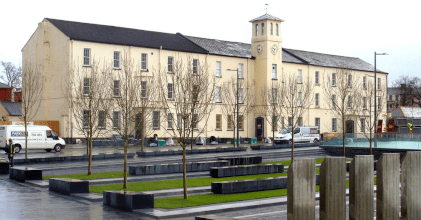
On April 6, 2000, the Real Irish Republican Army lowers a device consisting of 5 lbs. of homemade explosives over the perimeter fence of Ebrington Barracks at Browning Drive in the Waterside area of Derry, County Derry, Northern Ireland, using ropes, and the bomb subsequently explodes damaging the fence and the guardhouse. The explosion takes place around 6:30 a.m.

There are no reports of any casualties and army technical experts are at the scene shortly after the blast.

Gregory Campbell, security spokesman for the anti-agreement Democratic Unionist Party, visits the scene and says the blast bears similarities to an incident at Ballykelly, twelve miles away, in February 2000. He adds, “In Ballykelly there was a breach of the security fence, with the bomb planted near sleeping quarters. Here it was beside a former guardhouse. It appears to have been outside the perimeter.”

Campbell also claims that in recent months the base’s watchtowers had not been manned. “I get the impression that security has become a bit lax since the ceasefire,” he says. “This is confirmation of what we all knew was coming, a determined effort by paramilitary groups.”

Campbell continues, “When you look at the past few months it is very obvious that these groups – if they are splinter groups, if they are people who are leaving the Provisional IRA to join these dissidents or if the Provisional IRA is giving a wink and a nod to these dissidents – it is as plain as the nose on your face these people are developing terrorist capabilities.”

“When there is a device at a security cordon and another device inside another camp 12 miles down the road from here it is very obvious they are working towards a major attack with loss of life. Within a few months we are going to be faced with a major onslaught,” Campbell adds.

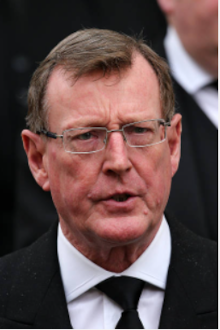
Meanwhile, Ulster Unionist Party (UUP) leader David Trimble, speaking in advance of a House of Commons debate warning of damaging consequences if the government presses on with moves to rename the Royal Ulster Constabulary, says it appears that the blast at the barracks in Derry is part of a wider campaign of low level terrorist activity by dissident republicans. Speaking on BBC Radio Trimble says, “There have been a number of incidents recently which have been attributed to dissident republicans. This may be another one. And there is reason to believe that dissident republicans are trying to launch a sustained campaign.”

(From: “Explosion at army camp,” BBC News, http://www.news.bbc.co.uk/, Thursday, April 6, 2000)


Leave a comment

Death of Edward Daly, Catholic Bishop of Derry

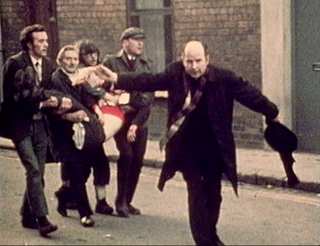
The retired Catholic Bishop of Derry, Dr. Edward Daly, whose photograph becomes the iconic image of Bloody Sunday in 1972, dies at the age of 82 on August 8, 2016.

Daly is born in Ballyshannon, County Donegal, but raised in Belleek, County Fermanagh in Northern Ireland. He attends and boards at St. Columb’s College in Derry on a scholarship, after which he spends six years studying towards ordination to the priesthood at the Pontifical Irish College in Rome. He is ordained a priest of the Diocese of Derry in Belleek on March 16, 1957. His first appointment is as a Curate in Castlederg, County Tyrone. In 1962, he is appointed a Curate in St. Eugene’s Cathedral in Derry, with responsibility for the Bogside area of the city. He leaves briefly in the 1970s to serve as a religious advisor to RTÉ in Dublin in the Republic of Ireland but spends the majority of his career in Derry.

During his time in Derry, Daly takes part in the civil rights marches. He has first-hand experience of the Battle of the Bogside in 1969, the early years of the Troubles, internment, and the events of Bloody Sunday, in which British soldiers fire on unarmed protesters on January 30, 1972, killing 14 people. He becomes a public figure after he is witnessed using a blood-stained handkerchief as a white flag in an attempt to escort 17-year-old Jackie Duddy, a wounded protester, to safety. Duddy dies of his injuries soon after and Daly administers the last rites. He later describes the events as “a young fella who was posing no threat to anybody being shot dead unjustifiably.”

Daly gives an interview to the BBC in which he insists, contrary to official reports, that the protesters were unarmed. He testifies as such to the Widgery Tribunal, though he also testifies that he had seen a man with a gun on the day, to the anger of some of those involved. The Widgery Report largely exonerates the British Army, perpetuating the controversy. Years later, he says that the events of Bloody Sunday were a significant catalyst to the violence in Northern Ireland, and that the shootings served to greatly increase recruitment to the Irish Republican Army (IRA).

Prior to Bloody Sunday, Daly is sympathetic to the “old” IRA, of which his father was a member, but the events of Bloody Sunday leave him of the opinion that “violence is completely unacceptable as a means to a political end,” which leads to tension with the Provisional Irish Republican Army throughout his career.

Daly is appointed Bishop of Derry in 1974, a position he holds until he is forced to retire in October 1993 after suffering a stroke. He continues in the role of chaplain to Derry’s Foyle Hospice until February 2016.

Daly makes headlines in 2011 when he says there needs to be a place in the modern Catholic Church for married priests. He addresses the controversial issue in his book about his life in the Church, A Troubled See. Allowing clergymen to marry would ease the church’s problems, he says.

Daly is awarded the Freedom of the City by Derry City Council in 2015 in a joint ceremony with Bishop James Mehaffey, with whom he had worked closely while the two were in office. He is “hugely pleased to accept [the award], particularly when it is being shared with my friend and brother, Bishop James.” The city’s mayor, Brenda Stevenson, announces that the joint award is in recognition of the two bishops’ efforts towards peace and community cohesion.

Daly dies on August 8, 2016, at Altnagelvin Area Hospital in Derry, having been admitted after a fall several weeks previously. He had also been diagnosed with cancer. He is surrounded by family and local priests.

Daly’s remains are taken to St. Eugene’s Cathedral, where he lay in state with mourners able to file past. His coffin is sealed at midday on August 11, 2016, and buried after Requiem Mass in the grounds of St. Eugene’s Cathedral alongside his predecessor as Bishop of Derry, Neil Farren. The bells of the cathedral toll for one hour on the morning of Daly’s death while many local people arrived to pay tribute. The mayor of Derry, Hilary McClintock, opens a book of condolence in the city’s guildhall for members of the public to sign. The funeral, conducted by the incumbent Bishop of Derry Donal McKeown, is attended by multiple religious and political leaders from across Ireland and retired leaders from throughout his career. A message from Pope Francis is read aloud at the beginning of the service. Hundreds of members of the public also attend the funeral, some lining the route from the cathedral to the gravesite. His coffin is greeted with applause as it is carried out of the cathedral for burial.

(Pictured: Father Edward Daly, waving a blood-stained white handkerchief as he escorts a mortally-wounded protester to safety during the events of Bloody Sunday (1972) in Derry, Northern Ireland, an image which becomes one of the most recognisable moments of the Troubles)


Leave a comment

Death of Northern Irish Artist Basil Blackshaw

Basil Blackshaw, Northern Irish artist, dies at the age of 83 on May 2, 2016. He is best known for his paintings of dogs, horses, landscapes and people and is regarded as one of the country’s most talented artists.

Blackshaw is born in 1932 in Glengormley, County Antrim, Northern Ireland and raised in Boardmills in Lisburn, County Down. He attends Methodist College Belfast and studies at Belfast College of Art (1948–1951). In 1951 he is awarded a scholarship to study in Paris by the Committee for the Encouragement of Music and the Arts.

Blackshaw’s home and studio is in County Antrim by Lough Neagh. He becomes well known for his country scenes including landscapes, farm buildings and horses, painted in an expressionist style.

Blackshaw is initially acclaimed for his mastery of traditional approaches to painting. He continues to develop as an artist, becoming most highly regarded for his very loose gestural application of paint and a very distinctive and subtle use of colour. His paintings of such sports as horse racing and boxing make him particularly popular, but he is also a talented portrait painter.

Blackshaw’s paintings are often figurative in form, but with a non-naturalistic palette which re-balances the composition in an expressionist, even abstract, way. His themes are very Irish and often rural; greyhounds, Irish Travellers, and the landscape. He also produces portraits and designs posters for Derry‘s Field Day Theatre Company.

The Arts Council of Northern Ireland organises a major retrospective of Blackshaw’s work in 1995, which travels from Belfast to Dublin, Cork and many galleries in the United States. In 2001 he receives the GlenDimplex Award for a Sustained Contribution to the Visual Arts in Ireland. The Ulster Museum holds a major exhibition of his work in 2002 and a major book is published by Eamonn Mallie on the artist in 2003.

For a 2005 exhibition at the Fenton Gallery in Cork, Blackshaw works exclusively over a period of 20 months creating a dramatic collection of fifteen new paintings. His choice of arguably mundane subjects, The Studio Door, Car, Wall, Six Trees, express both an engagement with tradition and a watchful detachment.

In 2006 Blackshaw’s work is exhibited at the Irish College in Paris (French: Centre Culturel Irlandais).

Blackshaw is elected as an associate of The Royal Ulster Academy of Arts in 1977 and elected an Academician in 1981. Dublin’s Royal Hibernian Academy describes him as “one of Ireland’s greatest artists” who was “lauded by the art world and his fellow painters.”

Basil Blackshaw dies on May 2, 2016. Father to well-known artist Anya Waterworth, he is buried in a wicker coffin in a humanist funeral, the ceremony ending to Bob Dylan‘s “Mr. Tambourine Man” at Roselawn Cemetery on the outskirts of Belfast. More than 100 mourners come to pay their respects. Among them are artists Jack Pakenham and Neil Shawcross, actor Stephen Rea and boxing legend Barry McGuigan.


Leave a comment

Gerry Adams & David Trimble Meet at Stormont

On November 4, 2002, Ulster Unionist leader David Trimble and Sinn Féin president Gerry Adams meet face-to-face for the first time since the suspension of Northern Ireland‘s power-sharing government in an attempt to break the deadlock in the peace process. They meet at Stormont as Secretary of State for Northern Ireland, Paul Murphy, continues his round of meetings with the political parties in an attempt to find a way to end the deadlock.

The province’s institutions are suspended on October 14 following a row over allegations of Irish Republican Army (IRA) activity, including alleged spying within the Northern Ireland Office (NIO).

Speaking after a 40-minute meeting with Trimble, Adams says they had had a “useful exchange of views.” But he adds, as expected, “there were very few conclusions in terms of the big picture….I asked Mr. Trimble how he thought things could be sorted out and Mr. Trimble had no particular suggestion to offer. But it was a good meeting.”

The Sinn Féin president says he had suggested to Trimble that each leader could address the executive of the opposite’s party. “He declined. But I hope he will think about the suggestion.”

Trimble says no significant developments came out of the meeting. He adds that the onus is on the republican movement to move the process forward. He dismisses Adams’s suggestion that they should address each other’s parties as a “stunt.”

Elsewhere on this date, Minister for Foreign Affairs Brian Cowen and Northern Secretary Paul Murphy also hold talks with a Social Democratic and Labour Party (SDLP) delegation in Dublin. Among the items on the agenda are how to restore the North’s devolved political institutions and whether or not the next Northern Ireland Assembly elections will be held as planned the following May.

Adams leaves for Washington, D.C. the following day, where he is expected to brief President George W. Bush‘s Special Envoy for Northern Ireland, Richard N. Haass. He also plans to visit New York, New Jersey and Canada for fund-raising events during his six-day trip.

(From: “Trimble Adams meeting ‘useful'”, BBC News, news.bbc.co.uk, November 5, 2002)


Leave a comment

Death of The Chieftains Harpist Derek Bell

George Derek Fleetwood Bell, harpist, pianist, oboist, musicologist and composer best known for his accompaniment work on various instruments with The Chieftains, dies unexpectedly on October 17, 2002 in Phoenix, Arizona during a recovery period from minor surgery.

Bell is born in Belfast, Northern Ireland. He is something of a child prodigy, composing his first concerto at the age of twelve. He graduates from the Royal College of Music in 1957. While studying there, he became friends with the flautist James Galway. From 1958 to 1990 he composes several classical works, including three piano sonatas, two symphonies, Three Images of Ireland in Druid Times (in 1993) for harp, strings and timpani, Nocturne on an Icelandic Melody (1997) for oboe d’amore and piano and Three Transcendental Concert Studies (2000) for oboe and piano.

As manager of the Belfast Symphony Orchestra, Bell is responsible for maintaining the instruments and keeping them in tune. Out of curiosity, he asks Sheila Larchet-Cuthbert to teach him how to play the harp. In 1965 he becomes an oboist and harpist with the BBC Northern Ireland Orchestra. He serves as a professor of harp at the Academy of Music in Belfast.

Bell is briefly featured in a 1986 BBC documentary, The Celts, in which he discusses the role and evolution of the harp in Celtic Irish and Welsh society. He also appears with Van Morrison at the Riverside Theatre at the University of Ulster in April 1988.

Bell is an admirer of the music of Nikolai Karlovich Medtner and is the co-founder, with the bass-baritone Hugh Sheehan, of the first British Medtner Society which gives a series of successful concerts of Medtner’s music in the 1970s long before Medtner’s music is recognised as it is today.

On St. Patrick’s Day in 1972 Bell performs on the radio the music of Turlough O’Carolan, an 18th-century blind Irish harpist. At that time O’Carolan’s music is virtually unknown, though today almost every album of harp music contains one of his compositions. Working with him on the project are several members of The Chieftains. Bell becomes friends with the leader of The Chieftains, Paddy Moloney. For two precarious years, he records both with the BBC Northern Ireland Orchestra and with The Chieftains, until finally becoming a full-time member of the Chieftains in 1975.

Bell is the only member of the band to wear a necktie at every public performance. He favours socks with novelty designs, such as images of Looney Tunes characters. He wears scruffy suits, often with trousers that are too short. He is eccentric and tells obscene jokes. The title of his 1981 solo album Derek Bell Plays With Himself has a conscious double entendre.

While touring in Moscow he grabs his alarm clock and puts it in his pocket while rushing to catch a plane. He is then stopped by the Soviet police on suspicion of carrying a concealed weapon. Paddy Moloney affectionately calls him “Ding Dong” Bell. He relishes the eclectic collaborations, such as those with Van Morrison, Sting and the Chinese orchestra. In 1991 he records with his old friend James Galway. He is awarded an MBE in the 2000 Queen’s Birthday Honours for services to traditional music.

Bell dies of cardiac arrest in Phoenix, Arizona on October 17, 2002, just four days shy of his 67th birthday. He is remembered at Cambridge House Grammar School, Ballymena, as House Patron of Bell House.


Leave a comment

20th Anniversary of the 1981 IRA Hunger Strikes

hunger-strike-20th-anniversary

On August 12, 2001, loyalist protesters block a main road in north Belfast to prevent the republican Wolfe Tone Flute band from joining a parade in the Ardoyne district commemorating the 20th anniversary of the 1981 Irish Republican Army (IRA) hunger strikes.

The 20-minute blockade of the Ligoniel Road is in response to the local branch of the loyalist Apprentice Boys of Derry organisation being refused permission to drive their bus past the nationalist Ardoyne the previous day.

Billy Hutchinson, the Progressive Unionist Party Assembly member for Belfast North says, “Nationalists are saying that the Apprentice Boys can’t come down the Crumlin Road on a bus because it is seen to be a parade.” He adds further, “I think loyalists are saying if the Apprentice Boys can’t go down on a bus why should the Wolfe Tone band be allowed to go down on a bus?”

On August 11, police officers prevent the Ligoniel Walker Club of the Apprentice Boys of Derry from driving their bus down the Crumlin Road past the Ardoyne shops because it constitutes a parade and breaches a ruling by the Parades Commission. The club is prevented by the Commission from marching through the area and tries in vain to broker a last minute compromise to use their bus.

Gerry Kelly, Sinn Féin Assembly member for Belfast North, describes the loyalist protest as a “nonsense,” adding he does not believe that nationalist residents had objected to the organisation using their bus. “That is a decision the RUC (Royal Ulster Constabulary) took on the ground. I don’t think there would have been a problem from the people of Ardoyne,” he adds.

The Apprentice Boys vow to seek a judicial review into the decision to prevent them from traveling through the area to get to their main parade in Derry.

After a six and a half hour stand-off, Apprentice Boys representative Tommy Cheevers brands the Parades Commission a “farce.”

(From: “Hunger strike march blocked by loyalists” from The Irish Times, Sunday, August 12, 2001 | Photo credit: PA:Press Association)


Leave a comment

Death of Alex “Hurricane” Higgins, Snooker World Champion

alex-hurricane-higgins

Alexander Gordon “Alex” Higgins, Northern Irish professional snooker player, who is remembered as one of the most iconic figures in the game, dies in Belfast, Northern Ireland on July 24, 2010. He is nicknamed “Hurricane Higgins” because of his fast play.

Higgins is born in Belfast on March 18, 1949.  He starts playing snooker at the age of eleven, often in the Jampot club in his native Sandy Row area of south Belfast and later in the YMCA in the nearby city centre. At age fourteen and weighing seven and a half stone (47.6 kg), he leaves for England and a career as a jockey. However, he never makes the grade because, in his youth, he drinks a lot of Guinness and eats a lot of chocolate, making him too heavy to ride competitively. He returns to Belfast and by 1965, at the age of sixteen, he has compiled his first maximum break. In 1968 he wins the All-Ireland and Northern Ireland Amateur Championships.

Higgins turns professional at the age of 22, winning the World Snooker Championship at his first attempt in 1972, against John Spencer winning 37–32. Higgins is then the youngest ever winner of the title, a record retained until Stephen Hendry‘s 1990 victory at the age of 21. In April 1976, Higgins reaches the final again and faces Ray Reardon. Higgins leads 11–9, but Reardon makes four centuries and seven breaks over 60 to pull away and win the title for the fifth time with the score of 27–16. Higgins is also the runner-up to Cliff Thorburn in 1980, losing 18–16, after being 9–5 up. Higgins wins the world title for a second time in 1982 after beating Reardon 18–15 (with a 135 total clearance in the final frame). It was an emotional as well as professional victory for him. Higgins would have been ranked No. 1 in the world rankings for the 1982-1983 season had he not forfeited ranking points following disciplinary action.

Throughout his career, Higgins wins 20 other titles, one of the most notable being the 1983 UK Championship. In the final he trails Steve Davis 0–7 before producing a famous comeback to win 16–15. He also wins the Masters twice, in 1978 and in 1981, beating Cliff Thorburn and Terry Griffiths in the finals respectively. Another notable victory is his final professional triumph in the 1989 Irish Masters at the age of 40 when he defeats a young Stephen Hendry, which becomes known as “The Hurricane’s Last Hurrah.”

Higgins comes to be known as the “People’s Champion” because of his popularity, and is often credited with having brought the game of snooker to a wider audience, contributing to its peak in popularity in the 1980s. He has a reputation as an unpredictable and difficult character. He is a heavy smoker, struggles with drinking and gambling, and admits to using cocaine and marijuana.

First diagnosed with throat cancer in 1998, Higgins is found dead in bed in his flat on July 24, 2010. The cause of death is a combination of malnutrition, pneumonia, and a bronchial condition. Higgins’ funeral service is held in Belfast on August 2, 2010. He is cremated and his ashes are interred in Carnmoney Cemetery in Newtownabbey, County Antrim.


Leave a comment

David Cameron Issues Formal State Apology for Bloody Sunday

cameron-bloody-sunday-apology

On June 15, 2010, David Cameron, Prime Minister of the United Kingdom, issues a formal state apology for the “unjustified and unjustifiable” killing of fourteen civil rights marchers in Derry, County Londonderry, Northern Ireland by British soldiers on Bloody Sunday, January 30, 1972. Cameron says Lord Saville inquiry’s long-awaited report shows soldiers lied about their involvement in the killings and that all of those who died were innocent.

Bloody Sunday, as the events on January 30, 1972, come to be known, is one of the most controversial moments of the Troubles. Paramilitary open fire while trying to police a banned civil rights march. They kill 13 marchers outright, and, according to Saville, wound another 15, one of whom subsequently dies later in the hospital.

In the House of Commons of the United Kingdom, Cameron begins his statement by saying he is “deeply patriotic” and does not want to believe anything bad about his country. Cameron says the inquiry, a 5,000-page, 10-volume report, which takes twelve years to compile at a cost of almost £191m, is “absolutely clear” and there are “no ambiguities” about the conclusions. He adds, “What happened on Bloody Sunday was both unjustified and unjustifiable. It was wrong.”

The report concludes there is no justification for shooting at any of those killed or wounded on the march. “None of the firing by the Support Company [Paratroopers] was aimed at people posing a threat or causing death or serious injury.” The report adds that the shootings “were not the result of any plan to shoot selected ringleaders” and that none of those killed by British soldiers was armed with firearms and no warning was given by the soldiers.

“The government is ultimately responsible for the conduct of the armed forces, and for that, on behalf of the government and on behalf of the country, I am deeply sorry,” says Cameron. The inquiry finds that the order sending British soldiers into the Bogside “should not have been given.” Cameron adds the casualties were caused by the soldiers “losing their self-control.”

The eagerly awaited report does not hold the British government at the time directly responsible for the atrocity. It finds that there is “no evidence” that either the British government or the unionist-dominated Northern Ireland administration encouraged the use of lethal force against the demonstrators. It also exonerates the army’s then commander of land forces, Major General Robert Ford, of any blame.

Most of the damning criticism against the military is directed at the soldiers on the ground who fired on the civilians. Saville says that on Bloody Sunday there had been “a serious and widespread loss of fire discipline among the soldiers.” He concludes that many of the soldiers lied to his inquiry. “Many of these soldiers have knowingly put forward false accounts in order to seek to justify their firing.” Under the rules of the inquiry this conclusion means that soldiers could be prosecuted for perjury.

The report also focuses on the actions of two Republican gunmen on the day and says that the Official Irish Republican Army (IRA) men had gone to a prearranged sniping position. But Saville finds that their actions did not provoke in any way the shootings by the paramilitary regiment.

Relatives cheer as they watch the statement, relayed to screens outside the Guildhall in Derry. A minute of silence is held as thousands of supporters fill the square outside, waiting to be told about the report’s contents. A representative of each of the families speaks in turn and a copy of the hated report by Lord Widgery, which in 1972 accuses the victims of firing weapons or handling bombs, is torn apart by one of the families’ representatives.

Denis Bradley, who played a key part in secret talks that brought about the IRA ceasefire of 1994 and who was on the Bloody Sunday march in 1972, welcomes the report’s findings. The former Derry priest, who narrowly escaped being shot on the day, says he is “amazed” at how damning the findings are against the soldiers. He adds, “This city has been vindicated, this city has been telling the truth all along.”

(Pictured: Family and supporters watch David Cameron’s formal state apology in Guildhall Square in Derry, County Londonderry, Northern Ireland)


Leave a comment

Claire McCollum Proposes to Alastair Clarke

claire-mccollum

Claire McCollum, newsreader at Downtown Radio in Newtownards, County Down, Northern Ireland, makes headlines herself on February 29, 2000 when she proposes on air to Dungannon and Ulster rugby star Alastair Clarke and he accepts.

McCollum is born on June 5, 1974 in Carrickfergus, County Antrim. An MA graduate at the University of Dundee, she begins her career in broadcasting with Macmillan Media in 1997. She also works as a researcher for CNN and as a newsreader on Downtown Radio.

McCollum joins UTV in March 2000. As well as presenting and reporting for UTV Sport, she has also presented UTV News bulletins and Sport on Sunday.

In February 2009, McCollum announces she is leaving UTV as part of a voluntary redundancy scheme at the station. In an interview with a regional newspaper, she announces her intention to become a freelance broadcast journalist.

Following her departure from UTV, McCollum builds up her portfolio with BBC Northern Ireland. She becomes synonymous with many of Northern Ireland television’s highest profile events. She co-hosts BBC Proms in the Park at Titanic Slipways, the Olympic flame arriving at Belfast City Hall and the Clipper Homecoming in Derry.

McCollum also presents and reports on two series of the popular BBC Northern Ireland consumer programme In Your Corner and covers many major sporting events including the North West 200, Commonwealth Games in Manchester, Northern Ireland’s Football World Cup qualifiers, Tennis Legends in Belfast and the Belfast International Horse Show. She is also a regular presenter on Balmoral Agricultural Show and Children In Need programmes and hosts the second glittering ‘Celebrity Strictly Come Dancing’ extravaganza for Children in Need.

McCollum and Clarke have two children and reside in her hometown of Newtownabbey, County Antrim.


Leave a comment

Royals Visit St. Malachy’s Church in Belfast

royals-visit-st-malachys-church-belfast

Charles, Prince of Wales, and the Duchess of Cornwall fly into George Best Belfast City Airport on February 4, 2011 for a one-day visit to Northern Ireland. The primary focus of their visit is to view a £3.5 million restoration project at St. Malachy’s Church in Belfast.

First Minister Peter Robinson, who greets Prince Charles on the doorstep of the building, is quoted as saying “Northern Ireland has entered a new era. It is the first time in recent history that we have had a royal in a Roman Catholic Church here.” Robinson adds, “So it is a good start. It should send of an indication that respect, understanding and tolerance is growing in Northern Ireland.”

St. Malachy’s Church was destroyed by a Luftwaffe bomb in 1941, but in 2006 the Roman Catholic Diocese of Down and Connor embarked on a project to restore its original features. Robinson says, “It has been set out very well and has held on to the architecture of the original.”

Prince Charles also presides over the first inter-faith meeting of members of the four main churches, organised by the local branch of The Prince’s Regeneration Trust.

The Northern Ireland Trustee Fionnuala Jay-O’Boyle says, “It’s a hugely exciting event. Not only does it celebrate the fantastic restoration of St. Malachy’s Church, but equally it is very significant because we brought together a group of very senior church figures to begin the discussion of unlocking the potential of redundant churches.”

The Royal couple also visits the Palace Barracks, Holywood for a medal presentation. They meet the soldiers of 2nd Battalion, Mercian Regiment who are preparing for service in Afghanistan.

(Pictured: First Minister Peter Robinson greets the Prince of Wales on the doorstep of St. Malachy’s Church; From a BBC article “Royal visit to St Malachy’s Church is historic,” February 4, 2011)