Downey attends Thornhill College, a Catholic girls school. Her mother, Maureen O’Reilly Downey, a homemaker with an interest in the performing arts, dies of a heart attack at age 48 when Downey is 10 years old. Her father, Patrick Downey, is a schoolteacher by training but works as a mortgage broker. He dies when Downey is 20. Originally, she plans to be a painter and earns a Bachelor of Arts at Brighton College of Art. She studies BA(Hons) Expressive Arts at Brighton Polytechnic, which later becomes the University of Brighton. Based at the Falmer campus she combines Art and Drama for her degree.
Downey joins the Abbey Players in Dublin and tours the United States in a production of The Playboy of the Western World. She moves to New York after an agent, whom she met during the tour of The Playboy of the Western World, suggests she has potential for success there. She takes a job as a coat checker at an Upper West Side restaurant before getting cast in Broadway shows. The production leads to a nomination during the Broadway run for the Helen Hayes Award for Best Actress in 1991. She also stars on Broadway in The Circle with Rex Harrison and also at the Roundabout Theater and The Public Theater in New York City.
Downey stars in and is executive producer for a number of hit television movies for the CBS network. She is an ambassador for Operation Smile, a nonprofit medical service organization. On August 11, 2016, she is honored for her work as an actress and producer with a star on the Hollywood Walk of Fame. In her acceptance speech, she dedicates her star to the people of Derry and anyone who ever “walked Hollywood Boulevard with a dream in their hearts.”
Variety recognizes Downey and Burnett as “Trailblazers” and lists Downey as one of Variety’s “100 Most Powerful Women in Hollywood.” The Hollywood Reporter includes the couple in their “Most Influential People of 2013” and Downey as one of the “100 Women in Entertainment Power” in 2014. She is honored on Variety‘s “Women of Impact in 2014.” Downey and Burnett also produce The Dovekeepers (2015) based on the bestselling book by Alice Hoffman for CBS and A.D. The Bible Continues (2015) for NBC, Women of the Bible for Lifetime, and Answered Prayers (2015) for TLC. Downey is the executive producer of the documentary “Faithkeepers” about the persecution of Christians in the Middle East.
Downey is the author of two books, Love Is a Family (2001) and Box of Butterflies: Discovering the Unexpected Blessing All Around Us (2018).
Eames spends his early years in Larne, with the family later moving to Belfast. He is educated at the city’s Belfast Royal Academy and Methodist College Belfast before going on to study at Queen’s University Belfast, graduating LL.B. (Upper Second Class Honours) in 1960 and earning a Ph.D. degree in canon law and history in 1963. During his undergraduate course at Queen’s, one of his philosophy lecturers is his future Roman Catholic counterpart, Cahal Daly.
Turning his back on legal studies for ordination in the Church of Ireland, Eames embarks on a three-year course at the divinity school of Trinity College, Dublin in 1960, but finds the course “intellectually unsatisfying.” In 1963 he is appointed curate assistant at Bangor Parish Church, becoming rector of St. Dorothea’s in Belfast in 1966, the same year he marries Christine Daly.
During his time at St. Dorothea’s, in the Braniel and Tullycarnet area of east Belfast, Eames develops a “coffee bar ministry” among young people but is interrupted by the Troubles. He turns down the opportunity to become dean of Cork and in 1974 is appointed rector of St. Mark’s in Dundela in east Belfast, a church with strong family links to C. S. Lewis.
On May 9, 1975, at the age of 38, Eames is elected bishop of the cross-border Diocese of Derry and Raphoe. Five years later, on May 30, 1980, he is translated to the Diocese of Down and Dromore. He is elected to Down and Dromore on April 23 and that election is confirmed on May 20, 1980. In 1986, he becomes the 14th Archbishop of Armagh and Primate of All Ireland since the Church of Ireland’s break with Rome. It is an appointment that causes some level of astonishment among other church leaders.
Drumcree Church, a rural parish near Portadown, becomes the site of a major political incident in 1996, when the annual Orangemen‘s march is banned by the Chief Constable of the Royal Ulster Constabulary from returning to the centre of Portadown via the nationalist Garvaghy Road after attending worship at Drumcree Church. Public unrest and violence escalate over the next three summers as other parades come under first police and later commission sanction.
Eames, as diocesan bishop and civil leader finds himself immersed in the search for a resolution to the issue. Within the wider Church of Ireland there is unease as it is a broad church in theology and politics including within its congregations nationalists in the south and unionists in the north. Eames, along with the rector of Drumcree, has to navigate this political and social controversy and seeks political assistance to diffuse tension. Some bishops in the Republic of Ireland call for Eames to close the parish church, including Bishop John Neill who later becomes Archbishop of Dublin. He refuses to do so, believing this action could precipitate greater unrest and possible bloodshed.
Eames is, for many years, a significant figure within the general Anglican Communion. In 2003, the self-styled ‘divine optimist’ is appointed Chairman of the Lambeth Commission on Communion, which examines significant challenges to unity in the Anglican Communion. The Commission publishes its report, the Windsor Report, on October 18, 2004.
At the Church of Ireland General Synod in 2006 Eames announces his intention to retire on December 31, 2006. Church law permits him to continue as primate until the age of 75 but he resigns, in good health, at the age of 69. On January 10, 2007, the eleven serving bishops of the Church of Ireland meet at St. Patrick’s Cathedral in Dublin and elect Alan Harper, Bishop of Connor, as Eames’s successor.
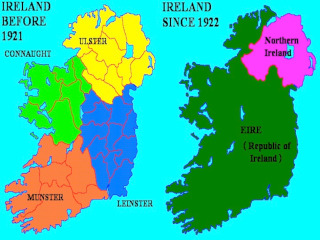
At the start of the twentieth century, the people of Ireland are divided into two mutually hostile factions. The much larger group (nationalists) are mostly Roman Catholic, identified primarily as Irish, and want some form of Irish home rule or independence from Britain. The smaller group (unionists), concentrated primarily in the province of Ulster, are mostly Protestant, identified primarily as British and are committed to remaining within the United Kingdom. In the years before World War I, both groups establish armed militias intended to enforce their aims and protect their communities from the other side’s militias. The British government resolves to partition Ireland in an effort to alleviate unionists and nationalists, with the six most Protestant counties of Ulster forming Northern Ireland while the rest of Ireland achieves self-rule. This is accepted by most unionists as the best deal they are likely to get, but bitterly disappoints many nationalists, especially those who live in the six counties which become Northern Ireland. Many nationalists on both sides of the border feel that their country has been unjustly divided, and for many decades the Irish government claims that Northern Ireland is rightfully its territory.
Partition is formally established with the Government of Ireland Act 1920. This also establishes the Parliament of Northern Ireland, which comes into being the following year. Partition is followed by high levels of inter-communal violence, especially in Belfast. The Irish Republican Army (IRA), although it spends most of these years fighting in the Irish Civil War, aims to use armed force to end partition and compel the United Kingdom to withdraw sovereignty from Northern Ireland.
The Special Powers Act is presented as being necessary to re-establish peace and law and order in Northern Ireland and enable the government to “take all such steps and issue all such orders as may be necessary for preserving the peace and maintaining order,” although it is specified that the ordinary course of law should be interfered with as little as possible. The Minister of Home Affairs is empowered to make any regulation felt necessary to preserve law and order in Northern Ireland. Anyone who breaks these regulations can be sentenced to up to a year in prison with hard labour, and in the case of some crimes, whipping. A special summary jurisdiction is enabled to hear cases involving such crimes. The Minister of Home Affairs is also permitted to forbid the holding of inquests if he feels this is required to preserve order and peace.
The Schedule to the Act specifies actions which the government can take in order to preserve peace, although the body of the Act enables the government to take any steps at all which it thinks necessary. Actions specified in the Schedule include the closing of licensed premises, the banning in any area of meetings and parades in public places, the closing of roads, the taking of any land or property, and the destruction of any building. The Schedule also forbids the spreading by word of mouth or text any “reports or…statements intended or likely to cause disaffection to subjects of His Majesty.”
Because it is presented as emergency legislation, the Special Powers Act is initially current for only one year and has to be renewed annually. In 1928, however, it is renewed for five years and when this period expires in 1933 the Act is made permanent. According to John Whyte, this happens because, from 1925, nationalist MPs begin sitting in the Stormont parliament which they had initially boycotted. Unsurprisingly, they object strenuously to the renewal of the Act, and it is felt by the Ulster Unionist Party Minister of Home Affairs that it would be better to make the Act permanent than for Parliament annually to “wrangle” over it.
Initially, regulations under the Act are used mostly to curb immediate violence and disorder. One of the most controversial of these is internment without trial, outlined in Paragraph 23 of the Schedule. In the period from May 1922 to December 1924, 700 republicans are interned under the Act.
Political violence declines dramatically by 1925, and the government gradually shifts its emphasis from broad measures designed to return civil order to the province to more preventative regulations aimed at suppressing the threat posed by republican aspirations. Regulations banning meetings and parades and restrictions on the flying of the Irish tricolour become more common. Between 1922 and 1950, the government bans nearly 100 parades and meetings, the vast majority of which are nationalist or republican. No loyalist gathering is ever directly banned under the Act, although a few are caught in blanket bans against parades or meetings in a particular area. From 1922 until 1972, 140 publications are banned, the vast majority of which express republican viewpoints.
After the troubles of the early 1920s has died down, the provision for internment is not used until the IRA’s border campaign of the 1950s, in which several hundred republicans are interned. Following the outbreak of the Troubles in 1968, many within the Protestant community call for the reintroduction of internment. This occurs in 1971 and authorises internment of those suspected to be involved in terrorism. Although there is loyalist as well as republican terrorists at this time, of the 1,981 men interned, only 107 are loyalists.
Internment ends in 1975 but is credited with increasing support and sympathy for the Provisional Irish Republican Army amongst the Catholic community and outside of Northern Ireland. It helps to create political tensions which culminate in the 1981 Irish Hunger Strike and the death of MP Bobby Sands. Imprisonment under anti-terrorism laws specific to Northern Ireland continue until the 1998 Good Friday Agreement, but these laws require the right to a fair trial be respected.
The Act encounters further controversy in the 1970s due to the deployment of the British Army in Northern Ireland and its role in maintaining order and similar policing-style duties. In 1972, the government is forced to amend the Act in order to legalise the detention of internees arrested by soldiers. Martin Meehan had been arrested after escaping from Crumlin Road Gaol and charged with escaping from lawful custody. At his trial he successfully argues that under the Special Powers Act a soldier has no power of arrest and, as such, he has the legal right to escape. He is awarded £800 in compensation for being illegally detained for twenty-three days.
Dennis Taylor, former professional snooker player and commentator, is born on January 19, 1949, in Coalisland, County Tyrone, Northern Ireland. He is most well-known for winning the 1985 World Snooker Championship, where he defeats Steve Davis with the final ball of the 35th frame in the final to seal an 18-17 win. During his playing career he wears distinctive specially designed glasses manufactured for snooker, often described as looking upside-down, giving him a unique look on the circuit.
Taylor is the son of a lorry driver and has six siblings. As an amateur, he wins the 1968 British Junior Billiards Championship. He turns professional in 1972. That season he makes his debut in the World Snooker Championship debut in the 1973 event, losing 8–9 to Cliff Thorburn in the first round. Over the next few years, he reaches the semi-finals at the event in 1975 and 1977. Two years later he reaches the 1979 final but loses 16–24 to qualifier Terry Griffiths. He reaches his highest world ranking for the following season, second behind Steve Davis.
Taylor reaches the semi-final for a third time in 1984, losing to Davis. His mother dies as he is beginning the new season at the 1984 Jameson International Open. He retires from the event before his quarter-final match against Silvino Francisco. However, he wins the first ranking event of his career at the 1984 Rothmans Grand Prix later that year defeating Thorburn 10–2 in the final.
Following his first ranking tournament victory, Taylor, seeded 11th, plays in the 1985 World Championship and reaches the final. In the final, he plays three-time winner and world number one Steve Davis. Never being ahead, he takes the match to a deciding frame with the scores tied at 17–17. Trailing 62–44 in the deciding frame with five coloured balls remaining, he pots a long brown ball, which he says is one of his best ever shots under pressure. He also pots the blue and pink to bring the score to 62–59 with one ball, worth seven points, remaining. Both players miss a shot on the black, but it is finally potted by Taylor to win the championship.
The final is considered by many to be the greatest snooker match in history and is broadcast to a peak audience of 18 million viewers in the United Kingdom. As of 2020 this is the highest viewership of any broadcast after midnight in the country, and a record for any programme shown on BBC Two. On his return to Northern Ireland, he is awarded the key to the city of Coalisland and receives a victory parade that 10,000 attend.
At the 1990 Snooker World Cup, Taylor teams with Alex Higgins and Tommy Murphy to form a Northern Irish team. After failing to win the tournament, Higgins threatens Taylor saying, “if you ever come back to Northern Ireland, I’ll have you shot.” Shortly afterwards they meet in the quarterfinals of the 1990 Irish Masters, and a determined Taylor wins 5–2. In the next decade, his form drops, and he falls out of the top 16 in the world rankings in 1995. He retires as a professional in 2000.
Following the end of his professional career, Taylor plays on the WPBSA World Seniors Tour and is featured as a commentator on BBC snooker broadcasts. He appears on the third series of Strictly Come Dancing, finishing eighth alongside dance partner Izabela Hannah. He currently lives in Llay near Wrexham, Wales.
Bleakley runs for the Westminster seat of Belfast East in 1970 (gaining 41% of the vote), February 1974 and October 1974 for the Northern Ireland Labour Party each time, but never enough to win the Westminister seat from the Ulster Unionist Party (UUP). In 1971, Brian Faulkner appoints him as his Minister for Community Relations at Stormont, but as Bleakley is not an MP, he can only hold the post for six months. He resigns five days before his term expires in order to highlight his disagreement with government policy, specifically the failure to widen the government to include non-Unionist parties, and the decision to introduce internment. He writes a respectful biography of Faulkner and his own memoir of the period.
After the Parliament is abolished, Bleakley stands for, and is elected to, the Northern Ireland Assembly and its successor, the Northern Ireland Constitutional Convention. He stands again for Belfast East in the February and October UK general elections, but wins only 14% of the vote each time.
Morrison is the son of Daniel and Susan Morrison. His father works as a painter at the Harland & Wolff shipyard in East Belfast. His uncles, including Harry White, had been jailed for their part in the IRA‘s Northern Campaign in the 1940s. He joins Sinn Féin in 1966 and helps to organise 50th anniversary commemorations of the Easter Rising in Belfast. At this time, he later recalls, “as far as we were concerned, there was absolutely no chance of the IRA appearing again. They were something in history books.”
After the 1969 Northern Ireland riots, in which nationalist areas of Belfast are attacked and burned, Morrison joins the newly formed Provisional IRA. After this, he is engaged in clandestine republican activities, but as late as 1971, is still attending Belfast College of Business Studies and editing a student magazine there. He is interned in Long Kesh Detention Centre in 1972.
Morrison’s talents for writing and publicity are quickly recognised within the republican movement and after his release in 1975 he is appointed editor of Republican News. In this journal, he criticises many long-standing policies of the movement. At this time, he becomes associated with a grouping of young, left-wing Belfast based republicans, led by Gerry Adams, who want to change the strategy, tactics and leadership of the IRA and Sinn Féin.
With the rise of Adams’ faction in the republican movement in the late 1970s, Morrison succeeds Seán Ó Brádaigh as Director of Publicity for Sinn Féin. During the 1981 Irish hunger strike, he acts as spokesman for the IRA hunger strikers’ leader Bobby Sands, who is elected to the British Parliament on an Anti H-Block platform.
Morrison is elected as a Sinn Féin Member for Mid Ulster of a short-lived Northern Ireland Assembly from 1982 to 1986. He also stands unsuccessfully for the European Parliament in 1984 and again in 1989. He also stands for the Mid Ulster Westminster seat in 1983 and 1986. Along with Owen Carron, he is arrested on January 21, 1982, while attempting to enter the United States illegally from Canada by car. He is deported and later both men are convicted on a charge of making false statements to US immigration officials.
Morrison is director of publicity for Sinn Féin from 1979 until 1990, when he is charged with false imprisonment and conspiracy to murder a British informer in the IRA, Sandy Lynch. He is sentenced to eight years in prison and is released in 1995.
Since 1989, Morrison has published several novels and plays on themes relating to republicanism and events in the modern history of Belfast. His latest play, The Wrong Man, opens in London in 2005. It is based on his 1997 book of the same name and deals with the career of an IRA man who is suspected by his colleagues of working for the police.
The Bobby Sands Trust (BST) is formed after the 1981 Hunger Strike where ten republican prisoners die due to their hunger strike protest against the UK Government. The legal firm Madden & Finucane continues to act for the Trust whose original members are Gerry Adams, Danny Morrison, Tom Hartley, Tom Cahill, Marie Moore and Danny Devenny. For a time, Bobby’s two sisters, Marcella and Bernadette, are members of the Trust. Current members still include Adams, Morrison and Hartley. The BST claims to hold copyright to all the written works of Bobby Sands. The family of Sands has been critical of the BST, and they have called for it to disband.
Morrison lives in West Belfast with his Canadian-born wife, Leslie. He has two sons from his first marriage.
Dobbs is born in County Antrim on November 19, 1871 to barrister Conway Edward Dobbs who is Justice of the Peace for County Antrim, High Sheriff for Carrickfergus in 1875 and High Sheriff for County Louth in 1882. Her mother is Sarah Mulholland, daughter of St. Clair Kelvin Mulholland of Eglantine, County Down. The family spends time living in Dublin where Dobbs is born. She attempts to learn Irish, however, when her father dies in 1898 her mother moves the family back to Glenariff.
Dobbs is interested in learning Irish and finds it easier to learn in County Donegal where it is still spoken. Her first teacher is Hugh Flaitile. She attends the Irish College at Cloughaneely in the Donegal Gaeltacht. She brings the idea of promoting the language to the Glens of Antrim and her circle of friends. She is one of the small number of Protestant women interested in the Gaelic revival.
The year 1904 sees the “Great Feis” in Antrim and Dobbs is a founder member of the Feis na nGleann committee and later a tireless literary secretary. In 1946, the Feis committee decides to honour her by presenting her with an illuminated address. It can be seen today at Portnagolan House with its stained glass windows commemorating a great Irishwoman. During her speech she says, “Ireland is a closed book to those who do not know her language. No one can know Ireland properly until one knows the language. Her treasures are hidden as a book unopened. Open the book and learn to love your language.”
Dobbs writes seven plays, published by Dundalgan Press in 1920, though only three are actually performed. The Doctor and Mrs. McAuley wins the Warden trophy for one-act plays at the Belfast festival in 1913. Her plays, however, are generally not a success and after 1920 she never writes another. She continues to work on historical and archaeological studies and her articles are published in the Ulster Journal of Archaeology, in a German magazine for Celtic studies, in the French Revue Celtique and in the Irish magazine Ériu.
Roger Casement is a good friend and although Dobbs never makes her political opinions known she contributes to his defence costs when he is accused of treason. Although her political views are not clearly known, Dobbs has been a member of the Gaelic League and in the executive of Cumann na mBan.
Dobbs dies at her home, Portnagolan House, Cushendall, on January 2, 1962.
The Irish Republican Army (IRA) begins what it calls “The Campaign of Resistance to British Occupation” on December 12, 1956. Also known as the “Border Campaign,” it is a guerrilla warfare campaign carried out by the IRA against targets in Northern Ireland, with the aim of overthrowing British rule there and creating a united Ireland. Although the campaign is a military failure, but for some of its members, the campaign is justified as it keeps the IRA engaged for another generation.
The border campaign is the first major military undertaking carried out by the IRA since the 1940s, when the harsh security measures of the Republic of Ireland and Northern Ireland governments had severely weakened it. In 1939 the IRA tries a bombing campaign in England to try to force British withdrawal from Northern Ireland. From 1942 to 1944 it also mounts an ineffective campaign in Northern Ireland. Internment on both sides of the border, as well as internal feuding and disputes over future policy, all but destroy the organisation. These campaigns are officially called off on March 10, 1945. By 1947, the IRA has only 200 activists, according to its own general staff.
Chief of Staff of the Irish Republican ArmyTony Magan sets out to create “a new Army, untarnished by the dissent and scandals of the previous decade.” Magan believes that a degree of political mobilization is necessary and the relationship with Sinn Féin, which had soured during the 1930s, is improved. At the 1949 IRA Convention, the IRA orders its members to join Sinn Féin, which partially becomes the “civilian wing” of the IRA.
By the mid-1950s, the IRA has substantially re-armed. This is achieved by means of arms raids launched between 1951 and 1954, on British military bases in Northern Ireland and England. By 1955, splits are occurring in the IRA, as several small groups, impatient for action, launch their own attacks in Northern Ireland. In November 1956, the IRA finally begins planning its border campaign.
On December 12 the campaign is launched with simultaneous attacks by around 150 IRA members on targets on the Border in the early hours. A BBCrelay transmitter is bombed in Derry, a courthouse is burned in Magherafelt by a unit led by an 18-year-old Seamus Costello, as is a B-Specials post near Newry and a half-built Army barracks at Enniskillen is blown up. A raid on Gough Barracks in Armagh is beaten off after a brief exchange of fire.
The IRA issues a statement announcing the start of the campaign, “Spearheaded by Ireland’s freedom fighters, our people have carried the fight to the enemy…Out of this national liberation struggle a new Ireland will emerge, upright and free. In that new Ireland, we shall build a country fit for all our people to live in. That then is our aim: an independent, united, democratic Irish Republic. For this we shall fight until the invader is driven from our soil and victory is ours.”
The year 1957 is the most active year of the IRA’s campaign, with 341 incidents recorded. The most dramatic attack of the whole campaign takes place on January 1 when fourteen IRA volunteers, including Séan Garland, Alan O Brien and Dáithí Ó Conaill plan an attack on a joint Royal Ulster Constabulary (RUC)/B-Specials barracks in Brookeborough, County Fermanagh, though they attack the wrong building. On 11 November, the IRA suffers its worst loss of life in the period when four of its members die preparing a bomb in a farmhouse at Edentubber, County Louth, which explodes prematurely. The civilian owner of the house is also killed.
By 1958, the campaign’s initial impetus has largely dissipated. Certain IRA activities produce public hostility, and by 1958, there are already many within the IRA in favour of calling off the campaign. The Cork IRA, for instance, has effectively withdrawn. By mid-1958, 500 republicans are in gaol or interned, North and South.
The period after the summer of 1958 sees a steep drop in the intensity of the IRA campaign. That the IRA’s campaign had run its course by 1960 is testified by the fact that the Republic of Ireland’s government closes the Curragh Camp, which housed internees in the South, on March 15, 1959, judging them to be no further threat. The Northern Irish government follows suit on April 25, 1961.
In November 1961 a RUC officer, William Hunter, is killed in a gun battle with the IRA in south County Armagh. This is the final fatality of the conflict. Minister for JusticeCharles Haughey reactivates the Special Criminal Court, which hands down long prison sentences to convicted IRA men.
Although it had petered out by the late 1950s, by late 1961 the campaign is over and is officially called off on February 26, 1962, in a press release issued that day, drafted by Ruairí Ó Brádaigh who consults with several other persons including members of the IRA Army Council. The campaign costs the lives of eight IRA men, four republican supporters and six RUC members. In addition, 32 RUC members are wounded. A total of 256 Republicans are interned in Northern Ireland during this period and another 150 or so in the Republic. Of those in Northern Ireland, 89 sign a pledge to renounce violence in return for their freedom.
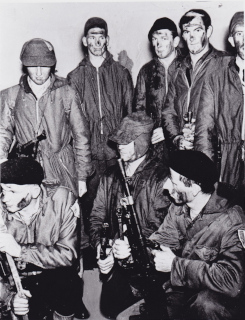
(Pictured: A group of IRA men before embarking on an operation in the 1950s | Photo credited to http://laochrauladh.blogspot.ie/)
The six counties of what would become Northern Ireland opt out of the Irish Free State on December 7, 1922, and become a separate political entity with allegiance to England.
As originally enacted, the Irish Free State Constitution Act 1922 consists of a preamble, five sections (three of which are very brief), and a schedule. The schedule is the text of the Constitution of the Irish Free State (Saorstát Éireann) Act 1922, which had been passed in Ireland by the Third Dáil sitting as a constituent assembly and provisional parliament for the nascent Free State. This Irish Act itself has two schedules, the first being the actual text of the Constitution, and the second the text of the 1921 Treaty, formally the Articles of Agreement for a treaty between Great Britain and Ireland.
The Irish Act had been approved by the Irish constituent assembly on 25 October 25, 1922. The bill for the UK Act is introduced by the Prime MinisterBonar Law into the Parliament of the United Kingdom in November 1922. The bill’s third reading in the House of Commons is on November 30. The Act receives Royal assent on December 5, 1922.
On December 7, 1922, the day after the establishment of the Irish Free State, the Parliament of Northern Ireland addresses King George V requesting its secession from the Irish Free State. The address is unanimous, with the abstentionistNationalist Party and Sinn Féin members absent. The King replies shortly thereafter to say that he has caused his Ministers and the Government of the Irish Free State to be informed that Northern Ireland is to do so.
After the Statute of Westminster 1931, the UK government recognises the right of the Irish government to amend or repeal the UK act, but in fact the Irish government does not do so until it is formally repealed as spent by the Statute Law Revision Act 2007. The Irish government amends the Irish act in 1933 and the 1937 Constitution of Ireland repeals the entire Free State constitution. The UK Judicial Committee of the Privy Council rules in 1935 that the 1933 Act had implicitly amended the UK Act with respect to the jurisdiction of the Free State. The Supreme Court of Ireland has taken the view that the Free State constitution was enacted by the Irish Act, not by the subsequent UK Act. This reflects the view of popular sovereignty rather than parliamentary sovereignty, with the constitution’s legitimacy ultimately springing from the 1922 Irish general election.
Logue is born in Kilmacrennan, County Donegal in the west of Ulster on October 1, 1840. He is the son of Michael Logue, a blacksmith, and Catherine Durning. From 1857 to 1866, he studies at Maynooth College, where his intelligence earns him the nickname the “Northern Star.” Before his ordination to the priesthood, he is assigned by the Irish bishops as the chair of both theology and belles-lettres at the Irish College in Paris in 1866. He is ordained priest in December of that year.
Logue remains on the faculty of the Irish College until 1874, when he returns to Donegal as administrator of a parish in Letterkenny. In 1876, he joins the staff of Maynooth College as professor of Dogmatic Theology and Irish language, as well as the post of dean.
On May 13, 1879, Logue is appointed Bishop of Raphoe by Pope Leo XIII. He receives his episcopal consecration on the following July 20 from Archbishop Daniel McGettigan, with Bishops James Donnelly and Francis Kelly serving as co-consecrators, at the pro-cathedral of Raphoe. He is involved in fundraising to help people during the 1879 Irish famine, which, due to major donations of food and government intervention never develops into a major famine. He takes advantage of the Intermediate Act of 1878 to enlarge the Catholic high school in Letterkenny. He is also heavily involved in the Irish temperance movement to discourage the consumption of alcohol.
Logue publicly supports the principle of Irish Home Rule throughout his long reign in both Raphoe and Armagh, though he is often wary of the motives of individual politicians articulating that political position. He maintains a loyal attitude to the British Crown during World War I, and on June 19, 1917, when numbers of the younger clergy are beginning to take part in the Sinn Féin agitation, he issues an “instruction” calling attention to the teaching of the Roman Catholic Church as to the obedience due to legitimate authority, warning the clergy against belonging to “dangerous associations,” and reminding priests that it is strictly forbidden by the statutes of the National Synod to speak of political or kindred affairs in the church.
Logue opposes the campaign of murder against the police and military begun in 1919, and in his Lenten pastoral of 1921 he vigorously denounces murder by whomsoever committed. This is accompanied by an almost equally vigorous attack on the methods and policy of the government. He endorses the Anglo-Irish Treaty in 1921.
In 1921, the death of Cardinal James Gibbons makes Logue archpriest (protoprete) of the College of Cardinals. He is more politically conservative than Archbishop of DublinWilliam Joseph Walsh, which creates tension between Armagh and Dublin. In earlier life he was a keen student of nature and an excellent yachtsman.
Cardinal Michael Logue dies in Ara Coeli, the residence of the archbishop, on November 19, 1924, and is buried in a cemetery in the grounds of St. Patrick’s Cathedral, Armagh.



 seamus dubhghaill