Earhart first makes headlines in 1928 when she becomes the first woman to cross the Atlantic as a passenger on a trans-Atlantic airplane flight. At the time of her 1932 flight, just one other person, Charles Lindbergh, has flown solo across the Atlantic. A female aviator, Ruth Nichols, attempts the flight in 1931, but crashes in Canada.
After departing Newfoundland, Earhart encounters many difficulties including fatigue, a leaky fuel tank, and a cracked manifold that spews flames out the side of the engine cowling. Ice forms on her Lockheed Vega 5B‘s wings and causes an unstoppable 3,000-foot descent to just above the waves.
Earhart’s plan is to fly to Paris, which was also Lindbergh’s destination, but the weather and mechanical problems force her to land at a farm near Derry, completing the flight in 14 hours and 56 minutes. She describes her landing in a pasture, “After scaring most of the cows in the neighborhood, I pulled up in a farmer’s back yard.”
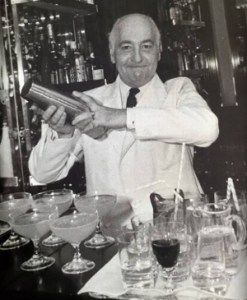
Joe Gilmore, one of the longest running Head Barmen at the Savoy Hotel‘s American Bar, is born in Belfast on May 19, 1922.
The Gilmores own a popular tobacconist shop at the top of the Limestone Road, which remains in business through the Troubles until the mid-1990s. But Gilmore has plans to go places so, at the age of sixteen, he sets out with a friend for London.
His first job is packing rolls of wallpaper at a Sanderson’s factory before moving to a Lyons Corner House as a dish washer with the prospect of getting some decent dinners. He begins training as a barman at London’s La Coquille and The Olde Bell at Hurley, where a chance encounter serving a stylish couple sets the scene for the remarkable life that follows.
At the age of eighteen, Gilmore starts as a trainee barman at The American Bar in 1940 and is appointed Head Barman in 1955, a position he holds until he retires in 1976. Over his years as Head Barman, Gilmore invents numerous cocktails to mark special events and important guests, a longstanding tradition at the American Bar.
Gilmore never forgets his Irish roots or family, and never loses his soft Belfast accent. Joe Gilmore dies at the age of 93 on December 18, 2015. His funeral is arranged by A. France & Son, undertakers to Admiral Nelson and near-neighbours in Lamb Conduit Street for more than 50 years. The Savoy sends their senior management and bar staff in their smart white uniforms.
O’Sullivan is the daughter of Evangeline “Mary Eva” Lovatt and Charles Joseph O’Sullivan, an officer in the Connaught Rangers who serves in World War I. She attends a convent school in Dublin, then the Convent of the Sacred Heart at Roehampton, England. One of her classmates there is Vivian Mary Hartley, future Academy Award-winning actress Vivien Leigh. After attending finishing school in France, O’Sullivan returns to Dublin to work with the poor.
O’Sullivan’s film career begins when she meets motion picture director Frank Borzage, who is doing location filming on Song o’ My Heart for 20th Century Fox. He suggests she take a screen test, which she does, and wins a part in the movie, which stars Irish tenor John McCormack. She travels to the United States to complete the movie in Hollywood. O’Sullivan appears in six movies at Fox, then makes three more at other movie studios.
In 1932, she signs a contract with Metro-Goldwyn-Mayer. After several roles there and at other movie studios, she is chosen by Irving Thalberg to appear as Jane Parker in Tarzan the Ape Man, opposite co-star Johnny Weissmuller. She is one of the more popular ingenues at MGM throughout the 1930s and appears in a number of other productions with various stars. In all, O’Sullivan plays Jane in six features between 1932 and 1942.
She plays another Jane in Pride and Prejudice (1940) with Laurence Olivier and Greer Garson and supports Ann Sothern in Maisie Was a Lady (1941). After appearing in Tarzan’s New York Adventure (1942), O’Sullivan asks MGM to release her from her contract so she can care for her husband who has just left the Navy with typhoid. She retreats from show business, devoting her time to her family. In 1948, she re-appears on the screen in The Big Clock, directed by her husband for Paramount Pictures. She continues to appear occasionally in her husband’s movies and on television. However, by 1960 she believes she has permanently retired. In 1958, Farrow’s and O’Sullivan’s eldest son, Michael, dies in a plane crash in California.
Actor Pat O’Brien encourages her to take a part in summer stock, and the play A Roomful of Roses opens in 1961. That leads to another play, Never Too Late, in which she co-stars with Paul Ford in what is her Broadway debut. Shortly after it opens on Broadway, John Farrow dies of a heart attack. O’Sullivan sticks with acting after Farrow’s death. She is also an executive director of a bridal consulting service, Wediquette International. In June and July 1972, O’Sullivan is in Denver, Colorado, to star in the Elitch Theatre production of Butterflies are Free with Karen Grassle and Brandon deWilde. The show ends on July 1, 1972. Five days later, while still in Denver, deWilde is killed in a motor vehicle accident.
When her daughter, actress Mia Farrow, becomes involved with Woody Allen both professionally and romantically, she appears in Hannah and Her Sisters, playing Farrow’s mother. She has roles in Peggy Sue Got Married (1986) and the science fiction oddity Stranded (1987). Mia Farrow names one of her own sons Ronan O’Sullivan Farrow for her mother. In 1994, she appears with Robert Wagner and Stefanie Powers in Hart to Hart: Home Is Where the Hart Is, a feature-length made-for-TV movie with the wealthy husband-and-wife team from the popular weekly detective series Hart to Hart.
Maureen O’Sullivan dies in Scottsdale, Arizona, of complications from heart surgery on June 23, 1998, at the age of 87. O’Sullivan is buried at Most Holy Redeemer Cemetery, Niskayuna, New York. She is survived by six of her children, 32 grandchildren, and 13 great-grandchildren. Michael, her oldest son, is killed at age 19 in a plane crash in 1958.
In 484, Brendan is born in Tralee, County Kerry, in the province of Munster. He is born among the Altraige, a tribe originally centred around Tralee Bay, to parents called Finnlug and Cara. He is baptised at Tubrid, near Ardfert by Saint Erc, and is originally to be called “Mobhí” but signs and portents attending his birth and baptism lead to him being christened “Broen-finn” or “fair-drop.” For five years he is educated under Saint Ita, “the Brigid of Munster.” When he is six, he is sent to Saint Jarlath‘s monastery school at Tuam to further his education. Brendan is one of the “Twelve Apostles of Ireland,” one of those said to have been tutored by the great teacher, Finnian of Clonard.
At the age of twenty-six, Brendan is ordained a priest by Saint Erc. Afterwards, he founds a number of monasteries. Brendan’s first voyage takes him to the Aran Islands, where he founds a monastery. He also visits Hinba, an island off Scotland where he is said to meet Columcille. On the same voyage he travels to Wales, and finally to Brittany, on the northern coast of France. Between the years 512 and 530 Brendan builds monastic cells at Ardfert and, at the foot of Mount Brandon, Shanakeel— Seana Cill, usually translated as “the old church.” From here he supposedly sets out on his famous seven-year voyage for Paradise.
St. Brendan is chiefly renowned for his legendary journey to the Isle of the Blessed as described in the ninth century Voyage of St. Brendan the Navigator. Many versions exist that tell of how he sets out onto the Atlantic Ocean with sixteen pilgrims searching for the Garden of Eden. One of these companions is said to be Saint Malo, the namesake of Saint-Malo. This occurs sometime between 512 and 530 AD, before his travel to the island of Great Britain. On the trip, Brendan supposedly sees Saint Brendan’s Island, a blessed island covered with vegetation. He also encounters a sea monster, an adventure he shares with his contemporary, Saint Columba. The most commonly illustrated adventure is his landing on an island which turns out to be a giant sea monster called Jasconius or Jascon. This too, has its parallels in other stories, not only in Irish mythology but in other traditions, from Sinbad the Sailor to Pinocchio.
Brendan travels to Wales and the holy island of Iona, off the west coast of Scotland. Returning to Ireland, he founds a monastery at Annaghdown, where he spends the rest of his days. He also founds a convent at Annaghdown for his sister Briga. Having established the bishopric of Ardfert, St. Brendan proceeds to Thomond and founds a monastery at Inis-da-druim, in the present parish of Killadysert, County Clare, about the year 550. He then journeys to Wales and studies under Saint Gildas at Llancarfan, and then to Iona, for it is said that he leaves traces of his apostolic zeal at Kil-brandon and Kil-brennan Sound. After a three years’ mission in Britain, he returns to Ireland, and does more proselytising in various parts of Leinster, especially at Dysart, Killiney, and Brandon Hill. He establishes churches at Inchiquin, County Clare and at Inishglora, County Mayo, and founds Clonfert in County Galway around 557 AD.
Brendan dies on May 16, 577 at Annaghdown, while visiting his sister Briga. Fearing that after his death his devotees might take his remains as relics, Brendan arranges before his death to have his body secretly carried back to the monastery he founded at Clonfert concealed in a luggage cart. He is buried in Clonfert Cathedral.
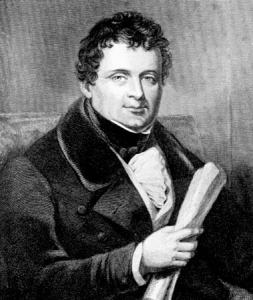
Daniel O’Connell, lawyer who becomes the first great 19th-century Irish nationalist leader and is known as “The Liberator,” dies in Genoa, Italy on May 15, 1847. Throughout his life, he campaigns for Catholic emancipation, including the right for Catholics to sit in the Westminster Parliament and the repeal of the Act of Union which combines Great Britain and Ireland.
Compelled to leave the Roman Catholic college at Douai, France, when the French Revolution breaks out, O’Connell goes to London to study law, and in 1798 he is called to the Irish bar. His forensic skill enables him to use the courts as nationalist forums. Although he has joined the Society of United Irishmen, a revolutionary society, as early as 1797, he refuses to participate in the Irish Rebellion of the following year. When the Act of Union takes effect on January 1, 1801, and abolishes the Irish Parliament, he insists that the British Parliament repeal the anti-Catholic laws in order to justify its claim to represent the people of Ireland. From 1813 he opposes various Catholic relief proposals because the government, with the acquiescence of the papacy, has the right to veto nominations to Catholic bishoprics in Great Britain and Ireland. Although permanent political organizations of Catholics are illegal, O’Connell sets up a nationwide series of mass meetings to petition for Catholic emancipation.
On May 12, 1823, O’Connell and Richard Lalor Sheil found the Catholic Association, which quickly attracts the support of the Irish priesthood and of lawyers and other educated Catholic laymen and which eventually comprises so many members that the government cannot suppress it. In 1826, when it is reorganized as the New Catholic Association, it causes the defeat of several parliamentary candidates sponsored by large landowners. In County Clare in July 1828, O’Connell himself, although as a Catholic ineligible to sit in the House of Commons, defeats a man who tries to support both the British government and Catholic emancipation. This result impresses on the British prime minister, Arthur Wellesley, 1st Duke of Wellington, the need for making a major concession to the Irish Catholics. Following the passage of the Catholic Emancipation Act of 1829, O’Connell, after going through the formality of an uncontested reelection, takes his seat at Westminster.
In April 1835, he helps to overthrow Sir Robert Peel’s Conservative ministry. In the same year, he enters into the “Lichfield House compact,” whereby he promises the Whig Party leaders a period of “perfect calm” in Ireland while the government enacts reform measures. O’Connell and his Irish adherents, known collectively as “O’Connell’s tail,” then aid in keeping the weak Whig administration of William Lamb, 2nd Viscount Melbourne, in office from 1835 to 1841. By 1839, however, O’Connell realizes that the Whigs will do little more than the Conservatives for Ireland, and in 1840 he founds the Repeal Association to dissolve the Anglo-Irish legislative union. A series of mass meetings in all parts of Ireland culminate in O’Connell’s arrest for seditious conspiracy, but he is released on appeal in September 1844 after three months’ imprisonment. Afterward his health fails rapidly, and the nationalist leadership falls to the radical Young Ireland group.
O’Connell dies at the age of 71 of cerebral softening in 1847 in Genoa, Italy, while on a pilgrimage to Rome. His time in prison has seriously weakened him, and the appallingly cold weather he has to endure on his journey is probably the final blow. According to his dying wish, his heart is buried at Sant’Agata dei Goti, then the chapel of the Irish College, in Rome and the remainder of his body in Glasnevin Cemetery in Dublin, beneath a round tower.
Through his father, Fínall Fíngein, Mo Chutu belongs to the Ciarraige Luachra, while his mother, Finmed, is of the Corco Duibne. Notes added to the Félire Óengusso, the Martyrology of Óengus, claim that his foster father is Carthach mac Fianáin, also known as Carthach the Elder, whose period of activity can be assigned to the late 6th century.
Mo Chutu first becomes abbot of Rahan, a monastery which lays in the territory of the southern Uí Néill. He composes a rule for his monks, an Irish metrical poem of 580 lines, divided into nine separate sections, a notable literary relic of the early Irish Church.
According to the Annals of Ulster, he is expelled from the monastery during the Easter season of 637. The incident is connected with the Easter controversy in which Irish churches are involved during the 7th century. Through his training in Munster, Mo Chutu is possibly a supporter of the Roman system of calculation, which likely brought him into conflict with adherents of the “Celtic” reckoning in Leinster.
Following his expulsion, Mo Chutu journeys to the Déisi, where he founds the great monastery of Lismore in modern day County Waterford. The Latin and Irish lives make very little of Mo Chutu’s earlier misfortune and focus instead on the saint’s resistance to the oppressive Uí Néill rulers and his joyous reception among the Déisi. He is portrayed in a heroic light in Indarba Mo Chutu a r-Raithin (The expulsion of Mo Chutu from Rahan).
His foundation at Lismore flourishes after his lifetime, eclipsing the reputation of the saint’s earlier church. It is able to withstand the Viking depredations which plague the area and benefit from the generosity of Munster kings, notably the Mac Carthaig of Desmond. In the 12th century, St. Déclán‘s foundation of Ardmore aspires to the status of episcopal see in the new diocese, but the privilege goes instead to Lismore.
His feast day in the Irish martyrologies is May 14, as well as in the Great Synaxaristes of the Orthodox Church. In the present calendar of the Catholic Church in Ireland, in which May 14 is the feast of Saint Matthias, the memorial of Saint Carthage is celebrated on May 15.
Parnell receives her early education at home, later attending the Royal Dublin Society Art School and the South Kensington School of Design.
Following her father’s death in 1859, the family leaves Avondale, living in Dublin, Paris, and London. While studying in London, Parnell attends parliamentary sittings and writes accounts of them for an Irish-American journal. She helps to organize an American fund for the relief of famine in Ireland in 1879–1880.
When it becomes apparent that the men of the Irish National Land League are likely to be arrested, it is suggested that a women’s league in Ireland can take over the work in their absence. Public opinion at the time is against women in politics, but Anna and her sister, Fanny Parnell, establish the Central Land League of the Ladies of Ireland (LLL), of which she becomes organizing secretary and effective leader in January 1881.
When Charles Stewart Parnell and other leaders are imprisoned in 1881, as predicted, the Ladies’ Land League takes over their work. Offices are given to the ladies but they receive very little assistance. The women hold public meetings and encourage country women to be active in withholding rent, in boycotting, and in resisting evictions. They raise funds for the League and for the support of prisoners and their families. They distribute Land League wooden huts for shelter to evicted tenant families and by the beginning of 1882 they have five hundred branches, thousands of women members, and considerable publicity. Fanny Parnell dies in 1882 at the age of thirty three.
After his release from prison, Charles Stewart Parnell dissolves the Ladies’ Land League in August 1882. Anna, whose nationalist fervor exceeds that of her brother, parts with him on bad terms over politics. She lives the rest of her life in the south of England under an assumed name. She writes an angry account of her Land League experiences in Tale of a Great Sham, which is not published until 1986.
Anna Parnell never marries. She drowns at Ilfracombe, Devon, England on September 20, 1911.
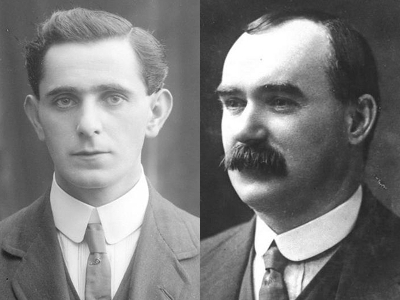
Seán MacDiarmada is born in 1884 in Leitrim. He emigrates to Glasgow in 1900 and from there to Belfast in 1902. A member of the Gaelic League, he is acquainted with Bulmer Hobson. He joins the Irish Republican Brotherhood (IRB) in 1906 while still in Belfast, transferring to Dublin in 1908 where he assumes managerial responsibility for the IRB newspaper Irish Freedom in 1910. Although MacDiarmada is afflicted with polio in 1912, he is appointed as a member of the provisional committee of Irish Volunteers from 1913 and is subsequently drafted onto the military committee of the IRB in 1915. During the Rising, MacDiarmada serves in the General Post Office (GPO). Following the surrender, MacDiarmada nearly escapes execution by blending in with the large body of prisoners. He is eventually recognised by Daniel Hoey of G Division and faces a court-martial on May 9.
James Connolly is born in Edinburgh in 1868. Connolly is first introduced to Ireland as a member of the British Army. Despite returning to Scotland, the strong Irish presence in Edinburgh stimulates Connolly’s growing interest in Irish politics in the mid-1890s, leading to his emigration to Dublin in 1896 where he founds the Irish Socialist Republican Party. He spends much of the first decade of the twentieth century in America. He then returns to Ireland to campaign for worker’s rights with James Larkin. A firm believer in the perils of sectarian division, Connolly campaigns tirelessly against religious bigotry. In 1913, Connolly is one of the founders of the Irish Citizen Army. During the Easter Rising he is appointed Commandant-General of the Dublin forces, leading the group that occupies the General Post Office.
The treatment accorded to Connolly is particularly despicable. Crippled by an infected wound in the ankle, he is carried to Kilmainham Gaol, tied to a chair, and shot. As the men are loading their rifles, Connolly forgives the men of the army firing squad for their actions. Shaken by their distasteful task, a ragged volley of shots resounds from their rifles. He is the last of the leaders to be executed.
John Francis Lemass is born in Ballybrack, County Dublin before his family moves to Capel Street in Dublin city centre. He is the second of seven children born to John and Frances Lemass. Within the family his name soon changes to Jack and eventually, after 1916, he himself prefers to be called Seán. He is educated at O’Connell School where he was described as studious, with his two best subjects being history and mathematics.
Lemass is first elected as a Sinn FéinTeachta Dála (TD) for the Dublin South constituency in a by-election on November 18, 1924, and is returned at each election until the constituency is abolished in 1948, when he is re-elected for Dublin South–Central until his retirement in 1969.
When de Valera becomes President of Ireland in 1959, Lemass inherits the office of Taoiseach, serving in this position until 1966. Under him the country takes a more outward-looking approach, and he especially presses for Ireland’s entry into the European Economic Community (EEC), now the European Community embedded in the European Union, and for reconciliation with Northern Ireland.
Ill health forces Lemass to relinquish the leadership of his party in 1966 and he withdraws from politics altogether in 1969. He has been a heavy pipe smoker all his life, smoking almost a pound of tobacco a week in later life. At the time of his retirement, it is suspected that Lemass has cancer, but this is later disproved. In February 1971, while attending a rugby game at Lansdowne Road, he becomes ill, is rushed to hospital, and is told by his doctor that one of his lungs is about to collapse.
On Tuesday, May 11, 1971, Seán Lemass dies in Dublin’s Mater Misericordiae University Hospital. He is afforded a state funeral and is buried in Dean’s Grange Cemetery.
Lemass is widely regarded as the father of modern Ireland, primarily due to his efforts in facilitating industrial growth, bringing foreign direct investment into the country, and forging permanent links between Ireland and the European community. His greatest legacy, Ireland’s membership in the EEC, is not secured until 1973, after his death.
Paul David Hewson, Irish singer-songwriter, musician, venture capitalist, businessman, and philanthropist known by his stage name Bono, is born in the Rotunda Hospital, Dublin, on May 10, 1960.
Bono writes almost all U2 lyrics, frequently using religious, social, and political themes. During U2’s early years, his lyrics contribute to their rebellious and spiritual tone. As the band matures, his lyrics become inspired more by personal experiences shared with the other members. Bono wins numerous awards with U2, including twenty-two Grammy Awards and the 2003 Golden Globe Award for best original song, “The Hands That Built America,” for the film Gangs of New York.
In 2005, the U2 band members are inducted into the Rock and Roll Hall of Fame in their first year of eligibility. In November 2008, Rolling Stone magazine ranks Bono as the 32nd-greatest singer of all time.
In 1992, Bono, along with The Edge, purchase and refurbish Dublin’s two-star 70-bedroom Clarence Hotel, converting it into a five-star 49-bedroom hotel.
Bono is on the board of Elevation Partners, a private equity firm, which attempts to purchase Eidos Interactive in 2005 and has since gone on to invest in other entertainment businesses. Bono invests in the Forbes Media group in the United States through Elevation Partners. Elevation Partners becomes the first outsider to invest in the company, taking a minority stake in Forbes Media LLC, a new company encompassing the 89-year-old business which includes Forbes magazine, the Forbes.com website and other assets. The terms of the deal are not disclosed, but reports say the stake is worth about $250 million. The firm also owns a 1.5 percent stake in the social networking site Facebook, originally purchased for $210 million.
Bono is also widely known for his activism concerning Africa, for which he co-founds DATA, EDUN, the ONE Campaign and Product Red. He organises and plays in several benefit concerts and meets with influential politicians. Over the years, Bono is praised and criticised for his activism and involvement with U2.
In 2007, Bono is named in the UK‘s New Year Honours list as an honorary Knight Commander of the Order of the British Empire. On March 29, 2007, he is formally granted knighthood by Queen Elizabeth II of the United Kingdom for “his services to the music industry and for his humanitarian work.” He is also made a Commandeur of the French Ordre des Arts et des Lettres (Order of Arts and Letters). Together with Bill and Melinda Gates, Bono is named Time Person of the Year in 2005, among other awards and nominations.








 seamus dubhghaill