Ó Dónaill is the olderst of the six children of Tarlach Ó Dónaill and Éilis Nic Ruairí from Grial, Loughanure. They own a little land and a few cows. His father spends June to November working in Scotland and dies when he is 13 years old. He himself spends summers working in the tunnels in Scotland.
Ó Dónaill receives his education at Scoil Loch an Iúir in Loughanure before gaining a scholarship to St. Eunan’s College in Letterkenny. Another scholarship takes him to University College Dublin to study Irish, English and History. During his time in university Ó Dónaill spends his summers teaching at Coláiste Bhríde in Rann na Feirste, County Donegal.
Ó Dónaill writes the book Bruigheann Féile which is based on stories of pastimes in the Gaeltacht town Loughanure and its surrounding area. His book Na Glúnta Rosannacha is first published in 1952.
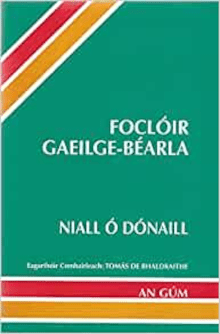
Ó Dónaill is most famous for his work as editor of the 1977 Irish-English dictionary Foclóir Gaeilge-Béarla, which is still widely used today.
Like other literary civil servants of the period, Wall often takes a satirical view of bureaucracy. Unlike Brian O’Nolan, however, he can play the bureaucrats at their own game and by most accounts he is a highly efficient public servant in his own right. His late novel Hermitage (1982) has some sharp sidelights on the world of Green Tape.
Wall makes his mark mainly as a novelist, but he begins as a playwright and has at least two works performed in the Abbey Theatre. His first real success comes in 1946 with The Unfortunate Fursey, in which he creates a mythical monk who is tormented by the Devil. The picaresque humour and fantasy of the story are enjoyed by the public as essentially good-natured farce, but it is possible that he also intends it as oblique satire on the Irish clergy in general, at a time when any open criticism of them might invite trouble. Fergus Linehan later turns it into a successful musical.
The first Fursey book has successors, and all of them are published in a single volume in 1985, entitled The Complete Fursey. During the 1950s Wall writes two “serious” novels of social criticism, Leaves for the Burning and No Trophies Raise, in which his satirical sense takes a more direct route. They are praised at the time by respected critics and are still well worth rereading.
Apart from his writing, Wall has a distinguished career in Radio Éireann, where he and his colleagues, the novelist Francis MacManus and the poet Roibeard O Farachain, make up a literary and administrative trio nicknamed “Frank, Incense and Mer” by a staff wit. He later becomes secretary of the Arts Council, a sometimes-difficult job which he handles with tact and fairness.
Wall is himself a witty, observant, sometimes catty man in a generation famous for its wit. He and his wife Fanny, who is known as a leading music critic, are for decades an almost indispensable duo in Dublin cultural and social life, although Wall, in spite of his various public roles, is at heart a home loving and industrious man who never seeks publicity.
If and when a fullscale cultural history of Ireland in the 1940s and 1950s comes to be written, Wall’s place in it should be assured. As a successful, long term civil servant, he learned how to work the system in favour of literature and the arts in an age when patronage of them was thin on the ground.
Casey is born to a teacher during the height of the Great Famine of 1846. Eight years later he moves to Gurteen, near Ballymahon in County Longford, when his father is given the post of headmaster at the local school. His work would come to be closely associated with Ballymahon.
As a teenager Casey works as an assistant to his father and is expected to follow him into teaching. However, he is disillusioned by the insufficiently nationalistic nature of the curriculum and spends a great deal of time writing poetry. It is at this time, reputedly at the age of fifteen, that he writes his best-known song, “The Rising of the Moon,” which commemorates the Irish Rebellion of 1798.
Following the increasing popularity of his songs and ballads at nationalist gatherings, Casey moves to Dublin in the 1860s and becomes active in the Fenian movement. He is a major contributor to The Nation newspaper, for which he assumes his pen name of ‘Leo.’
In 1866, at the age of 20, Casey publishes a collection of poems, entitled A Wreath of Shamrocks. Most of the poems therein had already been published elsewhere, primarily in The Nation. The further fame engendered by the success of the book leads him to be sought after as a speaker. He addresses mass rallies in Dublin, Liverpool and London that year, in the lead up to the Fenian Rising in 1867.
When the uprising fails, Casey is imprisoned without trial for eight months in Mountjoy Prison. He is released on the understanding that he would leave for Australia and not return to Ireland. However, he chooses to stay on in Summerhill, Dublin in disguise, living as a Quaker and continuing to write and publish in secret.
Casey marries Mary Josephine Briscoe in January 1868 and they have a son Michael, who dies shortly after birth in October 1869. Casey’s health had been broken by the treatment he had received in prison. He falls from a cab on or near O’Connell Bridge in the centre of Dublin in 1870. He dies from his injuries on St. Patrick’s Day, March 17, 1870.
Following his death, Casey is buried in Glasnevin Cemetery. The newspapers report that between fifty and one hundred thousand mourners walk in his funeral procession.
Sweeney meets Rosemary Barber in 1972 and they marry in 1979. Two offspring – daughter Nico and son Malvin – are produced before the couple goes their separate ways in the early 21st century. Having lived in London for many years until 2001, he separates from Rosemary and goes to live in Timișoara, Romania and Berlin. In 2007, he meets his partner, Mary Noonan, and in early 2008 he moves to Cork to live with her there.
Sweeney produces numerous collections of poetry for which he wins several awards. His novels for children include The Snow Vulture (1992) and Fox (2002). He authors a satirical thriller, co-written with John Hartley Williams, and entitled Death Comes for the Poets (2012).
As Bill Swainson, Sweeney’s editor at Allison & Busby in the 1980s, recalls: “As well as writing his own poetry, Matthew was a great encourager of poetry in others. The workshops he animated, and later the residencies he undertook, were famous for their geniality and seriousness and fun. Sometime in the late 1980s I attended one of these workshops in an upstairs room of a pub in Lamb’s Conduit Street, Bloomsbury, where the poems were circulated anonymously and carefully read and commented on by all. Around the pushed-together tables were Ruth Padel, Eva Salzman, Don Paterson, Maurice Riordan, Jo Shapcott, Lavinia Greenlaw, Michael Donaghy, Maura Dooley and Tim Dooley.” Sweeney later has residencies at the University of East Anglia and Southbank Centre, among many others. He reads at three Rotterdam Poetry Festivals, in 1998, 2003 and 2009.
According to the poet Gerard Smyth: “I always sensed that in the first instance [Sweeney] regarded himself as a European rather than an Irish poet – and rightly so: like the German Georg Trakl whom he admired he apprehended the world in a way that challenged our perceptions and commanded our attention.” Sweeney’s work has been considered “barely touched by the mainstream of English writing” and more so by the German writers Heinrich von Kleist, Georg Büchner, Franz Kafka, Günter Grass and Heinrich Böll, as well as the aforementioned Georg Trakl. According to Poetry International Web, he would be among the top five most famous Irish poets on the international scene.
Having been diagnosed with motor neuron disease the previous year, Sweeney dies at the age of 65 at Cork University Hospital on August 5, 2018, surrounded by family and friends. He continues writing up until three days before his death. In an interview shortly before his death he is quizzed on his legacy, to which he gives the response, “Mostly what awaits the poet is posthumous oblivion. Maybe there will be a young man in Hamburg, or Munich, or possibly Vienna, for whom my German translations will be for a while important – and might just contribute to him becoming a German language poet with Irish leanings.”
Among those attending a special ceremony on August 8, 2018 at the Triskel Arts Centre in Cork to celebrate Sweeney’s life are fellow poets Jo Shapcott, Thomas McCarthy, Gerry Murphy, Maurice Riordan and Padraig Rooney. On August 9, 2018, he is buried in Clonmany New Cemetery in County Donegal.
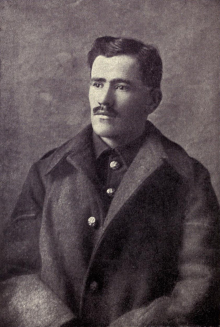
Born on August 19, 1887, to a poor family in Slane, County Meath, Ledwidge starts writing at an early age, and is first published in a local newspaper at the age of fourteen. Finding work as a labourer and miner, he is also a trade union activist and a keen patriot and nationalist, associated with Sinn Féin. He becomes friendly with a local landowner, the writer Lord Dunsany, who gives him a workspace in the library of Dunsany Castle and introduces him to literary figures including William Butler Yeats and Katherine Tynan, with whom he has a long-term correspondence. He is elected to a local authority post and helps organise the local branch of the Irish Volunteers, while Dunsany edits and helps him secure publication for a first volume of his poetry.
Having sided with the faction of the Irish Volunteers which oppose participation in the war, he enlists in the Royal Inniskilling Fusiliers in October 1914, and continues to write poetry on assignment, sending work to Lord Dunsany and to family and other friends. The poems he writes on active service reveal his pride at being a soldier, as he believes, in the service of Ireland. He often wonders whether he would find a soldier’s death.
On July 31, 1917, a group from Ledwidge’s battalion of the Royal Inniskilling Fusiliers are road-laying in preparation for an assault during the Third Battle of Ypres, near the village of Boezinge, northwest of Ypres.
According to Irish author and lecturer Alice Curtayne, “Ledwidge and his comrades had been toiling since the early morning at roadmaking. The army’s first need was men; their second, guns; their third roads. These latter consisted mainly of heavy beech planks bolted together, which could be rapidly laid down. No advance could be supported in that sodden land without a sufficiency of these communications tracks, six or seven feet wide. Supplies were conveyed by pack mules over the wooden paths. Survivors concur in placing the road work done by B Company that day one mile northeast of Hellfire Corner, so called because it was very exposed to German shelling. There was a violent rainstorm in the afternoon, shrouding the region in a gray monochrome. Sullenly, the enemy’s long-range guns continued to fling their shells far behind the lines. Roadwork could not be suspended, however, as the tracks were in use as fast as they were laid down. Tea was issued to the men and, drenched to the skin, they stopped to swallow it. A shell exploded beside Ledwidge and he was instantly killed.”
A Roman Catholicmilitary chaplain, Father Devas, is the first on the scene. That night, Father Devas writes in his diary, “Crowds at Holy Communion. Arranged for service but washed out by rain and fatigues. Walk in rain with dogs. Ledwidge killed, blown to bits; at Confession yesterday and Mass and Holy Communion this morning. R.I.P.”
Ledwidge is first buried at Carrefour de Rose, and later re-interred in the nearby Artillery Wood Military Cemetery, at Boezinge, where the Welsh poet Hedd Wyn, who was killed in action on the same day, also lies buried.
Dunsany arranges for the publication of more of Ledwidge’s poems, and a collected edition in 1919. Further poems, from the archives at Dunsany Castle and some material held by family, are later published by Ledwdige’s biographer, Alice Curtayne, and by one of the Ledwidge memorial societies. Ledwidge is selected as one of twelve prominent war poets for the exhibition Anthem for Doomed Youth at the Imperial War Museum in London in 2002, and memorialised at an event in Inchicore, Dublin, in 2017, with his work set to music by Anúna. A museum of his life and work is opened in his birthplace cottage in 1982. Some of his manuscripts are held in the National Library of Ireland and more in the archives of Dunsany Castle.
O’Donoghue is born to Irish parents and grows up in the Hans Town area of Chelsea. He is the son of John O’Donoghue, a bricklayer from Kilworth, County Cork, and Bridget Griffin, who is from County Tipperary. He is the third of nine children, and has four brothers, Thomas, John, James, and Edmund, and four sisters, Mary, Ellen, Katherine, and Agnes. He is first an upholsterer‘s apprentice from the age of sixteen before becoming a journalist and author.
O’Donoghue attends a Catholic school and furthers his education at the British Museum. He begins his journalistic work by writing for the Dublin papers upon subjects relating to Irish music, art, and literature. A founder-member of the Irish Literary Society in London, he is also vice president of the National Literary Society, Dublin, and the compiler of a biographical dictionary, The Poets of Ireland (1891–93; revised edition, 1912), with entries on 2,000 authors. His published works also include Irish Poetry of the Nineteenth Century (1894), Humor of Ireland (1894), List of 1300 Irish Artists (1894), The Life and Writings of James Clarence Mangan (1897), Bibliographical Catalogue of Collections of Irish Music (1899), and Geographical Distribution of Irish Ability (1906).
In 1896 O’Donoghue moves to Dublin. In 1909 he becomes librarian of University College Dublin. He is co-editor of Catalogue of the Gilbert Library (in Dublin; 1918). William Butler Yeats writes of him in his Autobiographies of William Butler Yeats (1938).
Keane’s mother is a poet who writes under the pseudonym Moira O’Neill. Her father is a fanatic for horses and hunting. She grows up at Ballyrankin in County Wexford and refuses to go to boarding school in England as her siblings had done. She is educated by her mother, governesses, and at a boarding school in Bray, County Wicklow. Relationships between her and her parents are cold and she states that she had no fun in her life as a child. Her own passion for hunting and horses is born out of her need for fun and enjoyment. Reading does not feature much in her family and, although her mother writes poetry, it is of a sentimental nature, “suitable to a woman of her class.”
Keane claims she had never set out to be a writer, but at seventeen she is bedbound due to suspected tuberculosis, and turns to writing out of sheer boredom. It is then she writes her first book, The Knight of Cheerful Countenance, which is published by Mills & Boon. She writes under the pseudonym “M. J. Farrell,” a name over a pub that she had seen on her return from hunting. She explains writing anonymously because “for a woman to read a book, let alone write one was viewed with alarm: I would have been banned from every respectable house in County Carlow.”
In her teenage years Keane spends much of her time in the Perry household in Woodruff, County Tipperary. Here she befriends the two children of the house, Sylvia and John Perry. She later collaborates with John in writing a number of plays. Among them is Spring Meeting, directed by John Gielgud in 1938, and one of the hits of the West End that year. She and Gielgud become life long friends.
It is through the Perry family that Molly meets Bobby Keane, whom she marries in 1938. He belongs to a County Waterfordsquirearchical family, the Keane baronets. The couple goes on to have two daughters, Sally and Virginia.
Keane loves Jane Austen, and like Austen’s, her ability lay in her talent for creating characters. This, with her wit and astute sense of what lay beneath the surface of people’s actions, enables her to depict the world of the big houses of Ireland in the 1920s and 1930s. She “captured her class in all its vicious snobbery and genteel racism.” She uses her married name for her later novels, several of which, including Good Behaviour and Time After Time, have been adapted for television. Between 1928 and 1956, she writes eleven novels, and some of her earlier plays, under the pseudonym “M. J. Farrell.” She was a member of Aosdána.
Keane’s husband dies suddenly in 1946, after which she moves to Ardmore, County Waterford, a place she knows well, and lives there with her two daughters. Following the failure of a play shortly after her husband’s death, she publishes nothing for twenty years. In 1981 Good Behaviour comes out under her own name. The manuscript, which had languished in a drawer for many years, is lent to a visitor, the actress Peggy Ashcroft, who encourages her to publish it. The novel is warmly received and is short-listed for the Man Booker Prize.
Keane dies at the age of 91 on April 22, 1996 in her Cliffside home in Ardmore. She is buried beside the Church of Ireland church, near the centre of the village.
Campbell is born into a Catholic and Irish nationalist family from County Down. He is educated at St. Malachy’s College, Belfast. After working for his father he teaches for a while. He travels to Dublin in 1902, meeting leading nationalist figures. His literary activities begin with songs, as a collector in Antrim, County Antrim and working with the composer Herbert Hughes. He is then a founder of the Ulster Literary Theatre in 1904. He contributes a play, The Little Cowherd of Slainge, and several articles to its journal Uladh edited by Bulmer Hobson. The Little Cowherd of Slainge is performed by the Ulster Literary Theatre at the Clarence Place Hall in Belfast on May 4, 1905, along with Lewis Purcell’s The Enthusiast.
Campbell moves to Dublin in 1905 and, failing to find work, moves to London the following year where he is involved in Irish literary activities while working as a teacher. He marries Nancy Maude in 1910, and they move shortly thereafter to Dublin, and then later to County Wicklow. His play Judgement is performed at the Abbey Theatre in April 1912.
Campbell takes part as a supporter in the Easter Rising of 1916, doing rescue work. The following year he publishes a translation from Irish of the short stories of Patrick Pearse, one of the leaders of the Rising.
Campbell becomes a Sinn FéinCouncillor in Wicklow in 1921. Later in the Irish Civil War he is on the Republican side, and is interned in 1922-23. His marriage breaks up, and he emigrates to the United States in 1925 where he settles in New York City. He lectures at Fordham University, and works in academic Irish studies, founding the University’s School of Irish Studies in 1928, which lasts four years. He is the editor of The Irish Review (1934), a short lived “magazine of Irish expression.” The business manager is George Lennon, former Officer Commanding of the County WaterfordFlying Column during the Irish War of Independence. The managing editor is Lennon’s brother-in-law, George H. Sherwood.
Campbell returns to Ireland in 1939, settling at Glencree, County Wicklow. He dies at Lacken Daragh, Enniskerry, County Wicklow on June 6, 1944.
Sebastian Barry, novelist, playwright and poet, is born in Dublin on July 5, 1955. He is noted for his lyrical literary writing style and is considered one of Ireland’s finest writers. He is named Laureate for Irish Fiction, 2019–2021.
Barry starts his literary career with the novel Macker’s Garden in 1982. This is followed by several books of poetry and a further novel, The Engine of Owl-Light (1987), before his career as a playwright begins with his first play produced in the Abbey Theatre, Boss Grady’s Boys (1988).
Both The Steward of Christendom and the novel The Whereabouts of Eneas McNulty, are about the dislocations, physical and otherwise, of loyalist Irish people during the political upheavals of the early 20th century. The title character of the latter work is a young man forced to leave Ireland by his former friends in the aftermath of the Irish War of Independence.
Barry has been twice shortlisted for the Man Booker Prize for his novels A Long Long Way (2005) and The Secret Scripture (2008), the latter of which wins the 2008 Costa Book of the Year and the James Tait Black Memorial Prize. His fifth novel, On Canaan’s Side (2011), is longlisted for the 2011 Man Booker Prize and wins the 2012 Walter Scott Prize. In January 2017, he is awarded the Costa Book of the Year prize for Days Without End (2016), becoming the first novelist to win the prestigious prize twice. The novel also wins The Walter Scott Prize and The Independent Booksellers’ Prize, and is longlisted for the Man Booker Prize 2017.
In 2001, Barry establishes his personal and professional archive at the Harry Ransom Center. More than sixty boxes of papers document his diverse writing career and range of creative output which includes drawings, poetry, short stories, novels, essays, and scripts.
Bardwell is born Leland Hone in India on February 25, 1922, to Irish parents William Hone and Mary Collise, and moves to Ireland at the age of two. Her father’s family are of the Anglo-IrishHone family. She grows up in Leixlip, County Kildare. She is educated at Alexandra School and later at the University of London.
Bardwell realises from childhood that a writing life is inevitable. In her memoirs she records: “Since the age of six writing had been not an ambition but a condition.” However, there are years of editorial rejections before she blossoms into a writer of the poetry, short stories for radio, plays and autobiographical novels that flowed, due in part to the encouragement of the coterie assembled there, from her basement flat in Dublin.
Bardwell’s five volumes of acclaimed poetry are The Mad Cyclist (1970), The Fly and the Bed Bug (1984), Dostoevsky’s Grace (1991), her “new and selected” The White Beach (1998) and The Noise of Masonry Settling (2005).
Bardwell is considered an important poet by her contemporaries. On the publication of her fourth collection of poetry, The White Beach, Eiléan Ní Chuilleanáin states, “it is good to see her work of the decades collected – it has inspired many Irish poets, male and female, and should be much more widely known,” adding that her work is “witty, full of sharp intimate honesty, full of truth and surprises.”