Fermanagh County Council is formed under orders issued in accordance with the Local Government (Ireland) Act 1898 which comes into effect on April 18, 1899. Elections are held using proportional representation until 1922 when it is abolished in favour of first-past-the-post voting. On December 15, 1921, shortly before the partition of Ireland and transfer of power from the Dublin Castle administration, Fermanagh County Council passes a resolution on a 13–10 majority not to recognise the newly formed Parliament of Northern Ireland and pledges their allegiance to the unrecognised republicanSecond Dáil of the self-proclaimed Irish Republic in Southern Ireland before the ratification of the Anglo-Irish Treaty. The resolution states, “We, the County Council of Fermanagh, in view of the expressed desire of a large majority of people in this county, do not recognise the partition parliament in Belfast and do hereby direct our Secretary to hold no further communications with either Belfast or British Local Government Departments, and we pledge our allegiance to Dáil Éireann.” In response, the Royal Irish Constabulary evict them from their council offices and confiscate official documents. As a result, the council is temporarily dissolved. The council are replaced by Commissioners appointed by Sir Dawson Bates.
The council is reformed by the time of the 1924 Northern Ireland local elections. As a protest against the abolition of proportional representation nationalist parties boycott the election, allowing unionist parties to take control of the council uncontested. Due to the abolition of proportional representation and gerrymandering, the council always has a unionist majority of councillors elected up until abolition. In 1967, the Government of Northern Ireland passes the County Fermanagh (Transfer of Functions) Order 1967. This makes Fermanagh County Council amalgamate with the smaller Enniskillen Borough Council and the rural district councils in Enniskillen, Irvinestown and Lisnaskea to turn Fermanagh County Council into a unitary authority.
In 1969, the Fermanagh Civil Rights Association publishes a booklet criticising the council and accusing them of favouring the Protestant community over the Catholic community. Some of the accusations include that the council deliberately hires Protestants for skilled local government and school jobs and that they propose to build a new village for Catholics in a gerrymandered district that already has a Catholic majority. The council is abolished in accordance with the Local Government Act (Northern Ireland) 1972 on October 1, 1973 and replaced by Fermanagh District Council.
(Pictured: Coat of arms of Fermanagh County Council, Northern Ireland)
One of five children born to Archibald McNeill, a Roman Catholic working class “baker, sailor and merchant,” and his wife, Rosetta (née McAuley) McNeill, McNeill is the brother of nationalist leader Eoin MacNeill. He serves as a high-ranking member of the Indian Civil Service in Calcutta.
When the first Governor-General of the Irish Free State, Tim Healy, retires in December 1927, McNeill is proposed as his replacement by the Irish government of W. T. Cosgrave and duly appointed by King George V as Governor-General of the Irish Free State.
In office, McNeill clashes with the King’s Private Secretary when he insists on following the constitutional advice of his Irish ministers, rather than that of the Palace, in procedures relating to the receipt of Letters of Credence accrediting ambassadors to the King in Ireland. He also refuses to attend ceremonies in Trinity College, Dublin, when some elements in the college try to ensure that the old British national anthemGod Save the King is played, rather than the new Irish anthem, Amhrán na bhFiann.
However, McNeill’s tact is not reciprocated by de Valera’s government, and some of its ministers seek to humiliate him as the King’s representative by withdrawing the Irish Army‘s band from playing at functions he attends and demanding he withdraw invitations to visitors to meet him. In one notorious incident in April, two ministers, Seán T. O’Kelly (a future President of Ireland) and Frank Aiken, publicly walk out of a diplomatic function when McNeill, there as the guest of the French ambassador, arrives. In a fury, McNeill writes to de Valera demanding an apology for this treatment. When none is forthcoming, apart from an ambiguous message from de Valera that could be interpreted as partially blaming McNeill for attending functions at which ministers would be present, he publishes his correspondence with de Valera, even though de Valera had formally advised him not to do so. De Valera then demands that George V dismiss him.
The King engineers a compromise, whereby de Valera withdraws his dismissal request and McNeill, who is due to retire at the end of 1932, will push forward his retirement date by a month or so. McNeill, at the King’s request, resigns on November 1, 1932.
On December 9, 1994, Sinn Féin, the political wing of the Irish Republican Army (IRA), holds its first formal talks with the British Government in over 70 years. The negotiations take place in Belfast, almost one year after Britain and Ireland began an uncertain program to try to resolve the conflict in Northern Ireland. The first session is held at Stormont, a gigantic, columned edifice on top of a hill on the outskirts of Belfast that houses the old Northern Ireland parliament.
Although the announcement of the negotiations is not a surprise, it still sets off an exciting ripple that history is in the making. British officials have conducted secret talks with Sinn Féin leaders in the past, but never before have they sat down openly at the same table with them.
In both a letter to the Sinn Féin leader, Gerry Adams, and in a three-paragraph statement, Downing Street pointedly refers to the meeting as “exploratory dialogue.” This is in keeping with London‘s position that it is simply joining in “talks about talks,” not a full negotiating session, which must involve all parties to the conflict.
For 25 years the IRA has been fighting in the name of the Roman Catholic minority of 650,000 in Northern Ireland. It wants to link Ulster, the six counties of Northern Ireland that remain British after partition, to the Irish Republic, a move opposed by most of the province’s 950,000 Protestants.
The announcement of talks evoke a predictable pattern of responses across Northern Ireland’s political spectrum. Adams, who works to persuade the IRA to go along with a unilateral cease-fire that was declared on September 1, welcomes it. “The opportunity to realize a lasting peace, which will benefit all of the people of Ireland, has never been greater,” he says in a statement. Adams had been accusing London of foot-dragging on the peace effort. Now, he says, it is time to move on to “the next phase of dialogue — multilateral talks led by both Governments.”
The Ulster Unionist Party (UUP), the main Protestant political group in Northern Ireland, is skeptically accepting, as it has been all along. John Taylor, a UnionistMember of Parliament, says the talks will at least establish whether “Sinn Féin really is to become a normal political party.”
The Rev. Ian Paisley, a Member of Parliament whose Democratic Unionist Party (DUP) has become a rejectionist front, continues to oppose talks or any move smacking of compromise. He tells the House of Commons that “a vast majority of people” resent the decision to talk to “the men of blood.”
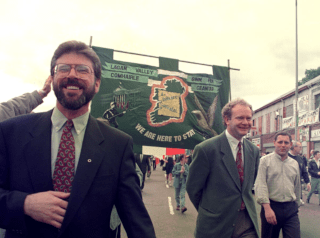
Sinn Féin is represented at the talks by Martin McGuinness, a veteran IRA political leader who took part in secret contacts that broke up the previous year. In 1972, together with Adams, he was flown to London for a meeting with William Whitelaw, who was then Secretary of State for Northern Ireland. Those talks eventually failed.
Adams is in Washington, D.C. on Wednesday, December 7. He attends a meeting at the White House, his first one there, with Anthony Lake, President Bill Clinton‘s National Security Advisor. Seven weeks earlier, Britain protests vigorously at the thought of Adams visiting the White House. But events moved so swiftly that he gains a kind of legitimacy that is hard for Whitehall to deny. His visa to the United States, good for three months, allows several visits.
The Government team of civil servants, in contrast to higher-level ministers, are led by Quentin Thomas, deputy secretary of the British administration called the Northern Ireland Office.
Going into the negotiations, the key question is what will be discussed. On the British side, the top of the agenda is how to get the IRA to turn over its considerable stash of 100 tons of arms and explosives. There is nothing, of course, that Sinn Féin is less likely to agree to at the outset. So should the British make this a condition for multilateral talks to begin, the two sides will meet an obstacle right away.
McGuinness says that the issue of IRA weapons has to be considered “in the context of us removing the causes of conflict, the reason why people use armed force in our society.”
From its side, Adams says Sinn Féin wants to discuss being treated with “a parity of esteem” with the other parties, and “the release of all political prisoners.”
The British Government says that it will soon hold talks with the so-called loyalist paramilitaries on the Protestant side. And it indicates it will have no objection if elected Sinn Féin councillors attend a major international investment conference in Belfast on December 13 and 14.
(From: “Britain and I.R.A. Group to Begin Talks in Northern Ireland” by John Darnton, The New York Times, December 2, 1994 | Pictured: Gerry Adams and Martin McGuinness lead a Republican parade in Belfast, commemorating 25 years of British troops on the streets of Northern Ireland in 1994)
The Northern state consists of the six northeastern counties of Ulster with a unionist majority. They are Antrim, Down, Armagh, Derry, Tyrone, and Fermanagh. Belfast is to be the seat of a government and hold limited devolved powers. The counties of Donegal, Cavan, and Monaghan are to be absorbed within the Irish Free State controlled from parliament in Dublin.
Irish nationalists are dismayed with the plan. Protestant Unionists, particularly those living within the boundaries of the new state, accept and start to implement the Act. Sectarian attacks are launched upon Catholic homes in Belfast, Derry, Banbridge, Lisburn, and Dromore. Catholics are driven from Belfast shipyards and from various engineering works in the city. Supposedly these attacks are in revenge for Irish Republican Army (IRA) assassinations.
The IRA continues the campaign to establish a republic with the Irish War of Independence. By the middle of 1921, both sides are exhausted, and a truce is called on June 9.
In July 1921, Éamon DeValera, the president of Dáil Éireann, goes to London to meet with Prime Minister Lloyd George. They agree an Irish delegation will come to London to discuss terms in the autumn.
During the debate, Lloyd George insists Ireland remain part of the Commonwealth and Dáil Éireann members take the oath of allegiance to the British throne. After a delay of two months, Lloyd George delivers the ultimatum on December 5, sign a treaty within three days or there will be war.
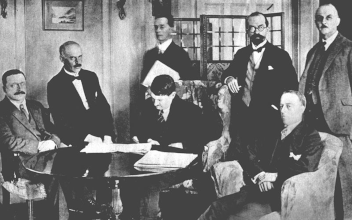
The Anglo-Irish Treaty is to give Ireland a 26 county Free State with Dominion status. The right to raise taxes, regulate foreign trade, independence in internal affairs, own an army, and the oath of allegiance is changed to one of fidelity.
The British are to retain three naval bases within the jurisdiction of the Free State, at Cobh, Lough Swilly, and Berehaven. The Northern Ireland boundary is to be determined by a commission. This gives false hope to large tracts of Tyrone, Fermanagh, Down, Armagh, and Derry City would be given to the Free State as they have Catholic majorities.
Just after 2:00 AM on December 6, 1921, the Irish delegation, without consulting the Dáil, finally sign a treaty with the British. Collins writes, prophetically, later on the day of the signing, “early this morning I signed my death warrant.”
The Treaty displeases the Catholics in the north and the unionists in the south. Meanwhile, many of those involved in the conflict are abhorred at the fact that not all of Ireland is to leave the United Kingdom.
(From: “The Anglo-Irish Treaty (1921)” by Brian O’Neill, Your Irish Culture, http://www.yourirish.com, May 20, 2020)
John Toler, 1st Earl of NorburyPC, KC, Irish lawyer, politician and judge known as The Lord Norbury between 1800 and 1827, is born at Beechwood, Nenagh, County Tipperary, on December 3, 1745. A greatly controversial figure in his time, he is nicknamed the “Hanging Judge” and is considered to be one of the most corrupt legal figures in Irish history. He is Chief Justice of the Common Pleas for Ireland between 1800 and 1827.
Toler is the youngest son of Daniel Toler, MP, and Letitia, daughter of Thomas Otway (1665–1724), of Lissenhall, Nenagh, County Tipperary. His elder brother Daniel Toler is also a politician, serving as High Sheriff for Tipperary and also as MP for Tipperary. The Toler family is originally from Norfolk, East Anglia, England, but settles in County Tipperary in the 17th century. He is educated at Kilkenny College and at Trinity College, Dublin.
In 1800 Toler is appointed Chief Justice of the Common Pleas for Ireland and raised to the Peerage of Ireland as Baron Norbury, of Ballycrenode in the County of Tipperary. His appointment to the bench is controversial and John FitzGibbon, 1st Earl of Clare, the Lord Chancellor of Ireland, is said to have quipped, “Make him a bishop, or even an archbishop, but not a chief justice.” His tenure as Chief Justice lasts for 27 years, despite the fact that, the Dictionary of National Biography opines, “his scanty knowledge of the law, his gross partiality, his callousness, and his buffoonery, completely disqualified him for the position. His court was in constant uproar owing to his noisy merriment. He joked even when the life of a human being was hanging in the balance.” This earns him the nickname the “Hanging Judge.” His most famous trial is that of Irish nationalist leader Robert Emmet. He interrupts and abuses Emmet throughout the trial before sentencing him to death. In spite of this, with his strong belief in the Protestant Ascendancy, he is considered to have had great influence over the government in Ireland in the early part of the nineteenth century.
However, Toler’s position eventually becomes untenable even to his strongest supporters, especially with the British government‘s aim of establishing a better relationship with the Catholic majority. His reputation is tainted in 1822, when a letter written to him by William Saurin, the Attorney-General for Ireland, is discovered, in which Saurin urges him to use his influence with the Irish Protestant gentry which makes up local juries against the Catholics. Saurin is dismissed soon afterwards. He finds his greatest adversary in Daniel O’Connell, to whom Toler is “an especial object of abhorrence.” At O’Connell’s instigation the case of Saurin’s letter is brought before the House of Commons of the United Kingdom by Henry Brougham. Toler survives this as well as an 1825 petition drawn up by O’Connell, which calls for his removal on the grounds of him falling asleep during a murder trial and later being unable to present any account of the evidence given. However, it is not until George Canning becomes Prime Minister in 1827 that Toler, then 82, is finally induced to resign. His resignation is sweetened by him being created Viscount Glandine and Earl of Norbury, of Glandine in King’s County, in the Peerage of Ireland. Unlike the barony of Norbury these titles are created with remainder to his second son Hector John. His eldest son Daniel is then considered mentally unsound.
Toler marries Grace, daughter of Hector Graham, in 1778. They have two sons and two daughters. In 1797 Grace is raised to the Peerage of Ireland as Baroness Norwood, of Knockalton in the County of Tipperary, in honour of her husband. She dies in 1822 and is succeeded in the barony by her eldest son, Daniel. Toler survives her by nine years and dies at the age of 85 at his Dublin home at 3 Great Denmark Street on July 27, 1831. He is succeeded in the barony of Norbury by his eldest son Daniel and in the viscountcy and earldom according to the special remainder by his second son, Hector. In 1832 the latter also succeeds his elder brother in the baronies of Norwood and Norbury. He is considered to be the father of the astronomer John Brinkley.
(Pictured: John Toler, 1st Earl of Norbury, coloured etching by unknown artist, early 19th century, National Portrait Gallery, NPG D9303)
Cahir Healy, Irish nationalist politician, is born in Mountcharles, County Donegal, on December 2, 1877. He is a leader of northern Nationalists and is a self educated man who makes major contributions to Ireland’s cultural and literary heritage.
Healy is re-elected in 1923, but remains in custody until the following year, in which he does not defend his seat. Instead, he is elected to represent the seat in the House of Commons of Northern Ireland in the 1925 Northern Ireland general election, but does not take his seat until 1927 due to the Nationalist abstentionist policy. In 1928 he becomes a founder of the National League of the North. In 1929, with the break-up of the large Fermanagh and Tyrone constituency, he switches to sit for the new seat of South Fermanagh. In a 1931 Fermanagh and Tyrone by-election he is again elected for Fermanagh and Tyrone to the British Parliament, but stands down again in 1935.
Healy becomes an insurance official but continues to write, his output including journalism, poetry and short stories. He is interned by the United Kingdom government for a year during World War II under Defence Regulation 18B. In 1950 he is elected to the British House of Commons for a third time, on this occasion representing Fermanagh and South Tyrone. He finally sits in the British Parliament in 1952, and holds the seat until he stands down in 1955. He leaves the Northern Ireland House of Commons in 1965, by which point he is the Father of the House.
Healy dies on February 8, 1970, at the age of 92 at Enniskillen, County Fermanagh.
(Pictured: Portrait of Cahir Healy by Lafayette, half-plate nitrate negative, July 7, 1932, given by Pinewood Studios via Victoria and Albert Museum, 1989, National Portrait Gallery, London)
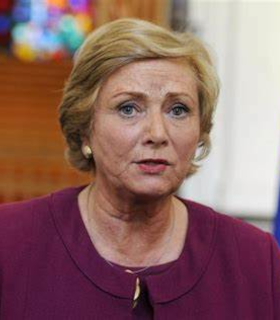
TánaisteFrances Fitzgerald resigns from Government in the “national interest” on November 28, 2017, hours ahead of a no-confidence motion in the Dáil threatens to bring down the Government.
Fitzgerald tells a Cabinet meeting she will be “vindicated” by the Disclosures Tribunal led by Justice Peter Charleton, which is examining allegations of the smear campaign against Garda whistleblower Sgt. Maurice McCabe.
The Tánaiste tells her colleagues she believes she has done nothing wrong but is resigning to avoid “an unwelcome and potentially destabilising general election.” In a statement, she says, “It has been the greatest honour of my life to serve in Government, but I believe it is necessary to take this decision to avoid an unwelcome and potentially destabilising general election at this historically critical time.”
The Tánaiste says she has always sought to act with integrity and responsibility and is now seeking to place “the national interest ahead of my own personal reputation.” She adds, “I decided that my continuation in office risks destabilising that good work, and so I have decided to step down so that this work may continue, and the country can be spared an unnecessary election. It will also allow me to vindicate my good name at the Charleton tribunal, without causing any further distraction to the work of the government. I have always believed in due process, and I believe that in the current situation that is becoming increasingly difficult for me. I acted correctly in difficult circumstances and, in fact, did everything that I could to support the search for truth and protect whistleblowers.”
Earlier in the day, Attorney GeneralSéamus Woulfe gives a presentation to the Cabinet insisting it would be “inappropriate and improper” for Fitzgerald to have intervened when she received the emails in 2015.
TaoiseachLeo Varadkar accepts Fitzgerald’s resignation at the end of the Cabinet meeting and telephones Fianna Fáil leader Micheál Martin to advise him of the development. In a statement in the Dáil, Varadkar says she is leaving office without getting a full and fair hearing, but the work of Government must not be interrupted. It is my strong view that a good woman is leaving office without getting a full and fair hearing. Frances has been an exemplary member of Government and a loyal colleague.”
Varadkar also announces that Minister for JusticeCharles Flanagan is to make a Dáil statement on the controversies surrounding his department. He tells the Dáil that Flanagan will apologise for his department’s failure to answer questions fully in recent weeks and will offer further assurance that questions not answered yet would be answered.
In the evening, Secretary General of the Department of Justice Noel Waters confirms his departure from his position. He is due to resign in February 2018 but confirms he will leave the role immediately. This is a decision he has made on his own, he adds.
Meanwhile, Fine Gael sources say the resignation of Fitzgerald has handed the Fianna Fáil leader a “significant win” and has damaged the Taoiseach. Speaking at his frontbench meeting after the resignation is confirmed, Martin thanks his party for their patience over a difficult few days. He says the focus now needs to be on Brexit and supporting the Government’s stance during the talks scheduled for mid-December.
Fitzgerald had been under intense political pressure in recent days over the handling of the case of Garda whistleblower Sgt McCabe. However, even if the immediate threat of an election has been removed, the crisis has significantly weakened the Government and damaged trust between Fine Gael and Fianna Fáil, which supports the minority Government with a confidence-and-supply arrangement.
Fitzgerald has insisted she was unaware of a legal strategy by former Garda commissioner Nóirín O’Sullivan in 2015 to question the integrity and credibility of Sgt. McCabe at the O’Higgins commission, which was examining allegations of Garda malpractice.
Fianna Fáil and Sinn Féin have been seeking the Tánaiste’s resignation, and both table motions of no confidence in her, the first of which is due to have been heard at 8:00 PM that evening.
During the crisis Varadkar stands by Fitzgerald and offers her his full support. However, Fine Gael Teachtaí Dála (TD) and Ministers question Varadkar’s confidence in Fitzgerald in recent days as more details emerge. Fine Gael Ministers react with fury on November 27 when it emerges that Fitzgerald had received three emails on two separate dates notifying her of the legal strategy pursued by O’Sullivan against Sgt. McCabe.
The Department of Justice emails show Fitzgerald was repeatedly told in 2015 about an “aggressive” approach to undermine Sgt. McCabe at the O’Higgins commission. In two separate emails on July 4, 2015, she is advised of media queries about the “aggressive” approach being adopted by former Garda commissioner O’Sullivan and advises how to respond if the media asks her about the matter. It is a senior Department of Justice official who describes the approach as “aggressive.”
The emails reveal that a senior official suggested to Fitzgerald that she should say that it would be “very unfair to Sgt. McCabe” if she was to respond to queries about the commission. This release of emails about the controversy undermines efforts to defuse the row between Fine Gael and Fianna Fáil over Fitzgerald’s position.
Earlier in the day, Independent Alliance members of Cabinet say they will seek “political accountability” from Fitzgerald. There had been no appetite from within Fine Gael for a general election on the matter, as they fear they will face an intense backlash from voters.
(From: “Frances Fitzgerald resigns in ‘national interest’ to avoid an election” by Sarah Bardon, The Irish Times, http://www.irishtimes.com, November 28, 2017)
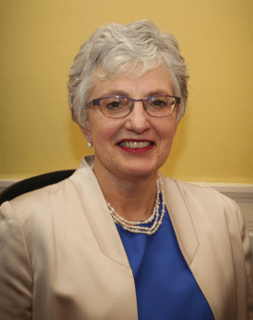
Zappone is nominated by Taoiseach Enda Kenny to the 24th Seanad in 2011, having been recommended by Eamon Gilmore, the then leader of Fine Gael‘s coalition partners, the Labour Party. With her Seanad nomination, she becomes the first openly lesbian member of the Oireachtas and the first member in a recognised same-sex relationship.
Zappone is elected to the Dáil for the Dublin South-West constituency at the 2016 Irish general election, becoming the first openly lesbian TD and, by her own reckoning, the world’s 32nd lesbian to be elected to a national parliament. In May 2016, after a delay in government formation, due to prolonged talks, she becomes Ireland’s first openly lesbian government Minister and the first Minister to have been openly gay at the time of appointment to cabinet, when Taoiseach Enda Kenny appoints her as the Minister for Children and Youth Affairs. She loses her seat at the February 2020 Irish general election and continues to serve as a minister until June 2020 on the election of a new government.
In July 2021, it is announced that Zappone is to be appointed to the newly created position of Special Envoy to the UN for Freedom of Opinion and Expression. It subsequently emerges that the proposed appointment had not been flagged in advance of the Cabinet meeting where it was proposed by Minister Simon Coveney, raising the concerns of the Taoiseach, Micheál Martin. However, he does not block the appointment, attracting criticism from within government, the opposition and the public, with Sinn Féin describing the appointment as “cronyism.”
In the following days it is reported that Zappone had lobbied for the creation of an appointment to the part-time position, which was not openly advertised or subject to a competition. Further controversy arises when it is reported that shortly prior to the announcement of her appointment, she had hosted a party for 50 guests, including politicians such as Leo Varadkar, at the Merrion Hotel, while the COVID-19 pandemic in the Republic of Ireland was ongoing. Comparisons are made between the party and the Oireachtas Golf Society scandal from earlier in the pandemic. On August 4, 2021, she announces that she will not take up the envoy role, saying “While I am honoured to have been appointed by the Government to be the Special Envoy on Freedom of Opinion and Expression, it is clear that criticism of the appointment process has impacted the legitimacy of the role itself. It is my conviction that a Special Envoy role can only be of real value to Ireland and to the global community if the appointment is acceptable to all parties.”
In September 2021, Zappone is invited to appear before the Oireachtas Committee on Foreign Affairs and Defence, but chooses not to attend. As a U.S. citizen and resident, the committee has no power to compel her attendance.
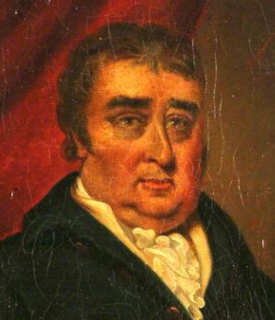
French belongs to the long-established French family of Frenchpark, County Roscommon, who are substantial landowners who also make money in the wine trade. He is the eldest son of Arthur French MP and Alicia Magenis, daughter of Richard Magenis of Dublin and sister of Richard Magenis. He marries Margaret Costello, daughter of Edmond Costello of Edmondstown, County Mayo, and has nine children, including Arthur French, 1st Baron de Freyne, John, 2nd Baron and Charles, 3rd Baron.
In 1783, French is elected a Member of Parliament (MP) for Roscommon County in the Irish House of Commons. After the Act of Union 1800 he represents Roscommon in the Parliament of the United Kingdom. He is alleged to have been offered an Earldom if he would support the union of Ireland with Great Britain but refuses the honour. Later he also refuses a Barony with no strings attached, although in time three of his sons would hold the title of Baron de Freyne. The Crown is frequently irritated by his demands for offices and favours for his brothers and sons, although such behaviour is entirely typical of an Irish politician at the time.
A critic of the policy of collective fines as a deterrent to the illicit distillation of poteen, French incurs the wrath of Chief Secretary for IrelandRobert Peel who calls him “an Abominable fellow,” but his enormous popularity in Roscommon means that he cannot be ignored. He also criticizes the continuation of martial law in Ireland.
By 1817 French is complaining of ill-health. He dies on November 24, 1820. One report at the time states that he had died “from excessive fox hunting.”
Derrig is born on November 26, 1897, in Westport, County Mayo. He is educated locally and later at University College Galway. During his time in college, he organises a corps of the Irish Volunteers. After the 1916 Easter Rising, he is arrested and imprisoned, and sent to the prisons of Woking, Wormwood Scrubs and Frongoch internment camp. He is arrested in 1918 and is accused of attempting to disarm a soldier. He is sentenced to five months imprisonment by a court in Belfast. When he is released, he supports Joseph MacBride at the 1918 Irish general election. He also graduates from college and becomes headmaster in a technical college in Mayo.
At the June 1927 Irish general election Derrig is elected to Dáil Éireann as a Fianna Fáil TD for Carlow–Kilkenny. In Éamon de Valera‘s first government in 1932 Derrig is appointed Minister for Education. He initiates a review of industrial and reformatory schools and the rules under the Children Act 1908, resulting in the critical 1936 Cussen Report that follows which he shelves, and a report in 1946-48 by the Irish American priest Father Edward J. Flanagan, which is also shelved. His lack of action wis noted in 2009 when the Ryan Report examines the subsequent management of these “residential institutions.” He is the first Minister to seek a report that could result in much-needed reforms. It is suggested that he does not want to follow British law reforms in the 1920s and 1930s, because of his strong anti-British views, and that Irish children have suffered needlessly as a result. From 1939 to 1943, he serves as Minister for Lands. He is re-appointed to Education in 1943 until 1948. During this period a bitter teachers’ strike, involving the Irish National Teachers Organisation (INTO), takes place, lasting from March 20 to October 30. Between 1951 and 1954, he becomes Minister for Lands again.