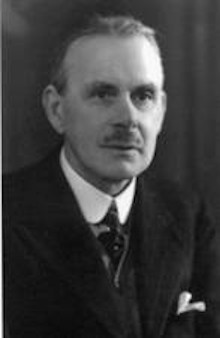
In April 1943 backbench dissent forces Andrews from office. He is replaced as Prime Minister by Basil Brooke, 1st Viscount Brookeborough. He remains, however, the recognised leader of the UUP for a further three years. Five years later he becomes the Grand Master of the Orange Order. From 1949, he is the last parliamentary survivor of the original 1921 Northern Ireland Parliament, and as such is recognised as the Father of the House. He is the only Prime Minister of Northern Ireland not to have been granted a peerage. His predecessor and successor receive hereditary viscountcies, and later prime ministers are granted life peerages.
Throughout his life Andrews is deeply involved in the Orange Order. He holds the positions of Grand Master of County Down from 1941 and Grand Master of Ireland (1948–1954). In 1949 he is appointed Imperial Grand Master of the Grand Orange Council of the World.
Andrews is a committed and active member of the Non-subscribing Presbyterian Church of Ireland. He regularly attends Sunday worship, in the church built on land donated by his great-grandfather, James Andrews, in his hometown Comber. He serves on the Comber Congregational Committee from 1896 until his death on August 5, 1956, holding the position of Chairman from 1935 onwards. He is buried in the small graveyard adjoining the church.
Early in the day the government rushes legislation through the House of Commons providing for the suspension of the Executive if the Irish Republican Army (IRA) fails to decommission all its arms by May 2000 in line with a timetable, yet to be drawn up. It refuses to accept any Ulster Unionist amendments. But within 12 hours, British Prime MinisterTony Blair signals that three new amendments will be included to tighten the so-called failsafe mechanism when the bill is debated in the House of Lords in the evening.
The first amendment makes clear that decommissioning must proceed in line with a timetable to be drawn up by General John de Chastelain. The second provides for the automatic suspension of the Executive, while the third provides for the party in default to be clearly identified.
They fail to sway Trimble, who criticises The Way Forward as a hastily concocted scheme. However, he does leave the door open for further negotiations to save the agreement. “If there was a clear watertight scheme, in which there was at the outset an unequivocal commitment to change and a process that genuinely guaranteed to deliver that change, we would have to consider whether a scruple over a period of days could be justified.”
Sinn Féin is furious with party president Gerry Adams saying, “Those who may genuinely want to deal with the issue of guns are going about it in absolutely the worst and wrong way.” The party wants the assembly to be wound up immediately, and all members’ wages to be stopped. It wants the British and Irish governments to continue to implement all aspects of the agreement which are within their control. Adams is enraged by Blair’s move to amend the failsafe legislation. His party says it will consider applying for judicial review of the amended bill, believing it to compromise the International Commission on Decommissioning and unlawfully conflict with the agreement.
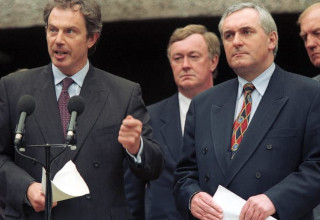
Blair and TaoiseachBertie Ahern announce on the following day that the 15-month-old and ailing Good Friday Agreement will go into a review procedure involving all the political parties and be effectively parked over the summer.
Trimble, leader of the Ulster Unionists, resists intense government pressure as he refuses to back the British and Irish governments’ blueprint providing for a power-sharing executive the following week and IRA decommissioning in the summer. He repeats his party’s view that Sinn Féin can only join his cabinet once the IRA has started to hand over its weapons.
The outcome is a bitter personal setback for Blair. In a last-minute televised appeal to the Unionists not to “close the door’ on an agreement, he appears to acknowledge that they will have to try to find another way forward. “I believe in the end we will get an agreement on this. Whether we manage it by tomorrow morning, that is more difficult,” he says.
Trimble complains he had too little time to secure backing within his split party for The Way Forward, which the governments issued twelve days earlier after a week of intense negotiations at Stormont Castle. Blair’s handling of the affair is questioned.
Trimble’s problem with the legislative failsafe is that it punishes all parties for an IRA transgression of a decommissioning timetable, yet to be drawn up. It provides for the executive to be suspended, rather than carry on with Sinn Féin’s two ministerial posts allocated to other parties. The nationalist Social Democratic and Labour Party (SDLP), which could have given Trimble cover on the issue of expulsion, declines to say whether it will vote for Sinn Féin’s expulsion, which infuriates Ulster Unionists.
Negotiations to save the Good Friday Agreement have gone through four deadlines during the year. There are fears that the latest delay might lead to Sinn Féin withdrawing its declaration on IRA arms.
(Pictured: British Prime Minister Tony Blair and Taoiseach Bertie Ahern present a joint British-Irish blueprint for implementation of the Good Friday Agreement at Stormont Castle in Belfast, June 2, 1999 | Sean Gallup | Getty Images)
During 1920 and 1921, Kennedy is a senior legal adviser to the representatives of Dáil Éireann during the negotiations for the Anglo-Irish Treaty. He is highly regarded as a lawyer by Michael Collins, who later regrets that Kennedy had not been part of the delegation sent to London in 1921 to negotiate the terms of the treaty.
On January 31, 1922, Kennedy becomes the first Attorney General in the Provisional Government of the Irish Free State. Later that year he is appointed by the Provisional Government to the Irish Free State Constitution Commission to draft the Constitution of the Irish Free State, which is established on December 6, 1922. The functions of the Provisional Government are transferred to the Executive Council of the Irish Free State. He is appointed Attorney General of the Irish Free State on December 7, 1922.
In 1923, Kennedy is appointed to the Judiciary Commission by the Government of the Irish Free State, on a reference from the Government to establish a new system for the administration of justice in accordance with the Constitution of the Irish Free State. The Judiciary Commission is chaired by James Campbell, 1st Baron Glenavy, who had also been the last Lord Chancellor of Ireland. It drafts the Courts of Justice Act 1924 for a new court system, including a High Court and a Supreme Court, and provides for the abolition, inter alia, of the Court of Appeal in Ireland and the Irish High Court of Justice. Most of the judges are not reappointed to the new courts. Kennedy personally oversees the selection of the new judges and makes impressive efforts to select them on merit alone. The results are not always happy. His diary reveals the increasingly unhappy atmosphere, in the Supreme Court itself, due to frequent clashes between Kennedy and his colleague Gerald Fitzgibbon, since the two men prove to be so different in temperament and political outlook that they find it almost impossible to work together harmoniously. In a similar vein, Kennedy’s legal opinion and choice of words could raise eyebrows amongst legal colleagues and fury in the Executive Council e.g. regarding the Kenmare incident.
Kennedy is also a delegate of the Irish Free State to the Fourth Assembly of the League of Nations between September 3-29, 1923.
Kennedy is elected to Dáil Éireann on October 27, 1923, as a Cumann na nGaedheal TD at a by-election in the Dublin South constituency. He is the first person to be elected in a by-election to Dáil Éireann. He resigns his seat when he is appointed Chief Justice of Ireland in 1924.
On June 5, 1924, Kennedy is appointed Chief Justice of Ireland, thereby becoming the first Chief Justice of the Irish Free State. He is also the youngest person appointed Chief Justice of Ireland. When he is appointed, he is 44 years old. Although the High Court of Justice and the Court of Appeal had been abolished and replaced by the High Court and the Supreme Court respectively, one of his first acts is to issue a practice note that the wearing of wigs and robes will continue in the new courts. This practice is still continued in trials and appeals in the High Court and the Supreme Court (except in certain matters). He holds the position of Chief Justice until his death on December 1, 1936, in Goatstown, Dublin.
In September 2015, a biography by Senator Patrick Kennedy (no relation) is written about Kennedy called Hugh Kennedy: The Great but Neglected Chief Justice.
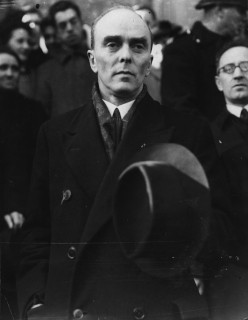
Brugha is born Charles William St. John Burgess of mixed Roman Catholic and Protestant parentage in Dublin on July 18, 1874. He attends Colmkille Schools until 1888 when he is admitted to Belvedere College. He intends to study medicine, but this does not come to fruition after his father’s business fails in 1890. He is seen as an austere figure, not very different from Éamon de Valera, and is known not to smoke cigarettes, swear or drink alcohol.
In 1899, Brugha joins the Gaelic League, and he subsequently changes his name from Charles Burgess to Cathal Brugha. He meets his future wife, Caitlín Kingston, at an Irish class in Birr, County Offaly, and they marry in 1912. The marriage produces six children. He becomes actively involved in the Irish Republican Brotherhood (IRB) and in 1913 he becomes a lieutenant in the Irish Volunteers. He leads a group of twenty Volunteers to receive the arms smuggled into Ireland in the Howth gun-running of 1914.
Brugha is second-in-command at the South Dublin Union under Commandant Éamonn Ceannt in the Easter Rising of 1916. On the Thursday of Easter Week, being badly wounded, he is unable to leave when the retreat is ordered. Brugha, weak from loss of blood, continues to fire upon the enemy and is found by Eamonn Ceannt singing “God Save Ireland” with his pistol still in his hands. He recovers over the next year but is left with a permanent limp.
Brugha proposes a Republican constitution at the 1917 Sinn Féin convention, which is unanimously accepted. In October 1917, he becomes Chief of Staff of the Irish Republican Army and holds that post until March 1919.
Brugha is elected Ceann Comhairle of Dáil Éireann at its first meeting on January 21, 1919, and he reads out the Declaration of Independence in Irish, which ratifies “the establishment of the Irish Republic.” On the following day he is appointed president of the ministry pro tempore. He retains this position until April 1, 1919, when Éamon de Valera takes his place.
Brugha has differences with Michael Collins, who, although nominally only the Irish Republican Army‘s (IRA) Director of Intelligence, has far more influence in the organisation as a result of his position as a high-ranking member of the IRB, an organisation that Brugha sees as undermining the power of the Dáil and especially the Ministry for Defence. He opposes the oath of allegiance required for membership of the IRB. In 1919, his proposition that all Volunteers should swear allegiance to the Irish Republic and the Dáil is adopted.
At a top-level IRA meeting in August 1920, Brugha argues against ambushes of Crown forces unless there is first a call to surrender, but it is dismissed as unrealistic by the brigade commanders present. He also has the idea of moving the front line of the war to England but is opposed by Collins.
On January 7, 1922, Brugha votes against the Anglo-Irish Treaty. During the Treaty debates, he points out that Collins has only a middling rank in the Department for Defence, which supervises the IRA, even though Griffith hails him as “the man who had won the war.” It is argued that, by turning the issue into a vote on Collins’ popularity, Brugha swings the majority against his own side. Frank O’Connor, in his biography of Collins, states that two delegates who had intended to vote against the Treaty changed sides in sympathy with Collins. Brugha leaves the Dáil and is replaced as Minister for Defence by Richard Mulcahy.
In the months between the Treaty debates and the outbreak of Irish Civil War, Brugha attempts to dissuade his fellow anti-treaty army leaders, including Rory O’Connor, Liam Mellows and Joe McKelvey, from taking up arms against the Free State. When the IRA occupies the Four Courts, he and Oscar Traynor call on them to abandon their position. When they refuse, Traynor orders the occupation of the area around O’Connell Street in the hope of easing the pressure on the Four Courts and of forcing the Free State to negotiate.
On June 28, 1922, Brugha is appointed commandant of the forces in O’Connell Street. The outbreak of the Irish Civil War ensues in the first week of July when Free State forces commence shelling of the anti-treaty positions.
Most of the anti-Treaty fighters under Traynor escape from O’Connell Street when the buildings they are holding catch fire, leaving Brugha in command of a small rearguard. On July 5, he orders his men to surrender, but refuses to do so himself. He then approaches the Free State troops, brandishing a revolver. He sustains a bullet wound to the leg which “severed a major artery causing him to bleed to death.” He dies on July 7, 1922, eleven days before his 48th birthday. He had been re-elected as an anti-Treaty TD at the 1922 Irish general election but dies before the Dáil assembles. He is buried in Glasnevin Cemetery in Dublin.
Clann na Poblachta, a radical new republican party, is founded in Barry’s Hotel, Dublin, on July 6, 1946, by former members of the Irish Republican Army (IRA) who are very unhappy at the treatment of IRA prisoners during “The Emergency” and who are prepared to try and engage in parliamentary politics. The party lasts 19 years but fails in its objectives due to internal feuds and lack of unity.
Clann na Poblachta realises that it has to place an emphasis on practical improvements to living standards and welfare issues such as public health. These policies attract a number of younger members such as Noël Browne and Jack McQuillan. One potential problem for the future is that almost the entire Provisional Executive is resident in Dublin and the party has no organisation in the six counties of Northern Ireland.
In 1948, Éamon de Valera dissolves the Dáil and calls an election for February. Clann na Poblachta wins only ten seats in the 1948 Irish general election, fewer than the breakthrough expected, caused in part by the error of running multiple candidates in many constituencies. The party believes there will be a landslide in their favour like the 1918 Westminster election but 48 of their 93 candidates lose their deposits. The party wins 13.3% of the vote but only 6.8% of the seats. Of their ten Teachtaí Dála (TD), six are elected in Dublin constituencies, two in Tipperary and one each in Cavan and Roscommon.
The party is the driving force behind the 26 counties exiting the Commonwealth of Nations and the all-party Anti-Partition Campaign.
The controversy of the “Mother and Child Scheme,” a progressive healthcare programme opposed by the Catholic Church, helps bring down the government and leads to the disintegration of the party. Many of the party’s TDs resign in solidarity with Noël Browne and his scheme, so the official party wins only two seats in the 1951 Irish general election.
In 1954, Clann na Poblachta agrees to give outside support to the Fine Gael-led government. In this election, three TDs are returned – MacBride, John Tully and John Connor. Controversy dogs the party as Liam Kelly, a Northern-based Clann na Poblachta senator, is also active in Saor Uladh and leads a number of military raids in County Fermanagh and County Tyrone against the Royal Ulster Constabulary (RUC).
Clann na Poblachta withdraws its support from the Government in late 1956 due to its anti-IRA stance. The party wins only one seat at the 1957 Irish general election with MacBride being defeated by Fianna Fáil. John Tully remains the only Clann TD until his retirement in 1961, after he loses his seat. However, Joseph Barron is elected in Dublin South-Central on his fourth attempt.
In 1965, Tully wins back his seat, but he is in effect an Independent as the party only stands four candidates. There had been negotiations between MacBride and Brendan Corish, the new Labour Party leader about forming a political alliance but this does not come to fruition.
A special Ardfheis, held on July 10, 1965, agrees to dissolve Clan na Poblachta.
(Pictured: Sean MacBride, former Chief of staff of the Irish Republican Army and founder of Clann na Poblachta)
The proclamation states that the proscribed organisations are dangerous, and a “grave menace” designed to “terrorise the peaceful and law-abiding subjects of His Majesty in Ireland.” It goes on to say that these associations “encourage and aid persons to commit crimes and promote and incite to acts of violence and intimidation and interfere with the administration of the law and disturb the maintenance of law and order.”
The Irish Times, no supporter of any of the banned organisations, welcomes the development as a sign that the government has decided that sedition will “no longer be preached and practised with impunity in Ireland.” The paper also says that this new policy “furnishes final proof of the gravity of the Irish problem.”
In the immediate aftermath of the proclamation, business continues as usual at the Sinn Féin headquarters at 6 Harcourt Street and at the Gaelic League’s head offices at 25 Parnell Square. Both organisations claim that they have not received any direct communication, let alone any visits, from the police or military.
Speaking to a representative of the Evening Telegraph, Eoin MacNeill, President of the Gaelic League, strikes a defiant note, declaring that the organisation will “not allow itself to be driven underground” and will continue to “have the support of the nation and of Irishmen abroad.”
MacNeill points out that the Gaelic League is approaching its 25th anniversary, on July 23, and that throughout its lifetime it has always been “non-political – that is to say has never interfered in the controversy with regard to the form of the Irish Government and left all its members absolutely free to hold whatever political opinions they pleased. Of course, it is a new situation now. The Government itself has taken the initiative in making the neutrality of the Gaelic League impossible.”
Apparently, the banning of the Gaelic League spurs interest in the language movement as several booksellers refer to being “inundated with orders” for booklets and manuals of instruction and conversations in the Irish language. The casual use of Irish on the streets also reportedly increases.
Cumann na mBan expresses surprise at the actions of the government and takes it as a sign that “conscription is now a certainty.” All of the organisation’s public work up to this point has been geared towards the campaign to oppose conscription.
The Lord Lieutenant makes his proclamation under the Criminal Law and Procedure (Ireland) Act of 1887 which gives the authorities the power to outlaw any organisation it believes to be involved in criminal activities.
(From: “BANNED: Sinn Féin, Irish Volunteers, Cumann na mBan and the Gaelic League,” RTÉ.ie, the website of Raidió Teilifís Éireann | Photo: The government trying to douse the flames of Sinn Féin, from “The Republic,” April 11, 1907, DigitalLibrary@Villanova University)
McCaughey comes to Australia with an uncle, Charles Wilson, a brother of Sir Samuel Wilson, and lands at Melbourne in April 1856. He immediately goes to the country and begins working as a jackaroo. Within three months he is appointed an overseer and two years later becomes manager of Kewell station while his uncle is on a visit to England.
In 1860, after his uncle’s return, McCaughey acquires an interest in Coonong station near Urana with two partners. His brother John who comes out later becomes a partner in other stations.
During the early days of Coonong station McCaughey suffers greatly from drought conditions but overcomes these by sinking wells for artesian water and constructing large tanks, making him a pioneer of water conservation in Australia.
In 1871 McCaughey is away from Australia for two years on holiday, and on his return does much experimenting in sheep farming. At first, he seeks the strains that can produce the best wool in the Riverina district. Afterwards, when the mutton trade develops, he considers the question from that angle.
In 1880 Sir Samuel Wilson goes to England and McCaughey purchases two of his stations, Toorale and Dunlop Stations, during his absence. He then owns about 3,000,000 acres. In 1886 he again visits the old world and imports a considerable number of Vermont sheep from the United States and also introduces fresh strains from Tasmania. He ultimately owns several million sheep, earning the nickname of “The Sheep King.”
In 1900 McCaughey purchases North Yanco and, at great cost, constructs about 200 miles of channels and irrigates 40,000 acres. The success of this scheme is believed to have encouraged the New South Wales government to proceed with the dam at Burrinjuck.
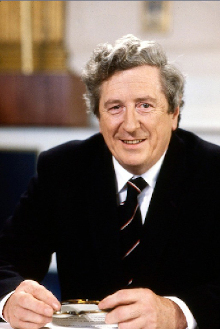
Garret FitzGerald succeeds Charles Haughey to become the eighth Taoiseach of Ireland on June 30, 1981. He serves in the position from June 1981 to March 1982 and December 1982 to March 1987.
FitzGerald joins Fine Gael, attaching himself to the liberal wing of the party. and in 1969 is elected to Dáil Éireann, the lower house of the Oireachtas, the Irish parliament. He later gives up his university lectureship to become Minister for Foreign Affairs in the coalition government of Liam Cosgrave (1973–1977). When the coalition government is resoundingly defeated in the 1977 Irish general election, Cosgrave yields leadership of Fine Gael to FitzGerald. In his new role as Leader of the Opposition and party leader, he proceeds to modernize and strengthen the party at the grass roots. He briefly loses power in 1982 when political instability triggers two snap elections.
By the time of the 1981 Irish general election, Fine Gael has a party machine that can easily match Fianna Fáil. The party wins 65 seats and forms a minority coalition government with the Labour Party and the support of a number of Independent TDs. FitzGerald is elected Taoiseach on June 30, 1981. To the surprise of many FitzGerald excluded Richie Ryan, Richard Burke and Tom O’Donnell, former Fine Gael stalwarts, from the cabinet.
On May 5, 2011, it is reported that FitzGerald is seriously ill in a Dublin hospital. Newly elected Fine Gael Taoiseach Enda Kenny sends his regards and calls him an “institution.” On May 6 he is put on a ventilator. On May 19, after suffering from pneumonia, he dies at the Mater Private Hospital in Dublin at the age of 85.
In a statement, Irish PresidentMary McAleese hails FitzGerald as “a man steeped in the history of the State who constantly strove to make Ireland a better place for all its people.” Taoiseach Enda Kenny pays homage to “a truly remarkable man who made a truly remarkable contribution to Ireland.” Henry Kissinger, the former United States Secretary of State, who serves as an opposite number to FitzGerald in the 1970s, recalls “an intelligent and amusing man who was dedicated to his country.”
FitzGerald’s death occurs on the third day of Queen Elizabeth II‘s state visit to the Republic of Ireland, an event designed to mark the completion of the Northern Ireland peace process that had been “built on the foundations” of FitzGerald’s Anglo-Irish Agreement with Margaret Thatcher in 1985. In a personal message, the Queen offers her sympathies and says she is “saddened” to learn of FitzGerald’s death.
On his visit to Dublin, United States PresidentBarack Obama offers condolences on FitzGerald’s death. He speaks of him as “someone who believed in the power of education; someone who believed in the potential of youth; most of all, someone who believed in the potential of peace and who lived to see that peace realised.”
FitzGerald is the author of a number of books, including Planning in Ireland (1968), Towards a New Ireland (1972), Unequal Partners (1979), All in a Life: An Autobiography (1991), and Reflections on the Irish State (2003).
From June 7, 1921, until March 30, 1972, the devolved legislature for Northern Ireland is the Parliament of Northern Ireland, which always has an Ulster Unionist Party (UUP) majority and always elects a UUP government. The Parliament is suspended on March 30, 1972.
Shortly after this first parliament is abolished, attempts begin to restore devolution on a new basis that will see power shared between Irish nationalists and unionists. To this end a new parliament, the Northern Ireland Assembly, is established by the Government of the United Kingdom on May 3, 1973.
Following the June 28 elections, the Northern Ireland Constitution Act 1973, which receives the Royal Assent on July 18, 1973, abolishes the suspended Parliament of Northern Ireland and the post of Governor and makes provision for a devolved administration consisting of an Executive chosen by the Assembly.
One hundred eight members are elected by single transferable vote from Northern Ireland’s eighteen Westminster constituencies, with five to eight seats for each depending on its population. The Assembly meets for the first time on July 31, 1973.
After opposition from within the Ulster Unionist Party and the Ulster Workers’ Council strike over the proposal of an all-Ireland council, the Executive and Assembly collapses on May 28, 1974, when Brian Faulkner resigns as Chief Executive. The Northern Ireland Assembly is abolished by the Northern Ireland Act 1974.
In 1982 another Northern Ireland Assembly is established at Stormont, initially as a body to scrutinise the actions of the Secretary of State, the British minister with responsibility for Northern Ireland. It receives little support from Irish nationalists and is officially dissolved in 1986.
The Northern Ireland Act 1998 formally establishes the Assembly in law, in accordance with the Good Friday Agreement. The first election of Members of the Northern Ireland Assembly is on June 25, 1998, and it first meets on July 1, 1998. However, it only exists in “shadow” form until December 2, 1999, when full powers are devolved to the Assembly. Since then, the Assembly has operated intermittently and has been suspended on five occasions.
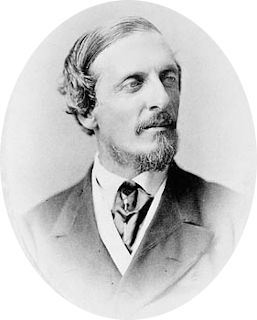
In 1872 Lord Dufferin becomes the third Governor General of Canada, bolstering imperial ties in the early years of the Dominion. After leaving Ottawa in 1878 at the end of his term, he returns to Great Britain to continue his diplomatic career. He serves as British ambassador to Imperial Russia from 1879 to 1881. In 1881 he becomes ambassador to the Ottoman Empire and deals with the problems raised by the British occupation of the Ottoman dependency of Egypt. In 1884 he reaches the pinnacle of his diplomatic career when he succeeds George Robinson, 1st Marquess of Ripon as Viceroy and Governor-General of India and placates the British community there, which had been antagonized by Ripon’s reforms.
By the annexation of Burma (Myanmar) in 1886, Lord Dufferin consolidates British territories. For his services he is made Marquess of Dufferin and Ava when, in 1888, he retires from India. He then spends three years (1889–91) as Britain’s ambassador to Italy and four years (1892–96) as ambassador to France. He retires in 1896.
Following his retirement from the diplomatic service, Lord Dufferin’s final years are marred by personal tragedy and a misguided attempt to secure his family’s financial position. In 1897, worried about the family financial situation, he is persuaded to become chairman of the London and Globe Finance Corporation, a mining promotion and holding company controlled by Whitaker Wright. It subsequently transpires that Wright is a consummate fraudster and the firm goes bankrupt, although Lord Dufferin is not guilty of any deception and his moral standing remains unaffected. Soon after the misfortune, his eldest son, Lord Ava, is killed in the Second Boer War and another son is badly wounded.
Following the death of his son and in poor health, Lord Dufferin returns to his country house at Clandeboye, near Bangor, County Down, and dies there on February 12, 1902.
Lord Dufferin’s biographer Richard Davenport-Hines says he was “imaginative, sympathetic, warm-hearted, and gloriously versatile.” He was an effective leader in Lebanon, Canada and India, averted war with Russia, and annexed Burma. He was careless with money but charming in high society on three continents.

 On July 14, 1999,



 seamus dubhghaill