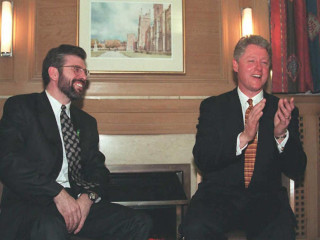
Some of the fifty people at the luncheon, most of them Irish American members of Congress, think Clinton might forgo a handshake because he is under tremendous pressure from Britain’s Prime MinisterJohn Major not to give Adams a warm embrace. But Clinton does not hesitate although the handshake comes after photographers have left the room.
“Gerry was concerned about the protocol of how he should go up to the President, but when he walked up, the President gave him a very big handshake,” says RepresentativePeter T. King, a Republican from Seaford, Long Island, who sits to the right of Adams at the lunch. After an awkward moment of silence, the room explodes with applause.
The President and the Sinn Féin leader speak for five minutes. Later Adams says, “The engagement was positive, was cordial.”
According to Rep. King, Clinton says he is committed to making the Irish peace effort succeed and, while talking to Adams, puts his fist in front of him and says, “This is going to work.” Adams says Clinton does not urge him to make sure the IRA disarms, something Major asked the President to do. Clinton invites Adams to a White House reception scheduled for the following day and, according to his aides, plans to speak to Major over the weekend in an effort to patch up their differences.
The tone at the luncheon is often light. Clinton jokes that finally he is at a place where people will not criticize him for taking a drink of Guinness. Also, Bruton hails Gingrich as an honorary Irishman, noting that his mother apparently descended from the Doherty clan of County Donegal.
Wearing a white carnation tinged with green, Gingrich gives the Taoiseach a bowl of Georgia peanuts and a book on the history of the United States Capitol. Telling Gingrich that he is not the first person to consider overhauling welfare, Bruton gives him an 1840’s book about welfare reform in Ireland.
Isaac Weld, Irish topographical writer, explorer, and artist, is born on Fleet Street, Dublin on March 15, 1774. He is a member of the Royal Dublin Society.
Weld’s name stems from his great-grandfather Nathanael Weld’s close friendship with Sir Isaac Newton, and as such both his grandfather and father are also named Isaac. His father is a close friend of Charles James Fox. His sister marries George Ensor, and their half-brother is Charles Richard Weld, traveler and author of A Vacation Tour in the United States and Canada (London, 1855), which is dedicated to his brother, Isaac. He is sent to the school of Samuel Whyte at Grafton Street and from there to another private school Barbauld at Palgrave near the town of Diss in Norfolk. From Diss he proceeds to Norwich as a private pupil of Dr. William Enfield. He leaves Norwich in 1793.
In 1795 he sails to Philadelphia from Dublin and spends two years traveling in the United States and Canada, partly as an adventure and partly as research into suitable countries to which the Irish can emigrate. He visits Monticello and Mount Vernon and meets George Washington and Thomas Jefferson. He travels on horseback, by coach and by canoe in Canada with local native guides. He returns in 1797 “without entertaining the slightest wish to revisit it.” He finds the Americans to be obsessed with material things and prefers Canada. His published Travels (1799) quickly goes into three editions and is translated into French, German, Italian, and Dutch.
Weld writes on slavery that “there will be an end to slavery in the United States…[as] negroes will not remain deaf to the inviting call of liberty forever.” With regard to Americans in general, he states, “Civility cannot be purchased from them on any terms; they seem to think that it is incompatible with freedom.” On Washington, D.C., he writes “If the affairs of the United States go on as rapidly as they have done, it will become the grand emporium of the West, and rival in magnitude and splendour the cities of the whole world.”
Weld visits Killarney, navigates the lakes in a boat he made from compressed brown paper, and publishes Scenery of Killarney (1807), illustrated with his own drawings. He is also well known for his drawings of American life and, in particular, the Niagara Falls.
In May 1815 Weld sails from Dún Laoghaire to London in the 14 horsepower (10 kW) steamboat Thames, the first such vessel to make the passage. He compiles the Statistical Survey of the County of Roscommon (1838) for the Royal Dublin Society, of which he is Honorary Secretary and Vice-President. In later life, he spends much time in Italy and particularly Rome, where he develops a friendship with Antonio Canova.
Coveney is interested in yachting throughout most of his adult life. His yacht Golden Apple of The Sun, designed by Cork-based designer Ron Holland, is a successful competitor in the Admiral’s Cup in the 1970s. A later 50-foot yacht, Golden Apple, is used by the family for the “Sail Chernobyl” project. The family sails around the world to raise €650,000 for Chernobyl Children’s Project International, a charity which offers assistance to children affected by the 1986 Chernobyl disaster.
In March 1998 it becomes publicly known that the Moriarty Tribunal has questioned Coveney about whether he had a secret offshore account with Ansbacher Bank, a bank which had become notorious for facilitating tax evasion. Ten days later, on March 13, 1998, Coveney visits his solicitor to change his will. The following day, he dies in a fall from a seaside cliff while out walking alone. His son, Simon Coveney, insists that his father had never held an Ansbacher account. It later emerges that Hugh Coveney had $175,000 on deposit in the secret Cayman Islands-based bank. The account was closed in 1979.
The funeral of Hugh Coveney takes place at St. Michael’s Church in Blackrock, Cork on March 18, 1998. Simon Coveney is later elected to succeed his father in the resulting by-election on November 3, 1998.
By 1590 English rule is, with the exception of Ulster, firmly secured throughout Ireland. The CatholicGaels and Old English of Munster, Leinster, and Connacht have been more or less brought to heel, and Presidencies are established over each of them.
English law is dominant, and Protestant English planters are laying claim to the lands seized from the Catholics. The present-day counties are already taking shape, land divisions modeled on the shires of Great Britain. Queen Elizabeth I feels that the time is right to bolster up English civility and in 1592 she grants the city of Dublin a charter to establish a university.
The university is to be named The College of the Holy and Undivided Trinity of Queen Elizabeth, juxta Dublin. It has been commonly called Trinity College Dublin ever since.
The lands and buildings of the college are donated by the city corporation and are originally those of the Augustinian All Hallows Priory which had been suppressed in 1583. This property is situated about half a mile from the city walls.
In Dublin Loftus is appointed the dean of St. Patrick’s Cathedral and in 1567 he is appointed to the See of Dublin. He has opposition from the Lord Deputy of Ireland Sir John Perrot who had sought to have the university put to St. Patrick’s Cathedral. However, at this time Perrot is under suspicion for having verbally abused her majesty’s legitimacy and is to die in the Tower of London in September 1592.
Within two years of its foundation, Trinity College, consisting of a small square, is up and running with some fellows and a handful of students. Its raison d’etre is to provide a Protestant education and to consolidate the Tudor monarchy. Catholics and Dissenting Christians are not permitted entrance unless they convert to the Anglican faith. Those who do attend are the children of the New English and the children of Old English and native Irish who have abandoned their ancestors’ faith, for reasons of dogma or, as is more likely, in order to retain their lands and wealth.
Trinity is, over the next three centuries, to grow into a wealthy establishment. It receives appropriated properties and has annuities paid in from the government. In later years it is to be the the alma mater of many famous men. Sons of the Protestant Ascendency consider it their own during the 17th and 18th centuries but in the 20th century Trinity manages to adapt to the new Irish state with which it is fully involved in all aspects of Irish education and Irish life, and it is much loved by the Irish people.
(From: “The Founding of Trinity College Dublin 1592,” YourIrishCulture, http://www.yourirish.com)
The government and military consistently claim the men died while clearing a land mine although it is generally believed, especially in Republican circles, that the five men were victims of a horrific war crime which saw them shot and strapped to a mine by an Irish Free State death squad.
The victims of the shocking and notorious incident are Michael Courtney Jnr, Eugene Dwyer, Daniel Shea, John Sugrue and William Riordan, all from the Waterville area. The five men are held by Free State troops at Bahaghs workhouse, then in use as a temporary detention centre, following their arrest for irregular activities several days earlier.
In the early hours of March 12 members of the Free State’s Dublin Guard, who had been tasked with defeating irregular forces in Kerry and who had earned a notorious reputation for brutality in the process, arrive at the workhouse and select five of the twenty men in custody there. The five are then brought to an irregular roadblock several miles away where the IRA men are, allegedly, shot in the legs before being laid over a land mine which is detonated by the Free state troops blowing the five men to pieces.
The Bahaghs killings are part of a series of deaths which begin with another horrific incident on March 6, 1923, in which five soldiers are killed by a booby trap bomb at the village of Knocknagoshel. Immediately after the Knocknagoshel incident the Free State commander for Kerry, Maj. Gen. Paddy O’Daly, previously head of Michael Collin‘s Dublinassassination squad, authorises the use of republican prisoners to clear mined roads, as “the only alternative left us to prevent the wholesale slaughter of our men.” Two separate incidents occur the following day in which thirteen additional Republican prisoners are killed by land mines.
When questioned in the Dáil by Labour Party leader Thomas Johnson, the National Army’s commander-in-chief, Gen. Richard Mulcahy, says he accepts the findings of a military court of inquiry which exonerates the troops of all wrongdoing in any of the incidents.
In recent years, previously confidential state papers have been released which shed new light on one of Kerry’s most terrible episodes. The evidence in the file sharply contradicts the official line on the killings and paints a damning portrait of Free State army brutality and subsequent government efforts to cover up three massacres perpetrated by its troops in Kerry.
Further documents prove that a top official in the Ministry of Home Affairs utterly dismissed the findings of a military inquiry into the killings, but the cabinet of the day took no action and rejected all claims for compensation by relatives.
Nothing has ever been done in relation to the three Kerry massacres after the executive council decision and, to this day, the true events of Bahaghs, Countess Bridge and, most famously, Ballyseedy have never been revealed.
(Pictured: Irish Republican Army Brigade in County Kerry)
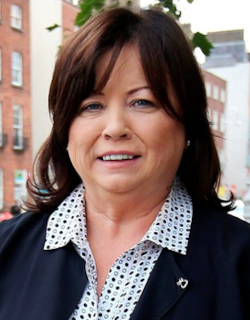
Harney studies economics at Trinity College Dublin and is the first woman auditor of the College Historical Society, popularly referred to as “The Hist.” After graduation she spends a year teaching mathematics and economics at Castleknock College in Dublin. In 1977, her political career begins when she is appointed to Seanad Éireann, becoming the youngest ever member of the Seanad in Ireland. She continues to make history throughout here 34-year career in politics.
Ever ready to challenge the status quo, Harney’s entire political life is characterised by a passion for reform, innovation and enterprise. After seventeen years in government, she reaches the height of her career. She serves as Tánaiste from 1997 to 2006, becomes the first woman to lead a political party in Ireland and holds many important ministerial portfolios. She is also notably the longest serving female Government minister and Teachta Dála (TD) in the state’s history.
Harney’s work in environmental protection leads to major improvement in the air quality in Dublin as she tackles the problem of smog in the capital by making Dublin a smokeless fuel city. By founding the Environmental Protection Agency (EPA) she leads a unified response among all 31 local authorities in their responsibility towards licensing and monitoring environmental standards. She establishes the first recycling initiative in the country.
During her tenure as Minister for Enterprise, Trade and Employment (1997-2004), Harney promotes indigenous industry and foreign direct investment in the country and leads many trade and investment missions to various parts of the world, working with both national and international companies. She works particularly to enhance the presence of high technology companies both indigenous and international in Ireland. She leads a major drive to increase employment in Ireland through a combination of activation measures for unemployed people and improving incentives for people to take up jobs. She pioneers the first ever major programme of investment in basic research in Ireland through Science Foundation Ireland based on internationally peer-reviewed projects. She establishes the Personal Injuries Assessment Board, avoiding unnecessary legal intervention and in turn dramatically cuts the cost of insurance in Ireland, notably in the areas of Employers’ and Public Liability and Motor Insurance. She strengthens competition law and enforcement and establishes an independent office for corporate enforcement.
As Minister for Health and Children (2004-2011), Harney begins the move towards a unified Health Service by replacing a number of politically-dominated Health Boards with the Health Service Executive (HSE). She establishes an independent Health Information and Quality Authority (HIQA) to provide an independent inspector of the delivery of health services in Ireland and leads the reform of cancer services by consolidating them to eight specialist centres. She introduces “Fair Deal,” a financing mechanism to deliver nursing home care for the elderly. She reforms the regulation of the Medical and Pharmacy Professions, introducing statutory requirements to maintain professional competence. She introduces, for the first time, a lay majority on the boards of the Medical Council of Ireland and of the Pharmaceutical Society of Ireland (PSI).
Harney wins a number of awards as employment minister and for promoting science and innovation. She serves as president of the Council of the European Union during Irish presidency and is a member of International Women’s Forum. She is the youngest member of Seanad Éireann and the longest serving female member of Dáil Éireann. She is the first woman leader of an Irish political party and the first woman to be Tánaiste. She is twice selected as Woman of the Year in Ireland. She is awarded an honorary doctorate from Trinity College Dublin in recognition of her contributions as Minister to science and innovation.
Harney is now the director of a number of private companies in pharmaceutical, healthcare, technology and financial services sectors. She provides business advisory services to a range of companies and organisations. She also undertakes speaking engagements, particularly in a business context. She is the current Chancellor of the University of Limerick.
TaoiseachEnda Kenny conveys his resignation to PresidentMichael D. Higgins at Áras an Uachtaráin on March 10, 2016, after failing to get re-elected to the position in a Dáil vote, becoming acting Taoiseach as the Dáil adjourns until March 22. “It’s not the outcome that I personally would have liked to see but I respect the verdict of the people,” Kenny says. The vote for the former Taoiseach stands at: For 57, Against 94, Abstain 5.
Kenny, the MayoTD, says the Cabinet will continue its work while the various parties try to form a government. A government statement issued in the evening reads, “The Taoiseach, Mr. Enda Kenny, T.D., has this evening conveyed to the President his resignation from office. In accordance with the Constitution, the Government and the Taoiseach will continue to carry on their duties until successors have been appointed.”
Kenny says when Fine Gael and the Labour Party entered government five years earlier “our very survival was in doubt.” He adds, “The Government had to face unprecedented sets of difficulties. Many believed the situation was hopeless. The country is in a different place now.”
The outgoing Taoiseach says he is “fully committed” to working with other parties and independents to form a new government. He adds that “a substantial number of people do not want to serve in government.” Fianna Fáil leader Micheál Martin says the situation is not unprecedented and people should put aside the notion that “speed” is an issue in forming a government. “Ireland is relatively unusual in how fast it carries out the formation of government,” he says.
A total of 50 Fine Gael TDs are re-elected to the 32nd Dáil. The five abstentions in the Enda Kenny vote are TDs Michael Harty, Noel Grealish, Denis Naughten, Michael Collins and Mattie McGrath. They say they will abstain on each vote for Taoiseach in an indication they are willing to hold further coalition talks.
The vote for the other nominees are: Fianna Fáil leader Micheál Martin: For 43, Against 108, 5 Abstain. Sinn Féin leader Gerry Adams: For 24, Against 116. AAA-PBP candidate Richard Boyd Barrett: For 9, Against 111.
(From: “Enda Kenny resigns as Taoiseach after failing to get re-elected as leader” by Kevin Doyle and Niall O’Connor, http://www.independent.ie, March 10, 2016)
Glennon is named Coadjutor Archbishop of St. Louis on April 27, 1903. He succeeds Archbishop Kain as the fourth Archbishop of St. Louis upon the latter’s death on October 13 of that year. Realizing the Cathedral of St. Louis can no longer accommodate its growing congregation, he quickly begins raising funds for a new cathedral, the cornerstone of which is later laid on October 18, 1908.
Glennon opens the new Kenrick Seminary in 1915, followed by the minor seminary in Shrewsbury. He delivers the eulogy at the funeral of Cardinal James Gibbons and is appointed an Assistant at the Pontifical Throne on June 28, 1921. He opposes British rule in Ireland and supports the leaders of the Easter Rising. He is an outspoken opponent of divorce, condemns gambling games, and prohibits dancing and drinking at church-sponsored events. He sometimes throws the opening ball for the St. Louis Cardinals, but does not play any sports himself, once saying, “I once tried golf, but I so disfigured the scenery that I never played again, in fear of public indignation and reprisal.”[2]
Despite a rather popular tenure, as Archbishop of St. Louis Glennon opposes racial integration in the city’s Catholic schools, colleges, and universities. During the early 1940s, many local priests, especially Jesuits, challenge the segregationist policies at the city’s Catholic schools. The St. Louis chapter of the Midwest Clergy Conference on Negro Welfare, formed locally in 1938, pushes the all-female Webster College to integrate first. However, in 1943, Glennon blocks the enrollment of a young black woman at the college by speaking privately with the Kentucky-based superior of the Sisters of Loretto, which staffs the college. When approached directly by pro-integration priests, he calls the integration plan a “Jesuit ploy,” and quickly transfers one of the complaining priests away from his mission at an African American parish.
The Pittsburgh Courier, an African American newspaper with national circulation, discovers Glennon’s intervention and runs a front-page feature on the Webster incident. In response, Father Claude Heithaus, professor of Classical Archaeology at the Catholic Saint Louis University, delivers an angry sermon accusing his own institution of immoral behavior in its segregation policies. Saint Louis University begins admitting African American students that summer when its president, Father Patrick Holloran, manages to secure approval from the reluctant Archbishop Glennon. Nevertheless, St. Louis maintains one of the largest numbers of African American parishes and schools in the country.
During the return trip to the United States, Glennon stops in his native Ireland, where he is received by PresidentSeán T. O’Kelly and TaoiseachÉamon de Valera. While in Dublin, he is diagnosed with uremic poisoning and dies on March 9, 1946, ending a 42-year tenure as Archbishop. The Cardinal’s body is returned to St. Louis and then buried at the Cathedral.
Sir James Peter Comyn, Irish-born barrister and English High Court judge, is born at Beaufield House, Stillorgan, County Dublin on March 8, 1921. Considered by many to be “the finest all-round advocate at the English bar”, he is appointed to the High Court of Justice in 1978, serving on the bench until his retirement in 1985.
Comyn is the son of Nationalist barrister James Comyn KC and of Mary Comyn. Through his father he is the nephew of the barrister Michael Comyn KC. Both his father and uncle had been political and legal advisers to Éamon de Valera, who at one point uses Beaufield House as a safe house. However, the Comyn brothers have a falling out with de Valera shortly before he comes to power in 1932, and Michael Comyn is passed over as Attorney General of the Irish Free State. As a result, James Comyn, who is then attending Belvedere College in Dublin, is sent by his father to attend The Oratory School in England. He spends six months as a trainee at The Irish Times under the editor R. M. “Bertie” Smyllie, but abandons journalism after a joke he added to an obituary is printed in the paper, leading to his demotion to the racing department.
Comyn is called to the English bar by the Inner Temple in 1942, the Irish bar in 1947, and the Hong Kong bar in 1969. In 1944, he begins his pupillage with Edward Holroyd Pearce KC, later a law lord, and joins his chambers at Fountain Court. He practises in London and on the Western circuit, supplementing his earnings by teaching banking, a subject of which he knows nothing. On one occasion, he rises in Lambeth County court to cross-examine a female defendant in an eviction case. Just as he begins by saying “Madam,” the defendant opens her bag, takes out a dead cat, and throws it at him. The judge’s reaction is to tell the defendant, “Madam, if you do that again, I’ll commit you.” Comyn wins the case.
Comyn takes silk in 1961, and acquires a large practice as a senior, appearing in many high-profile cases. In 1964, he wins damages for libel for the former safe-breaker Alfred George Hinds against a Scotland Yard inspector by convincing the jury that Hinds is in fact innocent. In 1970, he successfully defends the Labour MP Will Owen, who is accused of providing information to the Czechoslovak intelligence services. In 1975, he defeats the government’s attempt to obtain an injunction against the publication of the diaries of former minister Richard Crossman.
Comyn is Recorder of Andover between 1964 and 1971 (honorary life recorder from 1972), commissioner of assize for the Western Circuit in 1971, and a Recorder of the Crown Court between 1972 and 1977. He is elected a bencher of the Inner Temple in 1968 and serves as chairman of the Bar council from 1973 to 1974.
Having refused a previous invitation by Quintin Hogg, Baron Hailsham of St. Marylebone to join the bench, Comyn is again nominated by Elwyn Jones, Baron Elwyn-Jones, in 1977, and is appointed a High Court judge in 1978, receiving the customary knighthood upon his appointment. Initially assigned to the Family Division, he does not take to the work and is reassigned to the Queen’s Bench Division in 1979. He has a reputation for leniency in sentencing, first acquired as Recorder of Andover. In 1980–81, he presides over an unsuccessful libel action by a member of the Unification Church, colloquially known as the Moonies, against the Daily Mail, the longest libel trial in England up to that time. His Irish background makes him the target of Irish Republican Army (IRA) action, and in 1981 the Provisional IRA burns his house in Tara.
Recurring bouts of depression lead to Comyn’s early retirement, on grounds of ill health, in 1985. In retirement, he divides his time between England and Ireland, whose citizenship he has retained. He writes a number of books, including memoirs, light verse, and books on famous trials. He also breeds Friesian cattle. He dies in Navan, County Meath on January 5, 1997, at age 75.
The day after five Free State soldiers are killed by a booby trap bomb while searching a republican dugout at the village of Knocknagoshel, Paddy Daly, in command of the Free State’s Kerry forces, announces that prisoners will be used in the future to clear mined roads.
In Ballyseedy, nine Republican prisoners – Pat Buckley, John Daly, Pat Hartnett, Michael O’Connell, John O’Connor, George O’Shea, Tim Tuomey, James Walsh and Steven Fuller – are driven to the remote Ballyseedy Wood near Ballyseedy Cross to be executed. The troops make sure that they are ‘all fairly anonymous, no priests or nuns in the family, those that’ll make the least noise.’ As they are being loaded into the lorry, the Free State Army guards ask them if they would care to smoke, telling them it will be their last cigarette.
They are taken to a remote location near the banks of the River Lee, where a large log stretches across the Castleisland Road. The Republicans are all tied to the log alongside a mine which is then detonated. Several of the Republicans, however, survive the initial explosion. The Free State soldiers then proceed to throw a number of grenades and shoot at them ensuring they are dead.
They succeed in killing all but Steven Fuller. The force of the explosion hurls him clear across the road. Falling, dazed, but conscious that he is alive and unhurt he quickly realises that the blast had even burst apart the cords used to tie him. As the soldiers come out from their cover after the detonation he crawls along the shelter of the ditch into the river at the roadside, escaping to a nearby Irish Republican Army (IRA) hideout. For days afterwards the birds are eating human flesh off the trees at Ballyseedy Cross.
Eight anti-treaty volunteers and prisoners are killed in the explosion. The exact details are murky. Official government sources state that the men were killed while clearing mines left by anti-treaty forces. Conversely anti-treaty sources claim the men were attached to a mine which was then detonated in retaliation for an explosion the previous day which killed six government forces in Knocknagashel, 30 miles away. If anyone believes that the explosion at Ballyseedy had been an accident, they would have trouble explaining the deaths of nine more Republican prisoners in the next four days.
There is no way of knowing how many men had been killed. Eight prisoners of war are murdered that night at Ballyseedy Cross. Nine coffins are sent back to Tralee the next day. What are the people of Tralee to do with that ninth coffin? A mother wails, “But my son was six feet tall. How can he come home to me in such a small coffin?” They will not let the mother open that coffin.
For three generations following the Irish Civil War, the country is riven by the pain and anguish of the violent conflict. Ballyseedy is just one example of the horrors inflicted.
(From: Stair na hÉireann | History of Ireland, https://stairnaheireann.net/, Photo: Ballyseedy Massacre Monument, Curraghmacdonagh, County Kerry)





 seamus dubhghaill