seamus dubhghaill

Promoting Irish Culture and History from Little Rock, Arkansas, USA


Leave a comment

Birth of William Frederick Archdall Ellison, Clergyman & Astronomer

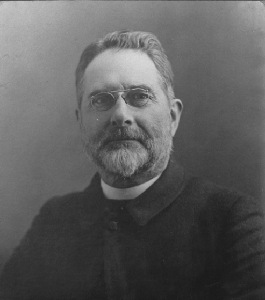
Reverend William Frederick Archdall Ellison FRAS, Irish clergymanHebrew scholar, organist, avid amateur telescope maker, and, from 1918 to 1936, director of Armagh Observatory in ArmaghNorthern Ireland, is born on April 28, 1864. He is the father of Mervyn A. Ellison, the senior professor of the School of Cosmic Physics at Dunsink Observatory from 1958 to 1963.

Ellison comes from a clerical family, his father Humphrey Eakins Ellison having been Dean of FernsCounty Wexford. He gains a sizarship of classics at Trinity College, Dublin in 1883, becomes a Scholar of the House in 1886 and graduates in 1887 with junior moderatorships in classics and experimental science. In 1890 he takes Holy Orders and moves to England, where he becomes the Curate of Tudhoe and Monkwearmouth. In 1894 he takes his MA and BD degrees and in the following year wins the Elrington Theological Prize.

In 1899 he returns to Ireland to become secretary of the Sunday School Society, a post which he holds for three years before accepting the incumbency of Monart, Enniscorthy, moving in 1908 to become Rector of Fethard-on-Sea with Tintern in Wexford. Ellison develops an interest in astronomy, having been introduced to practical optics by Dr. N. Alcock of Dublin and sets up his first observatory at Wexford. He becomes highly adept at making lenses and mirrors and writes several books and articles on the subject, including major contributions to the Amateur Telescope Making series, the Journal of the British Astronomical Association, and the weekly newspaper The English Mechanic. His book The Amateur’s Telescope (1920) is still considered a standard for telescope-makers and a forerunner of the more extensive series on the same topic by Albert Graham Ingalls.

On September 2, 1918 Ellison is appointed Director of the Armagh Observatory. He finds the Observatory in a state of disrepair and sets about repairing the instruments and the observatory dome. On January 3, 1919 he deeds a telescope of his own to the observatory, an 18-inch reflecting telescope, which is still there.

Ellison is a highly regarded planetary and binary star observer. Working with his son Mervyn, he makes many measurements of binary stars using the observatory’s 10-inch Grubb refracting telescope and even discovers a new one close to Beta Lyrae, and according to Patrick Moore, is one of the few people to have observed an eclipse of Saturn’s moon Iapetus by Saturn’s outermost ring on February 28, 1919.

In 1934 Ellison becomes Canon and Prebendary of BallymoreArmagh Cathedral. He dies on December 31, 1936, having held the office of Director of the observatory for nearly twenty years.

Leave a comment

Founding of the Royal University of Ireland

The Royal University of Ireland is founded by Royal Charter on April 27, 1880, in accordance with the University Education (Ireland) Act 1879 as an examining and degree-awarding university based on the model of the University of London. The first chancellor is the Irish chemist, Robert Kane.

The university becomes the first university in Ireland that can grant degrees to women on a par with those granted to men, granting its first degree to a woman on October 22, 1882. In 1888 Letitia Alice Walkington has the distinction of becoming the first woman in Great Britain or Ireland to receive a degree of Bachelor of Laws. Among the honorary degree recipients of the university is Douglas Hyde, founder of the Gaelic League and later President of Ireland, who is awarded a DLitt in 1906.

The Royal University of Ireland is the successor to the Queen’s University of Ireland, dissolved in 1882, and the graduates, professors, students and colleges of that predecessor are transferred to the new university. In addition to the Queen’s Colleges, Magee CollegeUniversity College Dublin, Cecillia St. Medical School, St. Patrick’s College, Maynooth and Blackrock College present students for examinations as well, and no special status is accorded to the colleges of the former Queen’s University. After the 1880 reforms Catholic Colleges such as St. Patrick’s, Carlow CollegeHoly Cross College and Blackrock College come under the Catholic University, and with a number of other seminaries present students for examination by the RUI.

External students not of approved colleges can sit examinations of the Royal University although they are seen as being at a disadvantage to those of designated colleges whose professors are part of the university. In fact, many schools, including convent schools prepare students for the examinations of the Royal University.

Like the Queen’s University, the Royal University is entitled to grant any degree, similar to that of any other university in the United Kingdom of Great Britain and Ireland, except in theology. The colleges themselves award degrees in theology and divinity.

The professorships and Senate of the Royal University are shared equally between Roman Catholics and Protestants. However, colleges of the university maintain full independence except in the awarding of degrees, and the compilation and enforcement of academic regulations and standards.

The members of the senate of the Royal University included Gerald MolloyWilliam Joseph WalshJohn Healy, the Marquess of Dufferin and AvaGeorge Arthur Hastings Forbes, 7th Earl of GranardDaniel MannixGeorge Johnston Allman.

(Pictured: Coat of Arms of the Royal University of Ireland)


Leave a comment

The Homosexuality Trial of Oscar Wilde

The trial of Oscar Wilde on charges of homosexuality, then considered a crime, begins at the Old Bailey on April 26, 1895.

With a warrant for Wilde’s arrest on charges of sodomy and gross indecency having been issued, Robbie Ross finds Wilde at the Cadogan Hotel, Knightsbridge, with Reginald Turner. Both men advise Wilde to go at once to Dover and try to get a boat to France. His mother advises him to stay and fight. Wilde, lapsing into inaction, can only say, “The train has gone. It’s too late.” Wilde is arrested for “gross indecency” under Section 11 of the Criminal Law Amendment Act 1885, a term meaning homosexual acts not amounting to buggery, an offence under a separate statute. At Wilde’s instruction, Ross and Wilde’s butler force their way into the bedroom and library of 16 Tite Street, packing some personal effects, manuscripts, and letters. Wilde is then imprisoned on remand at HM Prison Holloway where he receives daily visits from his partner, Lord Alfred Douglas.

Events move quickly and his prosecution opens on April 26, 1895. Wilde pleads not guilty. He has already begged Douglas to leave London for Paris, but Douglas complains bitterly, even wanting to give evidence. He is pressed to go and soon flees to the Hotel du Monde. Fearing persecution, Ross and many others also leave the United Kingdom during this time.

Under cross examination by Charles Gill, Wilde is at first hesitant, but then eloquently responds to Gill’s question about the meaning of “the love that dare not speak its name.” Wilde replies, “‘The love that dare not speak its name” in this century is such a great affection of an elder for a younger man as there was between David and Jonathan, such as Plato made the very basis of his philosophy, and such as you find in the sonnets of Michelangelo and Shakespeare. It is that deep spiritual affection that is as pure as it is perfect. It dictates and pervades great works of art, like those of Shakespeare and Michelangelo, and those two letters of mine, such as they are. It is in this century misunderstood, so much misunderstood that it may be described as ‘the love that dare not speak its name,’ and on that account of it I am placed where I am now. It is beautiful, it is fine, it is the noblest form of affection. There is nothing unnatural about it. It is intellectual, and it repeatedly exists between an older and a younger man, when the older man has intellect, and the younger man has all the joy, hope and glamour of life before him. That it should be so, the world does not understand. The world mocks at it, and sometimes puts one in the pillory for it.”

Wilde’s response is counter-productive in a legal sense as it only serves to reinforce the charges of homosexual behaviour. The trial ends with the jury unable to reach a verdict. Wilde’s counsel, Sir Edward Clarke, is finally able to get a magistrate to allow Wilde and his friends to post bail. The Reverend Stewart Headlam puts up most of the £5,000 surety required by the court, having disagreed with Wilde’s treatment by the press and the courts. Wilde is freed from Holloway and, shunning attention, goes into hiding at the house of Ernest and Ada Leverson, two of his firm friends. Edward Carson approaches Frank Lockwood QC, the Solicitor General and asks, “Can we not let up on the fellow now?” Lockwood answers that he would like to do so, but fears that the case has become too politicised to be dropped.

The final trial is presided over by Alfred Wills. On May 25, 1895 Wilde and Alfred Taylor are convicted of gross indecency and sentenced to two years’ hard labour. The judge describes the sentence, the maximum allowed, as “totally inadequate for a case such as this,” and that the case is “the worst case I have ever tried.” Wilde responds, “And I? May I say nothing, my Lord?” but it is drowned out by cries of “Shame” in the courtroom.

Oscar Wilde enters prison on May 25, 1895 and is released on May 18, 1897.

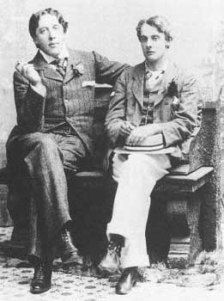
(Pictured: Oscar Wilde and Lord Alfred Douglas)


8 Comments

Birth of Philanthropist Vere Foster

Vere Henry Louis Foster, English educationist and philanthropist is born in Copenhagen on April 25, 1819.

Foster is the third son of Sir Augustus John Foster, 1st Baronet and his wife, Albinia Jane, daughter of George Vere Hobart, and granddaughter of George Hobart, 3rd Earl of Buckinghamshire. He is educated at Eton College, and matriculated at Christ Church, Oxford, on May 30, 1838.

Leaving Oxford without a degree, Foster joins the diplomatic service. From 1842 to 1843 he is attached to the diplomatic mission of Sir Henry Ellis in Rio de Janeiro, and from 1845 to 1847 to that of Sir William Gore Ouseley in Montevideo.

In 1847 Foster visits a family estate in County Louth, Ireland at the time of the Great Famine, with his eldest brother, Sir Frederick George Foster. They become involved in famine relief. In 1848 their father dies and Foster undergoes a crisis in his life, and he comes to concentrate on philanthropy in Ireland.

Foster makes three voyages to the United States as a steerage passenger in a ship of emigrants, finding the accommodations bad, and the treatment of emigrants exploitative. Through his cousin Vere Hobart, Lord Hobart, he is able to influence parliament and the Passengers Act 1851. He also takes practical steps to promote Irish emigration to the United States.

Later, Foster takes up the improvement of education in Ireland. This is a time of Catholic suspicion of the national education system introduced by Richard Whately. Foster contributes to the provision of better school accommodation and apparatus, and gives grants in aid of building several hundred new school-houses. He agitates for improved wages and conditions for teachers, and develops the “Vere Foster copy-books” to improve and standardise the teaching of writing. The immense popularity of these texts draw him to the Belfast printing firm Marcus Ward & Company, and into personal friendship with John Ward, one of the firm’s owners.

In 1867, Foster settles permanently in Belfast where he continues to work as the president of the Congress of the Irish National Teachers’ Organisation. He fundraises for the Royal Belfast Hospital, and helps to establish a school of art in the town, while continuing to promote emigration.

In 1879, with the Land War in Ireland, Foster concentrates on promoting female emigration to the United States and the British colonies. He is supported in his projects by both Catholic and Protestant clergy.

Vere Foster dies, unmarried, in Belfast on December 21, 1900. He is buried in Belfast City Cemetery.


Leave a comment

Birth of Bishop Eamonn Casey

Eamonn Casey, Irish Roman Catholic prelate who serves as bishop of Galway and Kilmacduagh in Ireland from 1976 to 1992, is born in FiriesCounty Kerry on April 24, 1927.

Casey is educated in Limerick and in St. Patrick’s College, Maynooth. He is ordained a priest for the Diocese of Limerick on June 17, 1951, and appointed Bishop of Kerry on July 17, 1969. He holds this position until 1976, when he is appointed Bishop of Galway and Kilmacduagh and apostolic administrator of Kilfenora. While in Galway, he is seen as a progressive. It is a significant change in a diocese that has been led for nearly forty years by the very conservative Michael Browne.

Casey is well known for his work aiding Irish emigrants in Britain. In addition, he supports the Dunnes Stores‘ staff, who are locked out from 1982 to 1986 for refusing to sell goods from apartheid South Africa.

Casey attends the funeral of the murdered Archbishop of San SalvadorMonsignor Óscar Romero. He witnesses firsthand the massacre of those attending the funeral by government forces. He then becomes a vocal opponent of United States foreign policy in Central America, and, as a result, opposes the 1984 visit of United States President Ronald Reagan to Ireland, refusing to meet him when he comes to Galway.

Casey is highly influential in the Irish Catholic hierarchy and serves as bishop until his resignation in 1992. He is a friend and colleague of another highly prominent Irish priest, Father Michael Cleary.

In 1992, newspapers discover that Casey has had a sexual relationship with Annie Murphy, an American divorcée. Together they have a son, Peter, born in 1974 in Dublin. Murphy later claims that Casey had attempted to persuade her to give the child up for adoption at birth. She chooses not to do so and raises him with the help of her parents. When Murphy decides to go public about the relationship and informs The Irish Times, Casey tenders his resignation and leaves the country.

Casey’s resignation is regarded as a pivotal moment when the Roman Catholic hierarchy begins to lose its considerable influence over the society and politics of Ireland. He is succeeded by his Secretary, Bishop James McLoughlin, who serves in the post until his own retirement on July 3, 2005.

Casey opts to embrace the life of a foreign missionary in South America. He works with members of the Missionary Society of St. James in a rural parish in Ecuador, despite his lack of knowledge of the Spanish language. During this time, he travels long distances to reach the widely scattered members of his parish. After his missionary period is completed, instead of returning to Ireland, Casey takes a position in the parish of St. Pauls, Haywards Heath, in South East England. He returns to Ireland in 2006.

In 2005, Casey is investigated in conjunction with the sexual abuse scandal in Galway, Kilmacduagh and Kilfenora diocese. He is subsequently cleared of any wrongdoing.

Casey suffers four mini strokes in 2002 and begins to experience memory issues. In August 2011, he is admitted to a nursing home in County Clare. Eamonn Casey dies on March 13, 2017, at the age of 89.


Leave a comment

Coronation of James II as King of England & Ireland

The coronation of James II as King of England and Ireland takes place at Westminster Abbey on April 23, 1685. He is also crowned King of Scotland as James VII. He is the last Roman Catholic monarch of EnglandScotland and Ireland.

The second surviving son of Charles I, James ascends the throne upon the death of his brother, Charles II. There is little initial opposition to his accession, and there are widespread reports of public rejoicing at the orderly succession. The new Parliament that assembles in May 1685, which gains the name of “Loyal Parliament,” is initially favourable to James, and the new King sends word that even most of the former exclusionists will be forgiven if they acquiesce to his rule.

Members of Britain’s Protestant political elite increasingly suspect him of being pro-French and pro-Catholic and of having designs on becoming an absolute monarch. When he produces a Catholic heir, leading nobles call on his Protestant son-in-law and nephew William of Orange to land an invasion army from the Dutch Republic, which he does in the Glorious Revolution of 1688. James flees England and thus is held to have abdicated. He is replaced by his eldest, Protestant daughter Mary and her husband William of Orange.

James makes one serious attempt to recover his crowns from William and Mary when he lands in Ireland in 1689. After the defeat of the Jacobite forces by the Williamites at the Battle of the Boyne in July 1690, James returns to France. He lives out the rest of his life as a pretender at a court sponsored by his cousin and ally, King Louis XIV.

James is best known for his struggles with the English Parliament and his attempts to create religious liberty for English Roman Catholics and Protestant nonconformists, against the wishes of the Anglican establishment. This tension makes James’s four-year reign a struggle for supremacy between the English Parliament and the Crown, resulting in his deposition, the passage of the Bill of Rights, and the accession of his daughter and her husband as king and queen.


Leave a comment

Birth of Michael Joseph O’Rahilly, Republican & Nationalist

Michael Joseph O’Rahilly, Irish republican and nationalist known as The O’Rahilly, is born in BallylongfordCounty Kerry, on April 22, 1875.

O’Rahilly is educated in Clongowes Wood College. As an adult, he becomes a republican and a language enthusiast. He joins the Gaelic League and becomes a member of An Coiste Gnotha, its governing body. He is well travelled, spending at least a decade in the United States and in Europe before settling in Dublin.

O’Rahilly is a founding member of the Irish Volunteers in 1913, which is organized to work for Irish independence and resist the proposed Home Rule. He serves as the IV Director of Arms. He personally directs the first major arming of the Irish Volunteers, the landing of 900 Mausers at the Howth gun-running on July 26, 1914.

O’Rahilly is not party to the plans for the Easter Rising, nor is he a member of the Irish Republican Brotherhood (IRB), but he is one of the main people who train the Irish Volunteers for the coming fight. The planners of the Rising go to great lengths to prevent those leaders of the Volunteers who are opposed to unprovoked, unilateral action from learning that a rising is imminent, including its Chief-of-Staff Eoin MacNeillBulmer Hobson, and O’Rahilly. When Hobson discovers that an insurrection is planned, he is kidnapped by the Military Council leadership.

Learning this, O’Rahilly goes to Patrick Pearse‘s school, Scoil Éanna, on Good Friday. He barges into Pearse’s study, brandishing his revolver as he announces, “Whoever kidnaps me will have to be a quicker shot!” Pearse calms O’Rahilly, assuring him that Hobson is unharmed, and will be released after the rising begins.

O’Rahilly takes instructions from MacNeill and spends the night driving throughout the country, informing Volunteer leaders in CorkKerryTipperary, and Limerick that they are not to mobilise their forces for planned manoeuvres on Sunday.

Arriving home, O’Rahilly learns that the Rising is about to begin in Dublin on the next day, Easter Monday, April 24, 1916. Despite his efforts to prevent such action which he feels can only lead to defeat, he sets out to Liberty Hall to join Pearse, James ConnollyThomas MacDonaghTom ClarkeJoseph PlunkettCountess MarkieviczSeán Mac DiarmadaEamonn Ceannt and their Irish Volunteers and Irish Citizen Army troops. Arriving in his De Dion-Bouton motorcar, he gives one of the most quoted lines of the rising, “Well, I’ve helped to wind up the clock — I might as well hear it strike!”

O’Rahilly fights with the General Post Office (GPO) garrison during Easter Week. On Friday, April 28, with the GPO on fire, O’Rahilly volunteers to lead a party of men along a route to Williams and Woods, a factory on Great Britain Street, now Parnell Street. A British machine-gun at the intersection of Great Britain and Moore streets cuts him and several of the others down. Wounded and bleeding badly, O’Rahilly slumps into a doorway on Moore Street, but hearing the English marking his position, makes a dash across the road to find shelter in Sackville Lane, now O’Rahilly Parade. He is wounded diagonally from shoulder to hip by sustained fire from the machine-gunner.

The specific timing of O’Rahilly’s death is very difficult to pin down but understanding can be gained from his final thoughts. Despite his obvious pain, he takes the time to write a message to his wife on the back of a letter he received from his son in the GPO. It is this last message to Nancy that artist Shane Cullen etches into his limestone and bronze sculpture. The text reads:

Written after I was shot. Darling Nancy I was shot leading a rush up Moore Street and took refuge in a doorway. While I was there, I heard the men pointing out where I was and made a bolt for the laneway I am in now. I got more [than] one bullet, I think. Tons and tons of love dearie to you and the boys and to Nell and Anna. It was a good fight anyhow. Please deliver this to Nannie O’ Rahilly, 40 Herbert Park, Dublin. Goodbye Darling.


Leave a comment

Birth of John Fitzpatrick, Trade Union Leader

John Fitzpatrick, Irish-born American trade union leader, is born in AthloneCounty Westmeath, on April 21, 1871. He is best remembered as the longtime head of the powerful Chicago Federation of Labor, from 1906 until his death in 1946.

Fitzpatrick attends grammar school in Ireland before coming to the United States in 1882, at the age of eleven, settling in Chicago. Following completion of his formal education, he goes to work as a horseshoer, becoming involved in the International Journeyman Horseshoers’ Union (IJHU), with which he remains affiliated for the next three decades.

Fitzpatrick serves variously as the President, Treasurer, and business agent for the Chicago local of the IJHU, being selected as a delegate to conventions of the union as well as its representative to the American Federation of Labor (AFL). This connection is instrumental in his appointment as the organizer of the Chicago Federation of Labor, city affiliate of the AFL, in 1902. Additionally, he is elected President of that organization in 1906 and remains in the capacity of President and Organizer throughout the ensuing half century.

Fitzpatrick is widely regarded as a progressive voice in the trade union movement, active in political fights beyond the ordinary hours-and-wages concerns which have traditionally dominated the union movement. He is active in the defense campaign on behalf of accused bomber Thomas Mooney, and is active in helping to organize packing house workers and steel workers in 1919.

During these campaigns, Fitzpatrick comes into close contact with radical trade union organizer William Z. Foster, founder of the Trade Union Educational League and outspoken advocate of the amalgamation of the hodge-podge of existing craft unions into unified, and thus more effective, industrial unions.

Fitzpatrick is also an advocate of independent labor politics and is one of the organizers of the Illinois Labor Party as well as its local affiliate, the Cook County Labor party. In November 1919, he runs for mayor of Chicago on the ticket of the Cook County Labor Party and receives a substantial vote of 60,000 of the 580,000 ballots cast. Bolstered by the degree of support which the new organization receives from voters, Fitzpatrick calls a national convention of local Labor Party movements, which is held in Chicago on November 22, 1919.

Fitzpatrick remains as President of the Chicago Federation of Labor until his death in 1946, with the exception of a single year, 1908, when Charles M. Dold serves as head of the organization.


Leave a comment

King James I Grants License for Old Bushmills Distillery

King James I grants a license to Sir Thomas Phillips, landowner and Governor of County Antrim, for the Old Bushmills distillery on April 20, 1608. The distillery is thought to date from at least 1276 making it the oldest distillery in the world.

The Bushmills Old Distillery Company itself is not established until 1784 by Hugh Anderson. Bushmills suffers many lean years with numerous periods of closure with no record of the distillery being in operation in the official records both in 1802 and in 1822. In 1860 a Belfast spirit merchant named Jame McColgan and Patrick Corrigan purchase the distillery and in 1880 they form a limited company. In 1885, the original Bushmills buildings are destroyed by fire but the distillery is quickly rebuilt. In 1890, the steamship SS Bushmills, owned and operated by the distillery, makes its maiden voyage across the Atlantic to deliver Bushmills whiskey to America. It calls at Philadelphia and New York City before heading on to SingaporeHong KongShanghai and Yokohama.

In the early 20th century, the United States is a very important market for Bushmills, as well as for other Irish Whiskeyproducers. American Prohibition in 1920 comes as a large blow to the Irish Whiskey industry, but Bushmills manages to survive. Wilson Boyd, Bushmills’ director at the time, predicts the end of prohibition and has large stores of whiskey ready to export. After the World War II, the distillery is purchased by Isaac Wolfson and, in 1972, it is taken over by Irish Distillers, meaning that Irish Distillers controls the production of all Irish whiskey at the time. In June 1988, Irish Distillers is bought by French liquor group Pernod Ricard.

In June 2005, the distillery is bought by Diageo for £200 million. Diageo announces a large advertising campaign in order to regain market share for Bushmills.

In May 2008, the Bank of Ireland issues a new series of sterling banknotes in Northern Ireland which all feature an illustration of the Old Bushmills Distillery on the obverse side, replacing the previous notes series which depicts Queen’s University Belfast.

In November 2014 it is announced that Diageo is to trade the Bushmills brand with Jose Cuervo in exchange for the 50% of the Don Julio brand of tequila that Diageo does not already own.

Some Bushmills offerings have performed well at international Spirits ratings competitions. In particular, its Black Bush Finest Blended Whiskey receives double gold medals at the 2007 and 2010 San Francisco World Spirits Competitions. It also receives a well-above-average score of 93 from the Beverage Testing Institute in 2008 and 2011.


Leave a comment

Birth of Conel Hugh O’Donel Alexander, Cryptanalyst & Chess Player

Conel Hugh O’Donel Alexander, Irish-born British cryptanalyst, chess player, and chess writer, is born in CorkCounty Cork, on April 19, 1909. He works on the German Enigma machine at Bletchley Park during World War II, and is later the head of the cryptanalysis division at Government Communications Headquarters (GCHQ) for over 20 years. In chess, he twice wins the British Chess Championship and earns the title of International Master. He is usually referred to as C.H.O’D. Alexander in print and Hugh in person.

Alexander is born into an Anglo-Irish family, the eldest child of Conel William Long Alexander, an engineering professor at University College Cork (UCC), and Hilda Barbara Bennett. His father dies during the Irish War of Independence in 1920, and the family moves to Birmingham in England where he attends King Edward’s School. He wins a scholarship to study mathematics at King’s College, Cambridge, in 1928, graduating with a first in 1931. He represents the University of Cambridge in the Varsity chess matches of 1929, 1930, 1931 and 1932.

From 1932, Alexander teaches mathematics in Winchester and marries Enid Constance Crichton Neate on December 22, 1934. In 1938 he leaves teaching and becomes head of research at the John Lewis Partnership.

In February 1940 Alexander arrives at Bletchley Park, the British codebreaking centre during the World War II. He joins Hut 6, the section tasked with breaking German Army and Air Force Enigma messages. In 1941, he transfers to Hut 8, the corresponding hut working on Naval Enigma. He becomes deputy head of Hut 8 under Alan Turing and formally becomes the head of Hut 8 in November 1942. In October 1944, Alexander is transferred to work on the Japanese JN-25 code.

In mid-1946, Alexander joins GCHQ, which is the post-war successor organisation to the Government Code and Cypher School (GC&CS) at Bletchley Park. By 1949, he has been promoted to the head of “Section H” (cryptanalysis), a post he retains until his retirement in 1971.

Alexander is twice a winner of the British Chess Championship, in 1938 and 1956. He represents England in the Chess Olympiad six times, in 1933, 1935, 1937, 1939, 1954 and 1958. At the 1939 Olympiad in Buenos AiresArgentina, Alexander has to leave part-way through the event, along with the rest of the English team, due to the declaration of World War II, as he is required at home for codebreaking duties. He is also the non-playing captain of England from 1964 to 1970. He is awarded the International Master title in 1950 and the International Master for Correspondence Chess title in 1970. He wins the Hastings International Chess Congress 1946/47 with the score 7½/9, a point ahead of Savielly Tartakower. His best tournament result may have been first equal Hastings 1953/54, where he goes undefeated and beats Soviet grandmasters David Bronstein and Alexander Tolush in individual games. He is also the chess columnist of The Sunday Times in the 1960s and 1970s.

Many knowledgeable chess people believe that Alexander had Grandmaster potential, had he been able to develop his chess abilities further. Many top players peak in their late twenties and early thirties, but for Alexander this stretch coincided with World War II, when high-level competitive opportunities were unavailable. After this, his professional responsibilities as a senior cryptanalyst limited his top-class appearances. He defeats Mikhail Botvinnik in one game of a team radio match against the Soviet Union in 1946, at a time when Botvinnik is probably the world’s top player. Alexander makes important theoretical contributions to the Dutch Defence and Petrov’s Defence.

Conel Hugh O’Donel Alexander dies on February 15, 1974, in CheltenhamGloucestershire, England.